Kawasaki disease, a mucocutaneous lymph node syndrome, was first described by Dr Kawasaki of Japan in 1967. Kawasaki disease is a febrile illness characterised by agnogenic whole-body vasculitis, which mostly occurs in children aged less than 5 years and easily combines with a coronary arterial lesion. In recent years, there have been some reports from Japan and the United States of America that acquired cardiac disease in children is mainly Kawasaki disease.Reference Newburger, Takahashi and Gerber1 The incidence of Kawasaki disease in different countries and regions is not the same. It is 138.8–184.6 per 100,000 in JapanReference Liang2–Reference Nakamura, Yashiro, Uehara, Oki, Watanabe and Yanagawa4 and 8.0–47.7 per 100,000 in the United States of America.Reference Holman, Cums, Belay, Steiner and Schonberqer5 In China, it was 40.9–55.1 per 100,000 in Peking between 2000 and 2004,Reference Zhang, Du, Zhao, Du, Lu and Yi6 16.6–36.8 per 100,000 in Shanghai between 1998 and 2002,Reference Huang7 5.55–6.96 per 100,000 in Jiangsu province,Reference Wang, Hu, Wang, Zhang, Kawasaki and Liu8 and 3.51–10.84 per 100,000 in Yunnan province between 1997 and 2006.Reference Ma, Du, Li, Shi, Wan and Fu9 There have been no reports about epidemiological investigation of Kawasaki disease in Jilin province. Jilin province, a multi-ethnic province, is located in the northeast of China. We carried out an epidemiological investigation in children with Kawasaki disease hospitalised in the First Affiliated Hospital of Jilin University and the First Affiliated Hospital of Yanbian University (the majority of the children with Kawasaki disease in Jilin province is here) between January 2000 and December 2008.
Materials and methods
Materials
The children who were in line with the diagnostic criteria of Kawasaki disease and were hospitalised in the First Affiliated Hospital of Jilin University and the First Affiliated Hospital of Yanbian University between January, 2000 and December, 2008 were identified. Their age, sex, disease time, the duration from having a symptom to seeing a doctor, other symptoms, family history, the number of recurrent cases, the number of deaths, therapeutic methods, clinical outcomes, and cardiovascular lesion were recorded.
Diagnosis and inclusion criteria
We used the revised diagnostic criteria for Kawasaki disease in the VIIth International Kawasaki Disease Symposium held in Hakone, Japan.Reference Yanagawa and Sonobe10 Coronary artery dilatation was diagnosed according to the criteria established in Housheng Province, Japan, in 1984. Coronary artery dilatation may be diagnosed if consistent with any other items of coronary artery diameter of greater than 3 millimetres in children below 5 years, or greater than 4 millimetres in children above 5 years, or a coronary cavity as large as 1.5 times of the adjacent segment, or irregular lumens. Coronary aneurysm was classified into small coronary aneurysm with a diameter of less than or equal to 4 millimetres, moderate coronary aneurysm with a diameter of greater than 4 millimetres and less than or equal to 8 millimetres, and a giant coronary aneurysm with a diameter of greater than 8 millimetres. In this study, coronary artery dilatation is internationally diagnosed when a Z-score is greater than or equal to 2.5 millimetres, which is calculated based on the body surface area described by Zorzi et al.Reference De Zorzi, Colan, Gauvreau, Baker, Sundel and Newburger11 Subsequently, Kurotobi et al Reference Kurotobi, Nagai, Kawakami and Sano12 in Japan and Tan et al Reference Tan, Wong, Cheng and Heng13 in Singapore found that coronary artery dilatation is diagnosed when the Z-score is greater than or equal to 2.0 millimetres. However, it is difficult to trace age, weight, and height of all the patients in clinical practice; therefore in our study, the data of coronary artery were obtained from an ultrasonic cardiogram.
Statistical treatment
Enumeration data were indicated with the number and percentage of cases. Measurement data were expressed as medians or X plus or minus S. The t-test and a one-factor analysis of variance were used for comparing mean difference. Statistical analyses were performed with SPSS11.0 statistical software. Fisher’s exact probability and chi-square tests were used for enumeration data. Logistic regression was used in the analysis of the risk factors for coronary artery. Statistical significance was established at p less than 0.05.
Results
Epidemiological characteristics
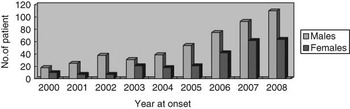
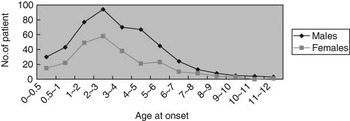
A total of 735 children with Kawasaki disease were found in the two hospitals between January, 2000 and December, 2008. Of the 735 children, 483 were boys and 252 were girls with the male-to-female ratio of 1.92:1 (Fig 1). In all, 28 children had Kawasaki disease in 2000, 32 in 2001, 45 in 2002, 52 in 2003, 57 in 2004, 75 in 2005, 117 in 2006, 155 in 2007, and 174 in 2008. Within the 9 years, the number of cases of Kawasaki disease showed a steadily increasing tendency, but no signs of an outbreak. The average age of these children with Kawasaki disease was 3.0 plus or minus 3.8 years, with a range of 51 days to 12 years, with a median age of 2.9 years. A total of 110 (15.0%) children with Kawasaki disease were below the age of 1 year, 388 (52.8%) were less than 3 years old, and 584 (79.5%) were less than 5 years old. Kawasaki disease most frequently occurred in 2–3-year-old children (Fig 2). There was no significant difference in average age of onset among the 9-year-olds.
Numbers of male and female children with Kawasaki disease in different years.

Associations of Kawasaki disease with age and sex between 2000 and 2008.

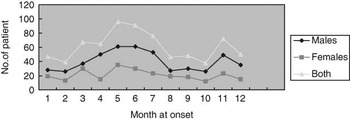
Kawasaki disease occurred all year round, but more frequently in May, June, and July, that is, at the end of spring and the beginning of summer, which was the first incidence peak, and the second incidence peak came in November. The incidence of Kawasaki disease was lower in August, September, and October, that is, at the end of summer and the beginning of autumn, and December, January, and February, that is, during winter. This seasonal incidence is more obvious in the male children, and the incidence of Kawasaki disease was higher in the male than in the female children in all months (Fig 3).
Associations of Kawasaki disease with season and sex between 2000 and 2008.

There was a difference in the trend in the age at onset, which varied according to the calendar month, without reaching statistical significance (p = 0.056). The age of onset in December and October were older with 4.0 plus or minus 2.9 years and 3.8 plus or minus 2.9 years, respectively. The age of onset in other months varied from 2.2 plus or minus 2.0 years of April to 3.8 plus or minus 1.8 years of January, respectively (F = 1.78, p = 0.056).
Clinical features
Of the 735 children with Kawasaki disease, 608 (82.8%) were in line with five of six major criteria, which belonged to a typical Kawasaki disease, and 127 (17.3%) have atypical Kawasaki disease. According to the statistics in this study, fever was still the most common clinical manifestation because it occurred in 732 children (99.6%) with Kawasaki disease, and the remaining five symptoms were as follows: alteration in the mucous member of the oral cavity and lips in 669 children (91%), changes in the four limbs and the periphery including desquamation of the feet and hands (397 children), in duration and erythema of the hands and feet (259 children), and perianal desquamation (47 children) with a total of 585 children (79.6%), conjunctive congestion in 572 (77.8%), pleomorphic rash in 531 (72.2%), acute non-suppurative enlarged cervical lymph nodes in 506 (68.8%), and redness of the BCG vaccination scar only in eight children (1.09%).
Treatment
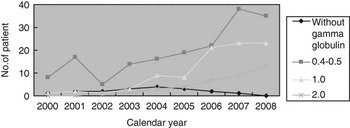
All children were given aspirin once diagnosed with Kawasaki disease. A total of 643 (87.5%) children were given intravenous immunoglobulin, and most of them received this treatment within 3–10 days after definite diagnosis (M = 4.6 days, X = 4.6 days). Three treatment protocols were carried out in our study. Details of treatment and coronary arterial lesions are shown in Table 1, and the status of intravenous immunoglobulin administration in different years is shown in Figure 4. Most children with Kawasaki disease received intravenous immunoglobulin at a dose of 0.4–0.5 grams per kilogram per day; children who received intravenous immunoglobulin, at a dose of 1.0 gram per kilogram per day and 2.0 grams per kilogram per day, showed an increasing tendency in recent years. In all, 117 (18.2%) of 643 children (87.5%) receiving intravenous immunoglobulin had a non-response to gamma globulin. Of the 117 children, 66 (56.4%) had a cardiovascular lesion. Additional single additional intravenous immunoglobulin, at a dose of 2 grams per kilogram was given to 99 children with Kawasaki disease, two additional intravenous immunoglobulins, at a dose of 2 grams per kilogram were given to 12 children. After two additional intravenous immunoglobulins, at a dose of 2 grams per kilogram, additional methylprednisolone, at a dose of 15–30 milligrams per kilogram per day, was given to five children with Kawasaki disease, intravenous immunoglobulin, at a dose of 2 grams per kilogram, methylprednisolone at a dose of 15–30 milligrams per kilogram per day, and prednisone in two children, intravenous immunoglobulin at dose of 2 grams per kilogram, methylprednisolone at a dose of 15–30 milligrams per kilogram per day, and cyclosporine A in one child. Glucocorticoids were used in 37 children with Kawasaki disease, all of whom received intravenous immunoglobulin, and in 24 (65.0%) children who had a coronary arterial lesion. Ten children were given intravenous immunoglobulin and oral glucocorticoids before 10 days of fever with 8 children having coronary arterial lesion; 12 children were given intravenous immunoglobulin before 10 days of fever but given glucocorticoids after 10 days of fever with 6 children having a coronary arterial lesion; eight children were given glucocorticoids before 10 days of fever but given intravenous immunoglobulin after 10 days of fever with six children having a coronary arterial lesion; seven children were given intravenous immunoglobulin and glucocorticoids after 10 days of fever with four children having a coronary arterial lesion.
The number of cases of coronary arterial lesion in various doses and in different time of administration of intravenous immunoglobulin.

IVIG, intravenous immunoglobulin; CAL, Coronary arterial lesion
X12: Comparison of the incidence of coronary arterial lesion in children given intravenous immunoglobulin before and after 9 days of fever in the same group, p < 0.01
X22: Comparison of the incidence of coronary arterial lesion between small-dose group and both high-dose groups of children given intravenous immunoglobulin before 9 days of fever, p < 0.01
*Compared with the incidence of coronary arterial lesion in children given intravenous immunoglobulin before 9 days of fever in the same group, p < 0.01
**Compared with the incidence of coronary arterial lesion in children given 0.4–0.5 g/kg/day of intravenous immunoglobulin before 9 days of fever, p < 0.01
statuses of intravenous immunoglobulin in different years.

Coronary arterial lesion and risk factors
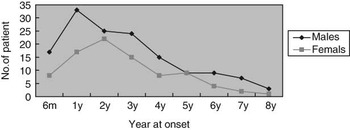
Echocardiography was performed in 671 (91.3%) of 735 children with Kawasaki disease, and cardiovascular complications in 278 (41.4%) were identified in 178 boys and 100 girls. Of the 278 children with cardiovascular complications, 228 (34.0%) had coronary arterial lesion, and 156 (23.2%) were boys and 72 (10.8%) were girls. A total of 75 children with coronary arterial lesion were less than 1 year old with a male-to-female ratio of 2.0:1, 161 children were less than 3 years old with a male-to-female ratio of 1.60:1, and 202 children were less than 5 years old with a male-to-female ratio of 1.57:1. The incidence peak of coronary arterial lesion occurred at the age of 1 year in boys with Kawasaki disease and at the age of 2 years in girls with Kawasaki disease (Fig 5). Of the total number of children with Kawasaki disease, 22.8% (153/671) had mild coronary artery dilatation, 4.2% (28/671) had moderate coronary artery dilatation, 6.6% (44/671) had a coronary aneurysm containing a 0.6% (4/671) giant coronary artery aneurysm, and 0.4% (3/671) coronary stenosis diagnosed by cardiac computed tomography examination. Other cardiovascular lesions included 4.2% (28/671) of valvular regurgitation, 22.4% (15/671) of myocarditis, 0.9% (6/671) of pericardial effusion, and 0.15% (1/671) of myocardial infarction. Giant coronary artery aneurysm was found in four children aged more than 2 years. A total of 73 children had cardiac complications 1 month later including mild coronary artery dilatation in 11 children (1.64%), moderate coronary artery dilatation in 39 (5.81%), coronary aneurysm in 6 (0.89%), coronary stenosis in 5 (0.75%), cardiac dilatation in 3 (0.45%), and valvular regurgitation in 9 children (1.34%).
Associations of coronary arterial lesion with sex and age in Kawasaki disease between 2000 and 2008.

Single-factor analysis revealed differences between children with and without coronary arterial lesion in the following aspects: fever duration of 9.53 plus or minus 3.40 versus 8.08 plus or minus 2.03 days (t = 5.86, p < 0.05), albumin at 32.59 plus or minus 7.09 versus 52.18 plus or minus 16.44 grams per litre (t = 17.09, p < 0.05), white blood cells of 15.94 plus or minus 6.34 versus12.06 plus or minus 4.92 × 10⁹ per litre (t = 8.50, p < 0.05); all these had statistical differences. But, the neutrophilic granulocyte ratio at 53.73 plus or minus 15.16 versus 52.19 plus or minus 16.44 percentage (t = 1.31, p > 0.05), C-reaction protein at 53.93 plus or minus 49.37 versus 48.63 plus or minus 47.91 milligrams per litre (t = 1.31, p > 0.05), and other items had no statistical differences. Logistic regression analysis showed that significant risk factors for coronary arterial lesion included fever duration, albumin, and white blood cell count.
Kawasaki disease was not found in siblings of these children. Parents declared a history of Kawasaki disease in two children – one male and one female – accounting for 0.27% of the cases. Kawasaki disease recurred in 19 children –10 boys and 9 girls, with a male-to-female ratio of 1.1:1 – accounting for 2.6% of the cases. Two boys (0.27%) died. One died of myocardial infarction and the other died of multiple organ failure.
Discussion
The cause of Kawasaki disease has been unclear for 40 years since it was discovered. Large-scale epidemiological investigations were carried out in some countries to know its distribution status, which is likely to provide a certain clue for exploring the pathogenesis of Kawasaki disease.Reference Nakamura and Yanagawa3 Recent data have indicated that the incidence of Kawasaki disease in a descending order are in Japan,Reference Nakamura and Yanagawa3 Korea,Reference Park, Han and Park14 and Taiwan.Reference Chang, Chang and Lu15 It has been suggested that Kawasaki disease more frequently occurs in Asian children, but the incidence of Kawasaki disease is lower in China than in Japan, and greatly varies with regions in China. However, all reports have shown that the incidence of Kawasaki disease is increasing every year. The increased incidence of Kawasaki disease may be related to increased awareness of Kawasaki disease, wider application of colour ultrasonography, and an increase of the incidence of Kawasaki disease itself.
Kawasaki disease shows strong characteristics of age. Most data show that children with Kawasaki disease aged less than 5 years account for 84%− 88% of the occurence,Reference Zhang, Du, Zhao, Du, Lu and Yi6, Reference Ma, Du, Li, Shi, Wan and Fu9 and the highest was 91.7% in Hong Kong.Reference Ng, Sung and So16 The average age at the onset of Kawasaki disease in Beijing was 2.0 years between 2000 and 2004,Reference Zhang, Du, Zhao, Du, Lu and Yi6 and its incidence peak occurred in children aged 18 months. In Shanghai, it was 1.8 yearsReference Huang7and the incidence peak was in children aged 9.6 months; in the United States of America, it was 18–28 monthsReference Holman, Cums, Belay, Steiner and Schonberqer5 and the incidence peak was in children aged 24 months; in Japan it was 6–12 monthsReference Nakamura and Yanagawa3 and the incidence peak was in children aged 9–11 months. This study indicated that children with Kawasaki disease aged less than 5 years accounted for 79.5% of the cases; the average age at onset was 3.0 years and incidence peak occurred in children aged 2.5 years, suggesting that the age at onset in Jilin province is slightly higher than that in other regions, which is likely to be related to regions and no enough awareness of Kawasaki disease in younger infants because of a long time span. The male-to-female ratio was 1.92:1, which is similar to those from Beijing, Shanghai, and Jiangsu province (1.83:1) of China,Reference Holman, Cums, Belay, Steiner and Schonberqer5–Reference Huang7 but higher than that from Sichuan (1.62:1)Reference Li, Li, Li, Wang, Xu and Zhang17 and Shaanxi provinces (1.62:1)Reference Jiao, Yang and Qiao18 and those from Japan (1.3:1),Reference Newburger, Takahashi and Gerber1 the United States of America (1.3–1.4:1),Reference Holman, Cums, Belay, Steiner and Schonberqer5 and Korea (1.52:1).Reference Park, Han and Park14 The male-to-female ratio appears to be higher than that in other countries, it may be related to the unbalanced ratio in the general population in China. The fifth census in Jilin has indicated that the male-to-female birth ratio in Jilin province was 107:100 and the male-to-female ratio in children aged less than 4 years was 110.7:100. On the other hand, Kawasaki disease is more common in boys; therefore, the incidence of Kawasaki disease may be related to sex. Kawasaki disease was not found in siblings, which may be related to the “one-child-per-couple” policy of China. The one-child families account for the majority in Jilin province. In recent years, atypical Kawasaki disease shows a growing trend and accounts for about 10–25% of typical cases according incomplete statistics. In our study, there were 127 children with atypical Kawasaki disease accounting for 17.3%, which is consistent with that reported by Genizi et al.Reference Genizi, Miron, Sp iegel, Fink and Horowitz19 In this study, Kawasaki disease more frequently occurred in the end of spring and the beginning of summer. The incidence of Kawasaki disease began to rise in March, reached a peak in May and June, and started to decline in July. The second incidence peak in both male and female children occurred in November, and Kawasaki disease rarely occurred in January, February, August, September, and October. The above seasonality of incidence is close to that from Beijing, Shanghai, and Guangdong provinces of China. Kawasaki disease occurred more frequently in the summer in Korea and Taiwan, in January in Japan, and more frequently in January, February, and March in the United States of America,Reference Huang20 showing that the occurrence of Kawasaki disease is associated with seasons. Bronstein et alReference Bronstein, Dille, Austin, Williams, Palinkas and Burns21 believed that the occurrence of Kawasaki disease was negatively correlated with the monthly average temperature, but was positively correlated with monthly average precipitation. However, in Jilin province, the minimum temperature occurs in January and February, and rainfall is the most in August, which seems not to support the viewpoint of Bronstein et alReference Bronstein, Dille, Austin, Williams, Palinkas and Burns21. In Jilin province, as it becomes warmer and the epidemic gastro-intestinal viral infections begin in May and June, the occurrence of Kawasaki disease may be related to viral infection and allergic reaction.
In this study, fever was the most common clinical feature and enlarged cervical lymph nodes were the smallest clinical manifestations accounting for 68.8%, which is similar to 69.3% reported from Shanghai.Reference Huang7 In this study, the pleomorphic rash accounted for 72.2% of the incidents. Kawasaki disease skin rash varies in appearance and is transient. In the past, it was often overlooked, but now is gradually gaining attention. In this study, perianal desquamation occurred in 47 children, and redness of the BCG vaccination scar was found in eight children, six male and two female, aged 4 months (two children), 5 and 6 months (two children), 7.5, 8, and 10 months, who were all less than the 1 year old. Redness of BCG vaccination scar may be conducive to early diagnosis of Kawasaki disease in younger infants, which is now supported by a significant amount of data.
In this study, Kawasaki disease combined with coronary arterial lesion accounted for 34.0% of the cases, which was higher than 27.1% in Shanghai and 17% in Sichuan province.Reference Li, Li, Li, Wang, Xu and Zhang17 The higher incidence rate of coronary arterial lesion in this study is due to the statistical data from two 3A hospitals of Jilin province where most Kawasaki disease are atypical or severe, and due to the wide application of the colour Doppler imaging, which is conducive to finding incomplete Kawasaki disease.
There are no early diagnostic criteria of Kawasaki disease due to the lack of specific clinical symptoms and laboratory tests. The diagnosis of Kawasaki disease mainly depends on clinical manifestations and the exclusion of other related diseases. Sometimes, the above clinical manifestations do not occur together in the same child, which easily leads to misdiagnosis and missed diagnosis. Delaying early treatment will result in a coronary lesion. On the basis of this study, we raise the following points about early diagnosis.
• Perianal desquamation: In this study, the first symptom was perianal desquamation in 47 children with fever. It has been reported that perianal desquamation is 3–7 days earlier than the desquamation of hands.Reference Zhou, Liao and Zuo22 Therefore, perianal desquamation is regarded as a valuable basis for the early diagnosis of Kawasaki disease.
• Redness of BCG vaccination scar: In this study, eight children had redness of BCG vaccination scar and they were less than 1 year old. Therefore, redness of BCG vaccination scar is helpful for the early diagnosis of atypical Kawasaki disease in infants, and in children with suspected Kawasaki disease, not only should the auscultation part be exposed, but the upper body should also be exposed during physical examination to avoid misdiagnosis.
• Laboratory examination: We have found that inflammatory markers are significantly increased in the acute phase of Kawasaki disease (without results in this study). Therefore, greater attention should be given to atypical Kawasaki disease when fever does not subside. C-reactive protein, white blood cell count, and erythrocyte sedimentation rate are significantly increased and the therapeutic effect of antibiotic treatment are poor.
There has been considerable debate about the use of glucocorticoids for the treatment of Kawasaki disease. KatoReference Kato23 reported that the single use of hormone promoted the formation of a coronary aneurysm. Wright et alReference Wright, Newburger, Baker and Sundel24 described that glucocorticoids showed satisfactory therapeutic effects in children with Kawasaki disease who had a non-response to intravenous immunoglobulin. Sundel et al Reference Sundel, Baker, Fulton and Newburger25 and Jibiki et alReference Jibiki, Terai and Kurosaki26 found that methylprednisolone could make the duration of fever reduce in children with Kawasaki disease and significantly decrease interleukin-2 after 24 hours of administration, but there were no significant changes in coronary aneurysm. Certainly, there is opposing view.Reference Shulman27 Glucocorticoids were used in 37 children with Kawasaki disease in this study, in whom 24 (65.0%) had coronary arterial lesion. The higher incidence rate of coronary arterial lesion after glucocorticoid administration may be due to, first, a more severe pathogenetic condition, which had a non-response to gamma globulin and aspirin; therefore, additional glucocorticoids were given. Second, partial atypical Kawasaki disease was misdiagnosed as pneumonia, septicaemia, drug rash, and so on, resulting in glucocorticoid misuse and failure to use gamma globulin in the early stage.Finally, glucocorticoid administration may easily lead to coronary arterial lesion. In our study, the children with Kawasaki disease who took glucocorticoids were fewer and some children were given glucocorticoids due to misdiagnosing as other diseases. To evaluate hormonal therapeutic effects on Kawasaki disease requires a strict, large sample and double-blinded control test.
According to our data, the younger the children, the more the cardiovascular lesions; and the younger the children, the more the number of boys with cardiovascular lesions, which is consistent with the single-factor analysis that a boy aged less than 2 years has a risk factor of cardiovascular complications. Muta et alReference Muta, Ishii, Furui, Nakamura and Matsuishi28 analysed 17 epidemiological investigations of Kawasaki disease in Japan and found that in 1855 cases (16.3%) again given intravenous immunoglobulin, intravenous immunoglobulin-related independent risk factors included male, relapse, and a first dose of intravenous immunoglobulin of less than 1 gram per kilogram. In 1991, Newburger et alReference Newhurger, Takahashi and Beiser29 found that in a total dose of intravenous immunoglobulin of 2.0 grams per kilogram, the therapeutic effect was better in children given a single intravenous immunoglobulin than in children given intravenous immunoglobulin for 4–5 days. A recent Chinese study has indicated that a single high dose of 1.0 grams per kilogram of intravenous immunoglobulin also provides enough immune activity with a high potency ratio.Reference Li, Yi and Li30 In this study, 87.5% of children with Kawasaki disease were given intravenous immunoglobulin. The results indicated that intravenous immunoglobulin of a high dose could decrease the incidence of coronary arterial lesion compared with a small dose in children given intravenous immunoglobulin before 9 days of fever with a statistically significant difference; and in various dose groups, the incidence of coronary arterial lesion was lower in children given intravenous immunoglobulin before 9 days of fever than those after 9 days of fever with a statistically significant difference. But, there was no significant difference in the incidence of coronary arterial lesion between the 1.0 gram per kilogram per day and the 2.0 grams per kilogram per day group in children given intravenous immunoglobulin before 9 days of fever. Our results are consistent with above reports. Therefore, the use of high-dose gamma globulin before 9 days of fever can decrease the incidence of coronary arterial lesion. In this study, more children in the high-dose groups received intravenous immunoglobulin after 9 days of fever, resulting in a higher incidence of coronary arterial lesion. Therefore, medical workers should pay attention to the time of administration of intravenous immunoglobulin in clinical practice.
In summary, the incidence of Kawasaki disease in Jilin province has shown an increasing trend. The number of boys with Kawasaki disease is more than girls with a ratio of 1.92:1. The age at onset is mainly between 2 and 3 years, which is slightly higher than that in other regions. Kawasaki disease is the most common at the end of spring and the beginning of summer and the second incidence peak occurs in autumn.