





Introduction
A dark cloud called spontaneous intracerebral haemorrhage (sICH) has long hung over the heads of people worldwide. sICH is a significant cause of morbidity and mortality worldwide, accounting for 28.8% of all strokes (Refs. Reference Qureshi, Mendelow and Hanley1, Reference Sheth2). Despite advances in prevention and acute care, 30-day mortality remains high at 30%–40%, with many survivors experiencing severe neurological deficits. Unlike the significant therapeutic advances achieved in ischaemic stroke with reperfusion therapies, the treatment of sICH faces greater challenges, with numerous randomized controlled trials (RCTs) showing neutral effects on functional outcomes (Ref. 3–Reference van Asch, Luitse, Rinkel, van der Tweel, Algra and Klijn10). The Surgical Treatment for Ischemic Heart Failure (STICH) trial, the first large-scale RCT published in 2005, and subsequent trials have explored surgical and medical interventions, such as haematoma evacuation and intensive blood pressure (BP) management, with limited efficacy (Refs. Reference Anderson, Heeley, Huang, Wang, Stapf, Delcourt, Lindley, Robinson, Lavados, Neal, Hata, Arima, Parsons, Li, Wang, Heritier, Li, Woodward, Simes, Davis and Chalmers4, Reference Hanley, Thompson, Rosenblum, Yenokyan, Lane, McBee, Mayo, Bistran-Hall, Gandhi, Mould, Ullman, Ali, Carhuapoma, Kase, Lees, Dawson, Wilson, Betz, Sugar, Hao, Avadhani, Caron, Harrigan, Carlson, Bulters, LeDoux, Huang, Cobb, Gupta, Kitagawa, Chicoine, Patel, Dodd, Camarata, Wolfe, Stadnik, Money, Mitchell, Sarabia, Harnof, Barzo, Unterberg, Teitelbaum, Wang, Anderson, Mendelow, Gregson, Janis, Vespa, Ziai, Zuccarello, Awad, Abdul-Rahim, Abou-Hamden, Abraham, Ahmed, Alba, Aldrich, Altschul, Amin-Hanjani, Anderson, Ansari, Antezana, Ardelt, Arikan, Baguena, Baker, Barrer, Becker, Bergman, Boström, Braun, Brindley, Broaddus, Brown, Buki, Cao, Cao, Carrion-Penagos, Chalela, Chang, Chorro, Chowdhry, Corral, Csiba, Davies, Díaz, Derdeyn, Diringer, Dlugash, Ecker, Economas, Enriquez, Ezer, Fan, Feng, Franz, Freeman, Fusco, Galicich, Gelea, Goldstein, Gonzalez, Grabarits, Greenberg, Gress, Gu, Hall, Hernandez, Hoesch, Hoh, Houser, Hu, Huang, Hussain, Insinga, Jadhav, Jaffe, Jahromi, Jallo, James, James, Jankowitz, Jeon, Jichici, Jonczak, Jonker, Karlen, Keric, Kerz, Knopman, Koenig, Krishnamurthy, Kumar, Kureshi, Laidlaw, Lakhanpal, Latorre, Leifer, Leiphart, Lenington, Li, Lopez, Lovick, Lumenta, Luo, Maas, MacDonald, MacKenzie, Madan, Majkowski, Major, Malhorta, Malkoff, Mangat, Maswadeh, Matouk, McArthur, McCaul, Medow, Mezey, Mighty, Miller, Mohan, Muir, Muñoz, Nakaji, Nee, Nekoovaght-Tak, Nyquist, O’Kane, Okasha, O’Kelly, Ostapkovich, Pandey, Parry-Jones, Perla, Pollack, Polster, Pouratian, Quinn, Rajajee, Reddy, Rehman, Reimer, Rincon, Rybinnik, Sanchez, Sansing, Schneck, Schuerer, Schul, Schweitzer, Seder, Seyfried, Sheth, Spiotta, Stechison, Szabo, Tamayo, Tanczos, Taussky, Terry, Testai, Thomas, Thompson, Thompson, Torner, Tran, Tucker, Ungar, Varelas, Vargas, Vatter, Venkatasubramanian, Vermillion, Vollmer, Wang, Wang, Wen, Whitworth, Willis, Wrencher, Wright, Xu, Yanase, Yi, Yu and Zomorodi6–Reference Qureshi, Palesch, Barsan, Hanley, Hsu, Martin, Moy, Silbergleit, Steiner, Suarez, Toyoda, Wang, Yamamoto and Yoon9).
More recently, selected trials have reported benefits. The Early Minimally Invasive Removal of Intracerebral Haemorrhage (ENRICH) trial, focusing on early minimally invasive surgery for lobar haemorrhage, showed positive outcomes in lobar sICH but no benefit in deep sICH (Ref. Reference Pradilla, Ratcliff, Hall, Saville, Allen, Paulon, McGlothlin, Lewis, Fitzgerald, Caveney, Li, Bain, Gomes, Jankowitz, Zenonos, Molyneaux, Davies, Siddiqui, Chicoine, Keyrouz, Grossberg, Shah, Singh, Bohnstedt, Frankel, Wright and Barrow11). Similarly, the Intensive Blood Pressure Reduction in Acute Cerebral Hemorrhage Trial (INTERACT)-3 trial, which implemented a bundled care strategy targeting BP, glucose and coagulation management, demonstrated modest functional improvement, though maintaining protocol targets was challenging in routine practice (Ref. Reference Ma, Hu, Song, Chen, Ouyang, Billot, Li, Malavera, Li, Muñoz-Venturelli, de Silva, Thang, Wahab, Pandian, Wasay, Pontes-Neto, Abanto, Arauz, Shi, Tang, Zhu, She, Liu, Sakamoto, You, Han, Crutzen, Cheung, Li, Wang, Chen, Liu, Zhao, Li, Liu, Jiang, Chen, Wu, Liu, Xu, You, Anderson, Robinson, Miranda, Anderson, You, Song, Parry-Jones, Sprigg, Durrans, Harris, Bamford, Smith, Herbert, Chen, Whiteley, Hu, Billot, Li, Mysore, Hu, Zhang, Liu, Sakamoto, You, Han, Crutzen, Li, Cheung, Jan, Liu, Ouyang, Sun, Chu, Anjum, Gonzalez Mc Cawley, del Rio, Rimoli, Cerantola, Jeevarajah, Kannangara, Joseph, Nanayakkara, Chen, Malavera, Zhang, Yang, Li, Meng, Ouyang, Liu, Ning, Dong, Armenis, Lim, Monaghan, Ma, Hu, Li, Luo, Cheng, Dong, Liu, Wang, Zhang, Cheng, Shi, Li, Mou, Yi, Chen, Chen, Weerawardena, Ellawala, Ranasinghe, Rodrigo, Wahab, Adeniyi, Pandian, Khanna, Muñoz Venturelli, González, Urrutia Goldsack, Wasay, Begum, Anjum, Pontes-Neto, Camilo, Dias, Vincenzi, Cerantola, Moro, Santos, Texeira, Longo, Liberato, Martins, Pille, Chwal, Silva, Titton, Weiss, Mora, Ouriques, Carbonera, Bazan, Modolo, Winckler, Miranda, Souza, Rojo, Uslar, Medel, Lopez, Herrero, Lavados, Vargas Latorre, Conejan, Esparza, Sotomayor, Wenger, Gigoux, Letelier, Acevedo, Moya, Figueroa, Vallejos, Conejan, Esparza, Sotomayor, Guerrero, Velasquez, Vallejos, Pallauta, Santibanez, Queirolo, Lobos, Jiang, Li, Huang, Luo, Liu, Tang, Yang, Jiang, Zhang, Jing, Zhu, Pu, Lv, Kang, Hu, She, Jiang, Chen, Yang, He, Li, Cheng, Huang, Wang, Lin, Chen, Yang, Ding, Deng, Luo, Zhang, Wang, Zhang, Yang, Zhang, Yang, He, Liu, Wang, Zhang, Xin, Feng, Hao, Song, Guo, Jiang, Chen, Tang, Zhu, Li, Cui, Xu, Li, Tang, Li, Gao, Yang, Xu, Deng, Zheng, Ge, Chen, Liu, Li, Zhong, Xu, Zhang, Wang, Zhu, Sun, Yu, Zhang, You, Ma, Hu, Xu, Li, Zhang, Wang, Ma, Jiang, Zhou, Liu, Nie, Li, Tian, Li, He, Tu, Wu, Liu, Zhong, Jiang, Sun, Tian, Wei, An, Wei, Luo, Lin, Liu, Wen, Cai, Chen, Lei, Li, Zhang, He, Chen, Liu, Liu, Li, Chen, Wang, Zhou, Ye, Zhang, Zhang, Pan, Yu, Xu, Xiao, Wang, Tao, Shi, Zheng, You, Lei, Chen, Wu, Hu, Zhao, Yu, Yuan, du, Tang, Li, Liu, Yang, Xiao, Luo, Wang, Che, Teng, Wan, Li, Liu, Fan, Zhang, Cai, Ma, Ma, Li, He, Li, Zhang, Zhang, Zhang, Dai, Lei, Mao, Huang, Zhou, Chen, Chen, Wei, Li, Chen, Zeng, Mou, Xue, Jiang, Tang, Chen, Zhang, Xu, Gu, Chen, Zhao, Yang, Kuai, Wang, Yang, Hu, Zhang, Yang, Wang, Zhang, Cheng, Zhang, Ma, He, Zhang, Gao, Liu, Ye, Xu, Wu, Yuan, Zou, Zhang, Cheng, Zhou, Zeng, Liang, du, Yu, Cao, You, Xu, Huang, Chen, Xiao, Zhu, Yuan, Wang, Shi, Hu, Xiang, Shi, Wang, Yang, Miao, Hu, Zhao, Hu, Liu, Zhou, Sun, Chen, Tang, Yao, You, Chen, Yao, Li, Liu, Bai, Yi, Deng, Luo, Wang, Jiang, Yang, He, Wang, Chen, He, Deng, Cao, Yi, Luo, Luo, Gong, Liu, Gao, Liu, Wu, Zhang, Sun, Li, Jia, Wu, Zhang, Zhang, du, Li, Yang, He, Liao, Zhou, Dong, Chen, Lin, Shui, Zhang, Zhao, Yang, Zhao, Zhang, Chen, Wu, Dai, Tang, Wang, Liu, Zhang, Duan, Luo, Jiao, Lei, Wang, Song, Tan, Ye, Qin, Liang, Liu, Yang, Yang, Lin, Yang, Ma, Qi, Pan, Jiang, Ye, Dong, Yue, Yang, Maimaitiyiming, Dong, Wu, Gao, Zhao, Zhang, Wang, Jiang, Li, Zhang, Chen, Tong, Wang, Qiao, Guo, Zhang, Hu, Feng, Song, Zuo, Chen, Qian, Li, Ma, Zhang, Kong, Dong, Li, Fang, Lu, Li, Zhang, Yang, Yu, Sun, Wang, Wang, Li, Li, Xu, Wang, Dong, Tang, Chu, Lu, Wang, Sun, Zhao, Yang, Qian, Saroja, Naik k, Chindhi, Pampaniya, Amaresh, Iype, R, Rajan, Panicker, das, Choudhury, Gohain, Webster, Pakma, Sangi, Sebastian, Aggrawal, Raj, Rajoura, Singh, Aggrawal, Narang, Arauz, Cano-Nigenda, López-Mena, Valdez-Ruvalcaba, Toledo-Treviño, Obiako, Abubakar, Emeka, Olayemi, Lois, Philip, Comfort O, Okubadejo, Agabi, Ojo, Wahab, Bello, Ibukun, Sanayaolu, Adeniyi, Jimoh, Wasay, Begum, Anjum, Waheed, Kamal, Shoaib, Orooj, Majid, Zehra, Khan, Shanker, Syed, Ahmad, Abanto, Valencia, Barrientos, Ramirez, Calle, Palliyeguruge, Muthucumarana, Ratnayaka, Ganihiarachchi, Bandaranayake, Somaratne, Narayana, Gallage, Senanayake, Samarasiri, Luke, Sivapathasundaram, Sahadevan, Rasmi, Deshaka, Fernando, Munasinghe, Rathnapriya, Nissanka, Karunathilake, Gayan, Wijenayake, Gunasekara, Vidyarathne, Keshavaraj, Janarthanan, Gerald Jeevathasan, Sivamainthan, John Priyanth, John Priyanth, Rajendiran, Alwis, Gunasekare, Liyanarachchi, Dissanayake, Uluwattage, Ratnayake, Rajinee, Jayawardana, Peiris, Wicramasinghe, Fernando, Abbas, Withanage, Bandara, Mai, Nguyen, Dao, Vuong, Nguyen, Dinh, Phan, Bui, Phung, Pham, Pham, do, Dang, Dang, Nguyen, Nguyen, Nguyen, Pham, Chau, Tai, le, le, Tran, Nguyen, Ngyen, Vo, Nguyen, Tran, Vo, Cao, Nguyen, le, la, Pham and Thai7, Reference Ouyang, Anjum, Mc Cawley, Wasay, Ma, Hu, Chen, Malavera, Li, Venturelli, Silva, Thang, Wahab, Pandian, Pontes-Neto, Abanto, Cano-Nigenda, Arauz, You, Jan, Song, Anderson and Liu12, Reference Ren, Li, Ouyang, Billot, Chen, Venturelli, de Silva, Nguyen, Wahab, Pandian, Wasay, Pontes-Neto, Abanto, Arauz, You, Ma, Hu, Anderson, Wang and Song13). The INTERACT4 trial introduced early prehospital BP reduction, showing promise in sICH, highlighting the importance of timing and accurate stroke classification (Ref. Reference Li, Lin, Yang, Anderson, Chen, Liu, Billot, Li, Chen, Liu, Ren, Zhang, Xu, Wu, Wang, Qiu, Jiang, Peng, Li, Huang, Zhao, Liang, Wang, Wu, Xu, Chen, Huang, Zhang, Zuo, Ma, Yang, Hao, Xu, Xiong, Tang, Guo, Yu, Li, He, Mao, Tan, Tan, Yu, Xu, Sun, Li, Guo, Liu, Liu, Ouyang, Si, Arima, Bath, Ford, Robinson, Sandset, Saver, Sprigg, van der Worp and Song14).
The neutral results from previous RCTs and challenges with complex bundled interventions point to a key therapeutic gap. Unlike ischaemic stroke, which is approached from the concept of the ischaemic penumbra, sICH involves dynamic, multifactorial processes like haematoma expansion, toxicity, neuroinflammation, oxidative stress, and blood–brain barrier disruption, for which no single target has yet been identified (Refs. Reference Sheth2, Reference An, Kim and Yoon15–Reference Keep, Hua and Xi18).
This review synthesizes therapeutic strategies in sICH, emphasizing that haematoma evacuation alone is insufficient for recovery. Effective treatment likely requires timely intervention to prevent secondary injury, combining haematoma evacuation with neuroprotection and physiological optimization. Non-surgical management also appears more effective when early, targeted, and system-level care is applied rather than relying on single therapies. This review outlines lessons from past trials and highlights future directions in research and multimodal treatment for sICH.
Search strategy and selection criteria
To identify high-quality RCTs related to the treatment of intracerebral haemorrhage (ICH), we conducted a search in PubMed using the following strategy: (intracerebral haemorrhage [Title] OR cerebral haemorrhage [Title]) AND (treatment [Title/Abstract] OR therapy [Title/Abstract] OR intervention [Title/Abstract]), and applied PubMed’s ‘Randomized Controlled Trial’ filter, resulting in a total of 241 identified articles. To further categorize the studies, we applied the additional keywords ‘surgery’ and ‘rehabilitation’, thereby identifying 38 surgery-related studies and 11 rehabilitation-related studies. The remaining potential pharmacological studies (n = 92) underwent further manual screening to exclude studies on subarachnoid haemorrhage and other non-ICH conditions.
To assess the impact of gender and reproductive factors on ICH, we conducted an additional search for (‘intracerebral hemorrhage’ [Title/Abstract] OR ‘cerebral hemorrhage’ [Title/Abstract]) AND (gender differences [Title/Abstract] OR gender [Title/Abstract] OR women [Title/Abstract]), limiting the search to studies published within the past five years.
Ultimately, 12 surgical studies, 2 rehabilitation studies, 12 pharmacological studies and 5 studies related to gender or reproduction were included.
Surgical treatment
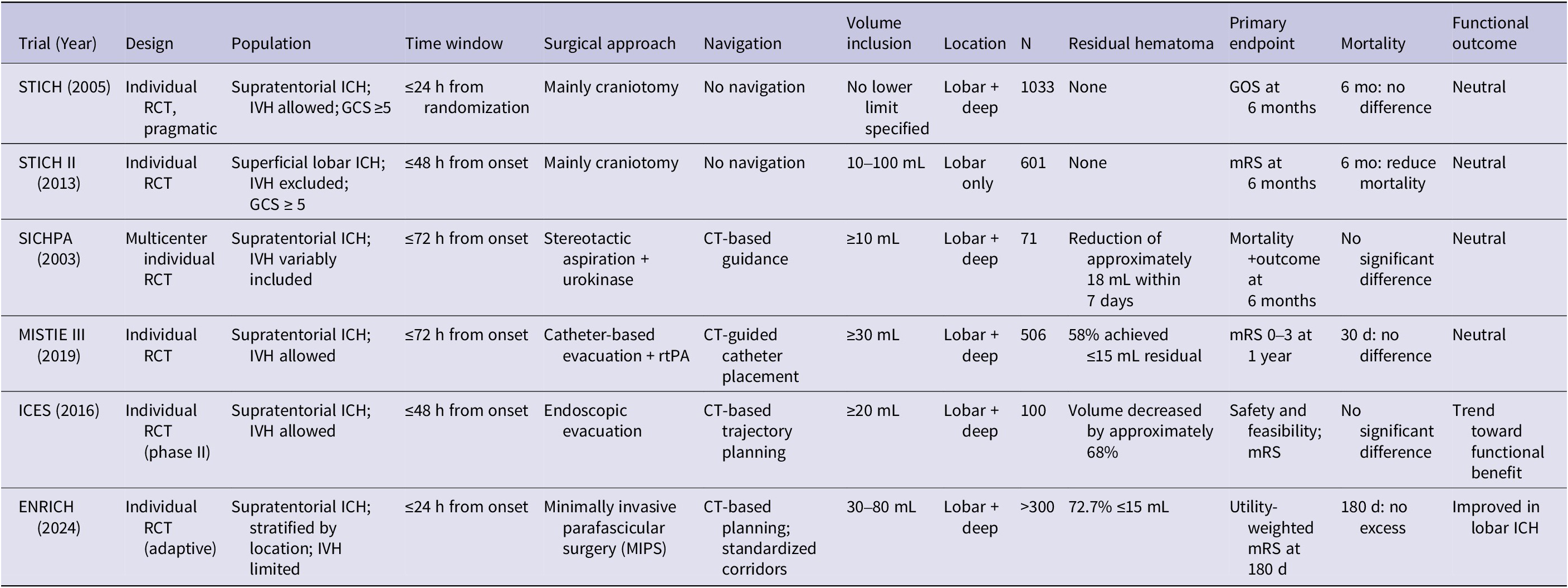
Surgical evacuation has long been considered a rational strategy for sICH, aiming to relieve mass effect, reduce haematoma toxicity and mitigate secondary brain injury (Refs. Reference Sheth2, Reference Keep, Hua and Xi18). Over the past two decades, surgical techniques have evolved from conventional open craniotomy toward minimally invasive, image-guided and tissue-sparing approaches (Refs. Reference Zhang, Ding, Wang, Zhang, Fan, Guo, Chen, Jiang, Cao, Wang, Zang and Wang19, Reference Wang, Liu, Zhang, Geng and Jin20). Despite these conceptual advances, consistent functional benefit has remained difficult to demonstrate in randomized trials (Refs. Reference de Oliveira Manoel21, Reference Gregson, Rowan, Francis, McNamee, Boyers, Mitchell, McColl, Chambers, Unterberg and Mendelow22). A summary of key surgical RCTs is provided in Table 1.
Key randomized trials of surgical treatment for sICH

Table 1. Long description
The table contains 13 columns: Trial (Year), Design, Population, Time window, Surgical approach, Navigation, Volume inclusion, Location, N (sample size), Residual hematoma, Primary endpoint, Mortality, and Functional outcome.
* S I C H P A (2003): Multicenter R C T using stereotactic aspiration plus urokinase within 72 hours. Included lobar and deep I C H ≥ 10 mL. N=71. Resulted in neutral functional outcome.
* S T I C H (2005): Pragmatic R C T using mainly craniotomy within 24 hours. Included supratentorial I C H with G C S ≥ 5. N=1033. Resulted in neutral functional outcome.
* S T I C H II (2013): R C T using mainly craniotomy within 48 hours for superficial lobar I C H (10-100 mL). N=601. Reduced mortality at 6 months but neutral functional outcome.
* I C E S (2016): Phase II R C T using endoscopic evacuation within 48 hours for I C H ≥ 20 mL. N=100. Showed a trend toward functional benefit.
* M I S T I E III (2019): R C T using catheter-based evacuation plus r t P A within 72 hours for I C H ≥ 30 mL. N=506. 58% achieved ≤ 15 mL residual volume; neutral functional outcome.
* E N R I C H (2024): Adaptive R C T using minimally invasive parafascicular surgery (M I P S) within 24 hours for I C H 30-80 mL. N > 300. 72.7% achieved ≤ 15 mL residual volume; improved functional outcome in lobar I C H.
Early single-centre studies of endoscopic evacuation emerged in the late 1980s, suggesting that lobar sICH may benefit from early endoscopic haematoma evaluation (Ref. Reference Auer, Deinsberger, Niederkorn, Gell, Kleinert, Schneider, Holzer, Bone, Mokry, Kleinert and Hanusch23). This finding laid the groundwork for subsequent RCTs, but they were limited by small sample sizes (Ref. Reference Auer, Deinsberger, Niederkorn, Gell, Kleinert, Schneider, Holzer, Bone, Mokry, Kleinert and Hanusch23). The first large multicentre evaluation was the International Surgical Trial in Intracerebral Haemorrhage (STICH) trial, which compared early surgery (primarily craniotomy) with conservative therapies across a broad sICH population and showed no overall improvement in functional outcome (Ref. Reference Mendelow, Gregson, Fernandes, Murray, Teasdale, Hope, Karimi, Shaw and Barer24). Although STICH established the feasibility of surgical randomization in ICH, its pragmatic design, heterogeneous inclusion criteria and substantial inter-centre variability likely diluted potential benefit (Ref. Reference Mendelow, Gregson, Fernandes, Murray, Teasdale, Hope, Karimi, Shaw and Barer24). Subgroup analysis suggested that the closer the location of the ICH to the cortex, the more likely the patient will benefit from surgery (Ref. Reference Mendelow, Gregson, Fernandes, Murray, Teasdale, Hope, Karimi, Shaw and Barer24). Thus, STICH II subsequently restricted enrolment to patients with lobar sICH, thereby improving population homogeneity in order to obtain statistical significance (Ref. Reference Mendelow, Gregson, Rowan, Murray, Gholkar and Mitchell8). However, despite refined selection, the STICH II study also failed to demonstrate a significant functional advantage of early craniotomy over conservative management in lobar sICH, suggesting that patient selection alone could not overcome the tissue damage caused by the surgical procedure associated with craniotomy (Ref. Reference Mendelow, Gregson, Rowan, Murray, Gholkar and Mitchell8).
Subsequent research shifted its focus to minimally invasive strategies aimed at significantly reducing hematoma volume while minimizing surgical trauma (Refs. Reference Hanley, Thompson, Rosenblum, Yenokyan, Lane, McBee, Mayo, Bistran-Hall, Gandhi, Mould, Ullman, Ali, Carhuapoma, Kase, Lees, Dawson, Wilson, Betz, Sugar, Hao, Avadhani, Caron, Harrigan, Carlson, Bulters, LeDoux, Huang, Cobb, Gupta, Kitagawa, Chicoine, Patel, Dodd, Camarata, Wolfe, Stadnik, Money, Mitchell, Sarabia, Harnof, Barzo, Unterberg, Teitelbaum, Wang, Anderson, Mendelow, Gregson, Janis, Vespa, Ziai, Zuccarello, Awad, Abdul-Rahim, Abou-Hamden, Abraham, Ahmed, Alba, Aldrich, Altschul, Amin-Hanjani, Anderson, Ansari, Antezana, Ardelt, Arikan, Baguena, Baker, Barrer, Becker, Bergman, Boström, Braun, Brindley, Broaddus, Brown, Buki, Cao, Cao, Carrion-Penagos, Chalela, Chang, Chorro, Chowdhry, Corral, Csiba, Davies, Díaz, Derdeyn, Diringer, Dlugash, Ecker, Economas, Enriquez, Ezer, Fan, Feng, Franz, Freeman, Fusco, Galicich, Gelea, Goldstein, Gonzalez, Grabarits, Greenberg, Gress, Gu, Hall, Hernandez, Hoesch, Hoh, Houser, Hu, Huang, Hussain, Insinga, Jadhav, Jaffe, Jahromi, Jallo, James, James, Jankowitz, Jeon, Jichici, Jonczak, Jonker, Karlen, Keric, Kerz, Knopman, Koenig, Krishnamurthy, Kumar, Kureshi, Laidlaw, Lakhanpal, Latorre, Leifer, Leiphart, Lenington, Li, Lopez, Lovick, Lumenta, Luo, Maas, MacDonald, MacKenzie, Madan, Majkowski, Major, Malhorta, Malkoff, Mangat, Maswadeh, Matouk, McArthur, McCaul, Medow, Mezey, Mighty, Miller, Mohan, Muir, Muñoz, Nakaji, Nee, Nekoovaght-Tak, Nyquist, O’Kane, Okasha, O’Kelly, Ostapkovich, Pandey, Parry-Jones, Perla, Pollack, Polster, Pouratian, Quinn, Rajajee, Reddy, Rehman, Reimer, Rincon, Rybinnik, Sanchez, Sansing, Schneck, Schuerer, Schul, Schweitzer, Seder, Seyfried, Sheth, Spiotta, Stechison, Szabo, Tamayo, Tanczos, Taussky, Terry, Testai, Thomas, Thompson, Thompson, Torner, Tran, Tucker, Ungar, Varelas, Vargas, Vatter, Venkatasubramanian, Vermillion, Vollmer, Wang, Wang, Wen, Whitworth, Willis, Wrencher, Wright, Xu, Yanase, Yi, Yu and Zomorodi6, Reference Cordonnier and Tymianski25). Stereotactic aspiration combined with urokinase was explored in the Stereotactic Treatment of Intracerebral Hematoma by Means of a Plasminogen Activator (SICHPA) trial, which demonstrated modest haematoma reduction but no improvement in mortality or functional outcome (Ref. Reference Teernstra, Evers, Lodder, Leffers, Franke and Blaauw26). These early catheter-based approaches nonetheless established procedural feasibility and laid the foundation for the Minimally Invasive Surgery Plus Recombinant Tissuetype Plasminogen Activator for Intracerebral Hemorrhage Evacuation (MISTIE) program. The phase II MISTIE study confirmed safety and technical reproducibility. MISTIE III prespecifying a residual haematoma target (≤15 mL), which introduced a key concept influencing the efficacy of haematoma in minimally invasive surgery (Refs. Reference Hanley, Thompson, Rosenblum, Yenokyan, Lane, McBee, Mayo, Bistran-Hall, Gandhi, Mould, Ullman, Ali, Carhuapoma, Kase, Lees, Dawson, Wilson, Betz, Sugar, Hao, Avadhani, Caron, Harrigan, Carlson, Bulters, LeDoux, Huang, Cobb, Gupta, Kitagawa, Chicoine, Patel, Dodd, Camarata, Wolfe, Stadnik, Money, Mitchell, Sarabia, Harnof, Barzo, Unterberg, Teitelbaum, Wang, Anderson, Mendelow, Gregson, Janis, Vespa, Ziai, Zuccarello, Awad, Abdul-Rahim, Abou-Hamden, Abraham, Ahmed, Alba, Aldrich, Altschul, Amin-Hanjani, Anderson, Ansari, Antezana, Ardelt, Arikan, Baguena, Baker, Barrer, Becker, Bergman, Boström, Braun, Brindley, Broaddus, Brown, Buki, Cao, Cao, Carrion-Penagos, Chalela, Chang, Chorro, Chowdhry, Corral, Csiba, Davies, Díaz, Derdeyn, Diringer, Dlugash, Ecker, Economas, Enriquez, Ezer, Fan, Feng, Franz, Freeman, Fusco, Galicich, Gelea, Goldstein, Gonzalez, Grabarits, Greenberg, Gress, Gu, Hall, Hernandez, Hoesch, Hoh, Houser, Hu, Huang, Hussain, Insinga, Jadhav, Jaffe, Jahromi, Jallo, James, James, Jankowitz, Jeon, Jichici, Jonczak, Jonker, Karlen, Keric, Kerz, Knopman, Koenig, Krishnamurthy, Kumar, Kureshi, Laidlaw, Lakhanpal, Latorre, Leifer, Leiphart, Lenington, Li, Lopez, Lovick, Lumenta, Luo, Maas, MacDonald, MacKenzie, Madan, Majkowski, Major, Malhorta, Malkoff, Mangat, Maswadeh, Matouk, McArthur, McCaul, Medow, Mezey, Mighty, Miller, Mohan, Muir, Muñoz, Nakaji, Nee, Nekoovaght-Tak, Nyquist, O’Kane, Okasha, O’Kelly, Ostapkovich, Pandey, Parry-Jones, Perla, Pollack, Polster, Pouratian, Quinn, Rajajee, Reddy, Rehman, Reimer, Rincon, Rybinnik, Sanchez, Sansing, Schneck, Schuerer, Schul, Schweitzer, Seder, Seyfried, Sheth, Spiotta, Stechison, Szabo, Tamayo, Tanczos, Taussky, Terry, Testai, Thomas, Thompson, Thompson, Torner, Tran, Tucker, Ungar, Varelas, Vargas, Vatter, Venkatasubramanian, Vermillion, Vollmer, Wang, Wang, Wen, Whitworth, Willis, Wrencher, Wright, Xu, Yanase, Yi, Yu and Zomorodi6, Reference Mould, Carhuapoma, Muschelli, Lane, Morgan, McBee, Bistran-Hall, Ullman, Vespa, Martin, Awad, Zuccarello and Hanley27). Although the overall primary endpoint was neutral, secondary and per-protocol analyses showed that patients achieving the evacuation target experienced better functional outcomes, identifying residual clot burden as a key mediator of surgical efficacy (Ref. Reference Cordonnier and Tymianski25).
More recently, modern minimally invasive strategies have emphasized early intervention, standardized operative corridors and tissue preservation. The Intraoperative Stereotactic Computed Tomography-Guided Endoscopic Surgery (ICES) trial demonstrated the safety and feasibility of CT-guided endoscopic evacuation. Then the The Early Minimally Invasive Removal of Intracerebral Haemorrhage (ENRICH) trial provided the first large-scale randomized evidence suggesting functional benefit from early minimally invasive parafascicular surgery, particularly in lobar haemorrhage, while no benefit was observed in deep sICH (Ref. Reference Vespa, Hanley, Betz, Hoffer, Engh, Carter, Nakaji, Ogilvy, Jallo, Selman, Bistran-Hall, Lane, McBee, Saver, Thompson and Martin28). These findings highlight the importance of anatomical selection and reinforce the concept that surgical benefit is location dependent (Ref. Reference Pradilla, Ratcliff, Hall, Saville, Allen, Paulon, McGlothlin, Lewis, Fitzgerald, Caveney, Li, Bain, Gomes, Jankowitz, Zenonos, Molyneaux, Davies, Siddiqui, Chicoine, Keyrouz, Grossberg, Shah, Singh, Bohnstedt, Frankel, Wright and Barrow11). The subsequent Minimally Invasive Surgery vs Medical Management Alone for Intracerebral Hemorrhage (MIND) study failed to demonstrate improved long-term functional outcomes, possibly due to the predominance of deep haemorrhages, delayed intervention (ICH<72 h), and insufficient attention to perihaematomal neuroprotection.
Unlike surgical haematoma evacuation strategy, which inevitably cause tissue damage, the Swiss trial of decompressive craniectomy versus best medical treatment of spontaneous supratentorial intracerebral haemorrhage (SWITCH) trial evaluated decompressive craniectomy without targeted hematoma evacuation, which can alleviate the increased intracranial pressure caused by sICH (Ref. Reference Beck, Fung, Strbian, Bütikofer, Z’Graggen, Lang, Beyeler, Gralla, Ringel, Schaller, Plesnila, Arnold, Hacke, Jüni, Mendelow, Stapf, Al-Shahi Salman, Bressan, Lerch, Hakim, Martinez-Majander, Piippo-Karjalainen, Vajkoczy, Wolf, Schubert, Höllig, Veldeman, Roelz, Gruber, Rauch, Mielke, Rohde, Kerz, Uhl, Thanasi, Huttner, Kallmünzer, Jaap Kappelle, Deinsberger, Roth, Lemmens, Leppert, Sanmillan, Coutinho, Hackenberg, Reimann, Mazighi, Bassetti, Mattle, Raabe and Fischer29). SWITCH demonstrated no improvement in functional outcomes compared with best medical therapy, underscoring the limited efficacy of decompression alone and suggesting that reduction of intracranial pressure without effective clot removal is insufficient to alter the biological course of sICH (Ref. Reference Beck, Fung, Strbian, Bütikofer, Z’Graggen, Lang, Beyeler, Gralla, Ringel, Schaller, Plesnila, Arnold, Hacke, Jüni, Mendelow, Stapf, Al-Shahi Salman, Bressan, Lerch, Hakim, Martinez-Majander, Piippo-Karjalainen, Vajkoczy, Wolf, Schubert, Höllig, Veldeman, Roelz, Gruber, Rauch, Mielke, Rohde, Kerz, Uhl, Thanasi, Huttner, Kallmünzer, Jaap Kappelle, Deinsberger, Roth, Lemmens, Leppert, Sanmillan, Coutinho, Hackenberg, Reimann, Mazighi, Bassetti, Mattle, Raabe and Fischer29). Together with previous trials, these results indicate that surgery must directly address haematoma burden rather than provide non-specific decompression.
Despite decades of investigation, most surgical trials have yielded neutral or modest results. After reviewing these study results, we have found that haematoma evacuation surgeries require a careful balance between the benefits of removing the haematoma and the tissue damage caused by the surgical procedure. The additional trauma caused by the surgical procedure is likely to offset any benefits gained from haematoma removal. This explains why craniotomy offers no benefit whatsoever to patients with sICH, as the surgical trauma is too great compared with minimally invasive surgery; it also explains the differences resulting from the location of the haematoma: for patients with deep sICH who require haematoma evacuation, the damage caused during the procedure is far greater than that experienced by patients with lobar sICH.
Moreover, maximizing haematoma removal is critical to patient prognosis, and endoscopic minimally invasive surgery offers significant advantages in this regard. Unlike stereotactic minimally invasive aspiration, which is less effective for irregular haematomas, endoscopic surgery ensures nearly complete removal of the haematoma (Ref. Reference Hanley, Thompson, Rosenblum, Yenokyan, Lane, McBee, Mayo, Bistran-Hall, Gandhi, Mould, Ullman, Ali, Carhuapoma, Kase, Lees, Dawson, Wilson, Betz, Sugar, Hao, Avadhani, Caron, Harrigan, Carlson, Bulters, LeDoux, Huang, Cobb, Gupta, Kitagawa, Chicoine, Patel, Dodd, Camarata, Wolfe, Stadnik, Money, Mitchell, Sarabia, Harnof, Barzo, Unterberg, Teitelbaum, Wang, Anderson, Mendelow, Gregson, Janis, Vespa, Ziai, Zuccarello, Awad, Abdul-Rahim, Abou-Hamden, Abraham, Ahmed, Alba, Aldrich, Altschul, Amin-Hanjani, Anderson, Ansari, Antezana, Ardelt, Arikan, Baguena, Baker, Barrer, Becker, Bergman, Boström, Braun, Brindley, Broaddus, Brown, Buki, Cao, Cao, Carrion-Penagos, Chalela, Chang, Chorro, Chowdhry, Corral, Csiba, Davies, Díaz, Derdeyn, Diringer, Dlugash, Ecker, Economas, Enriquez, Ezer, Fan, Feng, Franz, Freeman, Fusco, Galicich, Gelea, Goldstein, Gonzalez, Grabarits, Greenberg, Gress, Gu, Hall, Hernandez, Hoesch, Hoh, Houser, Hu, Huang, Hussain, Insinga, Jadhav, Jaffe, Jahromi, Jallo, James, James, Jankowitz, Jeon, Jichici, Jonczak, Jonker, Karlen, Keric, Kerz, Knopman, Koenig, Krishnamurthy, Kumar, Kureshi, Laidlaw, Lakhanpal, Latorre, Leifer, Leiphart, Lenington, Li, Lopez, Lovick, Lumenta, Luo, Maas, MacDonald, MacKenzie, Madan, Majkowski, Major, Malhorta, Malkoff, Mangat, Maswadeh, Matouk, McArthur, McCaul, Medow, Mezey, Mighty, Miller, Mohan, Muir, Muñoz, Nakaji, Nee, Nekoovaght-Tak, Nyquist, O’Kane, Okasha, O’Kelly, Ostapkovich, Pandey, Parry-Jones, Perla, Pollack, Polster, Pouratian, Quinn, Rajajee, Reddy, Rehman, Reimer, Rincon, Rybinnik, Sanchez, Sansing, Schneck, Schuerer, Schul, Schweitzer, Seder, Seyfried, Sheth, Spiotta, Stechison, Szabo, Tamayo, Tanczos, Taussky, Terry, Testai, Thomas, Thompson, Thompson, Torner, Tran, Tucker, Ungar, Varelas, Vargas, Vatter, Venkatasubramanian, Vermillion, Vollmer, Wang, Wang, Wen, Whitworth, Willis, Wrencher, Wright, Xu, Yanase, Yi, Yu and Zomorodi6).
In addition, prompt and effective removal of the haematoma is crucial to prevent any secondary damage that can be caused by it; if it is not removed in time, the patient is unlikely to benefit from surgery. However, in many trials, surgery occurred relatively late: STICH required operation within 24 h of randomization rather than onset, MISTIE III allowed intervention within 72 h, and STICH II and ICES within 48 h. Only ENRICH implemented surgery within 24 h of symptom onset (Refs. Reference Hanley, Thompson, Rosenblum, Yenokyan, Lane, McBee, Mayo, Bistran-Hall, Gandhi, Mould, Ullman, Ali, Carhuapoma, Kase, Lees, Dawson, Wilson, Betz, Sugar, Hao, Avadhani, Caron, Harrigan, Carlson, Bulters, LeDoux, Huang, Cobb, Gupta, Kitagawa, Chicoine, Patel, Dodd, Camarata, Wolfe, Stadnik, Money, Mitchell, Sarabia, Harnof, Barzo, Unterberg, Teitelbaum, Wang, Anderson, Mendelow, Gregson, Janis, Vespa, Ziai, Zuccarello, Awad, Abdul-Rahim, Abou-Hamden, Abraham, Ahmed, Alba, Aldrich, Altschul, Amin-Hanjani, Anderson, Ansari, Antezana, Ardelt, Arikan, Baguena, Baker, Barrer, Becker, Bergman, Boström, Braun, Brindley, Broaddus, Brown, Buki, Cao, Cao, Carrion-Penagos, Chalela, Chang, Chorro, Chowdhry, Corral, Csiba, Davies, Díaz, Derdeyn, Diringer, Dlugash, Ecker, Economas, Enriquez, Ezer, Fan, Feng, Franz, Freeman, Fusco, Galicich, Gelea, Goldstein, Gonzalez, Grabarits, Greenberg, Gress, Gu, Hall, Hernandez, Hoesch, Hoh, Houser, Hu, Huang, Hussain, Insinga, Jadhav, Jaffe, Jahromi, Jallo, James, James, Jankowitz, Jeon, Jichici, Jonczak, Jonker, Karlen, Keric, Kerz, Knopman, Koenig, Krishnamurthy, Kumar, Kureshi, Laidlaw, Lakhanpal, Latorre, Leifer, Leiphart, Lenington, Li, Lopez, Lovick, Lumenta, Luo, Maas, MacDonald, MacKenzie, Madan, Majkowski, Major, Malhorta, Malkoff, Mangat, Maswadeh, Matouk, McArthur, McCaul, Medow, Mezey, Mighty, Miller, Mohan, Muir, Muñoz, Nakaji, Nee, Nekoovaght-Tak, Nyquist, O’Kane, Okasha, O’Kelly, Ostapkovich, Pandey, Parry-Jones, Perla, Pollack, Polster, Pouratian, Quinn, Rajajee, Reddy, Rehman, Reimer, Rincon, Rybinnik, Sanchez, Sansing, Schneck, Schuerer, Schul, Schweitzer, Seder, Seyfried, Sheth, Spiotta, Stechison, Szabo, Tamayo, Tanczos, Taussky, Terry, Testai, Thomas, Thompson, Thompson, Torner, Tran, Tucker, Ungar, Varelas, Vargas, Vatter, Venkatasubramanian, Vermillion, Vollmer, Wang, Wang, Wen, Whitworth, Willis, Wrencher, Wright, Xu, Yanase, Yi, Yu and Zomorodi6, Reference Mendelow, Gregson, Rowan, Murray, Gholkar and Mitchell8, Reference Pradilla, Ratcliff, Hall, Saville, Allen, Paulon, McGlothlin, Lewis, Fitzgerald, Caveney, Li, Bain, Gomes, Jankowitz, Zenonos, Molyneaux, Davies, Siddiqui, Chicoine, Keyrouz, Grossberg, Shah, Singh, Bohnstedt, Frankel, Wright and Barrow11, Reference Mendelow, Gregson, Fernandes, Murray, Teasdale, Hope, Karimi, Shaw and Barer24, Reference Vespa, Hanley, Betz, Hoffer, Engh, Carter, Nakaji, Ogilvy, Jallo, Selman, Bistran-Hall, Lane, McBee, Saver, Thompson and Martin28, Reference Gregson, Broderick, Auer, Batjer, Chen, Juvela, Morgenstern, Pantazis, Teernstra, Wang, Zuccarello and Mendelow30). Delayed intervention may miss the opportunity to interrupt evolving secondary injury cascades, whereas excessively early surgery risks rebleeding if haematoma has not stabilized (Refs. Reference Mayer31, Reference Morotti, Boulouis, Charidimou, Li, Poli, Costa, De Giuli, Leuci, Mazzacane, Busto, Arba, Brancaleoni, Giacomozzi, Simonetti, Laudisi, Micieli, Cavallini, Candeloro, Gamba, Magoni, Warren, Anderson, Gurol, Biffi, Viswanathan, Casetta, Fainardi, Zini, Pezzini, Padovani, Greenberg, Rosand and Goldstein32). We propose a potential strategy – ‘stability-gated early evacuation’ – where surgery is performed early but only after physiological parameters like BP and glucose are rigorously controlled, which were highlighted by mediation analyses from the INTERACT3 trial (Ref. Reference Ren, Li, Ouyang, Billot, Chen, Venturelli, de Silva, Nguyen, Wahab, Pandian, Wasay, Pontes-Neto, Abanto, Arauz, You, Ma, Hu, Anderson, Wang and Song13). This ‘stability-gated early evacuation’ may create a safer window for earlier and more effective haematoma evacuation. However, this strategy has yet to be directly tested in RCTs.
Finally, perioperative physiological management has often been inconsistent. Hypertension, hyperglycaemia, fever and coagulopathy exacerbate secondary injury, yet these factors were frequently uncontrolled or non-protocolized in surgical trials. Recent bundled care strategies demonstrate that systemic optimization may be essential for maximizing the benefit of focal interventions, suggesting that surgery alone is unlikely to succeed without coordinated physiological management.
In conclusion, current evidence indicates that haematoma evacuation surgery alone does not automatically translate into neurological recovery. Although removal of the clot may reduce primary mechanical injury, meaningful functional improvement likely requires simultaneous minimizing surgical tissue trauma while mitigating secondary pathological processes such as inflammation, oxidative stress, oedema and metabolic dysfunction. Future progress will depend on earlier and adequately targeted evacuation, reliable achievement of low residual hematoma volumes, tissue-sparing operative techniques and integration with standardized perioperative physiological optimization. Advances in neuroimaging, tractography and molecular profiling may further enable precision selection of patients most likely to benefit from surgical intervention.
Non-surgical treatment
Blood pressure reduction treatment
Elevated BP is common in the acute phase of sICH and is strongly associated with haematoma expansion and poor clinical outcomes (Refs. Reference Anderson, Huang, Wang, Arima, Neal, Peng, Heeley, Skulina, Parsons, Kim, Tao, Li, Jiang, Tai, Zhang, Xu, Cheng, Heritier, Morgenstern and Chalmers33–Reference Kazui, Minematsu, Yamamoto, Sawada and Yamaguchi35). Accordingly, early BP reduction has been widely investigated as a cornerstone of non-surgical management. Timely BP control may limit ongoing bleeding, reduce intracranial pressure, and mitigate secondary injury.
The the Intensive Blood Pressure Reduction in Acute Cerebral Hemorrhage Trial (INTERACT) program provided the earliest large-scale randomized evidence supporting the safety and feasibility of intensive BP lowering. In INTERACT1, patients presenting within 6 h of symptom onset were randomized to intensive treatment (target systolic BP <140 mmHg within 1 h) versus guideline-recommended management (<180 mmHg), primarily using intravenous antihypertensives, demonstrating short-term safety and feasibility (Ref. Reference Anderson, Huang, Wang, Arima, Neal, Peng, Heeley, Skulina, Parsons, Kim, Tao, Li, Jiang, Tai, Zhang, Xu, Cheng, Heritier, Morgenstern and Chalmers33). Building on this, INTERACT2 randomized 2,839 patients within 6 h to the same targets. BP reduction was achieved using intravenous agents such as urapidil, nicardipine or labetalol, followed by oral therapy after stabilization (Ref. Reference Anderson, Heeley, Huang, Wang, Stapf, Delcourt, Lindley, Robinson, Lavados, Neal, Hata, Arima, Parsons, Li, Wang, Heritier, Li, Woodward, Simes, Davis and Chalmers4). The achieved systolic BP difference between groups was modest (~10–15 mmHg), and reduction was gradual and sustained. Although mortality was unchanged, INTERACT2 demonstrated a modest but statistically significant improvement in functional outcome on ordinal modified Rankin scale analysis, suggesting that early, moderate and well-tolerated BP lowering may confer functional benefit without compromising cerebral perfusion (Ref. Reference Anderson, Heeley, Huang, Wang, Stapf, Delcourt, Lindley, Robinson, Lavados, Neal, Hata, Arima, Parsons, Li, Wang, Heritier, Li, Woodward, Simes, Davis and Chalmers4).
In contrast, the Antihypertensive Treatment of Acute Cerebral Hemorrhage (ATACH)-II trial tested a more aggressive strategy (Ref. Reference Qureshi, Palesch, Barsan, Hanley, Hsu, Martin, Moy, Silbergleit, Steiner, Suarez, Toyoda, Wang, Yamamoto and Yoon9). Patients within 4.5 h of onset were randomized to an intensive target of 110–139 mmHg versus a standard target of 140–179 mmHg, with BP control achieved predominantly through continuous intravenous nicardipine infusion (Ref. Reference Qureshi, Palesch, Barsan, Hanley, Hsu, Martin, Moy, Silbergleit, Steiner, Suarez, Toyoda, Wang, Yamamoto and Yoon9). Despite more rapid and pronounced BP reduction, ATACH-II showed no functional benefit and a higher incidence of renal adverse events (Ref. Reference Qureshi, Palesch, Barsan, Hanley, Hsu, Martin, Moy, Silbergleit, Steiner, Suarez, Toyoda, Wang, Yamamoto and Yoon9). These results suggest that excessively aggressive and rapid BP lowering may increase systemic complications without improving neurological outcomes.
Together, INTERACT2 and ATACH-II illustrate a narrow therapeutic window for BP management in sICH: moderate lowering towards approximately 140 mmHg appears safe and potentially beneficial, whereas more intensive targets may be harmful. Meta-analyses indicate that intensive BP reduction consistently reduces haematoma expansion but does not reliably translate into improved long-term functional outcomes, highlighting the importance of treatment intensity and implementation.
Beyond single-target strategies, INTERACT3 evaluated a goal-directed, bundled care approach integrating BP control with standardized management of hyperglycaemia, fever and anticoagulation reversal (Ref. Reference Ma, Hu, Song, Chen, Ouyang, Billot, Li, Malavera, Li, Muñoz-Venturelli, de Silva, Thang, Wahab, Pandian, Wasay, Pontes-Neto, Abanto, Arauz, Shi, Tang, Zhu, She, Liu, Sakamoto, You, Han, Crutzen, Cheung, Li, Wang, Chen, Liu, Zhao, Li, Liu, Jiang, Chen, Wu, Liu, Xu, You, Anderson, Robinson, Miranda, Anderson, You, Song, Parry-Jones, Sprigg, Durrans, Harris, Bamford, Smith, Herbert, Chen, Whiteley, Hu, Billot, Li, Mysore, Hu, Zhang, Liu, Sakamoto, You, Han, Crutzen, Li, Cheung, Jan, Liu, Ouyang, Sun, Chu, Anjum, Gonzalez Mc Cawley, del Rio, Rimoli, Cerantola, Jeevarajah, Kannangara, Joseph, Nanayakkara, Chen, Malavera, Zhang, Yang, Li, Meng, Ouyang, Liu, Ning, Dong, Armenis, Lim, Monaghan, Ma, Hu, Li, Luo, Cheng, Dong, Liu, Wang, Zhang, Cheng, Shi, Li, Mou, Yi, Chen, Chen, Weerawardena, Ellawala, Ranasinghe, Rodrigo, Wahab, Adeniyi, Pandian, Khanna, Muñoz Venturelli, González, Urrutia Goldsack, Wasay, Begum, Anjum, Pontes-Neto, Camilo, Dias, Vincenzi, Cerantola, Moro, Santos, Texeira, Longo, Liberato, Martins, Pille, Chwal, Silva, Titton, Weiss, Mora, Ouriques, Carbonera, Bazan, Modolo, Winckler, Miranda, Souza, Rojo, Uslar, Medel, Lopez, Herrero, Lavados, Vargas Latorre, Conejan, Esparza, Sotomayor, Wenger, Gigoux, Letelier, Acevedo, Moya, Figueroa, Vallejos, Conejan, Esparza, Sotomayor, Guerrero, Velasquez, Vallejos, Pallauta, Santibanez, Queirolo, Lobos, Jiang, Li, Huang, Luo, Liu, Tang, Yang, Jiang, Zhang, Jing, Zhu, Pu, Lv, Kang, Hu, She, Jiang, Chen, Yang, He, Li, Cheng, Huang, Wang, Lin, Chen, Yang, Ding, Deng, Luo, Zhang, Wang, Zhang, Yang, Zhang, Yang, He, Liu, Wang, Zhang, Xin, Feng, Hao, Song, Guo, Jiang, Chen, Tang, Zhu, Li, Cui, Xu, Li, Tang, Li, Gao, Yang, Xu, Deng, Zheng, Ge, Chen, Liu, Li, Zhong, Xu, Zhang, Wang, Zhu, Sun, Yu, Zhang, You, Ma, Hu, Xu, Li, Zhang, Wang, Ma, Jiang, Zhou, Liu, Nie, Li, Tian, Li, He, Tu, Wu, Liu, Zhong, Jiang, Sun, Tian, Wei, An, Wei, Luo, Lin, Liu, Wen, Cai, Chen, Lei, Li, Zhang, He, Chen, Liu, Liu, Li, Chen, Wang, Zhou, Ye, Zhang, Zhang, Pan, Yu, Xu, Xiao, Wang, Tao, Shi, Zheng, You, Lei, Chen, Wu, Hu, Zhao, Yu, Yuan, du, Tang, Li, Liu, Yang, Xiao, Luo, Wang, Che, Teng, Wan, Li, Liu, Fan, Zhang, Cai, Ma, Ma, Li, He, Li, Zhang, Zhang, Zhang, Dai, Lei, Mao, Huang, Zhou, Chen, Chen, Wei, Li, Chen, Zeng, Mou, Xue, Jiang, Tang, Chen, Zhang, Xu, Gu, Chen, Zhao, Yang, Kuai, Wang, Yang, Hu, Zhang, Yang, Wang, Zhang, Cheng, Zhang, Ma, He, Zhang, Gao, Liu, Ye, Xu, Wu, Yuan, Zou, Zhang, Cheng, Zhou, Zeng, Liang, du, Yu, Cao, You, Xu, Huang, Chen, Xiao, Zhu, Yuan, Wang, Shi, Hu, Xiang, Shi, Wang, Yang, Miao, Hu, Zhao, Hu, Liu, Zhou, Sun, Chen, Tang, Yao, You, Chen, Yao, Li, Liu, Bai, Yi, Deng, Luo, Wang, Jiang, Yang, He, Wang, Chen, He, Deng, Cao, Yi, Luo, Luo, Gong, Liu, Gao, Liu, Wu, Zhang, Sun, Li, Jia, Wu, Zhang, Zhang, du, Li, Yang, He, Liao, Zhou, Dong, Chen, Lin, Shui, Zhang, Zhao, Yang, Zhao, Zhang, Chen, Wu, Dai, Tang, Wang, Liu, Zhang, Duan, Luo, Jiao, Lei, Wang, Song, Tan, Ye, Qin, Liang, Liu, Yang, Yang, Lin, Yang, Ma, Qi, Pan, Jiang, Ye, Dong, Yue, Yang, Maimaitiyiming, Dong, Wu, Gao, Zhao, Zhang, Wang, Jiang, Li, Zhang, Chen, Tong, Wang, Qiao, Guo, Zhang, Hu, Feng, Song, Zuo, Chen, Qian, Li, Ma, Zhang, Kong, Dong, Li, Fang, Lu, Li, Zhang, Yang, Yu, Sun, Wang, Wang, Li, Li, Xu, Wang, Dong, Tang, Chu, Lu, Wang, Sun, Zhao, Yang, Qian, Saroja, Naik k, Chindhi, Pampaniya, Amaresh, Iype, R, Rajan, Panicker, das, Choudhury, Gohain, Webster, Pakma, Sangi, Sebastian, Aggrawal, Raj, Rajoura, Singh, Aggrawal, Narang, Arauz, Cano-Nigenda, López-Mena, Valdez-Ruvalcaba, Toledo-Treviño, Obiako, Abubakar, Emeka, Olayemi, Lois, Philip, Comfort O, Okubadejo, Agabi, Ojo, Wahab, Bello, Ibukun, Sanayaolu, Adeniyi, Jimoh, Wasay, Begum, Anjum, Waheed, Kamal, Shoaib, Orooj, Majid, Zehra, Khan, Shanker, Syed, Ahmad, Abanto, Valencia, Barrientos, Ramirez, Calle, Palliyeguruge, Muthucumarana, Ratnayaka, Ganihiarachchi, Bandaranayake, Somaratne, Narayana, Gallage, Senanayake, Samarasiri, Luke, Sivapathasundaram, Sahadevan, Rasmi, Deshaka, Fernando, Munasinghe, Rathnapriya, Nissanka, Karunathilake, Gayan, Wijenayake, Gunasekara, Vidyarathne, Keshavaraj, Janarthanan, Gerald Jeevathasan, Sivamainthan, John Priyanth, John Priyanth, Rajendiran, Alwis, Gunasekare, Liyanarachchi, Dissanayake, Uluwattage, Ratnayake, Rajinee, Jayawardana, Peiris, Wicramasinghe, Fernando, Abbas, Withanage, Bandara, Mai, Nguyen, Dao, Vuong, Nguyen, Dinh, Phan, Bui, Phung, Pham, Pham, do, Dang, Dang, Nguyen, Nguyen, Nguyen, Pham, Chau, Tai, le, le, Tran, Nguyen, Ngyen, Vo, Nguyen, Tran, Vo, Cao, Nguyen, le, la, Pham and Thai7). This multicomponent protocol significantly improved functional outcomes at 6 months, suggesting that BP management may be most effective when embedded within coordinated physiological optimization rather than delivered in isolation (Ref. Reference Ma, Hu, Song, Chen, Ouyang, Billot, Li, Malavera, Li, Muñoz-Venturelli, de Silva, Thang, Wahab, Pandian, Wasay, Pontes-Neto, Abanto, Arauz, Shi, Tang, Zhu, She, Liu, Sakamoto, You, Han, Crutzen, Cheung, Li, Wang, Chen, Liu, Zhao, Li, Liu, Jiang, Chen, Wu, Liu, Xu, You, Anderson, Robinson, Miranda, Anderson, You, Song, Parry-Jones, Sprigg, Durrans, Harris, Bamford, Smith, Herbert, Chen, Whiteley, Hu, Billot, Li, Mysore, Hu, Zhang, Liu, Sakamoto, You, Han, Crutzen, Li, Cheung, Jan, Liu, Ouyang, Sun, Chu, Anjum, Gonzalez Mc Cawley, del Rio, Rimoli, Cerantola, Jeevarajah, Kannangara, Joseph, Nanayakkara, Chen, Malavera, Zhang, Yang, Li, Meng, Ouyang, Liu, Ning, Dong, Armenis, Lim, Monaghan, Ma, Hu, Li, Luo, Cheng, Dong, Liu, Wang, Zhang, Cheng, Shi, Li, Mou, Yi, Chen, Chen, Weerawardena, Ellawala, Ranasinghe, Rodrigo, Wahab, Adeniyi, Pandian, Khanna, Muñoz Venturelli, González, Urrutia Goldsack, Wasay, Begum, Anjum, Pontes-Neto, Camilo, Dias, Vincenzi, Cerantola, Moro, Santos, Texeira, Longo, Liberato, Martins, Pille, Chwal, Silva, Titton, Weiss, Mora, Ouriques, Carbonera, Bazan, Modolo, Winckler, Miranda, Souza, Rojo, Uslar, Medel, Lopez, Herrero, Lavados, Vargas Latorre, Conejan, Esparza, Sotomayor, Wenger, Gigoux, Letelier, Acevedo, Moya, Figueroa, Vallejos, Conejan, Esparza, Sotomayor, Guerrero, Velasquez, Vallejos, Pallauta, Santibanez, Queirolo, Lobos, Jiang, Li, Huang, Luo, Liu, Tang, Yang, Jiang, Zhang, Jing, Zhu, Pu, Lv, Kang, Hu, She, Jiang, Chen, Yang, He, Li, Cheng, Huang, Wang, Lin, Chen, Yang, Ding, Deng, Luo, Zhang, Wang, Zhang, Yang, Zhang, Yang, He, Liu, Wang, Zhang, Xin, Feng, Hao, Song, Guo, Jiang, Chen, Tang, Zhu, Li, Cui, Xu, Li, Tang, Li, Gao, Yang, Xu, Deng, Zheng, Ge, Chen, Liu, Li, Zhong, Xu, Zhang, Wang, Zhu, Sun, Yu, Zhang, You, Ma, Hu, Xu, Li, Zhang, Wang, Ma, Jiang, Zhou, Liu, Nie, Li, Tian, Li, He, Tu, Wu, Liu, Zhong, Jiang, Sun, Tian, Wei, An, Wei, Luo, Lin, Liu, Wen, Cai, Chen, Lei, Li, Zhang, He, Chen, Liu, Liu, Li, Chen, Wang, Zhou, Ye, Zhang, Zhang, Pan, Yu, Xu, Xiao, Wang, Tao, Shi, Zheng, You, Lei, Chen, Wu, Hu, Zhao, Yu, Yuan, du, Tang, Li, Liu, Yang, Xiao, Luo, Wang, Che, Teng, Wan, Li, Liu, Fan, Zhang, Cai, Ma, Ma, Li, He, Li, Zhang, Zhang, Zhang, Dai, Lei, Mao, Huang, Zhou, Chen, Chen, Wei, Li, Chen, Zeng, Mou, Xue, Jiang, Tang, Chen, Zhang, Xu, Gu, Chen, Zhao, Yang, Kuai, Wang, Yang, Hu, Zhang, Yang, Wang, Zhang, Cheng, Zhang, Ma, He, Zhang, Gao, Liu, Ye, Xu, Wu, Yuan, Zou, Zhang, Cheng, Zhou, Zeng, Liang, du, Yu, Cao, You, Xu, Huang, Chen, Xiao, Zhu, Yuan, Wang, Shi, Hu, Xiang, Shi, Wang, Yang, Miao, Hu, Zhao, Hu, Liu, Zhou, Sun, Chen, Tang, Yao, You, Chen, Yao, Li, Liu, Bai, Yi, Deng, Luo, Wang, Jiang, Yang, He, Wang, Chen, He, Deng, Cao, Yi, Luo, Luo, Gong, Liu, Gao, Liu, Wu, Zhang, Sun, Li, Jia, Wu, Zhang, Zhang, du, Li, Yang, He, Liao, Zhou, Dong, Chen, Lin, Shui, Zhang, Zhao, Yang, Zhao, Zhang, Chen, Wu, Dai, Tang, Wang, Liu, Zhang, Duan, Luo, Jiao, Lei, Wang, Song, Tan, Ye, Qin, Liang, Liu, Yang, Yang, Lin, Yang, Ma, Qi, Pan, Jiang, Ye, Dong, Yue, Yang, Maimaitiyiming, Dong, Wu, Gao, Zhao, Zhang, Wang, Jiang, Li, Zhang, Chen, Tong, Wang, Qiao, Guo, Zhang, Hu, Feng, Song, Zuo, Chen, Qian, Li, Ma, Zhang, Kong, Dong, Li, Fang, Lu, Li, Zhang, Yang, Yu, Sun, Wang, Wang, Li, Li, Xu, Wang, Dong, Tang, Chu, Lu, Wang, Sun, Zhao, Yang, Qian, Saroja, Naik k, Chindhi, Pampaniya, Amaresh, Iype, R, Rajan, Panicker, das, Choudhury, Gohain, Webster, Pakma, Sangi, Sebastian, Aggrawal, Raj, Rajoura, Singh, Aggrawal, Narang, Arauz, Cano-Nigenda, López-Mena, Valdez-Ruvalcaba, Toledo-Treviño, Obiako, Abubakar, Emeka, Olayemi, Lois, Philip, Comfort O, Okubadejo, Agabi, Ojo, Wahab, Bello, Ibukun, Sanayaolu, Adeniyi, Jimoh, Wasay, Begum, Anjum, Waheed, Kamal, Shoaib, Orooj, Majid, Zehra, Khan, Shanker, Syed, Ahmad, Abanto, Valencia, Barrientos, Ramirez, Calle, Palliyeguruge, Muthucumarana, Ratnayaka, Ganihiarachchi, Bandaranayake, Somaratne, Narayana, Gallage, Senanayake, Samarasiri, Luke, Sivapathasundaram, Sahadevan, Rasmi, Deshaka, Fernando, Munasinghe, Rathnapriya, Nissanka, Karunathilake, Gayan, Wijenayake, Gunasekara, Vidyarathne, Keshavaraj, Janarthanan, Gerald Jeevathasan, Sivamainthan, John Priyanth, John Priyanth, Rajendiran, Alwis, Gunasekare, Liyanarachchi, Dissanayake, Uluwattage, Ratnayake, Rajinee, Jayawardana, Peiris, Wicramasinghe, Fernando, Abbas, Withanage, Bandara, Mai, Nguyen, Dao, Vuong, Nguyen, Dinh, Phan, Bui, Phung, Pham, Pham, do, Dang, Dang, Nguyen, Nguyen, Nguyen, Pham, Chau, Tai, le, le, Tran, Nguyen, Ngyen, Vo, Nguyen, Tran, Vo, Cao, Nguyen, le, la, Pham and Thai7).
Extending intervention even earlier, INTERACT4 initiated BP reduction in the prehospital setting (Ref. Reference Li, Lin, Yang, Anderson, Chen, Liu, Billot, Li, Chen, Liu, Ren, Zhang, Xu, Wu, Wang, Qiu, Jiang, Peng, Li, Huang, Zhao, Liang, Wang, Wu, Xu, Chen, Huang, Zhang, Zuo, Ma, Yang, Hao, Xu, Xiong, Tang, Guo, Yu, Li, He, Mao, Tan, Tan, Yu, Xu, Sun, Li, Guo, Liu, Liu, Ouyang, Si, Arima, Bath, Ford, Robinson, Sandset, Saver, Sprigg, van der Worp and Song14). Patients with suspected stroke and systolic BP ≥150 mmHg received ambulance-based intravenous urapidil targeting 130–140 mmHg within 2 h of onset (Ref. Reference Li, Lin, Yang, Anderson, Chen, Liu, Billot, Li, Chen, Liu, Ren, Zhang, Xu, Wu, Wang, Qiu, Jiang, Peng, Li, Huang, Zhao, Liang, Wang, Wu, Xu, Chen, Huang, Zhang, Zuo, Ma, Yang, Hao, Xu, Xiong, Tang, Guo, Yu, Li, He, Mao, Tan, Tan, Yu, Xu, Sun, Li, Guo, Liu, Liu, Ouyang, Si, Arima, Bath, Ford, Robinson, Sandset, Saver, Sprigg, van der Worp and Song14). While no overall benefit was observed, subgroup analyses suggested potential improvement in sICH but not ischaemic stroke, emphasizing the importance of ultra-early treatment and accurate stroke classification (Ref. Reference Li, Lin, Yang, Anderson, Chen, Liu, Billot, Li, Chen, Liu, Ren, Zhang, Xu, Wu, Wang, Qiu, Jiang, Peng, Li, Huang, Zhao, Liang, Wang, Wu, Xu, Chen, Huang, Zhang, Zuo, Ma, Yang, Hao, Xu, Xiong, Tang, Guo, Yu, Li, He, Mao, Tan, Tan, Yu, Xu, Sun, Li, Guo, Liu, Liu, Ouyang, Si, Arima, Bath, Ford, Robinson, Sandset, Saver, Sprigg, van der Worp and Song14). These findings highlight the importance of timing and accurate stroke classification for optimizing treatment efficacy.
Drug treatment of ICH
sICH is associated with high mortality and long-term disability. Pharmacological strategies for sICH have primarily focused on two therapeutic domains: (i) limiting hematoma expansion and (ii) attenuating secondary brain injury (Ref. 18). The latter involves multiple pathological processes, including neuroinflammation, immune-cell dysregulation, oxidative stress, and blood–brain barrier disruption (Refs. Reference Zhang, Ding, Wang, Zhang, Fan, Guo, Chen, Jiang, Cao, Wang, Zang and Wang19–Reference Wang, Liu, Zhang, Geng and Jin20).
Agents targeting haematoma expansion
Early pharmacological strategies focused on limiting ongoing bleeding and haematoma growth given the strong association between haematoma expansion and poor outcome (Refs. Reference Anderson, Huang, Wang, Arima, Neal, Peng, Heeley, Skulina, Parsons, Kim, Tao, Li, Jiang, Tai, Zhang, Xu, Cheng, Heritier, Morgenstern and Chalmers33–Reference Kazui, Minematsu, Yamamoto, Sawada and Yamaguchi35). Recombinant activated factor VII (rFVIIa) was among the first agents evaluated in large randomized trials (Ref. Reference Mayer, Brun, Broderick, Davis, Diringer, Skolnick and Steiner36). Although rFVIIa significantly reduced haematoma expansion when administered within a narrow hyperacute window, it failed to improve survival or functional outcome and raised concerns regarding thromboembolic complications (Ref. Reference Mayer, Brun, Begtrup, Broderick, Davis, Diringer, Skolnick and Steiner37). These findings demonstrated that modifying haematoma growth alone is insufficient to translate into meaningful functional recovery.
Similarly, antifibrinolytic therapy with tranexamic acid was investigated in large phase III trials (Ref. Reference Sprigg, Flaherty, Appleton, Al-Shahi Salman, Bereczki, Beridze, Christensen, Ciccone, Collins, Czlonkowska, Dineen, Duley, Egea-Guerrero, England, Krishnan, Laska, Law, Ozturk, Pocock, Roberts, Robinson, Roffe, Seiffge, Scutt, Thanabalan, Werring, Whynes and Bath38). Although tranexamic acid modestly reduced early hematoma expansion in some patients, no clear improvement in long-term functional outcome was observed (Ref. Reference Sprigg, Flaherty, Appleton, Al-Shahi Salman, Bereczki, Beridze, Christensen, Ciccone, Collins, Czlonkowska, Dineen, Duley, Egea-Guerrero, England, Krishnan, Laska, Law, Ozturk, Pocock, Roberts, Robinson, Roffe, Seiffge, Scutt, Thanabalan, Werring, Whynes and Bath38). Together, these studies suggest that pharmacological suppression of haematoma expansion, particularly when administered beyond very early time windows, yields limited clinical benefit when applied as a standalone intervention.
The failure of anti-expansion strategies highlights several constraints: the extremely narrow therapeutic window required to meaningfully alter bleeding dynamics, the inability of pharmacological agents to reverse established mass effect or hematoma toxicity and the likelihood that downstream secondary injury mechanisms continue to drive disability even when early expansion is attenuated.
Agents targeting secondary brain injury
A second major class of investigational therapies for sICH has focused on limiting secondary brain injury, including neuroinflammation, oxidative stress, iron-mediated toxicity and blood–brain barrier disruption.
Iron chelation with deferoxamine (DFO) has been investigated based on strong preclinical evidence implicating haemoglobin degradation products in perihaematomal injury. Early-phase trials demonstrated safety and feasibility but limited efficacy signals. In the phase 2 i-DEF trial, DFO did not improve the primary functional outcome at 90 days in the overall population (Refs. Reference Nakamura, Keep, Hua, Schallert, Hoff and Xi39–Reference Wu, Wu, Xu, Wang and Wang41). However, post hoc analyses suggested haematoma volume as a potential effect modifier: Patients with moderate haematoma volumes (approximately 10–30 mL) showed improved 180-day functional outcomes, whereas those with small or large haematomas derived no benefit (Refs. Reference Selim, Foster, Moy, Xi, Hill, Morgenstern, Greenberg, James, Singh, Clark, Norton, Palesch, Yeatts, Dolan, Yeh, Sheth, Kunze, Muehlschlegel, Nieto, Claassen, Falo, Huang, Beckwith, Messe, Yates, O’Phelan, Escobar, Becker, Tanzi, Gonzales, Tremont, Venkatasubramanian, Thiessen, Save, Verrault, Collard, DeGeorgia, Cwiklinski, Thompson, Wasilewski, Andrews, Burfeind, Torbey, Hamed, Butcher, Sivakumar, Varelas, Mays-Wilson, Leira, Olalde, Silliman, Calhoun, Dangayach, Renvill, Malhotra, Kordesch, Lord, Calahan, Geocadin, Parish, Frey, Harrigan, Leifer, Mathias, Schneck, Bernier, Gonzales-Arias, Elysee, Lopez, Volgi, Brown, Jasak, Phillips, Jarrett, Gomes, McBride, Aldrich, Aldrich, Kornbluth, Bettle, Goldstein, Tirrell, Shaw and Jonczak42, Reference Selim, Yeatts, Goldstein, Gomes, Greenberg, Morgenstern, Schlaug, Torbey, Waldman, Xi and Palesch43). These findings indicate that DFO may provide selective benefit in biologically permissive subgroups and highlight the importance of mechanism-informed patient selection and timing (Ref. Reference Wei, Wang, Foster, Yeatts, Moy, Mocco, Selim, Palesch, Griffin, Perlmutter, Norton, Dillon, Thornhill, Greenberg, Morgenstern, Hanley, Xi, Bleck, Balk, Palesch, Griffin, Thornhill, Perlmutter, Dillon, Zhao, Kim, Kumar, Norton, Farinella, Siwila-Sackman, Feigert, Schlaug, Wang, Wright, Janis, Gilbert, Kase, Carson, Flaherty, Kessler, McClure, Bannon, Broderick and Dill44). Therefore, the Fifth INTEnsive pReventing Secondary Injury in Acute Cerebral Haemorrhage Trial Within ACT-GLOBAL (INTERACT5) aims to evaluate the efficacy of deferoxamine/colchicine in cases of sICH exceeding 10 mL in volume, and is currently recruiting patients.
Other anti-inflammatory and immunomodulatory approaches have yielded significant positive results. Small proof-of-concept studies of fingolimod showed reductions in perihaematomal oedema and short-term neurological improvement, but larger clinical trials are needed (Ref. Reference Fu, Hao, Zhang, Ren, Sun, Li, Yan, Huang, Yu and Shi45). Minocycline demonstrated safety without functional benefit (Ref. Reference Fouda, Newsome, Spellicy, Waller, Zhi, Hess, Ergul, Edwards, Fagan and Switzer46). The CHAIN trial, evaluating a multimodal neuroprotective strategy, also failed to improve long-term outcomes (Ref. Reference Guo, Chen, Wu, Wang, Zhao, Li, Tang, Che, Xia, Liang, Shi, Jiang, Chen, Liu, Ren, Ouyang, Wang, You, Billot, Wang, Liu, Jing, Meng, Tian, Liu, Xiang, Tang, Xie, Cui, Zheng, Cao, Zhang, Wen, Huang, Wang, You, Pan, Cai, Lu, Hankey, Al-Shahi Salman, Anderson and Song47).
Several factors likely explain the limited success of these therapies. Persistent clot burden and mass effect may overwhelm neuroprotective effects in the absence of haematoma removal, while blood–brain barrier disruption restricts drug delivery. Moreover, substantial inter-individual heterogeneity in haematoma characteristics and inflammatory responses may dilute treatment effects.
Although many agents modify intermediate phenotypes such as haematoma expansion or oedema, these biological effects rarely translate into functional recovery. Collectively, these findings suggest that pharmacological therapy alone is insufficient and that future strategies will likely require integration with timely haematoma evacuation and standardized physiological management within multimodal, stage-specific treatment paradigms.
Rehabilitation treatment
Survivors of sICH frequently experience persistent motor, language, cognitive and neuropsychiatric impairments that contribute substantially to long-term disability and reduced quality of life. Accordingly, contemporary guidelines emphasize early initiation of rehabilitation in clinically stable patients, multidisciplinary team-based care, coordinated discharge planning and continuity across the care pathway as core components of high-quality ICH management (Ref. Reference Greenberg, Ziai, Cordonnier, Dowlatshahi, Francis, Goldstein, Hemphill, Johnson, Keigher, Mack, Mocco, Newton, Ruff, Sansing, Schulman, Selim, Sheth, Sprigg and Sunnerhagen48).
A central question in ICH rehabilitation is not whether rehabilitation is beneficial, but when and how intensively it should be delivered given concerns regarding neurological instability, blood pressure lability and risk of early deterioration in the hyperacute phase. A multicentre RCT conducted in China reported that commencing structured rehabilitation within 48 h of ICH onset improved survival and functional outcomes at 6 months compared with usual care, supporting the potential value of early, protocolized rehabilitation in selected hospitalized patients (Ref. Reference Liu, Cadilhac, Andrew, Zeng, Li, Li, Li, Yu, Mi, Li, Xu, Chen, Wang, Yao, Li, Yan and Wang49).
However, ‘earlier’ should not be conflated with ‘more aggressive’. Evidence across stroke rehabilitation has increasingly highlighted that very early, high-dose mobilization may not uniformly benefit all patients and requires careful patient selection and dose titration; in ICH, this principle is particularly salient given the evolving secondary injury cascade and systemic instability that may limit tolerance to intensive early activity (Ref. Reference Greenberg, Ziai, Cordonnier, Dowlatshahi, Francis, Goldstein, Hemphill, Johnson, Keigher, Mack, Mocco, Newton, Ruff, Sansing, Schulman, Selim, Sheth, Sprigg and Sunnerhagen48). Thus, the emerging message is that early rehabilitation is best conceptualized as a stability-gated, stepwise program, beginning with early assessment and low-risk task engagement, followed by progressive intensification as physiological and neurological parameters stabilize, rather than a uniform ‘very early mobilization for all’ paradigm (Ref. Reference Greenberg, Ziai, Cordonnier, Dowlatshahi, Francis, Goldstein, Hemphill, Johnson, Keigher, Mack, Mocco, Newton, Ruff, Sansing, Schulman, Selim, Sheth, Sprigg and Sunnerhagen48).
Sex differences and reproductive considerations in sICH
Emerging evidence supports the notion that biological sex and reproductive status may influence the epidemiology, clinical presentation and outcomes of sICH (Refs. Reference Foschi, D’Anna, Gabriele, Conversi, Gabriele, De Santis, Orlandi, De Santis, Ornello and Sacco50, Reference Hou, Li, Zhu, Yi, Liu, Wu, Wu, Ji, Song and Rahimi51). Large population-based cohorts consistently report sex-related differences in ICH incidence and mortality: Men experience higher incidence at younger ages, whereas women, particularly postmenopausal, show increasing risk later in life, suggesting a potential influence of hormonal milieu on cerebrovascular vulnerability. Epidemiological analyses indicate that male sex is associated with worse functional outcomes and higher case fatality rates in some cohorts, partly mediated by factors such as deeper haematoma location and more severe presentations (Ref. Reference Zhao, Zhang, Wan, Yu, Wen and Wang52).
The role of sex hormones, especially oestrogen, as modulators of vascular integrity and neuroinflammation has been proposed, supported by experimental models showing oestrogen-mediated neuroprotection after haemorrhagic injury although clinical translation remains limited (Ref. Reference Roof and Hall53). Importantly, major RCTs and basic research in sICH have not systematically stratified by sex or reproductive status, leaving unresolved whether treatment responses, including blood pressure reduction, surgical evacuation or neuroprotective interventions, differ meaningfully between men and women.
Women of reproductive age and pregnancy-associated ICH represent distinct subpopulations with unique pathophysiological triggers (e.g. preeclampsia, reversible cerebral vasoconstriction) and therapeutic considerations, such as antihypertensive safety and anaesthetic risk, yet evidence to guide tailored acute management is scarce (Ref. Reference Ding, Mitta, Kole-White, Roth and Malhamé54). Furthermore, postmenopausal hormonal changes may influence cerebral vessel structure and inflammatory responses, highlighting a biologically plausible but clinically underexplored modifier of sICH outcome.
These observations underscore a critical knowledge gap: Sex and reproductive status are potential effect modifiers in sICH pathophysiology and treatment response but have not been prospectively incorporated into trial design or stratified outcome analyses. Future trials should prospectively stratify randomization and statistical analysis plans by sex and collect data on reproductive status to refine precision treatment paradigms in sICH.
Discussion
Over the past two decades, therapeutic progress in sICH has lagged behind advances in ischaemic stroke treatment. Despite extensive international efforts, randomized trials across surgical and non-surgical domains have largely failed to deliver consistent or transformative improvements in long-term outcomes. As summarized in Figure 1 (drawn using Biorender, https://www.biorender.com/), both surgical evacuation strategies, from open craniotomy in STICH and STICH II to minimally invasive approaches in MISTIE III and ENRICH, and intensive BP reduction have produced, at best, modest and context-dependent benefits.
Timeline of the major milestone clinical trials in sICH treatment.

Figure 1. Long description
The timeline is divided into four horizontal rows with a shared X-axis at the top ranging from 1998 to 2026, followed by a Future column on the far right.
1. Surgery category:
- S T I C H (2005): Craniotomy vs conservative; neutral result.
- S T I C H I I (2013): Craniotomy vs conservative for lobar I C H; neutral result.
- M I S T I E I I I (2014-2019): Stereotactic catheter plus r t P A vs conservative; neutral overall but may benefit residual less than or equal to 15 m L.
- S W I C H (2018-2023): Decompressive craniectomy vs conservative; neutral result.
- E N R I C H (2016-2024): Early M I P S vs conservative; functional benefit in lobar I C H.
- M I N D (2020-2025): Early M I S vs conservative; stopped early for no functional benefit.
- Future: Stability-gated ultra-early evacuation; anatomy-guided surgery; bundled perioperative care.
2. B P and Physiological bundle category:
- I N T E R A C T I (2005-2008): Titrated i.v. S B P less than 140 vs 180; safe pilot size.
- I N T E R A C T I I (2008-2013): Early titrated i.v. plus or minus oral; approached statistical significance.
- A T A C T I I (2011-2016): i.v. nicardipine infusion; no functional benefit.
- I N T E R A C T I I I (2017-2022): Protocolised bundle vs usual care; significant functional benefit.
- I N T E R A C T I V (2020-2024): Ambulance i.v. labetalol or nicardipine; improved 90-day outcome.
- Future: Multi-component care; ultra-early B P management.
3. Anti-hematoma expansion category:
- r F V I I a trials: F A S T (2005-2008) showed no clinical benefit; S P O T L I G H T / S P O T-T I (2010-2018) showed no significant reduction; F A S T E S T (2021-2026) is ongoing.
- Tranexamic acid trials: T I C H I I (2014-2018), S T O P-A U S T (2015-2020), and T R A I G E (2016-2021) all showed no clear functional benefit or improvement.
- Future: Ultra-early hemostasis; combination strategies; etiology-specific hemostasis.
4. Neuro-protection drugs category:
- Fingolimod (2013-2016): Reduced perihematomal edema with early functional benefit.
- M A C H (2015-2019): i.v. then oral minocycline; no clinical benefit.
- i D E F I I (2014-2019): i.v. deferoxamine; neutral overall but may benefit volume 10-30 m L.
- C H A I N (2021-2024): Oral traditional Chinese medicine F Y T F-919; neutral overall.
- Future: Depth exploration of I C H mechanism; stage-specific multimodal treatments; recovery-focused therapies.
A consistent lesson has emerged: Single-modality interventions are insufficient. Surgery alone rarely improves outcomes without careful attention to timing, patient selection and adequate haematoma clearance, while isolated physiological targets such as BP control provide limited functional gains. These neutral results likely reflect the multifactorial and dynamically evolving pathophysiology of sICH, in which haematoma toxicity, inflammation, metabolic dysfunction and systemic stress interact to drive injury. Targeting a single pathway is therefore unlikely to meaningfully alter prognosis without integration into coordinated care. In this context, the INTERACT3 trial is instructive, demonstrating that a bundled, protocolized physiological management strategy can achieve modest but significant functional benefit, supporting system-level optimization over escalation of individual therapies.
Progress has also been hindered by limited mechanistic and translational research. Unlike ischaemic stroke, where the penumbra concept guided decades of innovation, ICH lacks a unifying biological framework. Key questions remain regarding optimal haematoma volume thresholds, surgical timing, BP targets and windows for immunomodulation.
Encouragingly, recent advances in single-cell and spatial transcriptomics have provided new insights into the pathophysiology of sICH. Studies utilizing single-cell RNA sequencing (scRNA-seq), single-nucleus RNA sequencing (snRNA-seq) and spatial transcriptomics have identified critical cellular and molecular responses to haemorrhagic injury. (Refs. Reference Gu, Chen, Geng, Sun, Shi, Chen, Chang, Wei, Ma, Xiao, Bao and Wang55–Reference Zhou, Ma, Feng, Tian, Li, Guo, Shi, Cui, Dong, Hao, Guo, Xu, Han, Bai, He, Cui, Chen, Wu, Gao, Hu, Zhang, Wang, Zhou, Feng, Xue, Lin, Wang, Gao, Heng, Zhao, Luo, Tian, Zhang, Guo, Li, Liu, Ge, Liu and Qu61) These findings, along with integrated multi-omics analyses, have revealed how metabolic dysfunction and inflammation drive secondary injury in perihaematomal tissues, highlighting potential therapeutic targets for future clinical trials (Refs. Reference Wu, Chen, Chen, Zhang, Wu, Shu, Pan and Tang57, Reference Zhang, Liu, Meng, Yu and Xu62). For instance, Zhou et al. used scRNA-seq, identified a pro-inflammatory C5aR1+ microglial subtype that exacerbates neuroinflammation and promotes the polarization of neurotoxic astrocytes via the LGALS9–CD44 pathway and through the CCL3/CCL5–CCR1 axis, thereby exacerbating blood–brain barrier disruption and cerebral oedema following sICH. This finding may provide guidance for the development of precision therapies targeting the C5a–C5aR1 pathway like avacopan, rather than broadly inhibiting neuroinflammation using drugs such as minocycline (Ref. Reference Zhou, Ma, Feng, Tian, Li, Guo, Shi, Cui, Dong, Hao, Guo, Xu, Han, Bai, He, Cui, Chen, Wu, Gao, Hu, Zhang, Wang, Zhou, Feng, Xue, Lin, Wang, Gao, Heng, Zhao, Luo, Tian, Zhang, Guo, Li, Liu, Ge, Liu and Qu61).
All in all, we call upon clinicians and researchers alike to join forces in the pursuit of meaningful breakthroughs for the treatment of ICH despite the setbacks encountered in past efforts. Through collaboration and innovation, we can strive to uncover the potential for improving outcomes in this challenging field.
Funding statement
This work was supported by the National Natural Science Foundation of China (92148206 and 82571528), the National Science and Technology Major Project (2025ZD0552600), the Major Program (JD) of Hubei Province (2023BAA005, 2024BCB111), and the Key Research and Development Program of Wuhan (2024020702030123).
Competing interests
The authors declare no conflicts of interest.
Ethical standard
The authors declare no ethical issues.
Declaration of generative AI and AI-assisted technologies in the manuscript preparation process
During the preparation of this work the authors used ChatGPT for language polishing. After using this tool, the authors reviewed and edited the content as needed and take full responsibility for the content of the published article.


 Open access

