


V.O. Key recognized more than 70 years ago that “politicians and officials are under no compulsion to pay much heed to classes and groups of citizens who do not vote” (Reference Key1949, 527). This insight motivates the empirical literature on political participation and efforts to narrow gaps in turnout (Lijphart Reference Lijphart1997). Yet, political scientists have largely overlooked the dynamics of democratic representation in the context of U.S. public education. America’s schools are governed by 13,500 independent school districts that exercise considerable discretion over matters such as budgeting, staffing, curriculum, student discipline, and school attendance boundaries. In most districts, such policies are set by elected school boards and have profound implications for educational delivery and, ultimately, social mobility and economic growth (Chetty and Hendren Reference Chetty and Hendren2018; Hanushek and Woessmann Reference Hanushek and Woessmann2015).
What makes school governance unique is that the primary beneficiaries—school children—typically do not get to vote (Chubb and Moe Reference Chubb and Moe1990). Of course, parents participate in local elections and even childless voters have a stake in public education (Fischel Reference Fischel2005), but the incentives facing elected officials depend critically on the extent to which adults who vote in school board elections have children’s educational interests in mind. For example, there is evidence that older and childless voters are reluctant to raise taxes to fund investments in public education—especially when the school-aged population looks quite different (in terms of race or ethnicity) than the electorate (e.g., see Brunner and Johnson Reference Brunner and Johnson2016). Indeed, school tax referenda considered during off-cycle elections—when older and childless voters constitute a large share of voters relative to parents and racial minorities—are typically far more likely to fail (Kogan, Lavertu, and Peskowitz Reference Kogan, Lavertu and Peskowitz2018). In his classic study of New Haven, Dahl (Reference Dahl1961, 146) warned that high rates of private school enrollment in wealthier neighborhoods “generates latent opposition to increasing the outlays on public schools” and potentially lower expectations for educational excellence. Tax rates, however, represent only one policy lever through which voters can influence local education.
The decision to delegate the oversight of U.S. public schools to locally elected school boards is largely a historical accident. The Massachusetts Bay Colony tasked townships with providing public education in the 1600s (Danzberger Reference Danzberger1992). When other colonies (and later, states) set up their own school systems, they borrowed heavily from Massachusetts. At various points in American history, however, education reformers recognized that this arrangement sometimes failed to serve the interests of students. The shift from one-room schoolhouses to larger grade-based schools in the first half of the 20th century led to substantial district consolidation—from over 200,000 school districts in 1910 to fewer than 20,000 by 1970—and a consequent loss of local control. During this period, school boards also increasingly ceded authority to oversee day-to-day school operations to professionally trained superintendents and teacher tenure and licensure laws curtailed the allocation of teaching jobs as political patronage. These reforms arguably contributed to the historic gains in educational attainment that were realized in the subsequent decades (Tyack Reference Tyack1974).
Today, America’s education system faces potentially significant representational challenges that earlier waves of governance reform left unaddressed. For example, since 2014, racial and ethnic minorities have made up the majority of America’s public school enrollments, with the white share projected to continue shrinking in the coming years. However, more than 80% of school board members remain white (Hess and Meeks Reference Hess and Meeks2010) and American schools have made only modest progress in closing sizeable racial achievement gaps. In this letter, we consider whether local democracy may exacerbate such educational and representational inequities. Specifically, we provide the first systematic examination of the voters who participate in local school board elections and assess how representative these electorates are of local student bodies. Our analysis combines two sources of administrative data—official voter files and information about the composition and achievement of students attending public schools in four states—to document a sharp demographic disconnect between the students public schools educate and the voters who select their governing boards.
We document three important patterns. First, the majority of voters who cast ballots in school board elections do not actually have children who attend local schools. Second, the voters in these elections often look very different from the students these schools serve. We show that the gap is most pronounced in terms of race and ethnicity, with majority-white electorates determining the outcome of school board elections in more than two thirds of the majority-nonwhite school districts in our sample. Third, and perhaps most worrying, the magnitude of the representational gap is associated with disparities in student achievement. Specifically, the achievement gap between white and nonwhite students tends to be larger in districts where the electorate looks most dissimilar from the student population. Although we do not argue that these correlations are causal, they suggest that school board members likely face the least political pressure to close racial achievement gaps in precisely the districts where these gaps are largest. These results may help explain why many school board members report that voters do not hold them accountable for taking steps to narrow the gaps (Flavin and Hartney Reference Flavin and Hartney2017). Overall, our findings suggest that local democratic processes may be ill equipped to serve the educational interests of many public school students.
DATA SOURCES
To identify voters participating in local school board elections, we use validated turnout from official voter files. We obtained this information from Catalist, a national microtargeting vendor that works primarily with political campaigns.
We focus specifically on California, Illinois, Ohio, and Oklahoma, four large states with numerous school districts and, crucially, significant racial variation in the composition of students. In the latter three states, local school board elections are held on uniform off-cycle dates, and we identify the individuals recorded as having voted on these dates. In California, school board election timing varies considerably across and within districts, so we identify the dates relevant for each district using election results maintained by the California Election Data Archive.
We also take advantage of additional demographic information recorded in the Catalist database. Specifically, we observe the predicted race of each voter, estimated using a Bayesian procedure that combines Census racial surname distributions with the demographic composition of the Census block in which each voter resides. This procedure is widely used by empirical researchers for similar applications (Imai and Khanna Reference Imai and Khanna2016) and has a 90% accuracy rate, according to several validation studies. While we feature the Catalist estimates in our analysis, we show in the Supplemental Appendix that even the most conservative adjustments for measurement error do not affect our key results. In addition, for each voter, we observe the estimated family income and the likelihood that at least one child under the age of 18 lives in the household. These variables were sourced from InfoUSA, a major vendor of consumer data.
The Catalist records are most complete starting in 2008, so we limit our sample to elections held in each state between 2008 and 2016. We calculate the racial and income breakdown in the electorate as well as the proportion of voters who may have children for each election, and then we average these compositional measures across all election dates observed for each school district to obtain one observation per district. Catalist updates its records in real time, which means we observe the school district in which each voter currently resides, as opposed to the school district of residence at the time of each election. As we discuss in the Supplemental Appendix, however, measurement error due to voter migration is unlikely to affect our estimates.
Using these data, we construct voter composition measures for at least 70% of the school districts in each of our four states (Kogan, Lavertu, and Peskowitz Reference Kogan, Lavertu and Peskowitz2021).Footnote 1 To obtain information on students attending local schools, we rely on records from the Stanford Education Data Archive (SEDA; Reardon et al. Reference Reardon, Ho, Shear, Fahle, Kalogrides and DiSalvo2017). This collection includes student demographic data for each district compiled from federal sources as well as achievement estimates based on test scores states reported to the U.S. Department of Education. In the data, we observe the racial composition of students in each school district as well as the share of students who qualify for free and reduced-price lunch, which we use as a proxy for socioeconomic status. When examining achievement gaps between racial subgroups, we are limited to districts with at least 20 students in each student subgroup. We present a variety of descriptive statistics in the Supplemental Appendix.
RESULTS
In the sections that follow, we describe the composition of the electorate in each school district in terms of race and how many voters have children in the household. We also compare the racial demographics of students to the demographics of the electorate in each district. We then calculate the differences between voters and students and examine how these are associated with racial achievement gaps.
Child in Household
As we noted earlier, evidence suggests that parents may have different educational policy preferences than childless voters. While we cannot observe parental status directly, we do observe an important proxy—the probability that each voter has a child in the household. This probability is coded into one of three categories in the Catalist data: child “likely,” “possible,” and “unlikely.” To err on the side of overestimating the number of voters with children, we combine voters whose probability of having a child is classified as either “likely” or “possible” into a single category of potential parent-voters.
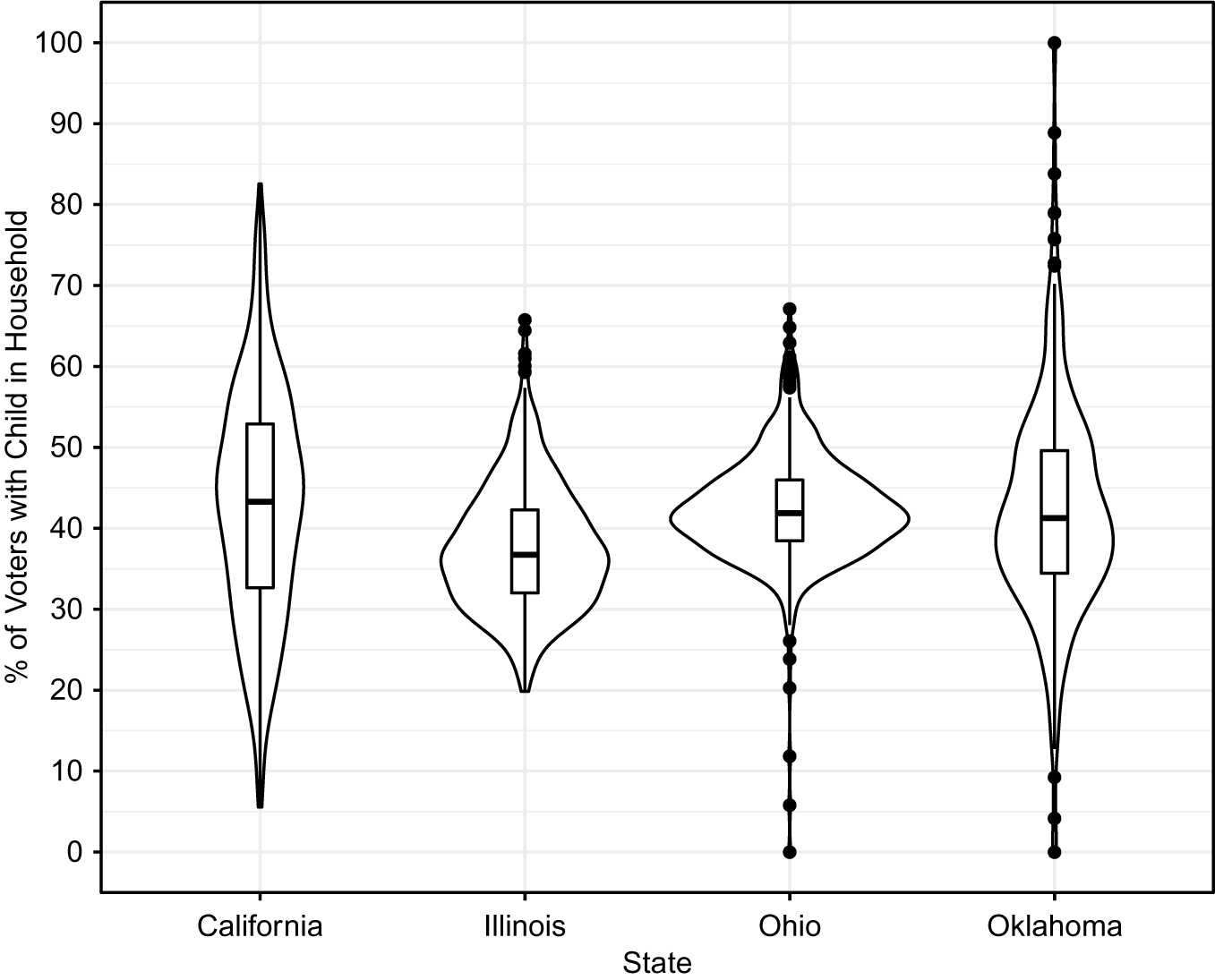
Figure 1 plots the distribution for the fraction of voters who fall into this combined category using violin plots. The plot for each state provides a visual representation of the distribution of observations, showing the median and interquartile range for the percentage of voters in each district with children possibly present in the household, with a density plot overlayed on top. Strikingly, the figure shows that the majority of voters in a typical school board election in each of the four states we examine is “unlikely” to have children.
Percentage of Voters in Each District Whose Likelihood of Having a Child is “Possible” or “Likely”

Voter Race
Of course, parents are not the only adults likely to have a significant personal stake in the performance of public schools, so the distributions in Figure 1 do not by themselves imply that voter and student interests are out of sync. We now turn to comparing and contrasting voters and students on other dimensions likely to be of particular consequence for local education policy. Race represents one such dimension, given the persistently high segregation of American schools. While much of the segregation is driven by racial disparities between school districts (Reardon, Yun, and Eitle Reference Reardon, Yun and Eitle2000), there is also evidence of considerable racial sorting within districts. Due to both high levels of housing segregation and intentional gerrymandering of school attendance boundaries, students of different races frequently attend different schools (Richards Reference Richards2014). Because of the strong correlations between student race and school assignments, a systematic skew in the racial composition of the local electorate may have important downstream consequences (e.g., for how resources are allocated among school buildings within a district).
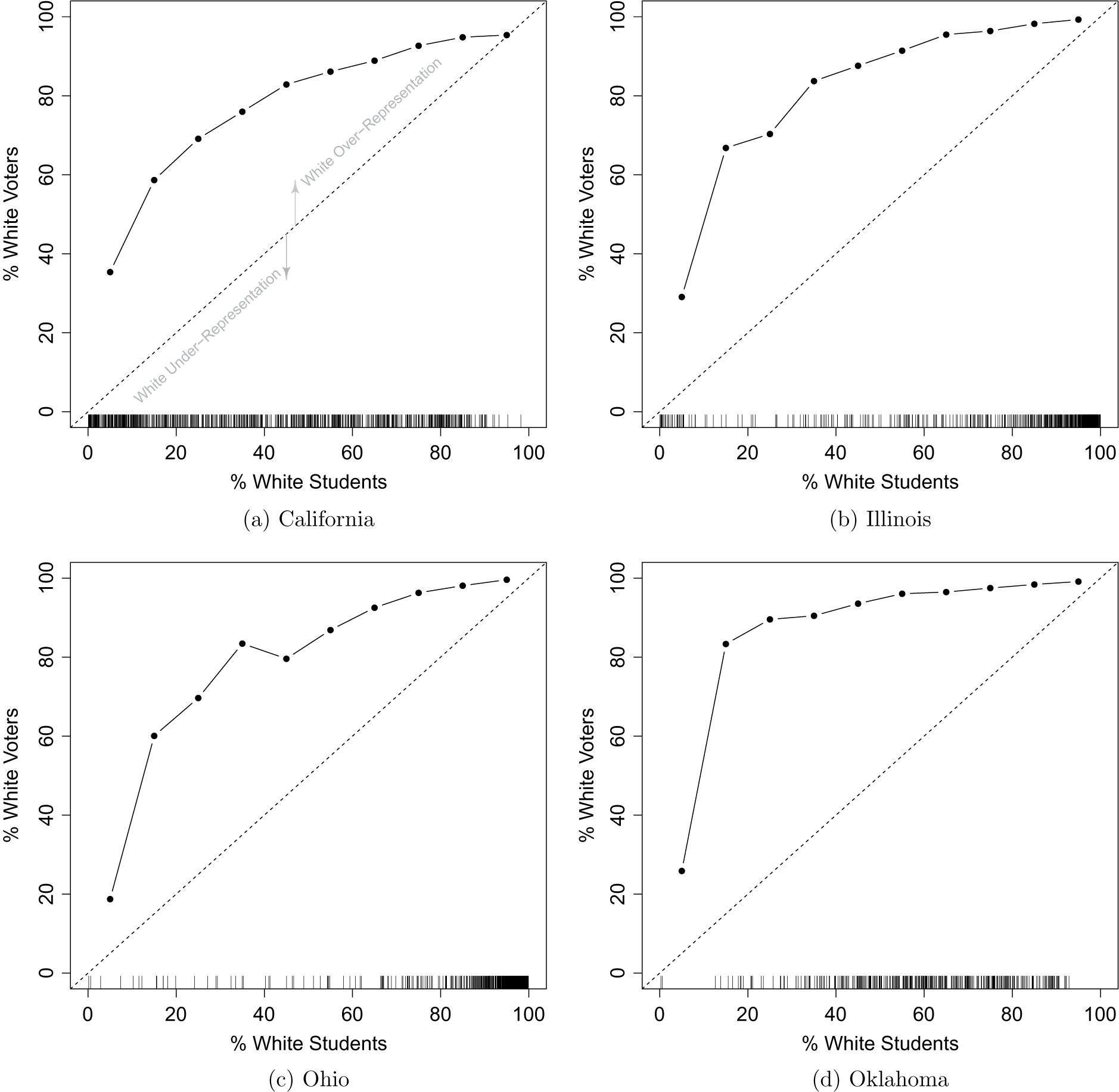
Figure 2 plots white students’ share of overall enrollment in each school district on the x-axis against white voters’ share of the electorate. We combine districts into groups based on similarity in their student racial composition, using 10 equally sized bins that cover the full range from zero to 100% white. For districts falling within each bin, we then calculate the average white voter share and plot it on the y-axis. If the electorate had identical racial composition as the student body, the points would all fall along the dashed diagonal 45-degree line in each panel. Points above this line indicate that the electorate is whiter than the student population, with the vertical distance from the diagonal line indicating the magnitude of the differential. The bottom of each panel also includes a rug plot illustrating the distribution of student composition in the samples, with a vertical bar representing each district in the data and its corresponding share of white students.
Racial Composition of School Board Electorate vs. Students

Across all four states, the figure shows a pronounced racial incongruence, with a much whiter school board electorate than the corresponding student body. The magnitude of the skew is quite large—in each state, the electorate typically becomes majority-white when white student enrollment reaches just 20% of the district total. In Table 1, we focus on districts where the majority of students are nonwhite. Strikingly, we find that the typical electorate in these districts is, on average, at least 60% white. Indeed, at least two thirds of the majority nonwhite districts in our sample are nevertheless governed by school boards chosen by majority-white electorates.
Most Majority-Nonwhite School Districts Have Majority-White Electorates

We report comparable figures for socioeconomic status in the Supplemental Appendix.
Racial Achievement Gaps
If elected officeholders respond to the preferences of the electorate, systematic political underrepresentation of some segments of the population could give rise to public policies that entrench inequities.
Given the overrepresentation of white voters we document above, one area where these dynamics could prove consequential is in efforts to close academic achievement gaps between student subgroups. Although it is widely known that white students tend to outperform their Black and Hispanic peers on average, recent research shows that racial achievement gaps vary considerably across geographic areas even after accounting for differences in economic resource disparities between groups (Reardon, Kalogrides, and Shores Reference Reardon, Kalogrides and Shores2019).
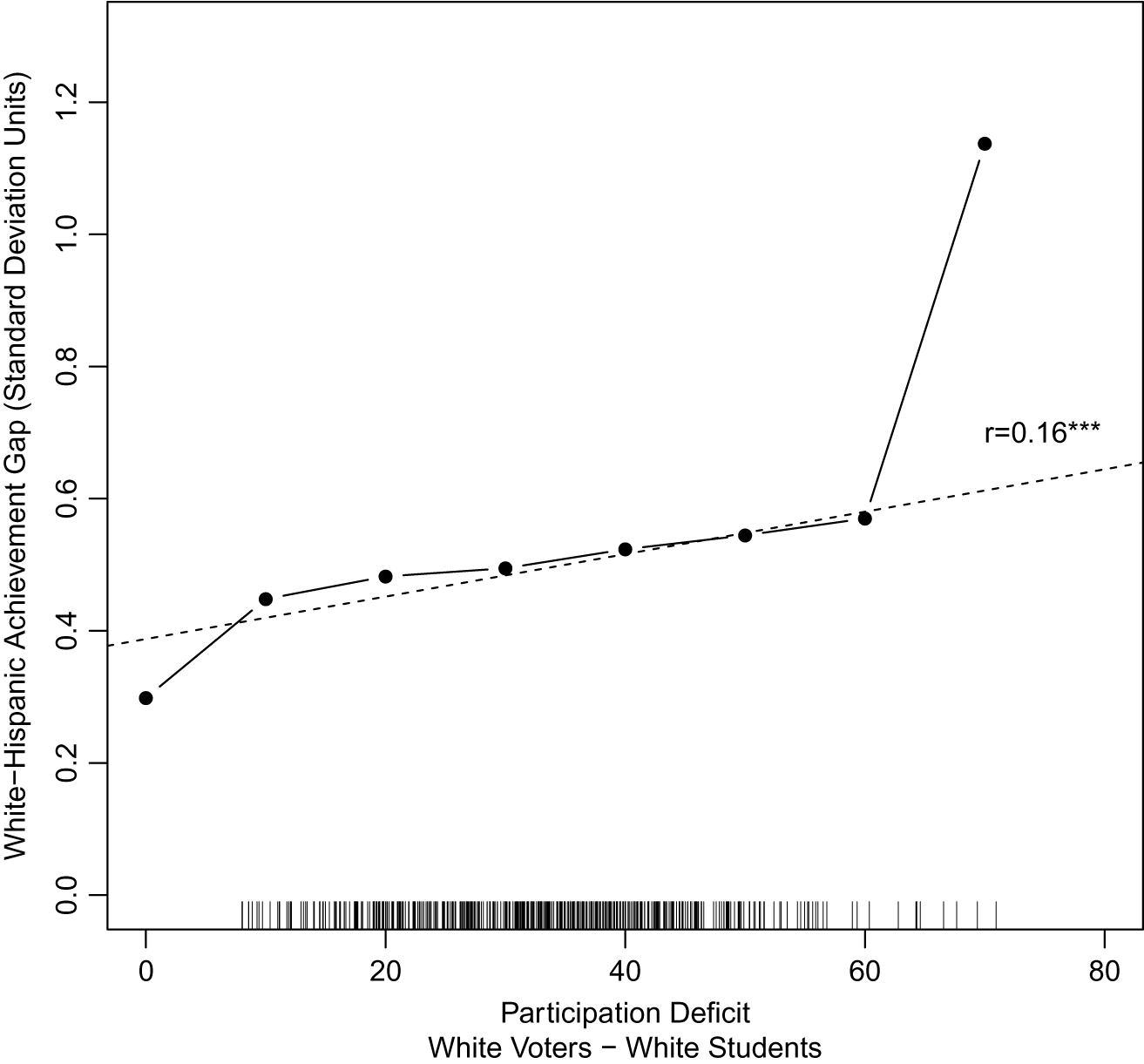
In Figure 3 above, we examine whether racial achievement gaps map onto representational shortfalls using California as an example. We continue to use a binned scatter plot for visual presentation, although the x-axis now corresponds to the shortfall in political participation—defined as the difference between the white share of the electorate and the white share of student enrollment. Thus, larger values correspond to a less representative voter population. On the y-axis, the figure plots the average white-Hispanic achievement gap for each district bin. We also overlay the predicted regression line, estimated using the raw (unbinned) data. The regression line has a significant positive slope, indicating that the gap between the achievement of white and Hispanic students is more pronounced in districts where white voters are most overrepresented in the electorate.
A Whiter Electorate, Relative to Student Population, Is Associated with Larger White-Hispanic Achievement Gaps in California

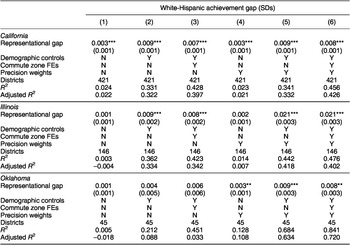
While the figure depicts the simple bivariate relationships, we present full multivariate results in Table 2 that control for student socioeconomic status, student race, and district type. For each state, we also estimate specifications that include commuting zone fixed effects, essentially leveraging variation among geographically proximate school districts.Footnote 2 These additional controls do not change the substantive results, nor does the use of precision weights provided in the SEDA data. In each case, we find that increasing white overrepresentation in the electorate by one percentage point is associated with an increase in the white-Hispanic achievement gap on the order of between 0.005 and 0.01 standard deviations (although the effect is as large as 0.02 in Illinois in some specifications). We provide comparable estimates for the white-Black achievement gap in the Supplemental Appendix.Footnote 3
Hispanic Students Most Underperform Whites in Districts with Least Representative Electorates

Note: Democratic controls include % FRPL, % white student enrollment, and district type (urban, suburban, town, or rural). *p < 0.10, **p < 0.05, ***p < 0.01.
These associations are substantively large. In the average California district, for example, the electorate is 30 percentage points whiter than the student body. That corresponds to a roughly 0.2-standard-deviation white-Hispanic achievement gap—equivalent to more than half a year of learning (Hill et al. Reference Hill, Bloom, Black and Lipsey2008) or about a third of the average difference in the performance of these two groups nationally (Reardon, Kalogrides, and Shores Reference Reardon, Kalogrides and Shores2019).
Of course, we do not claim that these correlations are causal. It is likely that a number of other variables simultaneously affect both political participation and student achievement. Nevertheless, we believe the associations are substantively and politically important. If elected officials are motivated to respond to voter preferences, our results suggest that school board members face the least political pressure to address persistent racial achievement gaps in precisely the districts where these gaps are largest because minority populations are most politically underrepresented in these jurisdictions.
CONCLUSION
A growing body of research has documented troubling disparities in the governance of American public schools. School board members remain overwhelmingly white (Hess and Meeks Reference Hess and Meeks2010), reside disproportionately in more affluent and whiter neighborhoods (Bartanen et al. Reference Bartanen, Grissom, Joshi and Meredith2018), and do not believe they are held electorally responsible for closing racial achievement gaps (Flavin and Hartney Reference Flavin and Hartney2017). Our analysis reveals the underlying electoral processes through which these disparities likely emerge. We show that most of those who cast ballots in school board elections do not have children enrolled in local schools and do not resemble the students schools educate. This demographic disconnect is most pronounced in terms of race, with most majority-nonwhite districts having a majority-white electorate. We also demonstrate that these representational deficits are most notable in districts with the largest racial achievement gaps.
While we do not examine the causes of these disparities in political participation, the Supplemental Appendix provides evidence that they are driven both by differences in voter eligibility among racial groups and shortfalls in turnout among eligible voters. Reforms such as moving school board elections to coincide with higher-turnout national elections would likely boost the political representation of households with children and increase the racial diversity of the electorate (Kogan, Lavertu, and Peskowitz Reference Kogan, Lavertu and Peskowitz2018). Nevertheless, significant disparities would almost certainly remain.
Taking these representational deficits into account is important for designing policy interventions that improve educational opportunity for all students. For example, recent research has shown that nearly 90% of the variation in racial achievement gaps is observed within states, suggesting that interventions designed to close these gaps should be targeted to address local needs. Although we do not argue that disparities in political participation are the cause of achievement shortfalls among nonwhite students, our findings suggest that local school districts may not be politically motivated to address these gaps.
We close with an example that highlights the importance of accounting for these electoral realities, and the risk of ignoring participation disparities, when delegating authority to local school districts. In 2013, California overhauled its state school funding formula, consolidating a series of categorical programs into a single “local control funding formula” that directs more state money to districts enrolling larger numbers of English learners and impoverished students. Reflecting Gov. Jerry Brown’s belief in the principle of “subsidiarity”—the idea that policy decisions are best made at the lowest level possible—the funds came with few strings attached and local districts had discretion in allocating these resources to serve high-need students. Although the reform was effective in channeling more state funds to districts serving larger disadvantaged student populations, recent analyses showed that only a fraction of these dollars ultimately reached schools enrolling the most disadvantaged students (Silberstein and Roza Reference Silberstein and Roza2020). A state audit concluded that the new policy “has not ensured that funding is benefiting intended student groups and closing achievement gaps” (Auditor of the State of California 2019). Other independent evaluations also found mixed evidence that the extra money was effective in closing student achievement gaps (California Legislative Analyst’s Office 2018; Johnson and Tanner Reference Johnson and Tanner2018).
The inequitable outcomes in California and the diversion of funds intended for high-need students likely would not have surprised V.O. Key. When disadvantaged groups are poorly represented in the political process, local elected officials may not have strong incentives to make decisions with their interests in mind.
SUPPLEMENTARY MATERIALS
To view supplementary material for this article, please visit http://dx.doi.org/10.1017/S0003055421000162.
DATA AVAILABILITY STATEMENT
Replication materials are available at the American Political Science Review Dataverse: https://doi.org/10.7910/DVN/H1HRYV.
ACKNOWLEDGMENTS
We are grateful to Craig Burnett, Deven Carlson, Katie Einstein, and Stephen Ross for their helpful comments on earlier drafts of the manuscript. Peskowitz thanks the Hoover Institution for supporting his research as a W. Glenn Campbell and Rita Ricardo-Campbell National Fellow and Starr Foundation Fellow.
FUNDING STATEMENT
The Spencer Foundation supported this research with a Lyle Spencer Research Award (#201600072).
ETHICAL STANDARDS
The authors affirm this research did not involve human participants. The authors declare no ethical issues or conflicts of interest in this research.





Comments
No Comments have been published for this article.