Introduction
Agricultural systems, including crop and pastureland, currently cover approximately 40% of terrestrial land area (Ramankutty et al., Reference Ramankutty, Evan, Monfreda and Foley2008). In large part, these systems are located in rural areas and are considered to be associated with low levels of regulating and supporting ecosystem services (ES) compared with the natural ecosystems that they replaced (Foley et al., Reference Foley, Ramankutty, Brauman, Cassidy, Gerber, Johnston, Mueller, O'Connell, Ray, West, Balzer, Bennett, Carpenter, Hill, Monfreda, Polasky, Rockstrom, Sheehan, Siebert, Tilman and Zaks2011). ES are the benefits humans obtain from ecological systems, and include regulating (e.g., water filtration and carbon sequestration), supporting (e.g., crop pollination and soil formation), provisioning (e.g., food, feed and fiber production) and cultural (e.g., recreation opportunities) services (MA, 2005). They are present in both natural environments and actively managed systems such as agricultural ecosystems, and can be both positively and negatively affected by land use change (Carpenter et al., Reference Carpenter, Mooney, Agard, Capistrano, DeFries, Diaz, Dietz, Duraiappah, Oteng-Yeboah, Pereira, Perrings, Reid, Sarukhan, Scholes and Whyte2009). Changes in ES that result from converting non-agricultural lands to agriculture (agricultural expansion or ‘extensification’), such as changes in the regional carbon sink capacity of a landscape, could have broad environmental, economic and social impacts at the regional, national and global levels (Tilman et al., Reference Tilman, Balzer, Hill and Befort2011). Thus, further expansion of agriculture via conversion of non-agricultural ecosystems to agricultural uses (i.e., agricultural extensification) is generally considered an undesirable strategy for meeting current and future food demand (Foley et al., Reference Foley, Ramankutty, Brauman, Cassidy, Gerber, Johnston, Mueller, O'Connell, Ray, West, Balzer, Bennett, Carpenter, Hill, Monfreda, Polasky, Rockstrom, Sheehan, Siebert, Tilman and Zaks2011; Tilman et al., Reference Tilman, Balzer, Hill and Befort2011).
Limiting further agricultural extensification into rural landscapes and its attendant effects on biodiversity and ES will be challenging, however, given that world population is predicted to reach over 9 billion by mid-century (UN, 2012). This increase in population, along with a shift toward greater consumption of meat and dairy in many diets, will result in unprecedented pressure to increase net agricultural productivity via either agricultural intensification (i.e., produce more on existing agricultural land) or extensification (Tilman et al., Reference Tilman, Balzer, Hill and Befort2011).
But what if the ecosystems that are converted to agriculture are already extremely low functioning in terms of ES, including food provisioning services? Is it possible that agricultural extensification in these cases could result in a net increase in ES? And if so, which services are most likely to be enhanced?
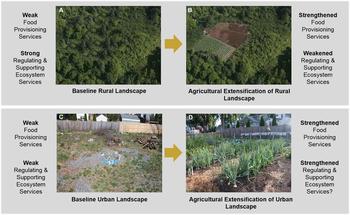
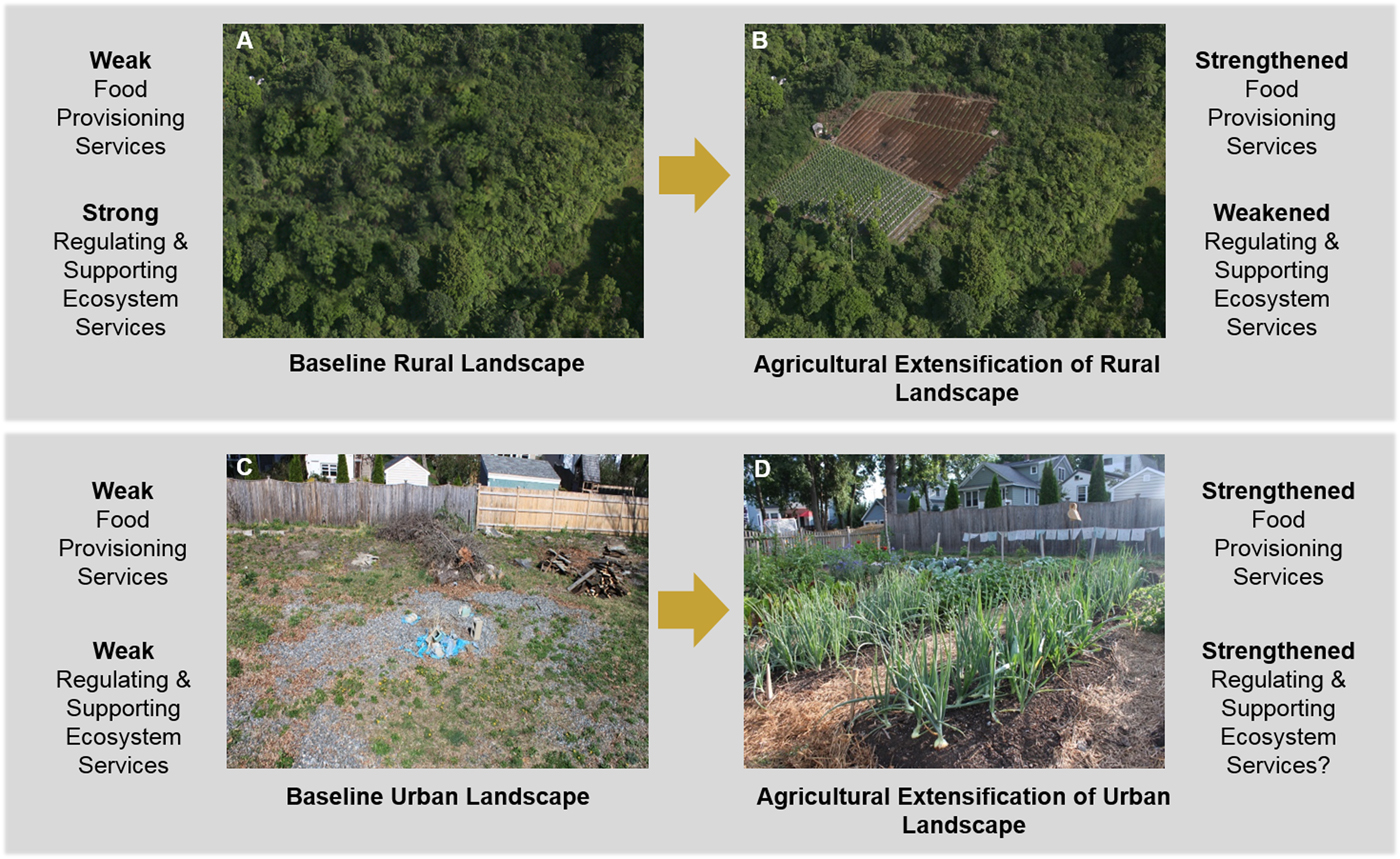
Urban and Peri-urban agriculture (hereafter UPA) is the production and distribution of food, fiber and fuel products in and around cities (Zasada, Reference Zasada2011). As described in Fig. 1, UPA represents a form of agricultural extensification that may enhance net ES, as these types of agricultural systems are typically established in vacant lots and other open areas in built environments (i.e., the human-engineered environment ranging from buildings to parks (e.g., Fig. 1C) where ES are typically low (Larondelle and Haase, Reference Larondelle and Haase2013). Additionally, if expansion of food production services in UPA systems offsets the demand for agricultural extensification into rural areas (e.g., Fig. 1A), where ecosystems tend to be more biologically diverse and ES tend to be higher, UPA could represent a mechanism for preserving and protecting sensitive natural ecosystems and their associated ES (i.e., land sparing). Thus, one could hypothesize that there are potentially two means by which UPA may contribute to net ES: by enhancing ES in built environments (by extensification of agriculture into urban environments with low ES), and by reducing pressure to convert ecosystems with high ES value to agricultural systems (reducing agricultural extensification into rural ecosystems). In other words, while converting rural ecosystems (such as forest) to agricultural production can increase food provisioning ES, the loss of those ecosystems leads to a net decrease in the supporting, regulating and cultural ES that are available across the landscape (e.g., Foley et al., Reference Foley, Ramankutty, Brauman, Cassidy, Gerber, Johnston, Mueller, O'Connell, Ray, West, Balzer, Bennett, Carpenter, Hill, Monfreda, Polasky, Rockstrom, Sheehan, Siebert, Tilman and Zaks2011). In contrast, it is possible that converting urban and peri-urban ecosystems (such as vacant lots) to agricultural production can increase both food provisioning ES and supporting, regulating and cultural ES across an urban landscape that would otherwise have no or very low ES value. Additionally, by increasing the food production capacity of urban environments, the need for additional agricultural extensification may decrease, thereby contributing to land sparing and the preservation of ecosystems with high intrinsic ES value.
Hypothetical examples of agricultural extensification into rural (A and B) and urban (C and D) landscapes, as conceptualized by the authors based on current literature. Images A and C represent the baseline landscape pre- agricultural conversion and images B and D represent the same landscapes post-conversion. The rural baseline landscape is assumed to have weak food provisioning services but strong regulating and supporting services, while conversion to crop production strengthens food provisioning but weakens regulating and supporting services. The urban baseline landscape is assumed to have both weak provisioning and regulating and supporting services, while all services are assumed to increase with conversion to crop production. Though crop production is highest in rural landscapes, potential tradeoffs with ecosystem services are higher. On the other hand, expanding agricultural production into urban landscapes may be more likely to enhance ecosystem services. Sources: Image B by Kate Evans/CIFOR, image A altered version of B by authors. Images C and D by Jennifer Wilhelm.
Despite the appeal of these hypotheses, their validity has not, to our knowledge, been formally assessed. Hence, the purpose of this review was to analyze the peer-reviewed UPA literature to address four main questions: (1) What are the temporal trends in UPA research and the availability of data, particularly in the context of ES? (2) Based on available data, what are the ES associated with UPA and how do these compare to other types of ‘habitat’ found in urban areas? (3) Are there potential ecosystem disservices associated with UPA? (4) What is the evidence that UPA can contribute to land sparing?
Materials and Methods
We conducted a comprehensive search of the peer-reviewed scientific literature using the ISI Web of Science, Agricola and Google Scholar databases in January of 2015. Search terms included ‘urban agriculture’ and ‘peri-urban agriculture.’ This initial search yielded 618 prospective articles. Each article was then examined and any duplicates, books, book reviews, articles with anonymous authors and non-peer reviewed articles were discarded. Articles that were not published in English, were not published between the years 2000 and 2014, did not contain at least one research objective directly related to UPA and were not related to current research (i.e., focused on historical aspects of UPA) were also discarded. The 371 articles that remained were then assessed to determine their relevance to our objectives. Of these, 320 unique articles met the criteria for this review (see Supplemental material).
To efficiently search the 320 articles and assist our review process, we used the qualitative analysis software, NVivo 9 (QSR International Pty Ltd., 2010), as an organizing tool. Bazeley and Jackson (Reference Bazeley and Jackson2013) describe the applications of NVivo as a computer assisted qualitative data analysis software, including the various search functions that assist with simultaneously exploring multiple text files. We employed NVivo as a searchable database, where each article was manually imported into the software and classified by year and the study's location (city, country, and development status). After all of the literature was imported, we conducted multiple searches (queries) of the database using a list of key words (‘ecosystem services,’ ‘production potential,’ ‘production capacity,’ ‘land sparing,’ ‘food security,’ ‘food insecurity’ and ‘food safety’). Of the 320 articles, six were not interpretable by the NVivo software and therefore could not be imported into the database. We individually searched these six articles by hand for the same key words used in the NVivo queries.
Additionally, we also reviewed literature that evaluated ES provided by other types of habitat found in urban environments (e.g., lawns, green space, etc.) to provide a baseline against which UPA systems could be compared. We searched the ISI Web of Science database using the terms ‘urban ecology’ and ‘ecosystem services AND urban.’ We did not conduct an exhaustive investigation of this literature, but rather reviewed articles for Supplemental data to inform our review of the UPA literature. The articles found through these searches included studies of various urban environments from impervious surfaces to urban greenways.
Results and Discussion
Trends in UPA Research and availability of ES data
Our first research question pertained to the temporal trends in UPA research, and in particular the availability of data regarding ES within UPA systems. With regard to temporal trends in UPA research, our review found that from 2000 to 2006 the number of peer-reviewed articles reporting research conducted in UPA was fairly low with moderate or no increase in numbers from 1 year to the next. Since 2007, however, there has been a dramatic increase in the number of publications reporting on UPA research, evidenced by the fact that 62% of the total publications included in our review were published between 2010 and 2014. These results are congruent with the work of Lichtfouse et al. (Reference Lichtfouse, Hamelin, Navarrete, Debaeke and Henri2010), who reported that urban agriculture ranked third in their top ten list of emerging topics in agroscience between 1999 and 2009.
Not only have the total numbers of publications reporting UPA research increased over this time period, but the scope and focus of the UPA research appears to have shifted as well. Prior to 2008, the majority of UPA research was focused on developing countries; however, since that time there has been a substantial increase in UPA research focused on developed countries. We defined regions as ‘developed,’ which included countries in North America, Europe, Japan, Australia and New Zealand; and ‘developing,’ which included countries in Africa, Latin America, Asia and the Middle East. These overall trends may reflect, in part, the global economic downturn that began in 2008, as well as the fact that UPA systems have historically been considered as resources for the food insecure, but more recently are being viewed as viable food production systems that challenge ‘the common belief that crops should be cultivated in rural areas’ (Lichtfouse et al., Reference Lichtfouse, Hamelin, Navarrete, Debaeke and Henri2010; Lovell, Reference Lovell2010).
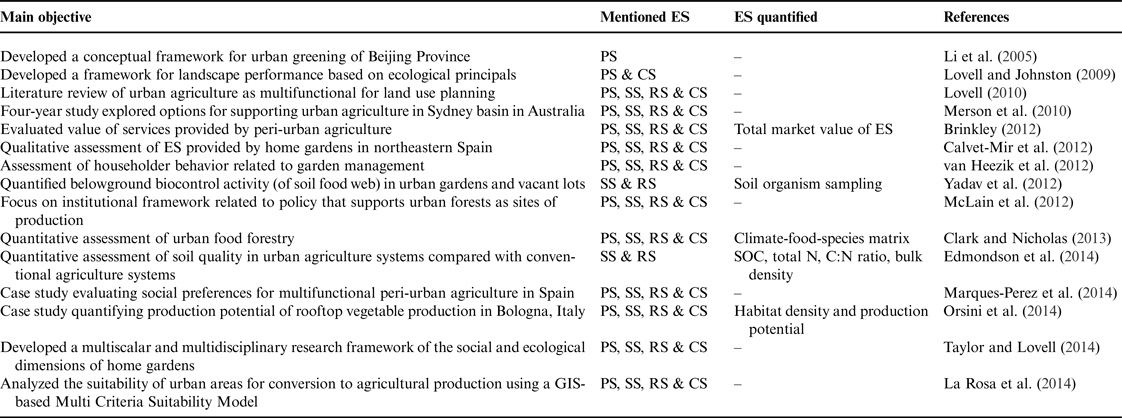
Of the UPA research assessed in this review, only 15 (4.7%) of the publications focused on ES, and of these, almost all were concerned with UPA in developed countries. Additionally, the explicit consideration of ES within different function areas (i.e., publication explicitly refers to supporting, regulating, provisioning, or cultural services), appears to be a relatively recent focus in UPA research, with 14 of the 15 ES-focused articles having been published between 2010 and 2014.
While ES related to urban landscapes have received some attention over the last two decades (e.g., Bolund and Hunhammar, Reference Bolund and Hunhammar1999; Gomez-Baggethun and Barton, Reference Gomez-Baggethun and Barton2013), in general, the availability of data related to ES in UPA systems specifically, is lacking. Of the 15 articles that explicitly address ES, only five quantitatively assess one or more services (Table 1). Interestingly, a number of studies evaluated various aspects of ES within UPA systems, such as nutrient cycling (Abdalla et al., Reference Abdalla, Predotova, Gebauer and Buerkert2012) or reducing wastewater contamination (Kurian et al., Reference Kurian, Reddy, Dietz and Brdjanovic2013), without specifically referring to these functions as ES. Among the studies that addressed ES, either qualitatively or quantitatively, there was no one category of ES that appeared to be represented disproportionately relative to the others (Table 1).
Summaries of the 15 peer-reviewed studies published between 2000 and 2014 that mention ecosystem services (ES) in the context of urban and peri-urban agriculture (UPA) systems.

ES mentioned within each source include provisioning services (PS), regulating services (RS), supporting services (SS) and cultural services (CS). Five papers quantitatively evaluated ES within UPA systems.
ES associated with UPA and other urban land uses
How an agricultural system is managed determines the degree to which ES are degraded or enhanced (Power, Reference Power2010; Hale et al., Reference Hale, Wollheim, Smith, Asbjornsen, Brito, Broders, Grandy and Rowe2014). Diversified agroecosystems located in rural landscapes can be multifunctional, providing services other than food provisioning alone, including regulating, supporting and cultural ES; land preservation; and a variety of socio-economic opportunities (Renting et al., Reference Renting, Rossing, Groot, Van der Ploeg, Laurent, Perraud, Stobbelaar and Van Ittersum2009). Thus, despite the fact that conversion of rural ecosystems that initially have high ES value to agricultural uses results in a net decrease in the levels of regulating and supporting ES, diversified agricultural systems can still provide a variety of valuable services (Tilman et al., Reference Tilman, Cassman, Matson, Naylor and Polasky2002; Power, Reference Power2010; Bommarco et al., Reference Bommarco, Kleijn and Potts2013). These same types of services are likely promoted in built environments when low ES value urban areas are converted to UPA systems. Our second research question, therefore, concerned the nature and magnitude of ES associated with UPA systems relative to those associated with other types of habitat and land uses found in urban environments.
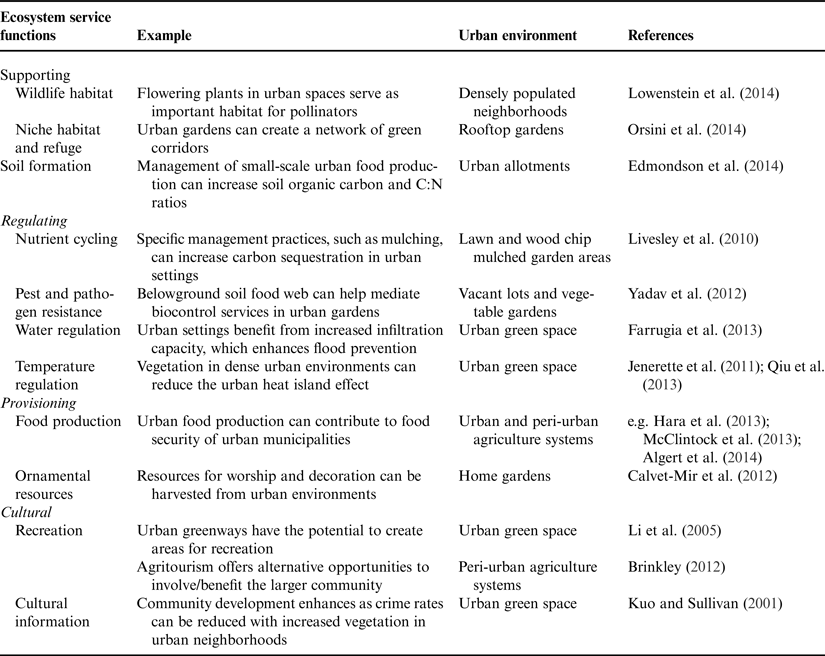
Relatively few studies have quantitatively assessed ES in UPA systems (Table 1); however, a number of studies have assessed ES in urban environments that have relevance to UPA. A summary of the ES assessed in urban environments, including in UPA systems, is presented in Table 2. These ES include wildlife habitat (Lowenstein et al., Reference Lowenstein, Matteson, Xiao, Silva and Minor2014; Orsini et al., Reference Orsini, Gasperi, Marchetti, Piovene, Draghetti, Ramazzotti, Bazzocchi and Gianquinto2014), nutrient cycling (Livesley et al., Reference Livesley, Dougherty, Smith, Navaud, Wylie and Arndt2010), temperature regulation (Qiu et al., Reference Qiu, Li, Zhang, Chen, Liang and Li2013), cultural information and recreation (Kuo and Sullivan, Reference Kuo and Sullivan2001; Brinkley, Reference Brinkley2012), carbon sequestration and soil organic matter formation (Edmondson et al., Reference Edmondson, Davies, Gaston and Leake2014), and water filtration and flood prevention (Farrugia et al., Reference Farrugia, Hudson and McCulloch2013).
Ecosystem services provided by urban habitats, including peri-urban agriculture (UPA) systems, organized by functional group.

Urban environments described in each study were defined by the individual study authors. Examples presented here represent a small selection of available studies focusing on urban habitats and is not intended to be an exhaustive list.
Our review found that UPA systems have the potential to contribute to the enhancement of a number of supporting ES compared with other types of urban habitats and land uses (Table 2). For example, unlike extensification of agriculture into rural landscapes, which is associated with decreases in biodiversity (Donald et al., Reference Donald, Green and Heath2001; Jenkins et al., Reference Jenkins, Green and Madden2003), UPA systems have been shown to host more wildlife than the urban space from which they are derived (Li et al., Reference Li, Wang, Paulussen and Liu2005; Lowenstein et al., Reference Lowenstein, Matteson, Xiao, Silva and Minor2014; Orsini et al., Reference Orsini, Gasperi, Marchetti, Piovene, Draghetti, Ramazzotti, Bazzocchi and Gianquinto2014).
Several regulating ES may also be enhanced within UPA systems (Table 2). For example, one low-input means of managing insect pests affecting urban agriculture is through the use of natural biocontrol services, which have been found to vary depending upon the plant heterogeneity of the urban habitat (Yadav et al., Reference Yadav, Duckworth and Grewal2012). Additionally, both nematode population density and microbial biomass nitrogen, two measures of ecosystem productivity that contribute to soil fertility services, have been found to be higher in urban vacant lots than nearby agricultural soils (Knight et al., Reference Knight, Cheng, Grewal, Islam, Kleinhenz and Grewal2013).
Greenhouse gas emissions can be relatively high in some urban environments (Jacobson, Reference Jacobson2010) and UPA systems might help to offset these emissions through carbon storage and sequestration. For example, Kulak et al. (Reference Kulak, Graves and Chatterton2013) found that peri-urban production could potentially reduce greenhouse gas emissions by up to 34 t CO2e ha−1 yr−1 (carbon dioxide equivalents per hectare per year). While this reduction may seem small, it is higher than carbon sequestration rates for urban park and forest green spaces (Kulak et al., Reference Kulak, Graves and Chatterton2013). Similarly, Edmondson et al. (Reference Edmondson, Davies, Gaston and Leake2014) found that soil organic carbon concentrations and C:N ratios in urban allotments were 32 and 36% higher than in pastures and arable fields, respectively. These studies support the idea that UPA systems can reduce greenhouse gas emissions on the production-side, while greater availability of agricultural products in densely populated areas could decrease emissions related to transportation on the supply-side.
Another regulating ES that UPA systems may contribute is temperature moderation in cities. While our review found no articles that expressly quantified UPA's contribution to temperature, several studies have found that urban vegetation plays a role in regulating temperatures in these environments. For example, Jenerette et al. (Reference Jenerette, Harlan, Stefanov and Martin2011) evaluated 30 years of data from Phoenix, AZ and established ‘an ecosystem services trade-offs approach’ to calculate the risk of urban heat effect. They found that vegetation in urban environments supported a surface cooling effect of nearly 25°C in comparison with bare soil. Additionally, urban vegetation in various environments (from treed parks to grassy fields) was found to reduce the urban heat island effect by 0.5–4.0°C, while the cooling effects of green roofs on ambient air temperature and roof surface temperature ranged from 0.24–4.0°C to 0.8–60.0°C, respectively (Qiu et al., Reference Qiu, Li, Zhang, Chen, Liang and Li2013). These data support the hypothesis that agricultural vegetation associated with UPA could help moderate the effects of global warming in urban areas.
In addition to supporting and regulating ES, UPA systems have been shown to enhance cultural ES, including preserving cultural customs and traditions (Colasanti et al., Reference Colasanti, Hamm and Litjens2012), increasing income generation opportunities and gender equality (Flynn, Reference Flynn2001; Bryld, Reference Bryld2003) and absorbing a surplus of urban wastes (Lydecker and Drechsel, Reference Lydecker and Drechsel2010). The use of UPA for enhancing food security, a provisioning ES (Yeudall et al., Reference Yeudall, Sebastian, Cole, Ibrahim, Lubowa and Kikafunda2007; Barthel and Isendahl, Reference Barthel and Isendahl2013), is well-documented, though most often not couched in ES terms. Urban home gardens, one of the many forms of urban agriculture, have been shown to enhance services on marginal lands, suggesting that UPA may also have a role to play in remediating degraded land (Calvet-Mir et al., Reference Calvet-Mir, Gomez-Baggethun and Reyes-Garcia2012).
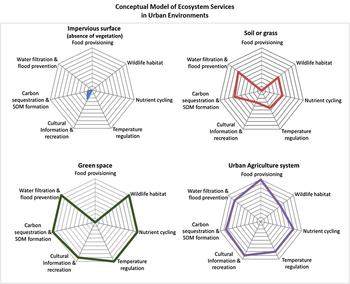
In Table 2, we summarize, which ES have previously been empirically assessed in the literature and specify in which type of urban environment the study was conducted. We also created a conceptual model, based on the current literature cited in Table 2, to visualize how ES might differ between four types of urban environments: (1) impervious surface (i.e., the absence of vegetation), (2) soil or grass, (3) green space (e.g., city parks) and (4) urban agricultural systems (Fig. 2). By considering the nature and magnitude of ES quantified in different urban environments, from built environments absent of vegetation to those with an abundance of vegetation it is possible to hypothesize on the nature and magnitude of ES within UPA systems. For example, green spaces within urban environments, such as public parks, UPA systems are likely similar in that they support a multitude of ES at relatively high levels, with the exception being that UPA also provides food provisioning services. In contrast, impervious surfaces likely have very little ES value relative to UPA systems or even abandoned lots or grass lawns (Fig. 2). Additional research on ES in UPA and other urban habitats will be necessary to fully assess the validity of these hypotheses.
Conceptual model, developed by the authors, describes the potential for different urban environments and land uses to provide seven ecosystem services. Differences in ecosystem services shown in each radar plot are hypothetical and not based on standardized values, but were informed by current literature (Table 2). Each axis of the plot represents a different ecosystem service; the outermost point on the axes represents the highest level of service, with service provisioning decreasing towards the center. The symmetry of each plot indicates the estimated relative balance of all the services; therefore, the larger and more symmetrical, the higher the overall potential ES benefits.

UPA and ecosystem disservices
Though there are several ES linked to UPA systems, there are also potential ecosystem disservices (ecosystem functions that cause negative consequences for human wellbeing) associated with crop production in built environments (Lyytimaki and Sipila, Reference Lyytimaki and Sipila2009). Here we assess the literature to understand the potential ecosystem disservices within UPA systems specifically. Globally, the pressure to increase agricultural production has currently experienced most in developing countries where the burgeoning urban population is resource poor. While UPA is not widespread in most cities in developed countries, developing countries within Africa, Asia, and Latin America use UPA as a necessary means of meeting nutritional requirements for many residents (Zezza and Tasciotti, Reference Zezza and Tasciotti2010). Although the use of waste can be a means of recycling organic material, it can often result in contamination of soil, water, and ultimately crops. A number of studies have shown that the use of city waste and waste water can increase heavy metals in soils and bacterial contamination of food crops (Amoah et al., Reference Amoah, Drechsel, Abaidoo and Henseler2007; Abdu et al., Reference Abdu, Abdulkadir, Agbenin and Buerkert2011). Additionally, standing water associated with UPA systems can provide a source for disease-carrying insects (Klinkenberg et al., Reference Klinkenberg, McCall, Wilson, Amerasinghe and Donnelly2008). Depending upon the type of production system, UPA has been cited as contributing to the degradation of already fragile ecosystems by draining water tables, causing landslides due to farming on slopes and blocking drainage systems (Matagi, Reference Matagi2002).
In addition to the potential disservices, there are also concerns about the safety of growing food in urban environments. Urban areas are exposed to more soil, water, and air pollution than rural landscapes (Wortman and Lovell, Reference Wortman and Lovell2013), yet may not have the regulating services necessary to processes these contaminants. Pollution in urban environments can contaminate agricultural products (Agrawal et al., Reference Agrawal, Singh, Rajput, Marshall and Bell2003; Amoah et al., Reference Amoah, Drechsel, Abaidoo and Henseler2007; Egwu and Agbenin, Reference Egwu and Agbenin2013) and pose health risks to both farmers and consumers (Diaz et al., Reference Diaz Rizo, Hernandez Merlo, Echeverria Castillo and Arado Lopez2012). Moreover, the policies needed to secure land for agricultural use, ensure that the land is safe, and support the infrastructure necessary to make agricultural production possible, currently do not exist in most urban municipalities (Redwood, Reference Redwood2009; Lovell, Reference Lovell2010).
UPA's potential role in land sparing
To consider what role UPA systems might play in both contributing to the increased food demand and reducing the conversion of ecologically important landscapes, we reviewed the UPA literature related to land sparing and calculated a rough estimate of the global land sparing potential of UPA systems. Traditionally, land sparing involves intensifying agricultural production on existing agricultural land to produce higher yields from the same area, while intentionally preserving neighboring landscapes that are biologically diverse (Fischer et al., Reference Fischer, Brosi, Daily, Ehrlich, Goldman, Goldstein, Lindenmayer, Manning, Mooney, Pejchar, Ranganathan and Tallis2008). Land sparing and land sharing—the use of less intensive production techniques that conserve biodiversity on farmland—have both been cited as a means of producing agricultural crops while maintaining or enhancing biodiversity (Green et al., Reference Green, Cornell, Scharlemann and Balmford2005). When compared with land sharing, land sparing was shown to contribute more to conserving plant species richness (Egan and Mortensen, Reference Egan and Mortensen2012). However, within the land sparing and land sharing literature there is controversy around how to quantify tradeoffs between the natural (e.g., stacking ES) and the managed aspects of the system (e.g., food provisioning alone) on a landscape scale (Grau et al., Reference Grau, Kuemmerle and Macchi2013; Fischer et al., Reference Fischer, Abson, Butsic, Chappell, Ekroos, Hanspach, Kuemmerle, Smith and von Wehrden2014). While the details of land sharing are beyond the scope of this article, we mention it here as context for the concept of land sparing.
We found no studies that explicitly examined the potential of UPA to contribute to sparing of rural land or sensitive habitat from conversion to agriculture. Previous work suggests that future increases in agricultural production will likely come through a combination of both intensification and extensification; however, the distribution of those two approaches will likely depend on a nation's developmental status (Tilman et al., Reference Tilman, Balzer, Hill and Befort2011). If global agricultural trends continue, extensification will occur most widely in ecologically sensitive areas of developing countries (e.g., biologically diverse rain forest), while intensification will primarily occur in wealthier nations (Green et al., Reference Green, Cornell, Scharlemann and Balmford2005; Tilman et al., Reference Tilman, Balzer, Hill and Befort2011). Given the importance of protecting high-diversity ecosystems, many of which occur in areas of the world that are most at risk of loss due to agricultural extensification, it is therefore particularly noteworthy that UPA has not yet been examined for its potential to contribute to land sparing. Although the scale of individual UPA systems may be small, the worldwide contribution of small-scale farming to global food production is large (Altieri, Reference Altieri2004). Small farms, <2 ha in size, comprise an estimated 60% of the world's arable land and include 85% of farmers (Lowder et al., Reference Lowder, Skoet and Singh2014), suggesting that UPA has the potential to contribute both to food production as well as ecosystem preservation.
To accurately estimate land sparing potential of UPA systems, researchers must understand both the extent of urban production on the landscape and production potential of various urban spaces. Though no literature expressly assessed land sparing potential through UPA systems, we did find several studies that attempt to quantify the extent of UPA. The exact number of people involved in UPA activities globally is currently unknown, though qualitative data from a 1996 publication is often cited as empirical evidence of its widespread implementation (Cheema et al., Reference Cheema, Smit, Ratta and Nasr1996). This publication estimates that as of 1993, 800 million people were involved in urban agriculture worldwide. These estimates were based on researcher observation and extrapolation and are now over 20 years outdated (Smit et al., Reference Smit, Nasr and Ratta2001). Hamilton et al. (Reference Hamilton, Burry, Mok, Barker, Grove and Williamson2014) estimate that 266 million households are engaged in urban agriculture in developing countries and note that more comprehensive surveys and inventories are needed to more accurately measure the extent of urban agriculture. Several other studies cite various statistics at the scale of individual cities and countries, though again, they are not based on comprehensive, quantitative data sets. In Africa, for example, Owusu (Reference Owusu2007) found that approximately one third of all residents in Kampala, Uganda are involved with UPA and it is estimated that 90% of the vegetables consumed in cities of Ghana were grown within cities (Keraita et al., Reference Keraita, Drechsel and Konradsen2008). In Beijing, China, assessments suggest that 80,000 residents were directly involved with UPA in 2005, and 524,000 were engaged in UPA related activities (Zhang et al., Reference Zhang, Cai and Liu2009).
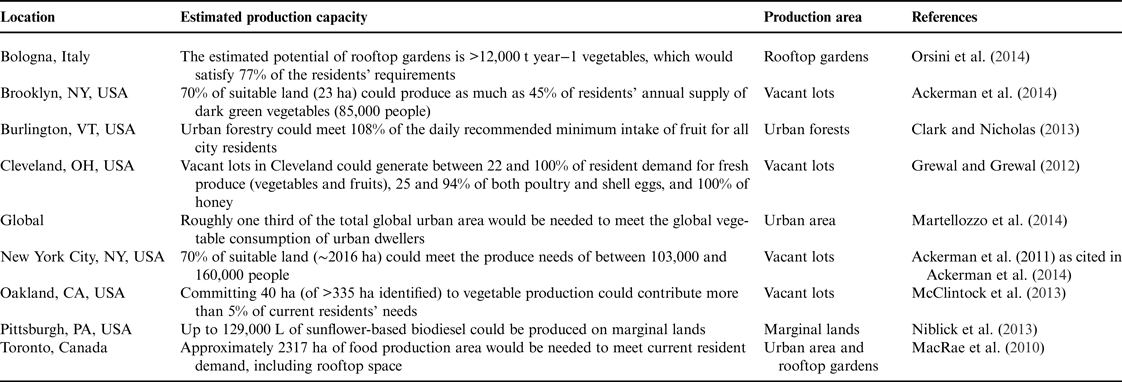
More recently there have been a small number of assessments aiming to quantify urban agriculture systems and outputs more precisely. In North America, several studies have been conducted detailing existing and potential UPA sites, and in some cases making production estimations (Table 3). One study of Cleveland, Ohio found that there are an estimated 4000 residents involved with UPA on some portion of the approximately 13.35 km2 existing vacant lots (Bagstad and Shammin, Reference Bagstad and Shammin2012). McClintock et al. (Reference McClintock, Cooper and Khandeshi2013) reported that there are about 485.6 ha of arable land in Oakland, CA. The authors estimate that if just over 200 ha of this land were put into agricultural production, a projected one third of the city's vegetable consumption could be met. In Burlington, VT, researchers found that up to 108% of the daily recommended minimum fruit consumption could be met for all Burlington residents through urban food forests (Clark and Nicholas, Reference Clark and Nicholas2013). Several other studies have been conducted in Portland, OR; Seattle, WA; Toronto, Ontario; and Montreal, Quebec, but not published in peer reviewed journals (Kaethler, Reference Kaethler2006), and thus were not included in our analysis. Overall, nine of the studies reviewed were specifically aimed at identifying the number of existing UPA systems, or the potential for developing new systems (Table 3).
Selected studies that have attempted to estimate production capacity of urban and peri-urban agriculture (UPA) systems on the meso- to macro-scale (city-wide to global urban area).

Although some estimates exist for individual cities and countries, most production estimates for UPA are anecdotal and not based on empirical data. Overall there is a general lack of quantitative research conducted on production capacity of UPA systems. Of the 320 articles reviewed in this study, just 45 (14%) reported the size of the UPA systems studied. The type and size of UPA systems varied greatly, with systems as small as <0.01 ha in total size, and took the form of home and community gardens, subsistence farming with and without livestock, rooftop production, and market gardens. The lack of reliable quantitative data accounting for the scope and scale of UPA hinders the ability of researchers to estimate production capacity and land sparing potential.
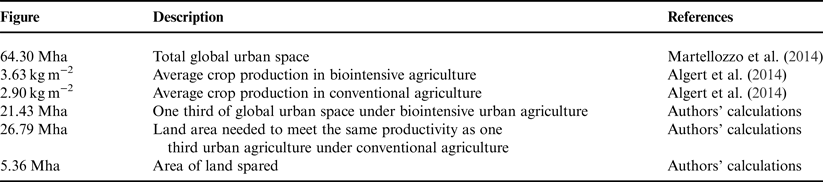
With those caveats aside, our review of the literature does allow us to develop a rough, back-of-the-envelope calculation of the land sparing potential of UPA. Our calculation is based on a recent study by Martellozzo et al. (Reference Martellozzo, Landry, Plouffe, Seufert, Rowhani and Ramankutty2014), who estimated that converting one third (21.43 Mha) of global urban area to agricultural production could provide all the vegetables required by urban residents. By applying the framework of land sparing to the analysis by Martellozzo et al. (Reference Martellozzo, Landry, Plouffe, Seufert, Rowhani and Ramankutty2014), we can get a rough estimate of UPA's potential role in land sparing (Table 4). Several studies have shown that small-scale production methods have a higher land use efficiency ratio compared with conventional production. For example, one study found that onion yields were three times higher under small-scale, biologically-intensive production methods compared with mechanized production (Moore, Reference Moore2010). Algert et al. (Reference Algert, Baameur and Renvall2014) found production practices in urban community gardens to be more similar to biologically-intensive farming, producing 3.63 kg of vegetables m−2, compared with conventional agricultural practices, which produced an average of 2.90 kg m−2.
Land area and production calculations used to derive a rough estimate of urban agriculture's potential role in land sparing.

Given that small-scale production methods are typically biologically-intensive and UPA systems are inherently small-scale, we can assume that yields are usually higher in these systems compared with conventional, large-scale agriculture. Based on the data reported by Algert et al. (Reference Algert, Baameur and Renvall2014), we can estimate that biologically-intensive production is 1.25 times more productive than conventional production. If one third of global urban space were converted to agricultural production, the area identified by Martellozzo et al. (Reference Martellozzo, Landry, Plouffe, Seufert, Rowhani and Ramankutty2014), extensification could be reduced by an estimated 5.36 Mha (53,599 km2), an area nearly twice the size of the US state of Massachusetts. Due to a variety of factors, including zoning laws, land contamination, lack of sunlight due to tall buildings and competition for land use, among other challenges, converting one third of total urban area to agricultural production may be unrealistic. However, our review suggests that converting even a fraction of this land area could still result in substantial sparing of ecologically sensitive habitat, while at the same time increasing provisioning services and other ES in urban centers, where there is perhaps greatest demand.
Conclusions
The growing body of UPA literature and the diversity of research conducted within this field, points to an increasing recognition of the contribution of UPA to the agricultural landscape worldwide (Lichtfouse et al., Reference Lichtfouse, Hamelin, Navarrete, Debaeke and Henri2010). Our review of this literature suggests, however, that the majority of UPA research is lacking an ecological focus. Researchers in developing countries have recognized the important role of UPA systems as a means of subsistence for many urban residents, and therefore the majority of the articles from these regions are focused on food security. Although a food security and safety focus is an important framework for UPA research, understanding the ecology of UPA is equally as important, particularly in the context of UPA's potential to enhance ES and spare ecologically sensitive land.
Most ES have yet to be quantified within UPA systems. Our review found that 15 articles included an ES perspective, of which only five studies quantified ES in UPA systems specifically. We found that soil quality, production potential, belowground biocontrol services, wildlife habitat and carbon storage are maintained or enhanced compared with other urban, and in some cases rural, landscapes. While there are ES benefits of UPA systems, there are also potential ecosystem disservices, as well as health safety concerns.
No studies explicitly explored land sparing in direct relation to urban agricultural production. Production potential, key for understanding land sparing, was measured in only 19 studies and included various urban food production systems ranging from fruit trees to green roofs. Though these studies suggest that UPA can contribute substantively to the food matrix, the scale and scope of the data that are available is currently limited. To better understand and quantify the potential of UPA in land sparing it will be necessary to develop better assessments of land availability in highly populated areas around the world, especially in regions where sensitive ecosystems are currently being threatened by expansion of agriculture.
The context of UPA systems research has implications for both policy and land use planning in urban environments (Lovell, Reference Lovell2010; Cohen and Reynolds, Reference Cohen and Reynolds2014). The available data suggests that UPA has the capacity to improve urban environments and enhance provisioning, regulating and supporting ES. To that end, our review promotes two main concepts relevant to land use planners and policymakers. First, UPA systems can be managed to enhance ES that are of greatest importance to urban environments, including increasing the food production capacity. The ES inherent in UPA systems may be a means of offsetting costly maintenance of urban infrastructure such as storm water management and reduced energy costs through mitigation of the urban heat island effect (Lydecker and Drechsel, Reference Lydecker and Drechsel2010; Jenerette et al., Reference Jenerette, Harlan, Stefanov and Martin2011). Developing a catalog of how such services are mediated in urban ecosystems could contribute to best practices for both UPA practitioners and land use planners, and could potentially minimize the occurrence of ecosystem disservices. Second, while UPA has typically involved biologically-intensive vegetable or fruit production, one could envision a greater diversity of agricultural systems being practiced in urban and peri-urban environments. By viewing urban and peri-urban environments as an alternative agricultural space, larger tracts of contiguous land could, for example, be conserved for pasture-based and other low-intensity forms of agricultural production, or for preserving wild habitat (e.g., Table 4). Therefore, studies that analyze the spatial extent of undeveloped urban and peri-urban land could contribute to a database of potential land available for different types of UPA production.
Our review highlights the need to recognize the inherent multifunctionality of UPA systems and to pursue more ecologically-focused research in these systems. As agriculture expands to meet the food, feed, fiber and fuel needs of a growing global population, two-thirds of which reside in urban areas (UN, 2014), it will become increasingly critical to understand UPA's potential role in a global food system that produces adequate amounts of food while protecting the ES that underpin human wellbeing.
Supplementary material
The supplementary material for this article can be found at https://doi.org/10.1017/S1742170517000205
Acknowledgements
The authors are grateful to the editor and anonymous referees for their suggested edits, as well as Nicholas Warren and Charles French who provided helpful comments on a previous draft of this manuscript. Partial funding for the work reported here was provided by the USDA Sustainable Agriculture Research and Education Program and the NH Agricultural Experiment Station. This is scientific contribution number 2606. This work was supported by the USDA National Institute of Food and Agriculture Hatch Project 0229253.