Biogenic amines (BAs) are low molecular weight organic bases sometimes present in foods. They are mainly produced by the microbial decarboxylation of certain amino acids. BA formation in foods should be controlled since these compounds are associated with respiratory distress, headache, hyper- and hypotension, and allergies. These problems are particularly severe in people with low levels of monoamine and diamino-oxidase (enzymes belonging to the BA detoxification system); such deficiencies are associated with genetic background and certain medical treatments (Joosten & Northolt, Reference Joosten and Northolt1987, Halász et al. Reference Halász, Baráth, Simon-Sarkadi and Holzapfel1994). Although there are no regulations governing the BA content in most foodstuffs, the European legislation (Directive 91/493/EEC) set a limit for the histamine levels in fishery products of 100–200 mg Kg−1 for fresh fish and up to 400 mg Kg−1 for cured products. The US Food and Drug Administration set a limit for histamine in canned tuna of 500 ppm (http.//www.fda.gov). Some authors have suggested a general limit for histamine levels in food of 100 mg Kg−1 (Ten Brick et al. Reference Ten Brick, Damink, Joosten and Huis in't Veld1990).
Histamine, tyramine, putrescine and cadaverine are the most common BAs in fermented foods. They are mainly produced by lactic acid bacteria (LAB; Lonvaud-Funel, Reference Lonvaud-Funel2001); their appearance and accumulation are therefore influenced by the environmental factors (temperature, pH, availability of substrate, etc.) that affect the growth and/or decarboxylase activity of these organisms (Valsamaki et al. Reference Valsamaki, Michaelidou and Polychroniadou2000). Methods that can rapidly detect BA-producing strains in foodstuffs are required if food quality and safety is to be assured. Such a capability would also help the dairy industry inspect raw materials destined for use in food production.
Cheese is one of the foods most commonly associated with BA poisoning; indeed, the term ‘cheese reaction’ has been coined to refer to it (Ten Brick et al. Reference Ten Brick, Damink, Joosten and Huis in't Veld1990). The microbiota present in cheese has different origins (milk, starters, and contaminating microorganisms) and its development is affected by factors such as the treatment the milk receives and the ripening conditions. Several authors have shown the BA content of cheese made from raw milk to be higher than that of cheese made from pasteurized milk (Joosten & Northolt, Reference Joosten and Northolt1987; Ordoñez et al. Reference Ordoñez, Ibañez, Torre and Barcina1997; Novella-Rodríguez et al. Reference Novella-Rodríguez, Veciana-Nogués, Roig-Sagués, Trujillo-Mesa and Vidal-Carou2004). Since BAs accumulate in food products, the duration of ripening is a critical factor affecting the final BA content (Ordoñez et al. Reference Ordoñez, Ibañez, Torre and Barcina1997; Novella-Rodríguez et al. Reference Novella-Rodríguez, Veciana-Nogués, Izquierdo-Pulido and Vidal-Carou2003a). In addition, the high level of proteolysis that occurs in cheeses (which provides the amino acid substrates for the production of BAs), combined with the acidic environment of this food, favors the synthesis and activity of decarboxylation enzymes (Joosten & Northolt, Reference Joosten and Northolt1987).
In recent years, a number of techniques based on HPLC, capillary electrophoresis, etc. have been developed for the detection of BAs (Cinquina et al. Reference Cinquina, Longo, Cali, De Santis, Baccelliere and Cozzani2004). These methods can identify the different types in food samples and accurately quantify them. However, they have the drawback of long sample preparation times, and are tedious if large numbers of samples must be examined. Further, raw materials seldom contain BAs, and although these may develop over time, these methods cannot predict this. Methods for the detection of BA-producing strains have been proposed based on differential media that demonstrate their decarboxylase activity. However, these methods require the isolation of the strains and days may pass before a reliable result is obtained. PCR has also been proposed as a technique for detecting BA-producing LAB strains, and several sets of primers for the detection of histamine, tyramine and pustrescine producers have been proposed (Le Jeune et al. Reference Le Jeune, Lonvaud-Funel, Ten Brink, Hofstra and Van der Vossen1995; Coton et al. Reference Coton, Coton, Lucas and Lonvaud2004; Fernández et al. Reference Fernández, Linares and Alvarez2004; de las Rivas et al. Reference de Las Rivas, Marcobal and Muñoz2005). Recently, PCR was proposed for the early detection of tyramine-producing bacteria during cheese production (Fernández et al. Reference Fernández, Flórez, Linares, Mayo and Alvarez2006).
In this work, the BA content of different commercial cheeses was analysed by HPLC. PCR detection of tyramine-producing bacteria was also performed and the results were compared with those obtained by HPLC.
Materials and Methods
Samples
Sixty one randomly purchased commercial cheeses 48 of them of different Spanish regions and 13 imported from Europe (France, Switzerland and Italy) were analysed for their BA content and for the presence of tyramine-producing bacterial strains. These commercial samples included cheeses made from different types of milk (goat, cow and sheep), from raw or pasteurized milk, and which were subject to different ripening periods (short <3 months, long ⩾3 months).
Analysis of biogenic amines by HPLC
One gram of cheese was homogenized with 10 ml 0·1 m-hydrochloric acid solution containing 0·2% 3,3′-thiodipropionic acid (TDPA) (Fluka, Madrid Spain) using Ultra-Turrax homogenizer (OMNI International, Watersburry USA) for 2 min at 20 000 rpm. This mixture was kept in an ultrasonic bath for maximal 30 min, centrifuged at 5000 g for 20 min, and any top fat layer was removed. The supernatant was filtered through a 0·45 μm membrane and 3 ml of the filtrate was deproteinized by passing through ultrafiltration inserts (Amicon Biomax 5; Millipore) via centrifugation at maximal 3500 g for about 1 h. Membrane-filtrated liquid food samples were diluted with 0·1 m-HCI 0·2%TDPA 250 mm internal standard and ultrafiltrated as described above. Twenty microlitres of the sample were derivatized following the protocol described by Krause et al. (Reference Krause, Bockhardt, Neckermann, Henle and Klostermeyer1995), and 10 μl of the derivatized sample was injected. The quantitative analysis of the BA content extracted was carried out by reverse-phase (RP)-HPLC using a Waters liquid chromatograph controlled by Millenium 32 Software (Waters Milford, MA, USA) following the protocol of Krause et al. (Reference Krause, Bockhardt, Neckermann, Henle and Klostermeyer1995). All the separations were carried out on Waters Nova-pack C18 column (150×3·9 mm) and detection was performed at 436 nm. Gradient and detection conditions were similar to those described by Krause et al. (Reference Krause, Bockhardt, Neckermann, Henle and Klostermeyer1995).
PCR analysis
Five grams of each cheese sample were homogenized mechanically in 40 ml 2% sodium citrate in a Stomacher Lab-Blender 400 (Seward Medical, London, UK) for 1 min. DNA was extracted from the homogenate following the method of Ogier et al. (Reference Ogier, Son, Gruss, Tailliez and Delacroix-Buchet2002) ; 20 ng of total DNA were used in each PCR reaction. Two hundred nanomoles of the oligonucleotides tdc1 and tdc2, designed on the basis of LAB tyrosine decarboxylase gene sequences (Fernández et al. Reference Fernández, Linares and Alvarez2004), were used as primers for the amplification of an internal fragment of the tyrosine decarboxylase gene. The PCR conditions involved an initial denaturation step (95°C for 5 min), 35 amplification cycles (95°C for 45 s, 50°C for 1 min, and 72°C for 1 min), and a final extension step at 72°C for 7 min. All amplifications were performed with puRe Taq Ready-To-Go PCR beads following the manufacturer's instructions (Amersham-Biosciences, Buckinghamshire, UK) The amplicons were separated and visualized on 0·7% agarose gel as described by Sambrook et al. (Reference Sambrook, Fritsch and Maniatis1989).
Results
Biogenic amine content of the cheeses
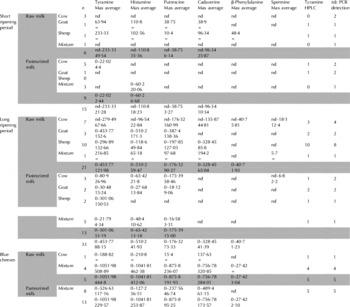
BAs were detected in over 70% of the samples, but the concentrations were very variable (Table 1). The average tyramine content of the positive samples was close to 187·47 mg Kg−1; for histamine the value was 130·92 mg Kg−1. Putrescine, histamine and particularly tyramine (detected in 42, 52 and 54% of the samples respectively) were the most common and abundant BAs, reaching maximum values of 876, 1042, and 1052 mg Kg−1 respectively in some cheeses. Other BAs were much less common, e.g., spermine was detected in only five samples, and β-phenylethylamine in just three. More than one type of BA was usually detected in positive samples; only three cheeses had one type of BA alone (always tyramine). Table 1 shows the maximum and minimun values, and averages for each BA and cheese type.
Biogenic amines: Maximum and average content (mg Kg−1) in the different classes of cheese analysed. Cheeses were organized based on milk type and length of ripening period. n: number of cheeses analysed in the category. The averages (shown in grey) were calculated including the samples that had not detected (nd) values. The data presented in columns ‘tyramine HPLC’ and ‘tdc PCR detection’ correspond to number of positive samples.=not calculated.

Influence of milk treatment on BA formation
Some 87·5% cheeses made from raw milk were BA-positive, compared with 68·9% of those made from pasteurized milk. In addition, the BA concentration of the raw milk cheeses was higher. For example, the average tyramine content of the long ripening period raw milk cheeses was 121·98 mg kg−1 compared with 33·19 mg kg−1 in long ripening period, pasteurized milk cheeses. For histamine the values were 59·47 mg kg−1 and 13·18 mg kg−1 respectively. Cadaverine and β-phenylethylamine were only detected in cheeses made from raw milk. Moreover, the highest concentrations of all BAs were recorded in raw milk cheeses (Table 1), with tyramine the most common. The highest concentrations of this BA were found in raw milk blue cheeses, both on average (444·8 mg kg−1) and in terms of maximum concentration (1051·98 mg kg−1).
Influence of milk origin
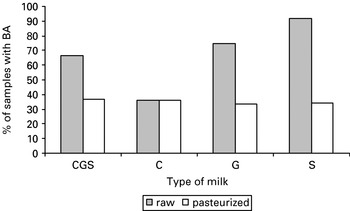
To determine the importance of milk origin on the BA content, the cheese samples were grouped into four categories: those made from cows' milk (n=19), sheep's milk (n=13), goats' milk (n=7), or a mixture of milks (n=22). BAs were detected in almost 70% of the goats' milk and milk mixture cheeses, a value very similar to the mean for all cheeses. In the cheeses made from sheep's milk, however, the percentage of positive samples was much higher at 92%. However, it should be borne in mind that 85% of the sheep's cheeses were made from raw milk. BAs were detected in only 32% of the cheeses made from cows' milk (only 45% of these were raw milk cheeses). Figure 1 summarizes the results of the BA content of these different types of cheese. The number of BA-positive cheeses made from pasteurized milk of all types was similar. However, the number of positive raw milk cheeses varied significantly depending on the origin of milk (sheep>goat>cow). Pasteurization of the milk is therefore an important first step in the production of safe cheese.
Percentage of samples containing biogenic amines according to the treatment and the type of milk used. CGS: cheeses made from a mixture of cows', sheep's and goats' milk; C cheeses made from cows' milk; G cheeses elaborated with goats' milk, S cheeses made from sheep's milk.

Influence of ripening period
To check whether the ripening period influenced the final BA content, the cheeses were grouped as either short or long ripening period cheeses. Some 66·7% of long ripening period cheeses were BA-positive, while only 33·3% of short ripening period cheeses had detectable BA concentrations. The highest BA concentrations were observed in long ripening period cheeses (more than double that seen in the short ripening period cheeses). These samples had the highest average (88·15 compared with 21·28 mg kg−1 for short ripening period cheeses) and absolute values (453·77 compared with 233·33 mg kg−1), both for individual BAs and total BA content (Table 1). This suggests that proteolysis, and the availability of consequent amino acid precursors, is required for BA production, as reported by other authors (Pinho et al. Reference Pinho, Pintado, Gomes, Pintado, Malcata and Ferreira2004).
The long ripening period raw milk cheeses had the highest BA concentrations. Remarkably, although in the long ripening period cheeses the putrescine concentration was higher than that of cadaverine, in the short ripening period cheeses the cadaverine concentration was higher than that of putrescine.
The highest BA concentrations of all were reached in raw milk blue cheeses (1051·98 and 1041·81 mg kg−1 of tyramine and histamine respectively). In these cheeses, fungi with strong proteolytic activity might make more amino acid substrates available to the decarboxylating enzymes.
Detection of tyramine producing strains by PCR
Clearly, the presence of BA-producing strains is necessary for the accumulation of these compounds in cheese. Since tyramine was the most abundant BA detected, BA-producing strains were sought by PCR. PCR was used to detect the presence of tyramine-producing strains in all 61 cheese samples and the results were compared with the HPLC tyramine detection results. A band of the expected size was obtained with 41 samples (Table 1). In nine of these, tyramine had not been detected by HPLC; these samples corresponded to short ripening period cheeses (all showed a low concentration of tyrosine, the precursor of tyramine, as determined by HPLC [30 mg kg−1; data not shown]). In three cases, tyramine-producing strains were not detected by PCR although tyramine had been detected by HPLC. Remarkably, these samples corresponded to cheeses made from raw milk. Since the primers used in the PCR reaction were only designed to detect LAB, other microorganisms might be responsible for this tyramine production.
Discussion
The BA content of cheeses has been analysed by several authors, although most have only focused on one type of cheese (Valsamaki et al. Reference Valsamaki, Michaelidou and Polychroniadou2000; Novella-Rodríguez et al. Reference Novella-Rodríguez, Veciana-Nogués, Trujillo-Mesa and Vidal-Carou2003b; Pinho et al. Reference Pinho, Pintado, Gomes, Pintado, Malcata and Ferreira2004). In this work, random samples of commercial cheese samples, including different types made from different varieties of milk, differently treated milks, and which were subject to different ripening periods, were analysed. As described by other authors (Gennaro et al. Reference Gennaro, Gianotti, Marengo, Pattono and Turi2003; Novella-Rodríguez et al. Reference Novella-Rodríguez, Veciana-Nogués, Izquierdo-Pulido and Vidal-Carou2003a), tyramine, histamine, putrescine and cadaverine were the most common and abundant BAs detected. It is noteworthy that 46% of the samples contained tyramine or histamine in concentrations that exceed 100 mg kg−1; indeed, two samples had concentrations of over 1 g kg−1. In blue cheeses, the average content of tyramine was 448 mg kg−1. These results indicate that more tools are needed, not only for detection and quantification of BA in food products, but also for its early detection and the prevention of its accumulation.
Several authors have related the presence and concentration of BA in cheeses with the treatment the milk undergoes (Joosten & Northolt, Reference Joosten and Northolt1987; Ordoñez et al. Reference Ordoñez, Ibañez, Torre and Barcina1997; Novella-Rodríguez et al. Reference Novella-Rodríguez, Veciana-Nogués, Roig-Sagués, Trujillo-Mesa and Vidal-Carou2004). The present results confirm that pasteurization of the milk reduces the BA content of cheese, perhaps due to a reduction in the number of decarboxylating microorganisms such as Enterobacteriaceae and enterococci (Ordoñez et al. Reference Ordoñez, Ibañez, Torre and Barcina1997; Gennaro et al. Reference Gennaro, Gianotti, Marengo, Pattono and Turi2003; Novella-Rodríguez et al. Reference Novella-Rodríguez, Veciana-Nogués, Roig-Sagués, Trujillo-Mesa and Vidal-Carou2004). This effect was particularly noticeable with respect to cadaverine. Certainly, it has been shown that pasteurization reduces the number of Enterobacteriaceae strains (Marino et al. Reference Marino, Maifreni, Moret and Rondinimi2000). Other authors attribute the differences in the BA content of pasteurized and non-pasteurized cheeses to the heat sensitivity of certain cofactors, such as pyridoxal 5-phosphate, needed for the amino acid decarboxylation reaction (Joosten & Northolt, Reference Joosten and Northolt1987).
The BA content of cheese depends more on the microbiological quality of the milk than on the type of milk used. For example, raw sheep's milk cheese had the highest percentage of BA-positive samples, whereas the pasteurized sheep's milk cheeses had a number of BA-positive samples similar to that of other pasteurized milk cheeses (Fig. 1).
Higher BA contents were detected in long ripening period than in short ripening period cheeses. The influence of proteolysis on BA formation has been reported by others authors (Ordoñez et al. Reference Ordoñez, Ibañez, Torre and Barcina1997; Fernández-García et al. Reference Fernández-García, Tomillo and Nuñez2000; Novella-Rodríguez et al. Reference Novella-Rodríguez, Veciana-Nogués, Roig-Sagués, Trujillo-Mesa and Vidal-Carou2004). Proteolysis links the ripening period with BA formation since the amino acids that form the substrate of the decarboxylating enzymes have to be released from casein. Innocente & D'Agostin, (Reference Innocente and D'Agostin2002) showed that the total amine content tends to increase with advancing proteolytic maturation. Similarly, Fernández-García et al. (Reference Fernández-García, Tomillo and Nuñez2000) recorded the positive influence on BA formation of adding proteinase to the cheese matrix. Proteolytic activity also explains the high BA concentration detected in the blue cheeses, in this case enhanced by the presence of fungi with strong proteolytic activity.
An essential factor in BA production in cheese is the presence of microorganisms with decarboxylation activity; the correlation between the presence of bacteria with the tyrosine decarboxylase gene (tdcA) and the capability of strains to synthesize tyramine has been demonstrated, and PCR has been proposed by a number of authors as a method for identifying tyramine-producing strains (Coton et al. Reference Coton, Coton, Lucas and Lonvaud2004; Fernández et al. Reference Fernández, Linares and Alvarez2004). PCR provides a rapid means of detecting tyramine-producing microorganism in fermented foodstuffs, and for predicting tyramine accumulation. The present results show an acceptable correlation between the PCR and HPLC results. The three cheeses in which tyramine was detected by HPLC, yet no amplification product was obtained, were all made from raw milk. The tyramine-producing strains responsible may have been Gram negative bacteria, which would not have been detected by the primers used (it should be remembered, of course, that Gram negative bacteria are highly undesirable in any foodstuffs; many are pathogens or spoilage agents). The low number of samples with these characteristics appears to indicate that the main tyramine-producing strains in cheeses are LAB, which are easily detected by PCR.
In nine samples, tyramine was not detected by HPLC, although a tdcA PCR product was obtained. Seven of these samples corresponded to short ripening period cheeses. The absence of tyramine is probably related to low level proteolytic activity and therefore to a low tyrosine concentration in the cheese matrix (confirmed by HPLC). However, these seven cheeses are potentially able to accumulate tyramine (Fernández et al. Reference Fernández, Flórez, Linares, Mayo and Alvarez2006).
In the remaining two samples of cheese, although tyrosine was detected by HPLC and tyramine-producing bacteria were identified by PCR, no tyramine was detected. The alkaline pH of this type of cheese might be related to a weaker expression and/or activity of the decarboxylase enzyme. In any event, cheeses containing both the precursor amino acid and decarboxylating microorganisms are potentially dangerous to consumers since tyramine could be synthesized at a later time during the ripening period or during storage before consumption.
Although there is no legislation regarding the tyramine content of cheese, the reduction of its concentration in food is recommended. HPLC and PCR are complementary technologies that can be used to help attain this goal: HPLC analysis is essential for determining the exact concentration of tyramine in the samples, while PCR is an easy and rapid method for analyzing large numbers of samples for the presence of tyramine-producing microorganisms when tyramine itself would be undetectable.
This research was performed with financial support from the Commission of the European Communities (QLK1-CT2002-02389) and MEC, Spain (AGL2006-01024). We thank Adrian Burton for proofreading the English. DM Linares was the recipient of a fellowship from the Spanish Ministry of Education and Science. M Fernández and B del Río are beneficiaries of I3P CSIC contracts financed by the European Social Fund.