Significant outcomes
∙ Patients with obsessive–compulsive disorder (OCD) bisected significantly fewer lines to the left and had significant rightward deviation compared with controls.
∙ The correlations observed in this study suggest that patients with impaired laterality have more severe illness at baseline.
∙ Study findings indicate anomalous cerebral asymmetry in OCD, suggesting right hemisphere dysfunction.
Limitations
∙ Patients were on treatment with medications at the time of task administration, and the effect of medications on task performance is not known.
∙ We used a cross-sectional study design, which made it difficult to draw definitive conclusions about the relationship between laterality and treatment response.
∙ We could not carry out subtype analysis due to the limited sample size.
Introduction
A unique feature of the brain is asymmetry in the structural and functional organisation of the cerebral hemispheres. Although the left hemisphere is dominant for language ability, the right hemisphere is dominant for visuo-spatial tasks. This asymmetry, also referred to as laterality, may be related to the development and evolution of humans from lower primates (Reference Crow1). As cerebral asymmetry may underlie much of our behaviour and cognition, anomalous asymmetry is proposed in the pathogenesis of neuropsychiatric disorders such as obsessive–compulsive disorder (OCD), schizophrenia and autism (Reference Wheeler, Davidson and Tomarken2,Reference Bradshaw and Sheppard3). In this context, anomalous asymmetry refers to a lack of functional and structural asymmetry, which is seen in normal neurodevelopment.
Although results from different studies suggest possible lateralised pathology in the pathogenesis of OCD, findings are inconclusive. Neuropsychological studies in OCD have consistently reported greater impairment in visuo-spatial memory compared with verbal memory, suggestive of right hemisphere dysfunction (Reference Kuelz, Hohagen and Voderholzer4–Reference Abramovitch, Abramowitz and Mittelman6). However, evidence from neuroimaging studies is mixed, as studies have reported abnormalities in both the hemispheres. Meta-analyses of structural imaging studies have reported significant bilateral grey matter volume increases in the lenticular nucleus and caudate nucleus, as well as in the right superior parietal lobule (Reference Radua and Mataix-Cols7). Significant volume decreases are reported in bilateral dorsal medial frontal/anterior cingulate gyri, supplementary motor area and frontal eye fields (Reference Radua and Mataix-Cols7). Similarly, a meta-analysis of functional imaging studies reported significant likelihoods of activation in the right anterior prefrontal cortex, right premotor cortex, bilateral orbitofrontal cortex and anterior cingulate cortex, left dorsolateral prefrontal cortex and left precuneus and superior temporal gyrus (Reference Rotge, Guehl and Dilharreguy8).
Only few studies have directly examined laterality abnormalities in OCD. An earlier study examined patients with tourette syndrome and OCD using body turning tasks and a simple line bisection task (Reference Yazgan, Peterson, Wexler and Leckman9); patients with comorbid Tourette syndrome and OCD showed absence of right dominance compared with healthy volunteers on line bisection task and had significantly fewer leftward turns in the body turning task. In this study, the authors used a different version of the line bisection task in which individuals were asked to divide five lines of different lengths using their right hand. However, the use of only right hand in one-hand line bisection method is considered a limitation as there is a possibility of using the less accurate hand (Reference Morton10). These findings provided the preliminary behavioural corroboration for laterality abnormalities (Reference Cohen, Hollander and Stein11,Reference Peterson, Leckman and Lombroso12). Another study reported decreased inhibition of return for left visual field targets but not for right visual field targets (Reference Nelson, Early and Haller13). Recently, Maril et al. (Reference Maril, Hermesh, Gross-Isseroff and Tomer14) examined nine OCD patients and nine controls using the Posner task. Although controls responded faster to left visual field targets than to the right, patients lacked this asymmetry. Importantly, asymmetry anomaly was correlated with obsession severity. Despite small sample sizes, these preliminary findings provide a strong rationale for further examination of laterality abnormalities in OCD.
In the present study, we examined laterality abnormalities in a larger sample of patients with OCD using the line bisection task. Line bisection task is a sensitive and valid test to assess functional cerebral asymmetry (Reference Rao, Arasappa, Reddy, Venkatasubramanian and Gangadhar15). In this task, participants are asked to bisect horizontal lines printed and arranged on both sides of a paper. Healthy controls tend to bisect lines to the left of the midline, as the right hemisphere dominates in spatial tasks. This is known as ‘right pseudoneglect’ (Reference Bowers and Heilman16). Right hemisphere damage results in left hemispace neglect and a marked tendency to bisect horizontal lines to the right of the midline (Reference Schenkenberg, Bradford and Ajax17). In this study, we used a two-hand version of the line bisection task. Based on earlier studies, we hypothesised that OCD patients will bisect significantly fewer lines to the left and will have significantly higher rightward deviation compared with controls.
Materials and methods
Subjects
The study group consisted of 30 patients with OCD and 30 healthy controls. Patients who attended the specialty OCD clinic of the National Institute of Mental Health and Neurosciences, Bangalore, India during the year 2010–2011 were recruited for the study. All patients attending the OCD clinic are routinely assessed with a detailed clinical interview, Mini International Neuropsychiatric Interview (MINI)-Plus (Reference Sheehan, Lecrubier and Sheehan18), Yale-Brown Obsessive–Compulsive Disorder Checklist and Severity Scale (YBOCS) (Reference Goodman, Price and Rasmussen19) and Clinical Global Impression Scale for Severity (CGI-S) and Improvement (CGI-I) (Reference Guy and Bonato20) at baseline. On follow-up visits, patients were assessed using YBOCS, CGI-S and CGI-I once every 2 months. All study participants were diagnosed with OCD as per DSM-IV, using MINI-Plus and clinical interview by a qualified psychiatrist. We noted baseline YBOCS scores from case records of patients and calculated changes in the YBOCS scores from baseline to the time of line bisection task administration. YBOCS is a symptom severity scale with 5 items each for obsessions and compulsions, with higher scores indicating greater severity. Understandably, greater the change in YBOCS, better the improvement. Out of 30 individuals, 17 of them had YBOCS≤16 and 16 individuals had YBOCS≤14, indicating symptom remission. CGI-S and CGI-I are clinician-administered scales and measure global severity and improvement. Lower scores indicate lesser severity and better improvement.
At the time of the line bisection study, all study patients were on treatment with serotonin re-uptake inhibitors (mean duration of treatment was 5.36±5.73 years; median duration of 4 years with a range of 0 to 21 years) and were at various stages of improvement. Five patients had received cognitive behaviour therapy. On the day of assessment, in addition to the line bisection task, we administered MINI–Plus and Mini Mental Status Examination (MMSE) (Reference Folstein, Folstein and McHugh21) to all the participants. We excluded participants with current co-morbid axis I disorders and MMSE score below 24. We also excluded patients with lifetime diagnosis of schizophrenia, bipolar affective disorder, substance abuse or dependence, co-morbid neurological disorder and visual impairment. All patients gave their written informed consent.
We recruited healthy controls by word of mouth. Those who volunteered for the study were screened using MINI-Plus to rule out psychiatric disorder. A qualified psychiatrist conducted a comprehensive clinical examination, which included a detailed family history. None of the healthy controls had any neurological disorder, visual impairment, head injury or family history of psychiatric disorder among first-degree relatives. We administered the 10-item Edinburgh handedness inventory (Reference Oldfield22) to both patients and controls, and only right-handed individuals were included (score of >75). The study was reviewed and approved by the Institute’s ethics committee and all participants gave their informed consent.
Line bisection task and measurement
The detailed methodology is explained in our earlier paper (Reference Rao, Arasappa, Reddy, Venkatasubramanian and Gangadhar15). We followed the two-hand version of Schenkenberg’s line bisection task (Reference Schenkenberg, Bradford and Ajax23) as described by Morton et al. (Reference Morton10). We selected this version of the task as the two-hand line bisection version had excellent correlation with physiological and psychological measures of hemisphericity – namely, polarity questionnaire, preference questionnaire, dichotic deafness test and phased mirror tracing test (Reference Morton10). In addition, this version of the line bisection task was independent of the following variables: (a) the hand used to mark the first page of line bisection task; (b) whether one or both eyes were used; (c) whether or not corrective lenses were worn; (d) whether one page or 20 pages were used; (e) position of the horizontal line in the page; (f) age, time of the day and date of birth; (g) whether the test was timed or not; and (h) number of test repetitions (Reference Morton10).
We administered the task to all participants during the day while keeping the environmental variables identical throughout the study. The task consisted of bisecting 20 staggered lines printed on two sides of a vertical sheet of paper. The line lengths ranged from 70 to 160 mm, increasing in duplicate by 10-mm intervals. These 20 lines were placed in a random manner to avoid any obvious midline patterns within the page. Participants were first instructed to mark the centre of each of the 20 lines using their right hand. They were then directed to mark the centre of each of the 20 lines on the other side of paper using their left hand. We constructed a transparent overlay by printing these lines on a transparency along with vertical markings at 1-mm intervals. Two blind raters calculated the deviation from the centre using the transparent overlay. The raters were blind to the status of participants (patient vs. control). The inter-rater reliability as ascertained by the intra-class correlation coefficient was >0.8. The errors to the right of the centre (rightward bias) were marked positive and to the left (leftward bias) negative. Right and left deviations were calculated by adding rightward bias and leftward bias in both hands, respectively.
Statistical analysis
We analysed the data using statistical package for social sciences version 15 (SPSS Inc, Chicago, IL, USA). We analysed categorical variables using the χ2 test and continuous variables using analysis of covariance with sex and age as covariates. We used Spearman’s correlation to assess the relationship between line bisection task score, severity of illness and clinical improvement.
Results
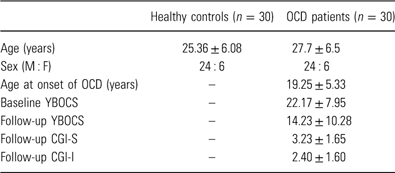
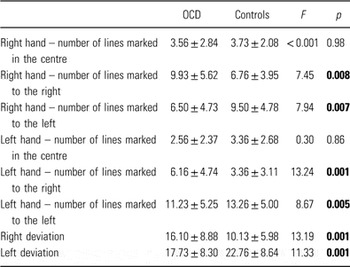
Patients and controls were comparable with regard to age and sex ratio (p>0.1). Demographic and clinical details of patients and controls are given in Table 1. The scores of the line bisection task are given in Table 2. While using their right hand, patients bisected significantly fewer lines to the left and bisected more lines to the right of the midline compared with controls. Similarly, while using their left hand, patients bisected significantly fewer lines to the left and bisected significantly more lines to the right compared with controls. There was a significant rightward deviation in patients compared with controls. Controls, on the other hand, demonstrated leftward deviation from the centre.
Demographic and clinical profiles of study participants
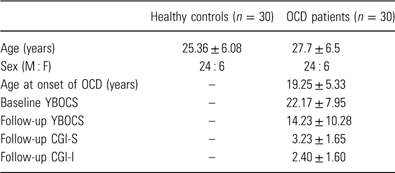
CGI-I, Clinical Global Impression Scale for Improvement; CGI-S, Clinical Global Impression Scale for Severity; OCD, obsessive–compulsive disorder; YBOCS, Yale-Brown Obsessive–Compulsive Disorder Checklist and Severity Scale.
Comparative profile of the line bisection task performance among patients and healthy controlsFootnote *

OCD, obsessive–compulsive disorder. Bold values indicate statistically significant result with p <0.05.
* Analysis of covariance with age and sex as covariates.
Rightward deviation had a significant positive correlation with the baseline YBOCS score (Spearman’s ρ=0.38; p=0.008). Rightward deviation also had a significant negative correlation with the CGI-I score (Spearman’s ρ=−0.37; p=0.04), and, understandably, a significant positive correlation with the change in YBOCS score (Spearman’s ρ=0.34; p=0.01). We did not observe any significant correlation between rightward or leftward deviations and CGI-S.
Discussion
In this study, we systematically examined laterality abnormalities in co-morbidity-free patients with OCD and matched control individuals using the line bisection task. Results of the study indicate a rightward bias in patients, suggesting anomalous cerebral laterality. There was an overall leftward bias in healthy controls, consistent with previous evidence for right ‘pseudoneglect’ in healthy controls (Reference Jewell and McCourt24). There was a rightward bias in patients when compared with controls – that is, there was decreased pseudoneglect in patients with OCD.
These findings are in line with previous studies examining laterality abnormalities in OCD patients. Maril et al. (Reference Maril, Hermesh, Gross-Isseroff and Tomer14) measured patterns of lateralised dysfunction in OCD patients using the Posner task, and found that patients had slower responses to left visual field targets. Siviero et al. (Reference Siviero, Rysovas, Juliano, Del Porto and Bertolucci25) reported higher prevalence of left handedness and left eyedness in OCD patients than in healthy controls, which is an indirect measure of laterality. Eyedness, which is also called ocular dominance, is the tendency to prefer the visual input from one eye to the other. The right hemisphere is dominant in visuo-spatial functions, and damage to this area results in left hemispace neglect and rightward deviation on the line bisection task (Reference Schenkenberg, Bradford and Ajax17,Reference Siviero, Rysovas, Juliano, Del Porto and Bertolucci25). Therefore, our study findings indicate right hemisphere dysfunction in OCD. Several neuropsychological and neuroimaging studies have documented right hemisphere dysfunction in patients with OCD. Neuropsychological studies have demonstrated that both symptomatic and recovered patients exhibit impaired visuo-spatial memory (Reference Kuelz, Hohagen and Voderholzer4,Reference Rao, Reddy, Kumar, Kandavel and Chandrashekar5). Neuroimaging studies have reported reduced fractional anisotropy in the right inferior parietal white matter (Reference Menzies, Williams and Chamberlain26), decreased right parietal white matter volume (Reference Koprivova, Horacek and Tintera27) and decreased activation of the right caudate nucleus (Reference Nakao, Nakagawa and Yoshiura28).
The correlations observed in this study indicate that patients with impaired laterality have more severe illness at baseline but have better treatment response. Moreover, in an earlier study, (Reference Wexler and Goodman29) patients with pronounced abnormality in dichotic listening task, a test of cerebral laterality, had more severe illness and better treatment response. Although preliminary, these findings suggest a possible relationship between laterality abnormality and severity of OCD and treatment response. This could have a potential clinical utility to evaluate improvement over time and prognosticate the individual patient. However, considering the preliminary nature of our findings, a cautious interpretation is advised. Future prospective studies are required to conclusively answer whether line bisection abnormality can predict treatment response.
Some of the methodological advantages of our study are systematic examination of all patients to ascertain the clinical diagnosis, the use of a matched control group and blinded measurement of deviation in the line bisection task with good inter-rater reliability. We excluded patients with other Axis I disorders, as co-morbid conditions could confound the interpretation of study findings; altered line bisection performance has been demonstrated in patients with generalised anxiety disorder and treatment-resistant depression (Reference He, Chai, Zhang, Yu, Chen and Wang30). We matched the subject groups on age and sex, as earlier studies have indicated the effect of sex on the magnitude and direction of bisection (Reference Varnava and Halligan31).
Although we controlled for most of the limitations of previous studies, our findings need to be interpreted in the background of a few limitations. Patients were on treatment with medications, which might affect the task performance. Seven patients were on treatment with benzodiazepines, which are known to impair cognitive functions. Although the sex ratio was balanced across the groups, it was not equal within the groups; both groups had fewer women compared with men, which limited sex-wise sub-group analysis. We did not measure the severity of tremors using a structured scale, as none of the participants had clinically significant tremors. We administered the task only once, as task performance tended to be consistent across repeated measurements (Reference Morton10). A repeat administration and averaging the scores would have made the study more rigorous and further established longitudinal consistency. We did not rule out axis II psychiatric disorders in healthy volunteers and their family members. Exclusion of individuals with anankastic personality traits and disorder would have made the study methodology more rigorous. Although the number of participants in our study was larger compared with previous studies examining laterality, it was not large enough for meaningful sub-group analysis.
Future directions and conclusions
Considering the waxing and waning course of OCD, future longitudinal studies are required to examine the relationship between the line bisection task performance and response to treatment. Similarly, as OCD is a heterogeneous disorder with multiple dimensions, future studies with bigger samples need to examine the relationship between symptom dimensions and the line bisection task performance. We used the two-hand line bisection task as described by Morton et al. (Reference Morton10). Although this version of the task is superior to some of the other versions, future studies need to compare psychometric properties of different versions of the line bisection task on same individuals. A consensus statement is required to have a standardised methodology.
In conclusion, the findings of our study indicate abnormal cerebral lateralisation in patients with OCD. Preliminary results indicate a possible relationship between rightward deviation and symptom severity and outcome.
Acknowledgement
The authors thank Ms. Jacob A. and Ms. Rupa M. for proof reading. Authors’ contribution: N.P.R., G.V. and Y.C.J.R. conceptualised the study and wrote the protocol. N.P.R., R.A. and N.R. collected the data. N.P.R. conducted the analysis. N.P.R. wrote the first draft of manuscript with contribution from all the authors.
Financial Support
None.
Conflicts of Interest
None.
Ethical Standards
The authors assert that all procedures contributing to this work comply with the ethical standards of the relevant national and institutional committees on human experimentation and with the Helsinki Declaration of 1975, as revised in 2008.