Children and adults with right ventricular outflow tract stenosis including stenotic right ventricle–pulmonary conduits are at potential risk for progressive right ventricular hypertrophy, arrhythmias, and right ventricular dysfunction after surgery. Kan et alReference Kan, White, Mitchell and Gardner 1 first described percutaneous balloon pulmonary valvuloplasty in 1982 and proposed it as the preferred treatment.Reference Rocchini, Kveselis, Crowley, Dick and Rosenthal 2 , Reference Pepine, Gessner and Feldman 3 This procedure provides both acute and intermediate-term gradient relief in patients with isolated pulmonary valve stenosis; however, in complex pulmonary stenosis, like that of valved conduits, its efficacy is limited.Reference Ino, Okubo and Akimoto 4 Melody® Transcatheter Pulmonary Valve System, a percutaneously positioned pulmonary valve, which was introduced in January 2010 for relief of both obstruction and regurgitation of right ventricule–pulmonary artery conduits, has been approved in many countries, and provides both acute and intermediate-term haemodynamic benefits.Reference McElhinney, Hellenbrand and Zahn 5 However, the Melody® valve is unavailable in Japan, meaning that balloon dilatation for right ventricle–pulmonary artery conduits with predominant stenosis may be advised as an alternative. As the diameter of right ventricle–pulmonary artery conduits commonly exceeds 12 mm, a double balloon method using high-pressure balloons (nominal inflation pressure of around 10 atm) is usually used for this purpose. However, even the double high-pressure balloon technique may occasionally fail to relieve the obstruction, especially in the presence of heavy calcification and solid fibrous tissue. We report successful balloon dilatation using a triple ultra-high-pressure balloon in three adult patients, which achieved satisfactory relief of the obstruction.
Materials and methods
Of the adult patients with severe obstruction of a right ventricle–pulmonary artery conduit, three were referred for balloon dilatation and were subsequently enrolled at our institute during July, 2010 to June, 2011. All three patients had received homografts as part of intracardiac repair. Pressure measurements under sedation showed postoperative peak systolic pressure gradients of 10, 35, and 30 mmHg, respectively. As any transcatheter pulmonary valve is unavailable in our country, our indication of balloon dilatation for predominantly stenotic conduit is decided based on the recommendation for pulmonary valvuloplasty in the Scientific Statement of the American Heart Association.Reference Warnes, Williams and Bashore 6 Doppler echocardiography estimated peak systolic pressure gradient between right ventricle and pulmonary artery exceeded 40 mmHg in all three patients. Furthermore, arrhythmia, syncope, and persisting right ventricular outflow tract stenosis caused immediate postoperative deterioration in Cases 1 and 3. The indications to use the triple ultra-high-pressure balloon method were unsuccessful double-balloon dilatation or highly calcified lesions, which were expected to demand ultra-high pressure to relieve. Each patient underwent a pre-procedural clinical examination, electrocardiogram, and echocardiogram. Informed written consent was obtained following our institutional guidelines. All three patients received heparin (50 U/kg for a maximum dose of 5000 U). The annular diameter of the valved conduit was directly measured on the lateral projection of the right ventriculogram.
Double-balloon method
Standard angioplasty techniques were used. All three patients underwent balloon dilatation with ultra-high-pressure balloon dilatation catheters (Conquest®, C. R. Bard Inc., United States). Double 12 mm×4 cm balloons were used in Cases 1 and 2, and double 10 mm×4 cm balloon in Case 3. Because the stenotic lesion was highly calcified, and 12 mm was the largest diameter Conquest balloon, 12 mm or less ultra-high-pressure balloon dilatation was performed. All balloons freely expanded within the conduit with no evidence of a waist and of a reduced right ventricle-to-pulmonary artery systolic pressure gradient.
Triple-balloon method using ultra-high-pressure balloon
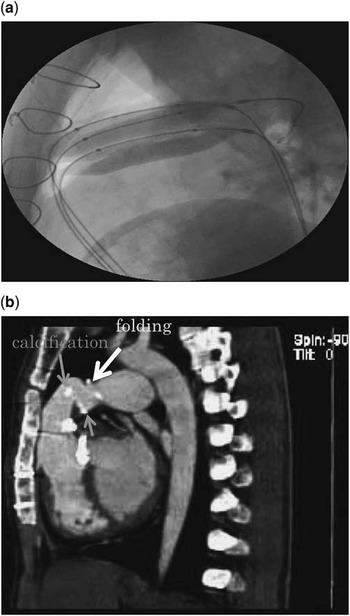
In all, three venous sheaths were inserted percutaneously into the femoral or jugular veins, as in the double-balloon method. Balloon diameter was limited to 10% larger than the nominal conduit diameter to minimise the risk of false aneurysm formation, as previously described.Reference Powell, Lock, Keane and Perry 7 Use of simple linear equation, D=2.154 days, where D=diameter of a circular lumen and d=diameter of the chosen balloon, enables calculation of a lumen size for three identical balloons. When we used different sized balloons, like in Case 3, the diameter of the circular lumen was approximated by the table, as reported previously.Reference Gaylord, Pritchard, Chuang, Casarella and Sprawls 8 A flow-directed end-hole balloon catheter (balloon wedge; Arrow, Reading, Pennsylvania, United States of America) was introduced through each sheath and advanced to the peripheral pulmonary arteries. Subsequently, exchange-length 0.035” stiff guide wires (Amplatz Super Stiff; Boston Scientific, Watertown, Massachusetts, United States of America) were introduced, two were positioned in either the right or left pulmonary artery, and the third one was placed in the contralateral pulmonary artery. An ultra-high-pressure balloon dilatation catheter was then inserted over each guide wire and positioned across the stenosis. An inflator with digital manometer (Monarch; Merit Medical Systems, South Jordan, Utah, United States of America) was attached to each balloon catheter and the balloons were inflated simultaneously until complete disappearance of the stenotic waist was achieved, or until rated burst pressure was attained (Fig 1). Haemodynamic studies were conducted after dilatation.
( a ) Lateral image of triple-balloon method using ultra-high-pressure balloon in Case 1. ( b ) Sagittal multi planar reconstruction image in Case 1. Calcified and kinked lesions in right ventricular outflow tract stenosis.

Results
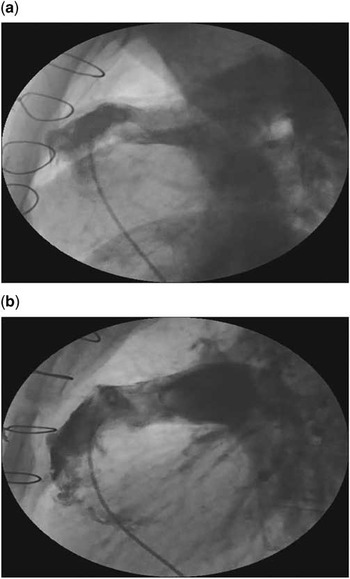
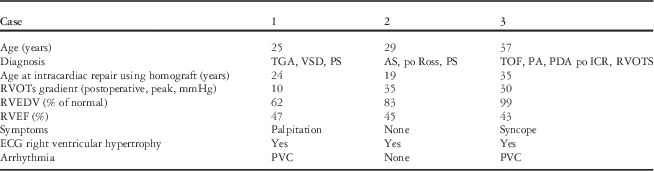
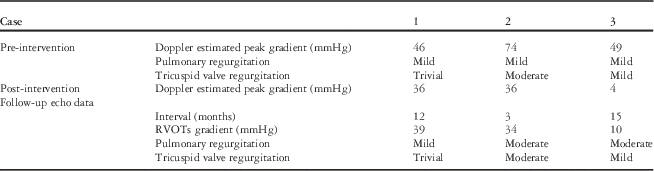
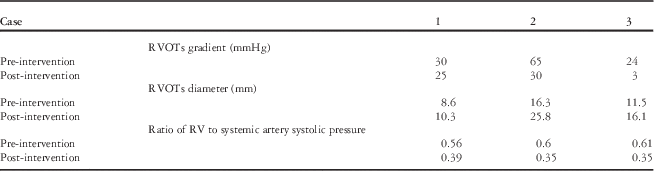
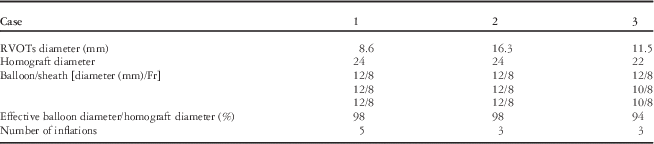
All patients showed right ventricular hypertrophy on electrocardiography (Table 1). Doppler echocardiography estimated the peak right ventricle-to-pulmonary artery systolic pressure gradient to be >40 mmHg in all three patients before balloon dilatation (Table 2). Pressure measurements under sedation yielded peak systolic pressure gradients of 24, 30, and 65 mmHg, respectively (Table 3). All three patients had calcified areas in the conduit (Fig 2). Because the left femoral and the right jugular vein were occluded in Case 3, we inserted two sheaths in the right femoral vein and one in the left jugular vein. The homograft diameters were 22, 24, and 24 mm, whereas the effective balloon-to-homograft diameter ratios were 0.94, 0.98, and 0.98 (Table 4). Following balloon dilatation, the peak pressure gradients were reduced to 3, 25, and 30 mmHg, respectively, and ratios of right ventricle to systemic artery systolic pressure were reduced to 0.35, 0.35, and 0.39, respectively. Minor procedural complications occurred that needed no treatment. None of the three patients developed increased tricuspid regurgitation, there were no tears, pseudoaneurysms, or recoil in the conduit. There were no ischemic ECG abnormalities to suggest coronary compression in any patient during the procedure. Patients 2 and 3, who had mild pulmonary regurgitation before the procedure, experienced some deterioration to moderate regurgitation. Neither thrombus nor pericardial effusion occurred with the procedure in any of the patients and there were no balloon ruptures.
( a ) Pre-lateral angiogram in Case 1. ( b ) Post-lateral angiogram in Case 1.

Patient profiles.

AS=aortic stenosis; ICR=intra-cardiac repair; PA=pulmonary artery; PDA=patent ductus arteriosus; PS=pulmonary stenosis; PVC=premature ventricular contractions; RVEDV=right ventricular end-diastolic volume; RVEF=right ventricular ejection fraction; RVOTs=right ventricular outflow tract; TGA=transposition of great arteries; TOF=tetralogy of Fallot
Echocardiographic date.

RVOTs=right ventricular outflow tract
Catheterisation date.

RV=right ventricle; RVOTs=right ventricular outflow tract
Procedural techniques.

RVOTs=right ventricular outflow tract
Discussion
Several studies have shown that the double-balloon method has several advantages over the single-balloon method,Reference Pedra, Arrieta and Esteves 9 including (1) need for smaller sheaths, which can accept higher pressure balloons; (2) better maintenance of pulmonary blood flow during balloon inflation and deflation owing to space between balloons and a shortened deflation time. However, as the double balloons form an ellipsoidal cross-sectional area at the contact zone, they may overstretch the circular vessel wall in the long-axis direction. Such uneven stress may subsequently increase the risk of injury to the vessel wall.
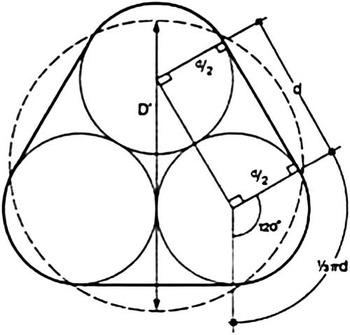
One of the benefits of the triple balloon is that the outer circumferential geometry is more round than that of the double balloon (Fig 3). Consequently, the triple balloon stretches the circular vessel wall more evenly,Reference Gaylord, Pritchard, Chuang, Casarella and Sprawls 8 whereas the triple-balloon method is better able to preserve systemic arterial blood pressure during balloon inflation.Reference Escalera, Chase and Owada 10 , Reference Cazaniga, Breitbart, Armentano, Gamboa and Solorzano 11 The triple-balloon method also allows the use of ultra-high-pressure balloons whose maximum balloon diameters are usually 10–12 mm, which is insufficient to dilate a large conduit even by the double-balloon method. Actually, in our series, all stenotic lesions were expanded with no evidence of a waist by the double-balloon dilatation with ultra-high-pressure balloon dilatation catheters.
Image of triple balloons of a same size.

An ultra-high-pressure balloon, such as Conquest, has recently become available in Japan. Jessica et al reported that Conquest is effective for rigid stenotic lesions, such as a resistant stenosis within an implanted pulmonary arterial stent.Reference Maglione, Bergersen, Lock and McElhinney 12 In this report, angioplasty by ultra-high-pressure balloons achieved a significantly greater increase of the vessel diameter in 34 lesions in 29 patients (median of 3.1 mm, 36%), than did angioplasty by regular high-pressure balloon (1.3 mm, 19%, p<0.05). There were no vascular or other complications.
Our study is the first to use a combined triple-balloon technique with the use of ultra-high-pressure balloons. We dilated the heavily calcified obstructed conduit using three ultra-high-pressure balloons. All three of our patients were effectively treated using this approach and no major adverse events were encountered, except for slightly increased pulmonary regurgitation. As the transcatheter melody valve is not available in Japan, the aim of ballooning is to delay repeat surgery for right ventricular outflow reconstruction by decreasing right ventricular pressure overload, admittedly at the cost of a slight increase of pulmonary regurgitation. We believe such a slight increase in pulmonary regurgitation is a minor complication.
Disadvantages of this method include the requirement for more human resources and its higher cost than for a single- or double-balloon procedure. First, during triple-balloon dilatation, three interventionists must simultaneously manipulate three catheters, wires, and inflators. In contrast, in the double-balloon system, the two adjustable haemostatic valves (Y connector; B. Braun Medical, Melsungen, Germany) can be managed by one interventionist. The ultra-high-pressure balloon is more expensive than the regular high-pressure balloon, and the method requires three ultra-high-pressure balloons. Despite these disadvantages, we believe that this method is safer and more cost-effective than reoperation.
Some reports show balloon angioplasty using conventional balloon alone has resulted in only partial relief of obstruction and was minimally effective in prolonging conduit life. Sanatani et al reported that only one patient had replacement deferred as a result of balloon angioplasty using conventional balloons in 12 patients.Reference Sanatani, Potts and Human 13 On the contrary, placement of balloon expandable stents is reportedly superior to simple conduit angioplasty using conventional balloons in terms of reducing obstruction and prolonging conduit lifespan. Sugiyama et al reported that freedom from conduit replacement from the time of stent implantation was 83%, 75%, and 47% at 1, 2, and 5 years, respectively.Reference Sugiyama, Williams and Benson 14 However, there are several complications associated with stenting, such as stent migration or malposition,Reference Powell, Lock, Keane and Perry 7 jailing of side branches, and right ventricle dilatation following worsening pulmonary insufficiency.Reference Law, Shamszad and Nugent 15 Furthermore, stent fracture limits long-term outcome. Consequently, it is unclear whether stenting is better than ultra-high-pressure balloon dilatation alone in terms of safety and medium to long-term outcome. In this study, stent implantation was considered in all cases; however, it was not indicated because of concerns on the risk of deteriorating pulmonary regurgitation. The triple ultra-high-pressure method needs to be confirmed as being as effective as in our study and further studies are required comparing the safety and effectiveness of these two methods.
Limitations
This study is limited by its retrospective nature and non-randomised design. Long-term outcome has not yet been determined as the follow-up intervals for these patients are relatively short, <15 months. Furthermore, we did not perform follow-up catheterisation. However, judging by serial Doppler echocardiography, there has been no sign of restenosis or deterioration of regurgitation in this follow-up interval.
Conclusions
Triple-balloon dilatation using an ultra-high-pressure balloon seems to be effective in two of three of our patients and safe for treating predominantly stenotic right ventricle–pulmonary artery conduits in adults. This method may decrease the number of reoperations for right ventricular reconstruction in adults, when the melody valve is unavailable. Further large volume studies are required to determine the optimal use and long-term outcome of the triple-balloon method using ultra-high pressure balloons.
Acknowledgements
The authors would like to thank Dr Peter M. Olley, Professor Emeritus, Alberta University, for his language consultation.
Financial Support
This research received no specific grant from any funding agency, commercial, or not-for-profit sectors.
Conflicts of Interest
None.
Ethical Standards
The authors assert that all procedures contributing to this work comply with the ethical standards of the relevant national guidelines on human experimentation and with the Helsinki Declaration of 1975, s revised in 2008, and has been approved by the institutional committees of National Cerebral and Cardiovascular Center.