For nearly three decades, governments and policy makers have been highly involved in supporting business creation worldwide. By means of financial incentives, the development of supporting institutions (e.g. business incubators), the reduction of administrative barriers, the implementation of education programs, they have tried to increase the number of business creations. In essence, the advantages of business creation are two-fold: the fostering of economic growth (given that business creation favors innovation and the transfer of knowledge to society) and the reduction of unemployment. This latter aspect of entrepreneurship is also of great importance at individual level, given that self-employment is a good alternative to searching for salaried jobs. This alternative career option is all the more important in a context of high unemployment.
However, despite its advantages, entrepreneurship remains a too often neglected career option. In particular, low-rates of business creation among graduates are a concern for policy makers. Through their education, graduates have acquired knowledge and developed skills which make them good candidates for business creation. In other words, they have a higher entrepreneurial potential than average salaried workers. Consequently, understanding why most students are reluctant to create their own business, even in the presence of an entrepreneurial opportunity, is an important issue that requires investigation (Ekore & Okekeocha, Reference Ekore and Okekeocha2012).
Thus, identifying factors that encourage or discourage entrepreneurship is nowadays an active field of research. Among such factors, entrepreneurial intention is considered as a major antecedent to the creation of a business, given that behaviors which lead to the creation of a business are in the majority intentional and planned (Fitzsimmons & Douglas, Reference Fitzsimmons and Douglas2011). Entrepreneurial intention concerns the degree to which an individual has an intention of starting a business in the near future. The interest of this research is to take account one of the criticisms with regard to intention models, namely that this models have a linear structure that does not take account of interactions between variables (Auzoult, Reference Auzoult2015). Accordingly, the aim of this article is to further analyze its formation. In particular, it examines the idea that the formation of an entrepreneurial intention involves the implementation of processes associated with the self, given that entrepreneurship is in essence a personal project that requires total dedication on behalf of the individual, as the business and its founder are intertwined, especially at the creation stage. More precisely, we address the possibility that the judgment and awareness which individuals have of them influence their intention to start, or not to start, a business. To this end, the concepts of core self-evaluations (CSE) and self-consciousness (SC) have been related to current research on the formation of entrepreneurial intentions and have resulted in the conducting of an empirical study.
Before presenting the method and results, we begin this article by presenting theoretical models of entrepreneurial intention and the different variables considered antecedents of intention.
Perceived desirability, perceived feasibility and intention to start a business
Several models are based on behavioral intention as a central variable in the career path which leads to entrepreneurship. The majority of empirical studies have referred to the theory of planned behavior (TPB, see Fishbein & Ajzen, Reference Fishbein and Ajzen2010) and/or Shapero and Sokol’s (Reference Shapero, Sokol, Kent, Sexton and Vesper1982) entrepreneurial event theory (EET) (see Schlaegel & Koenig, Reference Schlaegel and Koenig2014 for a meta-analysis). The TPB postulates that behaviors are the result of behavioral intention, a motivational factor resulting from (1) the overall evaluation of the perceived consequences of the behavior (attitude), (2) the perception of the behavior from the point of view of the social environment (subjective norm) and the perceived possibility of achieving it (perceived behavioral control). The EET explains entrepreneurial intention on the basis, in particular, of life events and the perception which the individual has of the desirability and feasibility of starting a business. These events include transitions (leaving the Army, education, prison, etc.), and positive displacements (flourishing market/ product, investors, etc.), in addition to what they refer to as negative displacements (divorce, unemployment, immigration, etc.). Desirability refers to the valence associated with the behavior of starting a business and feasibility to the perceived possibility of its achievement. Many studies have agreed on a partial similarity of the two approaches, desirability being comparable with attitude and the subjective norm, and feasibility with behavioral control (see Schlaegel & Koenig, Reference Schlaegel and Koenig2014). On this basis Krueger and Brazeal (Reference Krueger and Brazeal1994) have proposed a model incorporating both the TPB and EET.
Regulatory focus and entrepreneurial intention
Within this perspective, Fitzsimmons and Douglas (Reference Fitzsimmons and Douglas2011) have put forward the hypothesis that perceived feasibility and desirability would also determine intention, in accordance with an interactive principle, and not solely additive. Drawing support from Brockner, Higgins and Low (Reference Brockner, Higgins and Low2004), they identify two possible interactions. A negative interaction, first of all, when the dissuasive effect of a low perceived feasibility (or desirability) would be compensated by a high perceived desirability (or feasibility). In other terms, the fact that one or the other of these constructs is subject to a favorable judgment (high desirability or high feasibility) would be sufficient for intention to be high. They next considered the existence of a positive interaction, where the fact of judging the act of entrepreneurship as desirable (or feasible) could only induce a high entrepreneurial intention on the condition that it was also judged as feasible (or desirable). In other words, that perceived feasibility and desirability must both be high in order to induce a high intention.
These two interactions are said to be the result of two different regulatory foci: the focus of promotion and the focus of prevention (Shah & Higgins, Reference Shah and Higgins1997). Positive interaction is said to correspond to the focus of promotion, that is to say when individuals are focused on the maximization of gains (material or symbolic). In this case, they would only be motivated by starting a business if it appeared to them to be definitely profitable. The negative interaction is said to correspond to the focus of prevention, that is to say when individuals focus on the prevention of losses. Consequently, in this case, abandoning a business project which is feasible but moderately desirable, or very desirable but barely feasible, appears unacceptable to them. For Brockner, Higgins, and Low (Reference Brockner, Higgins and Low2004) these two types of foci are necessary for the creation of a business, each one needing to predominate during a phase of the process. The focus of promotion is said to be adapted to the phase of generating new ideas and exploring possible alternatives, whereas the focus of prevention comes into play when the implementation of all the operations necessary for the success of the project is concerned. From an empirical point of view, Fitzsimons and Douglas (Reference Fitzsimmons and Douglas2011) confirmed the presence of a negative interaction amongst MBA students, between 26 and 30 years of age, with professional experience and on the point of deciding on a career.
In accordance with these theoretical and empirical elements it is possible to put forward several hypotheses: Hypothesis 1a (H1a): it is expected that the more feasible starting a business is judged to be, the higher the entrepreneurial intention will be; Hypothesis 1b (H1b); the stronger the perceived desirability of starting a business is the higher intention will also be; Hypothesis (H1c): these two variables have an interaction effect on intention.
Core self-evaluations and entrepreneurial intention
The concept of Core Self-Evaluations (CSE) refers to the more or less favorable fundamental conclusions which individuals come to about themselves and their relationship with their environment. They are expressed through four personality traits: locus of control, generalized self-efficacy, self-esteem and emotional stability (Judge, Locke, & Durham, Reference Judge, Locke and Durham1997). Accordingly, a positive self-evaluation manifests itself through an internal locus of control, a strong feeling of personal efficacy, a high self-esteem and a low disposition to negative feelings (i.e. anxiety, irritability, pessimism). Conversely, a negative self-evaluation manifests itself through an external locus of control, a feeling of personal inefficacy, a low self-esteem and a high disposition to negative feelings.
The CSE approach has been successfully used in the explanation of numerous phenomena (see Chang, Ferris, Johnson, Rosen, & Tan, Reference Chang, Ferris, Johnson, Rosen and Tan2011, for a review). Originally, researches put forward and empirically corroborated the hypothesis that job satisfaction was rooted in the CSE, considering that individuals having the feeling of being capable, of controlling their environment, having the feeling of being persons of value and experiencing fewer negative feelings are individuals who are the most disposed to view their work situation positively and extract the potential benefits from it. Subsequently CSE have been found to be associated with performance at work, the aptitude to bring about organizational change, career adaptability, professional ambition, career decision-making, the intensity of job search amongst the unemployed and organizational involvement.
On the whole, positive CSE lead to a more positive perception of work and effort, mediates the impact of skills on professional career paths, reduces indecision and facilitates personal changes and participation in organizational changes. Individuals with positive CSE set themselves higher goals, persist more in their efforts, more often achieve the objectives incumbent on them and are more capable of extracting benefit from fortuitous life situations and, in doing so, are more successful in their career.
With regard to the formation of entrepreneurial intentions, the large majority of studies did not analyze the influence of CSE on these intentions. However, the feeling of generalized self-efficacy and neuroticism has on several occasions been identified as influencing entrepreneurial creation and success (see Brandstätter, Reference Brandstätter2011, for review). Likewise, a study by Laguna (Reference Laguna2013) highlights a positive relationship between self-esteem and intention. With regard to the locus of control, entrepreneurs appeared to be more internal than the rest of the population and countries whom culture promote internal locus of control are more prone to business creation (Bonnett & Furnham, Reference Bonnett and Furnham1991; Mueller & Thomas, Reference Mueller and Thomas2001). As a whole, these studies indirectly corroborate the idea of a positive link between CSE and entrepreneurial intention. This point of view is also in line with Shane (Reference Shane2003) who puts forward the hypothesis that individuals with a high CSE are more able to recognize the potential of entrepreneurial opportunities which present themselves and to exploit them effectively, a hypothesis recently corroborated empirically by Ahmetoglu, Leutner, and Chamorro-Premuzic (Reference Ahmetoglu, Leutner and Chamorro-Premuzic2011).
To our knowledge, the sole study that referred to the CSE concept in the study of entrepreneurial intentions was conducted by Ekore and Okekeocha (Reference Ekore and Okekeocha2012). This study showed that CSE are positively linked to these intentions because having positive CSE implies a high self-confidence and, thus, reduces the fear of failure associated to entrepreneurship. Accordingly, as a high self-evaluation signifies the self-attribution of high-level abilities and a high level of control, it can be expected that the more positive the CSE are, the higher will be the perceived feasibility of starting a business. Likewise, an individual with a positive self-evaluation is more stable emotionally and has confidence in their chances of success, which leads them to anticipate an overall positive experience of situations. Consequently, it can be expected that this tendency to optimism encourages the individual to more easily evaluate the potential positive consequences of starting a business as probable, which would help to increase its perceived desirability. Conversely, those with a negative self-evaluation attribute fewer abilities and less control to themselves and are more inclined to anxiety and deprecation of themselves and events (neuroticism), which thus has a negative effect on perceived feasibility and desirability.
On this basis, it is possible to put forward the following hypotheses: the more positive an individual’s CSE, the greater is their entrepreneurial intention (hypothesis 2a, H2a), as well as the greater are their perceived feasibility (H2b) and perceived desirability (H2c) of business creation, which are supposed to mediate the CSE-intention relationship.
Thus, our study pursues the objective to complete Ekore and Okekeocha’s (Reference Ekore and Okekeocha2012) observations. Furthermore, we consider that the CSE concept offers a more comprehensive and parsimonious approach to self-evaluation and, consequently, might serve as an integrating framework within the field of entrepreneurship. More precisely, we consider that it can be used to integrate in a unique theoretical model entrepreneurship research that separately addressed the role of locus of control, generalized self-efficacy, self-esteem and emotional stability /neuroticism.
Self-consciousness and regulation of action
Another factor relative to the Self probably plays a role in the formation of entrepreneurial intentions: self-consciousness (SC). The concept of SC refers to the fact that individuals are not all equal with regard to the attention which they pay to themselves, that is to say their propensity to become aware of the elements which characterize them (e.g. beliefs, attitudes, feelings, personality traits, habits and appearance). One of the central ideas developed in this field is that self-consciousness encourages the reciprocal adjustment of behaviors produced and the self (Auzoult, Reference Auzoult2013; Carver & Scheier, Reference Carver and Scheier2001). In other words, as stated by Buss (Reference Buss2001), SC accentuates the visibility of internal states and encourages the establishment of an accurate perception of the different aspects of the self, this perception being expressed through behaviors.
As a corollary to the SC concept, the self-focus process plays a central role in the regulation of behaviors. This self-focus can be induced by the situation (self-awareness) or constitute a stable disposition (self-consciousness). In both cases, self-focus leads individuals to act in a manner which is more consistent with the elements of themselves to which they have access. From this perspective, the public SC which expresses attention to the elements of the self which are perceivable by others (e.g. appearance) is distinguished from private SC which expresses attention to the non-perceivable aspects (e.g. personality, emotions and attitudes). The higher the public SC of individuals the more sensitive they are to the presence of others and to situations and objects of thought making the judgment of others salient. As for private SC, the higher it is the more individuals base their reasoning and decision-making on their own judgments and emotions, and on the components of their self-concept (e.g. Pitesa & Thau, Reference Pitesa and Thau2013).
Close to our concerns, the concept of managerial self-awareness (i.e. the degree to which the manager is aware of their strengths and weaknesses) has also been subject to attention and development (e.g. Church, Reference Church1997). For example, in his study on managerial self-awareness, Church (Reference Church1997) observed that the stronger this awareness was the more effective the managers were, as they had an accurate perception of themselves allowing them to appropriately adjust their managerial practices. From a closely related perspective, Pitesa and Thau (Reference Pitesa and Thau2013) studied the effect of power on private SC, and on the adoption of ethical behaviors. In particular they demonstrated that the more power managers have the more this increases their private SC, the latter leading them to act more in accordance with their personal convictions and less under the influence of an unethical, ambient organizational context. To conclude, the study by Echabe and Valencia-Garate (Reference Echabe and Valencia-Garate1994) associated the theory of planned behavior with the study of private SC. Their objective was to explain voting behaviors. They observed in particular that in the case of individuals with a high private SC, attitudes influenced intentions more strongly than in the case of individuals with a low private SC.
As for the CSE concept we consider that the private SC concept has a great relevance for entrepreneurship research. It could be viewed as complementary to CSE given its central role in self-regulation of cognition and behavior. In particular, as being self-conscious (self-aware) is necessary in order to think and behave in accordance with self-related factors, it enables us to understand why and when some individuals act consistently with them, whereas some others do not. Thus, from this point of view, an integrating framework that relates self-perceptive factors to the intention to start a business (i.e. to be self-employed) cannot be complete without considering the role of private SC. Accordingly, private SC is said to moderate the relationships between the CSE, desirability, feasibility and entrepreneurial intention. More precisely, the more private SC increases the more these constructs can be expected to be strongly related. In other words, it can be considered that the higher private SC is, the more desirability (H3a), feasibility (H3b) and CSE (H3c) strongly affect intention. Likewise, the effect of CSE on perceived desirability (H3d) and perceived feasibility (H3e) is likely to increase in parallel with the increase in private SC.
Method
Participants and procedure
Two hundred and sixteen French students from a unique region (Franche Comté) took part in the study. These students (105 men, Average age = 21 years and 6 months) were pursuing their studies in universities (in sciences and human sciences, n = 93), at engineering college (n = 110) and management school (n = 13). Out of the entire sample, 102 were at degree level, 107 at Masters and Ph.D. level, 11.53% had already taken part in an innovative technological initiative, 39.43% had already received instruction on entrepreneurship, 60.45% had already sought employment and 23.7% stated that they planned to start a business.
These students replied to an online questionnaire (58 items) via a link sent through the university and college mailing lists (Response rate: 45.5%). The presentation message stipulated that the researchers were conducting a study on the theme of business creation and that they needed replies from a large number of students whether they felt themselves to be concerned with this theme or not. It was also stipulated that as the questionnaire was being conducted for research purposes, the information collected would remain anonymous and confidential and would be analyzed for all the participants as a whole. This collection was carried out at the beginning of the academic year.
Material
The different variables studied and the measures employed are presented in the order of completion by the participants.
Independent and moderating variables; CSE and SC
The participants replied to the 23 items of the French version of the SC scale (Pelletier & Vallerand, Reference Pelletier and Vallerand1990) using a Likert-type 4-point scale ranging from 0 (does not describe me) to 3 (completely describes me). This scale includes 10 items referring to the private dimension of SC (for example: I constantly thinking about my reasons for doing things) (α = .70), 7 items referring to public SC (for example: I usually worry about making a good impression) (α = .79) and 6 items referring to social anxiety which we are not dealing with in this study.
The participants also replied to the core self-evaluations scale (Baudin, Reference Baudin2009). The scale includes 12 items (α = .83) in relation to which the participants have to indicate to what extent they are in agreement on a 5-point scale ranging from 0 (strongly disagree) to 4 (strongly agree). Six items were connoted negatively (reversed scores), six others positively. They are the reflection of varying degrees of higher and lower self-esteem, higher or lower levels of personal efficacy, an internal or external locus of control and a tendency to neuroticism or emotional stability.
Dependent variable: entrepreneurial intention
Entrepreneurial intention was measured on a seven-point scale (score ranging from 0 to 6) using two items (α = .95): I intend to start my business at the end of my studies [response modalities with the extremes: strongly disagree/ strongly agree]; at the end of your studies, what is the probability of you starting your business? [extremely improbable/extremely probable].
Mediating variables: feasibility and desirability
Feasibility (i.e. behavioral control) was measured using six items (α = .87) accompanied by seven response modalities ranging from 0 to 6: For me, taking into account the situation I will face when I finish my studies, starting my business would be…[completely impossible/completely possible]; All the conditions necessary for starting my business at the end of my studies will be present [no, not at all/yes, completely]; I think that at the end of my studies, I will have all the skills necessary to start my business [don’t agree at all/completely agree]; I do not feel capable of starting my business at the end of my studies [don’t agree at all/completely agree] (reversed item); At the end of my studies, there will be too many obstacles for me to be able to start my business [don’t agree at all/completely agree] (reversed item); Starting my business at the end of my studies would be for me… [very difficult/very easy].
This way of measuring perceived feasibility is different from that employed, for example, by Fitzsimmons and Douglas (Reference Fitzsimmons and Douglas2011). This choice complies with the recommendations of Fishbein and Ajzen (Reference Fishbein and Ajzen2010) with respect to the formulations that are employed and the fact of measuring two types of control: perceived autonomy (in connection with the obstacles and facilitating elements external to the individual) and perceived capacity (in connection with the aptitudes, skills and knowledge particular to the individual). These questions also constitute direct and overall measures of control, whose superiority in terms of the prediction of intentions are highlighted by Notani’s (Reference Notani1998) meta-analysis.
Desirability was measured using six items (α = .73) accompanied by seven response modalities ranging from 0 to 6. Three expressed personal attitude: With regard to the idea of starting my business at the end of my studies I am… [for/against]; The idea of starting my business at the end of my studies makes me feel… [excited/bored]; In my opinion, starting my business at the end of my studies would be… [advantageous/disastrous]. Three others expressed the subjective norm: the important people in my life would approve of me starting my own business at the end of my studies [totally disagree/totally agree]; the people closest to be expect me to start my own business at the end of my studies [no not at all/yes completely]; The majority of people who matter to me advise me (or would advise me) not to start my own business at the end of my studies… [totally false/totally true] (reversed item). Before replying to these last three items, the participants were invited to write the initials of the most important people in their lives (those who counted the most in their eyes), with the purpose of rendering the normative referents cognitively salient.
This way of measuring perceived desirability also differs from the research of, for example, Fitzsimmons and Douglas. Once again, this choice was motivated by the recommendations of Fishbein and Ajzen (Reference Fishbein and Ajzen2010). As regards personal attitudes in particular, they recommend the use of three types of items: items with an affective connotation (measuring the affectivity aroused by the idea of accomplishing the act), with an instrumental connotation (measuring the overall judgment of the probable consequences of the behavior) or denoting an overall, undifferentiated evaluation of the act.
Controlled variables: experiences linked with entrepreneurship, the place of entrepreneurs in the social environment, gender and age
The participants indicated whether they had any knowledge of support structures (e.g. business incubators), whether they had already been involved in an innovative technological initiative which could lead to the creation of a marketable product, whether they had already completed education or training for the purpose of learning to start and manage a business and whether they had already sought employment. The responses were nominal (yes = 1/no = 0).
Likewise, two questions evaluated the place of entrepreneurs in the students’ social environment. First of all, they had to indicate the number of people who had started their own business or who managed a business amongst the people who were closest to them (family, friends). Next, five employment-related situations were presented to them (entrepreneur/company manager, employee in the private sector, employee in the public sector, jobseeker and student). They had to rank them in accordance with the number of people in their immediate circle who were in this situation. The situation ranked first was that which most concerned the people in their immediate circle and obtained the score of 5, the last was that involving the least number of people and obtained the score of 1. This question allowed us to assess the place of entrepreneurship in the social environment in relation to alternative professional situations. Finally, the respondents had to supply the following information at the end of the questionnaire: gender, age and training completed.
Results
Descriptive and correlational analyses results
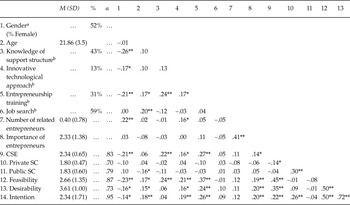
After calculating the means for each main measures (CSE, SC, perceived desirability, perceived feasibility, and entrepreneurial intention) descriptive statistics and correlations between variables were examined first (see Table 1). Internal consistency was satisfactory for all the mean scores (> .70).
Descriptive statistics and intercorrelations between all variables

Note: aMale (1), Female (2); bYes (1), No (0); *p < .05; **p < .01
As the correlations demonstrate, private SC and CSE were positively linked with entrepreneurial intention. CSE was also positively associated with the perceived desirability and feasibility of starting a business. Intention was also positively correlated with these last two variables, with the relative importance of entrepreneurs in the social environment and with experiences of entrepreneurship (technical innovation and education). The women reported having had less experience of entrepreneurship, a less good evaluation of themselves (CSE), evaluated the creation of a business as less feasible and desirable and had less intention to do so. Likewise, age was positively associated with the fact of having completed training on entrepreneurship, and also with entrepreneurial intention.
Hierarchical linear regression analyses results
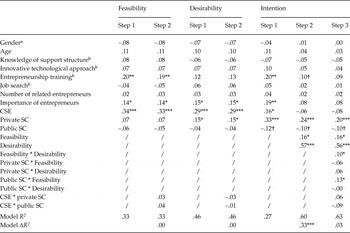
In a second step, we carried out three hierarchical linear regression analyses (Table 2) with feasibility (analysis 1), desirability (analysis 2) and entrepreneurial intention (analysis 3) as dependent variables. For the three analyses of demographic characteristics, personal experiences and dispositional variables were introduced during the first step. With regard to entrepreneurial intention, perceived feasibility and desirability were introduced at the second step, whereas the interactions between variables predicted by the hypotheses were added during the third. For feasibility and desirability, only the interactions between CSE and the two dimensions of SC were introduced during the second step. It should be noted that the interaction effects relative to public SC were also added insofar as SC is comprised of two positively correlated factors.
Hierarchic regression analyses – Dependant variable: feasibility (analysis 1), desirability (analysis 2) and intention (analysis 3)

Note: The values correspond to standardized regression coefficients (β); aMale (1), Female (2); bYes (1), No (0); *p <.05, ** = p < .01, *** = p < .0001, † = p < .07
With regard to feasibility, the explanatory variables were CSE, the fact of having received training in entrepreneurship and the relative importance of entrepreneurs in the social environment. 33% of feasibility (R 2) was thus explained by these different variables. CSE and the two dimensions of SC did not significantly interact on this variable (Step 2). For desirability, CSE, the relative importance of entrepreneurs in the social environment and private SC were the main explanatory factors. The variance explained by these variables was 46% (R 2). As for feasibility, the consideration of the interactions between CSE and SC did not increase the explained variance, these having no significant effect. And so, the effects of CSE on feasibility (H2a) and desirability (H2b) were confirmed, whereas the moderation of these effects by private SC was not confirmed (H3d and H3e).
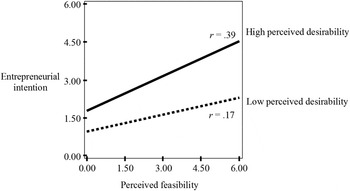
The variables included during step 1 explained 27% of intention. Amongst these variables, private SC, the fact of having had training in entrepreneurship, the relative importance of entrepreneurs in the social environment and CSE significantly encouraged the intention to behave entrepreneurially. The effect of CSE on intention was thus confirmed (H2a). Public SC had a trend effect (β = –.12, p = .066) reducing intention. During the second step, the addition of feasibility and desirability increased the explained variance by 33% (ΔR 2 ). These two variables had the significant effects expected (H1a et H1b), desirability however having a stronger effect than feasibility. During the third step, the interaction between desirability and feasibility, and the moderating effects of the two dimensions of SC increased the explained variance by 3% (ΔR 2 ). As expected (H1c), feasibility and desirability had a significant interaction effect on intention, the latter also being positive. As illustrated by figure 1 below, when one of the two factors was subject to an unfavorable judgment, the effect of the other factor decreased.
Relationship between entrepreneurial intention and perceived feasibility amongst individuals having a high and low perceived desirability

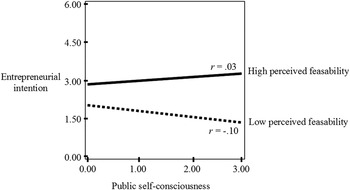
Contrary to what was expected (H3a, H3b and H3c), private SC did not significantly moderates the effect of feasibility, that of desirability or that of the CSE on intention. However, the interaction between public SC and feasibility was significant. The analysis of figures 2 highlights the fact that public SC moderated the effect of feasibility on intention, this being higher for individuals with a high public SC.
Relationship between entrepreneurial intention and public self-consciousness amongst individuals having a high and low perceived feasibility

Mediation analyses results
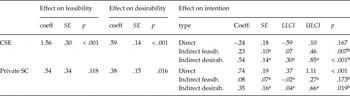
These analyses support the idea that the perceived feasibility and desirability of starting a business mediate the effect on intention of variables relative to the Self. For example, the effect of the CSE becomes non-significant when desirability and feasibility are added (step 2). Likewise, the effect of private SC on intention diminished (Δβ = .09) after the inclusion of these variables. In order to confirm the existence of these mediations, the Hayes (2013) procedure was applied using the PROCESS macro for SPSS. This procedure is an integration and extension of the familiar mediation/moderation analyses and allows the significance of indirect effects to be estimated via the use of the bootstrap technique. Multiple samples were simulated by random replacement of values. With each resampling the regression coefficients were estimated. So this procedure gave a confidence interval (CI) for each indirect effect. If this CI did not contain the value 0 that signified that the effect was robust. The data were resampled 2000 times and the bias-corrected method to create 95% confidence intervals was used. The results obtained are presented in table 3 below.
Mediation Analyses: CSE and private SC (VI), feasibility and desirability (VM) and intention (VD)

Note: abootstrap estimate, bSobel’ z test (1982). SE = Standard Error, LLCI = Lower Limit of Confidence Interval, ULCI = Upper Limit of Confidence Interval, Alpha risq = 5%. The effects of other variables were controlled.
These analyses confirm first of all that the entire effect of the CSE was mediated, mainly by desirability (b = .54, SE = .14, p < .001) and to a lesser extent by feasibility (b = .23, SE = .10, p = .007). They also confirm that private SC had a large, direct effect on intention (b = .74, SE = .19, p < .001), but also an indirect effect, mediated solely by desirability (b = .35, SE = .16, p = .019).
Discussion
Desirability, feasibility and entrepreneurial intention
The results obtained confirmed first of all that the intention to create a business actually depends on the perception which the individual has of the desirability and feasibility of starting a business. In addition, in accordance with Fitzsimmons and Douglas (Reference Fitzsimmons and Douglas2011), we observed an interaction effect between desirability and feasibility on entrepreneurial intention. However, unlike their study, this interaction was positive. This difference is probably explained by the fact that the students questioned by Fitzsimmons and Douglas, aged between 26 and 30 years of age and with professional experience, were all at the end of their studies and thus on the point of making a decision about their career. And so, in accordance with Brockner and collaborators approach (2004), the students were in a later stage of the process which could lead to entrepreneurship, a phase necessitating the adoption of a preventive focus. Conversely, the students questioned during this research were much younger, with less experience and generally not in the process of making a decision about their career, which probably favored the adoption of a promotion focus. It should also be noted that they were questioned at the beginning of the academic year.
Self-regulation and entrepreneurial intention
This study also highlights the impact of dispositions relative to the Self (SC and CSE) in the formation of entrepreneurial intention. In accordance with the hypotheses put forward in this regard (H2a, H2b and H2c), the CSE was positively linked with the intention to create a business and with desirability and feasibility, these last two variables mediating its effect on the first. Consequently, the fact of starting a business is actually a phenomenon influenced by the core evaluations which the individual has of themselves. This study thus obtained results convergent with research on CSE and corroborates the theoretical positions and empirical observations related to entrepreneurial intention (Ahmetoglu et al., Reference Ahmetoglu, Leutner and Chamorro-Premuzic2011; Ekore & Okekeocha, Reference Ekore and Okekeocha2012; Shane, Reference Shane2003).
SC also had an appreciable influence on the intention to create a business. However, this influence did not take the expected form: private SC did not moderate the effects of desirability and feasibility (H3a and H3b) or those of CSE (H3c, H3d and H3e). This absence of a moderating effect from private SC can possibly be explained by the study technique employed, namely the questionnaire. In fact, according to Buss (Reference Buss2001), carrying out interviews or completing questionnaires can encourage a temporary increase in self-awareness. The result of such an increase would be that all individuals express an intention to create a business consistent with the evaluation which they have of this act (desirability, feasibility), and of themselves (CSE), consequently cancelling out the moderating effect of SC.
Anyway, private SC had a major effect on intention. This effect indicates that the formation of an entrepreneurial intention necessitates having a minimal level of private SC. In other words, focusing attention on the self, on preferences, emotions, beliefs and goals is likely to be an element conducive to entrepreneurship, in the sense that it would help the individual to think of themselves as an entrepreneur, to envisage themselves in this possible future and to determine if this career alternative corresponds to the Self. Conversely, individuals with little inclination to introspection and to take a step back from themselves (i.e. having a low private SC), are likely to be less able to evaluate the connection between themselves and entrepreneurship. And so, these individuals only envisage the most socially common professional career paths, those which are the most popular and/or the most prototypical in the culture and/or the environment in which they lived. And the fact that in France becoming an entrepreneur is not one of these socially privileged directions (Carayannis, Evans, & Hanson, Reference Carayannis, Evans and Hanson2003) makes this interpretation completely plausible. And so, an individual considering becoming an entrepreneur would only do so after having concluded that these socially favored directions do not suit them, especially in a social context which does not favor entrepreneurship. In this respect, individuals with a high private SC are best placed to realize that entrepreneurship suits them best. In fact, without that the individual would not feel the need to evaluate career alternatives which exist beyond those with which they are faced in their everyday life in order to find the one which suits them best.
Unexpectedly, public SC moderated the influence of feasibility on the intention to behave entrepreneurially. More precisely, feasibility had more impact for individuals with a high public SC and a lower effect for individuals with a low public SC. Through perceived feasibility the students evaluated their chances of success or their risk of failure. Yet, failing or succeeding does not give the same image to others: that of a “winner” in the first case and that of a “loser” in the second. Consequently, it appears logical that individuals with a high public SC were more sensitive to this factor than those having a low public SC, as the first are more anxious than the second about the image which they give through their actions.
This interpretation is convergent with the works of Shepperd and Arkin (Reference Shepperd and Arkin1989) which observed that individuals with a high public SC more often displayed self-handicapping than others when they thought of undertaking a task which involved their image (i.e. they more often put themselves in an unfavorable context allowing them to explain any failure by the difficult situation and any success by their ability to overcome the difficulties). More generally speaking, as illustrated by the research of Tunnell (Reference Tunnell1984), individuals with a high public SC are more conformist, less attracted by innovation and seek risk less than individuals with a low public SC. For Tunnell (Reference Tunnell1984, p. 553) “subjects chronically concerned about their social image were more anxious, affiliative, exhibitionistic, conforming, other-directed and conventional […] the higher pressure to conform experienced by these individuals may increase their anxiety, since they may lack the ability to perform behaviors appropriated to the social situation. […] They take fewer risks and are less autonomous and achievement-oriented than low public subjects”. Moreover, as demonstrated by Plant and Ryan (Reference Plant and Ryan1985), the behaviors of individuals with a high public SC are less intrinsically motivated, which complies with the idea that the view of others in the event of success or failure is more important for them and would thus increase the influence of perceived feasibility. It should be noted, in this respect, that the French are one of those nations where the fear of failure is the strongest and the perceived ability to create a lasting business the lowest, which strengthens the plausibility of this interpretation.
Despite the results obtained, this study leaves several questions unresolved. As far as the interaction between feasibility and desirability is concerned, the presumed relationship between the type of regulatory focus and the form of this interaction was not empirically demonstrated by this study, or by that of Fitzsimmons and Douglas (Reference Fitzsimmons and Douglas2011). This relationship remains at the theoretical stage, as no specific measure or experimental manipulation operationalizing the two types of focus has been employed until now. Such an empirical operationalization proves to be all the more important as several research studies, conducted within the framework of the theory of planned behavior, do not draw on regulatory foci to explain such an interaction, considering that perceived behavioral control (equivalent to feasibility), does not have an intrinsically motivational nature, unlike attitude (i.e. desirability) (see Yzer, Reference Yzer, Ajzen, Albarracin and Hornik2007, for a review and discussion).
By analogy one could consider that the effects of desirability and feasibility on intention are similar to the effect of the two pedals which allow you to control the speed of an automobile. Desirability would correspond to the accelerator, and feasibility to the clutch. And so, it’s actually the accelerator which has a propulsive influence on the vehicle, the clutch, not so. However, the fact of pressing more or less strongly on the accelerator of a vehicle has no effect unless the clutch has been engaged. Although it does not allow us to record the existence of a negative interaction, this alternative approach highlights however the necessity of studying empirically the presence of promotion and prevention foci in the formation of entrepreneurial intentions.
In addition, this interaction effect between feasibility and desirability has probably been under-evaluated statistically. In fact, the lack of statistical power of the interaction tests conducted on the basis of correlational data has been amply discussed (e.g. Cohen, Cohen, West, & Aiken, Reference Cohen, Cohen, West and Aiken2003). In particular, there is an increase in the error of measure when the product of the two variables is obtained. This considerable error of measure greatly reduces statistical power and therefore negatively affects the accurate demonstration of the effect (which is then underestimated). This fact strengthens the necessity to employ other study procedures, such as the use of experimental methodology, for example. The use of such a methodology would also allow us to more easily control the effect of self-awareness induced by questioning. The use of implicit measures of desirability and feasibility could also help to reduce this phenomenon.
The methodology used also presents another limitation. As we sent a questionnaire to students, and some of them answered it on a voluntary basis, we cannot rule out the possibility of a self-selection (or non-response) bias. That is, it is conceivable that only students with a high interest in entrepreneurship have answered the questionnaire. Thus, our results may reflect with a moderate accuracy the way the investigated phenomena were interrelated in the overall target population. Consequently, they need to be replicated with a procedure that overrides such potential bias.
These results illustrate that the Self is involved in the formation of entrepreneurial intentions. In particular, having a positive CSE and a high private SC favors these intentions. So these results support the idea that these variables play a not inconsiderable role in starting a business and probably have an influence on entrepreneurial success. However, having the intention to create a lasting business does not equate to success in doing so, and, as the literature suggests, CSE and SC can have a completely reverse effects in terms of performance. In fact, it is probable that a very positive CSE can have a counter-productive effect as it can induce overconfidence. Several studies have in fact demonstrated that being very self-confident and very optimistic leads to an overestimation of the chances of success and has a damaging effect on the performance of the company (e.g. Hmieleski & Baron, Reference Hmieleski and Baron2008). Similarly SC exerts an influence on goal-attainment and performance (see Carver & Scheier, Reference Carver and Scheier2001). For instance, having a high private SC – in interaction with the situation – may lead individuals to choke under pressure. It may also promote failure in the performance of a task if it induces a concentration on the aspects of the Self which are irrelevant to the situation. Consequently, specific studies on the role of CSE and SC in entrepreneurial success will prove necessary.
The more the students had a high private SC and positive CSE, the more they intended to start a business. Moreover, public SC moderated the influence of perceived feasibility on intention. Thus, these results corroborated our Self-regulation approach of entrepreneurial intentions and highlight the necessity to use interventions that promote positive self-evaluations and private SC, as well as public SC for more feasible business project.
To that end, implementing interventions inspired from the 6-step model of the coaching process (Kampa-Kokesch & Anderson, Reference Kampa-Kokesch and Anderson2001) may be of a great relevance. More precisely, we consider that education programs should assist more students in constructing their career plans with an advisor who would coach them (i.e. who would help them to acknowledge their strength and weakness, set training goals and implement the relevant actions in order to attain them, as well as to autonomously analyze their performance with a view to initiating corrective action). Given that coaching fosters self-awareness, generalized self-efficacy, positive work attitudes, and goal-directed self-regulation (Theeboom, Beersma, & van Vianen, Reference Theeboom, Beersma and van Vianen2014), implementing these types of measures for students is likely to increase both SC and CSE. Thus, according to our self-regulation approach to entrepreneurship, this would increase both their perceived desirability and the feasibility of business creation and, therefore, this would promote their entrepreneurial intentions. Besides, the fact that coaching had successfully increased the performance of MBA and EMBA students (Sue-Chan & Latham, Reference Sue-Chan and Latham2004), strengthens the relevance of this recommendation.