Hospital-acquired infections (HAIs) are harmful and expensive complications of healthcare. In 2011, 722,000 HAIs occurred in United States hospitals and were associated with 75,000 deaths.Reference Magill, Edwards and Bramberg 1 The total annual costs for HAIs approach $10 billion in the United States.Reference Zimlichman, Henderson and Tamir 2 HAIs due to multidrug-resistant organisms (MDROs), such as methicillin-resistant Staphylococcus aureus (MRSA) and vancomycin-resistant Enterococcus (VRE), are associated with higher mortality rates and costs than HAIs due to non-MDRO HAIs.Reference Cosgrove, Sakoulas, Perencevich, Schwaber, Karchmer and Carmeli 3 – Reference DiazGranados, Zimmer, Klein and Jernigan 7
Hospitals currently allocate a substantial amount of effort and resources toward monitoring and preventing HAIs. For example, most hospitals use contact precautions for patients who are colonized with these organisms and also use active surveillance methods to detect colonization. Patient bathing with chlorhexidine gluconate (CHG) has been widely implemented as an additional strategy to combat HAIs. CHG has antimicrobial activity against Gram-positive and Gram-negative bacteria and decreases bacterial colony counts on the surface of the skin.Reference Popovich, Lyles and Hayes 8 As a result, CHG has been used to lower rates of blood culture contamination,Reference Popovich, Hota, Hayes, Weinstein and Hayden 9 environmental contamination,Reference Vernon, Hayden and Trick 10 and surgical site infection.Reference Darouiche, Wall and Itani 11
The impact of CHG bathing on HAI prevention in intensive care units (ICUs) has been examined in quasi-experimentalReference Popovich, Hota, Hayes, Weinstein and Hayden 9 , Reference Armellino, Woltmann and Parmentier 12 – Reference Climo, Sepkowitz and Zuccotti 16 and cluster-randomized studies with and without crossover,Reference Climo, Yokoe and Warren 17 – Reference Milstone, Elward and Song 20 and by meta-analyses,Reference Chen, Li, Li, Wu and Zhang 21 , Reference O’Horo, Silva, Munoz-Price and Safdar 22 with varying endpoints and results. However, to our knowledge, no previous studies have examined the impact of CHG bathing on HAIs in a multi-center, observational manner. Thus, the effectiveness of CHG bathing in a real-world, type 3 translational research setting is unknown.
Our goal was to estimate the effect of CHG bathing on the incidence of ICU-acquired HAIs, including MRSA and VRE infections, using time-trended surveillance data from a large network of community hospitals.
METHODS
Study Setting and Design
We conducted an interrupted time series analysis of the effect of using CHG bathing on 13 potential infection-related outcomes of interest in hospitals participating in the Duke Infection Control Outreach Network (DICON). DICON is a network of more than 40 community hospitals in 5 states throughout the southeastern United States that has been described previously.Reference Anderson, Miller and Chen 23 DICON provides infection control resources and services from liaison infection preventionists and physician epidemiologists. Infection preventionists at each hospital collect surveillance data using a standardized database employing National Healthcare Safety Network (NHSN) definitions. Liaison infection preventionists validate a subset of surveillance data at each hospital each month. Decisions to use CHG bathing were made by each hospital independently and were not controlled by researchers but were relayed to researchers by local infection control teams. All ICU patients in the intervention hospitals were assumed to have received CHG bathing. DICON hospitals that reported complete data about the use of CHG bathing and surveillance data between January 2008 and December 2013 were included in the study.
This study was approved by the Duke University Institutional Review Board.
Infections and Variables of Interest
The study outcomes included 13 HAIs arising in the ICU in 3 major categories: MRSA infections, VRE infections, and non–species-specific infections. We analyzed HAIs due to MRSA and VRE by looking at 5 categories: central-line–associated bloodstream infection (CLABSI); ventilator-associated pneumonia (VAP); and catheter-associated urinary tract infection (CAUTI) due to MRSA or VRE; other HAIs that were not CLABSI, VAP, or CAUTI; and all HAIs due to MRSA or VRE. For non–species-specific (ie, “all”) HAIs arising in the ICU, we examined primary bloodstream infections (BSIs), CLABSIs, VAP, and CAUTIs.
Additional covariates included whether or not the hospital was performing active MRSA surveillance and a proxy for hospital patient mix estimated using the ratio of ICU patient days to total patient days.Reference Moehring, Lofgren and Anderson 24
Statistical Analysis
The effect of bathing with CHG was estimated using a multivariate piecewise Poisson mixed-effects model, also known as an interrupted time series model. We estimated the incidence rate ratio (IRR) and 95% confidence interval (CI) for the effect of using CHG bathing compared to baseline, as well as the linear trends in incidence over time both before and after implementation of CHG bathing. Control hospitals were used as concurrent controls in the analysis. Each hospital’s time series was calculated in months, centered on the date of the initiation of CHG bathing or the last time point in their series (for control hospitals). This allowed control hospitals to contribute to estimates of secular trends in infection rates and confounding variables and increased the precision of estimates prior to CHG bathing implementation. The effect of each random variable was estimated for the entire study period but was allowed to vary randomly within each hospital to account for both within- and between-hospital variability. The effect of initiating CHG bathing was modeled as a fixed effect that was not allowed to vary between hospitals; the time trends before and after CHG bathing was implemented were modeled as random effects. Higher-order terms for time trends were considered using nonlinear modeling, and the resulting Akaike Information Criterion were used to determine the ideal shape for time trends (ie, linear, quadratic, etc.). The 2 potential confounding variables, patient mix for each hospital and whether or not the hospital was engaged in active MRSA screening, were evaluated for inclusion in the multivariate model for each outcome using a 10% change-in-estimate approach.
RESULTS
The study included 1,932 monthly observations of prospectively collected surveillance data from 33 hospitals, 17 (52%) of which implemented CHG bathing during the 6-year study period. Hospitals that initiated CHG bathing protocols during the study period contributed 297,126 ICU patient days prior to implementing CHG bathing and 247,612 ICU patient days after implementing CHG bathing, for a total of 544,738 ICU patient days. Hospitals that implemented CHG bathing contributed a median of 33 months of surveillance data per hospital after implementation of CHG bathing (interquartile range, 6–51 months). Hospitals that did not use CHG bathing contributed 304,893 ICU patient days. Active MRSA screening was performed by 15 hospitals (88%) that implemented CHG bathing during the study period and by 8 hospitals (50%) that did not use CHG bathing.
Baseline Analysis: Comparison of Aggregate Rates
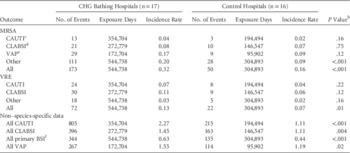
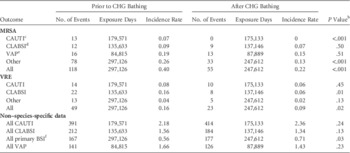
Hospitals that instituted protocols for CHG bathing had significantly higher overall incidence rates of total MRSA infections, total VRE infections, and all non–species-specific ICU infections compared with hospitals that did not implement CHG bathing (Table 1). Hospitals that implemented CHG bathing during the study period had significantly higher initial incidence rates of all combined MRSA infections and all combined VRE infections (Table 2). The incidence rates of non–species-specific ICU primary BSI significantly increased after implementation of CHG bathing among hospitals that started using CHG during the study period.
Overall Incidence of Selected Infections Occurring in INTENSIVE CARE UNITS at All Community Hospitals From January 1, 2008, Through December 31, 2013Footnote a

NOTE. CHG, chlorhexidine gluconate; MRSA, methicillin-resistant Staphylococcus aureus; CAUTI, catheter-associated urinary tract infection; CLABSI, central line-associated bloodstream infection; VRE, vancomycin-resistant Enterococcus species; VAP, ventilator-associated pneumonia; BSI, bloodstream infection; ICU, intensive care unit.
a Surveillance for VAP was performed from January 1, 2008, through December 31, 2012.
b Derived using the χ 2 test.
c Incidence rate calculated as number of infections per 1,000 ICU Foley days.
d Incidence rate calculated as number of infections per 1,000 ICU central-line days.
e Incidence rate calculated as number of infections per 1,000 ICU ventilator days.
f Incidence rate calculated as number of infections per 1,000 ICU patient days.
Aggregate Incidence of Hospital-Acquired Infections Occurring in Intensive Care Units at 17 Hospitals Prior to and After Implementation of Chlorhexidine Gluconate Bathing From January 1, 2008, Through December 31, 2013Footnote a

NOTE. CHG, chlorhexidine gluconate; BSI, bloodstream infection, incidence rate calculated as number of infections per 1000 intensive care unit patient days; MRSA, methicillin-resistant Staphylococcus aureus; CAUTI, catheter-associated urinary tract infection, incidence rate calculated as number of infections per 1000 intensive care unit Foley days; CLABSI, central-line–associated bloodstream infection, incidence rate calculated as number of infections per 1,000 intensive care unit central-line days; VAP, ventilator-associated pneumonia, incidence rate calculated as number of infections per 1,000 intensive care unit ventilator days; VRE, vancomycin-resistant Enterococcus species; ICU, intensive care unit.
a Surveillance for ventilator-associated pneumonia was performed from January 1, 2008, through December 31, 2012.
b Derived using the χ2 test.
c Incidence rate calculated as number of infections per 1,000 ICU Foley days.
d Incidence rate calculated as number of infections per 1,000 ICU central-line days.
e Incidence rate calculated as number of infections per 1,000 ICU ventilator days.
f Incidence rate calculated as number of infections per 1,000 ICU patient days.
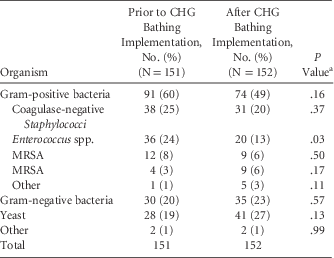
We reviewed species-specific data for 303 ICU CLABSIs before and after the implementation of CHG bathing (Table 3). Gram-positive bacteria were less commonly identified after initiation of CHG bathing, whereas Gram-negative bacteria and yeast species were more commonly identified after initiation of CHG bathing; however, these trends were not significant.
Microorganisms Isolated From CLABSIs Occurring in ICUs at 17 Community Hospitals Prior to and After Implementing Chlorhexidine Gluconate Bathing

NOTE. CLABSI, central-line–associated bloodstream infection; ICU, intensive care unit; CHG, chlorhexidine gluconate; MRSA, methicillin-sensitive Staphylococcus aureus.
a Based on crude incidence rate ratios.
Interrupted Time Series Analysis: Rate Trends
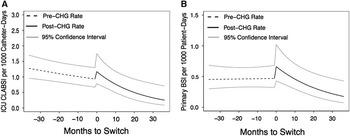
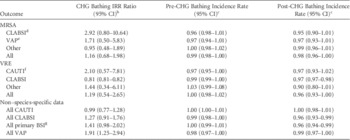
CHG bathing was associated with significant downward trends in incidence rates of ICU CLABSIs and ICU primary BSIs (Table 4). The incidence rate of ICU CLABSIs had a significant downward trend prior to implementation of CHG bathing, but the post-implementation trend was steeper (Figure A). Hospitals that implemented CHG bathing during the study period had a 1% decrease in ICU CLABSIs each month before implementation and a 4% decrease in ICU CLABSIs each month after implementation. ICU primary BSIs did not display a downward trend prior to CHG implementation, but there was a 4% decrease in BSIs each month after CHG bathing was implemented (Figure B).
Incidence rates of hospital-acquired infections in intensive care unit (ICU) patients before and after implementation of chlorhexidine gluconate bathing at 17 community hospitals are compared against incidence rates of hospital-acquired infections in ICU patients in 16 community hospitals that did not use chlorhexidine gluconate bathing for the following infections: (A) central-line associated bloodstream infection (CLABSI); (B) primary bloodstream infection (BSI).

Adjusted Incidence Rate Ratios and Linear Trends in Incidence Over Time Before and After Chlorhexidine Gluconate Bathing ImplementationFootnote a

NOTE. CHG, chlorhexidine gluconate; IRR, implementation incidence rate; CI, confidence interval; MRSA, methicillin-resistant Staphylococcus aureus; CLABSI, central-line–associated bloodstream infection; VAP, ventilator-associated pneumonia; VRE, vancomycin-resistant Enterococcus species; CAUTI, catheter-associated urinary tract infection; BSI, bloodstream infection; ICU, intensive care unit.
a Estimates obtained using a multivariate piecewise Poisson mixed-effects model. Surveillance for VAP was performed from January 1, 2008, through December 31, 2012. MRSA CAUTIs could not be modeled.
b Calculated as the rate during the month before CHG bathing implementation to the rate during the month of CHG bathing implementation.
c Monthly change in rate of infection.
d Incidence rate calculated as number of infections per 1,000 ICU central-line days.
e Incidence rate calculated as number of infections per 1,000 ICU ventilator days.
f Incidence rate calculated as number of infections per 1,000 ICU Foley days.
g Incidence rate calculated as number of infections per 1,000 ICU patient days.
CHG bathing was similarly associated with significant, downward trends in incidence rates of VRE CLABSIs and all combined VRE infections (Table 4). The incidence rate of VRE CLABSIs exhibited a significant downward trend prior to CHG bathing implementation and a steeper post-implementation trend. Hospitals that implemented CHG bathing during the study period had a 1% decrease in VRE CLABSIs each month before CHG bathing implementation and a 3% decrease in VRE CLABSIs each month after CHG bathing implementation. All combined VRE infections did not display a downward trend prior to CHG implementation, but there was a 4% decrease in VRE infections each month after CHG bathing was implemented.
The incidence rate of VRE CAUTIs decreased significantly prior to implementation of CHG bathing, but this trend was not seen after the implementation of CHG bathing. The incidence rate of non–species-specific ICU CAUTIs did not change before or after implementation of CHG bathing.
MRSA infection incidence rates (CLABSI, VAP, other, or all combined MRSA infections) did not significantly change prior to or following implementation of CHG bathing. Issues with the convergence of the statistical model prevented examination of MRSA CAUTI infections. The incidence rate of non-CLABSI, non-CAUTI VRE infections also was not affected by CHG bathing implementation. The rate of non–species-specific ICU VAPs decreased significantly prior to CHG bathing implementation, but this trend was not seen after CHG bathing was implemented.
Patient mix for each hospital and whether or not the hospital was engaged in active MRSA screening did not impact any estimates and thus were not included in the final models. Notably, for a number of the HAI incidence trends, a sharp increase or decrease in HAI incidence rate occurred during the first month after CHG bathing was implemented. This is likely the result of the pre-intervention time series, in which the data from all hospitals was used, whereas the post-intervention time series, by its very nature, only leveraged data from those hospitals that implemented CHG bathing. The immediate changes in HAI incidence rates are more likely statistical artifacts from the different pre-existing infection rates between control hospitals and those that implemented CHG bathing, rather than an outcome of the CHG bathing intervention itself.
DISCUSSION
Incidence rates of several important HAIs, including ICU CLABSIs, ICU primary BSIs, and VRE CLABSIs, declined after the implementation of CHG bathing in ICUs. Hospitals that implemented CHG bathing achieved a 59% decrease in ICU CLABSIs, a 36% decrease in ICU primary BSIs, and a 33% decrease in VRE CLABSIs after using CHG bathing for 12 months. Our findings largely support the results from previously published multicenter trials.Reference Climo, Yokoe and Warren 17 , Reference Huang, Septimus and Kleinman 19 , Reference Milstone, Elward and Song 20 However, our study was performed in multiple community hospitals in a real-world setting; thus, our study is the first to support the use of CHG bathing to decrease HAIs in ICU patients in a type 3 translational research setting.
Overall, our results support the findings of Climo et al,Reference Climo, Yokoe and Warren 17 who conducted a multicenter, cluster-randomized, nonblinded crossover study in which CHG bathing led to a significant decreases in primary BSIs, CLABSIs, and VRE infections, but not to a decrease in MRSA infections. Huang et alReference Huang, Septimus and Kleinman 19 and Milstone et alReference Milstone, Elward and Song 20 also found that CHG bathing led to a lower incidence of BSIs in their multicenter, cluster-randomized trials. Our findings contrast with those of Noto et al,Reference Noto, Domenico and Byrne 18 whose single-center, cluster-randomized, crossover study found that daily bathing with CHG did not reduce the incidence of CLABSIs.
Notably, implementation of CHG bathing did not significantly affect the incidence of MRSA CLABSIs, MRSA VAPs, or other MRSA infections. Hospitals that implemented CHG bathing exhibited a trend toward fewer MRSA CLABSIs; MRSA non-CLABSI, non-VAP infections; and all MRSA infections. It is possible that too few MRSA infections occurred at the study hospitals to realize a significant difference. However, other studies have also reported that CHG bathing does not impact MRSA infection rates.Reference Climo, Yokoe and Warren 17 , Reference Karki and Cheng 25 This finding further underscores the importance of using interrupted time series methods over strict before-and-after analyses. Our baseline analysis comparing aggregate rates of the different types of MRSA infections suggested that the rates were lower after implementing CHG bathing. In contrast, our controlled, multivariate, interrupted time series analysis did not support this conclusion. In other words, hospitals that evaluate the impact of interventions like CHG bathing using a single-center, quasi-experimental approach may lead to incorrect conclusions.
Lower rates of CLABSI due to Gram-positive cocci accounted for most of the observed decline in CLABSI rates in ICUs that implemented CHG bathing. The most common pathogen causing CLABSIs in hospitals prior to implementing CHG bathing were coagulase-negative Staphylococci (CoNS), whereas yeast species and Gram-negative bacteria became the most common causes of CLABSI after CHG bathing implementation. Other studies also saw a decrease in CoNS CLABSIs after the implementation of CHG bathing.Reference Climo, Yokoe and Warren 17 , Reference Huang, Septimus and Kleinman 19 , Reference Milstone, Elward and Song 20 While CLABSIs due to CoNS may often be contaminants, we believe that they are still treated as pathogens by clinicians. Thus, we conclude that decreasing the rate of CLABSIs caused by CoNS remains an important outcome for ICU patients.
CHG bathing to prevent CLABSIs is recommended for all ICU patients,Reference Marschall, Mermel and Fakih 26 but it is unclear whether hospitals with low baseline infection rates gain additional benefit from CHG bathing. In our study, hospitals that chose not to implement CHG bathing had significantly lower incidence rates of CAUTIs, CLABSIs, primary BSIs, all combined MRSA infections, and all combined VRE infections than did hospitals that implemented CHG bathing. Hospitals that did not implement CHG bathing also had a lower number of ICU patient days. One interpretation of these findings is that some hospitals, perhaps those with lower ICU utilization, may not need to use CHG bathing in their ICUs. It is possible that there is a threshold of MDRO colonization pressure and patient volume above which hospitals benefit from CHG bathing. Our study was not designed to evaluate this question, and further studies are warranted.
Our study has several limitations. First, our standard, prospective surveillance approach only included the specific outcomes described above. There may be additional important outcomes and confounders that we did not measure. The study population consists of hospitals that chose to participate in an infection control network, which may have caused selection bias. Additionally, we were not able to assess adherence to CHG bathing protocols or CHG bathing techniques. However, the practical use of CHG bathing will not be a controlled process, and thus we believe that our findings are representative of real-world use of CHG bathing. Our large cohort of community hospitals and the large amount of data that we accumulated over the study period further strengthens the applicability of our results.
In conclusion, our interrupted time series analysis suggests that hospitals that implemented CHG bathing over the study period achieved decreases in ICU CLABSIs, ICU primary BSIs, and VRE CLABSIs, but CHG bathing did not affect MRSA infection rates. Thus, our findings further support the use of daily CHG bathing of ICU patients, particularly in hospitals with high incidence rates of ICU CLABSIs, ICU primary BSIs, and VRE CLABSIs.
ACKNOWLEDGMENTS
Financial support: Dr. Anderson was supported by NIAID/NIH (grant no. K23AI095357).
Potential conflicts of interest: All authors report no conflicts of interest relevant to this article.