INTRODUCTION
Daily growth increments in otoliths are formed by a cyclic deposition of calcium and protein, and they are associated with the endogenous rhythms, which are synchronized with the photoperiod (Campana & Neilson, Reference Campana and Neilson1982). Daily increment formation in otoliths was first reported by Pannella (Reference Pannella1971), and since then age determination of fish has become widely used in growth studies (Vigliola, Reference Vigliola1997). These otolith increments have potential for the exact determination of hatching dates and early life history growth rates of wild fish populations (Campana & Neilson, Reference Campana and Neilson1982).
Development and growth in teleost fish is more or less directly under the control of environmental factors (temperature, salinity and food availability) (Wootton, Reference Wootton1990; Boeuf & Payan, Reference Boeuf and Payan2001). Brothers (Reference Brothers1981) reported that daily growth ring formations take place with daily temperature changes. Also, positive relationships between growth and temperature in marine fish have been reported by Houde (Reference Houde1989).
The common two-banded seabream is a demersal species that lives in the Mediterranean and the western Black Sea, along the eastern Atlantic coast from France to Senegal, including the Madeira, Azores and Canaries Archipelagoes, and from Angola to South Africa (Bauchot & Hureau, Reference Bauchot, Hureau, Whitehead, Bauchot, Hureau, Nielsen and Tortonese1986, Reference Bauchot, Hureau, Quero, Hureau, Karrer, Post and Saldanha1990). It can be found close to rocky and sandy bottoms, from shallow waters to a maximum depth of 160 m. Juveniles usually live in coastal lagoons and estuaries (Monteiro, Reference Monteiro1989; Ribeiro et al., Reference Ribeiro, Monteiro, Monteiro, Bentes, Coelho, Gonçalves, Lino and Erzini2008). Juvenile D. vulgaris specimens, less than 12 cm total length, make small movements while usually remaining in shallow areas, covered with seagrass where food is abundant and predators more scarce, in order to escape predation (Abecasis et al., Reference Abecasis, Bentes and Erzini2009).
The spawning season of D. vulgaris occurs mainly during winter (October–November) in the north-west Mediterranean (Bauchot & Hureau, Reference Bauchot, Hureau, Whitehead, Bauchot, Hureau, Nielsen and Tortonese1986). There are similarities in the spawning season (October–November) of this species with the studies of Gonçalves & Erzini (Reference Gonçalves and Erzini2000) on the south coast of Portugal and in Mediterranean areas (Jug-Dujaković & Glamuzina, Reference Jug-Dujaković and Glamuzina1988; Hadj Taieb et al., Reference Hadj Taieb, Ghorbel, Ben Hadj Hamida and Jarboui2012; Mouine et al., Reference Mouine, Francour, Ktari and Chakroun-Marzouk2012). Also, Hadj Taieb et al. (Reference Hadj Taieb, Ghorbel, Ben Hadj Hamida and Jarboui2013) reported that D. vulgaris is a winter spawner in the Gulf of Gabès.
The common two-banded seabream is commercially valuable and is important for the coastal and recreational fisheries in Turkey. This species has high commercial value, with a total catch of 195.2 tons in 2012, representing about 47.7% of total landings of common two-banded seabream from the Marmara and Aegean Seas (Tüik, 2012). The species is mainly caught by gill nets and longlines along the Turkish coasts. Despite the importance of the species, many aspects of its biology are unknown. Although data on the growth are very important for fisheries management (Pauly, Reference Pauly1983), published information on the growth of the common two-banded seabream is very scarce and focused only on adult populations (Gordoa & Molí, Reference Gordoa and Molí1997; Gonçalves et al., Reference Gonçalves, Bentes, Coelho, Correia, Lino, Monteiro, Ribeiro and Erzini2003; Pajuelo & Lorenzo, Reference Pajuelo and Lorenzo2003; Mouine et al., Reference Mouine, Ktari and Chakroun-Marzouk2010; Dulčić et al., Reference Dulčić, Pallaoro, Matić-Skoko, Dragičević, Tutman, Grgičević, Stagličić, Bukvić, Pavličević, Glamuzina and Kraljević2011; Hadj Taieb et al., Reference Hadj Taieb, Ghorbel, Ben Hadj Hamida and Jarboui2013). Daily increment formation in sagittal otoliths have been validated for D. vulgaris (Vigliola, Reference Vigliola1997; Villanueva & Molí, Reference Villanueva and Molí1997), and back-calculated spawning dates and pelagic larval duration have been determined (Macpherson & Raventos, Reference Macpherson and Raventos2006; Di Franco et al., Reference Di Franco, Qian, Calo, Di Lorenzo, Planes and Guidetti2013), but no studies on the daily growth rates have been conducted.
The main goal of the current study was to determine the daily growth rates and hatching periods of the D. vulgaris from Çanakkale, Turkey, by using otolith microstructure. This study also concerns the effects of temperature on the growth rates. Therefore, changes in the somatic growth rates in the declining sea temperature period (October–December) and lowest sea temperature period (January–March) were estimated.
MATERIALS AND METHODS
Study area and sampling
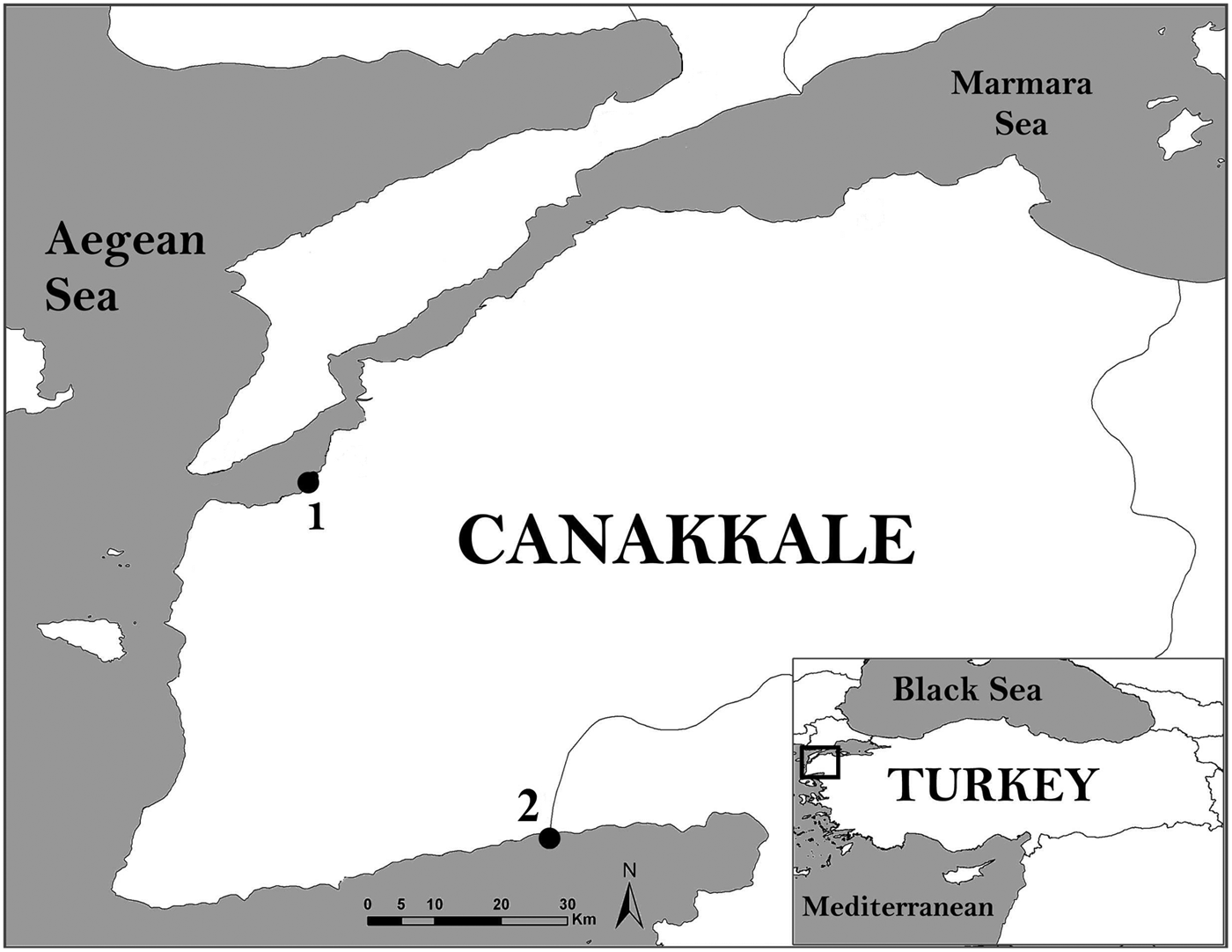
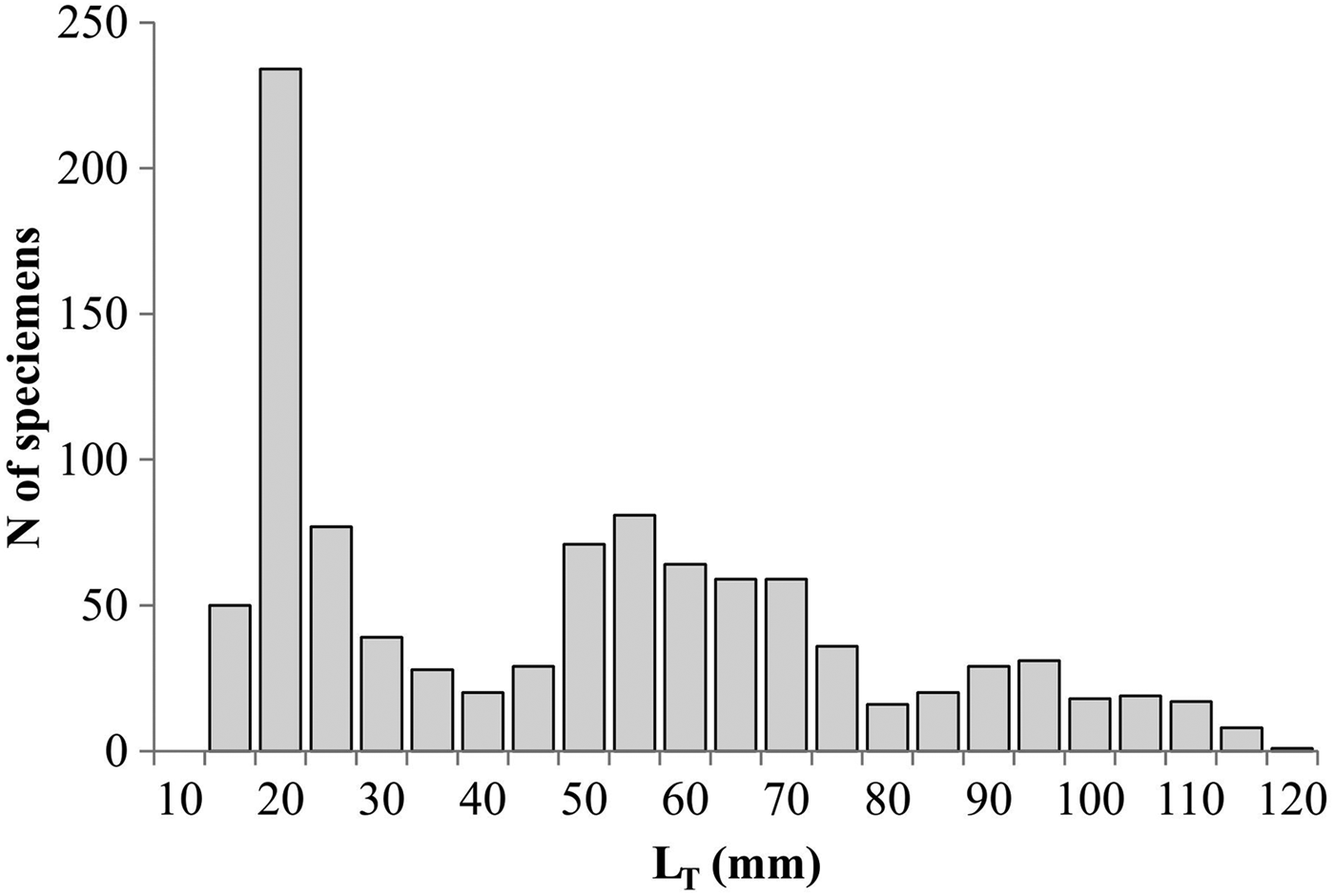
Fish collection was carried out in the shallow waters (0–2 m) of Çanakkale surrounded by the north Aegean Sea, Çanakkale Strait and Sea of Marmara (Figure 1). The shallow waters of Çanakkale stretch for 671 km, and include Çanakkale Strait (Site 1), the north Aegean Sea (Site 2), and the Sea of Marmara. Çanakkale Strait is characterized by complex current systems (Beşiktepe et al., Reference Beşiktepe, Özsoy and Ünlüata1993; Tugrul et al., Reference Tugrul, Besiktepe and Salihoglou2002). These shallow waters are completely exposed to strong currents and wave actions. Samples were collected at two sites with a beach seine of 32 m in total length, with 15 m wing lengths. The net was constracted of 13 mm stretch mesh. The dimensions of the bag were 2 × 2 × 0.6 m, and the bag was constracted with 5 mm mesh. Sampling sites were chosen according to small-scale fishing grounds for Diplodus vulgaris. These two sites were sampled once a month between January and December 2007. The hauls were made parallel to the shore randomly on two occasions and at least 100 m apart. A total of 882 young of the year (YOY) common two-banded seabream, ranging from 11 to 108 mm in total length (L T) were collected during the 12 months in Çanakkale shallow waters (Figure 2; Table 1). Processing very large numbers of otoliths is time consuming. Therefore, a total of 263 (nearly 30% of the total catch) otoliths were processed for daily ring counts as a subsample. Subsamples were randomly selected from all collections.
Map of the Çanakkale coastline indicating locations where samples of young of the year Diplodus vulgaris were collected (•).

Length–frequency distribution of young of the year Diplodus vulgaris collected in the Çanakkale shallow waters during the sampling period (January–December 2007). N = 882.

Sampling sites with the number of specimens of total and otolith processed Diplodus vulgaris collected from Çanakkale shallow waters in January and December 2007.

N, total number of specimens; Min, minimum; Max, maximum.
The surface water temperature was measured with a Hach-Lange HQ40d probe during samplings. Monthly average sea surface water temperatures for the Çanakkale shallow waters during the study were recorded between 14.3 and 27.0°C. The effects of temperature on seasons were analysed by repeated measures ANOVA.
Laboratory procedures
Total length (L T) of the collected YOY common two-banded seabream was measured with a calliper to the nearest 0.1 mm, and they were weighed with an electric balance to the nearest 0.01 g. Sagittal otoliths (left and right) were removed, cleaned of adhering tissue, dried and stored in clean micro vials. From each pair, one otolith was randomly selected and mounted on a glass slide with thermoplastic cement. Each otolith was ground with a series of abrasive papers of decreasing roughness from 12 to 9 to 3 µm and polished with 0.3 µm alumina paste on a polishing cloth until daily rings were discernible from the centre to the edge (Miller & Storck, Reference Miller and Storck1982; Secor et al., Reference Secor, Dean and Laban1991; Jones, Reference Jones, Stevenson and Campana1992; Hayes, Reference Hayes1995). The process was checked frequently under a light microscope to avoid over-polishing the centre. Counts of rings in each otolith were blind-read; the information about fish length and date of capture was withheld from the reader. All otoliths were read twice and final age estimates achieved when the differences, obtained from the two readings, were less than 4 days for the younger specimens (up to 100 days old) and less than 10 days for the older specimens (more than 100 days old). A third reading was performed if the first two readings differed by more than 4 or 10 days, respectively. If the contradiction persisted, the otolith was discarded. The mean from the two readings was used when the differences between two readings were less than 4 days (up to 100 days old) or 10 days (older than 100 days old). A system microscope Olympus BX 51 with objective lenses with nominal magnifications of 20 × , 40× and 100× was used for the daily ring counts. The daily rings were counted from the nucleus to the dorso-posterior axis, however, the readings were not always countable in a linear axis.
Data analysis
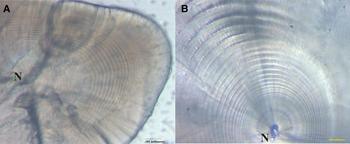
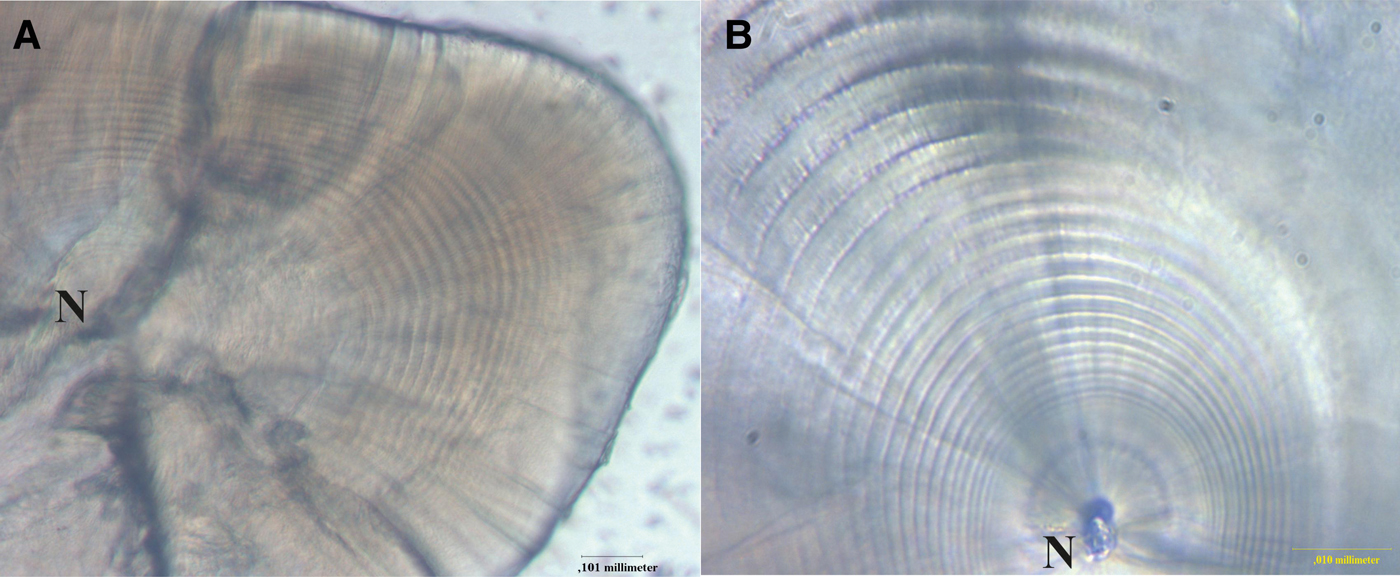
Age was determined by counting the number of increments from the nucleus to the outer edge (Figure 3). Paired t-tests were used to determine if there were different daily age counts between left and right otoliths. No significant differences in increment counts were found between left and right otoliths (paired t-test, N = 30, P > 0.05), so for further daily age estimations only one otolith was randomly selected. The precision of the daily ring counts was calculated using the average percentage error (APE) of Beamish & Fournier (Reference Beamish and Fournier1981) and coefficient of variation (CV) (Chang, Reference Chang1982; Campana, Reference Campana2001). An age–length key was generated to give the probability of age in given length.
Polished sagittal otolith of 19 mm total length (L T) young of the year Diplodus vulgaris aged 57 days. N, nucleus.
GROWTH RATES
The relationship between fish size (L T) and age (days) was assessed by linear regression which corresponds to an average growth rate (mm day−1). In order to determine temperature effects on the somatic growth rates, aged fish were grouped into two cohorts; first, declining sea temperature period (October–December) and second, lowest sea temperature period (January–March), according to the hatching dates. Differences in growth rates between these two cohorts were tested using analysis of covariance (ANCOVA). In all data analyses, statistical significance level (α) was set at 0.05.
HATCH DATE
Hatch date distributions were back-calculated by subtracting the number of otolith growth increments from the date of capture.
RESULTS
In the present study, repeated measures ANOVA showed that sea surface temperatures determined important differences between seasons (P < 0.05). A total of 263 otoliths were processed for daily ring counts, however, 23 pairs of the sagittal otoliths were over-ground, cracked or gave conflicting age readings during the process. Thus, 240 otoliths obtained from YOY D. vulgaris that ranged between 12 and 86 mm L T were used in the analyses.
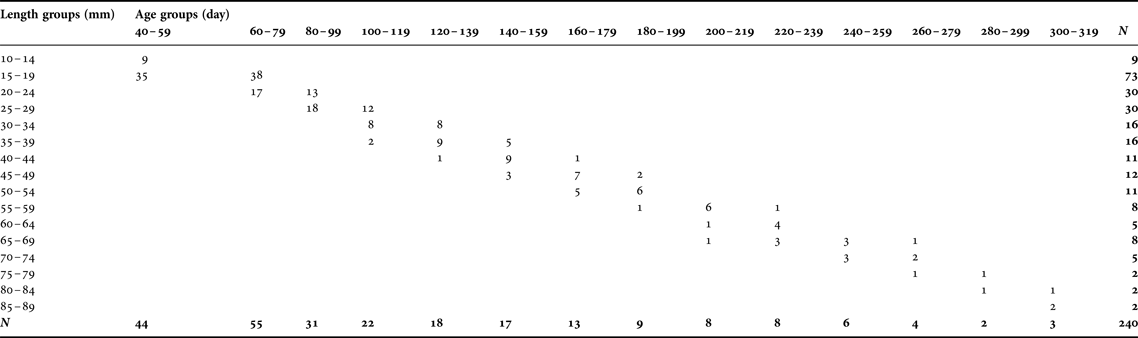
The estimated age obtained from the increment counts of the otoliths ranged between 42 and 313 days (Table 1; Figure 3). The largest individual (86 mm L T) was estimated as 313 days old, whereas the smallest measured individual (12 mm L T) was estimated as 42 days old. The age group 60–79 days (15–24 mm) was the dominant age group (22.9%). A general decline in number of specimens was apparent as the fish got older (Table 2).
Age–length key for young of the year common two-banded seabream, Diplodus vulgaris.
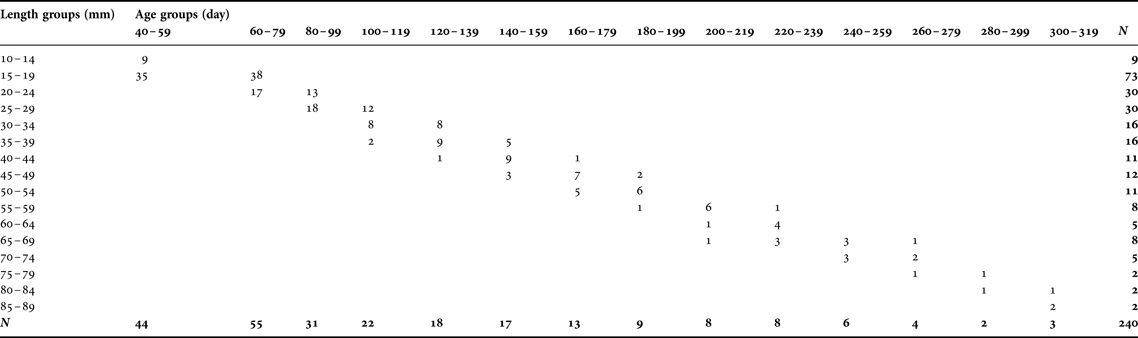
N, total number of specimens.
Precision of daily ring counts estimates was calculated as APE 6.2% and CV 8.41%. An APE and CV values which are below 10% comprise an acceptable ageing accuracy between ageing estimates.
Growth rates
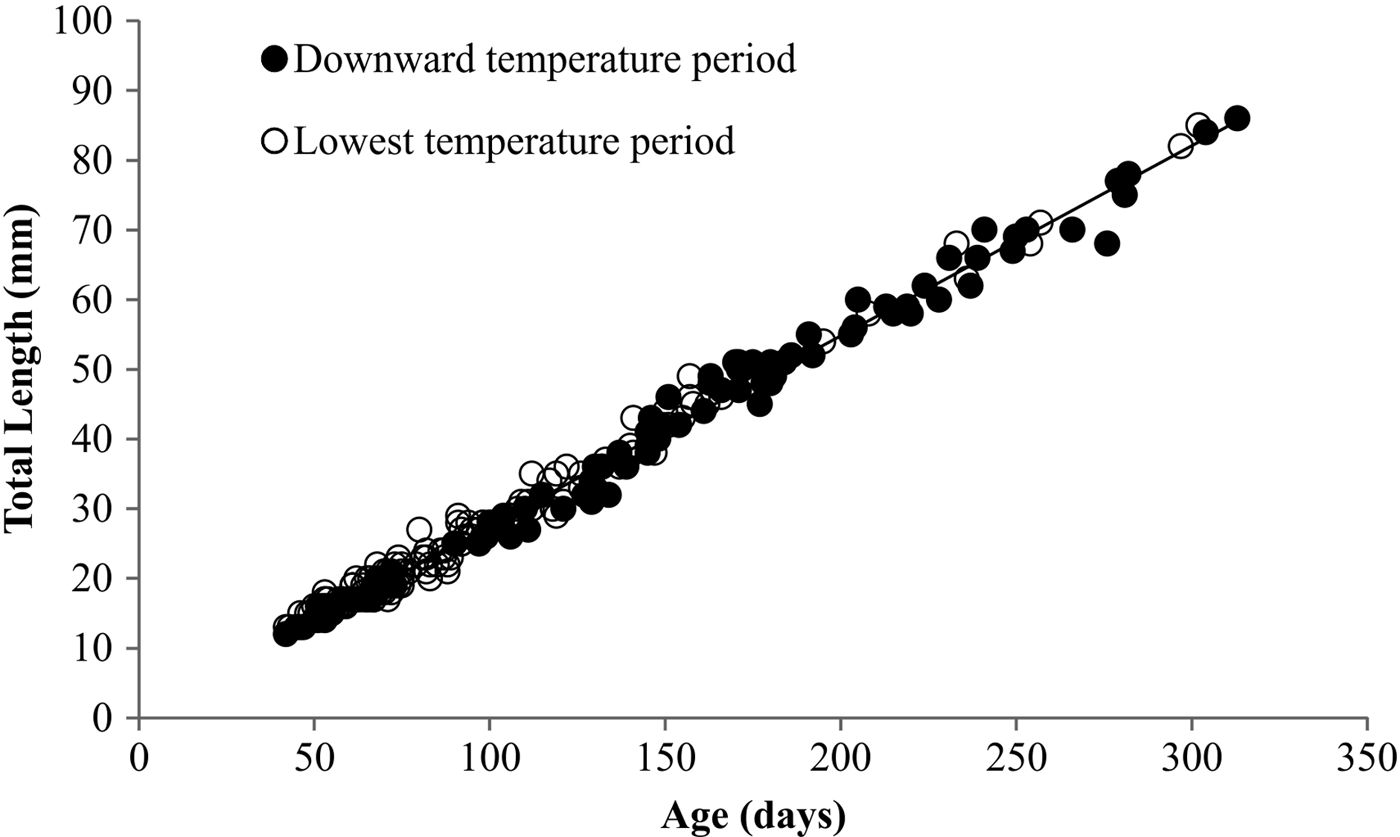
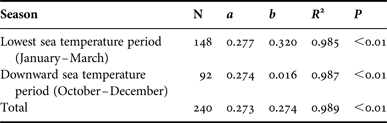
The daily growth rate of YOY D. vulgaris was estimated by fitting a linear regression to the entire length–age data set (Figure 4A). Length–age regression analysis resulted in somatic growth rates of 0.273 mm day−1. To test for temperature effects on the growth rate of YOY D. vulgaris, linear regressions were fitted to the age–length data for larvae hatched during the two periods as defined above. According to the length–age regression analysis, maximum daily growth rates were found to be 0.277 mm day−1 in the lowest sea temperature period and minimum values of 0.274 mm day−1 were observed in the declining sea temperature period (Table 3). ANCOVA indicated that there were no significant differences in slope between the equations (F = 0.4008, P = 0.527).
Age–length relationships estimated for young of the year Diplodus vulgaris during two periods collected from shallow waters of Çanakkale, Turkey.

Parameters of the length-at-age linear relationships for different seasons of Diplodus vulgaris in Çanakkale shallow waters, Turkey.
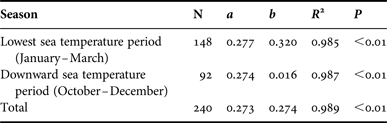
N is the number of specimens, ‘a’ is the slope of the regression line, ‘b’ is y-intercept and R 2 is the coefficient of determination.
Hatch date
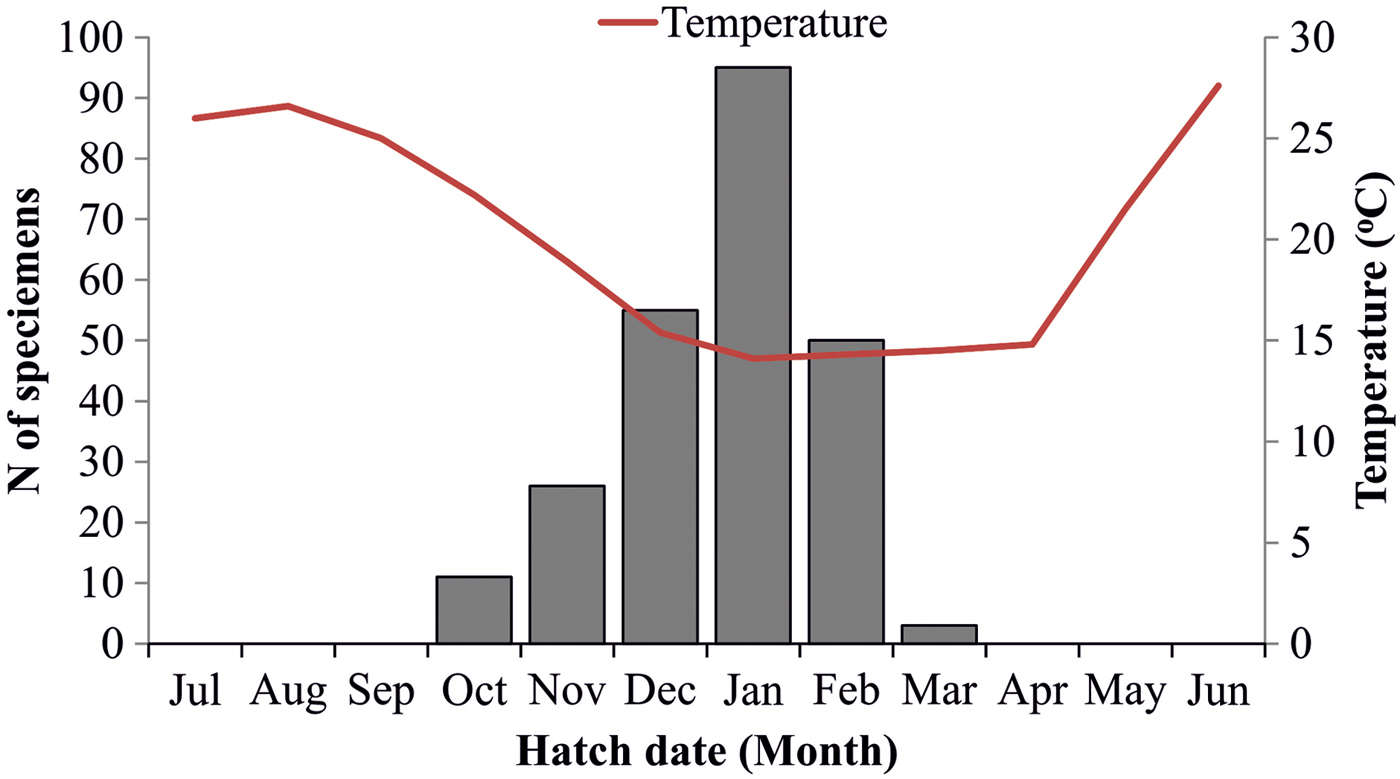
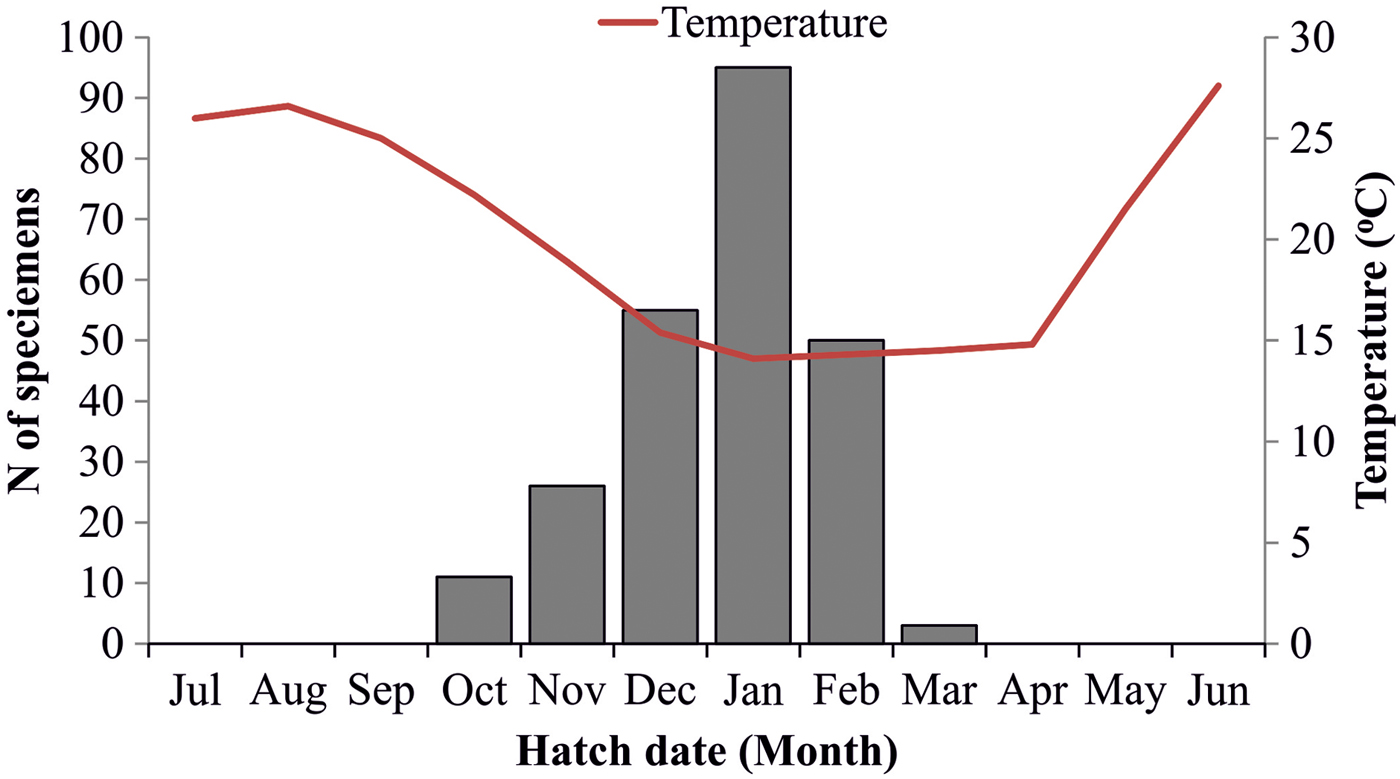
Hatching time of the YOY D. vulgaris was estimated to occur between October and March, with relatively higher hatching frequency in January (Figure 5).
Hatch date monthly distributions of young of the year Diplodus vulgaris back-calculated from age estimates and date of capture with mean surface water temperature. The line corresponds to temperature and the boxes to numbers of larvae hatched.
DISCUSSION
Otolith microstructure analysis for Diplodus vulgaris could be an acceptable method for age estimation in the juvenile stages (Vigliola, Reference Vigliola1997). Present results showed that the sagittal otoliths of the YOY D. vulgaris have the common ring pattern with a pair of opaque and translucent marks (Figure 3). Daily growth increments of the YOY D. vulgaris sagittal otoliths were clearly identifiable. Also, the index of average percentage error and coefficient of variation were calculated to be less than 10%, so the readings are acceptable according to Campana (Reference Campana2001).
The age group 60–79 had relatively higher frequency (22.9%) than older age groups. A general decline in number of specimens was apparent as the fish got older (Table 2). The decline in the number of the older fish might not only be due to mortality, but also partially due to movements of the larger size fish to deeper waters. Harmelin-Vivien et al. (Reference Harmelin-Vivien, Harmelin and Leboulleux1995) reported that individual sizes of the six species of Sparidae (Diplodus annularis, D. puntazzo, D. sargus, D. vulgaris, Oblada melanura and Sarpa salpa) increased when depth increased from the rocky shore near Marseill on the French Mediterranean coast. Shallow seagrass areas are continuously used by juveniles of D. sargus and D. vulgaris up to 12 cm, but larger fish use bigger areas and leave these coastal areas (Abecasis et al., Reference Abecasis, Bentes and Erzini2009). Also, juveniles of Sparidae are usually found in shallow waters in relatively bigger groups, but group sizes decrease when the juveniles get older (Macpherson, Reference Macpherson1998). So the shortage of larger fish is also partially because the larger fish in smaller groups have more chance of escaping the sampling gear.
For many fish species, growth rate and mortality in the early life stages are closely connected, with faster-growing fish having higher survivorship (Sim-Smith et al., Reference Sim-Smith, Jeffs and Radford2012). Slow-growing fish have a high mortality rate in the wild (Kingsford & Atkinson, Reference Kingsford and Atkinson1994). In this study, the average somatic growth rate of the YOY D. vulgaris was estimated as 0.273 mm day−1. This is a little higher than the growth rate of approximately 0.24 mm day−1 indicated by the data of Monteiro (Reference Monteiro1989) from juveniles of D. vulgaris in the Ria Formosa lagoon. Daily age validation of the D. vulgaris in the Mediterranean has been studied under experimental conditions, and growth rate was determined as 0.15 and 0.20 mm day−1 (Vigliola, Reference Vigliola1997). The growth results from Çanakkale differed from those of the Mediterranean (Vigliola, Reference Vigliola1997), probably due to the experimental conditions. Also, daily growth rates obtained from its congener D. annularis have been found to be 0.369 mm day−1 in the shallow waters of Çanakkale, Turkey (Ayyildiz et al., Reference Ayyildiz, Ozen and Altin2014). This result may be explained by the different species, although they were both sampled from the same region.
Growth of the YOY fish is affected by various physical and biological variables and temperature (Houde, Reference Houde1989; Wootton, Reference Wootton1990). The roles of temperature and food supply for determining the growth of fish are essential (Perrier et al., Reference Perrier, Molinero, Gerdeaux and Anneville2012). In the present study, maximum growth rates of YOY D. vulgaris have been estimated in the lowest sea temperature period (January–March) and lowest growth rate were determined in the declining sea temperature period (October–December). The study has shown a slightly faster growth rate in the lowest sea temperature period. However, ANCOVA indicated that the observed differences between periods in this study were not statistically significant (P = 0.527). This result may be explained by the fact that growth rate is not affected by only environmental factors (temperature and food availability) but also genetic factors (Oozeki et al., Reference Oozeki, Watanabe and Kitagawa2004).
Hatching period of the YOY D. vulgaris occurred between October and March, with relatively higher hatching frequency in January. The maximum hatching frequency in D. vulgaris was observed in the winter when temperature was the lowest. Di Franco et al. (Reference Di Franco, Qian, Calo, Di Lorenzo, Planes and Guidetti2013) reported that spawning dates of D. vulgaris ranged from 20 October to 14 February, while more than 60% occurred in December in the south-western Adriatic Sea. The spawning period estimated by microscopic examination of the gonads and the gonadosomatic index indicated that spawning occurs once a year between November and February, with peak activity in November and December in the Gulf of Gabès, Tunisia (Hadj Taieb et al., Reference Hadj Taieb, Ghorbel, Ben Hadj Hamida and Jarboui2012). Previous research related to sparid reproduction showed that spawning seasonality correlated with food availability and sea temperature (Pajuelo et al., Reference Pajuelo, Lorenzo, Bilbao, Ayza and Ramos2006). According to Wootton (Reference Wootton1990), temperature is the most important environmental factor among those that may influence the reproduction of fish. In this study common two-banded seabream spawned when the sea temperature decreased (Figure 5), as has been observed in the same species in different regions, on the south coast of Portugal (Gonçalves & Erzini, Reference Gonçalves and Erzini2000) and Mediterranean Sea (Jug-Dujaković & Glamuzina, Reference Jug-Dujaković and Glamuzina1988; Mouine et al., Reference Mouine, Francour, Ktari and Chakroun-Marzouk2012). These previous studies all pointed to the winter spawning time, which was confirmed by the otolith microstructure analysis in the present study and in the south-western Adriatic Sea (Di Franco et al., Reference Di Franco, Qian, Calo, Di Lorenzo, Planes and Guidetti2013). The spawning season of common two-banded seabream could also change from year to year as a function of temperature, photoperiod and food availability (Gonçalves & Erzini, Reference Gonçalves and Erzini2000; Morato et al., Reference Morato, Afonso, Lourinho, Nash and Santos2003; Pajuelo et al., Reference Pajuelo, Lorenzo, Bilbao, Ayza and Ramos2006).
The present study provides some insight into the daily age, growth rates and hatching periods of the early life stage of YOY D. vulgaris in the Çanakkale shallow waters. Determining the parameters of YOY D. vulgaris growth rates and hatching periods will lead to estimates of the relevant parameters of population dynamics and to a better understanding of the long-term changes in the stock size of YOY D. vulgaris in the Çanakkale shallow waters.
ACKNOWLEDGEMENT
Thanks to A. Oztekin for logistical support in the field.
FINANCIAL SUPPORT
This study was funded by The Scientific and Technological Research Council of Turkey (TUBITAK project number: 106T123).