Introduction
Cryptothecia, a widespread genus in the family Arthoniaceae (Arthoniales) is represented by 53 species (Thor Reference Thor1997; Sparrius & Saipunkaew Reference Sparrius and Saipunkaew2005). The genus was established by Stirton (Reference Stirton1877) and subsequently a large number of species was added by various workers. Makhija & Patwardhan (Reference Makhija and Patwardhan1985, Reference Makhija and Patwardhan1987, Reference Makhija, Patwardhan, Sarma, Saini, Trivedi and Sharma1994) studied the genus at world level and recognized 40 species including many new species from India. Later, Lücking (Reference Lücking1995), Thor (Reference Thor1997), Sipman (Reference Sipman2003), Sparrius & Saipunkaew (Reference Sparrius and Saipunkaew2005), Lücking et al. (Reference Lücking, Thor, Aptroot, Kalb and Elix2006), Elix (Reference Elix2007, Reference Elix2008) and Wolseley & Aptroot (Reference Wolseley and Aptroot2009) also added several species to the genus. The lichen genus Herpothallon was established by Tobler (Reference Tobler1937) and included in the non-lichenized basidiomycetes. It was later recognized as an ascolichen and referred to as Chiodecton and Cryptothecia in the Roccellaceae and Arthoniaceae, respectively (Aptroot et al. Reference Aptroot, Thor, Lücking, Elix and Chaves2009). Recently, Aptroot et al. (Reference Aptroot, Thor, Lücking, Elix and Chaves2009) reinstated the genus in Cryptothecia s. lat. by including all the sterile, crustose-byssoid species and also discussed the circumscription of the genus and recognized 29 species world-wide. While studying the lichens in eastern India (Assam, Meghalaya, Sikkim and West Bengal) five new species in Cryptothecia and two new species and two new records in Herpothallon have been discovered. These new species are described below and short notes on the new records are provided.
Material and Methods
Specimens collected from eastern India and deposited in ASSAM and BSA were investigated. Thin hand-cut sections of thalli and ascigerous parts (ascomata) were mounted in water, 10% KOH solution, Lugol's iodine solution and lactophenol cotton blue (LCB) and examined with a Leica DM 2500 research microscope. The lichen substances were identified by thin-layer chromatography following White & James (Reference White and James1985).
The New Species
Cryptothecia alboglauca Jagadeesh Ram, G. P. Sinha & Kr. P. Singh sp. nov
Thallus corticola, epiphloeodes, albo-griseus ad glauco-griseus, laevigatus, vel rimosus, verrucosus; isidia et soredia non visa; asci frequentes, aggregati, 6-8-spori, 140–185 × 135–168 μm; ascosporae hyalinae, ellipsoideae ad ovoideae, muriformes, transverse 8–9- et longitudinaliter 2-6 -septatae, (55–)66–110(–125) × 38–55 μm.
Typus: India, West Bengal, Sundarbans Biosphere Reserve, Matla mangrove forests, alt. sea level, onHeritiera fomes, 28 February 2004, T. A. M. Jagadeesh Ram 1045 (BSA— holotypus; CAL—isotypus).
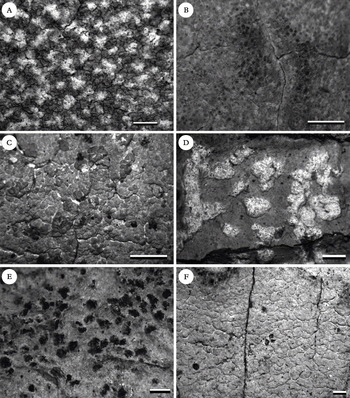
Habit of Cryptothecia species. A, C. alboglauca (holotype); B & C, C. bengalensis (holotype), B, younger portion, C, older portion; D, C. farinosa (holotype); E, C. multipunctata (holotype); F, C. verruculifera (holotype). Scale = 1 mm.

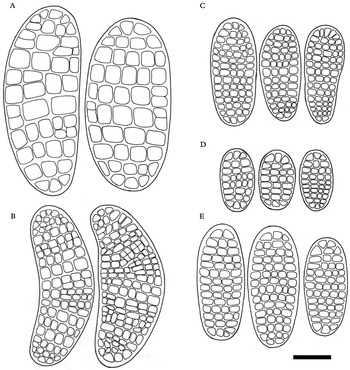
Cryptothecia, ascospores. A, C. alboglauca (holotype); B, C. bengalensis (holotype); C, C. farinosa (holotype); D, C. multipunctata (holotype); E, C. verruculifera (holotype). Scale = 20 μm.

Thallus corticolous, epiphloeodal, tightly attached, suborbicular to irregular, 5–10 cm across, whitish grey to glaucous grey, smooth, felty, becoming verrucose, finely cracked, lacking isidia and soredia, heteromerous, 110–350 μm thick. Prothallus distinct, whitish, byssoid, mainly of radiating loosely interwoven hyphae, 1–2 mm wide, dark brown to black while bordering the same or different species. Photobiont Trentepohlia, in short, irregular threads, single to aggregated. Medulla white, with calcium oxalate crystals; crystals few to many, 3–35 μm wide; medullary hyphae 1·5–3 μm wide.
Ascigerous parts (ascomata) externally visible as whitish areas, irregular, not raised, 0·3–0·8(–1·0) mm diam. Paraphysoids enclosing the asci, tightly attached, I+ blue, KI+ blue. Asci frequent, solitary in the medulla or aggregated in whitish areas, globose, 6–8-spored, 140–185 × 135–168 μm. Ascospores colourless, ellipsoid to ovoid or broadly ellipsoid, muriform, with 8–9 transverse septa and 2–6 longitudinal septa, (55–)66–110 (–125) × 38–55 μm.
Chemistry. Medulla K−, C−, KC−, P−; I+ and KI+ blue in patches (section); no lichen substances detected by TLC.
Remarks. Cryptothecia alboglauca is characterized by the glaucous grey, heteromerous, cracked thallus with whitish ascigerous parts, 6–8-spored asci, rather large ascospores and the absence of lichen substances. The thallus and ascospores of this species resemble C. genuflexa (Müll. Arg.) R. Sant. and C. monospora (Vain.) Makhija & Patw., but both the latter species have norstictic and psoromic acids, respectively. Lack of substances is also found in C. dissimilis Makhija & Patw., but that species has an homoiomerous thallus, distinctly elevated ascigerous parts with exposed asci and rather small ascospores (Makhija & Patwardhan Reference Makhija and Patwardhan1987, Reference Makhija, Patwardhan, Sarma, Saini, Trivedi and Sharma1994). At present C. alboglauca is known only from the mangrove reserve, Sundarbans Biosphere Reserve, West Bengal.
Additional specimen examined. India: West Bengal: Sundarbans Biosphere Reserve, Goshaba mangrove forest, alt. sea level, on Excoecaria agallocha, 2004,Jagadeesh Ram 1081 (BSA).
Cryptothecia bengalensis Jagadeesh Ram, G. P. Sinha & Kr. P. Singh sp. nov
Thallus corticola, epiphloeodes, viridi-albus ad viridi-griseus, verrucosus; isidia et soredia non visa; asci frequentes, non aggregati, 6–8-spori, 110–180 × 95–155 μm; ascosporae hyalinae, ellipsoido-oblongae ad ovoido-oblongae, muriformes, transverse 14–20- et longitudinaliter 2-8 -septatae, 70–132 × 25–46 μm.
Typus: India, West Bengal, Sundarbans Biosphere Reserve, Netidopani mangrove forest, alt. sea level, on Excoecaria agallocha, 24 February 2003, T. A. M. Jagadeesh Ram 13458 (BSA—holotypus).
Thallus corticolous, epiphloeodal, tightly attached, irregular, up to 20 cm across, greenish white to greenish grey, felty, verrucose, lacking isidia and soredia, heteromerous, 95–270 μm thick, up to 700 μm thick in older portions. Prothallus whitish, byssoid, mainly of radiating loosely interwoven hyphae, up to 3 mm wide, dark brown to black while bordering the same or different species. Photobiont Trentepohlia, in short, irregular threads, single to aggregated. Medulla white, with calcium oxalate crystals; crystals few, 3–10 μm wide.
Ascigerous parts (ascomata) extensive, indistinct. Paraphysoids enclosing the asci, tightly attached, I+ pale blue, KI+ pale blue. Asci frequent, solitary in medulla, weakly or not aggregated, globose to subglobose, 6–8-spored, 110–180 × 95–155 μm. Ascospores colourless, oblong-ellipsoid to oblong-ovoid, straight to slightly curved, muriform, with 14–20 transverse septa and 2–8 longitudinal septa, 70–132 × 25–46 μm.
Chemistry. Medulla K−, C−, KC−, P−; I+, KI+ blue in patches (section); no lichen substances detected by TLC.
Remarks. Cryptothecia bengalensis is characterized by the greenish white to greenish grey, verrucose thallus, indistinct ascigerous parts, 6–8-spored asci, rather large ascospores and the absence of lichen substances. It resembles C. stirtonii A. L. Sm. morphologically, which contains psoromic acid in the thallus. Cryptothecia alboglauca and C. dissimilis Makhija & Patw also lack substances, but C. alboglauca has a cracked thallus, whitish ascigerous parts and ellipsoid to ovoid ascospores with fewer septa, while C. dissimilis Makhija & Patw. has an homoiomerous thallus and distinctly elevated ascigerous parts with exposed asci (Makhija & Patwardhan Reference Makhija and Patwardhan1987, Reference Makhija, Patwardhan, Sarma, Saini, Trivedi and Sharma1994). At present C. bengalensis is known only from the type locality.
Cryptothecia farinosa Jagadeesh Ram, G. P. Sinha & Kr. P. Singh sp. nov
Thallus corticola, endophloeodes, glauco-griseus ad griseus vel albo-griseus, laevigatus; isidia et soredia non visa; asci frequentes, in aream elevatam albam aggregati, 8-spori, 75–125 × 72–115 μm; ascosporae ovoideae ad ellipsoideae, muriformes, transverse 12–15 -et longitudinaliter 1–6 -septatae, (40–)46–56(–64) × (18–)21–26(–28) μm; acida psoromicum et substantia ignota continentia.
Typus: India, Sikkim, Rumtek, alt. c. 1223 m, 25 November 2006, G. P. Sinha 3756 (BSA—holotypus).
Thallus corticolous, endophloeodal, tightly attached, irregular, 1·5–6 cm across, glaucous grey to grey, whitish grey, thin, smooth, ± even, continuous, byssoid, homoiomerous, 15–30(–35) μm thick, lacking isidia and soredia, with calcium oxalate crystals; crystals few, 2·5–10 μm wide. Prothallus indistinct, forming a dark brown to black line while bordering the same species or different species. Photobiont Trentepohlia, in short, irregular threads, single to aggregated.
Ascigerous parts (ascomata) whitish, raised, rounded to elongated, irregular, 0·7–2 mm diam. if rounded, 0·5–3 mm long and 0·5–2 mm wide if elongated, up to 500 μm high; surface, farinose to granular. Paraphysoids enclosing the asci, loosely attached, I−, KI−. Asci aggregated in whitish ascigerous areas, often externally visible as brownish dots, globose, 8-spored, 75–125 × 72–115 μm. Ascospores colourless, ovoid to ellipsoid, straight, often slightly constricted at the middle, muriform, with 12–15 transverse septa and 1–6 longitudinal septa, (40–)46–56(–64) × (18–)21–26(–28) μm.
Chemistry. Thallus K−, C−, KC−, P+ yellow; I−, KI+ pale blue in patches (section); psoromic acid (major) and an unknown minor substance (greenish yellow spot at 7) found in solvent system A.
Remarks. Cryptothecia farinosa is characterized by the thin homoiomerous thallus, whitish raised farinose ascigerous parts and the presence of psoromic acid. The ascospores and chemistry of the species resemble C. verrucominuta Makhija & Patw., which has a thick, distinctly cracked, heteromerous thallus, immersed to slightly emergent ascigerous parts and comparatively larger ascospores with more septa (Makhija & Patwardhan Reference Makhija, Patwardhan, Sarma, Saini, Trivedi and Sharma1994). At present C. farinosa is known only from the Eastern Himalayan region (Sikkim).
Additional specimen examined. India: Sikkim: Gangtok, Dikchu-Singtam road, Tumin, alt. c. 1489 m, 2006, G. P. Sinha 3636 (BSA).
Cryptothecia multipunctata Jagadeesh Ram, G. P. Sinha & Kr. P. Singh sp. nov
Thallus corticola, endophloeodes, albus ad albo-griseus, laevigatus; isidia et soredia non visa; asci frequentes, aggregati, 6–8-spori, 55–68 × 55–66 μm; ascosporae hyalinae, ellipsoideae ad ovoideae, muriformes, transverse 8–10 -et longitudinaliter 2–5-septatae, 38–42 × 16–20 μm; acidum psoromicum continens.
Typus: India, West Bengal, Sundarbans Biosphere Reserve, Chulkati Island mangrove forests, alt. sea level, on Excoecaria agallocha, 16 March 2002, T. A. M. Jagadeesh Ram 12105 (BSA—holotypus).
Thallus corticolous, endophloeodal, tightly attached, irregular, 2–3 cm across, white to whitish grey, smooth, continuous, lacking isidia and soredia, homoiomerous, 44–70 μm thick, with calcium oxalate crystals; crystals few, 4–15 μm wide. Prothallus indistinct, whitish, forming a dark brown to black line at the borders. Photobiont Trentepohlia, in short, irregular threads, single to aggregated.
Ascigerous parts (ascomata) externally visible as slightly elevated, ± rounded to irregular brownish areas formed by aggregated asci, 0·2–0·5(–0·7) mm diam. Paraphysoids enclosing the asci, tightly attached, I+ pale blue, KI+ pale blue. Asci frequent, aggregated in ascigerous parts, externally visible as brownish dots, globose, 8-spored, 55–68 × 55–66 μm. Ascospores colourless, ellipsoid to ovoid, muriform, with 8–10 transverse septa and 2–5 longitudinal septa, 38–42 × 16–20 μm.
Chemistry. Thallus K−, C−, KC−, P+ yellow; I−, KI+ pale blue in patches (section); psoromic acid detected by TLC.
Remarks. Cryptothecia multipunctata is characterized by a partly endophloeodal homoiomerous thallus, slightly elevated brownish ascigerous parts, rather small ascospores and the presence of psoromic acid. Cryptothecia atropunctata G. Thor, C. exilis G. Thor, C. farinosa Jagadeesh Ram et al. and C. verrucominuta Makhija & Patw. are the other species having psoromic acid as major substance, but all of these have rather large ascospores. The ascospores resemble those of C. albomaculata Makhija & Patw., but that species has distinct, larger, white ascigerous parts and lacks psoromic acid (Makhija & Patwardhan Reference Makhija, Patwardhan, Sarma, Saini, Trivedi and Sharma1994; Thor Reference Thor1997). At present C. multipunctata is known from the type locality only.
Cryptothecia verruculifera Jagadeesh Ram, G. P. Sinha & Kr. P. Singh sp. nov
Thallus corticola, epiphloeodes, albo-griseus, verruculosus; isidia et soredia non visa; asci frequentes, non aggregati, 6–8-spori, 77–140 × 55–72 μm; ascosporae hyalinae, ellipsoideae ad ovoideae, muriformia, transverse 9–14- et longitudinaliter 2–5-septatae, 38–62 × 20–25 μm; acidum perlatolicum continens.
Typus: India, West Bengal, Darjeeling district, Kanchan View Tea Estate, alt. c. 2250 m, on shade tree, 15 May 2005, V. N. Singh 2255 (BSA—holotypus).
Thallus corticolous, epiphloeodal, tightly attached, suborbicular to irregular, up to 8·5 cm diam., dull, whitish grey, verruculose, cracked, heteromerous, up to 400 μm thick, lacking isidia and soredia. Prothallus whitish, pale brown at the margin, byssoid, mainly of radiating hyphae, 1–2 mm wide. Photobiont Trentepohlia, in short, irregular threads, single to aggregated. Medulla white, with calcium oxalate crystals; crystals few, 3–10 μm wide; medullary hyphae 1–3 μm wide.
Ascigerous parts (ascomata) extensive, externally invisible. Paraphysoids enclosing the asci, loosely attached, brownish, I+ blue, KI+ blue. Asci frequent, scattered, solitary in medulla, weakly or not aggregated, 8-spored, 77–140 × 55–78 μm. Ascospores colourless, ellipsoid to ovoid, straight, rarely slightly curved, muriform, with 9–14 transverse septa and 2–5 longitudinal septa, 38–62 × 20–25 μm.
Chemistry. Medulla K+ yellow-brown, C−, P−; I+ pale blue, KI+ blue in patches (section); perlatolic acid detected by TLC.
Remarks. Cryptothecia verruculifera is characterized by its epiphloeodal verruculose thallus, externally indistinct, extensive ascigerous parts and the presence of perlatolic acid. The ascospores somewhat resemble C. exilis G. Thor and C. effusa (Müll. Arg.) R. Sant., but both these species have distinct ascigerous parts and a different chemistry. The chemistry resembles C. filicina (Ellis & Everh.) Lücking & G. Thor, which has distinct, emergent, rounded ascigerous parts (Makhija & Patwardhan Reference Makhija and Patwardhan1985, Reference Makhija, Patwardhan, Sarma, Saini, Trivedi and Sharma1994; Thor Reference Thor1997; Lücking et al. Reference Lücking, Thor, Aptroot, Kalb and Elix2006). At present C. verruculifera is known only from the type specimen from the Eastern Himalayan region (Darjeeling).
Herpothallon granulosum Jagadeesh Ram & G. P. Sinha sp. nov
Thallus corticola, epiphloeodes, byssoideus, albo-griseus ad viridi-griseus; soredia densa, granulares, 0·04–0·08 mm diam.; asci non visi; acidum barbaticum continens.
Typus: India, Meghalaya, Shillong, Laitumkhrah, Botanical Survey of India Eastern Circle campus, near Orchidarium, alt. c. 1435 m, on living bark, 14 February 2008, T. A. M. Jagadeesh Ram 4155 (BSA—holotypus).
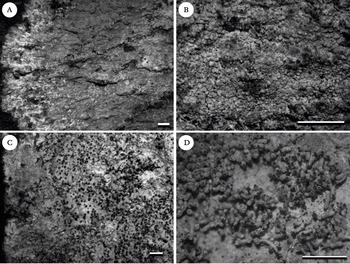
Habit of Herpothallon species. A & B, H. granulosum (holotype); A, with marginal zone; B, enlarged sorediate region; C & D, H. isidiatum (holotype); C, with marginal zone; D, enlarged isidiate region. Scale = 1 mm.

Thallus corticolous, epiphloeodal, loosely attached, firm, not flaking off, orbicular to suborbicular, up to 12 cm across, whitish grey to greenish grey, byssoid, felty, 25–85(–180) μm thick, with calcium oxalate crystals; crystals few to many, 3–20 μm wide. Hypothallus white, byssoid, below the thallus, hyphae 1·5–2·5 μm wide. Prothallus distinct, white, byssoid, mainly of radiating loosely interwoven hyphae, up to 5 mm wide. Pseudoisidia numerous, merging into soredia-like granules, scattered to aggregated, few to dense, granular to globose, greenish grey to pale grey, or whitish grey, 0·04–0·08 mm diam. Photobiont Trentepohlia, in short, irregular threads, single to aggregated.
Asci and pycnidia not seen.
Chemistry. Medulla K−, C−, KC−, P−; I+, KI+ blue in patches (section); barbatic acid detected by TLC.
Remarks. Herpothallon granulosum is characterized by its epiphloeodal granular sorediate thallus and the presence of barbatic acid. It closely resembles Herpothallon granulare (Sipman) Aptroot & Lücking which also has soredia-like structures but the latter has perlatolic acid as major substance. Herpothallon furfuraceum G. Thor is the other species having soredia-like granules, but it has red granules in the hypothallus and prothallus and confluentic and chiodectonic acids as the major lichen substances (Aptroot et al. Reference Aptroot, Thor, Lücking, Elix and Chaves2009).
At present H. granulosum is known from the Khasi hills (Shillong) and the Eastern Himalayan region (Darjeeling). It is common in the type locality on the trunks of Lindera sp., Photinia notoniana, Pyrus pashia and other trees.
Additional specimens examined. India: Meghalaya: Shillong, Laitumkhrah, Botanical Survey of India Eastern Circle campus, near Orchidarium, alt. c. 1435 m, on bark of dead tree, 2008, Jagadeesh Ram 4156 (BSA). West Bengal: Darjeeling district, Neora Valley National Park (rain forest), Neora river bank, N 27° 05′ 50.9″, E 88° 43′ 28.6″, alt. 2166 m, 2008, Jagadeesh Ram 4305 (BSA).
Herpothallon isidiatum Jagadeesh Ram & G. P. Sinha sp. nov
Thallus corticola, epiphloeodes, byssoideus, albo-griseus ad glauco-griseus, laevigatus, verrucosus; pseudoisidia densa, simplicia, ramosa, 0·3–1·5 mm longa, 0·08–0·15 mm lata; asci non visi; acida stictici, constictici, hypostictici et norstictici continentia.
Typus: India, West Bengal, Darjeeling district, Kalimpong, Divisional Forest Manager Office campus, alt. c. 1206 m, on Pinus, 6 March 2007, T. A. M. Jagadeesh Ram 3881 (BSA—holotypus; CAL—isotypus).
Thallus corticolous, epiphloeodal, tightly attached, orbicular to suborbicular, or irregular, 2–9 cm across, firmly attached, dull, glaucous grey to whitish grey, or pale grey, minutely felty, with scattered slightly raised areas, up to 280 μm thick, with calcium oxalate crystals; crystals many, 3–25 μm wide. Hypothallus white, below the thallus, hyphae 1–2·5 μm wide. Prothallus distinct, whitish, byssoid, up to 1·5 mm wide. Pseudoisidia numerous, cylindrical, of the same colour as the thallus, scattered to dense, often minutely felty with projecting hyphae, with dark brown to black pycnidia at the tips, usually simple, rarely branched and often coralloid, 0·5–1·5 mm long, 0·08–0·15 mm wide. Photobiont Trentepohlia, in short, irregular threads, single to aggregated.
Asci not seen.
Pycnidia common, on the tips of pseudoisidia, black, 0·08–0·1 mm diam.; conidia not seen.
Chemistry. Thallus K+ yellow, C−, P+ orange, I−, KI−; stictic acid (major), constictic acid (minor), hypostictic and norstictic acids (trace) detected by TLC.
Remarks. Herpothallon isidiatum is characterized by the thallus with cylindrical, up to 1·5 × 0·15 mm pseudoisidia and the presence of stictic and constictic acids. Herpothallon antillarum (Vain.) Aptroot, Lücking & G. Thor, H. australasicum (Elix) Elix & G. Thor and H. phillipinum (Vain.) Aptroot & Lücking are the other species having similar pseudoisidia, but all these species have a different chemistry. Herpothallon nigroisidiatum G. Thor is another species which has black tips in the pseudoisidia due to protruding black hypothallus but differs in its globose to cylindrical (0·4 × 0·3 mm) pseudoisidia and in neodiffractic (major), confluentic and chiodectonic (trace) acids as the lichen substances (Aptroot et al. Reference Aptroot, Thor, Lücking, Elix and Chaves2009). It is common in the plains of Assam and West Bengal, and the Eastern Himalayan region (Darjeeling and Sikkim) at altitudes of 140 m to 1210 m.
Additional specimens examined. India: Assam: Lakhimpur district, Koilamari, Koilamari Tea Estate, alt. c. 150 m, on shade tree, 2006, G. P. Sinha & V. N. Singh 3302 (BSA). Sikkim: Simiklingey – Patukchandy, alt. c. 777 m, 2006, G. P. Sinha 3657 (BSA). West Bengal: Jalpaiguri district, Kalchini, Kalchini Tea Estate, alt. c. 140 m, on shade tree, 2005, V. N. Singh 2434 (BSA).
New Records
Herpothallon australasicum (Elix) Elix & G. Thor
This species was previously known from Australia and has been found on the lower trunk of trees in a montane rainforest in the Eastern Himalaya. It is characterized by the firmly attached thallus with many calcium oxalate crystals, white hypothallus, white to red prothallus, cylindrical, up to 1 × 0·1 mm pseudoisidia and the presence of psoromic acid.
Specimen examined. India: West Bengal: Darjeeling district, Neora Valley National Park, near Chaudapheri forest camp, alt. 2290 m, 2007, Jagadeesh Ram 3886, 3890 (BSA).
Herpothallon granulare (Sipman) Aptroot & Lücking
This species has been found on the trunks of trees on the plains and in foot hills of Assam. Previously it was known from China, Costa Rica, Singapore and Thailand. It is characterized by its firmly attached thallus with many calcium oxalate crystals, whitish hypothallus and prothallus, granular to globose, up to 0·05 × 0·05 mm soredia-like pseudoisidia and by the presence of perlatolic acid.
Specimens examined. India: Assam: Jorhat district, Duklingia Tea Estate, alt. 140 m, on Acacia sp., 2004, Jagadeesh Ram & V. N. Singh 1278 (BSA); North Cachar Hills district, Sonai Tea Estate, on shade tree, 2005, V. N. Singh 1863 (BSA); Dibrugarh district, near Bakel Tea Estate, alt. 150 m, on Areca catechu, 2005, G. P. Sinha & V. N. Singh 3108 (BSA).
The authors thank Dr R. Lücking, Field Museum, Chicago, USA, for going through the manuscript and for valuable suggestions; Dr U. Makhija, Agharkar Research Institute, Pune, for comments on some species of Cryptothecia; Dr M. Sanjappa, Director, Botanical Survey of India, Kolkata, for facilities and Dr V. J. Nair, Botanical Survey of India, Southern Circle, Coimbatore, for Latin diagnoses. One of the authors (TAMJR) is grateful to Ministry of Environment & Forests, New Delhi, for financial assistance under an All India Co-ordinated Project on Taxonomy.