Introduction
Deliberation is routinely considered to be an essential component of trial by jury, contributing to the quality of its fact-finding and to confidence in its verdicts. Extensive research confirms the importance of deliberation (Devine et al. Reference Devine, Clayton, Dunford, Seying and Pryce2001, Reference Devine, Buddenbaum, Houp, Stolle and Studebaker2007). Indeed, even anticipating deliberating with other jurors in the group can influence judgments (Sommers Reference Sommers2006). It is remarkable then that, in Brazil, the jury in criminal trials does not deliberate (Gomes and Zomer Reference Gomes and Paula Zomer2001).Footnote 1 In contrast to the United States and other countries that use juries (Kutnjak Ivković and Hans Reference Kutnjak Ivković and Hans2021), Brazilian jurors decide their verdicts individually, without talking to one another about the case. They submit their votes in secret. They are asked to vote on at least three standard questions: (1) did the crime occur; (2) is the defendant the one who committed it; and (3) do you acquit the defendant? The jurors decide whether or not the defendant committed the crime and, if so, whether a condemnation is deserved. Thus, a jury could decide in a sequence of votes that the crime occurred and that the defendant committed it but, nonetheless, that an acquittal is warranted. For this reason, some say that the Brazilian jury judges the social legitimacy of the act of killing (Schritzmeyer Reference Schritzmeyer2012) as US juries are able to do with their general verdicts. Jurors may also be asked to vote on the existence of other circumstances that may increase or decrease the seriousness of the crime and the likely penalty. But every vote is made without speaking about the case to other jurors, and, based on their íntima convicção (intimate conviction), a judgment that rests on their conscience and the dictates of justice, as stated in Article 472 of the Código de Processo Penal (Criminal Procedure Code).Footnote 2 There is no need to provide reasons or justifications for the verdict.
Some scholars attribute the required absence of deliberation, referred to as regra da incomunicabilidade (the incommunicability rule), to the constitutionally mandated secrecy of jurors’ votes (see, for example, Crozara Reference Crozara2010; Gomes Reference Gomes2010). Secrecy has two purposes. The first one is to ensure the protection of jurors against external influences or pressure during the act of voting (Nucci Reference Nucci2005). To avoid such influence or pressure, the law determines that voting must be held in a special room, popularly known as the secret room—a reserved space to which the public does not have access. Second, the secrecy of the voting procedure—especially in the absence of deliberation—protects the privacy of each juror’s judgment; there is no way of knowing how each of the jurors have decided. The seven jurors vote by depositing a “yes” or “no” ballot in an urn. In order to guarantee secrecy in case of juror unanimity, once four identical votes are cast—the required number for a simple majority for either conviction or acquittal—the verdict is deemed to have been reached, and the other ballots are discarded.
How Brazilian jurors experience the absence of deliberation is largely unknown. The aim of this article, which is part of a broader research project on jurors’ decision making in femicide trials in Brazil, is to understand how Brazilian jurors engage with their decision-making tasks under these distinctive circumstances. The research explores jurors’ experiences and views by using qualitative methods, including field research, ethnographic observations, and, most importantly, semi-structured interviews of jurors. We explore the approach that jurors take to deciding the case in the absence of deliberation, examine their views about the appropriateness of the incommunicability rule, and assess their evaluation of the overall jury experience. Current scrutiny in Brazilian legal and policy circles focusing on jury trial procedures in Brazil, including the incommunicability rule, makes the present research timely and important. In addition, the absence of deliberation in this jury system allows us to consider the significance of its presence in other jury systems around the globe.
To place the current project and its results in context, we begin by briefly summarizing relevant literature on jury deliberation and its key importance in the jury decision-making process. Although the qualitative methodology used in interviewing real jurors in the current project does not allow us to discover the actual impact of deliberation’s absence on Brazilian jurors, it does allow us to explore the subjective experiences of this distinctive form of jury trial. In the next section, we outline the questions we address in the current article. We then provide a brief background description of jury trial procedures in Brazil, including the jury selection process and the incommunicability rule, and proceed to present and discuss the results of our study. The conclusion reflects on the significance of our findings for understanding varieties of lay participation and democracy.
Jury research on the value and impact of jury deliberation
Brazil stands alone among countries with trials by jury in its practice of incommunicability, and the existing jury literature does not address this practice. Interviewing Brazilian jurors offers an opportunity to investigate whether and how they view the impact of the absence of deliberation on their jury experience.
The values served by jury deliberation
Jury research conducted in other countries has documented several significant benefits of the deliberation process. First, a number of important features of deliberation add to the jury’s soundness as a decision maker (Devine et al. Reference Devine, Clayton, Dunford, Seying and Pryce2001, Reference Devine, Buddenbaum, Houp, Stolle and Studebaker2007). Deliberation gives jurors the opportunity to exchange and combine their diverse sources of knowledge, to test their competing construals of evidence and their understandings of the law, and to correct one another’s errors (Ellsworth Reference Ellsworth1989; Waters and Hans Reference Waters and Hans2009). The benefits of deliberation are most apparent when jurors from diverse parts of the community participate actively in deliberation (Sommers Reference Sommers2006; Cornwell and Hans Reference Cornwell and Hans2011, 668–69).
Two experiments have studied the effects of expanding deliberation, which typically occurs only at the end of a jury trial, by allowing juror discussions during the trial as well. A contrast between jurors who could participate in expanded discussions and those who could not do that can help us further understand the value of discussing the case with other jurors. In an initial study of an Arizona jury reform that allowed jurors in civil cases to participate in discussions of the evidence during the trial, prior to deliberation, most jurors supported the ability to do so, agreeing that the trial discussions were helpful in resolving confusion about the testimony and evidence and expressing little concern about inappropriately influencing or being influenced by other jurors (Hans et al. Reference Hans, Hannaford-Agor and Thomas Munsterman1999; Hannaford et al. Reference Hannaford, Hans, Mott and Thomas Munsterman2000). Similarly, in a subsequent study of the reform, Shari Seidman Diamond and colleagues (Reference Diamond, Vidmar, Rose, Ellis and Murphy2003) found that Arizona jurors permitted to discuss the case during trial sought information and clarification from one another and exchanged different views about the evidence. Such discussions helped jurors reconstruct the evidence presented at trial; jurors who could engage in trial discussions reported greater ease in understanding expert testimony.
Deliberation and decision-timing
When deliberation is an option, it appears to be a significant moment for decision making. Although there is a modest literature on the timing of opinion formation in US criminal and civil jury trials, this literature suggests that jury deliberation offers an important opportunity for jurors to make up or change their minds about the verdict. Not surprisingly, when asked when they began leaning toward one side or the other, jurors frequently identified the presentation of evidence at trial. For example, in research with US felony jurors, about half of jurors said that they began forming their opinion during the evidentiary portion of the trial, either during testimony by the state’s witnesses or the defense’s witnesses (Hannaford-Agor et al. Reference Hannaford-Agor, Hans, Mott and Thomas Munsterman2002). Even so, about 20 percent said that they did not start leaning toward one side or the other until jury deliberation; what is more, nearly one-quarter said that they changed their minds during the deliberation (Hannaford-Agor et al. Reference Hannaford-Agor, Hans, Mott and Thomas Munsterman2002). In a study of civil cases, the patterns were comparable (Hannaford et al. Reference Hannaford, Hans, Mott and Thomas Munsterman2000). Jurors often identified the presentation of evidence by the plaintiff and the defendant as what led them to lean toward one side, but 21.6 percent said that this occurred during the final jury deliberation. In total, 38.6 percent said that they changed their mind during the final deliberation, with close to half saying that they did not make up their minds until the final deliberation. This literature points to deliberation as a major segment of the trial during which jurors shift and change their views; when it is absent, how do jurors respond?
The impact of deliberation on jurors’ evaluations of their experience
Deliberation plays a significant role in what Nancy Marder (Reference Marder2022, 2) describes as “transforming citizens into jurors.” She recounts how Americans frequently view jury summons with irritation, displeasure, and a strong desire to be excused. Initially, they report not wanting to perform this duty or express a lack of confidence that they can do it well. Interestingly, a similar phenomenon appears to afflict Brazilians who are called for jury duty. In Fábio de Almeida’s (Reference Almeida2022) field research on Brazilian jury trials, the high number of exemption requests at the jury court where he conducted the research led him to title his book Ninguém quer ser Jurado (Nobody Wants to Be a Juror). However, Marder (Reference Marder2022) points out that, throughout the trial and, especially, during the jury deliberation, the members of the jury continue the transformation process into individuals who want to serve as jurors and, therefore, fulfill their duty responsibly. She observes that features of the jury deliberation room, including its isolation from the outside world and secrecy protections, help jurors to complete their transformation from citizens to jurors. In the end, they express pride in having performed an important role.
Research with jurors in the United States shows that they deeply value the ability to deliberate with others before reaching a verdict. Leah Sprain and John Gastil (Reference Sprain and Gastil2013, 165) found that US jurors “relished the opportunity to talk with their peers and work through the issues raised during trial” and wished they could talk with one another during the jury trial. One juror who deliberated said: “During the whole experience, the one thing I really dreaded was that in the end I would be selected the alternate and miss the deliberation” (163). Indeed, alternate jurors felt the absence of deliberation as a keen loss and a “psychological blow” (163). A benefit that accrues from deliberating with other jurors is that, after the opportunity for discussion and debate, jurors generally express more confidence and certainty in their decision (Hans and Vidmar Reference Hans and Vidmar1986).
For all these reasons, most US jurors express strongly positive views about their jury experiences. Diamond (Reference Diamond and Robert1993) and Liana Pennington and Matthew Dolliver (Reference Pennington and Dolliver2021) provide comprehensive summaries of the research. To offer a few examples, in a substantial survey of 8,468 jurors who served in sixteen federal and state courts, 63 percent reported that their impressions of jury service had become more favorable once they had served as jurors (Munsterman et al. Reference Munsterman, Thomas Munsterman, Lynch and Penrod1991). A study of 3,497 felony jurors found that the majority reported being satisfied with their jury’s deliberations (Hannaford-Agor et al. Reference Hannaford-Agor, Hans, Mott and Thomas Munsterman2002). And in a study of 3,149 individuals summoned for jury duty in Washington State courts, those who served on a trial expressed much greater satisfaction than those who did not (Gastil et al. Reference Gastil, Pierre Deess, Weiser and Simmons2010). For example, just 24.5 percent of the individuals who were called but did not serve as trial jurors rated their experience as very good or excellent, compared to 61.3 percent of those who actually served as trial jurors. Reasons given for positive evaluations included the actions of their fellow jurors during jury deliberation, the educational value of the experience, and the opportunity for democratic participation; as one juror put it, “it’s an honor to perform my civic duty” (Gastil et al. Reference Gastil, Pierre Deess, Weiser and Simmons2010, 68).
The benefits of deliberation extend beyond the jury room in producing greater civic engagement. Pennington and Dolliver (Reference Pennington and Dolliver2021, 392) have observed that “[j]ury deliberation offers a forum for active citizenship and an important place to build engagement with, and faith in, the justice system.” Comparing responses by jurors at the start and the end of their jury duty, they discovered that jurors who had deliberated significantly increased their positive views of the fairness of the jury system. John Gastil and his colleagues (Reference Gastil, Pierre Deess, Weiser and Simmons2010) found that US jurors’ participation in high-quality deliberations, where all jurors have ample opportunities to speak and to listen to one another, were more likely to participate in other types of civic activities following their jury experience, thus strengthening democratic self-governance. In sum, as Shari Diamond and Mary Rose (Reference Diamond and Rose2018, 250) observe, “the model of deliberative democracy that characterizes the American jury assumes that exchange and persuasion occur during deliberations, improving the quality and legitimacy of decision making and affecting processes and outcomes in positive ways.”
Thus, asking Brazilian jurors to discuss their views about the incommunicability rule that prevents them from deliberating with other jurors will allow us to contrast their responses and their satisfaction with jury service to those of US jurors who appear to highly value the deliberative process and their jury service.
Negative or null effects of deliberation
One must also consider the possibility that deliberation is not a critical and essential component of the jury trial. In Harry Kalven and Hans Zeisel’s (Reference Kalven and Zeisel1966, 489) classic work, The American Jury, they wrote: “The deliberation process might well be likened to what the developer does for an exposed film: it brings out the picture, but the outcome is pre-determined.” Kalven and Zeisel observed that, in their research comparing first ballot votes and final jury verdicts, there was a strong relationship between the two. The striking and significant relationship between first ballot votes and final verdicts has been confirmed in multiple other research studies (see, for example, Devine et al. Reference Devine, Clayton, Dunford, Seying and Pryce2001, summarizing research; see also Hannaford-Agor et al. Reference Hannaford-Agor, Hans, Mott and Thomas Munsterman2002). The fact that the final verdict can be well predicted by the first ballot vote suggests that deliberation does not significantly alter the outcomes of jury trials. However, Diamond and Rose (Reference Diamond and Rose2018) point out that some deliberation can occur before the first ballot vote, so simply comparing the first ballot vote and final verdict can understate the effect of deliberation. And even if the first ballot is strongly related to the eventual group verdict that the jury reaches, juries have acquitted the defendant in a minority of criminal jury trials, even though they reported that the first ballot vote favored conviction (Hans et al. Reference Hans, Hannaford-Agor, Mott and Thomas Munsterman2003). In post-trial interviews with jurors, Kalven and Zeisel (Reference Kalven and Zeisel1966) found that the minority prevailed in approximately one out of every ten trials, indicating the importance of deliberation in at least the minority of cases.
Jury deliberation may also exacerbate biases and reinforce status inequalities
With respect to biased decision making, the research described above documents the often strikingly positive effects of group discussion on verdict quality. Yet, under some circumstances, particularly when group members are homogeneous and hold the same biases, group discussion can produce more biased decisions (Kerr, MacCoun, and Kramer Reference Kerr, MacCoun and Kramer1996). Information that reflects the majority view is more likely to be shared during discussion, and conformity effects may create pressure to acquiesce to the majority’s views.
With respect to social inequalities, social status outside the jury room is often reflected inside it (Cornwell and Hans Reference Cornwell and Hans2011, 670–71; Winter and Clair Reference Winter and Clair2018). For example, in some US studies, men and people with higher occupational status were more often selected as jury leaders, participated more, and were reportedly more influential compared to women and people with lower status (James Reference James1959; Diamond and Casper Reference Diamond and Casper1992). In a study of felony juries in four US jurisdictions, educational attainment affected self-reported participation in the jury room; those with lower levels of education participated somewhat less than those with higher levels of education (Cornwell and Hans Reference Cornwell and Hans2011, 681). In a project with US civil juries, even though juror satisfaction was substantial across all racial and ethnic groups, satisfaction with the jury experience was lower among racial minority and Hispanic jurors than among white jurors (Antonio and Hans Reference Antonio, Hans, Roesch, Corrado and Dempster2001, 75–78). Another investigation showed that, although most jurors felt that they had enough time to express themselves during deliberation, Blacks and Hispanics with lower levels of education were less likely to feel the same (Winter and Clair Reference Winter and Clair2018, 1480). Pennington and Dolliver (Reference Pennington and Dolliver2021), however, did not find racial differences in the positive impact of jury deliberation on views of the fairness of the jury system.
Questions addressed in the current study
Considering the research on the consequences of deliberation, and the strongly positive endorsement of deliberation by US jurors who have experienced it, Brazilian juror interviews can provide important insights about the absence of deliberation. First, we can evaluate Brazilian jurors’ views about their inability to deliberate and compare it to the overall positive views of deliberation held by US jurors. In one previous study in which seven Brazilian jurors were interviewed, all of them said that they would like to have talked with the other jurors before reaching their decision if allowed (Lorea Reference Lorea2003). In the current project, we were able to ask a larger number of jurors from multiple cases about their preferences regarding deliberation.
Brazilian juror interviews are not well suited to the task of assessing the quality and correctness of jury verdicts or about the true impact of deliberation. Other methodological approaches would be better able to address these questions. However, the jurors’ responses can provide evidence about the approach they report taking in their individual decision making in a system in which they cannot discuss or debate. When deliberation is absent, as in Brazil, when do jurors say they decide? We also have an opportunity to assess whether Brazilian jurors, in the absence of an opportunity to discuss and debate with their colleagues, evaluate the jury experience positively and report a greater inclination to participate in civic activities following their jury service, as US jurors do (Gastil et al. Reference Gastil, Pierre Deess, Weiser and Simmons2010; Pennington and Dolliver Reference Pennington and Dolliver2021).
Trial by jury in Brazil
To put the juror interviews and fieldwork in context, it is useful for readers to have some background about the history and current status of the Brazilian jury. The jury was introduced into the Brazilian system with the Decree of June 18, 1822,Footnote 3 even before Brazil was an independent country, when twenty-four citizens judged crimes of abuse of freedom of the press (Rangel Reference Rangel2018). Over time, the jury has undergone numerous changes. The Brazilian Federal Constitution established that the jury court is a fundamental right and guarantee and competent to judge intentional crimes against life—that is, those cases in which there is the intention to kill.Footnote 4 This classification includes four crimes, whether they are consummated or attempted: (1) intentional homicide; (2) abortion; (3) infanticide; and (4) inducing, instigating, or assisting suicide. However, if another crime is connected to an intentional crime against life, it may also be judged by the same jury. For example, in the case of an accused who commits rape and, after that, kills the victim, a jury would reach decisions on both crimes.
Jury selection
To understand the perspectives of Brazilian jurors as revealed by the current research, it is also worthwhile to describe the approach to jury selection in Brazil, which results in juries that are often unrepresentative of the population (Streck Reference Streck1988; Brochado Neto Reference Djalma2016). In particular, Brazilian juries tend to overrepresent those with legal training and experience.
Annually, the presiding judge of a jury court must publish a list with a certain number of eligible jurors, which varies depending on the number of inhabitants in the region. To compose it, the judge asks local authorities, class and neighborhood associations, associative and cultural entities, educational institutions, universities, unions, public offices, and other community groups to identify people who fulfill the eligibility requirements. The citizen must be over eighteen years and be a person of notória idoneidade (remarkable integrity), a vague notion that usually means the absence of a criminal record. In addition, it is common for law students and legal professionals to volunteer to serve as jurors. This happens because the law considers the effective exercise of the juror’s role to be a relevant public service. It adds to the individual’s record of public service and can serve as a tiebreaker for applicants to judicial, prosecutorial, and other positions. Some commentators criticize the predominance of jurors trained in law because it can lead them to decide the case on technical grounds rather than based on their intimate convictions (Rangel Reference Rangel2018).
Jury selection involves two draws. The first occurs after the publication of the aforementioned list when the presiding judge draws twenty-five jurors for the next period of judgments. On the date of the jury trial, the presiding judge draws names from the ballot box to select the sitting jurors and announces each name as it is drawn. The defense lawyer and the prosecutor may dismiss up to three jurors each, without reason. There is no voir dire so dismissals are usually based on jurors’ sociodemographic characteristics, such as gender, race, and age as well as information gained from searching social media. Once these dismissals have been exhausted, the parties can only reject more jurors with justification, which must be approved by the judge.
Research has revealed that this selection process fails to produce representative juries. Although the notion is widespread that the jury allows for a trial by peers and is a fundamental human right and guarantee (Nucci Reference Nucci2005), Brazilian juries depart from representativeness (Streck Reference Streck1988; Lorea Reference Lorea2003). Brochado Neto (Reference Djalma2016, 50) gathered national data on the characteristics of Brazilian jurors and concluded that the most common juror is a public servant, with a graduate or specialist degree, married, over forty years of age, with an income between four and ten times the minimum wage, and experienced as a juror. Thus, the Brazilian jury does not meet the requirements related to jurors’ representativeness that Shari Diamond and Valerie Hans (Reference Diamond and Hans2023) cite as an important feature of fair trials.
Incommunicability rule
Once the seven jurors are selected, the judge reads the following oath: “In the name of the law, I invite you to examine this case impartially and to render your decision following your conscience and the dictates of justice.” The jurors, called by the judge one by one, must answer: “I promise so.”Footnote 5 From that moment on, jurors cannot communicate with other jurors about the case; they are also forbidden to discuss the case with members of the public during the trial. The Criminal Procedure Code specifies that, once the jury is drawn, jurors will not communicate about the case with one another or with others, nor express their opinion on the process, under penalty of exclusion from the poll and a fine. Because there are no alternate jurors selected, if a juror expresses an opinion about the case, the jury will be dissolved. If the communication is discovered after the end of the trial, the judgment will be nullified (Pereira e Silva and Surdi de Avelar Reference Pereira e Silva and Surdi de Avelar2020, 370).
But this was not always the rule. Although the law that instituted the jury in Brazil was silent about communication, juries did deliberate, likely because that was the rule in Portugal, the country that colonized Brazil (Bittencourt Reference Bittencourt2023). The first rule on this subject in the Brazilian system was the Law of September 20, 1830, which provided for communication between jurors: “The Judges of Fact will withdraw to another room, and will confer alone, behind closed doors, on each of the proposed issues, and what is judged by the absolute majority will be written, signed, and published, as in the Jury of Accusation.”Footnote 6 Other laws maintained communication between jurors in practically identical terms.Footnote 7
The requirement of incommunicability in the Brazilian legal system has traditionally been attributed to Decree-Law no. 167 of January 5, 1938, enacted during the Brazilian dictatorship established by Getúlio Vargas in 1937, which was in force until 1945. During that period, the procedure was as follows: “With the doors closed, the poll, presided over by the judge, assisted by the notary, who will serve as secretary, the prosecutor, and the lawyer, who will remain in their places without intervening in the discussions and votes, and by two bailiffs, will pass to vote on the questions proposed, observing the complete incommunicability of the jurors.”Footnote 8 However, despite this law being seen as a milestone for abrupt, immediate changes in jury procedure, recent research shows a more gradual shift. This change from deliberation to incommunicability occurred slowly, with advances and retreats, installing itself surreptitiously and consolidating itself over time, and such changes were attributed to concerns about the potential influence of one juror over another (Bittencourt Reference Bittencourt2023).
Because it is an inheritance from the dictatorial period, some argue that incommunicability is incompatible with the democratic state of law established by the Brazilian Federal Constitution of 1988 (Rangel Reference Rangel2018). This may partially explain why this rule came under discussion in Bill no. 8,045 of 2010, which corresponds with the draft reform of the Criminal Procedure Code, currently pending in the Chamber of Deputies, which proposes the establishment of communication between the lay jurors at the moment before the voting over the questions: “If there is no doubt to be clarified, the jurors must meet privately in a special room, for up to 1 (one) hour, to deliberate on the vote.”Footnote 9
Research method
Cases and participants
Fieldwork began in October 2019 and was conducted by the first author, who attended a total of twenty-seven jury trials. These observational experiences provided a broader context within which to focus on twenty-three jury trials involving gender violence. The first author attended twenty trials in person in the Jury Court of Campinas and one trial in the Jury Court of Sumaré, both in the state of São Paulo, due to the researcher’s proximity to these courts. She observed two additional trials, one from Campinas and a second from Curitiba, which is the capital of the state of Paraná, through online transmission due to the COVID-19 pandemic. Although both in-person and online trials were observed, she only conducted interviews with jurors from the in-person trials. These interviews were primarily conducted online.
In the majority of the gender violence trials, the defendants were charged with femicide, an element that may increase a convicted defendant’s penalty. It was added to the Brazilian Criminal Code in 2015 by Law no. 13.104, which defines femicide as a crime committed “against women for reasons of being female,” which may include (1) domestic or family violence or (2) contempt or discrimination against women.Footnote 10 Two other cases were similar to femicide but were not charged as such because the killing occurred in 2014, before the 2015 introduction of the charge of femicide (Cases 10 and 22). Finally, in one case, the defendant was charged with killing his girlfriend’s grandmother (Case 7)—a “linked femicide”—when people were murdered because they were trying to prevent femicide or have a family or emotional bond with the woman and were murdered to punish or psychologically destroy the victim (Vieira Reference Vieira, Martins Bertolin, Angotti and Corrêa Vieira2020, 320). The cases varied in their facts. They involved people who knew each other just one day, others who were in short-term and long-term dating relationships, some who lived together, and even a defendant and a victim who had been married for forty-three years. Most crimes occurred without the use of a gun, and most resulted in the death of the victim.
Once formal approval from the Research Ethics Committee was received, in compliance with the National Health Council of Brazil’s guidelines under Resolutions 466/2012 and 510/2016, the interviews began. Participants completed an informed consent form, providing their agreement to participate in the research. In Brazil, research participation is voluntary, and participants must not receive financial compensation. Thirty-nine jurors from fourteen jury trials participated in the interviews. Ten jurors participated in more than one jury trial during the study period; six served on two juries, and four served on three juries. The scheduling of interviews continued until substantial repetition among jurors in their interview responses or saturation was observed (for a discussion of saturation as a stopping point in qualitative research, see Saunders et al. Reference Saunders, Sim, Kingstone, Baker, Waterfield, Bartlam, Burroughs and Jinks2018).
In Case 8, all seven jurors were interviewed. There was only one trial (Case 11) in which six jurors refused to share their contact information, so only one juror was interviewed. This case involved an incident that was taboo: an attempted femicide of a young woman whose partner, then accused, was her mother’s ex-husband and, therefore, had been her stepfather. In most cases, people who did not want to participate in the research did not present a reason, even when asked. However, in one case, a juror claimed to be afraid that her data would be made available, despite the researcher’s describing the protocol to ensure confidentiality.
Regarding the sociodemographic characteristics of the thirty-nine jurors interviewed, the participation of female and male jurors was quite balanced, with 49 percent being female and 51 percent being male. The average jurors’ age was forty-two years old, with the youngest being twenty-two years old and the oldest being sixty-two years old. Although there is no report about jurors’ sociodemographic profile, this group was possibly more youthful than usual as the fieldwork occurred during the COVID-19 pandemic. When trials resumed following a pause in the early stages of the pandemic, jurors over sixty years old or who had any illness were dismissed. Most of the jurors had completed higher education courses or programs (72 percent or twenty-eight jurors). According to the Brazilian Demographic Census, just 16.8 percent of people aged twenty-five or over had completed a university degree (Instituto Brasileiro de Geografia e Estatística 2025). In line with previous research on Brazilian juries, jurors in the current project were not representative of the total population in their occupational backgrounds. The most common area for a juror was law; 38 percent of the jurors interviewed had a law-related degree or were actively pursuing it (eight and four jurors, respectively). This percentage does not include three other jurors who had some work or educational experience in law.
As mentioned, jurors can be summoned to join the jury after volunteering or being nominated. Sixty percent of respondents told the interviewer that they were recommended by their employer, such as a college or a public or private company (twenty-three jurors). Thirty percent of the jurors interviewed said that they volunteered (twelve jurors). Finally, 10 percent of respondents claimed not to know how they got on the jury (four jurors), so they probably were nominated by the company or did not remember volunteering.
Trials were paused periodically during the early stages of the COVID-19 pandemic and then resumed. The first interview occurred in December 2020, while the last happened in July 2022. The interviews lasted, on average, one hour (M = 1 hour, 3 minutes, 51 seconds; SD = 34 minutes, 49 seconds) with the shortest interview lasting about six minutes and the longest two-and-a-half hours.
Procedure
The first author identified potential femicide and gender-related cases by reviewing court jury trial lists. For each case, the electronic judicial record was accessed using the number provided on the list, and the charge was reviewed. She then attended the cases with femicide/gender issues. By the end of the trial, usually after voting and before reading the sentence, the presiding judge of the Jury Court of Campinas introduced the researcher to the jurors. The researcher then approached each of the seven jurors individually, inviting them to participate in a study focused on decision making in femicide trials. She explained that the Brazilian Criminal Procedural Code requires jurors to decide based on their conscience and the dictates of justice and that the research aimed to understand how they interpreted this rule in their individual decisions. Those who agreed to participate were contacted after the jury trial via WhatsApp to schedule an interview at a convenient time.
For the most part, interviews occurred through the Google Meet platform by video recording (77 percent or thirty jurors). Those who did not wish to use it, either due to difficulties with Internet access or lack of knowledge of the platform, participated by telephone with an audio recording (15 percent or six jurors). Two face-to-face interactions took place in the courthouse lobby, with a voice recording (5 percent or two jurors). Finally, one juror only agreed to be interviewed via WhatsApp text and audio messages (3 percent or one juror).
The interaction began by presenting the objectives of the research, highlighting our focus on the key factors that guided their decision making in the case, and explaining that the responses would be confidential and anonymous. Respondents completed an informed consent form, then participated individually in a semi-structured interview. Despite having formulated a script, the interviewer allowed the jurors some freedom regarding responding and exploring aspects that they themselves considered important.
The first questions were related to their experience as jurors, including a global question about the jury experience, whether they were volunteers or an enterprise had appointed them, the number of trials they had participated in, and when they were first summoned. At the end of the first block of questions, the jurors were asked about incommunicability: “So, what do you think about the impossibility of talking with the other jurors to decide?” Following that discussion, they were asked about the factors that led them to their verdict. Finally, jurors were asked a set of questions about femicide. Before ending the interview, the researcher thanked them for their collaboration and asked if they had anything else to add.
The interviews were transcribed and submitted to content analysis, which was defined by Laurance Bardin (Reference Bardin2016) as a grouping of techniques whose purpose is to obtain, through procedures, systematic and objective description of the content of the messages, indicators (quantitative or not) that allow the inference of knowledge related to their conditions of production/reception. Among its modalities, thematic analysis was chosen because it allows for the identification of the “nucleus of meaning” of the message, thus contributing to the research objective.
The first author categorized themes and subthemes in the interviews following Bardin’s (Reference Bardin2016) three-phase approach: pre-analysis, material exploration, and treatment of results. In the pre-analysis phase, the first author organized and familiarized herself with the transcribed interviews through a comprehensive review. Subsequently, during material exploration, analytical categories and subcategories were developed, adhering to the principle of mutual exclusivity. This involved identifying thematic axes and subthemes based on both a priori hypotheses and emergent interpretations of the interview data. Broad themes, such as “jurors’ origin,” “incommunicability rule,” “experience as a juror,” and “reasons for decision,” were identified across the interviews. These themes were then further refined into subcategories. For example, “jurors’ origin” was categorized as appointed by employer, volunteered, or unknown. Similarly, “incommunicability rule” was categorized as being in favor, mixed, and against, while “experience as a juror” was divided into positive experience, mixed experience, and negative experience. Some subcategories were further subdivided to capture nuanced distinctions within the data. For instance, “positive experience” was subdivided based on the reasons for positivity: knowing the jury, learning experience, civic duty, and the power associated with the juror role. This iterative process yielded a total of forty-nine categories. Finally, in the treatment of results phase, patterns, divergent perceptions, and relationships between themes and categories were analyzed. For the purposes of this article, we focus on three specific themes: the incommunicability rule, moment of decision, and experience as a juror, which are explored in detail below.
Results
Incommunicability rule
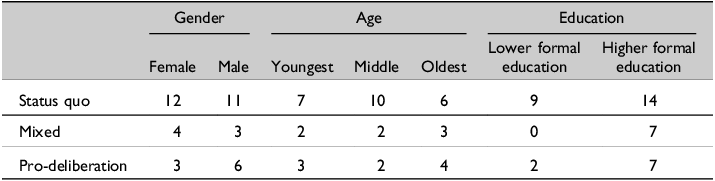
How did the jurors respond to not being able to talk with others? Figure 1 shows that a majority of the thirty-nine jurors interviewed (n = 23) said that they were content with the status quo. A significant number, however, were mixed in their answers (n = 7), describing both the pros and cons of the possibility of deliberating. The remaining jurors (n = 9) said that they wanted to express themselves and talk to others. Thus, 41 percent (sixteen of thirty-nine jurors) saw some merit in a change to the current incommunicability rule, even in the absence of any experience with deliberation.
Jurors’ view of the incommunicability rule
Source: created by the authors.
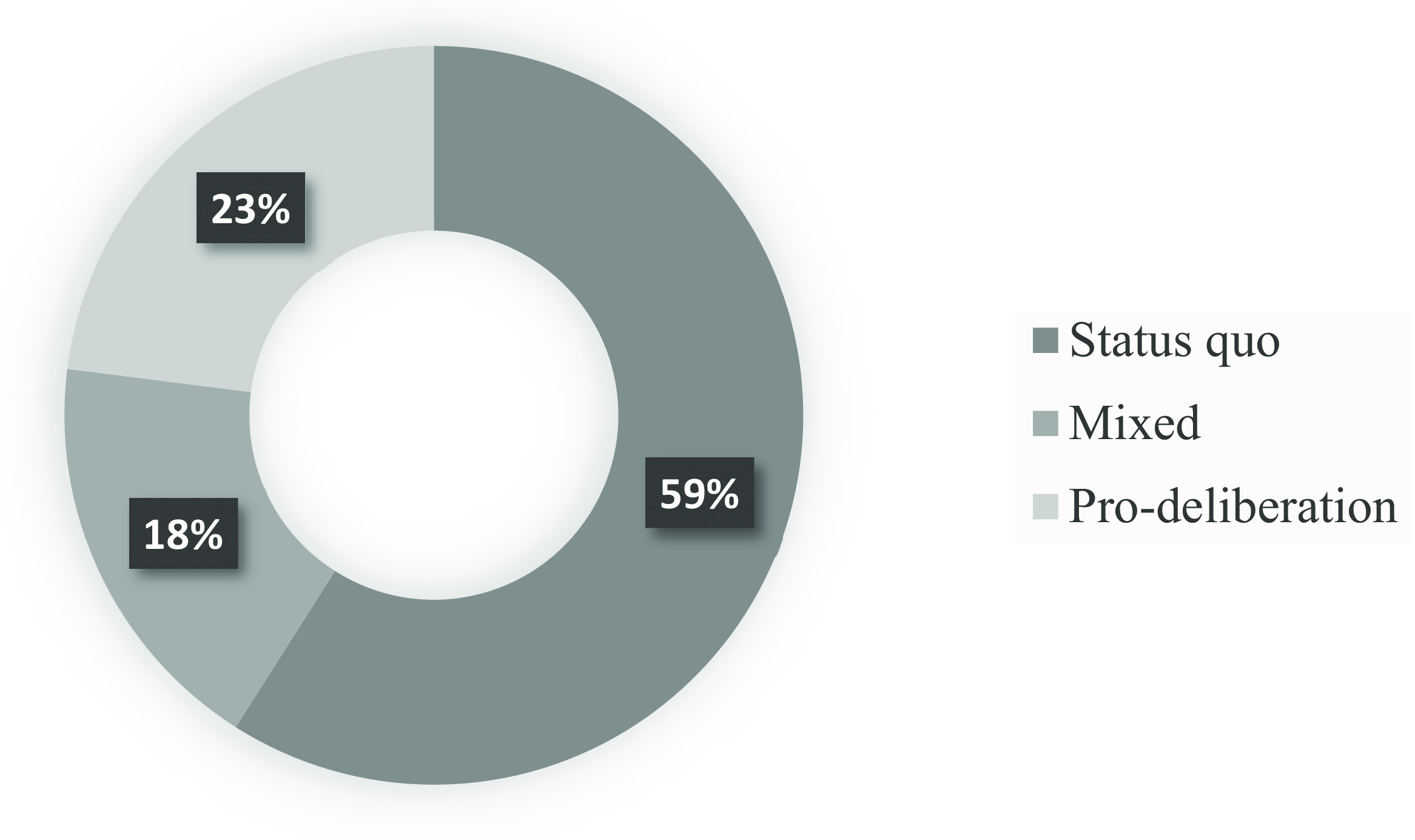
Table 1 breaks down these overall views of the incommunicability rule by the gender, age, and education of the jurors. The numbers are low, but what is notable is the level of support for the status quo appears to be shared across jurors with these characteristics. One possible exception is that individuals with more formal education are slightly more likely to express support for deliberation. But jurors with legal training are no more likely than others to support deliberation, with just three out of twelve (25 percent) law-trained jurors about as likely to express support for deliberation as jurors without legal training (six of twenty-seven, 22 percent). Although the numbers are small, whether jurors were volunteers versus nominated by their organization appears to be associated with their views of the incommunicability rule, with four of twelve volunteers (33 percent) supporting deliberation, and four of twenty-three nominated jurors (17 percent) doing so.
Juror’s views of incommunicability by gender, age, and education
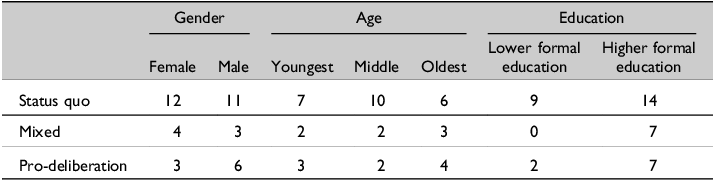
Table 1 Long description
The table presents data on jurors' views regarding the incommunicability rule, categorized by gender, age, and education. It consists of three rows labeled Status quo, Mixed, and Pro-deliberation, and six columns labeled Female, Male, Youngest, Middle, Oldest, Lower formal education, and Higher formal education. The Status quo row shows 12 females, 11 males, 7 youngest, 10 middle, 6 oldest, 9 with lower formal education, and 14 with higher formal education. The Mixed row shows 4 females, 3 males, 2 youngest, 2 middle, 3 oldest, 0 with lower formal education, and 7 with higher formal education. The Pro-deliberation row shows 3 females, 6 males, 3 youngest, 2 middle, 4 oldest, 2 with lower formal education, and 7 with higher formal education.
Note: Gender was self-identified. Age groupings were: 22–36 (youngest); 37– 46 (middle); 47–62 (oldest). Lower formal education included jurors with no formal education, those who had ceased formal education, and those whose formal education was in progress. Higher formal education included jurors who had completed higher education courses or programs.
Source: created by the authors.
Supporters of the status quo: The perceived dangers of influence
Those who defended incommunicability explained that, if deliberation was the rule in Brazil, people with stronger personalities could influence more vulnerable people in their decisions. Juror 2 (male, chemist, Jury 8) demonstrates this thinking: “I see that sometimes there are people who have a stronger opinion, there are people who are more easily influenced, so, whether they like it or not, sometimes they end up leaning towards one side, then the person ends up being partial. So, I particularly prefer not to be able to talk.” For this juror and all others who favored incommunicability, the expressed concern was that deliberation would compromise the principle of impartiality—the commitment made by jurors during their oath at the beginning of the jury trial. This juror associated an impartial performance with deciding alone, without external influence.
Some jurors thought communication among the members of the jury would generate an imbalance in the jury’s participation in the case of deliberation. One source of potential imbalance might derive from being an experienced juror; another is the juror’s gender, depending on the case:
I think it’s not good to talk about the case. Why? Because you can get a more one-sided jury, that tries to convince other people who are undecided. For example, someone who has been there seven times as a juror, can try to convince me, who went there for the first time, to acquit or to convict. Or, if it was a femicide, there could be a sexist guy as a juror who will try to exonerate the defendant or reduce his sentence. Or a woman who will try to push the conviction further, leave the defendant in jail longer. (Juror 31, male, antenna and digital channel analyst, Jury 12)
Other potential factors leading to influence were also mentioned, such as differences in years of education. People presume that those who have higher education would convince others with less education. Their influence could be especially potent if a juror has legal training: “I believe that because I have a degree in Law, I could influence others. It would influence a lot, for sure” (Juror 36, female, lawyer, Juries 3 and 15). In the words of another juror: “I am among the laypeople, but I am not a layperson, I am a technician. Suddenly, for example, if I start trying to convince, talking to people about the process and, in that speech, I can help convince them of a situation. And with this, perhaps, I may even be going too far, this may even lead to buying votes, which is not impossible” (Juror 34, male, security manager, Juries 9, 13, and 16). Like Juror 34, other interviewees who favored incommunicability acknowledged that they would be the ones who would likely to convince others, if they could: “I am extremely inquisitive about what I believe. I imagine that, if we could talk, the whole time I would be trying to argue in favor of what I believe” (Juror 26, female, receptionist, Juries 9, 13, and 18).
Surprisingly, some jurors admitted that they would be the ones who could have their minds changed if they could talk to the others. For instance, Juror 15 (female, works in a transport company, Jury 19) observed: “I think I prefer my opinion anyway. I think that suddenly I could be influenced by others’ opinions.” Similarly, Juror 10 (male, water and sewage technician, Jury 7) considered that others could be biased and undermine the quality of his decision: “I’d rather decide for myself. I highly value the prosecution and defense’s work, so I draw my conclusions based on what they show. I wouldn’t want to have that conversation with other jurors because I don’t know the person. Maybe there is a little passion there, I don’t know. Some prejudice, perhaps, that could tarnish my decision.” A similar perspective came from a juror with less education: “No, I prefer not to discuss it, because, as I said to you, I don’t think I’ve studied…. And there’s even a lawyer there with us! The girl next to me was a lawyer, right?” (Juror 8, female, cleaner, Jury 7). As we noted, most jurors with lower formal education did not endorse deliberation.
Recognizing the possibility of changing one’s own opinion, Juror 17 (female, television planning manager, Jury 19) stated that she preferred maintaining the incommunicability rule unless the jury was composed of people with better education or specific qualifications on certain subjects, such as crime or gender. As she mentioned, “[t]here is no guarantee that whoever is there knows more than you, or could help you to be fairer, let’s put it that way.” In Brazil, the description of the relevant law is given by the defense attorney and the prosecutor, both of whom are partial. Also, femicide was an offense recognized by the law only relatively recently, and the general public, from which the jurors are drawn, does not know exactly what it is. For instance, one juror, who was a lawyer, sat on Case 19, in which the evidence strongly supported a verdict of femicide. The defendant killed his girlfriend, stabbing her thirty-four times with a knife after she said she wanted a separation. During the interview, the lawyer-juror reported: “For me, that was a classic femicide, and when I saw [when votes were counted that] everyone did not qualify as such, I said [to myself]: ‘My God, people!’ Then I was very quiet, like, you can’t show it, right?” (Juror 13, female, lawyer, Jury 19). Nonetheless, she did not support deliberation, seeing influence as a negative, rather than a positive, thing.
The uncertainty associated with a huge burden of decision and tiredness after a long trial could lead to what another juror called “outsourcing responsibility.” In Brazil, most jury trials end on the same day they begin. The average duration of the observed cases was eight hours. They were usually scheduled to start at 1:00 p.m. but were delayed by around an hour so that they finished at 10:00 p.m. on average. Juror 4 (male, law student, Jury 8) articulated how this environment pushes individuals to rely on others’ judgments: “People are looking for someone to decide for them, to get rid of the weight of the decision by themselves. Something like, ‘Oh, I tried to elaborate my own thinking, but I can’t, I’m not capable of that’; That guy who is much more competent, saying that he believes him [the defendant], so if he is saying it, it must be true.”
Besides impartiality and the negative effects of influence, the law was often mentioned by the interviewees as an argument from authority that supported incommunicability. In this way, the rule is normalized and treated with a certain complacency, as expressed by Juror 7 (male, mechanic, Jury 8): “It’s a rule, isn’t it? So, it’s normal for anyone to not go along with other people’s ideas. Everyone has their own thoughts. So that no one interferes with anyone’s opinion. I think it’s right”.
Another argument mentioned was the fear that the deliberation would lead to conflict among the jurors. For instance, one juror said: “I prefer [not to talk], because I think that … it would be a lot of fighting. I think it would be a lot of confusion. I think it’s better not to talk, because then you are really judging by your opinion” (Juror 23, female, administrative assistant, Juries 20 and 21). In addition, Juror 19 (male, sociologist and lawyer, Juries 10, 16, and 18) showed a concern with physical confrontation, such as might occur in a case involving politics:
I already had a Bolsonarist colleague on a jury this year and I almost said: “If this guy keeps opening his mouth, I’m going to throw him out the window,” because you can’t talk about the case and then the guy takes the cue to say, not directly, it wasn’t a direct attitude of “Look, I’m a Bolsonarist,” but you can see that everything that is coming out of the guy’s mouth has everything to do with the misery of this government. Imagine this guy trying to convince someone on his side that they have to vote like him, because his values are more Christian, more patriotic, whiter, right?
Finally, another argument used by one juror to support the incommunicability rule was related to professional identity. A juror who was a psychology student mixed professional secrecy with the impossibility of deliberating: “For me, it was super natural [not to talk]. Because we from psychology cannot keep talking about the case. It’s something we have to keep secret” (Juror 21, female, psychology student, Jury 21).
In sum, the incommunicability supporters raised issues of impartiality, legalism, fear of conflict, and their own professional identities in their justifications for the status quo in Brazilian juries. Most of these topics were also mentioned by jurors who expressed ambivalence about the incommunicability requirement.
Mixed group
The group of mixed jurors presented arguments against and in favor of incommunicability. They frequently mentioned the role of incommunicability in ensuring impartiality, as the supporters did:
I think it makes sense, when you can’t talk, not to suddenly induce the other, right? But, on the other hand, I realize that there is doubt. … For example, on the day of this specific case, some people voted to acquit this person. I keep asking myself: “Guys, what did you not understand? Because there was a murder, the guy confessed, and they acquit the person?” … So, I think that, in that sense, if you could talk, maybe. ... There are people all over the place, and there are more enlightened people, there are people who have more difficulty. So suddenly it would be interesting to talk. To exchange ideas at least, right? I don’t know if they fear we end up inducing each other. I don’t know. (Juror 32, male, bank officer, Jury 12)
There were also those who would like to know other jurors’ perceptions as long as their decision remains individual and is not affected by consensus. Juror 3’s comments offer an interesting example. He begins his response to the incommunicability question by saying that he would not change his mind, but, by the end of his answer, he starts to admit that it would be possible:
I think arguing is cool in the sense that you see other points of view, but I think I form my opinion independent of the discussion. I don’t think I would be influenced in the decision by what others said, by the opinion of others. … Even for me to suddenly change my mind, “I didn’t see it that way,” something I didn’t observe, which is new, and think: “How cool that people see it from this other point of view!” I think it’s important, it’s enriching in that sense, you know? … I think it’s just to hear other opinions on the subject. The decision is mine. (Juror 3, male, human resources manager, Jury 8)
The mixed jurors saw some value in the incommunicability rule because they understood that it was thought to prevent undesirable influence, but they also confessed to the attractions of deliberation where one would be able to learn others’ viewpoints and clear away any doubts.
A final example of ambivalence is shown in Juror 22’s response. It was sharply divided as if each part had been uttered by a different person: “Talk about the case, you say? Like that American movie? I think certain things like American movies should come here. I think some things should come, like talking about the case itself. I think that here in Brazil it should be like this too. You sit everyone down, discuss and the decision is made. … I think we should talk. I know that we would end up influencing other people or people would end up influencing us.” However, Juror 22 (female, law student, Jury 20) goes on to say: “Most of the Brazilians, noting that the jury is composed of society in general, there is a lot of functional illiteracy. And I think letting people talk about the case, depending on the number of people and their cultural level, would be very complicated, because the smartest person would probably influence everyone else.”
It is interesting to read Juror 22’s opinion because she considers that jurors’ lack of cultural knowledge would prevent them from having a positive experience with deliberation. Based on this or another reason, jurors with lower education were the ones who really preferred not to talk, as discussed earlier.
Supporters of deliberation
We now turn to the views of the Brazilian jurors who uniformly expressed support for the ability to deliberate with one another. These jurors recognized the task of judging someone else’s fate by themselves to be arduous. Juror 5 (male, lawyer, Jury 8) said: “It’s simple, isn’t it? You put the little card ‘yes’ or ‘no.’ But, for you to reach the ‘yes’ or ‘no,’ a lot goes through our mind.” Juror 14 (female, general services, Jury 19) saw it as a complicated task that would have benefited from knowing others’ opinions: “There is also a question that we could have talked between us there, so that we could know what [others] think, their opinion, you know? That sometimes you … I don’t know, there, you just have to say ‘yes’ or ‘no,’ so it gets really complicated.”
Some of the people who favored deliberation said that they would have liked to talk but mostly to convince others rather than help themselves. Juror 5’s professional identity as a lawyer led him to wish he had been able to speak with the others. He was used to behaving in hearings as a criminal attorney. Yet, in contrast to his usual experience, as a juror, he was unable to speak. To compensate, he compulsively took notes during the trial: “Oh, yes [I would like to talk if I could]! Because when I get the summary of the facts there, I already start drafting as if I were working on the case as a lawyer. I wanted to share things with the fellow juror next to me, like this: ‘What they are saying is absurd,’ or ‘This thesis has no foundation at all! It is completely contrary to the reports’” (Juror 5, male, criminal lawyer, Jury 8).
Rather than professional identity, social identity affected another supporter of deliberation. She wanted to talk to share her perceptions and convince others as the only woman in an otherwise all-male jury. She revealed her concern about the predominantly male composition of the jury in a gender case and believed that the opportunity to dialogue with them would allow her to sensitize them to her point of view as a female juror:
I would like to talk if I could. … I would have expressed my indignation about it, you know? I was very afraid, even about the jurors, the fact that they were only men, right? As for what they were thinking about it, because, unfortunately, many people are sexist, right? … Oh, my God, there were moments when I even did this, as I was wearing a mask, you know, then I raised my eyebrow. Then I thought: “I cannot express myself,” but my desire was, all the time, to say: How can a person be so cold at this point? How evil! (Juror 1, female, business administrator, Jury 8)
Like the lawyer juror, this woman juror added that she had a great deal of difficulty controlling her reactions, especially indignation, in the face of what happened in the court. This situation shows that it is not just the impossibility of speaking that bothers some jurors and is prohibited by the incommunicability rule. Gestures too are forbidden as they communicate and transmit messages and meanings.
Despite the fact that all of the fourteen cases involved gender violence, contrary to expectations, this was the only case in which a woman mentioned a desire to share her gendered perspective. Jurors’ educational level was the only individual characteristic that appeared to be related to the jurors’ support for deliberation. People with more formal education were more positive about the prospect of deliberation. Possibly, these jurors assumed that they would participate in the deliberation as equals and that their views would be heard, unlike people with a lower level of formal education. One example is Juror 24 (male, commercial manager, Juries 16 and 18), who had a marketing degree plus a master’s degree in business administration, and saw deliberation as an opportunity to learn others’ views and share different perspectives that would assist them in better understanding the evidence and resolving doubts: “I think that if the decision was taken together, it would be easier, right? It’s because, when you manage to exchange ideas, sometimes there are some points you don’t quite understand, but then you talk. … Then you can make a more certain and concrete decision about what will happen.”
Although the deliberation supporters favored speaking to other jurors, some of them suggested the value of imposing some limits to that interaction. For instance, Juror 11 (female, school secretary, Jury 7) suggested that a mediator should be part of the debate so that things do not get out of control:
I think it would be worth talking about [the decision]. Of course, it will raise controversy because it will, right? Sometimes, it can even create a bit of discomfort, but it would be nice, always [emphasis] having a mediator there not to let things go out of control. ... Leaving it at ease, I don’t think it would be nice. It could be something more informal, but someone always gives [assistance] when things are heating up, right? But I think it would be cool.
Limited or not, and besides solving doubts, some jurors also think that deliberation would help them to achieve “ideal justice”:
Of course, of course, of course. Of course. Of course, if after we hear both of the parties and we go there, sit in a secret room, except perhaps with a judge watching, but without anyone else, not even the lawyers of both parties, as they do in the United States—because there the jurors can debate. Why? Because we are chasing an ideal justice, perfect justice and correct justice. If the jurors debated among themselves, one could bring up points that the other hadn’t considered and answer questions that the other didn’t. (Juror 27, male, sociologist and public servant, Juries 3 and 15)
Juror 27 mentioned the US practice of jury deliberation. The US model was frequently invoked by those who favored communication, underscoring Nancy Marder’s (Reference Marder2021) point that Hollywood helps to inform people worldwide about the jury system. Juror 33 (male, law student, Jury 12) watched the famous film Twelve Angry Men (Rose Reference Rose, Garrett, Hardison and Gelfman1972), although he did not remember its name:
So, I had seen a film for a subject in college, I think it was Philosophy of Law, it is an old film that spoke of a trial in the Jury Court and the jurors went to a room and they debated. So, they did exactly the opposite of what we can do. … So, it’s an old movie, so everyone on the jury wanted to convict the guy and only one person wanted to exonerate him. Then that person wasn’t sure of anything, but he put it in and planted some seeds, right?
Maybe because deciding alone can be challenging, some jurors talked about moments when others did not strictly follow the incommunicability rule. As Juror 20 (female, information technology technician, Juries 10, 13, and 18) mentioned, “I saw people commenting because they didn’t talk about the case inside the room but commented on similar cases.” When asked about what people said, she mentioned a man who was talking to her regarding a topic not related to the jury and suddenly said: “Oh, but today everything is femicide!”
Another juror reported that, as a lawyer, she felt that other jurors sometimes tried to generate a discussion with her about the case, subtly or not so subtly. This lawyer juror (who herself supported the status quo) remarked on the attempts to breach the legal fence: “Usually, I don’t say anything, I keep quiet. What often happens is that people say that I am a lawyer. … So, what usually happens is people come to surround me. The jurors come to surround me at coffee time. So, as I already know this is going to happen, I usually stick with the bailiff and chat with her/him. Random chats. … And even so people have been surrounding me, asking ‘What do you think?’ and I said: ‘No, we’ll talk later’” (Juror 37, female, lawyer, Jury 17).
In addition to what was shared during interviews, during an observation of a jury trial, another juror who endorsed the status quo did not fully abide by the incommunicability rule. He was talking to another law student before the beginning of the trial, and, after his name was drawn, they continued talking on the cell phone as it was possible to see them exchanging glances, making signs of agreement and disagreement. The contact only stopped after the witness testimony began, and the young man from the audience left the jury court.
Thus, supporters favored deliberation, seeing it as a way to improve their decision making, learn from other jurors, and influence other jurors.
Moment of decision: An exploratory analysis
Because Brazilian jurors are prohibited from discussing the case and deliberating amongst themselves before formal deliberations, the question arises: when do they actually form their opinions and decide on their verdict? Although we did not ask a question about when their opinions were formed, and, thus, this must remain an exploratory analysis, several jurors (n = 10) spontaneously mentioned when they arrived at their decision. Their comments suggest that this issue warrants further investigation.
Two jurors stated that they made their decisions immediately after the names were drawn when jurors are given a case report, which includes a summary of evidence presented at a preliminary phase of the litigation, and the judge’s decision, which determines that there is sufficient evidence to proceed to trial: “And I, ever since I started reading the report that said what we were going to judge, I confess that I was already on the side of the prosecution, you know? The other side didn’t move me at all. I had already made up my mind at that moment, regardless of what I would or wouldn’t hear from the defense, the public defender. … So, I already went in with my mind completely made up about this” (Juror 1, female, business administrator, Jury 8).
Two other jurors indicated that they typically formed an opinion after reviewing the initial documents but remained open to changing their mind during the trial. Juror 5 reported forming half of his opinion based on the initial documents and the other half after reviewing expert testimony. Other jurors described reaching conclusions at various points during the trial. Juror 3, for example, formed his opinion that a guilty verdict was warranted when the defendant exercised his right to remain silent and did not offer an alternative version of the facts. Juror 11 indicated forming an opinion before the midpoint of the trial and before hearing oral arguments from the prosecution and defense. Finally, three jurors reported forming their decisions after the attorneys’ final arguments, specifying that they did not finalize their decisions until the moment of voting. According to Juror 33 (male, law student, Jury 12): “In one of the cases that I participated in, I was in doubt until the time of the vote about one of the questions. It was at the voting moment that I decided.” Similarly, a second juror admitted:
So, in this specific case, I think I only decided when I sat down to vote. Because there was no technical evidence, I ended up having a lot of doubts, you know? I was more likely to consider him guilty, but because there was no technical evidence, I always have that question in mind… That, when in doubt, I prefer not to wrongly convict someone, but then there’s also that weight of “what if the person is [guilty]?” And so, in this case, … all we had were witnesses saying they saw them leaving the bar together, right? So, it was very doubtful for me, I think until the last minute, like, until the moment we sat down there to vote, but then, because of his coldness [I considered the defendant guilty]. (Juror 2, male, chemist, Jury 8)
These exploratory findings, though emerging spontaneously from juror interviews, suggest the importance of additional research on juror responses to case reports and related documents and the extent to which they may shape the juror’s evaluation of evidence presented at the formal trial. The fact that some jurors say that they formed opinions before encountering the evidence formally presented in court raises concerns about whether the review of the preliminary material biases them toward the prosecution and undermines the fundamental principle of presumption of innocence, where defendants are entitled to be considered innocent until proven guilty based on the evidence presented in court.
Jurors’ evaluation of their jury service
Given that Brazilian jurors are prohibited from deliberating due to the incommunicability rule and that some of them form opinions before all evidence is presented, how do they reflect on their jury service experience? To assess this, all jurors were asked: “How did you feel about your experience as a juror?” Their responses were then coded based on the valence of their experience: positive, mixed, or negative. Positive responses (n = 27) included expressions of satisfaction, civic duty, or personal growth; negative responses (n = 2) indicated frustration, stress, or dissatisfaction; and mixed responses (n = 10) contained both positive and negative elements.
The overwhelming majority of jurors reported a positive experience with jury service. Eight participants specifically described it as “very interesting,” citing the opportunity to have experience with how the jury works and to see what happens in their city. Jurors 18 and 31 exemplified this view:
I like it, I’ve always liked it, since the first time I went, I already found it interesting. … Because then at least you’re aware of everything that’s happening, even in our own city, to see what’s really happening there in our lives. So, it’s a bit of an idea of what’s going on even in the courts. Because, since it has nothing to do with my area, I don’t even try to find out, right? (Juror 18, female, lawyer, Jury 19)
Look, it was really interesting, to tell you the truth. How can I say that? We only saw these juries on TV, on the internet, you know? So, we had no idea what it was like to participate in a real jury. We knew in theory, but we didn’t know in practice. (Juror 31, male, antenna and digital channel analyst, Jury 12)
Six jurors emphasized the personal impact of their jury service, describing it as a significant learning experience that broadened their understanding of human nature and the complexities of the legal system. They expressed a sense of privilege and responsibility in participating in this process. Like Juror 31, Juror 23 (female, administrative assistant, Juries 20 and 21) contrasted the media depiction of jury trial with the in-person experience of jury service:
I volunteered to be on the jury, to become a juror, to do my curricular activities. And that made me learn what it means to be human. Because we hear a lot about everything, but we hear it on TV or from someone, and I had never really had contact with what I see on the jury. And there I learned that anyone can, in a minute, make a mistake that will change not only your life, but the lives of many people.
An additional eight jurors valued the experience as a chance to fulfill their civic duty. Two of these individuals further noted that jury service reinforced their belief that the justice system is functioning effectively. This perception of contributing to a functioning system highlights the potential for jury duty to strengthen public trust in the judicial process and foster a sense of civic responsibility, a link also found in US jury research on the connection between jury service and democracy (Gastil et al. Reference Gastil, Pierre Deess, Weiser and Simmons2010): “I understand that I am exercising my right as a citizen. Many times, we put ourselves in the position of the victim and, thus, analyzing the cases in which I participated, many of them touched me in such a way that, thus, I practically felt, thus, for that sentence, making justice prevail” (Juror 30, male, information technology technician, Juries 12 and 15).
One juror mentioned the power that they were invested with when they occupied the role of decision maker: “That’s really cool, to have it in your hands, to be one of the people who has the power to decide, according to what you believe, a person’s life” (Juror 26, female, receptionist, Juries 9, 13, and 18).
For the mixed jurors, the experience of jury service was more nuanced, presenting both advantages and disadvantages. While they acknowledged the benefits, such as the valuable learning opportunity it provided for law students, they also found the weight of responsibility a significant burden. This ambivalence underscores the complex nature of jury duty, highlighting the tension between the opportunity for civic participation and the personal challenges that it can present, particularly when jurors must decide independently:
Look, being a law student, I like. So, for me, it’s always a huge learning experience. However, the position, and the responsibility, I think is very heavy. It’s always very difficult. It’s too heavy for me. … And it’s really difficult to make a decision, it’s very heavy! It’s a huge burden on your conscience, with responsibility and everything else. And … for me, it was difficult. I don’t like! I would have preferred if I hadn’t been selected. Both times, both in the femicide and in this last one today. And for me it’s very bad. It’s exhausting. Yeah, like, you put all your principles at stake and that’s annoying, I don’t like it. … I would sign up, I would do it again, if it were back then, if I went back in time, wouldn’t I do it? No, I would, because it felt good. But the responsibility is heavy. I don’t … in fact, it’s bad. (Juror 4, male, law student, Jury 8)
Some of these people expressed an ambivalent opinion about this experience because they considered themselves not intellectually prepared for it. This sentiment reveals an important dimension of jury duty: the potential for self-doubt and feelings of inadequacy, particularly when faced with complex legal concepts or emotionally charged cases: “I like it, but I don’t like it very much, you know? Because we have to go, right? And there are some cases that affect our psychology, right? I don’t think I have enough education to participate in that there. And we get a little psychologically disturbed in certain judgments that we participate in” (Juror 8, female, cleaner, Jury 7).
Other disadvantages seen by such ambivalent jurors were concerns with their physical safety, the intense violence that they had to see and the time it took, mostly when they were self-employed. Despite these challenges, the majority of these jurors ultimately reported finding the experience valuable: “Look, at first, we didn’t want to be [a juror]. Because of the time it takes up, right? … But, as an experience, I thought it was worth it, I thought it was interesting to learn how it works” (Juror 29, male, dentist, Jury 15). Still, there are people who were unhappy about being summoned and whose perception, after serving as jurors, remained the same or worsened:
If I could, I wouldn’t be [a juror]. … There’s a whole technique that a person is, well, judged by a segment of society, right? But I think I don’t have the knowledge or discernment to evaluate a person, right? And we have to try to be as impartial as possible, but it’s very difficult for us, sometimes, to even give up some of our values in order to evaluate a person from the perspective that they need to be evaluated, right? So, I’m a little afraid of not being fair, let’s put it that way. … Sometimes, suddenly, I think in a certain way, I have a prejudice, I have some experience that could be traumatic for me and I end up evaluating the person from that perspective, you know? And that’s not right, I should be completely impartial about my beliefs, my experiences in order to evaluate another person. (Juror 17, female, television planning manager, Jury 19)
They explain everything, but … I didn’t understand anything. Why don’t they take someone who understands, who wants to stay there? They’re going to take a mother who depends on the job, who has to come and sit and watch…. For me, it can’t be something, not for me, you know, having to judge the person. There are people who like to stay there, there are people who have nothing better to do, who stay there. Not me, I have a family, I have my daughters and I have to sit there for whatever time. They say that if I don’t go, I have to pay this fine. Poor me, if I pay this fine, my entire salary will go away. … I want to be dismissed. I’ve been there on Tuesday, but I don’t want that anymore, you know? (Juror 14, female, general services, Jury 19)
Juror 14’s position is influenced by social markers and can be better understood through the lens of intersectionality (Collins and Bilge Reference Collins and Bilge2021). She is a Black woman, divorced, and the head of her household. Given her responsibilities for maintaining the home and her fear of losing her job, she saw serving on a jury as a “waste of time,” something that should be relegated to those who “have nothing better to do.” However, when delving deeper into the reasons for her preference not to serve as a juror, she mentioned “the weight of the decision” as the central aspect of her discomfort. It is noteworthy that this was a juror who supported deliberation. Moreover, as a survivor of domestic violence, the nature of the case—a femicide trial—may have been particularly emotionally challenging, potentially contributing to her negativity toward jury service.
In sum, despite no deliberation among jurors, participants overwhelmingly reported positive experiences with jury service. While volunteer jurors exhibited a slightly higher tendency toward positive feedback compared to employer-nominated jurors, both groups predominantly reported positive experiences (75 percent versus 70 percent, respectively). It is also interesting that, as shown in some studies, the impact of jury service often extends beyond the courtroom. One juror lawyer, for instance, reported diligently reading the full trial report afterward, while another juror, driven by curiosity, sought out the victim’s daughter on social media. Several participants described continuing to reflect on the case for days following the trial. The experience even prompted long-term behavioral changes in some jurors. Two expressed intentions to pursue careers in the court system, and one even decided to attend law school. Although these findings are based on a modest sample of Brazilian jurors, they nonetheless underscore the profound and lasting influence that jury duty can have on individuals, shaping their perspectives on the legal system and inspiring them for the future.
Discussion
Much of the research on lay participation in legal decision making has examined systems in the global North, and it is important to expand inquiry to systems in the global South (Hans et al. Reference Hans, Diamond, Ivković and Marder2024). Close to fifty countries around the world have jury systems, but the research and knowledge about these systems is uneven. The current investigation of the views and experiences of Brazilian jurors expands our understanding of trial by jury as it is practiced around the world, contributing to an emerging literature on global juries (Kutnjak Ivković et al. Reference Kutnjak Ivković, Diamond, Hans and Marder2021a).
The Brazilian jury is unique in the world in omitting deliberation among jury members. It is perhaps not surprising that a majority of the interviewed jurors supported this distinctive feature of the Brazilian jury and gave reasons why it was best to refrain from deliberation. The status quo bias is a well-researched psychological phenomenon that reflects the human tendency to keep things the way they are (Samuelson and Zeckhauser Reference Samuelson and Zeckhauser1988), and it was undoubtedly at work here. The incommunicability rule is furthermore supported and reinforced by trial judges, giving it the authority of the law. Indeed, it was surprising that 41 percent of the jurors did want to deliberate or expressed mixed evaluations of it, suggesting some dissatisfaction with the current model and pointing to the potential for a legal change that would allow Brazilian jurors to deliberate. This highlights the complex interplay of psychological biases, legal authority, and individual attitudes in shaping the lived experience of jury service.
One of the most common reasons that pro-incommunicability jurors gave for their position was that incommunicability promoted jurors’ impartiality by preventing one juror from biasing another. Doctrinally, impartiality corresponds to the judge’s duty to treat the parties equally (Baptista Reference Baptista2020, 208). Some scholars see the exchange of views during deliberation as a dangerous, rather than laudatory, feature of the jury trial process (see summaries of this school of thought in Nuñez Reference Nuñez2018, 148; Bittencourt Reference Bittencourt2023). Echoing these views, Brazilian jurors did express similar concerns about the potential negative effects of deliberation during their interviews. Some of their comments reflected an expectation that education and knowledge could result in uneven participation and conformity pressure. Here, the Brazilian jurors’ fears about the potential negative impact of deliberation on participation are in accord with the documented finding in the United States that deliberation participation can reinforce social inequalities (Cornwell and Hans Reference Cornwell and Hans2011; Winter and Clair Reference Winter and Clair2018).
In contrast, the Brazilian jurors who would have preferred to deliberate were primarily those with more formal education who saw the potential benefits that could have been generated if they had been able to engage in discussions of their cases with other jurors prior to voting. The pro-deliberation jurors in this Brazilian study voiced views about the value of juror discussion that are in line with many empirical findings from the United States about the benefits of jury deliberation—in particular, the opportunity to hear from others and to test one’s own interpretation of the evidence (Ellsworth Reference Ellsworth1989; Hans et al. Reference Hans, Hannaford-Agor and Thomas Munsterman1999; Devine et al. Reference Devine, Clayton, Dunford, Seying and Pryce2001, Reference Devine, Buddenbaum, Houp, Stolle and Studebaker2007; Diamond and Rose Reference Diamond and Rose2018). The inability to deliberate comes with costs, which we saw in the number of jurors who expressed their uncertainty about their votes and their lack of confidence in their ability to decide, alone, on the fate of their fellow citizens.
Of course, our methodological choice to survey real jurors and obtain their views about the incommunicability rule placed a limit on our ability to assess the actual impact of the absence of deliberation on decision-making quality. We know from extensive research in the United States, summarized in the introduction of this article, about the likely positive effects of deliberation on judgment and decision making (Hans, Hannaford-Agor, and Munsterman Reference Hans, Hannaford-Agor and Thomas Munsterman1999; Devine et al. Reference Devine, Clayton, Dunford, Seying and Pryce2001, Reference Devine, Buddenbaum, Houp, Stolle and Studebaker2007; Diamond and Rose Reference Diamond and Rose2018). We find it interesting that many of the Brazilian jurors’ insights about the incommunicability rule appear to anticipate some of the potential benefits and costs of deliberation, as demonstrated in the extant jury research, but such research, by itself, cannot prove the actual impact of deliberation. We propose that future research in Brazil include mock jury trials that systematically vary the presence or absence of deliberation, a method that would allow researchers to assess whether the addition of deliberation in the Brazilian jury model would promote better quality fact-finding or, in contrast, increase bias.
Brazil’s procedure that draws its jury pool from volunteers and nominations from local organizations resembles the now largely obsolete “key man” system in the United States, which contributed to unrepresentative juries (Diamond and Hans Reference Diamond and Hans2023, 888). Multiple studies have confirmed a lack of representativeness of Brazilian juries, formed mainly by middle-class people with higher education (Streck Reference Streck1988; Lorea Reference Lorea2003; Schritzmeyer Reference Schritzmeyer2012; Brochado Neto Reference Djalma2016; Almeida Reference Almeida2022). In the United States, jurors generally do not get specific instructions about how to go about the deliberation process, which may contribute to unequal juror participation. Should Brazil modify its jury system to include juror deliberation, we recommend (1) changing the method of summoning to produce more representative Brazilian juries and (2) developing guidance for jurors that promotes egalitarian participation during deliberation.
Although the interview protocol did not include a specific item exploring the timing of decision making, a number of the jurors volunteered remarks about the subject during the course of the interview. In jurisdictions with jury deliberation, the deliberation process often serves as a pivotal moment for jurors to weigh the evidence collectively and reach a verdict (Hannaford et al. Reference Hannaford, Hans, Mott and Thomas Munsterman2000; Hannaford-Agor et al. Reference Hannaford-Agor, Hans, Mott and Thomas Munsterman2002). Since Brazilian jurors have no opportunity to discuss the case, it was of interest to examine these comments. Some Brazilian jurors arrived at their judgments early on after reviewing the case report and judge’s decision assessing the sufficiency of evidence and referring the case to trial. Other jurors reported deciding during the presentation of evidence, and still others decided only at the time of voting. This evidence of frequent early decision making raises concerns that pretrial documents given to jurors, particularly the judge’s decision, may bias them toward the prosecution, a practice that warrants review. Moreover, six of the seven jurors interviewed from a case where the defendant remained silent indicated that this silence significantly influenced their opinion, including one juror who openly stated that he formed his opinion at that point. This highlights the need for careful consideration of how the defendant’s right against self-incrimination is interpreted given that Brazilian law prohibits its use against them.
It is striking that, despite the prevalence of early judgment formation and the absence of deliberation, Brazilian jurors reported overwhelmingly positive experiences with jury service. This seemingly paradoxical finding challenges the prevailing notion that deliberation is a critical factor in fostering confidence in the justice system and promoting lasting positive effects, as suggested by Gastil et al. (Reference Gastil, Pierre Deess, Weiser and Simmons2010), Hans and Vidmar (Reference Hans and Vidmar1986), Marder (Reference Marder2022), Pennington and Dolliver (Reference Pennington and Dolliver2021), and Sprain and Gastil (Reference Sprain and Gastil2013). In fact, there is similar positivity among lay judges who deliberate and decide cases in mixed tribunals of lay and law-trained judges (Hans et al. Reference Hans, Diamond, Ivković and Marder2024).
The fact that Brazilian jurors, who lack the opportunity for deliberation, still derive significant value from their service raises intriguing questions about the core elements of the jury experience that contribute to positive perceptions of the legal system. Does deliberation truly enhance faith in the judicial process, or is the mere act of civic participation sufficient to generate such positive outcomes? Yet it is noteworthy that some jurors reported feeling unprepared to decide cases independently, suggesting that, if deliberation were available, it might have improved the transformation of citizens into responsible jurors (Marder Reference Marder2022) and could have increased their confidence in their decision making (Hans and Vidmar Reference Hans and Vidmar1986). This study highlights the need for further research to explore the complex interplay between deliberation, individual experiences, and perceptions of justice, ultimately seeking a deeper understanding of how different jury systems impact public trust and civic engagement.
Some limitations of the research project are the qualitative methodology and the modest number of interviews. All the jurors who were interviewed sat on femicide cases, and the gendered nature of the charges and the content of the evidence may have affected the jurors’ views about the incommunicability rule, the decision-making process, and their overall positivity about their jury service. For example, jurors might be more reluctant to discuss their perspectives on the evidence in a femicide case as compared to other case types. We can only speculate about the impact of the nature of the cases on juror experiences. However, we note that jurors did not express particularized reluctance to discuss femicide evidence and charges during the interviews; rather, their concerns were more general and underscored their views that deliberation could compromise impartiality. As for other effects of the type of case, femicide cases have higher conviction rates (85 percent) compared to other homicide cases (66 percent) (Conselho Nacional de Justiça 2022, 21–23). Differences between femicide and other homicide cases could have influenced jurors’ experience, potentially prompting them to decide earlier and to report a more positive view of their service. Further research with Brazilian jurors deciding other cases, and systematically examining jurors’ decision-making processes, is definitely needed. Such research could also examine jurors’ confidence in their individual and group verdicts, an issue widely investigated in the United States but not in-depth in this study.
Conclusion
This article has aimed to understand the experiences of Brazilian jurors who are unique in the world in being unable to deliberate with their peers before deciding on a verdict. The research showed that a majority of the jurors who were interviewed supported the incommunicability rule, believing that it promoted the impartiality principle. Yet a substantial minority (41 percent) expressed positive attitudes about the benefits that the opportunity to deliberate with other jurors prior to voting could offer or had mixed responses, citing both the costs and benefits of deliberations. Whatever their views, jurors seemed mindful of the ways in which influence might contribute to higher-quality decision making, yet they nevertheless complied with the current law prohibiting such discussion as laid down by the trial judge. And, despite the fact that some jurors said that they formed opinions before considering all the evidence, jurors often reported positive and lasting impressions of their jury service.
Brazilian manuals about the jury court often connect this institution to democracy, even in their titles—see, for example, “Jury Court: A Study on the Most Democratic Brazilian Institution” (Tucci Reference Tucci1999)—and this is an association seen in many countries, as Sanja Kutnjak Ivković and Valerie Hans (Reference Kutnjak Ivković and Hans2023) have identified. However, currently, the Brazilian jury falls short of the democratic ideal—the jury pool is not chosen at random, and the jury does not represent the full range of the community. The jury decides by a bare majority, and it does not deliberate. Given the documentation of substantial benefits of deliberation to fact-finding in other jury systems, we suggest that the absence of deliberation in Brazilian juries is likely to lessen the accuracy of its verdicts.
Along with the current project, timely research may inform the jury reform debate in Brazil. As mentioned earlier, the Brazilian Criminal Procedure Code, which, among other things, describes the jury procedure, is being discussed. The bill’s explanatory memorandum states that this code dates from 1941 and was not framed under the aegis of the Federal Constitution of 1988. Thus, there is a new code proposal by the Federal Senate—Bill no. 156 of 2009—which is now pending in the Chamber of Deputies with Bill no. 8,045 of 2010, which proposes the establishment of deliberation before the voting over the questions.Footnote 11 This reform has long been recommended by legal scholars such as Paulo Rangel (Reference Rangel2018), whose book was first published in 1961. Other significant changes are proposed by this draft bill, such as increasing the number of jurors from seven to eight and, consequently, requiring a higher number of votes for conviction or acquittal than a simple majority. Indeed, further discussion is necessary—for instance, restricting deliberation to one hour, as the draft bill proposes, seems questionable. The perception of jurors can shed some light on this policy debate and should be considered as they will be directly affected by these potential changes.
Acknowledgments
The authors wish to thank Shari Seidman Diamond for her extraordinarily helpful suggestions for revision on earlier versions of this article.
Funding
This research was funded by the Brazilian National Council for Scientific and Technological Development – Grant no. 141038/2019-5 – and by the Coordination for the Improvement of Higher Education Personnel – Grant no. 88887.696526/2022-00. Valerie Hans’s work on this article was supported by the Milton and Eleanor Gould Research Fund at Cornell Law School. This study was approved by the Research Ethics Committee of the Federal University of São Carlos, Brazil (Certificado de Apresentação de Apreciação Ética no. 29371220.3.0000.5504).