INTRODUCTION
Intercropping may be helpful to solve future food problem in developing countries (Tsubo et al., Reference Tsubo, Walker and Mukhala2001). This is not an overstatement given the fact that a substantial amount of dominant crops such as maize and common bean are produced under intercropping in the tropics. Intercropping systems play an important role in subsistence and food production in developing countries (Tsubo and Walker, Reference Tsubo and Walker2002). It is most widely practiced in countries where arable land is scarce where it contributes to biodiversity and food security (Mushagalusa et al., Reference Mushagalusa, Ledent and Drave2008). Land scarcity is one of the constraints facing small farmers especially in developing countries of Asia and Africa (Awal et al., Reference Awal, Koshi and Ikeda2006). In southern Ethiopia, 40% of farmers have an average land holding of 0.1 to 0.5 ha with a further 30% having 0.51 to 1 ha. (CSA, 2010a). As earth's populations tend to increase and with agricultural land area being depleted by urbanization and salinization, it is necessary to make more and more efficient use of the available land area (Awal et al., Reference Awal, Koshi and Ikeda2006; Federer, Reference Federer1999). Moreover, land degradation has become a global environmental threat and farmers need to adopt sustainable land management and conservation strategies like intercropping and conservation tillage (Ketema and Bauer, Reference Ketema and Bauer2012). Intercropping is also an efficient strategy that can be followed with desirable outcome in the present climate change scenario (Venkateswarlu and Shanker, Reference Venkateswarlu and Shanker2009).
Maize and common bean are two of the leading crops in their respective category of cereals and pulses in southern Ethiopia. Accordingly, maize and common bean occupy 33 and 42% of the area devoted to cereals and pulses, respectively (CSA, 2010b). Mung bean is a pulse crop, which is currently not widely grown either in the region or in Ethiopia. However, this crop could be potentially important for two reasons. First, its early maturity makes it suitable to be produced under water-limited environments and to fit in various cropping systems. Second, it could diversify the source of protein and hence help to combat the malnutrition problem. There is an on-going work to develop and release adapted mung bean cultivars in the region. It might be easier to introduce and popularize the crop through intercropping than sole cropping.
Intercropping is common in the existing cropping systems of southern Ethiopia. There are various crops with diverse associations and components involved: maize, tef (Eragrostis tef (Zuc.) Trotter), rapeseed (Brassica carinata A. Braun), common bean, sweet potato (Ipomoea batatas (L.) Lam.), enset (Ensete ventricosum (Welw.) Cheeseman), coffee (Coffea spp) and banana (Musa acuminate Colla) (Worku, Reference Worku2004). Usually, common bean is intercropped with maize simultaneously, about three weeks after maize planting or when maize approaches physiological maturity.
Yield advantages and better financial returns from many cereal–legume intercropping systems have been reported in Ethiopia and elsewhere (Agegnehu et al., Reference Agegnehu, Ghizaw and Sinebo2006; Lithourgidis et al., Reference Lithourgidis, Vlachostergios, Dordas and Damalas2011; Ngwira et al., Reference Ngwira, Aune and Mkwinda2012; Rusinamhodzi et al., Reference Rusinamhodzi, Corbeels, Nyamangara and Giller2012; Workayehu and Wortmann, Reference Workayehu and Wortmann2011). Contributing factors for enhanced performance of intercropping include improved capture efficiency of water (Coll et al., Reference Coll, Cerrudo, Rizzalli, Monzon and Andrade2012) and radiation (Tsubo et al., Reference Tsubo, Walker and Mukhala2001), better resource use efficiency of radiation (Awal et al., Reference Awal, Koshi and Ikeda2006), water and nutrients (Baldé et al., Reference Baldé, Scopel, Affholder, Corbeels, Da Silva, Xavier and Wery2011), reduced disease and pest problems (Fininsa, Reference Fininsa1996; Theunissen and Schelling, Reference Theunissen and Schelling1996) and suppressed weed growth (Banik et al., Reference Banik, Midya, Sarkar and Ghose2006; Nelson, et al., 2012). However, most previous studies focused on intercropping systems involving two-crop associations irrespective of growing season length. On the other hand, a proper efficiency analysis of a cropping system should take the use of the field time into consideration, because increasing the number of component crops or harvests could allow the use of field time, soil and aerial resources more efficiently. For instance, Coll et al. (Reference Coll, Cerrudo, Rizzalli, Monzon and Andrade2012) observed that intercrops increased water resource capture compared to the sole counter parts as a result of extended duration of the intercropping system. A study by Nelson et al. (Reference Nelson, Pswarayi, Quideau, Frick and Spaner2012) comparing two-, three- and four-component intercrops grown together, reported that more crops in a mixture are likely to increase the chance for yield advantage and weed suppression. In the study area and its surroundings, there is an extended growing season covering the time between April and October and this could be enough to make two harvests from early maturing cultivars of pulses. Growing two pulse components sequentially under intercropping instead of one could permit fully utilize the growing season. When two or more pulses are sequentially involved as components, there are additional factors, which may influence the performance of the system. The relative sowing time of the component pulses is one of such factors because, weather variables like moisture and light and pest occurrence will be changing continuously in the crop environment. Thus, this research was carried out with the following objectives: (1) compare the efficiency and economic feasibility of the two- versus three-component intercropping system, (2) examine the effect of the common bean and mung bean sequence as components on the efficiency of the cropping system and (3) see the possibility of sole double cropping involving the two pulse crops.
MATERIALS AND METHODS
The experiment was conducted in southern Ethiopia during the 2007 and 2009 cropping seasons at Hawassa, which is located 7°05′ N and 38°30′ E, at 1660 mts a.s.l. The site is situated at the Hawassa University Research and Farm Centre.
Design and treatments
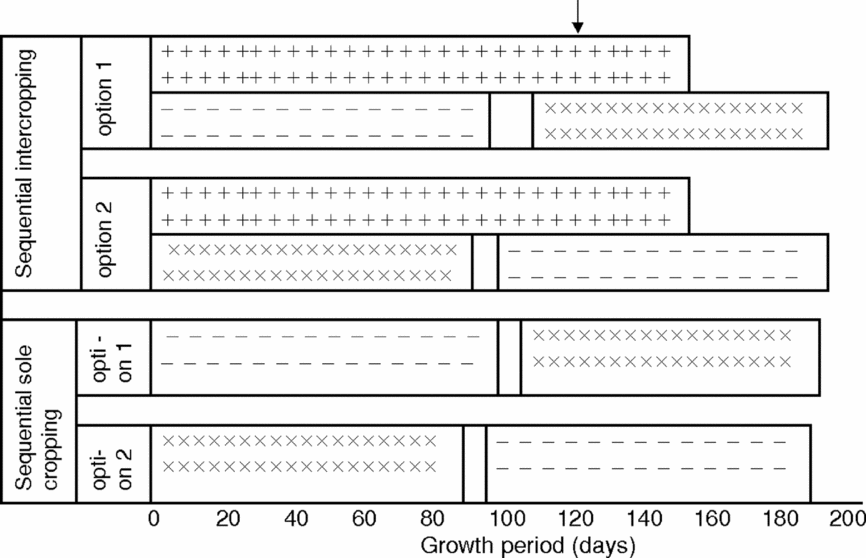
Three crops were involved in this experiment: maize, common bean and mung bean. Treatments were made from combinations involving intercropped and sole crops of all the three species. The intercropping contained two- and three-crop components. When the intercropping contained three species, the two pulse components were planted sequentially one after the other (Figure 1). Moreover, sole crops of the three species were planted with those of the pulses depicting the sequence of their intercropped counterparts. The following were the treatments:

Graphic representation of the sequential cropping used. ++, maize; −−, common bean; ××, mung bean. The arrow indicates date of maize defoliation.
Maize cultivar BH540 (released in 1995), which is one of the recommended hybrids for the area, was used. For common bean, the cultivar Ibbado (released in 2003) was selected based on its greater performance under both sole and intercropping conditions (Worku, Reference Worku2008). For mung bean, the variety Sunaina, which is under performance test, was chosen based on its early maturity and relative high yield. The experimental design was randomized complete block with three replications.
Agronomic management
All the first intercropped components of maize, common bean and mung bean were planted simultaneously on 18 April in 2007 and on 20 May in 2009. The 2009 planting was late by more than a month compared to 2007 due to unusually late rains. Sole crops of maize, common bean and mung bean were also planted on the same dates.
For the sole crops of maize and pulses and for the intercropped maize, the recommended N and P rates were applied. Accordingly, phosphorus fertilizer was applied on intercropped and sole maize plots at a rate of 46 kg P2O5 ha−1 as a one-time application before planting. Nitrogen was applied on the same plots at the rate of 54 kg ha−1 as split application. Half the rate of nitrogen was applied with phosphorus and the remaining half was given a month after emergence of maize. Sole common bean and mung bean plots received phosphorus at the rate of 23 kg P2O5 ha−1 and nitrogen at the rate of 9 kg ha−1 and were applied as a single dose just before planting. Intercropped common bean and mung bean plants did not receive additional fertilizer.
The intercropping was an additive type where the components were combined with their full sole crop densities: 41 666 plants ha−1 maize, 250 000 plants ha−1 common bean and 333 333 plants ha−1 mung bean. Intercrop and maize sole plots were 4.8 m wide and 3 m long. Sole plots of common bean and mung bean were planted on 2.4 wide and 3 m long plots. Maize seeds were hand planted with two seeds per hill with 80 cm inter-row and 30 cm intra-row spacing. Common bean and mung bean plots were also hand sown with two seeds per hill with inter-row spacing of 40 cm. The intra-row spacings were 10 and 7.5 cm for common bean and mung bean, respectively. All stands were thinned to the desired density a week after emergence.
Because of stalk borer infestation in 2007, the insecticide karate was applied twice on maize plots at the rate of 0.31 ml a.i. in 10 ml water m−2. The first application was on 30 April 2007, which was followed by a second spray 10 days later.
The first planted sole and intercrop components of mung bean were harvested on 16 July in 2007 and on 15 August in 2009 while those of common bean were harvested on 26 July in 2007 and on 25 August in 2009. Sequential intercrop plantings of common bean were made three weeks after mung bean was harvested while mung bean was planted one and half weeks after the harvest of common bean.
Maize was defoliated on targeted sole maize and in all sequentially intercropped plots, after full germination of the second planted pulse components. This was about 40 days from silking. All the leaves below the ear excluding the one subtended on the cob were removed. On average, five to six leaves were removed with three to four active ones. About six green active leaves remained including the flag leaf on each plant, on average.
Fraction of irradiance reaching the base of the maize canopy was estimated by using the SunScan Canopy Analysis System (Delta T devices Ltd., Cambridge, UK). Weather data were obtained from a station located about two km away from the experimental site.
Data analyses
Treatment effects were evaluated by a combined analysis of variance using the General Linear Models of the Statistical Analysis System (SAS Institute, 2000, version 8e), with cropping systems and year as fixed effect. The F-test was used to check for homogeneity of error variances between the two years (Gomez and Gomez, Reference Gomez and Gomez1984). Competitive ratios and area time equivalency ratio (ATER) data were transformed using the square root method before analysis. Mean separation for main effects was obtained by Fisher's least significant difference (LSD) test.
The intercropping efficiency of the cropping system was analysed using the land equivalent ratio (LER; Mead and Willey, Reference Mead and Willey1980) and the ATER (Hiebsch and McCollum, Reference Hiebsch and McCollum1987) methods:
 \[
{\rm Total }\,LER{\rm = }\sum\limits_{i = 1}^n {Ymi} /Ysi = \sum\limits_{i = 1}^n {LERi} ,
\]
Two types of LER were calculated for the pulse components: these were, LERsin and LERsum where sole yield from first planting and sum of sole yields from two plantings were used for standardization, respectively. Usually, LER is calculated using a single sole crop yield of each component. Using the sum of yield from the two harvests avoids the limitation of LER by accounting for differences in cropping duration as suggested by Hiebsch and McCollum (Reference Hiebsch and McCollum1987), who argued that cropping systems involve an investment in both land and time and should be evaluated as such. The method of standardization should vary according to the form and objective of the experiment (Mead and Willey, Reference Mead and Willey1980). In this experiment, the season is sufficient to grow two crops of the pulse components but a single one of the maize component.
The ATER was computed using the equation proposed by Hiebsch and McCollum (Reference Hiebsch and McCollum1987). They defined ATER as the ratio of area–time required in sole cropping to area–time used by the intercrop in producing the same quantities of all component crops.
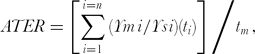 \[
{\it ATER} = \left[ {\sum\limits_{i = 1}^{i = n} {(Ymi/Ysi)(t_i )} } \right]\Bigg/t_m ,
\]
Competition that existed between associated crops is estimated by the competitive ratio (CR; Willey and Rao, Reference Willey and Rao1980). They suggested that CR provides a more appropriate and meaningful competition index especially for ‘additive’ types of intercrop associations.
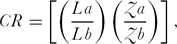 \[
CR = \left[ {\left( {\frac{{La}}{{Lb}}} \right)
\left( {\frac{{Za}}{{Zb}}} \right)} \right],
\]
The economic feasibility of the cropping systems was assessed by estimating net return, which was calculated by subtracting the total costs from gross return. Gross return was calculated by multiplying the yield adjusted downward by 25% (CIMMYT, 1988) with market price. The prices of maize in 2007 and 2009 were 455.58 and 484.84 US$ tone−1, respectively and those of common bean and mung bean were 593.07 in 2007 and 626.42 US$ tone−1 in 2009. Expenditures for seed, fertilizer, land preparation, sowing, weed control, harvest and transport were included for estimating cost of production.
RESULTS AND DISCUSSION
Weather conditions
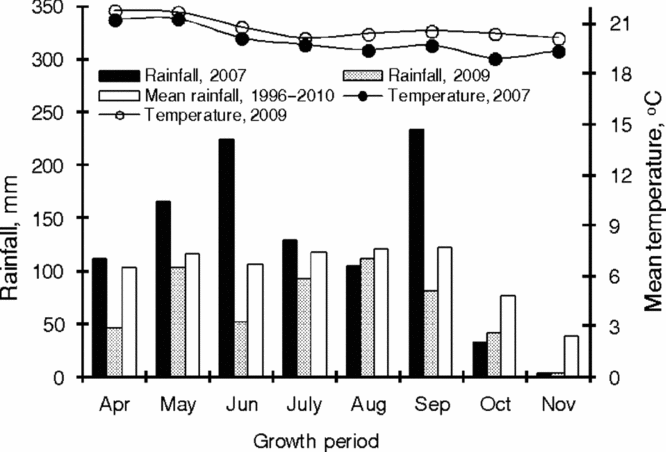
Both 2007 and 2009 were unusual in different ways. The year 2007 was extremely wet while the year 2009 was exceptionally dry. The amounts of rainfall during the cropping duration were 1003 mm for 2007 and 523 mm for 2009 (Figure 2). The 2007 rainfall was greater by 16% compared to the long-term average while the 2009 was lower by 39%. Though long-term rainfall data showed that amounts up to 1000 mm for the duration were not unusual, amounts as low as 523 mm have not been observed in the last 15 years. This is probably showing the increasing impact of climate change on rainfall amount. A declining trend of annual rainfall has been observed over the northern half of the country and southwestern Ethiopia while an increasing trend has been observed in central Ethiopia (NMSA, 2001). The low rainfall amount of 2009 was the main factor contributing for the reduced productivity of the component crops, especially common bean. The mean temperature comparison indicated that the year 2009 was slightly warmer particularly towards the end of the growing period, compared to 2007. Its effect was observed in shortening the growth duration of the component crops.
Rainfall and temperature of the experimental site during the growing period.
Effect on maize productivity
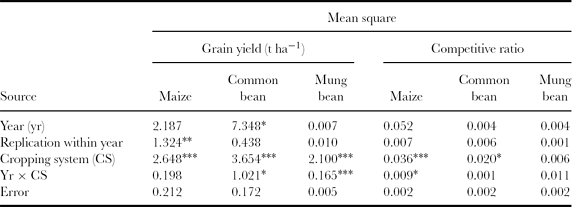
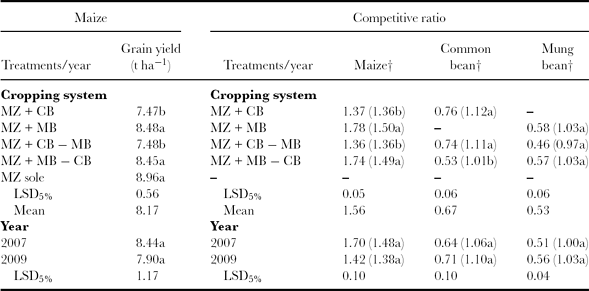
Significant grain yield differences were observed on maize due to cropping systems (Table 1). Simultaneously intercropped common bean reduced the associated maize grain yield by 16% (Table 2). However, sequential intercropping of common bean did not have a significant effect on maize yield. Also, differences were not observed in maize yield when mung bean was intercropped either simultaneously or in succession after common bean.
Combined analysis of variance for grain yield and competitive ratio of component crops under intercropping involving maize, common bean and mung bean at Hawassa.
*, ** and *** indicate significance at the 0.05, 0.01 and 0.001 probability levels, respectively.
Means for grain yield of maize and for competitive ratios of associated crops under intercropping at Hawassa.
Yield is adjusted to 13% moisture content; column means with the same letter are not significantly different at p ≤ 0.05; MZ: maize; CB: common bean; MB: mung bean.
†Transformed values are given in parentheses.
Planting sequence of the two legume species was more important than the number of species associated with maize yield performance. Maize had shown yield reduction whenever common bean came first in the sequence. On the other hand, yield performance of maize was not influenced due to sequentially intercropped common bean. Absence of yield loss in maize because of sequentially intercropped common bean could be due to the advanced growth stage of the maize crop allowing it to suppress the competition from the establishing young bean plants. Maize also gained some advantage from growing alone and free of competition for about three weeks after intercropped mung bean was harvested. Reported results on the performance of associated maize with common bean are variable. Gebeyehu et al. (Reference Gebeyehu, Simane and Kirkby2006), Worku (Reference Worku2008) and Tsubo et al. (Reference Tsubo, Mukhala, Ogindo and Walker2003) did not find a significant yield reduction from maize–common bean intercropping. On the other hand, Morgado and Willey (Reference Morgado and Willey2008) and Fininsa (Reference Fininsa1997) observed significant yield reduction from maize–common bean intercropping due to early introduction of the legume and reduced maize density, respectively. Fininsa (Reference Fininsa1997) indicated that earlier planting of the associated bean components depressed maize yield while it favoured that of the bean yield. Differences in plant density, spatial arrangements, overall growing conditions (Echarte et al., Reference Echarte, Della Maggiora, Cerrudo, Gonzalez, Abbate, Cerrudo, Sadras and Calviňo2011), relative planting times and genotypes included could be contributing for the discrepancy.
Mung bean had no impact on the intercropped maize productivity irrespective of its planting time in the association. This is because of the slow growth rate, small stature and short growth duration of mung bean plants making them poor competitors as indicated by a small competitive ratio. Moreover, for the sequentially planted mung bean, a disease problem affected their growth, reducing their competitive ability further. Similarly, Eyre et al. (Reference Eyre, Routley, Rodriguez and Dimes2011) observed that maize was more susceptible to intraspecific competition than interspecific competition while the reverse was true for mung bean, under a maize–mung bean replacement intercropping. Also, Polthanee and Trelo-ges (Reference Polthanee and Trelo-ges2003) reported that maize grain yield was unaffected by legume intercrops involving mung bean, peanut (Arachis hypogaea) and soybean (Glycine max) though reduced legume intercrop density partly contributed.
Effect on common bean productivity
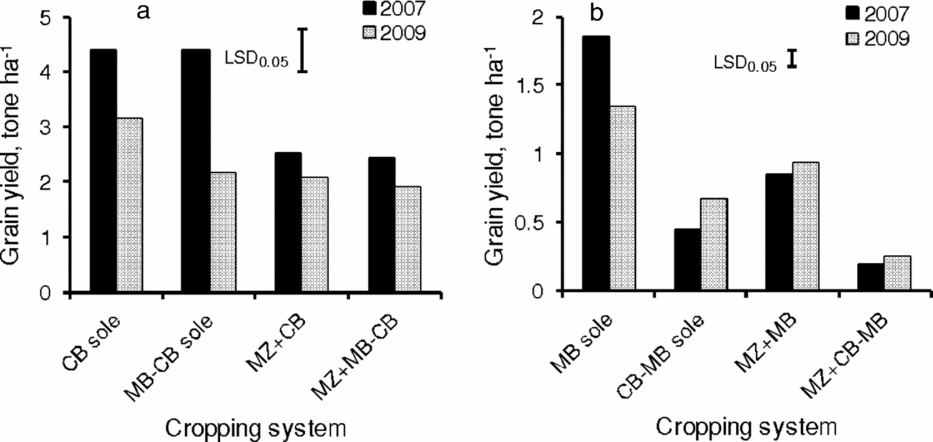
There was a significant year by cropping systems interaction for common bean (Table 1). The interaction showed that while the yield under sole cropping was similar between first and second sown common bean in 2007, it was significantly lower for the second sown crop in 2009 (Figure 3a). Intercropping with maize either simultaneously or in succession reduced common bean yield compared to sole crops in 2007 while only simultaneous planting had a similar impact in 2009. The reductions were 43 and 45% for simultaneous and sequential intercropping in 2007, respectively and 34% for simultaneous planting in 2009. Unlike 2007, yields were similar between intercropped and sole crops for sequentially planted plots in 2009.
The year by cropping system interaction for grain yield under sole and intercropping of components involving (a) common bean and (b) mung bean. MZ, maize; CB, common bean; MB, mung bean; yield is adjusted to 11% moisture.
Common bean productivity did not vary between the two planting times under both sole and intercropping during the wet year of 2007. However, yield performance varied depending on the planting time and the cropping system in 2009. Accordingly, grain yield from first bean planting exceeded that from sequential planting under sole cropping while the yield levels were more or less similar under sequential intercropping. It seems that in good years, either of the planting dates gives comparable yield under both sole and intercropping while in sub-optimal years first planting is more productive, especially for sole cropping. The poor performance of the second sole planting compared to first planting in 2009 was due to the increasing severity of water stress with the advancing season. On the other hand, shading from the taller maize component might have mitigated water stress on the intercropped common bean in the sub-optimal year of 2009. For instance, Worku and Skjelvåg (Reference Worku and Skjelvåg2006) indicated that shading reduced common bean yield under full water supply or moderate early drought while it increased it under terminal and season long drought. They suggested that shading could be advantageous during more sensitive developmental phases and under severe water stress. Moreover, Mushagalusa et al. (Reference Mushagalusa, Ledent and Drave2008) indicated that the presence of maize above a potato canopy affected soil temperature and moisture and was beneficial for potato tuber growth. Masojldek et al. (Reference Masojldek, Trivedi, Halshaw, Alexiou and Hall1991) found that CO2 assimilation rates and fluorescence were severely inhibited in sorghum (Sorghum bicolor (L.) Moench) and millet (Pennisetum glaucum (L.) R. Br.) leaves under the combined effects of drought stress and high irradiance while high irradiance slightly increased CO2 assimilation rate under optimum watering regime.
Yield reductions are common when beans are intercropped with maize. From a maize–common bean intercropping, Worku (Reference Worku2008) and Gebeyehu et al. (Reference Gebeyehu, Simane and Kirkby2006) reported 80 and 75–91% losses in the associated common bean yield, respectively. Moreover, from a double maize–common bean intercropping study in eastern Ethiopia, Tana et al. (Reference Tana, Fininsa and Worku2007) reported 23 to 55% reduction for simultaneous planting of the components and 59 to 74 reductions for sequential planting. The relatively lower bean yield reduction under sequential planting in this experiment might be partly due to the leaf removal that improved light distribution to the bean canopy by 18%, because shading from the taller maize component is one of the mechanisms responsible for the loss of bean productivity under intercropping. Maize intercepts most of the incident radiation due to its structural advantage and the amount filtered on the bean canopy is significantly reduced. For instance, Tsubo and Walker (Reference Tsubo and Walker2003) reported that the taller maize canopy at a density of 6.67 plant m−2 reduced incident radiation on the top of intercropped bean canopies by up to 90% decreasing total dry matter of beans by 67% at the end of the growing season. Also, Polthanee and Trelo-ges (Reference Polthanee and Trelo-ges2003) had observed no difference in amount of light intercepted between sole and intercropped maize while the light penetration through the maize canopy ranged from 46 to 73% in maize–peanut, maize–soybean and maize–mung bean intercropping.
Effect on mung bean productivity
Intercropping at both planting times significantly decreased mung bean yield compared to the respective sole yields during the two years (Figure 3b). The reductions in 2007 were 54 and 56% for the simultaneous and sequential plantings, respectively. In 2009, the losses were 31 and 63% for the same comparisons. Unlike common bean, sequential planting caused greater yield loss in sole mung bean during both years. Accordingly, sole mung bean yield from second planting was smaller than that from first planting by 76% in 2007 and by 50% in 2009. The year by cropping system interaction showed higher and significant grain yield difference between the two years under sole plants than intercropped plants (Figure 3b).
The yield losses from second planting were mainly caused by a disease problem from plantings in late July and August. This is different to common bean where productivity was mainly influenced by availability of moisture. Grain yield variation between the two years was more pronounced under sole than intercropping, which was similar to what has been observed under common bean. Mung bean had suffered greater yield reduction due to intercropping compared to common bean during both years. From a replacement maize–mung bean intercropping, Eyre et al. (Reference Eyre, Routley, Rodriguez and Dimes2011) reported that mung bean yield decreased by 56 to 70% in the intercrop compared to the sole counterpart though some of it was attributed to smaller intercrop densities. Similarly, Polthanee and Trelo-ges (Reference Polthanee and Trelo-ges2003) reported a 51% yield loss for mung bean from intercropping with maize, the highest loss among three component pulses. As a shorter component, one of the main contributing factors for reduced productivity could be competition for light especially under optimal years. Islam et al. (Reference Islam, Kubota, Mollah and Agata1993) indicated that mung bean is highly sensitive to shading particularly at grain filling stage. They observed yield losses as high as 38 and 63% from 45 and 75% artificial shading, respectively.
Competitive ratio
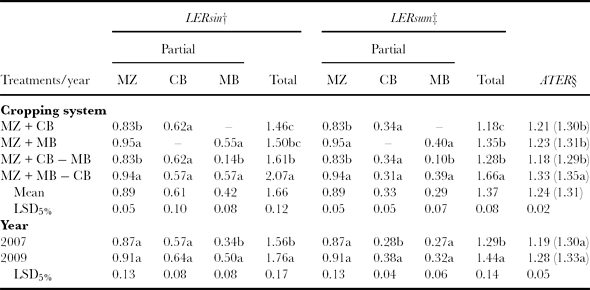
Maize has shown the strongest competitive ability among the associated crops during both years with a mean CR of 1.70 and 1.42 in 2007 and 2009, respectively (Table 2). It has shown greater competitive ability whenever it was planted simultaneously with mung bean under both two- and three-crop associations. On the other hand, its competitive ability decreased significantly whenever common bean was simultaneously planted with maize. Common bean ranked second in its competitive ability next to maize with a mean CR of 0.64 and 0.71, in 2007 and 2009, respectively. Mung bean was the weakest competitor of the three species with a CR of 0.51 in 2007 and 0.56 in 2009. The competitive abilities of common bean and mung bean were relatively greater when intercropped simultaneously than sequentially though the difference was not significant for the latter. In the year by cropping system interaction, the difference in maize CR between the two years was larger under simultaneous intercropping with mung bean.
Maize has been shown to possess stronger completive ability in cereal–legume intercropping systems. Competitive ratios were larger for maize (0.9–1.4) than for pigeonpea (Cajanus cajan (L.) Millsp.) (0.7–1.1) in maize–pigeonpea intercropping (Rusinamhodzi et al., 2012). Similarly, maize was more competitive in association with common bean with mean CR of 1.38 compared to bean which had 0.62 (Workayehu and Wortmann, Reference Workayehu and Wortmann2011). Ofori and Stern (Reference Ofori and Stern1987) indicated that the cereal component, with relatively higher growth rate, height advantage and more extensive root system is favoured in the competition with the associated legume. Moreover, Mao et al. (Reference Mao, Zhang, Li, van der Werf, Sun, Spiertz and Li2012) found a much higher water equivalent ratio for maize than the associated pea plant showing that the legume was at a disadvantage in underground competition which was confirmed by the evidence of water extraction from the pea zone by maize.
The competitive ability of common bean was influenced by the time of its introduction in to the system. It had larger CR when intercropped simultaneously than sequentially with maize. This is because simultaneous planting allows it to develop its canopy and root system before the dominant maize is vigorously established and suppress its growth. For instance, long duration maize starts to have a close canopy six weeks after emergence and maintains its canopy until the beginning of physiological maturity, making above ground competition more difficult. Addo-Quaye et al. (Reference Addo-Quaye, Darkwa and Ocloo2011) obtained greater leaf area index and crop growth rate for soybean introduced earlier in to the association with maize compared to those introduced late. On the other hand, mung bean had shown poor competitive ability irrespective of its relative planting time. The weak competitive ability of mung bean could be attributed to its slow growth and short stature. Asaduzzaman et al. (Reference Asaduzzaman, Karim, Ullah and Hasanuzzaman2008) observed that mung bean plant as a pulse crop showed a phase of slow dry matter production in early growth stage up to 40 days after sowing.
Intercropping efficiency
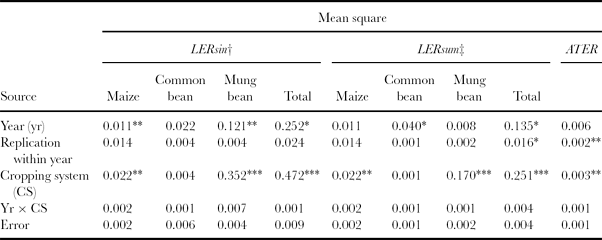
Partial LERs of maize and legume components were significantly different among the cropping systems (Table 3). Higher maize partial LERs were obtained whenever mung bean was planted simultaneously with maize while lower values were observed whenever common bean came first in the sequence (Table 4). Common bean had similar partial LERs under both simultaneous and sequential intercropping. On the other hand, partial LERs of mung bean were greater when mung bean was simultaneously planted with maize than when sequentially intercropped. Total LERs were also significantly different among the cropping systems (Table 3). The highest total LER (2.67 for LERsin and 1.66 for LERsum) was obtained from the three-species association involving sequential intercropping of maize with mung bean followed by common bean (MZ + MB − CB) (Table 4). Intercropping advantages were greater during the sub-optimal year of 2009 compared to 2007 as shown by larger total LER values.
Combined analysis of variance for land equivalent ratio (LER) and area time equivalency ratio (ATER) of component crops under intercropping involving maize, common bean and mung bean at Hawassa.
*, ** and *** indicate significance at the 0.05, 0.01 and 0.001 probability levels, respectively.
†Single sole crop yield of the first harvest used to standardize.
‡Sum of sole crop yields from two harvests used to standardize.
Partial and total land equivalent ratio (LER) and area time equivalency ratio (ATER) from intercropping of maize with common bean and mung bean at Hawassa.
Column means with the same letter are not significantly different at p ≤ 0.05. MZ: maize; CB: common bean; MB: mung bean.
†Single sole crop yield of the first harvest used to standardize.
‡Sum of sole crop yields from two harvests used to standardize.
§Transformed values are given in parentheses.
Intercropping efficiency analysis using the ATER approach has also shown significant differences among the different associations (Table 3). The ATER values showed an intercropping advantage for all associations, with intercrop benefits as high as 33% obtained for MZ + MB − CB association (Table 4).
The dominant component in the association maize had the highest partial LER followed by common bean and mung bean. Similarly, others have reported relatively greater partial LERs of maize with values of 0.86 (Workayehu and Wortmann, Reference Workayehu and Wortmann2011), 1.09 (Yilmaz et al., Reference Yilmaz, Atak and Erayman2008) and 1.01 (Worku, Reference Worku2008) from intercropping with common bean; the corresponding LERsin values for common bean were 0.76, 0.37 and 0.10–0.31, respectively. The higher partial LER of maize observed in this study from simultaneous intercropping with mung bean was due to the poor competitive ability of the latter allowing maize to grow vigorously during the early growth stage and suppress competition. On the other hand, the similarity of partial LERs of common bean observed in this experiment between the two planting times was because of its comparable yield performance under intercropping in these planting times. Mung bean had the least partial LER due to its greater sensitivity to competition. In agreement with this, Polthanee and Trelo-ges (Reference Polthanee and Trelo-ges2003) obtained the lowest LER value for maize–mung bean intercropping compared to either maize–peanut or maize–soybean association.
All intercrop associations showed a total LER value of greater than one indicating the advantage of intercropping compared to sole planting of the components, for both LER types. The highest biological efficiency was obtained from sequential intercropping of maize with mung bean followed by common bean (MZ + MB − CB). The LERsum value for this association was 1.66 with accompanying intercropping advantage of 66%. This association is not only advantageous compared with sole cropping but also better than any of the two-species intercropping and the other three-species association, MZ + CB − MB. The other three-crop association, MZ + CB − MB, was no better than the best two-crop association involving maize and mung bean showing the importance of planting sequence between the two legume species. Intercropping advantages were reported for many cereal–legume intercropping systems involving two components (Agegnehu et al., Reference Agegnehu, Ghizaw and Sinebo2006; Lithourgidis et al., Reference Lithourgidis, Vlachostergios, Dordas and Damalas2011; Nelson et al., Reference Nelson, Pswarayi, Quideau, Frick and Spaner2012; Ngwira et al., Reference Ngwira, Aune and Mkwinda2012; Rusinamhodzi et al., Reference Rusinamhodzi, Corbeels, Nyamangara and Giller2012; Workayehu and Wortmann, Reference Workayehu and Wortmann2011). Besides, Tana et al. (Reference Tana, Fininsa and Worku2007) have shown the advantage of intercropping maize with a double crop of common bean planted sequentially.
The greater intercropping efficiency of the drier year was contributed by improved partial LERs of the legume components, mainly common bean. This happened in spite of the smaller yields obtained from both intercropped and sole plots in this year. Greater LER values could arise not only from greater intercrop yields but also from smaller accompanying sole crop yields. It seems that drought raised the intercropping advantage by decreasing the sole crop yield more than the corresponding intercrop yield. Similarly, Agegnehu et al. (Reference Agegnehu, Ghizaw and Sinebo2006) observed increased intercropping advantage in years where there was water stress in a barley (Hordeum vulgare L.)–faba bean (Vicia faba L.) intercropping. Moreover, Natarajan and Willey (Reference Natarajan and Willey1986), from sorghum–cowpea (Vigna unguiculata (L.) Walp.) intercropping, observed an increasing intercrop advantage with rising water stress levels because grain yield decreased much less than those of their sole crops in response to rising water stress. They suggested that difference in rooting depth and a favourable microclimate for groundnut under shading may have contributed to the improved advantage.
Occurrence and extent of intercropping efficiency may depend on the methodology used for its assessment. Exaggerated LER values were observed in both common bean and mung bean when single sole crop yields were used for standardization (LERsin) instead of sum of the two sole crop yields (LERsum). For instance, for the best intercropping association, LERsin inflated intercropping efficiency by 25% compared to LERsum (Table 4). This exaggerated efficiency was produced because of the unused area–time of the components as suggested by Hiebsch and McCollum (Reference Hiebsch and McCollum1987). Thus, to avoid this deficiency it is possible to standardize the intercrop yields from a double harvest of short cycled components provided that the season is long enough to allow it. This would give a more realistic estimate of intercropping advantage than using a single sole crop yield. Estimation of intercropping efficiency using LER without considering the variation in crop duration overestimates the intercropping advantage (Hiebsch and McCollum, Reference Hiebsch and McCollum1987; Polthanee and Trelo-ges, Reference Polthanee and Trelo-ges2003). The other approach of estimating intercropping efficiency designed to overcome the limitation of LER is the ATER method (Hiebsch and McCollum, Reference Hiebsch and McCollum1987). In this study, ATER values were markedly lower than those obtained under LERsin and LERsum. Similar changes in intercropping efficiency, depending on the evaluation method, were reported for intercrops of maize with several legumes (Polthanee and Trelo-ges, Reference Polthanee and Trelo-ges2003). They showed, for instance, that a maize–mung bean association has given a considerable intercropping advantage of 48% with the LER method while the ATER evaluation availed no benefit with a value of 0.96. Even though ATER is more realistic than the LER method under such circumstances, it tends to underestimate the intercropping advantage, because ATER evaluates efficiency on yield per day basis by accounting for differences in growth duration even when such differences are too short to grow another crop.
Economic analysis
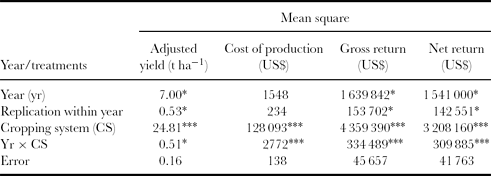
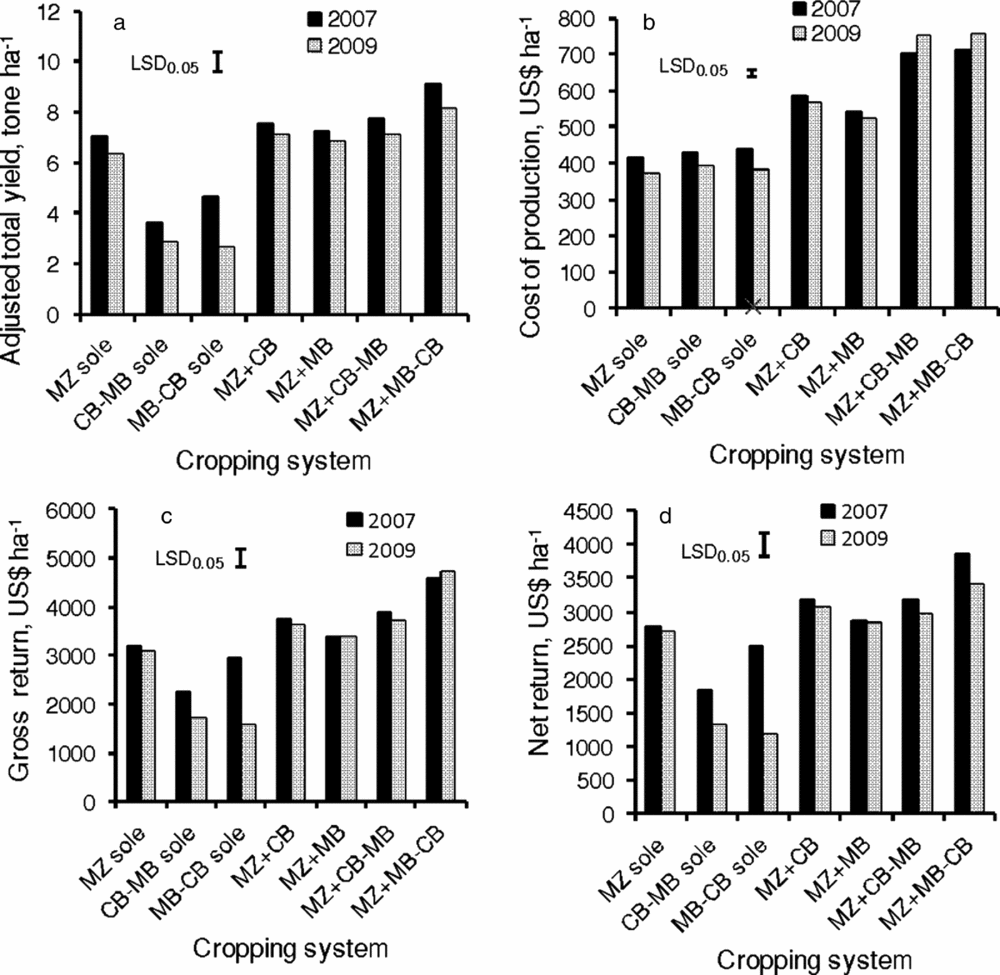
There was a significant year by cropping system interaction for the economic analysis involving adjusted total yield, cost of production, gross return and net return (Table 5). Lower total-adjusted yields were obtained from the sequential cropping of the two pulses as sole crops while the highest was obtained from sequential intercropping of maize and mung bean followed by common bean (Figure 4a). Production costs increased with rising number of components under intercropping (Figure 4b). The highest net return was obtained from the three-species intercropping, MA + MB − CB, during both years (Figure 4d). The other three-species intercropping, MA + CB − MB, was no better than the two-species intercropping involving maize and common bean in terms of net return.
Combined analysis of variance for economic feasibility of intercropping involving maize, common bean and mung bean at Hawassa.
* and *** indicate significance at the 0.05 and 0.001 probability levels, respectively.
The year by cropping system interaction for economic analysis of the various cropping systems showing (a) adjusted yield, (b) cost of production, (c) gross return, and (d) net return. MZ, maize; CB, common bean; MB, mung bean; 1 US$ = 8.78 in 2007 and 11.55 in 2009 Ethiopian Birr (ETB); yield is adjusted to 13% moisture content for maize and 11% for common bean and mung bean.
While performance in terms of adjusted yield, gross return and net return was more stable for sole maize and any of the intercropping systems, pronounced discrepancies were shown for sequentially planted sole pulses between the two years. Accordingly, sole cropping of mung bean followed by common bean was more advantageous in the wet year while the sequence was less important during the dry year. That was because common bean, with the greater yield potential, performed equally well from second planting provided that the season was good. Unlike the indication from LER values, the favourable year of 2007 was more advantageous than 2009 in economic terms showing the importance of supporting LER results with economic analysis. Economic feasibility of the intercropping systems is ultimately determined by their monetary advantage (Lithourgidis et al., Reference Lithourgidis, Vlachostergios, Dordas and Damalas2011). The economic return from the best combination has the highest marginal rate of return of 312% in 2007 and 161% in 2009 compared to sole maize, which is above the minimum rate of return (100%) needed for adoption by farmers (CIMMYT, 1988). Greater economic returns were reported in cereal–legume intercropping systems involving maize–pigeonpea (Ngwira et al., Reference Ngwira, Aune and Mkwinda2012), maize–common bean (Rusinamhodzi et al., Reference Rusinamhodzi, Corbeels, Nyamangara and Giller2012; Workayehu and Wortmann, Reference Workayehu and Wortmann2011) and barley–faba bean (Agegnehu et al., Reference Agegnehu, Ghizaw and Sinebo2006).
This study indicated that a three-crop association with the right sequence is more advantageous than a two-crop association with the tested crop varieties. Accordingly, sequential intercropping of maize with mung bean followed by common bean (MZ + MB − CB) is more beneficial than either sole cropping of the components or two-crop associations. This association has the highest biological efficiency, largest total productivity and the best monetary return. Thus, the combination of maize with the two legumes will be useful to address both the food requirement and cash needs of farmers. Rusinamhodzi et al. (Reference Rusinamhodzi, Corbeels, Nyamangara and Giller2012) observed that farmers’ evaluation of the intercrops was primarily based on the ability of the options to achieve food security and cash income whilst reducing input costs. This intercropping system would also be attractive to farmers because it little affects the yield of the principal crop of the area (maize). Thus, farmers would get greater advantage from practicing sequential intercropping in areas where the season is sufficient to grow long duration maize. Use of common bean and mung bean genotypes with longer growth duration as components is unlikely to succeed due to the increased risk of exposure to terminal drought. On the other hand, a double crop of mung bean followed by common bean is also a possibility should sole pulses are preferred, though yield is expected to suffer considerably from year to year weather variation. Defoliation of maize improved light distribution without significantly affecting its grain yield. However, the magnitude of its contribution to improving intercropping performance should be researched along with utilization pattern of soil and aerial resources.