Introduction
One of the most significant man-made changes in the environment is caused by the expansion of towns, converting originally natural ecosystems into urban environments. Typical features of such habitats include intense artificial lighting, noise, pollution, the permanent presence of humans, anthropogenic food sources, an impoverished flora and fauna, and fragmentation of habitats (Partecke et al., Reference Partecke, Van't Hof and Gwinner2005, Reference Partecke, Schwabl and Gwinner2006b). Urbanization dramatically alters the composition of wildlife communities, leading to biodiversity loss, a phenomenon which can also be observed in the parasite communities of hosts living in urban habitats (for review see Bradley & Altizer, Reference Bradley and Altizer2007). The effect of urbanization on the ecology of wildlife–parasite interactions has been illustrated for pathogens such as viruses (West Nile virus, canine parvovirus), bacteria (Borrelia burgdorferi s.l., Mycoplasma sp.) and protozoans (Toxoplasma gondii, Trypanosoma sp., Plasmodium sp.) (Bradley & Altizer, Reference Bradley and Altizer2007). However, data concerning the impact of urbanization on helminth communities of species that have adapted to a synanthropic existence are still scarce.
Some species have adapted well to urbanization and can therefore live in both natural and changed environments. These constitute good models for studying the effect of urbanization on the ecology of wildlife–parasite interactions. The European blackbird (Turdus merula), a passerine belonging to the thrush family, breeds throughout Europe, Asia and North Africa. Depending on latitude, T. merula may be resident, partially migratory or fully migratory. Populations are sedentary in the south and west of the range, while northern birds winter in northern Africa and tropical Asia. Turdus merula is omnivorous, feeding on a wide range of insects, earthworms, seeds and berries, with small vertebrates such as frogs, tadpoles and lizards occasionally being consumed (Clement et al., Reference Clement, Byers, Hathway and Wilczur2000; Partecke & Gwinner, Reference Partecke and Gwinner2007). The process of synanthropization of T. merula began during the nineteenth century and now the bird is more common in urban settings than in its natural forest habitat. Urban populations of T. merula differ significantly from forest populations in having higher breeding densities and smaller breeding territories, a higher level of aggressive social interactions and a longer daily activity time. Additionally, urban blackbirds are less likely to migrate and have a longer annual reproductive season (Luniak & Mulsow, Reference Luniak, Mulsow and Ouellet1988; Gliwicz et al., Reference Gliwicz, Goszczynski and Luniak1994; Partecke et al., Reference Partecke, Van't Hof and Gwinner2004, Reference Partecke, Van't Hof and Gwinner2005).
Differences in biology, as well as in physiological processes, of blackbirds living in natural and modified environment are quite well documented (Partecke et al., Reference Partecke, Gwinner and Bensch2006a, Reference Partecke, Schwabl and Gwinnerb; Partecke & Gwinner, Reference Partecke and Gwinner2007). However, only Geue & Partecke (Reference Geue and Partecke2008) have shown that the level of infection of haemoparasites of T. merula living in urban areas is significantly lower than that seen in birds from forests. The authors speculate that this may be due to a lack of vectors for haemoparasites in urban habitats. The life cycle of helminths can be direct (without intermediate hosts) or indirect (with the participation of intermediate hosts). In the case of complex life cycles, when the reproduction strategy relies on intermediate hosts (especially digenean species), it might be expected that the potential spectrum of hosts will also be limited in urban areas. We might therefore predict a lower helminth species richness and lower level of infection of blackbirds in synanthropic environments.
In this study we have investigated the helminth communities of T. merula in two distinct populations to determine whether living in synanthropy results in an impoverished helminth fauna when compared with birds living in forest habitats.
Materials and methods
Study area and sampling of the hosts
For 3 years (2003–2005) birds were collected from two ecologically distinct sites located in the eastern part of the Czech Republic. The first site was within the town of Prerov (49°27′33″N/17°27′41″E) where the birds represent a typical urban population of T. merula. The second site, Zahlinice (49°17′06″N/17°28′41″E), constitutes a forest area located 15 km south of Prerov. Adult birds were dissected either after being found dead on the streets or within the forest, or after dying during banding operations. Juveniles were found dead due to bad atmospheric conditions, especially after heavy rains or low temperatures. The age and sex of the birds were determined according to plumage characteristics (Svensson, Reference Svensson1992).
Collection and examination of birds
Birds were transported to the laboratory and examined for parasites. During full-body necropsy, subcutaneous tissue, body cavity, oesophagus, stomach, intestines including the cloaca and bursa Fabricii, liver and gall bladder, spleen, lungs with trachea and bronchus, air sacs, kidneys and oviduct were all examined using a stereomicroscope. Helminths were washed in physiological salt solution, counted, fixed and preserved in 70% ethanol. Later, parasites were processed according to standard parasitological techniques; digeneans, tapeworms and acanthocephalans were stained with alcoholic borax carmine, dehydrated, cleared and mounted in Canada balsam. Nematodes were cleared in glycerine or lactophenol. All helminth species were identified using standard keys for identification of helminth parasites and other available data in the literature.
In total, 320 birds (222 adults and 98 juveniles) were examined from the two sites. The proportion of males (39 individuals in the urban area versus 91 in the forested area) to females (23 in the urban area versus 69 in the forested area) did not differ significantly between the sites (χ2= 0.67; P= 0.413). However, a difference was observed in relation to the age of the birds: in the forest habitat 75% of autopsied birds were adults (160 individuals out of 213) whereas within the urban environment, approximately equal numbers of adults (62) and juveniles (45) were examined (χ2= 9.89; P= 0.002).
Measures of helminth component and infracommunities
The use of descriptive ecological terms follows Bush et al. (Reference Bush, Lafferty, Lotz and Shostak1997). The total number of helminth species was used to measure component structure. Several ecological indices were used in order to assess the effect of habitat factors on the occurrence and structure of parasite communities of blackbirds. Simpson's Index of Diversity was calculated according to Magurran (Reference Magurran2004) as: D= Σ[n i (n i− 1)/N(N− 1)], where n i is the number of individuals of species i and N is total number of helminths in a given community. Because the diversity is also influenced by the abundance of the most common species, the dominance index of Berger–Parker (d = N max/N; where N max is the number of individuals in the most abundant species and N is total number of individuals) was calculated. The index does not depend on the sample size and its value only indicates the proportion of the most abundant species in the community. Similarity between component communities was estimated by Jaccard's index of similarity J =[c/(a+b+c)]*100, where c is the total number of species present in both samples, a is the number of species present only in sample 1, and b is the number of species present only in sample 2. A species accumulation curve (a plot of the cumulative number of species recorded as a function of the number of samples) was used to calculate the species richness of the entire parasite assemblage at the particular sites. To assess the estimated species richness of separated component communities, two non-parametric estimators: Chao 2 and Bootstrap were calculated. These estimators allow the calculation of species richness irrespective of the proportion of rare and accessory species, based on presence/absence data (Poulin, Reference Poulin1998; Krebs, Reference Krebs1999). For a detailed description of these estimators, see Colwell (Reference Colwell2009). For each component community 200 randomizations with replacement were generated using the software EstimateS v. 8.2 (Colwell, Reference Colwell2009). Statistical significance of the differences between observed and estimated species richness was tested by chi-square tests.
Infracommunity structure was assessed by mean and maximum number of helminths species per host, species density distribution across the sample, mean number of helminth individuals per host, mean intensity ( ± standard error of the mean, SEM) and prevalence of individual species (given with the lower and upper 95% confidence limits).
Data analysis
The infection, expressed as presence/absence data, with Digenea, Cestoda, Nematoda and Acanthocephala in relation to extrinsic (study site) and intrinsic (host age and host sex) factors was analysed by maximum likelihood techniques based on log-linear analysis of contingency tables, beginning with the most complex model involving all possible effects (study site, presence/absence of helminths, host age and host sex) and interactions. Next, the minimum sufficient model was generated where a chi-square result was not significant, indicating that the model was adequate in explaining the data (Abu-Madi et al., Reference Abu-Madi, Behnke, Lewis and Gilbert1998; Behnke et al., Reference Behnke, Lewis, Mohd Zain and Gilbert1999). Since the species richness did not fit a normal distribution, the differences between mean species richness of all major groups of helminths and study site were tested using Mann–Whitney's non-parametric U-test. In all statistical methods, the agreed significance level was 0.05. The calculations were done with Statistica 9.0 PL (StatSoft Inc., Tulsa, Oklahoma, USA).
Results
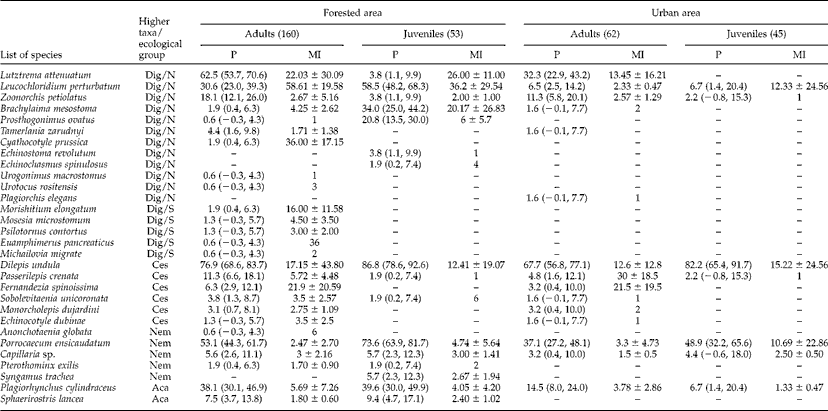
The overall prevalence of infection was 93.1% (95% confidence interval (CI) 90.3–95.9) and differed significantly between sites (χ2= 16.38; P< 0.001), i.e. more birds were infected in the forested (97.2%; 95% CI 94.9–99.4) than in the urban habitat (85.1%, 95% CI 78.2–91.9). The list of recorded parasites with the basic parasitological indices, i.e. prevalence given with 95% lower and upper confidence limits and mean intensity of infection ± SEM in particular sites and age categories, is given in table 1.
The prevalence (P), with upper and lower 95% confidence intervals, and intensity of infection (MI) ± SEM of T. merula with digenean (Dig), cestode (Ces), nematode (Nem) and acanthocephalan (Ac) species from forested (Zahlinice) and urban (Prerov) areas.

N, ‘northern species’ (Dogiel, 1962); S, ‘southern species’ (Dogiel, 1962).
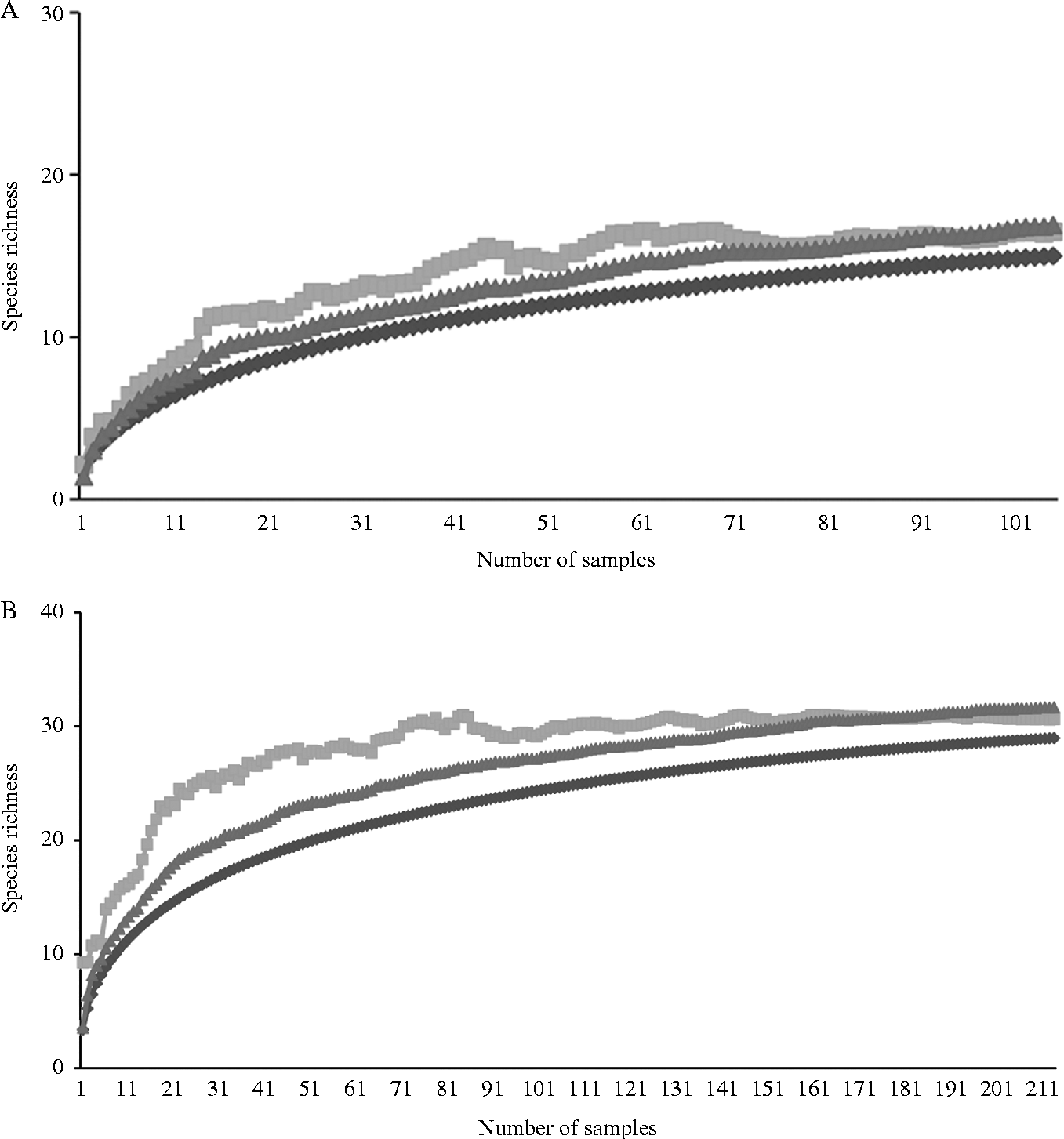
A total of 30 helminth species, including digeneans, tapeworms, nematodes and acanthocephalans were collected; 29 occurred in the forest population of T. merula but only 15 were found in T. merula from the urban area. Species accumulation curves for the component communities of helminths at the two sites did not reach an asymptote, suggesting that some additional rare species may remain to be discovered. For the urban population, the species richness index Chao 2 was 16.49 ± 2.21, while the more conservative Bootstrap estimate was 16.90 (fig. 1A), compared with the total of 15 species actually collected. However, those differences between the observed and estimated species richness were not statistically significant ( $$\chi _{Chao2}^{2} = 57.03 $$; P>0.999;
 $$\chi _{Bootstrap}^{2} = 19.18 $$; P>0.999). For the forest population, Chao 2 and Bootstrap estimates were 28.99 ( ± 2.58) and 29.49, respectively, compared with the actual recovery of 29 species (fig. 1B) (
 $$\chi _{Chao2}^{2} = 258.52 $$; P= 0.021;
 $$\chi _{Bootstrap}^{2} = 70.06 $$; P>0.999). This again suggests that the sample of birds examined was sufficient to detect the vast majority of the helminth species that infect them.
Species richness estimates predicted for helminth component communities in (A) urban and (B) forested habitats. The lower curves ( ) of each graph indicate the number of observed species (equivalent to the species accumulation curve which will merge with the total species richness asymptote), whereas the middle (
 ) and upper (
 ) curves, respectively, indicate the Bootstrap and Chao2 non-parametric estimates of species richness.
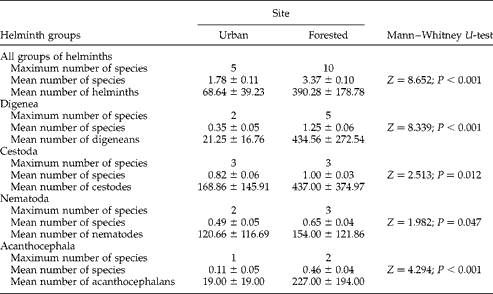
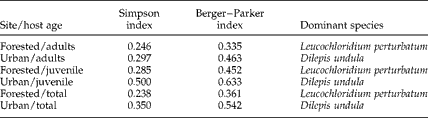
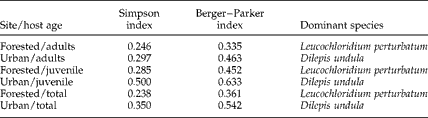
The mean species richness was almost three times higher in the forested area (3.37 ± 0.10) than in the urban site (1.78 ± 0.11), and the difference was statistically significant (Z = 8.652; P< 0.001). This trend was observed for all groups of helminths, although the biggest differences in species composition between the sites were observed for Digenea (table 2). The Berger–Parker index of dominance and Simpson's index of diversity recorded in each study site are given in table 3. The dominant species in the urban area was Dilepis undula whereas the helminth fauna of T. merula in the forested habitat was dominated by Leucochloridium perturbatum. The highest level of similarity of helminth fauna was observed between adult birds from both urban and forested habitats (53.8%) while in the case of adults from the forested area and juvenile birds from the urban population this value was the lowest (28.0%). The similarity between sites for juveniles was 46.7%.
Helminth species richness and the main helminth groups relative to study site.
Ecological indices of helminth diversity and dominance relative to host age and study sites.
To determine whether infection of T. merula by the representatives of major groups of helminths is affected by extrinsic (site) and intrinsic (host sex and age) factors, through a log-linear analysis of contingency tables, we show that for Digenea, Cestoda and Acanthocephala the overall prevalence of infection was higher in the forested area than in the urban site, while the infection with nematodes did not differ between the sites. However, we did not observe any differences in the prevalence of any particular group of helminths between the host sexes or age groups. The detailed information is given in table 4.
Results of log-linear analysis for the relationships between helminth infection and host sex, host age and site.
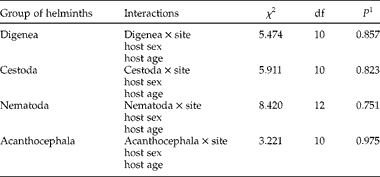
1 Probability that the data do not differ significantly from the minimum sufficient model decribed by the log-linear analysis.
Discussion
The present study demonstrates that urbanization leads to a significant reduction in the helminth fauna of a bird species that is highly adapted to synanthropic habitats, while still remaining common in its original forest habitat. The helminth fauna of T. merula in Central Europe has been studied on several occasions (e.g. Rysavy, Reference Rysavy1955, Reference Rysavy1958; Rysavy & Barus, Reference Rysavy and Barus1964; Binder, Reference Binder1970; Hanak & Vojtek, Reference Hanak and Vojtek1973; Borgarenko & Galina, Reference Borgarenko and Galina1978; Iskova, Reference Iskova1979; Machalska, Reference Machalska1980; Machalska & Okulewicz, Reference Machalska and Okulewicz1984), and the helminth parasites of this species are well documented. However, as these studies were mostly taxonomic in approach, we still know little of the ecology of these parasites. The present study allows us to follow the response of the helminth fauna of T. merula to urbanization.
Both the helminth species richness (3.37 in the forested area versus 1.78 in the urban area) and the level of parasitism (97.2% in Zahlinice versus 85.1% in Prerov) were significantly lower in the urban area than in the natural habitat. The effect of urbanization on changes in parasite distribution within host populations has been discussed widely in the literature (for a review see Bradley & Altizer, Reference Bradley and Altizer2007). The effect of urbanization may lead either to an increase in parasite abundance and prevalence, or may alternatively cause loss of parasite biodiversity.
The other biological features that differ between urban and forest populations of T. merula, (e.g. differences in the timing of reproduction, in stress physiology, different diet, residence instead of migration (Partecke et al., 2006a,b; Partecke & Gwinner, Reference Partecke and Gwinner2007),) may also affect parasite fauna and could lead to qualitative and quantitative changes in parasite assemblages. Only a few prior studies (Hatchwell et al., Reference Hatchwell, Wood, Anwar and Perrins2000; Bentz et al., Reference Bentz, Rigaud, Barroca, Martin-Laurent, Bru, Moreau and Faivre2006; Geue & Partecke, Reference Geue and Partecke2008) have examined the impacts of habitat on parasite infestation of T. merula. These studies were based only on blood parasites of the Eurasian blackbird; however, they clearly showed that the proportion of infected individuals was lower in the urban than in the forest habitat. The authors ascribed the reduced parasitaemia to differences in the frequency of appropriate vectors and different migration strategies (Geue & Partecke, Reference Geue and Partecke2008). Both factors can also be applied to helminth infection. For many helminth species it is obligatory to complete their life cycles in intermediate hosts which may be less available in urban areas. Additionally, in the city areas, dietary habits of T. merula are disparate from those living in forests and are usually strongly limited to human food waste. This could explain lower infection rates by digeneans and acanthocephalans, which require many invertebrate species as intermediate hosts, in blackbirds from urban environments when compared to forest populations.
Dogiel (1962) perceived that parasites of migratory birds formed four natural groups: (1) ‘ubiquitous species’, which occurred in their hosts throughout the year; (2) ‘southern species’, which infected birds only in their wintering grounds; (3) ‘northern species’, which infected birds in their nesting grounds; and (4) ‘migration species’, parasites that infected birds along their migratory routes. In our studies we found five ‘southern species’, i.e. Euamphimerus pancreaticus , Michailovia migrate , Mosesia microstomum, Morishitium elongatum and Psilotornus contortus, in adult birds from the forested habitat, while in the urban population we did not observe any parasite species infecting birds in the wintering grounds. Field studies on the behavioural ecology of migrating species revealed a tendency for sedentariness to increase in urban populations of several bird species, including T. merula (Yeh, Reference Yeh2004; Partecke & Gwinner, Reference Partecke and Gwinner2007). Our studies on the helminth fauna of two ecologically distinct populations of blackbirds showed that the parasite community of the urban population had no representatives of ‘southern species’, indicating that birds from Prerov do not migrate, in contrast to their counterparts from Zahlinice. An opposite tendency has been observed for nematodes (i.e. parasites with a direct life cycle), where no statistically significant differences in the occurrence of those parasites between both populations were clearly demonstrated and the qualitative (number of species) and quantitative (values of prevalence and mean abundance of nematodes) values were at comparable levels. Analyses of helminth diversity and dominance (based on Simpson and Berger–Parker indices) also showed that the parasite fauna of T. merula in the rural area was much more diverse than in the city birds. The dominant species in Zahlinice was Leucochloridium perturbatum, for which the intermediate hosts are snails of the genus Succinea, while in Prerov the dominant species was Dilepis undula, a tapeworm transmitted by Lumbricus terrestris. Those differences can also be explained by disparate food resources that are available in rural and urban areas.
In our studies we also investigated whether any biotic factors, i.e. host sex and host age, could affect the helminth infection in blackbirds. Log-linear analysis of contingency tables did not reveal differences in infection with representatives of major groups of helminths between adults and juveniles or males and females. However, we observed that for particular parasite species such separation was clearly visible. For example, infection with Lutztrema attenuatum and Zoonorchis petiolatus was higher in adult birds than in juveniles. In Passeriformes the representatives of the family Dicrocoeliidae constitute the dominant species in adult birds. These parasites are long-lived (minimum 6 months); metacercariae of L. attenuatum are transmitted by Oxidus gracilis (Diplopoda) and Z. petiolatus by Amaralidium vulgare (Isopoda) (Timon-David, Reference Timon-David1960; Krissinger, Reference Krissinger1984). These invertebrates constitute a major food resource during the spring and late autumn, thus infection in juvenile birds can be observed at the earliest during the winter. In birds from Zahlinice we found that the trematode Prosthogonimus ovatus differed significantly in prevalence and intensity between adults and juveniles. This fluke resides in the bursa Fabricii, an organ that is active in young birds and atrophies after about 6 months, thus finding P. ovatus in adult females is very rare. Differences in the occurrence of parasites between adults and juveniles were also found for Brachylaima mesostoma and L. perturbatum. The metacercariae of these trematodes occur in snails (Succicnea and Helicella) which constitute a major food resource while feeding the nestlings (Pavlov, Reference Pavlov1946; Pojmańska, Reference Pojmańska1969). Another example of an interesting parasite is Echinochasmus spinulosus, a typical trematode of grebes (Podiceps spp.). The second intermediate hosts for this parasite are small fish species of the genera Alburnus, Lebistes and Scardinius (Karmanova, Reference Rysavy1971). In 2007, due to the low water level at one of the fish ponds located in Zahlinice, the wind threw the small fish on to the shores where juvenile T. merula used them as food.
In summary, we conclude that the qualitative and quantitative differences in the helminth communities of T. merula obtained from two ecologically disparate localities can be explained by changes in the biology and behaviour of birds that are adapted to synanthropic habitats.