INTRODUCTION
Individuals with Alzheimer's disease (AD) experience marked decline in many areas of cognitive functioning, but deterioration in executive abilities such as inhibitory control are particularly salient features of the disorder (Amieva et al., 2004). Converging evidence suggests that these inhibitory failures are likely to have broader implications for socioemotional functioning and in particular may impact upon capacity for empathy, emotion regulation, as well as the likelihood of depression. However, no study to date has investigated the interaction between cognitive disinhibition and socioemotional functioning in the context of AD.
Cognitive Inhibition and Empathy
Empathy refers to the “capacity to understand others and experience their feelings in relation to oneself,” and it is as an essential prerequisite for successful social interaction and the development of close interpersonal relationships (Decety & Jackson, 2004). Converging evidence now suggests that the self-perspective is the cognitive “default mode,” and therefore, to evaluate another's perspective, some form of active inhibitory mechanism must regulate the prepotent self-perspective. However, although loss of empathy is a common feature of neurodegenerative disease, the only studies that have assessed the relationship between cognitive inhibition and empathy in relation to dementia have focused on frontotemporal dementia (Lough et al., 2006; Peters et al., 2006), and thus the relationship between cognitive disinhibition and empathy in individuals with AD remains to be established.
Cognitive Inhibition and Emotion Regulation
It also remains unclear whether the capacity for emotion regulation is affected by AD. Numerous methods by which emotions may be regulated have been proposed, but particular importance has been attributed to the processes of reappraisal and suppression. Whereas reappraisal requires cognitive flexibility in order to inhibit one's original view of a situation and consider an alternative perspective, suppression requires inhibition of prepotent affective and motor responses. Both types of strategy therefore impose substantial demands on inhibitory mechanisms, and as such, represent methods of emotion regulation which individuals with AD may not be able to effectively implement. Blanchard-Fields et al. (2004) argue that elderly individuals with a lack of cognitive resources rely more on passive emotion regulation strategies, such as “blind acceptance” of situations. The present study will be the first to assess how AD impacts capacity for emotion regulation and whether any observed difficulties are related to reduced inhibitory control.
Cognitive Inhibition and Depression
Finally, self-reported depression has been found to decrease with the severity of AD (Kashiwa et al., 2005; Starkstein et al., 2005). Increased dementia severity is also associated with reduced inhibitory control (Amieva et al., 2004), and there are at least two routes by which cognitive disinhibition may lead to reduced depression. Firstly, inhibitory deficits in AD have been consistently linked to anosognosia (Kashiwa et al., 2005; Starkstein et al., 2005), which in turn has been linked to reduced depression. Secondly, reduced cognitive inhibition may be associated with decreased ruminative thought. Increased rumination, or preoccupation with one's depressive symptoms and the implications of those symptoms, is associated with increased dysphoric mood and negative thinking (Watkins & Baracaia, 2002). Importantly, ruminative thinking has been argued to impose particular demands on executive control processes such as cognitive inhibition (Watkins & Brown, 2002), and thus for individuals with AD cognitive disinhibition may be associated with reduced depression.
Summary and Aims
Prior empirical and theoretical research has therefore clearly linked cognitive inhibition to various aspects of socioemotional functioning. The aims of the present study are to test the following hypotheses in relation to AD: (1) that reduced inhibitory control will be related to any observed deficits in empathy and emotion regulation and (2) that reduced inhibitory control will be associated with reduced depression.
METHODS
Research Participants
Twenty participants were recruited via geriatricians based at hospitals in Sydney and met DSM-IV and NINCDS-ADRDA criteria for AD (11 male). Of the twenty control participants (10 male) thirteen were partners of AD individuals, while seven were recruited from the community via advertisements placed in local newspapers, and community clubs. Control participant status (i.e. AD partner or community control) was not significantly related to any of the dependent measures. Exclusionary criteria for all participants were the presence of uncorrected hearing or visual loss, psychotic symptoms, and a history of substance abuse. An additional exclusionary criterion for the control participants was a MMSE score of less than 27.
AD and control participants did not differ significantly on either age (M age = 79.3, SD = 7.2 vs. M = 77.2, SD = 6.60, respectively) or education (M = 11.8, SD = 2.35 vs. M = 12.4, SD = 2.48, respectively; both ps > .05). All participants gave informed consent, and ethics approval was obtained from Northern Sydney Central Coast NSW Health and South Eastern Sydney Area Health Service–Eastern Section.
Measures
Cognitive Ability and Psychological Wellbeing:
The Australian version of the Revised Addenbrooke's Cognitive Examination (Mathuranath et al., 2000) was used to quantify general cognitive status. This measure assesses six cognitive domains; orientation, attention, memory, verbal fluency, language, and visuospatial ability. It has been shown to have high reliability, construct validity, and sensitivity to the presence of dementia (Mathuranath et al., 2000). Scores range from 0 to 100, with a score of 83 or less (out of 100) suggestive of potential cognitive deficits. The total score was used as the criterion measure of dementia severity because this provides a rigorous assessment of cognitive functioning, essentially constituting an elaboration of the MMSE (Lezak et al., 2004). The Geriatric Depression Scale (Yesavage et al., 1983) was used to measure depressive symptoms; scores on this measure range from 0 to 30, with higher scores indicative of greater depression.
Cognitive Inhibition
The Hayling Sentence Completion Test (Burgess & Shallice, 1996) requires completion of a sentence that has a word missing at the end. In section A, the word given must be congruent with the sentence and in section B, the word given must be incongruent with the sentence in every way. The number of unacceptable answers in section B provides an index of capacity to inhibit the prepotent correct response. Higher scores on this measure are indicative of poorer cognitive inhibition.
Emotion Regulation
The Difficulties in Emotion Regulation Scale (Gratz & Roemer, 2004) is a 41-item measure of emotion regulation difficulties within four dimensions: awareness and understanding of emotions; acceptance of emotions; the ability to engage in goal-directed behavior and refrain from impulsive behavior when experiencing negative emotions and access to regulation strategies perceived as effective. Participants are asked to indicate how often each items applies to themselves, with responses ranging from 1 (almost never) to 5 (almost always). The measure has good internal consistency and exhibits good convergent validity with other related emotional constructs (Gratz & Roemer, 2004). Scores on this measure range from 0 to 205, with higher scores indicative of greater difficulties in emotion regulation.
Empathy
The Interpersonal Reactivity Index (Davis, 1983) is a 28-item self-report questionnaire that consists of four seven-item subscales. Following the same procedure as Rankin et al. (2006), only the Perspective Taking subscale was used to assess cognitive empathy and the Empathic Concern subscale to assess affective empathy. Thus, perspective taking measures the tendency to adopt another person's point of view automatically (i.e., one's cognitive understanding of another's internal state), Empathic Concern the tendency to adopt feelings of concern or sympathy for less fortunate individuals (i.e., one's affective response to the inferred internal state of another). Participants must indicate how well each statement describes them by choosing the appropriate number on the scale from 1 (does not describe me well) to 5 (describes me well). Thus scores for each subscale range from 0 to 35, with higher scores indicative of greater perceived empathy. Both subscales possess acceptable reliability and validity (Davis, 1983).
RESULTS
Scores on the measures of dementia severity, cognitive inhibition and socioemotional functioning, along with inferential statistical test results, are presented in Table 1. Effect sizes of group differences expressed as Cohen d are also presented; Cohen (1988) defines effect sizes of 0.2 as small, 0.5 as medium, and 0.8 as large. Because AD participants' performance on many of the dependent measures is associated with greater variability than the controls' the results reported are based on inferential statistics that do not assume equal variances. The results indicate that, relative to controls, AD participants present with significant impairment on the Hayling.
Descriptive and inferential statistics for the measures of cognitive and socio-emotional functioning

For the measures of socioemotional functioning, there are no significant differences with regard to self-reported depression, or capacity for effective emotion regulation. With respect to empathy, it can be seen that whereas the p-value for affective empathy is 0.15 (which approaches a trend toward a group difference), the effect size for this comparison was relatively small (d = .34). In contrast, for cognitive empathy the group difference attained statistical significance, and the corresponding effect size was of a moderate magnitude (d = .62).
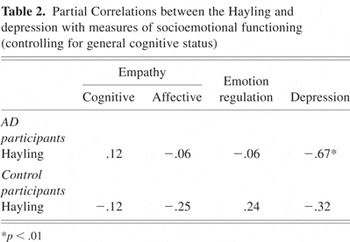
In the AD group, general cognitive status as indexed by the Addenbrooke Cognitive Examination-Revised was significantly correlated with the Hayling (r = −.70). Therefore, to control for the possibility that any observed relationships between the Hayling with the measures of socioemotional functioning might be attributable to more generalized cognitive impairment, performance on the Addenbrooke Cognitive Examination-Revised was partialed out (see Table 2). It can be seen that the Hayling is not significantly related to self-report scores on any of the measures of socioemotional functioning, with the exception of Depression scores in the AD group (r = −.67).
Partial Correlations between the Hayling and depression with measures of socioemotional functioning (controlling for general cognitive status)

DISCUSSION
Empathy
With regard to the group differences in cognitive (but not affective) empathy, the present results are consistent with Rankin et al. (2006) findings that AD participants' self-reported significantly reduced capacity for Perspective Taking (but not Empathic Concern) relative to healthy controls. However, in the present study there was a non-significant trend for empathic concern to also be reduced. Thus, whereas these data support Rankin et al. (2006) proposal that of the two types of empathy, cognitive empathy may be more susceptible to impairment in neurodegenerative disease, capacity for affective empathy may not be entirely spared. Future empirical investigation of this issue is clearly warranted. Further, although it has been argued that inhibitory control is an important facet of empathy (Decety & Jackson, 2004) inhibitory failures were unrelated to AD participants' perceived capacity for cognitive empathy suggesting that some other mechanism distinct from cognitive disinhibition may underlie the increased difficulties with cognitive empathy associated with AD.
Emotion Regulation
AD participants did not differ from controls with respect to their perceived capacity for emotion regulation, and no association between inhibitory control and emotion regulation was observed in either group. It might be argued that individuals with AD do experience increased difficulties with emotion regulation, but that lack of insight is affecting their responses on the measure used. However, although individuals with AD tend to underreport symptoms of depression and cognitive difficulties (Frank et al., 2006), they seem to have largely preserved insight into characteristics of their personality, even after changes as a result of their illness (Rankin et al., 2005). In contrast to depression, measures of empathy and emotion regulation examine what may be regarded as relatively trait-like emotional responses and are thus likely to be relatively unaffected by anosognosia. Consistent with this possibility, individuals with AD did self-report significantly reduced cognitive empathy, suggesting that they are aware of, and able to report, specific changes in their socioemotional functioning.
Another potentially important concern relates to whether the self-report measures differed in difficulty, in which circumstance any observed group differences may not reflect the intended constructs. However, it seems unlikely that any group differences (or indeed, any failures to identify group differences) emerged as a consequence of differential difficulty understanding the self-report measures. This is because both researchers responsible for testing the AD participants were registered intern clinical psychologists who therefore had the necessary clinical expertise to make judgments relating to comprehension of all tasks. For the participants included in the present study, there was no indication that they were unable to understand the self-report questions, or that any of the measures differed in this regard. It is also important to note that for all but one of the AD participants included in the present study, MMSE scores were greater than or equal to 20, and exclusion of the one participant who scored lower than 20 did not alter the basic pattern of results.
Depression
As has been found in other studies (Kashiwa et al., 2005), reduced inhibitory control was associated with lower levels of depression, but the present study is the first to demonstrate this relationship after controlling for overall cognitive functioning. These data therefore indicate that the observed relationship cannot simply be attributed to a more general factor of dementia severity. As noted previously, a failure of inhibitory control is associated with increased anosognosia (Kashiwa et al., 2005), and reduced rumination (Watkins & Brown, 2002), both of which are associated with reduced depression (Kashiwa et al., 2005; Watkins & Baracaia, 2002). This therefore suggests a potential mediating role for each of these variables, although clearly this possibility remains to be directly tested.
It is of note that depression that commences in late-life, as compared to that evident earlier, has been found to be associated with greater impairments in executive functioning (Alexopoulos, 2003; Rapp et al., 2005), and this has been attributed to the fact that executive control mechanisms are required to inhibit ruminative thinking once initiated (von Hippel et al., in press). The present results therefore support the possibility that there may be a qualitative distinction between the mild inhibitory failures characteristic of normal ageing relative to the more gross deficits characteristic of dementia with respect to their relationship with rumination (and consequently, depression). Specifically, because executive control mechanisms are required to inhibit ruminative thinking once initiated, mild inhibitory failures may be expected to lead to increased ruminative thought. However, since actual capacity for ruminative thinking has been argued to impose particular demands on executive control processes such as cognitive inhibition, more gross inhibitory deficits may conversely lead to reduced capacity for ruminative thought.
Limitations and Future Directions
Clearly the generalization of the present findings is limited by the relatively small sample size, which would have had insufficient power to detect small effects. Further, cross-validation of the present results is necessary because of the heterogeneous nature of AD. Thus, although the potential impact of the difference in in-group variances was taken into account in group comparisons, these differences in variances may account for differences in the magnitude of correlations across groups. However, it is important to emphasize that the findings of significant deficits on the measure of cognitive inhibition and cognitive (but not affective) empathy are entirely congruent with prior published research (see; Amieva et al., 2004; Rankin et al., 2006), as is the finding that reduced inhibitory control in the context of AD is associated with lower levels of self-rated depression (Kashiwa et al., 2005). Future research should seek to further delineate the neurocognitive mechanisms underpinning the changes in socioemotional functioning associated with AD.
ACKNOWLEDGMENTS
The authors thank all of the participants who took part in this study and the staff at Prince of Wales and Royal North Shore Hospitals, in particular Jane Southwell. The work was supported by an Alzheimer's Australia Research Grant awarded to Henry, McDonald, and Martin.