The rise of carbapenem resistance in Enterobacteriaceae poses a global threat to the accomplishments of modern medicine.Reference Perez and van Duin 1 , Reference Munoz-Price, Poirel and Bonomo 2 Advances in transplant medicine, surgery, and oncology are specifically at risk. The current treatment options for infections due to carbapenem-resistant Enterobacteriaceae (CRE) are very limited because most isolates are resistant to multiple classes of antibiotics. Antibacterials of last resort that are being used in the treatment of CRE include aminoglycosides, polymyxins, fosfomycin, and tigecycline.Reference van Duin, Kaye, Neuner and Bonomo 3 Novel antibiotics with activity against CRE currently under study include the aminoglycoside plazomicin and novel β-lactam/β-lactamase inhibitors such as ceftazidime/avibactam.Reference Flamm, Farrell, Sader and Jones 4 , Reference Walkty, Adam and Baxter 5 These compounds hold promise for more efficacious treatment of CRE infections combined with a more favorable side-effect profile. However, development of resistance remains a concern for all current and future antibiotics because resistance may spread rapidly among Enterobacteriaceae through plasmids and other mobile genetic elements.Reference Mathers, Cox and Kitchel 6
Causes of resistance development to various antibiotics are likely to overlap. Therefore, variables associated with tigecycline resistance, which has been increasingly observed in CRE isolates, may inform strategies for limiting the development of resistance against newer agents. In this context, we studied variables associated with tigecycline resistance in the Consortium on Resistance against Carbapenems in Klebsiella pneumoniae (CRaCKle).
METHODS
Patients
The current study represents a nested cohort within the Consortium on Resistance against Carbapenems in Klebsiella pneumoniae (CRaCKle) study, which has been described previously.Reference Van Duin, Cober and Richter 7 , Reference van Duin, Perez and Rudin 8 Briefly, CRaCKle is a prospective, observational, multicenter study in which we aimed to study patients who had positive cultures for carbapenem-resistant Klebsiella pneumoniae (CRKPs) during their hospitalization. This nested cohort consisted of all hospitalized patients who had a clinical culture that grew a CRKP during hospitalization that were tested for tigecycline susceptibility. Patients were included if their index hospitalization began and ended during the study period, from December 24, 2011 to October 1, 2013. Patients were included once at the time of their first positive culture. Patients who were known to be colonized with CRKP were placed in contact isolation. The Institutional Review Boards of all health systems involved approved the study.
Microbiology
According to Clinical and Laboratory Standards Institute (CLSI) guidelines, CRKPs are defined as K. pneumoniae isolates with nonsusceptibility to any of 3 carbapenems: meropenem, imipenem, or ertapenem. 9 Bacterial identification and routine antimicrobial susceptibility testing were performed using MicroScan (Siemens Healthcare Diagnostics, Malvern, PA) or Vitek2 (bioMérieux, Durham, NC), supplemented by GN4F Sensititre tray (ThermoFisher Scientific, Waltham, MA) to confirm carbapenem results and to test tigecycline susceptibility. The majority of CRKPs in CRaCKle have been confirmed to carry bla KPC, as previously described.Reference van Duin, Perez and Rudin 8 For interpretation of tigecycline MIC results, break points defined by the European Committee on Antimicrobial Susceptibility Testing (EUCAST) were used: susceptible (MIC<2 µg/mL), intermediate (MIC=2 µg/mL), and resistant (MIC>2 µg/mL).
Clinical Data
Clinical data were obtained from the electronic medical record and entered into a centralized database. The index hospitalization was designated as the first hospital stay within the study period during which CRKP was isolated and the CRKP isolate was tested for tigecycline susceptibility. Standardized criteria for CRKP infection were used, as previously described.Reference van Duin, Perez and Rudin 8 Briefly, CR-Kp isolated from blood or any other sterile source represented infection. For patients with positive respiratory cultures, the criteria outlined by the American Thoracic Society (ATS) and the Infectious Diseases Society of America (IDSA) were used.Reference Mandell, Wunderink and Anzueto 10 , 11 For patients with positive cultures from urine or surgical wounds, the CDC/NHSN criteria were used. 12 Critical illness was defined as a Pitt bacteremia score ≥4 points on the day of the index culture.Reference Chow and Yu 13 The Charlson comorbidity index was calculated.Reference Charlson, Pompei, Ales and MacKenzie 14 Onset was considered present on admission (POA) if the first positive culture for CRKP was obtained within 48 hours of hospitalization.
Analysis
Differences between groups were analyzed using the Wilcoxon rank sum for continuous variables. Fisher’s exact test and Pearson’s correlation coefficient were used for categorical variables where appropriate. A multivariate logistic regression model was constructed that included all preculture variables associated with tigecycline nonsusceptibility at the level of P<.10 in univariate analysis. In addition, a multivariate ordinal logistic model was constructed to test associations with the ordinal outcome of tigecycline susceptibility levels (susceptible vs intermediate vs resistant). Analyses were performed using JMP software (SAS, Inc., Cary, NC).
RESULTS
Patients
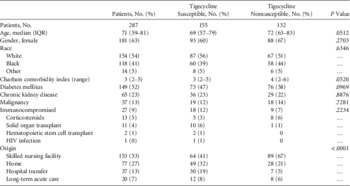
A total of 287 patients were included in the study cohort; the related demographics are listed in Table 1. In this nested cohort, the median age was 71 years (interquartile range [IQR], 59–81 years); 63% of patients were female; and 54% were white. Comorbidities were common; the median Charlson comorbidity index was 3 (IQR, 2–5), and more than half of patients had diabetes mellitus. The majority of patients (53%) were admitted from skilled nursing facilities (SNFs), but 27% were admitted from their homes.
Patient Demographics

NOTE. IQR, interquartile range.
Cultures and Timing of Onset
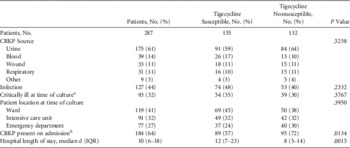
Urine (61%) was by far the most common anatomic source for positive CRKP cultures. Only 44 of 175 urine cultures (25%) represented a UTI. Culture data are summarized in Table 2. Overall, 44% of all patients met the criteria for CRKP infection. Critical illness was present in 32% of patients. Critical illness at the time of first positive culture was more common in patients with CRKP infection than in those with CRKP colonization. Of 127 patients, 56 patients with infection (44%) were critically ill; of 123 patients with CRKP colonization, 27 (23%) were critically ill (P=.0002). Overall length of hospital stay was prolonged, with a median of 10 days (IQR, 6–18 days). Remarkably, most of the hospital stays took place after the first positive CRKP culture. The median time from admission to first positive CRKP was 1 day (IQR, 0–5 days). A total of 184 CRKP patients (64%) were deemed POA. In multivariate analysis, SNF origin, anatomic source, and critical illness were associated with CRKPs that were POA. POA onset was more common in patients admitted from a SNF. POA onset was noted in 112 of 153 patients (73%) admitted from SNF vs in 72 of 134 patients (54%) admitted from other venues (OR, 2.53, 95%CI; 1.49–4.35; P=.0006). Using respiratory source (26%) as a reference, POA onset was noted to have originated from the following sources: 73% of patients from urine (OR 6.07; 95% CI, 2.50–16.00), 64% from a wound (OR, 3.84; 95%CI, 1.29–12.28), 59% from blood (OR, 4.36; 95%CI, 1.54–13.30), and 44% from other anatomic sources (OR, 2.24; 95% CI, 0.43–11.33) (P=.0014). In patients with critical illness, POA onset was less common as compared to patients without critical illness at the time of first CRKP positive culture (48% vs 72%; OR, 0.43; 95% CI, 0.24–0.76; P=.004).
Carbapenem-Resistant Klebsiella pneumoniae Culture Data

NOTE. CRKP, carbapenem-resistant Klebsiella pneumoniae; IQR, interquartile range.
a Defined by Pitt bacteremia score≥4 on the day of first positive culture.
b Defined as a positive culture within 48 h of hospitalization.
Prior Antibiotic Exposure
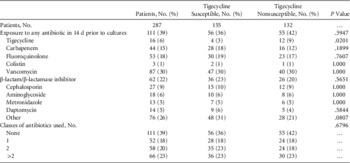
Antibiotics used during the 14-day period preceding the first positive CRKP culture are outlined in Table 3. In the cohort as a whole, 39% of patients received at least 1 antibiotic in that period. The most common antibiotic used was vancomycin, which was administered to 30% of patients in the 14 days leading up to the first positive CRKP culture. Use of β-lactam/β-lactamase inhibitors (22%) and fluoroquinolones (18%) were common as well. Prior use of tigecycline was uncommon; only 6% of patients had received tigecycline.
Exposure to Antibiotics in 14 Days Prior to First Positive Carbapenem-Resistant Klebsiella pneumoniae Culture

Tigecycline Susceptibility
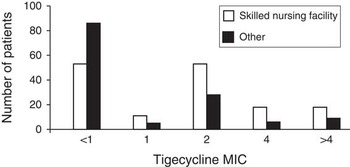
At the time of their respective index cultures, 132 of 287 patients (46%; 95% CI, 40%–52%) presented with a tigecycline nonsusceptible CRKP isolate. The distribution of MICs for tigecycline is shown in Figure 1. Using univariate analysis, origin prior to admission was strongly associated with tigecycline susceptibility (P<.0001). Admission from a skilled nursing facility was then compared to all other points of origin prior to hospitalization in multivariate logistic regression analysis (Table 4). In contrast, admission from a long-term acute care facility (LTAC) was not associated with tigecycline nonsusceptibility (data not shown). In this model, the following factors were independent risk factors for tigecycline nonsusceptibility: admission from a skilled nursing facility (OR, 2.51; 95% CI, 1.51–4.21; P=.0004), POA onset (OR, 1.82; 95% CI, 1.06–3.15, P=.03), and receipt of tigecycline within 14 days (OR, 4.38; 95% CI, 1.37–17.01; P=.02). An ordinal logistic regression model was also constructed for the ordinal outcome of tigecycline susceptibility (ie, susceptible vs intermediate vs resistant). In this model, the same variables were also found to be associated with the ordinal outcome: admission from a skilled nursing facility (P=.0005), POA onset (P=.0064), and receipt of tigecycline within 14 days (P=.0094). After stratification by CRKP infection vs colonization, admission from an SNF remained independently associated with tigecycline nonsusceptibility in multivariate analysis (OR, 3.61; 95% CI, 1.59–8.53; P=.002 in patients with CRKP infection, and OR, 2.38; 95% CI, 1.18–4.86; P=.015 in patients with CRKP colonization).
Tigecycline minimal inhibitory concentration (MIC) distribution in carbapenem-resistant Klebsiella pneumoniae isolates by origin prior to hospitalization.

Risk Factors for Tigecycline Nonsusceptibility

NOTE. CRKP, carbapenem-resistant Klebsiella pneumonia; OR, odds ratio; CI, confidence interval. Multivariate logistic regression model also included age, Charlson score, and presence of diabetes mellitus.
DISCUSSION
In this study cohort, predictors of tigecycline nonsusceptibility in patients with CRKP included (1) admission from a skilled nursing facility, (2) having an early onset of positive culture within the hospital stay, and (3) receipt of tigecycline in the previous 14 days. When the impact of treatment of CRKP bacteriuria on the development of tigecycline resistance had been previously evaluated, we found that tigecycline treatment of the index CRKP bacteriuria was strongly associated with risk for subsequent development of tigecycline resistance (OR, 6.13; 95% CI, 1.15–48.65; P=.03).Reference Van Duin, Cober and Richter 7 In addition, this resistance developed rapidly at a median of 65 days.Reference Van Duin, Cober and Richter 7 Nigo et alReference Nigo, Cevallos and Woods 15 evaluated the development of tigecycline resistance in multidrug-resistant K. pneumoniae (60% of these were CRKP) in a retrospective single-center case-control study. They also found that tigecycline exposure was associated with the subsequent development of tigecycline resistance (OR, 5.06; 95% CI, 1.80–14.23; P=.002).Reference Nigo, Cevallos and Woods 15 They did not evaluate origin prior to hospitalization.
Patients admitted from an SNF who had a positive culture on the first or second day of hospitalization were at the highest risk of having a tigecycline-nonsusceptible CRKP isolate. This finding implies that these patients were colonized with CRKP prior to their hospitalization. While we cannot establish the origin of tigecycline-nonsusceptible CRKP in this study, these findings suggest that either transmission of these isolates and/or de novo resistance mutations occur outside of the acute care setting.
In our cohort, the majority of patients with CRKPs are older adults admitted from SNFs. The presence of CRKP has been described in SNFs outside of the United States.Reference Prabaker, Lin and McNally 16 , Reference Marchaim, Chopra and Bogan 17 Within the United States, CRKPs have been isolated from patients transferred from LTACs and other long-term care facilities (LTCFs) that provide mechanical ventilation, but recovery in patients transferred from SNFs has been infrequently reported.Reference Ben-David, Maor and Keller 18 , Reference Adler, Hussein and Ben-David 19 The findings from the current study suggest that CRKPs might have disseminated throughout SNFs to a greater degree than has been previously described.
The number of Americans living in SNFs continues to increase and is currently estimated to be ~3 million people. The Centers for Disease Control and Prevention estimates that ~1–3 million serious infections occur in these patients annually and that as many as 380,000 people die of these infections per year. 20 Most nursing home residents receive at least 1 course of antibiotics per year, and most courses exceed 7 days.Reference Daneman, Gruneir and Bronskill 21 , Reference Daneman, Gruneir and Newman 22 In addition, other risk factors for acquiring multidrug-resistant organisms are prevalent in this population as well, including frequent use of indwelling devices such as urinary catheters, chronic wounds, advanced age, and comorbidities.Reference Safdar and Maki 23
These findings suggest that SNFs should be an increasingly important area of research and implementation of preventative strategies, including infection control and antimicrobial stewardship, to curtail the spread of resistance to antibiotics of last resort in CRE. Currently, tigecycline, polymyxins such as colistin, and aminoglycosides given as monotherapy or in combination with carbapenems are believed to represent the cornerstone of treatment of CRE infections.Reference van Duin, Kaye, Neuner and Bonomo 3 , Reference Tumbarello, Viale and Viscoli 24 Novel agents including novel aminoglycosides such as plazomicin and various β-lactam/ β-lactamase inhibitor combinations are currently under study and will hopefully become available for widespread clinical use soon.Reference Flamm, Farrell, Sader and Jones 4 , Reference Walkty, Adam and Baxter 5 As the first of such agents, ceftazidime/avibactam was recently approved by the US Food and Drug Administration. However, resistance to these agents will likely develop over time as well, and this subsequent resistance is likely to be related to similar risk factors.Reference Safdar and Maki 23 Therefore, taking action to limit spread of tigecycline resistant isolates will likely limit resistance development to novel anti-CRE antimicrobials as well. Disturbingly, resistance to ceftazidime/avibactam has already been reported in Pseudomonas aeruginosa.Reference Winkler, Papp-Wallace and Hujer 25
The main limitation of this study is that SNFs are not part of CRaCKle. Rather, we monitored the impact of SNFs by comprehensively monitoring all hospitalized patients with positive cultures for CRKP. Therefore, we are examining the “tip of the iceberg” and are missing those nursing home residents with rectal CRKP carriage, those who are not admitted to the hospital and those who have no clinical cultures positive for CRKP. Follow-up studies are needed that examine this issue directly in the nursing home. However, this multicenter consortium covers the great majority of hospitals in the region, and by employing a comprehensive inclusion strategy, we have assembled an unbiased cohort. In addition, these are the patients who confront acute care physicians. Another limitation of this study is that data on prior antibiotic usage were evaluated only for the 14-day period prior to the first positive CRKP culture. Only antibiotics reported either in notes or medication lists of the electronic medical record were included; this may have led to an underestimation of antibiotic usage. However, in an independent cohort, tigecycline use also was the only antibacterial independently associated with tigecycline resistance.Reference Nigo, Cevallos and Woods 15 This study validates our finding that tigecycline use is a major driver of the development of resistance to tigecycline. While this finding is intuitive, it is important to note that for other MDROs, a direct link is not always the main driver of resistance. For example, ceftriaxone use rather than vancomycin use was shown to be related to vancomycin resistance in Enterococcus faecium.Reference McKinnell, Kunz and Chamot 26 Finally, only patients with isolates that were clinically tested for tigecycline susceptibility were included, which may have resulted in an overestimate of tigecycline nonsusceptibility. However, the majority of CRKP isolates in CRaCKLe are routinely tested for tigecycline susceptibility.
In summary, in this multicenter, prospective cohort of hospitalized patients with CRKP, patients with tigecycline-nonsusceptible isolates were found to be similar in most respects to patients with tigecycline-susceptible CRKPs. The 3 variables associated with decreased tigecycline susceptibility were previous tigecycline exposure, admission from an SNF, and a positive culture for CRKP within the first 2 days of hospitalization. These findings emphasize the need for antimicrobial stewardship as well as the urgent need for evaluation of optimal infection control practices in long-term care facilities.
Acknowledgments
Financial support. This work was supported by the National Institute Of Allergy And Infectious Diseases of the National Institutes of Health (Grant no. UM1AI104681), and by funding to DVD and FP from the Clinical and Translational Science Collaborative of Cleveland (Grant no. UL1TR000439) from the National Center for Advancing Translational Sciences (NCATS) component of the National Institutes of Health and NIH roadmap for Medical Research. VGF was supported by Mid-Career Mentoring Award (Grant no. K24-AI093969) from NIH (Grant no. K24-AI093969). In addition, this work was supported in part by the Veterans Affairs Merit Review Program (RAB), the National Institutes of Health (Grant nos. AI072219-05 and AI063517-07 to RAB), and the Geriatric Research Education and Clinical Center VISN 10 (RAB), the Research Program Committees of the Cleveland Clinic (DVD), an unrestricted research grant from the STERIS Corporation (DVD). KSK is supported by the National Institute of Allergy and Infectious Diseases (DMID protocol 10-0065).
Potential conflicts of interest. DvD has received research funding from Steris and Scynexis; he has served on the Speaker’s Bureau for Astellas, on a drug safety monitoring board for Pfizer, on a consultancy board for Sanofi Pasteur, and as an editor for Medstudy. RAB has received research funding from Astra Zeneca, Merck, and Checkpoints and has served on a Tetraphase drug safety monitoring board. SSR has received research funding from bioMérieux, Nanosphere, BD Diagnostics, Biofire, Pocared, and Forest. All other authors report no conflicts of interest relevant to this article.The contents of this paper are solely the responsibility of the authors and do not necessarily represent the official views of the National Institutes of Health.