Experimental
Bamboos are perennial grasses belonging to the subfamily Bambusoideae and family Poaceae. The subfamily contains 75 genera and approximately 1250 species (Singhal et al., Reference Singhal, Bal, Satya, Sudhakar and Naik2013). The USDA-ARS temperate and subtropical bamboo collections are maintained by the Plant Genetic Resources Conservation Unit (PGRCU) in Byron, GA and the Tropical Agricultural Research Station (TARS) in Mayaguez, Puerto Rico and consist of 93 species. Bamboos are some of the fastest-growing plants in the world and depending on the species, provide a wide range of natural resources, including building materials, nutritional food and medicinal ingredients. Bamboo leaves are well known as the staple food for the giant panda and may also be used as a food source for livestock such as goats and cattle (Halvorson et al., Reference Halvorson, Cassida, Turner and Belesky2010). The genetic diversity and phylogenetic relationships of the collection at PGRCU have been previously determined using transferred EST-SSR markers (Barkley et al., Reference Barkley, Newman, Wang, Hotchkiss and Pederson2005), but the nutritional value of their leaves has not been evaluated. Therefore, the objectives of this study were to: (1) determine the variability in leaf protein content, mineral element content and amino acid composition among 93 species within the USDA-ARS collections; and (2) identify species with high leaf protein content with balanced amino acid composition and optimal element content for further experimentation and utilization.
Ninety-three bamboo species were grown and maintained in separate plots held at three locations: Byron, GA, in Norfolk, fine loamy sand, kaolintic, thermic, typic Kandiudult soil; TARS at Mayaguez, PR, in hydric clay soil; and Govardhan Gardens at Mayaguez, PR, in hydric clay soil. No fertilizer was supplied at each location. Leaves (apparently healthy, young and fully unfolded) were harvested from culms that were approximately 3–5 years old. Three replicates of leaf samples (50 g) for each accession were collected in two different seasons (summer/wet and winter/dry). Similar amounts of leaf tissue were also collected from switchgrass (Panicum virgatum L.) in Griffin, GA, and cassava (Manihot esculenta Crantz) in Mayaguez, PR, to serve as reference samples for comparison. The samples were stored in a low-humidity drying room. Prior to the experiment, leaf tissue samples were dried for 24 h at 60°C in a drying oven. An in-house, previously optimized modification of the micro-Kjeldahl method (Persson and Wennerholm, Reference Persson and Wennerholm2008) was used for extraction and quantification of crude protein (a standard conversion factor of 6.25 was used). Amino acids were analysed on 1100 HPLC System (Agilent Technologies). Eighteen amino acids (except for cysteine and methionine) were measured, but only 16 readings (amount of aspartic acid = aspartic acid + asparagine; amount of glutamic acid = glutamic acid + glutamine) are reported. A dry ashing method was used for determination of mineral (12 elements) content with a 7300 DV inductively coupled plasma (ICP) – spectrophotometer (Perkin Elmer). The experimental design was a split-plot design across years. Location was the main plot and accession was the sub-plot. A visual analysis of the residuals showed that the data were normally distributed and required no transformations. Analysis of variance was performed, and means were separated using Tukey's multiple comparison procedure (α = 0.05).
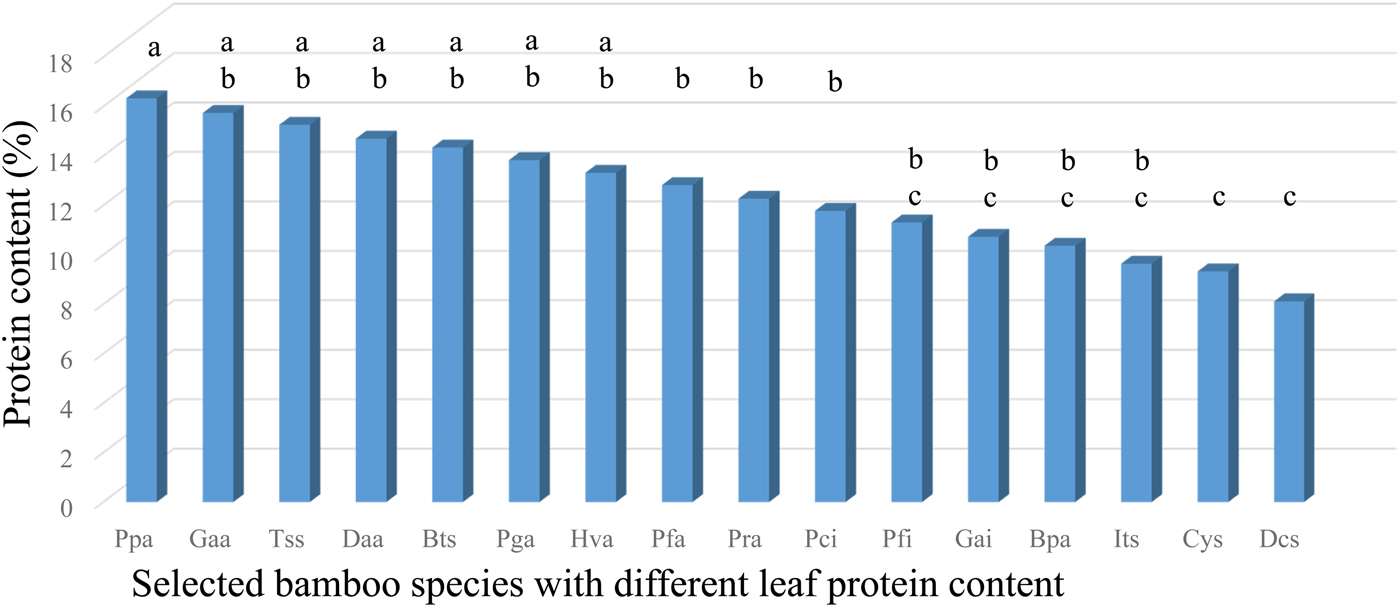
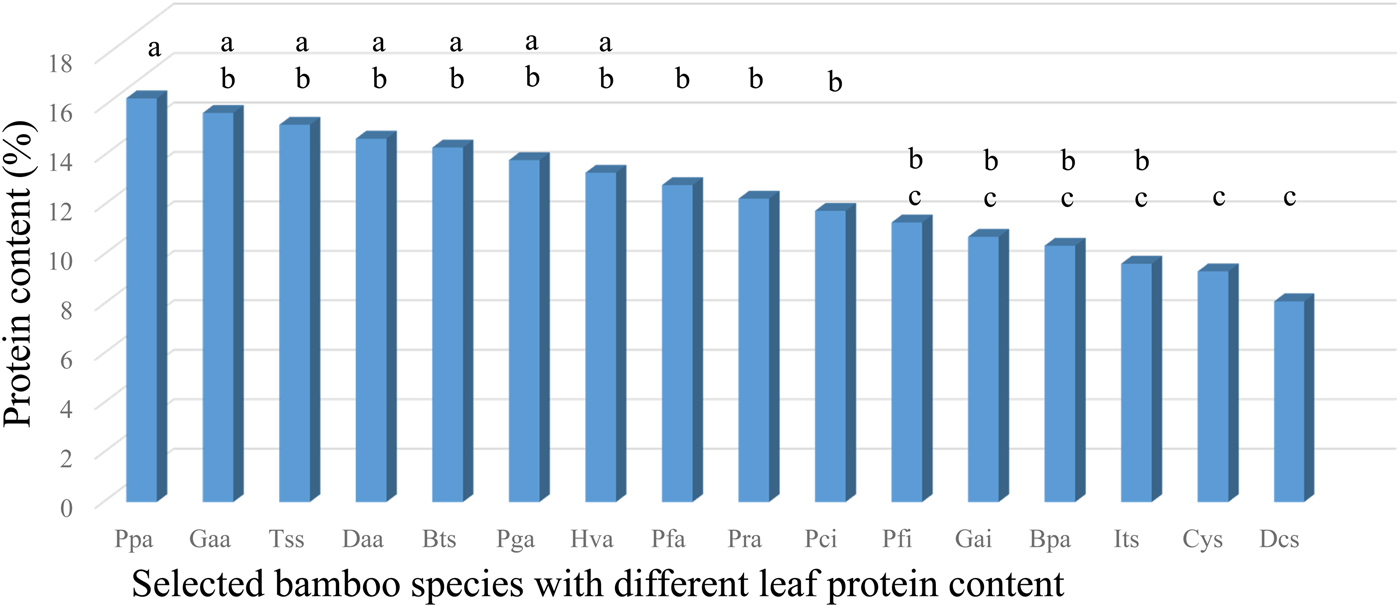
Significant variability in leaf protein content and amino acid composition among species was found. The results for leaf protein content and amino acid composition are listed in online Supplementary Table S1 and shown in Fig. 1. Leaf protein content (expressed as a per cent dry matter) among bamboo species ranged from 8.12 to 16.33% with an average of 12.84%. This average was higher than 9.0% found in switchgrass leaves, but considerably lower than 32.48% in cassava leaves. Phyllostachys propinqua, Gigantochloa nigrociliata and Bambusa maculata were identified as the species producing leaves with the highest protein content (16.33, 16.30 and 16.23%, respectively). B. maculata also had higher amounts of seven essential amino acids (His, 2.58; Thr, 6.26; Tyr, 4.73; Lys, 6.26; Ile, 5.63; Leu, 11.7; and Phe, 7.65) than the average. Dendrocalamus calostachyus and Indocalamus tessellatus were identified as species producing leaves with the lowest protein content (8.12 and 9.64%, respectively). There was more than a twofold variation on 18 quantified amino acids (online Supplementary Table S1). For 12 quantified mineral elements, there was significant variability from the low end (4.2-fold, 2.27–9.52 mg/g calcium; 4.4-fold, 56.17–246.43 µg/g sodium) to the high end (61.5-fold, 17.67–1087.0 µg/g manganese; 40.8-fold, 42.0–1713.5 µg/g aluminium) (online Supplementary Table S2). There was also significant variability in iron content (Fe, 26.3-fold, 52.44–1376.3 µg/g) and zinc content (Zn, 7.8-fold, 9.37–73.0 µg/g) among species. D. calostachyus and Cephalostachum pergracile produced leaves with the highest iron (1376.3 µg/g) and zinc content (73.0 µg/g), respectively.
Selected bamboo species with different leaf crude protein content. To reflect the variability in leaf protein content among bamboo species, the species with about 0.5% protein content difference from the highest to the lowest were selected and presented in the figure. Abbreviations for 16 selected bamboo species: Ppa, Phyllostachs propinqua; Gaa, Gigantochola albociliata; Tss, Thyrsostachys siamensis; Daa, Dendrocalamus argemica; Bts, Bambusa tuldoides; Pga, Phyllostachys glauca; Hva, Himalayacalamus velutina; Pfa, Phyllostachys flexuosa; Pra, Phyllostachys rubromarginata; Pci, Pseudosasa cantorii; Pfi, Pleioblastus fortunei; Gai, Guadua angustifolia; Bpa, Bambusa polymorpha; Its, Indocalamus tessellatus; Cys, Chimonobambusa yunnanesis; Dcs, Dendrocalamus calostachyus. For species with the same letter(s) above the bars, there were no significant statistical differences in leaf protein content.
Discussion
Extensive published literature does not exist reporting on the evaluation of the leaf nutrition value for many bamboo species. The results presented will provide new information to the bamboo research community. Due to sample-processing costs, amino acid content was determined for 50 of the 93 species, leaving 43 species not yet quantified. Therefore, the full spectrum of variability in amino acid composition was not covered by the present research. Variability was detected for leaf protein and amino acid composition, but this was especially true in mineral element content. One explanation for the significant differences may be due to the genetic variation in the species evaluated, while another reason may be caused by the fact that leaf samples were collected from multiple geographic areas (Georgia and Puerto Rico) with different eco-and agro-environmental conditions. Leaf protein for ten cold-hardy bamboo species was evaluated by Halvorson et al. (Reference Halvorson, Cassida, Turner and Belesky2010) who found protein content to be higher on average (15.9%) than the present study (12.84%). Nine of the 10 species in their study were also included in the present study. Only one species in the current evaluation, P. propinqua, produced leaves with slightly higher protein content (16.33%) than most species in the Halvorson study. This again might be explained by the sample-collected locations with different types of soil and soil nutrient variation. Bamboo leaf biomass can directly affect the protein yield in an area. In follow-up research, bamboo leaf biomass (especially for P. propinqua) should be determined.
Supplementary material
The supplementary material for this article can be found at https://doi.org/10.1017/S1479262117000053
Acknowledgements
The authors would like to thank MARS Inc. for their partial financial support of this project, as well as Drs Brad Morris and Zhenbang Chen for giving useful suggestions for improving the manuscript quality. In addition, authors thank Ms Zilma Poueymirou and Mr Delvis Perez for helping generate the protein and mineral element data, as well as Mr Sadhu Govardhan for bamboo leaf samples from his collection.