INTRODUCTION
In January 1946, the Supreme Commander of the Allied Powers (SCAP) in Japan issued a list of “certain political parties, associations, societies and other organizations” that were to be dissolved on the basis of the “Undesirable Organizations” directive.Footnote 1 Among the twenty-seven organizationsFootnote 2 listed was the Kokuryūkai 黒龍会, translated as the “Black Dragon Society” and identified as a political association (seiji kessha 政治結社 or seisha 政社Footnote 3) founded in 1901.Footnote 4 In late 1946, a document entitled “The Brocade Banner: The Story of Japanese Nationalism,” issued by the Civil Intelligence Section of SCAP, identified the Kokuryūkai as the cradle of the Japanese nationalist movement and a central organization in its later development.Footnote 5
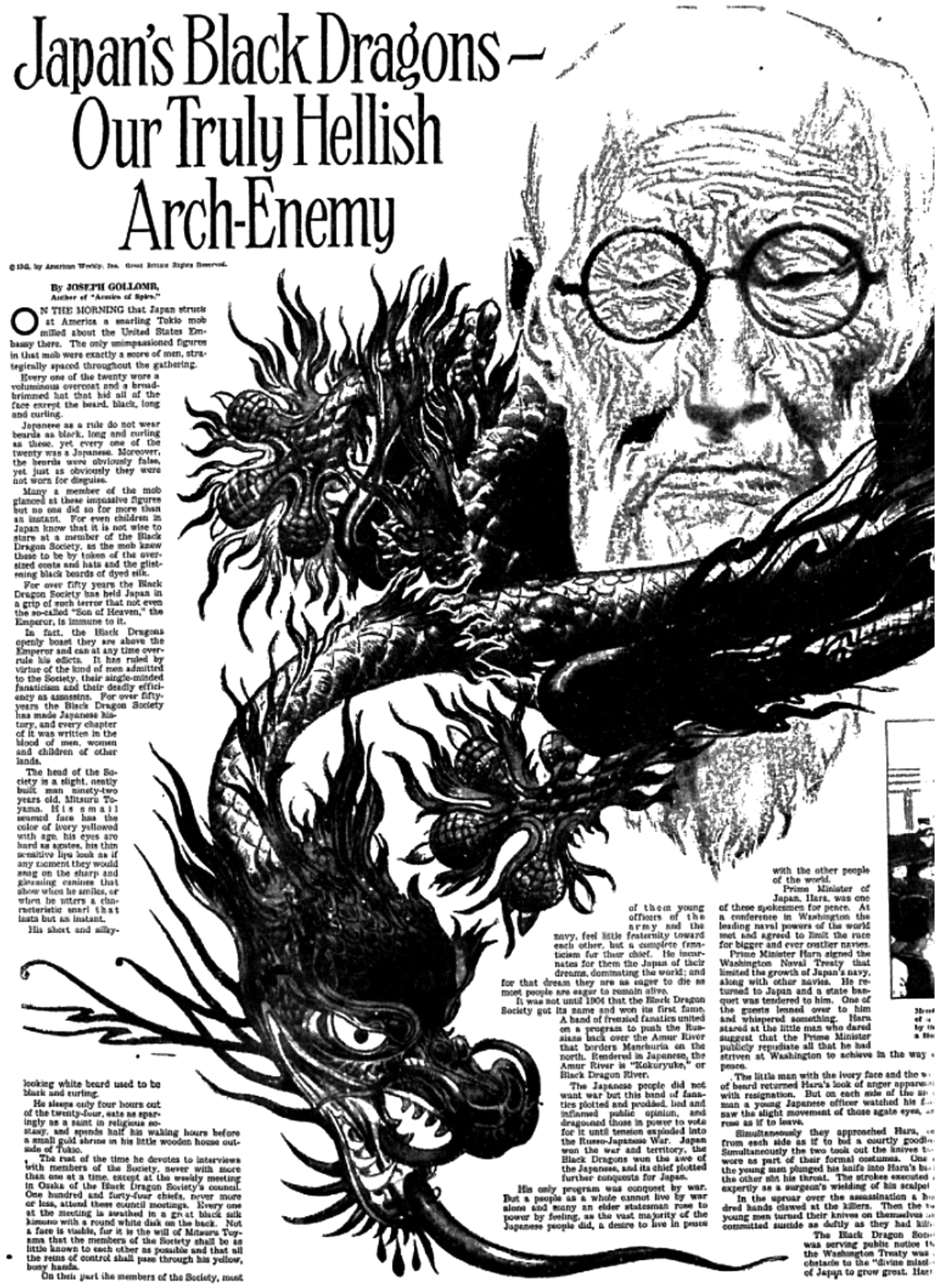
In pre- and postwar journalism and scholarship, Western commentators generally agree that the Kokuryūkai had a decisive influence in Japanese politics before 1945 and in particular played a key role in maneuvering Japan into war against the United States and Britain. The identification of the association as a potential threat to Western influence in Asia goes back to the early 1920s.Footnote 6 However, hysteria over the influence of the Kokuryūkai reached a climax in the United States and Britain during the later years of World War II. Although some might dismiss such scaremongering as war propaganda, this sort of polemic did much to influence the direction of later research on the Kokuryūkai. A typical wartime article on such organizations appeared in the Milwaukee Sentinel in January 1942; over two-and-a-half pages, the newspaper grabbed readers' attention with the headline “Japan's Black Dragons – Our Truly Hellish Arch-Enemy” and rumors about the society's objectives including a plot “to kill (Charlie) Chaplin.”Footnote 7
Article on the Kokuryūkai in the Milwaukee Sentinel, Jan. 1942.

The article was accompanied by a large illustration: a highly unflattering image of an evil-looking elderly Japanese with a dragon looped around his neck like a scarf. The miserable-looking old man shown in the newspaper was meant to represent Tōyama Mitsuru 頭山満 (1855–1944), a prominent leader of Japan's nationalist movement, who was, however, only loosely connected to the Kokuryūkai, as I show below. The founder and lifelong leader of the Kokuryūkai, Uchida Ryōhei 内田良平 (1873–1937), died several years before the outbreak of war with the United States. By 1942, the much older Tōyama had come to be regarded by the Allies as the central figure uniting all Japanese nationalist associations, including the Kokuryūkai. So powerful was he considered by Western commentators that the Milwaukee Sentinel placed a photograph of the Emperor next to Tōyama and, in the caption, described the Emperor as a “puppet of the Black Dragons.”Footnote 8 In the same vein, the article characterized the Kokuryūkai as a “strange secret society headed by the sinister, cynical and wholly inhuman old man of ninety-two [Tōyama] who boasts that he is stronger than the Emperor.”Footnote 9 When Tōyama died in 1944, the New York Times called him “one of world's most evil men.”Footnote 10 It was hardly surprising that the now famous 1945 propaganda movie Know Your Enemy: Japan also refers to the Kokuryūkai,Footnote 11 describing it as a “strictly Japanese invention” and a “secret gangster organization,” referring to its connections with organized crime in Japan.Footnote 12 Tōyama also appears in this movie, introduced as the “unofficial Emperor” of Japan and a “sinister” and “dreaded master murderer,” a reference to his involvement in a series of assassinations carried out by rightists in the 1930s.
The ban placed on the Kokuryūkai by SCAP following the war was accompanied by continuing treatment of the association in the media as a central actor in prewar Japan. On 13 September 1945 the London Times reported:
The River Amur (Black Dragon River) Society, sometimes called the Black Dragon Society, was originally founded to encourage the extension of the Japanese frontier to the River Amur, in Manchuria. It became identified with chauvinist activities, particularly those of the “Young Officer” class; and drew large funds in blackmail from industrialists as the price of immunity from assassination. From time to time efforts, all unavailing, have been made by Japanese statesmen of liberal outlook to secure its suppression. It has always succeeded in “going to ground” when its existence seemed threatened, only to emerge with unabated influence when expansionist policies were once more in the ascendant.Footnote 13
Although subsequent research has emphasized that the Kokuryūkai's influence in the process of steering Japan towards war “often has been greatly exaggerated,”Footnote 14 the image of the association created by wartime media – that of a well-run and powerful organization spearheading a national conspiracy to lead Japan into war – remains an influential one. Historical dictionaries, for example, regularly characterize the Kokuryūkai as a nationalist (kokkashugi 国家主義) or right-wing expansionist (uyoku shinryakushugi 右翼侵略主義) organization, but it is also frequently linked to Pan-Asianism. The Great Dictionary of Japanese History (Kokushi Daijiten 国史大辞典) describes the Kokuryūkai as “an influential nationalist organization that advocated and spread Greater Asianism (Dai-Ajiashugi 大アジア主義)” – a somewhat oxymoronic characterization given the transnational character of Pan-Asianism and Greater Asianism.Footnote 15 In his classic study of “Japanese Fascism,” Eizawa Kōji 栄沢幸二 identifies the founder of the Kokuryūkai, Uchida Ryōhei, as the “originator of fascism in Japan.”Footnote 16 Despite this characterization, Eizawa argues that, because he died in 1937, Uchida had no impact on developments during the decisive years leading up to the outbreak of war with the West.
As I argue here, the influence of the Kokuryūkai on Japan's advance to war was much less dramatic than some of the commentators quoted above suggest. To a large extent, the depiction of the society in the Western media was a result of the war fever that gripped the Allies in 1942/43. It was also influenced by the self-dramatization of the society in its own publications.Footnote 17 These reservations aside, scholars have so far failed to define the precise role that the Kokuryūkai played in Japanese politics during the 1910s and 1920s and in their subsequent development. Few detailed studies of the association exist;Footnote 18 in English, there is almost nothing on the subject.Footnote 19 Even recent studies of Japanese nationalism, such as Walter Skya's Japan's Holy War,Footnote 20 merely allude to the Kokuryūkai as an expansionist society,Footnote 21 and fail to explore its activities in detail or consider its significance for the political trajectory of modern Japan.
In this article I set out to remedy this situation by re-examining the activities of the Kokuryūkai and assessing its impact on politics and political decision-making in prewar Japan. The main task I have set myself is to analyze the methods adopted by the association to influence Japanese politics. How did it exert pressure on the political decision-making process and how did it influence public discourse on a number of issues? Through both quantitative and qualitative analyses of the Kokuryūkai's publications and other primary sources, I identify central figures in the association's network and their main areas of interest in the political discussions and debates of the 1910s and 1920s.
I argue that the Kokuryūkai had all the characteristics of a political pressure group – although at the time of its founding in 1901 it was thought of as a research association. The Kokuryūkai's activities became increasingly politicized following the Russo-Japanese War of 1904/05, a development that reached a climax around the time of World War I. While this article does not deal with the Kokuryūkai's activities in the 1930s, I show that the association reached a peak of power and influence in the late 1910s and early 1920s, a reality that has been largely ignored by previous studies. During this crucial period of modern Japanese history – often characterized as the period of “Taishō Democracy,” and defined here in terms of the formation of party cabinets amid the strengthening intellectual currents of liberalism and parliamentarianism – the Kokuryūkai emerged as a leading actor opposing these new ideological and political trends. Although preoccupied with issues of foreign policy and Pan-Asianism up until World War I, following the war the Kokuryūkai began to focus on domestic politics and, in tandem with the Japanese Imperial Army, helped pave the way for the growth of militarism and totalitarianism in the 1930s – although by that time the association was practically defunct.Footnote 22
THE FOUNDATION OF THE KOKURYŪKAI, ITS MEMBERSHIP, AND OBJECTIVES
The Kokuryūkai was founded in February 1901 in Kanda, Tōkyō, in the presence of 59 men.Footnote 23 Within a few months membership expanded to more than 300, by the late 1910s it had reached a total of around 1,000. In the first ten years of the association's existence, most of the Kokuryūkai's members came from Kyūshū. Among these, men from Fukuoka formed the majority, followed by those from Saga and Kumamoto. But unlike the Gen'yōsha 玄洋社, another political society (seiji kessha) founded in Fukuoka in 1881, which is often regarded as the parent organization of the Kokuryūkai, the Kokuryūkai would eventually recruit members from all over Japan.Footnote 24
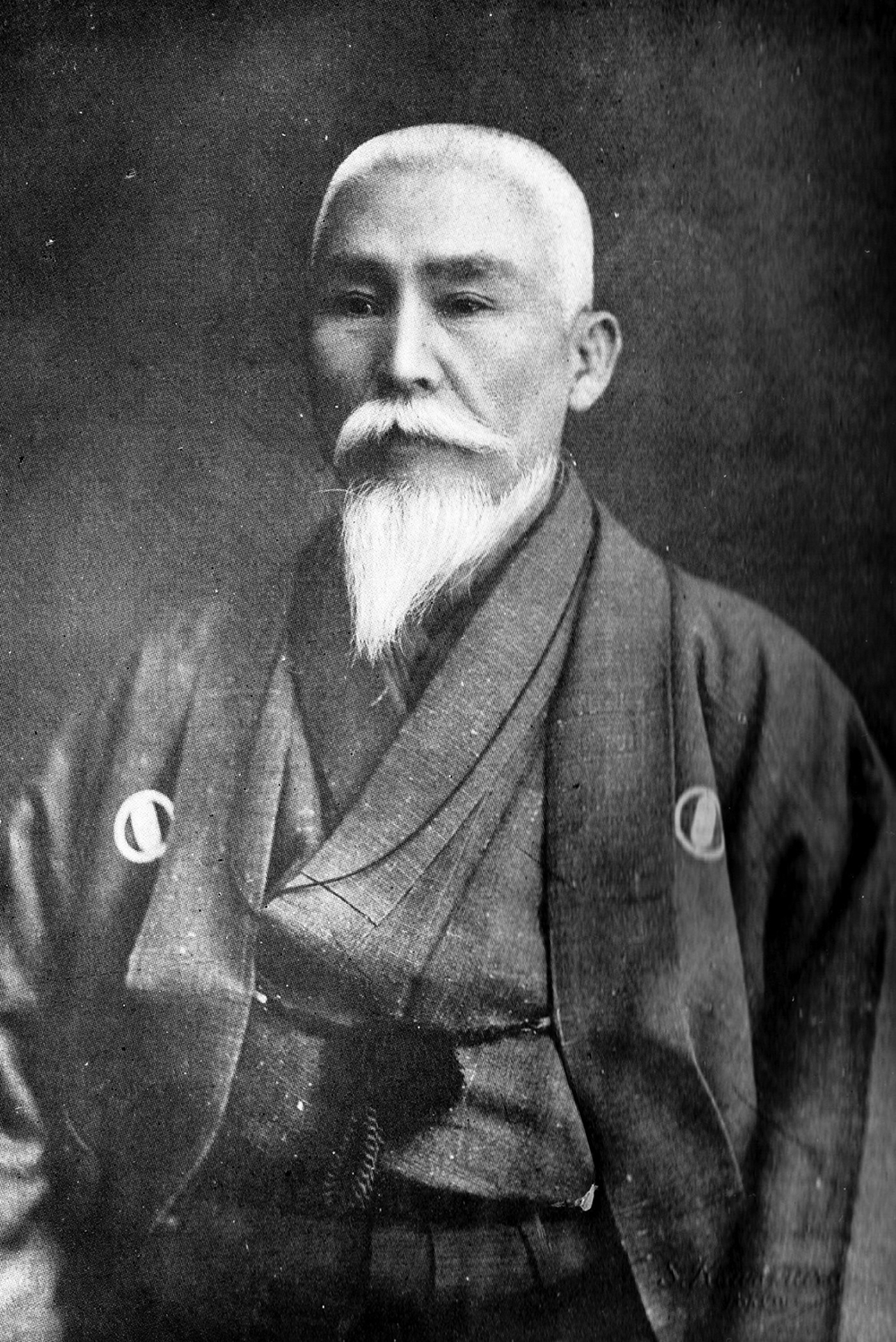
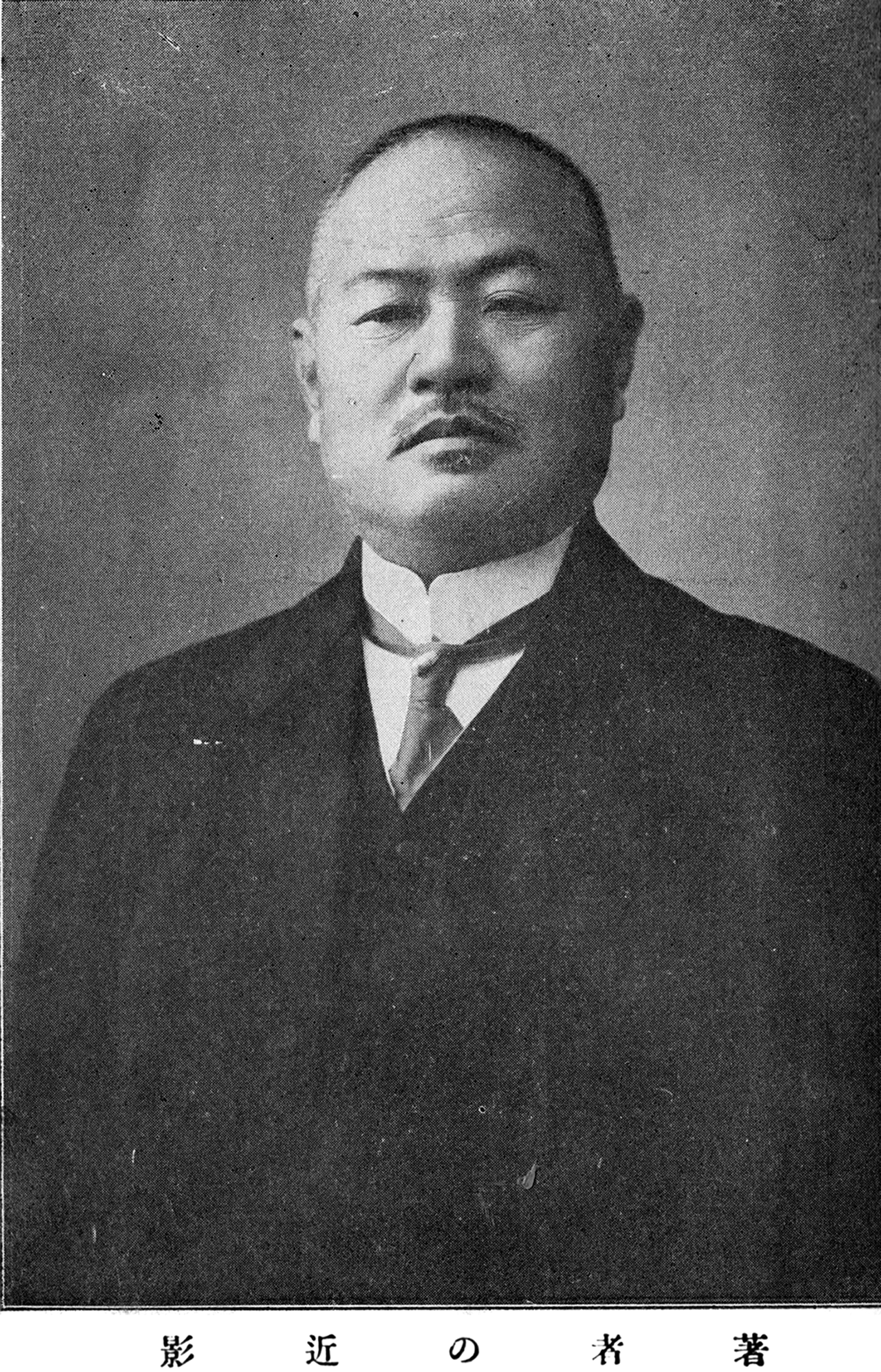
Uchida Ryōhei, founder of the Kokuryūkai, in the early 1930s (source: Uchida 1934).
Most of the association's members were also members of other societies such as the Gen'yōsha or Konoe Atsumaro's 近衛篤麿 Tōa Dōbunkai 東亜同文会 (East Asia Common Cultural Association), which included around twenty of the Kokuryūkai's founding members.Footnote 25 The leader of the Gen'yōsha, Tōyama Mitsuru, joined the Kokuryūkai as a supporting, but not as a regular member, as did other important members of this society. Even well-known mainstream party politicians such as Inukai Tsuyoshi 犬養毅 (1855–1932), who would become prime minister in the early 1930s and was regarded by many as a symbol of “Taishō Democracy,” supported the Kokuryūkai, because he shared its pan-Asian sentiments.Footnote 26 Among its members also was the group of so-called “continental adventurers” (tairiku rōnin 大陸浪人) – men who in their youth had traveled to Korea and China to assist revolutionary movements in those countries or to spy for the Japanese military and, to that purpose, had founded the association Ten'yūkyō 天佑侠 (Heavenly Blessed Heroes) in 1894.Footnote 27 Uchida, the leader of the Kokuryūkai, was one of those “adventurers.”Footnote 28 His “adventures” would continue when he went to the Russian stronghold Vladivostok in 1895 and opened a judo school in the city – evidently as a cover for reconnaissance activities in Eastern Siberia and the Russian Far East on behalf of the Japanese Imperial Army.Footnote 29 In 1897, he crossed Siberia and travelled to Moscow and St. Petersburg in what was probably a reconnaissance mission. His experiences and observations were later published by the society as books and maps.Footnote 30 The founding members of the Kokuryūkai included also Nakae Chōmin 中江兆民 (1847–1901) and Ōi Kentarō 大井憲太郎 (1843–1922), prominent figures in the Movement for Freedom and Peoples' Rights (jiyū minken undō 自由民権運動) in the 1870s and 1880s, and their membership in Uchida's society testifies to the close relationship between this early “liberal” movement and advocates of expansionism.
In contrast to the Gen'yōsha, which was predominantly concerned with domestic politics,Footnote 31 the Kokuryūkai initially tended to focus on foreign policy, aiming to inform and influence public opinion and policymakers and basing its stance on research conducted on Japan's neighbors. This focus on foreign relations was expressed in the association's founding manifestoFootnote 32 as well as in its very name (cf. footnote 4) and has to be recognized as the main characteristic of the Kokuryūkai.
A quantitative analysis of the Kokuryūkai's regular publications between 1901 and 1921Footnote 33 (see Table 1) shows a geographical shift in the organization's interests, from Siberia and Korea in the 1900s to China in the 1910s, with a renewed focus on Siberia in 1917−1919 as the result of the so-called Siberian Intervention – the Allied intervention in the Russian civil war, with Japanese troops remaining in Siberia until 1922.Footnote 34 As a result of the annexation of Korea in 1910, the “Korea problem” was considered settled for most Kokuryūkai members – although some had opposed and protested against the one-sided way in which Korea was annexed to Japan. These members had favored a more equal “union” (gappō 合邦) of the two nations, following Tarui Tōkichi's 樽井藤吉 (1850–1922) treatise Daitō Gappō-ron 大東合邦論 (Union of the Great East) from the 1880s.Footnote 35 Most Kokuryūkai members eventually acknowledged the annexation of Korea to Japan as the realization of a long-desired pan-Asian goal and expressed their acknowledgement with the construction of the “Monument for the Commemoration of the Japanese-Korean Union” (Nikkan Gappō Kinen-tō 日韓合邦記念塔)Footnote 36 in Tokyo in 1930. However, by choosing Tarui's term gappō for this monument rather than the official term for the annexation of Korea (heigō 併合), the society continued to keep a distance from official government discourse.
Number of articles referring to particular regions/countries in Kokuryūkai journals.
Source: Author's database. See author's website: http://www.japanesehistory.de/kokuryukai/.
After the 1919 uprising against Japanese rule in Korea (the so-called March 1 movement, or San ichi undō 三一運動, Kr. Samil Undong), Kokuryūkai members had criticized the government for not doing enough to bring about “true Japanese-Korean unity.” To promote this goal, in 1921 they founded an offspring organization known as the “Dōkōkai” 同光会 (Same Light Association) with the stated objective of “bringing about equality between Koreans,” but remained committed to strengthening Japanese colonial rule in Korea and did not consider Korean independence a viable option.Footnote 37 Uchida at times went so far as to claim the necessity of “domestic self-governance” (jichi 自治) for Koreans, but the Dōkōkai never won much support in Korea, and also retained little influence in Japan.
In addition to the Korean peninsula, the Kokuryūkai gave much attention to Siberia and the Russian Far East. In 1917 and 1918, the association lobbied for a strong and “independent,” i.e. exclusively Japanese, intervention in Siberia (jishu shuppei 自主出兵) in order to gain territorial control – whether direct or indirect – over Eastern Siberia as far as Lake Baikal. This interest in Siberia and the Russian Far East was not new, but had its roots in the early twentieth century. In its 1901 foundation statement, the association had described Russia as Japan's most dangerous enemy and referred to Russia's Far Eastern possessions as territories Japan should claim for its own colonial empire. In 1904, the Kokuryūkai had proposed a plan to occupy Sakhalin and Kamchatka during the Russo-Japanese War,Footnote 38 and now, once again, it promoted similar plans, with the support of a part of the Japanese academia – the so-called “Nine doctors of the Siberian intervention” (Shiberia shuppei kyū hakushi シベリア出兵九博士) under the leadership of Professor Tomizu Hirondo 戸水寛人 (1861–1935) of Tokyo Imperial University, also known as “Doctor Baikal” for his calls for Japan to annex all Russian territory as far as Lake Baikal.Footnote 39
Following World War I, another distinct shift in the Kokuryūkai's focus can be discerned, this time from foreign policy to domestic issues. The association began to play a leading role in agitation against Taishō Democracy and the “new thought” (shin shisō 新思想) coming with it, i.e. parliamentarianism and liberalism, but also against socialism and communism, all of which were considered “dangerous thought” (kiken shisō 危険思想) by the Kokuryūkai and like-minded nationalists. This subject will be discussed in detail below. Before that, I will look at the ways in which the association attempted to achieve its objectives.
THE KOKURYŪKAI'S SOCIAL CAPITAL
Kokuryūkai members rarely occupied public office or government positions. Uchida and his compatriots prided themselves on being independent, impartial, and selfless activists outside the “corrupt and dirty world of politics.” Only occasionally did Uchida accept official positions. For several years after 1906, for example, he worked for the Resident-General in Korea (Kankoku tōkan 韓国統監) and organized the support of the pro-Japanese society Ilchinhoe (Jp. Isshinkai 一進會, literally Restoration Society).Footnote 40 In 1912, he served briefly as foreign affairs advisor to the “Provisory President of the Chinese Republic,” Sun Yat-Sen 孫中山 (a.k.a. Son Bun 孫文, 1866–1925), following the inauguration of the Republic.Footnote 41 During the Russo-Japanese War, members of the Kokuryūkai temporarily worked as translators and spies for the Imperial Army. Kokuryūkai members accepted these positions to finance their activities, as they were frequently in need of cash and had to compete for political funds.Footnote 42
The main tactic used by the Kokuryūkai to exert influence on foreign policy and government decision-making was the accumulation of social capital and the creation of an extensive personal network among politicians, businessmen, and leading military figures. As head of the Kokuryūkai, Uchida Ryōhei often paid personal visits to politicians and sought to influence their decisions – at times by the use of brute force.Footnote 43 The table of contents of the eleven-volume “Papers Relating to Uchida Ryōhei” (Uchida Ryōhei kankei monjo 内田良平関係文書) reveals some of the central personalities in Uchida's social network.Footnote 44 The work contains letters from influential politicians, military officers, and diplomats. Particularly numerous are letters and telegrams involving fellow nationalist activists such as Sugiyama Shigemaru 杉山茂丸 (1864–1935), Kikuchi Chūsaburō 菊池中三郎 (1855–1821), Kita Ikki 北一輝 (1883–1937), and also pro-Japanese Korean politicians.
Perhaps more significant than his letters and visits to politicians were Uchida's frequent memoranda, which – solicited or not – he sent to cabinet members and influential politicians, diplomats, bureaucrats and businessmen, particularly during the Taishō period (1912–1926). While only seventeen of Uchida's memoranda (and other short pamphlets) from the Meiji period (1868–1912) are extant, we know of at least 140 from the – relatively short – Taishō period and a further 62 from 1926 to Uchida's death in 1937.Footnote 45 In 1915, for example, in response to a request from Kōno Hironaka 河野広中 (1849–1923), Minister for Agriculture, Uchida Ryōhei wrote a memorandum on foreign policy options titled “Views on China Policy” (Tai-shi seisaku iken 対支政策意見), which was widely read in political circles.Footnote 46 Uchida also published numerous magazine articles in the Kokuryūkai's official journals (kikanshi 機関紙, see below) as well as in other magazines such as the high-profile Taiyō 太陽 (The Sun), Dai-Kokumin 大国民 (Great Nation), Chūō Kōron 中央公論 (Central Tribune), Shin Nippon 新日本 (New Japan), Shina 支那 (China), Budō 武道 (Budo), Kaiten Jihō 回天時報 (Kaiten News), and Shōwa Seinen 昭和青年 (Shōwa Youth).Footnote 47
The Kokuryūkai's social network was not limited to Japan. Uchida was at the center of a pan-Asian network of revolutionary leaders who were striving for the independence of their countries from imperialist domination or rule and sought support in Japan. While the Japanese government enforced a policy of expelling such activists from Japan, for the sake of maintaining good relations with European countries and also China, members of national independence movements from Asia found shelter at the private homes of Tōyama and Uchida. While this brought the Kokuryūkai into conflict with the authorities, it boosted its prestige as an independent association with a reputation for being an uncompromising critic of the government and having firm pan-Asian credentials. Among the activists supported by the Kokuryūkai were Sun Yat-sen,Footnote 48 the Indian nationalist leader Ras Behari Bose (1886–1945),Footnote 49 Emilio Aguinaldo (1869–1964) from the Philippines,Footnote 50 and pro-Japanese Koreans such as Lee Yong-gu, the leader of the Ilchinhoe.Footnote 51
The most important connection for the Kokuryūkai and for Uchida was the military, particularly the Imperial Army. There were three significant dimensions to this relationship. First, Kokuryūkai members had experience of living in countries where the Japanese armed forces were increasingly involved – Korea, Manchuria, and Siberia – and could serve as informants, guides, and translators. The Kokuryūkai also maintained the only Russian language school in Japan in the 1900s and provided the army with a stock of Russia specialists. In addition, it had already published useful maps and guidebooks on Siberia and Manchuria, such as the “Guide to Conquering Russia” (Sei-Ro Annai 征露案内) in 1904Footnote 52 – publications which, again, became an important source of income for the Kokuryūkai. Second, the expansionist policies advocated by the Kokuryūkai were highly compatible with the aims of the military to legitimize Japanese rule on the Asian continent and thereby establish Japan as a “continental state” (tairiku kokka 大陸国家). Third, the Kokuryūkai and the military tended to be in agreement on domestic politics and plans to prepare Japan for a future war. I will deal with this highly important subject in a separate section below.
The Kokuryūkai's connections with business circles were also of great importance in promoting its aims and ideology. Political activity, of course, has always required large amounts of money. Throughout his life, Uchida received funding from business circles in support of his activities. His uncle, Hiraoka Kōtarō 平岡浩太郎 (1851–1906), diverted revenue from his coal-mining business to finance Uchida and the Kokuryūkai. The society also received funds from other large businesses, sometimes in the form of direct subsidies, as in the case of pharmaceutical concern Hoshi Seiyaku 星製薬,Footnote 53 sometimes as fees for advertisements placed in its journals (see next chapter). Many of the Kokuryūkai's publications, especially the Ajia Jiron (Asian Review 亜細亜持論) and the English-language Asian Review, featured advertisements for Japan's major industrial enterprises, such as the South Manchuria Railway (Minami Manshū Tetsudō Kabushiki Kaisha 南満鉄株式会社) and the Oriental Development Co. (Tōyō Takushoku Kabushiki Kaisha 東洋拓殖株式会社), major shipping companies (Ōsaka Shōsen Kaisha 大阪商船会社; Nippon Yūsen Kaisha 日本郵船会社; Tōyō Kisen Kaisha 東洋汽船会社), trading companies (Suzuki Shōten 鈴木商店; Sankyō Kabushiki Kaisha 三共株式会社; Furukawa Gōmei Kaisha 古川合名会社; Ōsaka Mitsukoshi 大阪三越; Ōkura Yōkō 大倉洋行; Mitsui Yōkō 三井洋行), banks (The Yokohama Specie Bank Ltd. 横浜正金銀行; The Mitsubishi Bank Ltd. 三菱銀行; The Mitsui Bank Ltd. 三井銀行; The Bank of Taiwan Ltd. 台湾銀行), and manufacturers of all kinds (from Asahi Pencil 朝日鉛筆 to Mikimoto Cultured Pearls 御木本真珠). The English-language Asian Review carried appeals by Japanese businessmen seeking “co-operation with American capitalists.”Footnote 54 The broad range of companies advertising in the Kokuryūkai's publications, and thus supporting the association financially, indicates that its activities and views enjoyed a significant degree of legitimacy in Japanese society and were not considered particularly “extremist” during the 1910s.
THE KOKURYŪKAI'S PROPAGANDA MACHINE
In addition to personal connections and contacts maintained through letters, telegrams, and memoranda, Kokuryūkai members also aimed to influence public opinion through the publication of journals, books, and other information outlets; through public lectures and political rallies; and by establishing ancillary societies that fostered cooperation with other groups in Japan's nationalist movement.
Between 1901 and 1921 the Kokuryūkai published six regular journals, albeit with some interruptions. The first to appear, titled simply Kaihō 会報 (Bulletin), was banned (hakkō teishi 発行停止) by the government after only two issues due to its “threatening (fuon 不穏) views” regarding Japanese expansion on the Asian continentFootnote 55 – views which contradicted the government's policy of “cooperation” with the Western powers, particularly as far as Japanese ambitions on the continent were concerned. This publication was resumed as Kokuryū 黒龍 shortly afterwards, only to be discontinued due to financial problems in 1903.
For a short while in 1908, the Kokuryūkai published the Tōa Geppō 東亜月報 (East Asian Monthly). In order to propagate the association's agenda in China, Korea, and elsewhere in East Asia, this journal was published in classical Chinese (kanbun 漢文). This tactic reflected the pan-Asian ambitions of the Kokuryūkai and the intent to strengthen relations with other pan-Asian groups in Asia, but also in Japan, such as Konoe Atsumaro's Tōa Dōbunkai.Footnote 56 However, Tōa Geppō's “publication manifesto” reveals as well a strong sense of superiority towards China, a stance which would grow in importance in pan-Asian discourse in the years to come. The first issue declared that its goal was “to inform the Chinese (Shinajin 支那人) about the state of the [Japanese] Empire in the larger framework of East Asia and about the international situation”Footnote 57 – reflecting the underlying assumption that China and Chinese leaders lacked sufficient knowledge to deal with world affairs on their own and were in need of Japanese assistance. Other articles described China as a “battlefield in [a struggle between] Eastern and Western powers,”Footnote 58 implicitly negating China's ability to act independently and refusing to recognize China as an independent country with its own sense of agency and identity. It is evident from the changes in the tone of Tōa Geppō that, despite the continuing emphasis on Asian unity and a repetition of the slogan “same culture − same race,” the Japanese claim to leadership in Asia (Ajia meishu-ron 亜細亜盟主論) became stronger in these years.
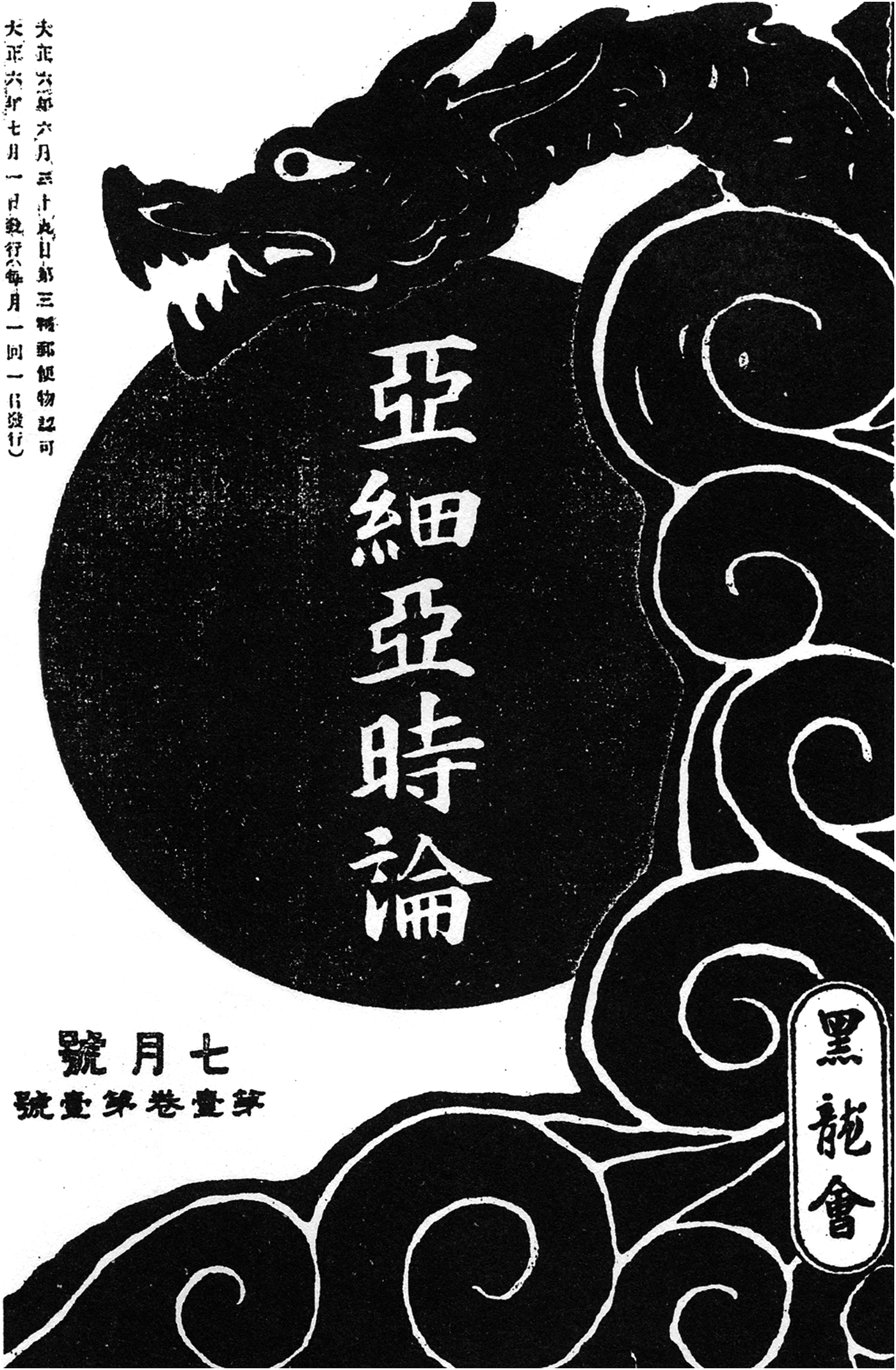
The Ajia Jiron, which was published between 1917 and 1921, is the most revealing publication for the study of the Kokuryūkai as it documents in great detail the association's activities during its most active period. Unlike its early publications, which had the prime objective of reporting more or less objectively the results of the Kokuryūkai's research on East Asian matters,Footnote 59Ajia Jiron had a strongly political character,Footnote 60 reflecting the growing political activism of the Kokuryūkai. It contained political memoranda, strongly worded editorials, and policy proposals, some of which we will look at in detail later.
Cover of Ajia Jiron, 1917.
To inform the world about the Kokuryūkai's and Japan's objectives, the Kokuryūkai also published an English-language journal from 1920 to 1921. Titled The Asian Review, it claimed (wrongly, as it happenedFootnote 61) to be “The Only English Monthly in Japan on Politics, Economy, Art, etc., of Asia, Managed and Edited by Japanese.” With its strong focus on Asian affairs, this journal was a tool for propagating Japanese Pan-Asianism in English-speaking countries; but it was also directed at readers in Europe and the United States in particular with the hope of furthering Western “understanding” of Japanese foreign policy objectives. As the editor put it: “We have to explain our foreign policy, which is based upon the will of the people, to the world.”Footnote 62 The journal can be seen as standing in a tradition of public and semi-public publications that aimed at improving Japan's image to a worldwide audience.Footnote 63
It is difficult to estimate the circulation of the Kokuryūkai's various magazines and, therefore, to judge how influential they actually were. In the first place, as official publications of the Kokuryūkai, these journals were distributed to the membership of the association, which, as we have seen, numbered around 1,000 by the end of the 1910s. Some scholars have argued that the members constituted the core of the readership.Footnote 64 However, it seems certain that the journals also reached influential individuals through the personal networks of Kokuryūkai members. By way of comparison, we should keep in mind the circulation of other magazines at the time: at the beginning of the twentieth century, even “popular” magazines such as Taiyō 太陽 (The Sun) or Kokumin no tomo 国民の友 (The People's Friend), only had circulations of 2,000–2,500 and 500, respectively.Footnote 65 But they probably had many more readers, as each copy was passed on to friends and colleagues. Only from the late 1910s did the general circulation of Japanese journals and magazines begin to increase significantly.Footnote 66
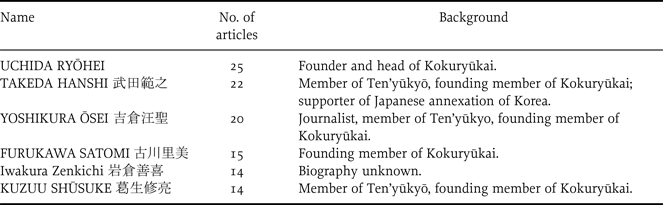
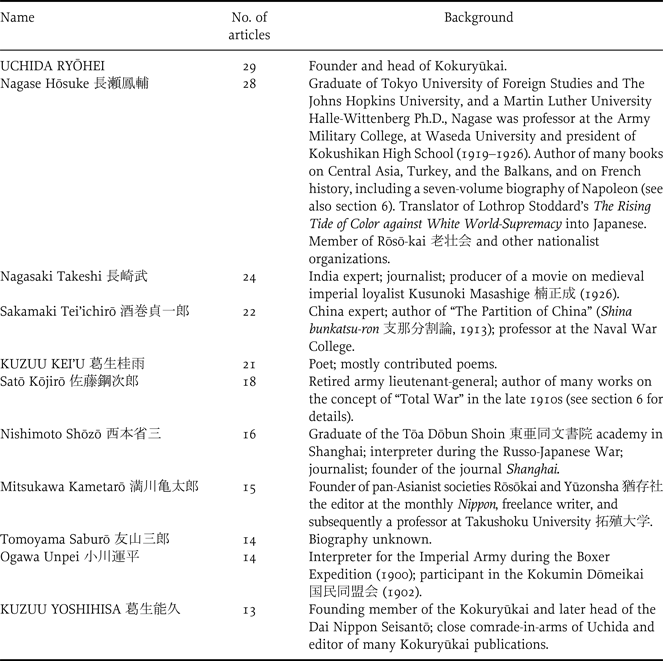
Besides their propagandizing effects on its readership, the journals' significance has to be seen in the deepening and widening of the association's social network among the political and academic elites. While the articles in the society's early journals, Kokuryū and Tōa Geppō, were mostly written by Kokuryūkai members, the contributions to Ajia Jiron were written to a conspicuous degree by non-members – freelance writers and independent scholars as well as established academics, who, through their contributions to Kokuryūkai publications, were integrated into the association's informal social network. The writers listed in Table 2 were the main contributors to the journal Kokuryū (Kokuryūkai members are in capitals).
Authors of articles published in Kokuryū.
Source: Author's database. See author's website: http://www.japanesehistory.de/kokuryukai/.
As we can see, almost all these writers were members of the Kokuryūkai. However, in the case of Ajia Jiron, published between 1917 and 1921 (see Table 3), members were the minority of writers. They were replaced by a number of well-known and prolific authors with a high profile in Japanese society, academia, and politics (Kokuryūkai members are again in capitals). Among the writers with fewer than a dozen contributions, we further find a large number of well-known journalists, academics, and mainstream politicians who were regular contributors to both Ajia Jiron and the English-language Asian Review. These included journalists Shiga Shigetaka 志賀重孝 (1863–1927) and Ōba Kakō 大庭柯公 1872–1924 [?]); international law experts Takebe Tongo 建部遯吾 (1871–1945), Matsunami Ni'ichirō 松波仁一郎 (1868–1945) and Terao Tōru 寺尾亨 (1859–1925, all members of the “Seven Doctors” of 1903 and the “Nine Doctors” of 1918); diplomat Horiuchi Kanjō 堀内干城; and politicians Hamaguchi Osachi 浜口雄幸 (1870–1931), Nagai Ryūtarō 永井柳太郎 (1881–1941), and Nagashima Ryūji 長島隆二 (1878–1940). Many of these contributors were requested by the Kokuryūkai to write a piece for the first issue of Ajia Jiron. Their acceptance did not necessarily mean that they fully endorsed the association's aims and methods, but with their contributions they helped the Kokuryūkai to foster its prestige and improve its social standing.
Authors of articles published in Ajia Jiron.
Source: Author's database. See author's website: http://www.japanesehistory.de/kokuryukai/.
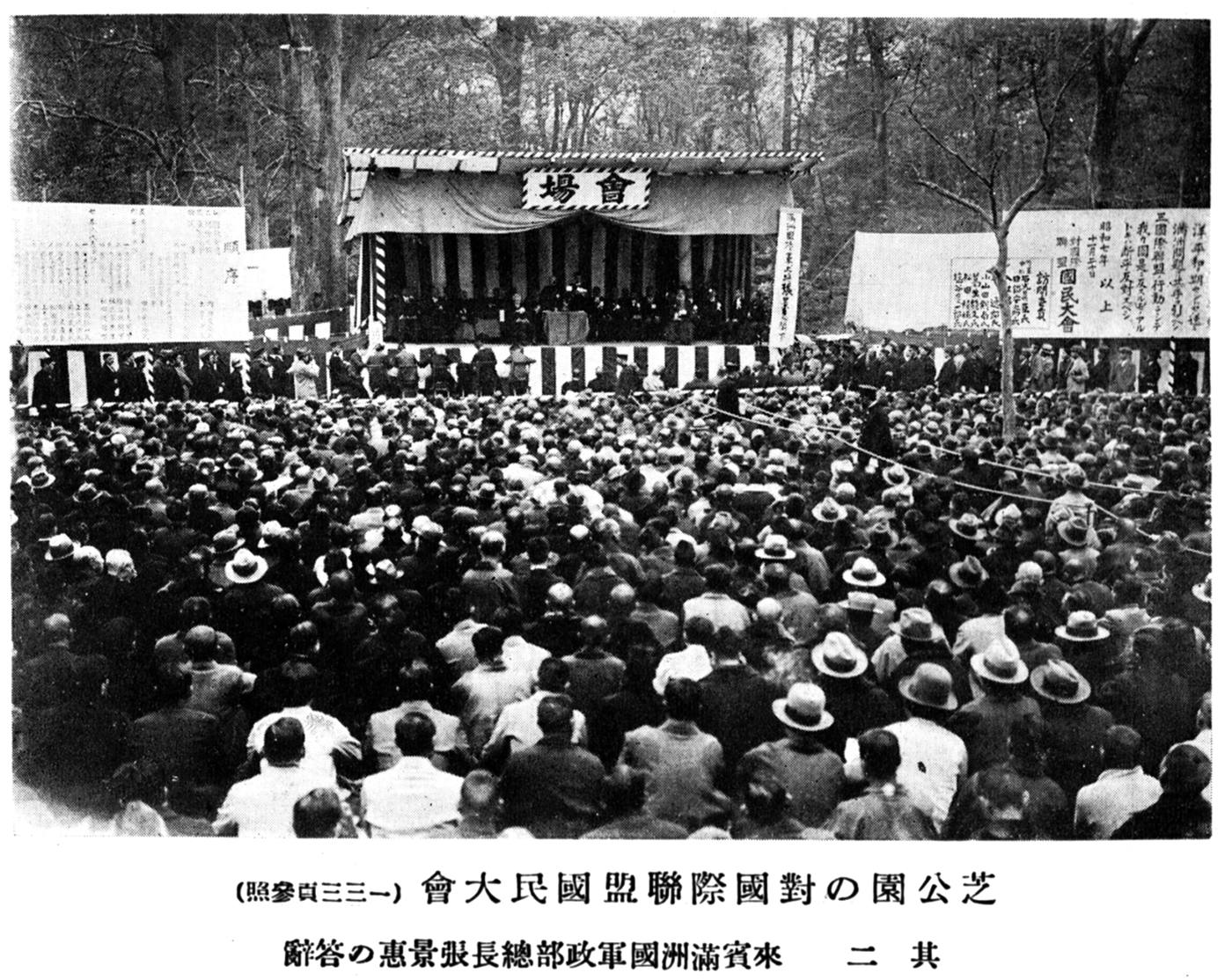
After the Kokuryūkai's regular publishing activities came to an end in 1921, the association relied on other methods of influencing political decision-makers and public opinion. As we have seen, Uchida Ryōhei began producing a growing number of memoranda during the Taishō period. Further, public lectures (kōenkai 講演会) and political rallies (taikai 大会) were held with increasing frequency in the 1910s in order to exert influence on key political questions. One of the first rallies held under the auspices of the Kokuryūkai was the “People's Rally on China Policy” (Tai-Shi Kokumin Taikai 対支国民大会) held on 7 July 1913 in Tokyo's Hibiya Park. Some 30,000 people reportedly attended. On this occasion, Kokuryūkai members as well as several university professors made speeches about the situation in China, which had been in revolutionary turmoil since late 1911. All the speakers were highly critical of the government's indecisive stance on China. In particular, they called on the government to support the Nanjing provisional government under Sun Yat-Sen, with whom Kokuryūkai members had been in close contact for more than a decade.Footnote 67 Four years later, the Kokuryūkai co-organized a rally with the objective to push the government towards a full-fledged military intervention in Siberia. The “Rally for the Promotion of a Self-defense Intervention in East Asia” (Tōa jiei shuppei kisei taikai 東亜自衛出兵期成大会) was held on 30 July 1918 in conjunction with thirteen other political organizations.Footnote 68
In 1919, the Kokuryūkai organized a “Rally to Promote the Abolition of Racial Discrimination” (Jinshuteki sabetsu teppai kisei taikai 人種的差別撤廃期成大会, 5 February 1919), aimed at pressuring the government to further pursue the question of inserting a racial non-discrimination clause in the charter of the League of Nations.Footnote 69 Even though only 300 people attended, the rally had a powerful impact on domestic politics thanks to the participation of influential figures such as politician Sugita Teiichi 杉田定一 (1851–1929).Footnote 70 In order to exert influence on the Japanese strategy at the ongoing Paris Peace Conference, a further event, the “Rally to discuss the peace treaty question” (Kōwa mondai taikai 講和問題大会) was held on 4 May 1919 with some 1,000 participants;Footnote 71 this was followed by a “Rally to discuss questions of foreign policy” (Gaikō monseki taikai 外交問責大会) staged in August.Footnote 72 In 1924, the United States government's Immigration Act, which restricted further immigration from Japan and other Asian countries, triggered a resurgence of the Kokuryūkai's activism. On 2 June 1924, 370 supporters gathered for the “People's rally to discuss the America question” (Taibei mondai kokumin taikai 対米問題国民大会). They included several Diet members.Footnote 73 One month later, another rally, the “People's rally to consider the America problem” (Taibei kinen kokumin taikai 対米記念国民大会), was held with more than 20,000 participants.Footnote 74 This was followed from 7–11 August 1924 by a “Lecture series on our America policy” (Taibei kokusaku daikōenkai 対米国策大講演会), where fifteen politicians, senior academics, and political activists presented their views on Japan's foreign policy and the “America problem.”
Political rally organized by the Kokuryūkai (Source: Kuzuu Yoshihisa: Tōa Senkaku Shishi Kiden, vol. 3. Tokyo: Kokuryūkai Shuppanbu, 1936).
All these activities indicate that, under the stimuli of the revolutionary turmoil in China and Russia, as well as the “anti-Japanese immigration legislation” passed in 1924 in the United States, the activities of the Kokuryūkai had received a considerable boost. However, according to Kokuryūkai sources, Uchida did not consider that the association was making its (and his own) views heard with sufficient force.Footnote 75 As a result, the association actively sought to broaden its activities and win new supporters by supporting or helping found a number of new political associations, most of which worked closely with it to organize the rallies discussed above (with some being founded for this purpose alone). Already in 1901, the Kokuryūkai had played a central role in bringing about the formation of the “Anti-Russian Society,” the Tai-Ro Dōshikai 対露同士会, and, in 1908, Uchida Ryōhei together with Tōyama Mitsuru, Terao Tōru, and others had founded the Rōninkai 浪人会, a political association which remained active throughout the Taishō period. Other organizations with similar objectives to the Kokuryūkai would be formed by the society or its members in the years to come, such as the Dōkōkai (see above). It is generally assumed by historians that these nationalist, ultranationalist, or proto-fascist societies were characteristic of Japanese politics during the 1930s, but it should be noted here that dozens of such groups, under the auspices of the Kokuryūkai, had already come into being in the 1910s and 1920s, as a primary and direct reaction against “Taishō Democracy” and the government's advocacy of a “cooperative foreign policy” (kyōchō gaikō 強調外交).
THE KOKURYŪKAI'S PAN-ASIANISM
Historians have credited Uchida Ryōhei and the Kokuryūkai with a central place in the development of Japanese Pan-Asianism, and dictionary entries generally characterize the society as a pan-Asian, nationalist, and/or expansionist political association. Here it is important to distinguish between Pan-Asianism as an ideology and Pan-Asianism as a movement.Footnote 76 Political activists from Kyūshū, members of associations such as the Gen'yōsha and the Kokuryūkai, lobbied for cooperation with the leaders of anti-imperialistic, anti-Western nationalist independence movements in various Asian countries.Footnote 77 However, this activism did not always lead to a strong intellectual commitment to particular positions on Asian regionalism. In terms of ideology, the Kokuryūkai did not come up with original proposals; rather it relied on the work of others – for example, the writings of Tarui Tōkichi, an early pan-Asianist. Uchida Ryōhei himself concedes in his writings that it was only after reading Tarui's “Treatise on the Great Eastern Union” (Daitō Gappō-ron) that he began thinking about Asia as a region.Footnote 78
While the Kokuryūkai's publications confront us with a mass of information in the form of detailed reports on the situation on the continent, there is a marked absence of theoretical writings on questions related to Asian regionalism or Asianism, on what constituted “Asia” in the first place, or on the future of the region as a whole. Interestingly, there is also no evidence for the use of the term “Pan-Asianism” (or “Asianism” or “Greater Asianism”) in the Kokuryūkai's publications before 1917. Thus, although the association's activism throughout Asia can be considered as an expression of early regionalism in modern Japan, it was left to others to channel this activism into concrete policy proposals and a well-defined theoretical framework. In Japan, one of the first usages of the term “Greater Asianism” (Dai Ajiashugi 大アジア主義) was made in a book published in 1916 by Kodera Kenkichi 小寺謙吉 (1877–1949), a Diet member and international law expert.Footnote 79 It was only after the appearance of Kodera's book that the expression was used by the Kokuryūkai, in the first issue of Ajia Jiron, dated July 1917:
The Japanese Empire, as the last [independent] representative of Asia (…), has to establish a comprehensive foreign policy vis-à-vis the world, implant the idea of Greater Asianism, the great achievement of the foundation of our country, in the minds of the people, and bring about a comprehensive solution to the East Asia problem based on this [Asian]ism.Footnote 80
A similar statement was included in a pamphlet on the “Revitalization of the Kokuryūkai” published the same month.Footnote 81 Several articles on Asianism appeared in the association's journalsFootnote 82 throughout 1917 and 1918.Footnote 83 By this time, however, it had become clear that the Kokuryūkai's version of Pan-Asianism and Asian regionalism was not to be regarded as an end in itself, but rather as an instrument to legitimize Japanese territorial ambitions. While early forms of Pan-Asianism embodied a strong idealism – as seen in the writings of Tarui Tōkichi or the activities of a group called the Kōa-kai 興亜会Footnote 84 and Miyazaki Tōten 宮崎滔天 (1871–1922)Footnote 85 – idealistic notions of racial equality and solidarity increasingly gave way to Realpolitik considerations of Japanese leadership and hegemony after the turn of the century.Footnote 86
In his influential introduction and commentary on an early collection of sources relating to Asianism, Takeuchi Yoshimi 竹内好 describes Pan-Asianism as “a loose set of ideas, a current in ideological discourse, but not a coherent ideology in itself.”Footnote 87 I have argued elsewhere that this judgement may be valid as regards the Pan-Asianism of the Meiji era (1868–1912), but by the time of World War I, Pan-Asianism had developed into a coherent ideology that was well defined in terms of its basic principles, content, and objectives.Footnote 88 The above-mentioned book by Diet member Kodera Kenkichi is the most obvious example of this trend. However, Takeuchi is probably right in asserting that the most important role of prewar Japanese Pan-Asianism lay in providing the basis for legitimizing Japan's overseas expansion and that it had a strong tendency to be “affirmative of the means of expansionism.” In the early Meiji period, Japan was not yet strong enough to expand onto the Asian continent and dominate the East Asian region. However, when it ascended to the position of a regional superpower due to the weakening influence of the European powers in East Asia during World War I, pan-Asian notions were increasingly used to legitimize Japanese expansionism. It therefore became obvious that while Pan-Asianism, as in the case of other pan-movements, had the potential to serve as an ideological basis for regional integration, it eventually fell victim to schemes of territorial expansion, succumbing to the temptation of nationalist-imperialist policies. While pan-ideologies were originally devised as alternatives to nationalist approaches, most ended up being instrumentalized in the service of a particular nation state claiming regional leadership.Footnote 89 The links between Pan-Asianism and the Japanese claim to regional leadership are no exception. The idea of regional cooperation was replaced by the notion of national domination of the region by a “Greater Japanism” (Dai Nihonshugi 大日本主義). The notorious “Greater East Asian Co-prosperity Sphere” of the 1940s was the logical consequence of this development.
THE KOKURYŪKAI AND THE MILITARY
As we have seen, following the end of World War I the Kokuyrūkai's journals were publishing fewer articles on Asia and Japan's foreign relations, while focusing increasingly on domestic issues. Above all, there was now a strong focus on military-related issues such as the question of disarmament, the subject of an intense international debate following the end of the war and the discussions surrounding the founding of the League of Nations.Footnote 90 The question of how to prepare a nation for a possible future “total war” (sōryokusen 総力戦) occupied military planners all over the world. Japan – and the Kokuryūkai – were no exceptions to this trend.Footnote 91 In the last years of the Great War, the society's publications intensively discussed the subjects of “total war” and “national mobilization.” For many Kokuryūkai members, a future “national mobilization” was at risk of being undermined by the activities of advocates of “new thought” – not only socialism and communism, but also Western ideas of liberalism and individualism. Thus, these “new” and “alien” ideologies were strongly criticized in Kokuryūkai publications – for example, in an aggressive editorial titled “Doing Away with Foolish Scholarly Views” (Shisōkai no gūron o haisu 思想界の愚論を排す) in the first 1919 issue of Ajia Jiron. The Kokuryūkai also engaged in direct campaigns against advocates of liberalism and democracy. In Ajia Jiron, for example, the association branded the daily Ōsaka Asahi Shinbun as a traitor to the nation (hikokumin 非国民). It also started a campaign to protect what it regarded as Japan's distinctive form of national polity, the kokutai 国体. The Rōninkai, an offshoot of the Kokuryūkai, stood at the forefront of the early Kokutai Yōgo Undō 国体擁護運動, the Movement to Protect the Kokutai, or National Body.Footnote 92
The activities of the Kokuryūkai and related societies such as the Rōninkai were not limited to media campaigns and the organization of rallies, but also included physical attacks on their enemies. For example, in 1919 “Kokuryūkai thugs dragged (...) the president of the Ōsaka Asahi through the streets of Ōsaka, after which they tied him to a lamp-post and hung a placard around his neck proclaiming ‘heavenly punishment’.”Footnote 93 In 1925, Uchida Ryōhei was involved in a plot to assassinate Prime Minister Katō Takaaki 加藤高明,Footnote 94 a leading figure of Taishō Democracy and the architect of a universal suffrage bill which the Kokuryūkai had strongly opposed.
In its fight against the “dangerous ideas,” the Kokuryūkai closely cooperated with the Japanese military, particularly the Imperial Japanese Army. As we have seen above, the society had already established strong links to the military in the 1900s. Some of its members had cooperated with the army in the Sino-Japanese and Russo-Japanese wars.Footnote 95 Since 1904, the Kokuryūkai had been receiving financial support from both the Army Ministry and the Ministry of Foreign Affairs. When, due to a shortage of funds, the Kokuryūkai was unable to publish a series of books and maps on Asian geography (mainly Russia, Siberia, and Manchuria), both these ministries stepped in to help the association with an advance payment for 800 copies.Footnote 96 The Army Ministry had recognized two Kokuryūkai publications in particular, “Guide to Conquering Russia” (Sei-Ro Annai) and “Recent Map of Korea and Manchuria” (Mankan Shinzu 満韓新図), as highly useful materials.Footnote 97 During the Siberian Intervention, the Kokuryūkai again cooperated closely with the Army General Staff, gathering intelligence and providing interpreters.Footnote 98
Members of the imperial military forces on active duty by law were not allowed to join political associations and parties in modern Japan. This regulation did not apply to retired military men, however. Some retired officers contributed articles to the Kokuryūkai's periodicals and took up military-related issues with increasing frequency during and after World War I. Lieutenant-General Satō Kōjirō (1862–1927) stands out among the contributors to the society's journals around the time of World War I. When Satō was put on the reserve list in 1918 he turned to writing, publishing a number of books on a future “total war” and the necessity for national – i.e., total – mobilization. Satō's book Kokuminteki sensō to kokka sōdōin (National War and State Mobilization 国民的戦争と国家総動員)Footnote 99 received a good deal of attention and gave him a reputation as a strong advocate of “national mobilization,” a reputation he confirmed in subsequent publications.Footnote 100 He also insisted that a war with the United States was inevitable – for example, in his book Nichibei moshi tatakawaba,Footnote 101 originally published in English in 1920 under the title If Japan and America Fight.Footnote 102
Satō Kōjirō (Source: Sato 1921).
In a 1918 article published in Ajia Jiron Satō called for “the necessity for the absolute unity” of the Japanese nation as a means of preparing for a future war, and strongly criticized the idea of civilian control of the military.Footnote 103 Like other writers, Satō was a believer in the superiority of the German military, notwithstanding the fact that Germany had been defeated in World War I. Satō attributed Germany's defeat to national disunity and treason on the part of some of the country's politicians, above all the Social Democrats and the Communists – a view which also led him to argue strongly (in another article) against the influx of thought and ideologies that he characterized as “truly dangerous for the army.”Footnote 104 His views indicate that, from an early time, Satō accepted the so-called stab-in-the-back legend, which blamed “weak politicians” in the German government for the defeat in World War I, in a situation where the army had “not been defeated on the battlefield.”Footnote 105 Juxtaposing strong German leadership in the Great War with the weakness of military command in democratic states, Satō wrote:
Britain's poor performance throughout the war was simply due to the fact that its Supreme Command was distracted by international diplomacy and had fallen into disunity. The British Supreme Command proved to be no different from the Supreme Command of France, which became agitated over every little problem and frequently found itself at the mercy of council discussions. Unlike these countries, the German Supreme Command had only a few members who had been drawn from the Kaiser's inner circle, and no one else was allowed to participate in the general staff meetings held at military headquarters. (…) It is clear from the above that Germany was in every respect superior (…). No enemy crossed her borders while she fought a number of other countries alone for five long years – and this was because the nation was well organized and united.Footnote 106
In 1919, Satō contributed another article to Ajia Jiron opposing proposals aimed at abolishing conscription and disbanding the Army General Staff (sanbō honbu 参謀本部) – both notions which had gained traction in Japan after Great Britain had discontinued conscription, introduced there during the war, and he declared this a step towards global disarmament. In this article, Satō emphasized that conscription was not merely about maintaining military strength: “The conscription system benefited the country in two ways: first, by making good citizens (ryōmin 良民) realize their responsibilities for national defense. (…) Secondly, the state needs the conscription system as a part of the education of its citizenry.”Footnote 107 The idea that conscription was a cornerstone of Japan's national education system and a means of instilling national consciousness were themes frequently stressed in contemporary discussions of the “National Mobilization System.” Satō argued that even though Great Britain and the United States had abandoned conscription after the war, Japan was in no position to discontinue it because its economic and material resources were no match for those of Great Britain and the United States and it lacked the industrial base to compete with the Anglo-Saxon powers.Footnote 108
Another issue that stirred Satō's interest, and which has already been touched on, was the relationship between politics and the military (seigun kankei 政軍関係) and the question of civilian control over the military. Prime Minister Hara Takashi 原敬 (1918–1921), famous as the first “commoner” prime minister in a cabinet made up almost exclusively of party politicians, strongly advocated civilian control. In response, the military insisted on the “independence of the Supreme Command” (tōsui-ken no dokuritsu 統帥権の独立), asserting the prerogative of the military to act independently under the auspices of the Emperor, whose military prerogatives were defined in articles 11 and 12 of the 1889 Constitution of the Japanese Empire.Footnote 109 In an article entitled “We Can't Fight a Battle with Mr. Hara (Politicians are Disrupting the Supreme Military Command)” published in Ajia Jiron in 1920, Satō criticized Hara for causing “disruption in the Supreme Command,” calling him an “amateur” dabbling in military affairs. “As the Germans say,” Satō continued, “military strategy is an art, and anyone untrained in this art has no right to interfere. No matter how smart Mr. Hara may be, allowing him to meddle in the affairs of the Supreme Command can only cause harm, as he is not trained in the art of war.”Footnote 110 In the same piece, Satō went on to criticize the Advisory Council on Foreign Relations (Gaikō chōsa-kai 外交調査会), which was then debating the Siberian Intervention:Footnote 111
As for the Research Council on Foreign Affairs, politicians overstepped the boundaries proper to the Supreme Command and usurped the prerogatives of the Commander of the Troops in Siberia. (…) (Politicians) ended up doing a half-baked job and taking control of the activities of soldiers on the front lines at their personal pleasure. It is by no means an exaggeration to point out that the politicians' interference in the Supreme Command produced utterly useless results.Footnote 112
While the Japanese government had reached an agreement with the United States that each country would send 7,000 troops to Vladivostok to protect the evacuation from Siberia of the so-called Czech Legion made up of former Czech prisoners-of-war,Footnote 113 the General Staff independently increased the strength of the Japanese contingent to more than 70,000 troops – at one point, around half the divisions in the Imperial Army were stationed in Siberia and Northern ManchuriaFootnote 114 – and expanded the area of engagement to include large parts of Eastern Siberia, from Vladivostok to Lake Baikal. However, due to stiff resistance from partisan fighters, the Japanese army failed to achieve control over these vast territories. In response, Satō blamed the nation's civilian leaders for obstructing the military's efforts. He was convinced that their interference in the independence of the Supreme Command had undermined military leadership and had caused the difficulties the army met in Siberia.
Similar arguments also appeared in articles written for Ajia Jiron by civilians, both Kokuryūkai members and others. One such polemicist was Nagase Hōsuke (1865–1926), a prolific writer whose name has already been mentioned. Nagase arrogantly claimed to be “superior to any of the so-called ‘new thinkers’ in Japan in terms of understanding ‘new ideas,’ as I have spent ten years in Europe completing my studies.”Footnote 115 He harshly criticized the influx of “new thought” – democratic thought, liberalism, socialism, and communism – into Japan. He claimed that the introduction of “new thought” to Japan was “dangerous, because the Japanese lacked an awareness of themselves as a nation” and therefore “accepted uncritically any idea imported from Europe or the United States”; the Japanese showed a “fondness for useless old-fashioned things” and, further, “lacked ethical judgment,” hardly able to distinguish between right and wrong, and good and evil.Footnote 116 Nagase expressed an astonishing degree of contempt for the average Japanese, concluding that an uncritical acceptance of these new ideologies would be dangerous and destructive to Japanese society and would undermine efforts to achieve national unity in wartime.Footnote 117
While Satō and Nagase were independent writers, using Ajia Jiron as one of many vehicles to publish their articles (and earn a living), a number of Kokuryūkai members also expressed strong interest in military matters. Uchida Ryōhei was an outstanding example of such interest himself and, as the head of the association, it was surely under his direction that the focus of Ajia Jiron shifted towards military-related issues. Uchida had sent a memo to Foreign Minister Uchida Yasuya 内田康哉 (1865–1936, no relation to Ryōhei) at the end of 1918 entitled “Reform or Ruin: An Appeal for an Overhaul of the Military,” which drew on the lessons of the Siberian Intervention to demand reform of Japan's military establishment.Footnote 118 As in many of his writings, Uchida used alarmist expressions such as the “ruined country” (bōkoku 亡国) or “A warning of a national crisis,”Footnote 119 with the aim of – preemptively – dismissing any alternatives to his proposals. What he had in mind, in concrete terms, was a strengthening of the military, boosting the independence of the Supreme Command, and a fusion of general and military education with the objective of fostering unity between the military and the Japanese people. In 1920, Uchida published a proposal for the reform of the conscription system in Ajia Jiron – again calling specifically for the integration of military and general education:
National schools will only function properly by maintaining contact between the military and the world outside the military. In other words, if a citizen is not a graduate of a military or national school, he will be unable to advance to a higher educational level, nor will it be possible for him to succeed in business. (…) Thus, in order to fulfill their mission as preparatory schools for the national education system, middle schools should give their students sufficient time for military drill practice as well as instructing them in the discipline of the samurai spirit, while providing a regular education centered on common knowledge.Footnote 120
During and after World War I, there was an international consensus that, more than anything else, German militarism was responsible for the outbreak of the war.Footnote 121 In Ajia Jiron, this assumption was questioned, and “militarism” was reinterpreted, in a strongly positive light, as a basic requirement for national mobilization in the future. The most straightforward attempt in this direction in Kokuryūkai publications was arguably an article titled “Advocating Good Militarism” (Yoki gunkokushugi no teishō 善き軍国主義の提唱), in which journalist Chikushi Jirō 筑紫次郎 argued that Japan had to “discover the virtues of militarism by recognizing the advantages that come with it.”Footnote 122 Emphasizing the similarities between militarism and nationalism, Chikushi claimed that “Japan today surely has much it could learn from a positive understanding of militarism, especially in terms of national thought and education.” He further urged that “we should inject a good militarism (yoki gunkokushugi 良き軍国主義) into our national thought (kokumin shisō 国民思想) and incorporate military education into national education, while at the same time assimilating national thought with military thought (gunjin no shisō 軍人の思想), never forgetting that public education operates in parallel with military education.” Chikushi further insisted on the elimination of what he called “anti-militarist extremists,” which he identified in particular in the ranks of “so-called scholars and active socialists”Footnote 123 who were undermining national unity, and on the organization of national mobilization. Chikushi expressed his sympathy for the strong anti-academic, anti-socialist and anti-communist stance held by right-wing political associations. He reserved special criticism for those he called “new scholars” who, he charged, “ignore the Japanese family system and upset the social order as a result of their excessive individualism, and end up leading the public astray with their anti-state language and behavior.”Footnote 124 In a similar vein, another journalist writing in Ajia Jiron, Nagasaki Takeshi, emphasized that militarism was crucial for national survival, affirming that Germany was in fact saved – and not destroyed – because of its strong militarism:
Some in our Empire, above all the new scholars, criticize Germany strongly and condemn German militarism. (...) However, Germany is not a country in ruins (bōkoku), and its militarism is not in danger. [Rather], the fact that Germany and the German nation still exist is the result of German militarism.Footnote 125
In expressing these views, Chikushi and Nagasaki were influenced by similar controversies in Germany about the meaning of “total war.” Chikushi's advocacy of the “necessity of militarism” rather than its rejection can be interpreted as an early sign of anti-Anglo-Saxon self-affirmation by Japan's elite.
In world opinion, World War I had been fought “to make the world ‘safe for democracy’”Footnote 126 and to “destroy militarism,” as one of the leading exponents of the liberalism of the Taishō period, Ozaki Yukio 尾崎行雄 (1858–1954), put it.Footnote 127 Chikushi, Nagasaki and many other contributors to Ajia Jiron disagreed. They turned to Japan's wartime enemy, Germany, in order to reaffirm the Japanese national identity and the Japanese polity, the kokutai. Japan had based its constitution and military system on German models in the 1880s and 1890s. Despite the collapse of imperial Germany in World War I, and reacting out of fear of the spread of liberal-democratic thought in Japan as a consequence of the Great War, they, and a host of other like-minded commentators, sought to reaffirm the validity of the “German model” for postwar Japan as well.
CONCLUSION
While the Kokuryūkai began life as an association dealing with foreign policy, it became increasingly involved in the discussion of domestic issues during World War I. Above all, it took the lead in the movement against the new – and supposedly “dangerous” – ideologies of liberalism, democracy and socialism. The revolutions in Russia (1917) and Germany (1919) surely contributed to the shift of the Kokuryūkai's attention to domestic issues, because these events demonstrated how easily the fate of imperial ancien régimes could be sealed by revolutionary turmoil. Closely related to this, the association advocated the establishment of a system of “national mobilization” in order to prepare for a future “total war.” These were discussions with broad implications for Japan's military establishment, but also for the overall relationship of the military to politics and society.
Some historians argue that Uchida Ryōhei and his associates “were not leading figures in the development of [Japanese] fascism,” because they were “traditional right-wingers.”Footnote 128 While Uchida was able to exert influence on the old elites, he and the Kokuryūkai failed to play any role in shaping the totalitarian and fascist tendencies of the 1930s. However, as this article shows, the association played a significant role in paving the way to the destruction of Taishō Democracy. The Kokuryūkai, which was founded as an association focused on foreign policy, transformed itself into a radical anti-democratic and anti-parliamentarian group during the late 1910s and early 1920s and attacked advocates of Taishō Democracy, condemning them as a “threat to our national polity” and “dangerous traitors.”Footnote 129 The society characterized parliamentarianism as “a threat to the existing political system and the authority of the Emperor”Footnote 130 and openly demanded the “abolition of parliamentary government.”Footnote 131
The Kokuryūkai's growing interest in military affairs and the strengthening of its cooperation with military circles was another major change that the society underwent in the 1910s. In 1924, the “Prospectus for the Expansion of the Kokuryūkai” (Kokuryūkai kakuchō shuisho 黒龍会拡張趣意書Footnote 132 explicitly stated that “we anticipate receiving the imperial military mandate, strengthening our martial spirit, reaping the fruit of universal conscription, and fulfilling the duty of national defense,” words clearly advocating a closer alignment with the military. In the same vein, the “rehabilitation” of “good militarism” and military values led to the inclusion of the military sector in the anti-democratic camp in the latter's campaign against the liberal newspapers of the day. Those newspapers that claimed that cabinets dominated by the oligarchy and the military, such as the cabinet under Terauchi Masatake 寺内正毅 (1916–1918), represented “the triumph of militarism in Japan”Footnote 133 were targeted by the Kokuryūkai and its allies, who of course understood the term “militarism” in quite a different sense.
The Kokuryūkai's growing concern with military matters, combined with its continuing cooperation with the military, reflected Japanese society's shift towards a military-dominated authoritarian political and social system, a structure which materialized in the 1930s. The Kokuryūkai was not the only factor contributing to this trend. Richard Smethurst,Footnote 134 for example, has demonstrated how the Imperial Reservists' Organization (IRO) worked hard to spread militarist thought in the countryside. The activities of the Kokuryūkai and the IRO represent threads of continuity in Japanese politics and society from the 1920s, which are usually seen as a relatively liberal and democratic period in modern Japanese history, to the 1930s, often characterized with the terms “militarism,” “military dictatorship” or even “fascism.” The Kokuryūkai itself, however, proved unable to cope with the exigencies of mass society, and became practically defunct by the early 1930s. Efforts to revive the association's activities through cooperation with a new mass religious movement, the Ōmotokyō 大本教,Footnote 135 or via the founding of the Great Japan Production Party (Dai Nihon Seisantō) in 1931, were largely without effect.
The development of the Kokuryūkai in the 1910s and 1920s adds to our understanding of the significance of the Great War in Japanese history, a significance which has not received sufficient attention from historians. The association's transformation during the war paralleled the radicalization of post-World War I German politics. From this perspective, the interpretation of the Great War as “the great seminal catastrophe of this century”Footnote 136 might also be applicable in the case of modern Japan.