Introduction
Governmental social programmes have included psychosocial and community strategies for three decades (Musitu and Castillo, Reference Musitu and Castillo1992). These strategies require the incorporation of psychologists (Alfaro, Reference Alfaro2012), who play a key role in establishing connections between personal/family/community assets and the opportunity network and public offerings (Cohen and Franco, Reference Cohen and Franco2006). However, links have been found between these intervention strategies and burnout (Arón and Llanos, Reference Arón and Llanos2004; Gomà-Rodríguez et al., 2018). This issue, despite multilevel efforts, continues to plague governmental psychosocial and community programmes across the world (Bilbao et al., Reference Bilbao, Martínez-Zelaya, Pavez and Morales2018; Barrera and Matamala, Reference Barrera and Matamala2020; Calquín Donoso et al., Reference Calquín Donoso, Guerra-Arrau and Araya Fernández2021; Verde-Diego et al., Reference Verde-Diego, González-Rodríguez, Frieiro and Fernández-Arias2021).
Classical definitions of burnout include references to emotional exhaustion, depersonalisation, and low personal realisation derived from work (Maslach and Jackson, Reference Maslach and Jackson1981), particularly in assistance activities (e.g. health care, education, social services) (Gálvez et al., Reference Gálvez, Moreno-Jiménez and Mingote2009). Within the context of social services, programmes with psychosocial and community components aimed at people affected by poverty and vulnerability, being based on the relationship between intervention agents and participants (Daher et al., Reference Daher, Jaramillo and Rosati2018, Reference Daher, Rosati, Campero, Guarda and Bunster2022a), offer ideal conditions for burnout to appear. This occurs, first, because working on psychosocial issues such as poverty, social vulnerability, abuse, violence, and suffering involves situations that can result in burnout (Kovalskys and Gómez, Reference Kovalskys and Gómez2000; Arón, Reference Arón2001; Arón and Llanos, Reference Arón and Llanos2004). Second, this happens because the relationship with the participants entails emotional and psychological demands, implicit or explicit interaction norms, passive or active behaviours by the participants, and possible accusations, complaints, requirements, or unrealistic expectations, all of which can be a source of burnout (Maslach, Reference Maslach1978; Lloyd et al., Reference Lloyd, King and Chenowethet2002; Langle, Reference Langle2003; Barrera and Matamala, Reference Barrera and Matamala2020).
However, apart from psychosocial issues and the relationship with the participants, which tend to be the most commonly highlighted causes of burnout in social programmes, other greatly relevant causes exist. These causes can be personal (e.g. sociodemographic factors, personality traits, cognitive and motivational factors, professional training), relational (e.g. bonds with peers, support networks and sources, social appreciation), organisational (e.g. structure of the work conducted, work dynamics, working conditions), and sociocultural (e.g. economic, political, and historical factors) (e.g. Cherniss, Reference Cherniss and Paine1982; Freudenberger, Reference Freudenberger1989; Grau et al., Reference Grau, Suñer and García2005; Arias and González, Reference Arias and González2008; Cogollo-Milanés et al., Reference Cogollo-Milanés, Batista, Cantillo, Jaramillo, Rodelo and Meriño2010; Vargas, Reference Vargas2010; Rodríguez and de Rivas, Reference Rodríguez and de Rivas2011; Wang et al., Reference Wang, Liu and Wang2015; Díaz and Gómez, Reference Díaz and Gómez2016; Alessandri et al., Reference Alessandri, Perinelli, De Longis, Schaufeli, Theodorou, Borgogni, Caprara and Cinque2018).
Within the specific context of social policy, the above causes are compounded by great technical demands, the multiple needs to be met, and the limited resources available to do so (Rodríguez et al., Reference Rodríguez, Granados and Larraín2013). Other factors that increase the complexity of these interventions include institutional poly-demand and working conditions affected by outsourcing, sometimes leading to irregular hiring practices (Bilbao et al., Reference Bilbao, Martínez-Zelaya, Pavez and Morales2018), all of which generates an environment of labor insecurity, feelings of abandonment, and a lack of control (Calquín Donoso et al., Reference Calquín Donoso, Guerra-Arrau and Araya Fernández2021). In view of these critical aspects of public policy, it is essential to examine certain organisational features involved in burnout: those associated with work settings such as working conditions and psychosocial risks (Arias and González, Reference Arias and González2008; Guevara-Manrique et al., Reference Guevara-Manrique, Sánchez-Lozano and Parra2014); those related to the intervention, such as workday length, workload, roles, coordination, and degrees of autonomy (LeCroy and Rank, Reference LeCroy and Rank1987; Román, Reference Román2003; Quintana, Reference Quintana2005); and those associated with labor and institutional relationships, such as management styles, social-work climate, communication, support – offered and perceived –, and acknowledgment and visibilisation of the intervention agents’ work (Langle, Reference Langle2003; Peiró and Rodríguez, Reference Peiró and Rodríguez2008; Cantera and García-Grané, Reference Cantera and García-Grané2021; Martínez-López et al., Reference Martínez-López, Lázaro-Pérez and Gómez-Galán2021).
To understand the type of burnout that takes place in governmental psychosocial and community programmes, it is important to consider three additional aspects. First, professional education and training, technical knowledge, and intervention competences, when mismatches are observed between these aspects and professional practice or technical professional field (Alfaro, Reference Alfaro2012). Second, the relationship between design and implementation, as well as between technical-normative frameworks and execution, when uncertainty, limitations, and gaps exist between both (Pülzl and Treib, Reference Pülzl, Treib, Fischer and Miller2007; Poblete et al., Reference Poblete, Zuzulich, Gylsling, Barros, Barticevic and Ferreira2010). Third, networking among programmes, benefits, and/or services, which has been incorporated into social policy from an intersectoral perspective (Barrientos and Santibáñez, Reference Barrientos and Santibáñez2009), even though researchers have reported how complex and challenging it is to establish a well-connected intervention network (González and Rodríguez, Reference González and Rodríguez2020).
As for the manifestations of burnout, they can be classed as individual (physical, cognitive, behavioral, psychological-emotional, social, spiritual), team-related (interpersonal relationships, communication, group processes, reflectivity), institutional (absenteeism, turnover, job insecurity), and intervention-related (relationship with participants, quality) (Arón and Llanos, Reference Arón and Llanos2004; Nahrgang et al., Reference Nahrgang, Morgeson and Hofmann2011; Suñer-Soler et al., Reference Suñer-Soler, Grau-Martín, Font-Mayolas, Gras, Bertran and Sullman2012; Reyes, Reference Reyes2013; Duque and Gómez, Reference Duque and Gómez2014). However, even though it is important to delimit these levels, the literature does not distinguish between the manifestations of burnout and their consequences and/or effects.
Lastly, though professional burnout has received a great deal of attention in theoretical and empirical research (Rodríguez and de Rivas, Reference Rodríguez and de Rivas2011; Díaz and Gómez, Reference Díaz and Gómez2016), there is a predominance of quantitative and diagnostic approaches (Foz, Reference Foz2008), with variables exhibiting limited interconnection (Ortega and López, Reference Ortega and López2003), and less focus on social services compared to health and education (Villar, Reference Villar2015). In this regard, it is relevant to study them in more depth within the context of social interventions, adopting a qualitative approach to highlight emerging experiences and phenomena.
The objective of this article was to analyse burnout in governmental psychosocial and community programmes considering training/knowledge, the technical-professional field, the institutional framework, and networking, based on the experience of the intervention teams of three Chilean programmes. These four aspects are relevant in this study, as they emerge from the data as those intervening conditions that articulate the experience of burnout, organising many of the elements already mentioned about burnout in social services, as well as others not previously explored.
Method
Design
This study is part of FONDECYT project 1150938 ‘The configuration of the psychologist’s technical field in social policies: analysis of the formulation and implementation of social programmes with a psychosocial component’, led by the last author of this article. We selected three programmes that featured substantial psychosocial and community components, implemented in two regions of Chile. These programmes covered the following topics: promotion of school success and psychosocial well-being in educational settings, classed as a low-complexity education programme; improvement of the living conditions of people in poverty, classed as a medium-complexity poverty programme; and overcoming rights violations in childhood, classed as a high-complexity childhood programme.
The objective of the main research project was to describe the effect of psychology knowledge present in the formulation of social policies over the technical work of intervention agents, this in three social programmes with psychosocial and community components. In the context of this research, some questions about burnout were incorporated into data production activities, assuming that it was a topic that could be important for the technical work of the intervention agents. Finally, burnout turned out to be a topic that emerged with even greater strength and clarity than expected, becoming an emerging phenomenon of this research.
Qualitative methodology of an exploratory type and with a comprehensive scope (Flick, Reference Flick2004) was employed, which made it possible to approach this phenomenon based on the participants’ experiences. The study was exploratory because burnout was an emerging phenomenon, and it is a topic that has been less explored in social services, especially from a qualitative approach. Also, it was comprehensive because it sought to have a deep understanding of the phenomenon of burnout, starting from its different edges and relating its different dimensions and properties that compose it, seeking to propose a comprehensive model of burnout in social programmes.
Participants
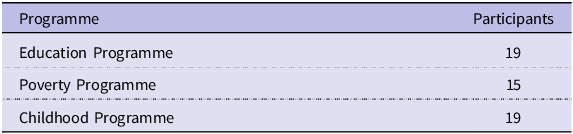
The participants were fifty-three people, most of them psychologists, as well as social workers and teachers, who worked in the three programmes under study (Table 1). We employed purposive critical case sampling (Patton, Reference Patton2002), inviting professionals whose implementation experiences were rich in information associated with the areas to be examined. The following inclusion criteria were set being a professional or a professional technician, being part of the programme teams or being associated with them (e.g. being a technical consultant or a supervisor), and having worked in the programme for at least six months. Our access strategy involved key informants in management positions associated with the programmes at a central level. These officials authorised the study, providing contact information for the local coordinators of each programme, who granted us access to the participants.
Participants of the study

Source: Own elaboration.
Data production
We conducted semi-structured individual interviews (Kvale and Brinkmann, Reference Kvale and Brinkmann2009) and focus groups (Flores, Reference Flores2009). Both the interviews and the focus groups followed a thematic script (Flick, Reference Flick2004) that covered the specific objectives of the project. The sections of the thematic script were: introduction and presentation, actors involved in the programme and policy, interaction between actors, institutional framework for professional performance, psychologist roles and technical-professional field, and identification data. Also, some questions about burnout were included since we expected it to be a relevant emerging topic. These questions were: In terms of burnout, how does it manifest (in the case of your programme, in your team and in you)? Do you think burnout is related to the interaction of the different actors? How does burnout influence your work? What self-care and care practices do you have (formal as well as informal)? Do you think care is related to the interaction of the actors? How does care influence your work? All activities were audio-recorded and transcribed for later analysis.
Data analysis
The data were analysed using Grounded Theory (Strauss and Corbin, Reference Strauss and Corbin2002). We conducted descriptive and relational analyses, reporting the latter in this article. In relational analysis, a central phenomenon is identified, which does not necessarily coincide with the object of research (as was the case in this study), which is emergent and relevant because key aspects of data can be organised around it. The NVivo 11 software package was used in the open coding process. We then performed axial coding, which yielded a comprehensive model of the phenomenon associated with burnout.
Ethical considerations and rigorousness criteria
We followed the ethical guidelines set by Chile’s National Agency for Research and Development (ANID, 2022). The project was approved by Ethics Committee of Universidad del Desarrollo. An informed consent procedure was carried out in all cases. As rigorousness criteria, we employed triangulation, which refers to the consideration of different elements to compare, contrast and complement perspectives, and thus achieve a more comprehensive and in-depth knowledge of the phenomenon under study (Daher et al., Reference Daher, Rosati, Campero and Stevenson2024). We considered triangulation in data production strategies (Denzin, Reference Denzin1970), by including focus groups and interviews; and intersubjective triangulation (Cornejo and Salas, Reference Cornejo and Salas2011), by being open to alternative analyses and regulating over-interpretations with the research team and external researchers in order to generate new interpretations and consensus.
Results
The central phenomenon identified was burnout among individual professionals and teams, which the participants reported as a corrosive and pervasive process in governmental psychosocial and community programmes (Figure 1). Burnout occurs within the context of public policy in the social welfare field, were psychosocial and community programmes are implemented. This context is characterised by the State’s tendering out of programmes to the third sector, the outsourcing of professionals, and – in several of the programmes studied – the subvention law, which grants funding upon the basis of the number of cases treated. All these features generate negative practices such as competition among bidders to be selected to implement the programmes, causing them to submit proposals that they may not have the competences or capabilities to fulfill, offer precarious and insecure working conditions, and fight over case allocation. These issues are compounded by the psychosocial complexity of the participants’ profile as established in the technical regulations of the programmes: multiproblem people or families, with high levels of vulnerability, and who live in poverty, among other issues. Furthermore, it is worth mentioning the scarce care offered to the teams and professionals or technicians working in these intervention programmes, which the participants describe as insufficient and of limited relevance. Transient and short-term, these efforts are labeled stopgap measures by the participants, who believe that they momentarily neutralise distress without ensuring their true well-being.
Burnout as a corrosive process in governmental psychosocial and community programmes.

These three elements, corresponding to psychosocial and community programmes, psychosocial complexity, and stopgap care measures, characterise the context where burnout occurs. They are relevant because they allow understanding that the labor field were burnout develops is highly precarious, demanding, and competitive, and that professional and teams care is addressed superficially, without medium- or long-term impact.
In this complex context, we identified four intervening condition or central aspects of the programmes that are involved in the development of burnout, because between them we identified three gaps that cause it. The four intervening condition are the following. First, training/knowledge, which consists in university or technical training, professional internship venues, continuing education, and self-learning. Second, technical-professional field, which concerns the practical activities associated with programme implementation. Third, institutional framework, which is composed of technical terms and regulations, the images and discourses of the programme, and the delimitation of the programme’s working conditions and the resources available for the intervention. Fourth, networking – consisting in inter and intrasectoral articulation as a key aspect of social intervention –, which includes roles, functions, and alliances between actors, as well as dialogue.
As was indicated previously, we detected three gaps that derives from the intervening condition. We use the word ‘gap’ to refer to a lack of articulation between the elements involved, which separates the ‘deal’ intervention or what it is expected to achieve from the real possibilities of its implementation. The first, which derives from the intervening conditions of training/knowledge and technical-professional field, is the gap between academic training and professional performance. The second, which emerges from the intervening conditions of technical-professional field and institutional framework, is the gap between formulation and implementation. The third, which derives from institutional framework and networking is the gap between the obligation to engage in networking and the limitations of this approach. These three gaps are the causes of burnout as a corrosive process in governmental psychosocial and community programmes.
The gap between academic training and professional performance
The first gap occurs because intervention agents’ training/knowledge is insufficient when it comes to dealing with a demanding technical-professional field where roles are undifferentiated. With respect to training/knowledge, the participants report a deficit in university education that keeps them from acquiring practical knowledge that might improve their performance. For instance, they mention insufficient community-related competences and general-purpose skills; the limited professional experience of the people who join the programmes, which prevents them from accumulating the necessary competences and skills; and general ignorance about how to tackle complex cases. Regarding the techniques and theories of the social sciences, even though the participants offer suggestions based on their personal views (such as the ecological approach), the technical guidelines for the interventions do not contain a shared comprehensive framework. This leads to burnout, manifested through a feeling of impotence; the participants ‘don’t know what to do’ or wonder what model they should adopt: ‘So… considering that, I mean, why should a systemic approach work in this case? Or why should the cognitive-behavioural model work in some other case?’ (Childhood Programme, Metropolitan Region). This can also be linked to the institutional framework, as programme budgets make it impossible to hire more qualified professionals or support the continuing education of intervention agents. The participants also report a lack of incentives and scarce recognition of their specialisation, or the experience acquired through the programmes.
The technical-professional field is demanding because it require community competences and general-purpose skills to deal with complexity; however, the participants report having no opportunities to develop these assets. Furthermore, the participants note that professional roles and technical guidelines are barely defined, except for generic session manuals or evaluation and intervention instruments. Therefore, the overlapping efforts of a variety of professionals are diluted; they are unable to contribute based on their specialisations because they are required to implement a wide range of actions that can be generically conducted. The need to develop community-related competences is illustrated by the following vignette:
So, I have, for example, a very good psychologist who’s coming from, let me put it this way, who’s coming from a more office-based drug programme. And when you send them to an on-site intervention, they find it hard to adjust. When you tell him ‘Okay, it’s time to do them a visit’, there is a bad management of frustration, like when you go to a family home and they don’t open the door or don’t want to work (Childhood Programme, Metropolitan Region).
The gap between formulation and implementation
The second gap, between programme design and the actions conducted as part of the programmes, occurs in an institutional framework characterised by vigilance and imposition, precarious jobs, and a technical-professional field that is both contradictory and strictly organised at the same time. This generates a tense relationship between the formulation of programmes and their implementation because certain actions – idealistic and confusing – are planned, but in practice the interventions are limited and restricted in scope.
The supervised and prescriptive nature of the institutional framework cements its position as an adverse agent. We use the term ‘supervision’ to refer to the experience of the participants, who feel that the record-keeping demands of their employer cause the quantitative aspect of the intervention to predominate. This means that the participants must, for instance, fill out case folders, note the number of sessions delivered, or check the fulfillment of the goals associated with each case. This is intensely experienced by the participants, causing them to harshly criticise their own work and leading to high levels of stress and impotence. The terms ‘prescriptive’ or standardised’ refer to the participants’ view that the interventions were highly rigid, since they had to be strictly ruled by the module or session guidelines included in the manual. The following vignette illustrates how record-keeping detracts from care delivery, revealing the participants’ frustration:
You don’t have enough time to keep a record of everything on the case folder, because you’re devoted to the person (…). I sometimes have time to take a few notes, but they don’t say much about the process. They’re supposed to be more thorough, but sometimes you just don’t have enough time. So, when the audits start, they check your folder, not the process you conducted with the person. But obviously, since this job demands results, verification, you need to handle both sides well, but it’s complicated, and I feel that can get really fatiguing. (Poverty Programme, Araucanía Region)
With respect to the participants’ working conditions, negative elements include deficient hiring and remuneration policies (subcontracting due to the outsourcing of programmes and the subvention policy in place, with fee-based, fixed-term contracts and very low salaries), non-fulfillment of labor rights (holidays, paid medical leave, maternity protection), and problems with infrastructure and facilities. Regarding this topic, two professionals stated:
In my case, I am going through a situation in which the labour contract does not include the pre- and post-natal period. At this point I am five months pregnant, and I don’t know what is going to happen to me. This is an obstacle that discourages me. (Education Programme, Araucanía Region)
So, how [the professionals] are going to sustain an intervention process? if sometimes they themselves are seeing their rights violated. With very low salaries, very low, I think… I have five years of experience in directing a programme of this kind and I am paid the same as the psychologist who joined last month and has no experience. (Childhood Programme, Metropolitan Region)
Furthermore, work is structured in such a way that small intervention teams need to address the many cases referred to them within very limited intervention periods, which also exposes them to risk (due to the complexity of the cases and the territories involved). In addition, the commissioning counterpart’s supervision, which consists in vague instructions given by technically unfit supervisors, fails to offer specific guidance to the professionals. All this results in mere record-keeping, as the supervisors only check the number of sessions conducted, the session records completed, and the number of participants treated. That is, the participants’ working conditions prevent them from operating adequately.
Within the field of technical or professional performance, implementation is inconsistent and constrained by strict guidelines, which generates tension. Regarding inconsistency, the participants note that they are given tasks that cannot be satisfactorily completed due to the complexity of the cases and the short duration of the intervention periods (during which they must focus on diagnosing or evaluating the participants, producing intervention plans, generating reports, and doing administrative work), and also because the interventions can only be implemented with certain types of people or families – those characterised by low complexity – but not in most cases. Regarding this, a participant stated:
The team is under constant pressure. They are permanently under pressure with deadlines, times and the work that has to be done… that is, twenty eight cases for psychologist, thirty three cases for social worker (…) there is a feeling that there is a lot of demand, and the conditions are not the most adequate. (Childhood Programme, Araucanía Region)
Furthermore, they are given contradictory instructions. For instance, the psychologists are instructed to conduct therapy sessions even though psychosocial and community programmes are more consistent with a territorial approach and despite lacking the necessary resources to deliver clinical care. The constraints affecting the agents include the imposition of tasks with inflexible instructions set out in manuals and support materials, leaving little room for innovation and on-site adjustments.
With respect to the latter issue, the participants mention the ability to innovate, enriching these interventions through a creative act that is expressed through the development of emergent strategies and a theoretical contribution of their own, as they expand or modify the institutional framework locally, adopting novel practices in line with the territorial (and non-individual) logic that these programmes require. The participants refer to this as a ‘community’ logic, since they need to do hands-on work, leaving their offices and traveling to the territory, where they must implement interventions in common areas used by all the programme participants. Thus, they describe emerging practices that go beyond what the technical guidelines establish, enabling them to work more pertinently by utilising knowledge and competences acquired through practice and developing a technical language adapted to each case.
However, such an approach takes a toll on their well-being because, even though they implement changes in practice that expand and contribute to the specifications of the institutional framework, these changes are not considered when the programmes are reformulated. This makes agents feel exhausted, reducing motivation and discouraging innovation:
Maybe we conduct fewer interventions in schools. Maybe we’re not as passionate anymore, we no longer want to do everything. The municipality puts us under a lot of pressure to do extra work. Over time, we’ve become less and less enthusiastic. So, ultimately, it’s … maybe that’s what’s happening, it’s our exhaustion that’s starting to show. Maybe there’s not so much creativity to do new things anymore. (Education Programme, Araucanía Region)
The participants also fear reporting these changes due to possible retaliations for operating beyond the institutional framework, which can include the non-renewal of the contract with the institution in charge of implementing the programme. This reflects the absence of a bottom-up logic, an issue highlighted by the participants. They state that tasks are imposed vertically and without taking contextual elements into account, causing any innovations to be viewed as negative and covert.
The gap between obligatory networking and the limitations of this approach
The third gap is a result of the obligation to engage in networking and the discourse about the benefits of this approach within the institutional framework, versus the limitations and conflicts among the multiple actors comprising the network (third sector, government counterparts, municipalities, courts, health care, education, and itinerant others). Programme design necessitates network-based efforts, with commands being issued from a technical and normative point of view, but being implemented in an informal, interpersonal, and subjective sphere.
As established in the technical guidelines, the institutional framework compels intervention agents to operate as part of a network, which means that programme management and actions are based on the relationships established between various actors. However, network-based operations are limited due to a lack of resources and insufficient guidance, which means that this obligation is no more than an unfeasible ‘declaration of intent’. Social policy is – by design – a collection of isolated elements, since cases are addressed one by one, with the network only operating as a referral channel, not as an opportunity for joint resolution. Furthermore, since the network is complex, contradictory, and disorganised, work conducted within it is hindered, which has a direct effect on the performance of the professionals and the achievements of the programmes while also weakening the network as a tool.
Thus, the participants state that the network is ‘ineffective’, chaotic, and disorganised, and that it deals with cases in isolation. They identify four underlying causes of these issues. First, ignorance of networking, as well as a lack of technical knowledge on the part of the referral body. Second, differences between the institutional frameworks of the organisations and people comprising the network, which are opposite and insufficient, with dissimilar conceptual approaches (e.g. ‘‘rights protection’ versus ‘crime control’), differing views of the issues and different languages (e.g. ‘neighbors’ versus ‘criminals’), dissociated technical guidelines, and problems with the commissioning agency, which hinders networking instead of promoting it, offering no guidelines or resources. One participant illustrates these issues as follows:
We have our own dynamic, each of us. In general, the projects are really isolated, so we never manage to operate as a network. That’s why it would be so hard to make an intervention here … we cannot receive any help because everyone here makes decisions based on their own best interest. (…) We have our own guidelines and our own institution … it’s hard to reach agreements! (Childhood Programme, Metropolitan Region)
Third, poor training and the short history of networking. This mode of operation has been weakly developed because the network is composed of young, inexperienced professionals and technicians who have been insufficiently trained to conduct intersectoral work; furthermore, their efforts are hindered by high personnel turnover. The participants also highlighted the weakness of the network’s articulating agent, which results in round-table meetings that do not work, and which lack the presence of the network manager. Fourth, the ‘all-consuming’ bureaucracy, a product of the inadequacy of the network’s operations, the fact that networking is not institutionalised, or the impossibility of adopting this approach due to the countless and urgent demands of daily practice. Some of the problems identified in the network are illustrated by the following vignette:
The communication between [the Ministry in charge of the programme] and [the Service that implements it], one of the obstacles is that they mostly work in an administrative capacity, and so they often ignore the difficulties that we encounter in the field. I think they find it hard to understand this reality, so, when we hold our meetings and they attend, sometimes they don’t… maybe they don’t fully understand the difficulties that we present to them (…) they’re only worried about whatever it is that needs to be done. Maybe these institutions have different types of objectives. (Poverty Programme, Araucanía Region)
Thus, in the three gaps identified, the predominant agent is the institutional framework, which comprises the formulation and methodological design of the programmes. These elements determine the overall structure of the programmes in terms of norms, agreements, and shared beliefs, either explicitly or implicitly. The participants experience the institutional framework as a ‘straitjacket’ that constrains programme administration, determining the scope of their actions while also limiting and restricting them.
Manifestations, consequences, and effects of burnout
The burnout produced by these gaps manifested itself at the level of individuals and teams. Among the professionals, it resulted in physical ailments and health issues, psychological discomfort (negative emotions, impotence, resignation), vicarious trauma, reduced motivation and productivity at work, and problems interacting with colleagues. In addition, the participants stated that it is natural for social-community sector workers to feel ‘worn out’. Regarding the psychological discomfort and vicarious trauma, a professional expressed:
I was very sensitive to the problems of the families, they also intersected with my family reality. Suddenly I would arrive at a house and see children who in winter had no heating and children who were the same age as my son or younger. (…) Since 2011 when I came here, I already felt like the listlessness, the discouragement, this sensitivity, this vicarious traumatisation that is sometimes described in texts that talk about burnout. (…) In this relationship with others, one also puts many things at the service of oneself more than of the professional. (Childhood Programme, Metropolitan Region)
Regarding their teams, the participants identified negative work dynamics, mistrust, individualism, communication problems, conflict-solving difficulties, tension in their relationship with programme heads, and replication of violent dynamics. Some of these elements are referred in the following vignette:
I think there are discussions… for example, differences of opinion, that ‘I want this or that’. Reaching an agreement is the same, but when you notice the burnout is when we start to argue badly. When we say, ‘I don’t believe you’, ‘I don’t believe you either’ … When you notice that the relationship is worn out is when each one stays in his or her place. Entire days go by, and nobody talks to each other, and that is strange. (Childhood Programme, Metropolitan Region)
The consequences of burnout identified are related to the four intervening conditions. First, with respect to training/knowledge, the participants reported a decrease in technical capabilities. Second, regarding the technical-professional field, the participants noted that their teams’ learning and experience were not used to improve programme implementation. Third, the institutional framework includes the ‘system’, which oppresses and does not listen to the professionals’ voices when making decisions and changes, causing it to become decontextualised. In addition, the participants reported high turnover, with professionals leaving the programmes soon after joining them due to their low retention power. People quit early on due to the poor working conditions offered, seeking better work opportunities that increase their well-being. Regarding the turnover, a professional indicated it was something ‘planned by the state’, commenting:
This has to do with a state policy, so I don’t see how the conflict will change much. There is a situation here that will continue to be planned… professionals will continue to rotate; inexperienced professionals will arrive to carry out intervention processes for which they are not prepared. And those who end up being harmed are the families and the children, they end up moving from programme to programme. (Childhood Programme, Metropolitan Region)
Fourth, regarding networking, the inadequate operation of the network, with relationships among institutional agents being marred by tension and constraints, leading to unequal information flows among programmes depending on the positive or negative attitude of the actors involved. Furthermore, problems were identified in programme procedures due to the arbitrary flexibilisation or adaptation of criteria and processes, all of which reduces coordination.
Finally, these consequences related to each intervening condition has two important effects on governmental psychosocial and community programmes. First, this phenomenon has consequences for professionals and teams, leading to reduced intervention quality as a result of limited technical contributions and deficient case analysis. This has a negative impact on programme participants, mainly due to over-intervention and because of low intervention quality. Regarding these aspects, a participant reported:
To make a good intervention you have to arrive with a lot of energy and optimism, and this is noticeable, even in your presence, in your tone of voice. And when you have already been through six sessions in one day, it is not the same in the last one what is transmitted to the families, so the quality is lost. (Poverty Programme, Araucanía Region)
Second, over-intervention leads to re-victimisation for many programme participants due to high turnover (which makes it necessary to transfer cases to multiple professionals over the course of a single intervention cycle), poor referral decisions, and slow case referrals, all of which makes participants spend more time than necessary in psychosocial and community programmes. In this context, programme participants develop dependency and/or learned hopelessness instead of gaining autonomy. Thus, a novel finding was that study participants revealed, apart from getting exhausted themselves due to their work, that programme participants also feel burnout.
Guidelines for improving governmental psychosocial and community programmes
The participants also shared guidelines regarding what governmental psychosocial and community programmes ‘should be’. These differ from what actually happens, offering a path forward for social interventions. With respect to training/knowledge, the participants noted the need to provide training opportunities and incentives for specialisation. Regarding the technical-professional field, the participants suggested adopting a clearer work approach, which should be led by the programmes. This requires developing a shared conceptual framework based on common knowledge of the technical-professional field specific to each programme, which should be complemented by knowledge of networking in practice. Furthermore, the participants voiced the need to find a balance between institutional structure and support for innovation within the context of programme execution; in this regard, they proposed stressing the role of supervision as a protective factor. Thus, they highlighted the importance of supervision and adaptation. The participants view supervision as an opportunity to receive more technical assistance to solve the specific issues of each case, which would allow to address them from a qualitative perspective capable of ensuring the quality of the intervention, while establishing a horizontal and collaborative relationship. The term ‘adaptation’ is used to refer to relational work with people or families, adapting the intervention to their priorities and pressing issues.
With respect to the institutional framework, the participants recommended implementing actions to acknowledge the efforts of intervention agents, improving agents’ working conditions, and establishing systematic and institutionally validated care procedures. Lastly, regarding networking, the participants suggested to improve network articulation for it to become a ‘safety net’, a secure and effective place to conduct participants referrals. Furthermore, in response to the ineffectiveness of the network, the participants stress the need to implement dialogue as a resolution mechanism. Within the context of networking, dialogue emerges as a mechanism common to multiple levels, since it can be established at an institutional level, between programmes, and among the professionals or technical staff involved. At an institutional level, which comprises commissioning bodies, this translates into the establishment of strategic objectives and clear guidelines that reflect a shared conceptual framework, but which also include institutional frameworks that converse with one another to address the multiple demands of the network. Also, it is necessary to create or strengthen the role of the person in charge of administering the network, so that he/she can operate as an articulating agent between programmes and orient case supervision in these terms. At the second level, that of programmes, dialogue is proposed as a tool that facilitates networking when there is coordination and adequate communication among programmes; furthermore, the participants suggest creating opportunities to publicise the efforts of each of the institutions and programmes that comprise the network. The third level, which comprises the professionals and technicians who are part of the programmes, requires the establishment of a bond and commitment to collaborative work through enthusiasm and a positive attitude, promoting interdependence and transdisciplinary.
Conclusions
Professional burnout has been associated almost exclusively with health and human service roles oriented toward others in need, and which therefore may be characterised by emotional and interpersonal stressors (Maslach and Jackson, Reference Maslach and Jackson1981; Maslach et al., Reference Maslach, Schaufeli and Leiter2001). However, although working with participants can generate burnout within the context of governmental social programmes, that is not the main cause identified in this study; rather, institutional aspects have the largest impact, manifesting themselves through the gaps found between the four intervening conditions: between academic training and professional performance, between formulation and implementation, and between the obligation to adopt networking and the limitations of this approach.
Improvement opportunities can be defined in order to enhance the well-being of workers and teams while also contributing to the development of social policy. First, regarding the gap between academic training and professional development, it is necessary to establish a closer connection between the academic sphere and governmental psychosocial and community programmes, encouraging the active involvement of researchers, professors, and advisors in the programmes as well as their incorporation into the operational network. This could help to bridge the gap between academic training and professional development while also bringing theory and practice closer together, thus strengthening the links between design and implementation.
Second, regarding the gap between formulation and implementation, the participants’ suggestions for improving the interventions are underappreciated, with their innovation efforts being restricted by the institutional framework and the technical-professional field of the programmes. These innovative actions and efforts that escape from what is indicated by the design of the programmes are related to professional discretion, understood in the framework of street bureaucracy studies as the capacity to adopt actions to reduce the tensions and complexity of the professional performance (Lipsky, Reference Lipsky1980). It also dialogues with the more recent concept of professional resistance, which refers to actions or omissions exercised by intervention agents whose purpose is to challenge the institutional framework, because they consider them inappropriate or unfair (Muñoz et al., Reference Muñoz, Duboy, Villalobos and Reininger2022).
Discretionary, as autonomy or control, has been associated with increased subjective well-being of workers (Bastida et al., Reference Bastida, Neira and Lacalle-Calderon2022). Also, autonomy, self-control and the use of skills have a positive relationship with job satisfaction (Boxall and Macky, Reference Boxall and Macky2014; Guest, Reference Guest2017). However, in the case of this study workers feel constantly threatened by negative repercussions if they deviate from what the programmes specifically establish, since they must operate within a model that hinders the formalisation of new positive practices. It is, therefore, essential to generate greater openness and confidence in the soundness of the knowledge and actions underlying the programmes, seeking to ensure that best practices can be formalised and incorporated into the institutional framework of the programmes. According to the results of this study, it could be proposed that the recognition of their knowledge would not only improve social programmes and policies but could also favour the reduction of burnout and the well-being of professionals. In this context, it is also essential to revise the social intervention cycle to avoid seeing them as lists of stages to be followed linearly. Although this would make it possible to organise and systematise the functioning of social policy, it is necessary to open a discussion on the separation between policymaking and programme design, implementation, and evaluation in order to acknowledge that these procedures are interconnected and that they even tend to operate in parallel or at least overlap one another. In addition, it would be helpful to involve intervention agents and even teams in programme design or redesign, facilitating bidirectional influence between formulation and implementation. This would improve working conditions in social programmes, thus reducing the gaps associated with the institutional framework. Furthermore, it is essential to foster communication opportunities across hierarchical levels and among the multiple institutions working together while also offering care opportunities conducive to a collaborative work climate. This is crucial during crises such as the current pandemic, where vulnerabilities increase and resources run out fast (Ruiz et al., Reference Ruiz, Vivar, Muñoz, Cárcamo and Lizama2022).
Third, regarding the gap between the obligation to operate as a network and the limitations of this approach, it is worth noting that networking is a defining feature of governmental psychosocial and community programmes, being justified by the complexity and multidimensionality of social issues (Alfaro, Reference Alfaro2012) as well as by the specialisation of public services. However, although this logic has gained ground through the efforts of multiple actors, according to current approaches to the analysis of public policy such as neo-institutionalism (Vargas, Reference Vargas2008), all changes require complex adaptation processes that gradually transform the necessary rules and practices; therefore, it is pertinent to acknowledge that networking is an approach on the path to becoming established and institutionalised.
In addition, if we consider that networking is a complex practice because it involves multiple actors, logics, and practices, it is necessary to acknowledge that it entails difficulties and challenges that are always novel and particular. Based on the participating teams’ experience, it can be asserted that networking is not free from tension, ultimately resulting in a network with worn-out dynamics (Daher et al., Reference Daher, Tomicic, Rosati, Hernández, Alfaro, Martin and Pérez-Luco2022b). In this regard, it is worth stressing how the outsourcing trend in public policy is generating competition or the perception that institutions belonging to the same network are ‘opponents’, which hampers their collaboration efforts. This requires paying attention to how networks are formed and organised and how they operate, which could be achieved by developing programmes specifically aimed at generating networks and encouraging networking among social protection institutions. Such an endeavor should help us to view networking as a complex practice that is far from operating ‘naturally or fluently’ and that, therefore, requires training opportunities for teams (Arón and Llanos, Reference Arón and Llanos2004) and initiatives that strengthen the personal and institutional capabilities of the actors involved, enabling them to operate as a true network.
Lastly, the results of this study indicate that burnout affects not only workers and teams, but also programmes and social policy as a whole. This can be attributed to a top-down formulation policy whereby the strategies proposed seem attractive, coherent, and integral design-wise (Peroni, Reference Peroni2014); however, in the absence of the institutional conditions necessary for their optimum implementation, they corrode psychosocial and community programmes, straying from their initial objectives and losing their transformative potential. This carries severe risks to intervention quality and may also result in a clash with the expectations of the participants and other actors. Public policy is the main tool that the State can use to operate within the social sphere and solve public issues (Lahera, Reference Lahera2004), representing a fundamental resource for its relationship with citizens; therefore, any reductions in its public appreciation can be especially problematic. Indeed, the consequences and effects of burnout for workers, teams, and programmes transcend the social field, also affecting politics and the State.
In brief, the contribution of this article is to visibilise an issue that is not often analysed in public policy. It is crucial to understand burnout in governmental psychosocial and community programmes as a situated phenomenon, with particular characteristics and dynamics linked not only to personal features, but also to working conditions, the institutional framework, and the way in which public policy is devised. Therefore, these specific aspects must be addressed to propose targeted actions aimed at reducing the burnout associated with them. By analysing programmes of a range of complexity levels, our study constitutes a step in this direction.
With respect to the limitations of the present study, even though the results obtained indicate that burnout in teams with psychosocial and community components is a relevant phenomenon, more in-depth research is needed to reach theoretical saturation because this is an emerging element of the core study. Furthermore, the present article seeks to identify commonalities in the burnout found in multiple programmes, without addressing the differences that might be associated with the object/subject of intervention and the complexity level of each.
Lastly, projections for this study include building on our research on burnout in governmental psychosocial and community programmes, a quantitative study to determine the scope, cost, severity, consequences, and effects of burnout, beyond the manifestations described in this article. To do so, it would be necessary to consider individual, group, and institutional indicators. In addition, it would be useful to analyse the phenomenon in more institutions and in a more complex manner, considering worker characteristics such as socioeconomic status, gender, and education. Finally, according to the results of the broader study in which this article was elaborated, professionals work in the psychosocial and community field mainly because of an ethical or ideological choice, as well as to contribute to social development (Daher et al., Reference Daher, Tomicic, Rosati, Hernández, Alfaro, Martin and Pérez-Luco2022b). Given this evidence, it would be interesting to explore in depth how these motivations may lead professionals to continue working in social policies despite poor institutional conditions, and to study how these motivations may be corroded or resisted in the face of burnout.
Funding statement
This article was prepared in the context of FONDECYT Regular project 1150938 ‘The configuration of the psychologist’s technical field in social policies: analysis of the formulation and implementation of social programs with a psychosocial component’, funded by the National Commission for Scientific and Technological Research (CONICYT) of the Chilean Government.
Competing interests
The authors declare none.