



Introduction
The family Arthoniaceae is one of the larger families of lichenized fungi, with c. 750 species in 20 genera (Lücking et al. Reference Lücking, Hodkinson and Leavitt2017). It is most diverse in the tropics. Brazil is the country with the highest known lichen diversity, with c. 4800 accepted species currently known (A. Aptroot et al., unpublished data). Given the rate in which new species have been found and described in recent years, now that a systematic investigation of all the different states has begun (see e.g. Aptroot & Cáceres Reference Aptroot and Cáceres2017), the true number of species must be much higher, at least 10 000.
Sterile crusts are a common element of the lichen flora. They are especially common on overhanging trees, and are often white. In the tropics they have been mostly disregarded, or at least left undescribed; the five most prolific authors (Malme, Müller Argoviensis, Nylander, Vainio and Zahlbruckner) did not generally describe sterile lichens, under the assumption that they were immature. However, it is clear that there exist whole groups of lichens that are never fertile, for instance Lepraria Ach. (with c. 80 known species) and Herpothallon Tobler (with c. 50 known species). Herpothallon is a mostly sterile genus in the Arthoniaceae, characterized by a byssoid thallus that can be easily removed from the substratum. After carrying out morphological and chemical studies, we reinstated this genus and described many species within it (Aptroot et al. Reference Aptroot, Thor, Lücking, Elix and Chaves2009). A small number of species have subsequently been shown to have other affinities, in related or less related genera, but mostly the work enabled colleagues to identify at least some of the sterile crusts, and many species have been added to the genus since. We left out the thinner sterile crusts (which are generally annotated as ‘cf. Cryptothecia sp.’) because we were not sure to which genus they belong, and even whether they belong to just one genus. Here we collected a representative set of specimens in ten states all over Brazil, and we describe these below, based on morphological and chemical characters, and assign them to genera based on sequencing. Our purpose is not to describe new genera, which has been abundantly presented in recent Arthoniales work (see e.g. Frisch et al. Reference Frisch, Ohmura, Ertz and Thor2015; Van den Broeck & Ertz Reference Van den Broeck and Ertz2016), but to describe species, some of which are probably quite common or at least widespread since we found some of them in locations thousands of kilometres apart. Obviously, some additional species groups might be recognized at genus level in the future. The present work aims to pave the way to naming sterile tropical Arthoniaceae in a similar way to our Herpothallon paper, and additional species will certainly be described in due course. We describe the new species in the genera that are phylogenetically closest; another option would be to describe them in the already polyphyletic genus Cryptothecia. We choose not to do this because almost all described species in that genus are fertile and without soredia and pseudoisidia. Adding many sterile species would make the genus even more of a dustbin. We could have described these and many other species much earlier, if we had chosen to publish them in Cryptothecia, but we deliberately waited until we had some phylogenetic framework. Here, we describe all new species in the genus that they seem phylogenetically closest to. Most species are described in the hitherto small genera Crypthonia and Cryptophaea.
In this paper, we describe only species that have been sequenced and cite only specimens that have been sequenced. We collected many more specimens for which sequencing failed or was never attempted. This means that several of the species are described here on the basis of only one specimen. However, the descriptions give mainly diagnostic characters and do not provide a detailed account of just one specimen. This approach has been used frequently in the past and many of the species described have been subsequently re-recorded. For instance in the case of a species which might only be described from one specimen; hundreds of specimens are now known for that species in Brazil or possibly even abroad. This also applies to the few sterile Arthoniales that we have so far described, viz. Cryptothecia isidioxanthina Aptroot & M. Cáceres, Dendrographa austrosorediata Aptroot & Gumboski and Opegrapha ramisorediata Aptroot & M. Cáceres; all are now known from several states, and the specimens were easily recognizable from the original descriptions.
Material and Methods
Specimens were observed with an Olympus SZX7 stereomicroscope and photographs were taken with a Nikon Coolpix camera attached to the dissecting scope. Hand-cut sections of ascomata and thalli were studied in material mounted in water, 5% KOH (K) and/or Lugol's reagent (1% I2) after pretreatment with KOH (IKI). Chemical spot reactions are abbreviated as K (5% KOH), C (commercial bleach), Pd (paraphenylenediamine) and UV (fluorescence at 366 nm). Thin-layer chromatography (Orange et al. Reference Orange, James and White2010) was performed in solvents A and C.
For all specimens, we generated sequences of the mitochondrial small subunit rDNA, following the same methods as applied by Aptroot & Stech (Reference Aptroot and Stech2018). The assembled sequences were blasted using NCBI Blast (https://blast.ncbi.nlm.nih.gov/Blast.cgi) and subsequently aligned with available sequences of Arthoniaceae using MAFFT v. 7 (Katoh & Standley Reference Katoh and Standley2013). The alignments were inspected manually and subjected to maximum likelihood (ML) tree search in RAxML v. 8 (Stamatakis Reference Stamatakis2014), using the universal GTR-Gamma model and 1000 bootstrap pseudoreplicates. Trees were visualized and edited in FigTree v. 1.4 (http://tree.bio.ed.ac.uk/software/figtree).
Results
We only describe species here for which we obtained sequences. Without sequence data, the identification of most of these species may prove difficult since there are relatively few diagnostic characters to make a positive identification. Over time, with more specimen sequences, this may improve.
We sequenced a conservative region and present a cladogram showing our sequences and the most similar sequences found on GenBank, as well as representative sequences of all sequenced genera in the family, mostly from Thiyagaraja et al. (Reference Thiyagaraja, Lücking, Ertz, Wanasinghe, Karunarathna, Camporesi and Hyde2020) (Fig. 1).
Cladogram of mitochondrial small subunit rDNA in Arthoniaceae. Bootstrap support values are reported adjacent to branches. Sequences downloaded from GenBank are shown in parentheses before the taxon names. New sequences and species are shown in bold. In colour online.

Key to sterile tropical species of Arthoniaceae, including some other Arthoniales
1 Thallus easily detached from the substratum, usually with hypothallus of a different colour than the thallus (often blackish) ………Crypthonia albida (Fée) Frisch & G. Thor, species of Dichosporidium Pat.,
………Erythrodecton G. Thor, Heiomasia Nelsen et al.,
………Herpothallon Tobler and Sagenidiopsis R.W. Rogers & Hafellner
Thallus not easily detached from the substratum, without hypothallus ……… 2
2(1) Thallus very thin, pinkish, with soredia ………3
Thallus not pinkish, often thicker or byssoid, with or without soredia ………. 4
3(2) Thallus C−, K+ yellow > red, with norstictic acid ………Opegrapha salmonea Ertz & Diederich
Thallus C+ pink, K−, with gyrophoric acid ……… Opegrapha ramisorediata Aptroot & M. Cáceres
4(2) Thallus UV+ yellow, with lichexanthone………. 5
Thallus UV−, without lichexanthone ………9
5(4) Thallus with soredia, medulla UV+ white, with divaricatic acid………Cryptophaea lichexanthosorediata Aptroot & M. Cáceres
Thallus with pseudoisidia ……… 6
6(5) Medulla without secondary metabolites ……… 7
Medulla with confluentic acid, with or without 2ʹ-O-methylperlatolic acid ……… 8
7(6) Thallus fluffy, corticolous ………. Cryptophaea lichexanthopseudisidiata Aptroot & M. Cáceres
Thallus compact, usually saxicolous ……… Cryptothecia isidioxantha Aptroot & M. Cáceres
8(6) Medulla with 2ʹ-O-methylperlatolic acid ………Pachnolepia longipseudisidiata Aptroot & M. Cáceres
Medulla without 2ʹ-O-methylperlatolic acid ………Cryptophaea constrictopseudisidiata Aptroot & M. Cáceres
9(4) Thallus C+ red, with erythrin, lecanoric and/or gyrophoric acid ………. 10
Thallus C− ………12
10(9) Thallus with irregular fluffy soralia, containing erythrin and lecanoric acid, usually saxicolous ……… ………Dendrographa austrosorediata Aptroot & Gumboski
Thallus with round soralia, with lecanoric or gyrophoric acid ………. 11
11(10) Thallus with punctiform soralia, with gyrophoric acid ………Cryptothecia punctosorediata Sparrius
Thallus with larger soralia, with lecanoric acid………. Cryptothecia lecanorosorediata Aptroot & M. Cáceres
12(9) Thallus with soredia or sterile stromata ………13
Thallus with isidia, pseudoisidia or pustules ……… 16
13(12) Thallus with sterile stromata, with confluentic acid………Crypthonia stromatica Aptroot & M. Cáceres
Thallus with soredia ………14
14(13) Thallus without secondary substances .………Arthonia farinosorediata Aptroot & M. Cáceres
Thallus with secondary substances ………. 15
15(14) Thallus with small soralia, containing only 2ʹ-O-methylperlatolic acid ……… ……… Myriostigma minisorediatum Aptroot & M. Cáceres
Thallus with irregular soredia, containing confluentic and 2ʹ-O-methylperlatolic acids ……… ……… Glomerulophoron confluentisorediatum Aptroot & M. Cáceres
16(12) Thallus Pd+ yellow, with psoromic acid ………. Herpothallon psorpseudisidiatum Aptroot & M. Cáceres
Thallus Pd− ………17
17(16) Thallus with pseudoisidia, without secondary metabolites ……… Crypthonia pseudisidiata Aptroot & M. Cáceres
Thallus with isidia, with confluentic acid ……… Crypthonia irregularis Aptroot & M. Cáceres
New Species
Arthonia farinosorediata Aptroot, L. A. Santos & M. Cáceres sp. nov.
MycoBank No.: MB 849935
Corticolous Arthonia with irregular shallow soralia, differing from all previous known species in the genus by the combination of irregular soralia and the absence of secondary substances.
Type: Brazil, Sergipe, Parque Nacional Serra de Itabaiana, alt. 400 m, 10°44ʹ35ʺS, 37°20ʹ25ʺW, on bark in transitional forest between Atlantic rainforest and Caatinga, 19 March 2017, M. E. S. Cáceres & A. Aptroot s. n. (ISE 40519—holotype; ABL—isotype). GenBank Accession no: OR544592.
Habitus of new species, taken from isotypes if no collection specified. A & B, Arthonia farinosorediata. C–F, Crypthonia irregularis (E & F, ISE 40251). Scales: A, C & E = 2 mm; B, D & F = 0.2 mm. In colour online.
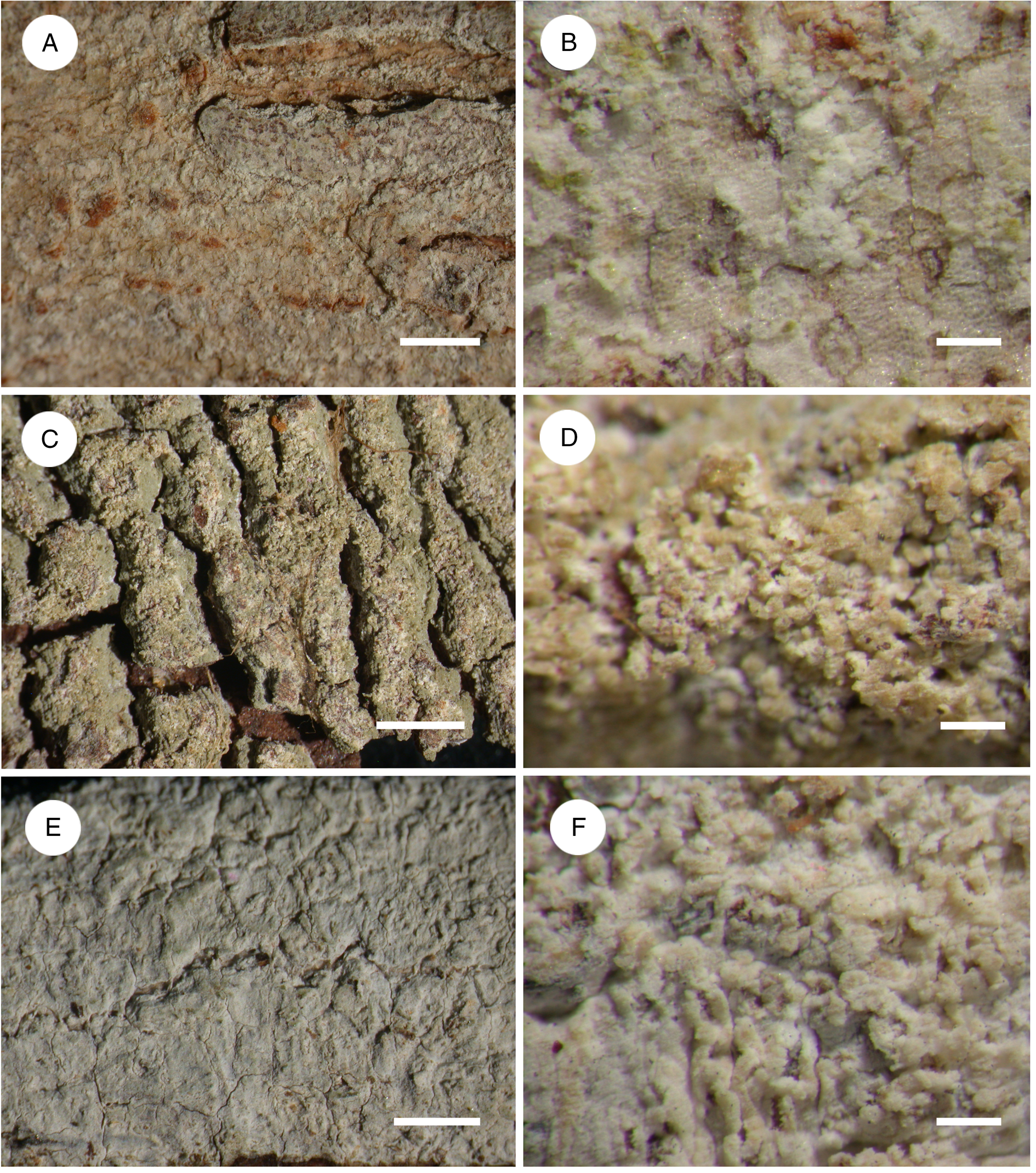
Thallus crustose, continuous, not corticate, dull, creamish, up to 5 cm diam., very thin to immersed, < 0.1 mm thick, not surrounded by a prothallus. Soredia numerous, in small, shallow irregular soralia of 0.2–0.6 mm diam., farinose, whitish. Photobiont trentepohlioid. Medulla IKI−, containing c. 1 μm wide hyphae without crystals.
Ascomata and pycnidia not observed.
Chemistry
Thallus UV−, K−, Pd−, C−. TLC: nil.
Etymology
Named for the farinose soredia.
Ecology and distribution
On tree bark in rainforest; known only from Brazil. All other species described so far in the genus are fertile.
Discussion
This species is well characterized by the farinose soredia. It is not related to the core group of Arthonia, but to Arthonia thoriana Ertz & Sanderson (Ertz et al. Reference Ertz, Sanderson, Łubek and Kukwa2018) and Cryptothecia austrocoreana J. J. Woo et al. (Woo et al. Reference Woo, Kös, Farkas, Park and Hur2017), with which it could be placed in a separate genus.
Crypthonia irregularis Aptroot, L. A. Santos & M. Cáceres sp. nov.
MycoBank No.: MB 849936
Corticolous Crypthonia with irregular isidia and confluentic acid, the combination of which distinguishes it from all known species in the genus.
Type: Brazil, Sergipe, Parque Nacional Serra de Itabaiana, alt. 400 m, 10°44ʹ35ʺS, 37°20ʹ25ʺW, on bark in transitional forest between Atlantic rainforest and Caatinga, 17 September 2013, M. E. S. Cáceres & A. Aptroot s. n. (ISE 18281—holotype; ABL—isotype). GenBank Accession no: OR544575.
Habitus of new species, taken from isotypes if no collection specified. A, Crypthonia irregularis (ISE 28189). B & C, Crypthonia pseudisidiata. D–F, Crypthonia stromatica (E, ISE 40518). Scales: A, B, D & E = 2 mm; C & F = 0.2 mm. In colour online.

Thallus crustose, continuous, smooth, corticate, dull, pale olivaceous green, up to 5 cm diam., < 0.1 mm thick, not surrounded by prothallus. Isidia irregular, globose to flattened and proliferating, upper surface greenish and corticate; non-corticate and cream-coloured below, c. 0.1 mm diam. Photobiont trentepohlioid. Medulla IKI−, containing c. 1 μm wide hyphae which are encrusted with small crystals.
Ascomata and pycnidia not observed.
Chemistry
Thallus UV−, K−, Pd−, C−. TLC: confluentic acid and sometimes 2ʹ-O-methylperlatolic acid.
Etymology
Named for the irregular isidia.
Ecology and distribution
On tree bark in primary rainforest; known only from Brazil.
Discussion
This species is well characterized by the irregular small isidia and the presence of confluentic acid. All other species described so far in the genus (Frisch & Thor Reference Frisch and Thor2010) are fertile.
Additional material examined
Brazil: Amazonas: Manaus, Reserva Florestal Adolpho Ducke, along trails in vicinity of field station, alt. 50 m, 2°56ʹS, 59°57ʹW, on tree bark in primary rainforest, 3–8 vi 2016, M. E. S. Cáceres & A. Aptroot s. n. (ISE 28189; ABL); GenBank no: OR544573. Pará: Dom Eliseu, Vila Nazaré, S Fazenda Pantera, alt. 120 m, 3°53ʹ56ʺS, 48°05ʹ44ʺW, on tree bark in primary rainforest, 29 x 2016, M. E. S. Cáceres & A. Aptroot s. n. (ISE 40251; ABL). GenBank No.: OR544574.
Crypthonia pseudisidiata Aptroot, L. A. Santos & M. Cáceres sp. nov.
MycoBank No.: MB 849937
Corticolous Crypthonia with soft pseudoisidia, differing from all known species in the genus by the presence of pseudoisidia and the absence of lichen substances.
Type: Brazil, Sergipe, Parque Nacional Serra de Itabaiana, alt. 400 m, 10°44ʹ35ʺS, 37°20ʹ25ʺW, on bark in transitional forest between Atlantic rainforest and Caatinga, 19 March 2017, M. E. S. Cáceres & A. Aptroot s. n. (ISE 40507—holotype; ABL—isotype). GenBank Accession no: OR544578.
Thallus crustose, continuous, smooth, pseudocorticate, pure white, up to 6 cm diam., c. 0.1 mm thick, not surrounded by prothallus. Pseudoisidia dispersed or in groups, irregular, not very different from irregular soredia, c. 0.05 mm diam., pure white. Photobiont trentepohlioid. Medulla IKI−, containing c. 1 μm wide hyphae without crystals.
Ascomata and pycnidia not observed.
Chemistry
Thallus UV−, K−, Pd−, C−. TLC: nil.
Etymology
Named for the pseudoisidia.
Ecology and distribution
On tree bark in primary rainforest; known only from Brazil.
Discussion
This species is well characterized by the soft pseudoisidia. All other species described so far in the genus (Frisch & Thor Reference Frisch and Thor2010) are fertile.
Crypthonia stromatica Aptroot, L. A. Santos & M. Cáceres sp. nov.
MycoBank No.: MB 849939
Corticolous Crypthonia with sterile stromata and confluentic acid, which in addition to the absence of isidia or pseudoisidia, distinguishes it from all known species in the genus.
Type: Brazil, Pará, Dom Eliseu, Vila Nazaré, S Fazenda Pantera, alt. 120 m, 3°53ʹ56ʺS, 48°05ʹ44ʺW, on tree bark in primary rainforest, 29 October 2016, M. E. S. Cáceres & A. Aptroot s. n. (ISE 40264—holotype; ABL—isotype). GenBank Accession no: OR544576.
Thallus crustose, more or less continuous, following the surface of the substratum, not corticate, dull, whitish, up to 5 cm diam., < 0.1 mm thick, not surrounded by prothallus. Stromata sterile, white, c. 0. 2 mm diam. Photobiont trentepohlioid. Medulla IKI−, containing c. 1 μm wide hyphae which are encrusted with small crystals.
Ascomata and pycnidia not observed.
Chemistry
Thallus UV−, K−, Pd−, C−. TLC: confluentic acid.
Etymology
Named for the stromata.
Ecology and distribution
On tree bark in primary rainforest; known only from Brazil.
Discussion
This species is well characterized by the stromata and the confluentic acid. All other species described so far in the genus (Frisch & Thor Reference Frisch and Thor2010) are fertile.
Additional material examined
Brazil: Sergipe: Parque Nacional Serra de Itabaiana, alt. 400 m, 10°44ʹ35ʺS, 37°20ʹ25ʺW, on bark in transitional forest between Atlantic rainforest and Caatinga, 19 March 2017, M. E. S. Cáceres & A. Aptroot s. n. (ISE 40518; ABL); GenBank no: OR544577.
Cryptophaea constrictopseudisidiata Aptroot, L. A. Santos & M. Cáceres sp. nov.
MycoBank No.: MB 849940
Corticolous Cryptophaea with pseudoisidia, lichexanthone and confluentic acid, the combination of which distinguishes it from all other known species in the genus.
Type: Brazil, Bahia, Chapada Diamantina, Lençois, Cachoeira do Mosquito, alt. 450 m, 12°23ʹS, 41°22ʹ40ʺW, on tree bark in primary Atlantic rainforest, 22 July 2017, M. E. S. Cáceres & A. Aptroot s. n. (ISE 40575—holotype; ABL—isotype). GenBank Accession no: OR544589.
Habitus of new species, taken from isotypes if no collection specified. A–C, Cryptophaea constrictopseudisidiata (B, ISE 40568). D & E, Cryptophaea lichexanthopseudisidiata. F, Cryptophaea lichexanthosorediata. Scales: A, B & F = 2 mm; C & E = 0.2 mm; D = 1 mm. In colour online.

Thallus crustose, continuous, not corticate, dull, bluish white, up to 5 cm diam., < 0.1 mm thick, surrounded by a brown prothallus line c. 0.4 mm wide. Pseudoisidia numerous, not corticate, single, more or less globose, fluffy, constricted at their base, c. 0.1 mm diam. Photobiont trentepohlioid. Medulla IKI−, containing c. 2 μm wide hyphae which are encrusted with small crystals.
Ascomata and pycnidia not observed.
Chemistry
Thallus UV+ yellow, K−, Pd−, C−. TLC: lichexanthone and confluentic acid.
Etymology
Named for the constricted pseudoisidia.
Ecology and distribution
On tree bark in primary rainforest; known only from Brazil.
Discussion
This species is characterized by the pseudoisidia and the presence of lichexanthone and confluentic acid. All other species described so far in the genus (Van den Broeck & Ertz Reference Van den Broeck and Ertz2016) are fertile. It does not clearly cluster with other species of the same genus and probably merits classification in a separate genus.
Additional material examined
Brazil: same as the type, 40568 (ISE; ABL); GenBank no: OR544588.
Cryptophaea lichexanthopseudisidiata Aptroot, L. A. Santos & M. Cáceres sp. nov.
MycoBank No.: MB 849941
Corticolous Cryptophaea with pseudoisidia and lichexanthone and an absence of confluentic acid, the combination of which distinguishes it from all other species known in the genus.
Type: Brazil, Bahia, Chapada Diamantina, Lençois, Cachoeira do Mosquito, alt. 450 m, 12°23ʹS, 41°22ʹ40ʺW, on tree bark in primary Atlantic rainforest, 22 July 2017, M. E. S. Cáceres & A. Aptroot s. n. (ISE 40776—holotype; ABL—isotype). GenBank Accession no: OR544581.
Thallus crustose, continuous, somewhat verrucose, fluffy, not corticate, dull, whitish, up to 5 cm diam., < 0.1 mm thick, not surrounded by a prothallus. Pseudoisidia numerous, not corticate, single, globose, c. 0.07 mm diam. Photobiont trentepohlioid. Medulla IKI−, containing c. 1 μm wide hyphae which are encrusted with small crystals.
Ascomata and pycnidia not observed.
Chemistry
Thallus UV+ yellow, K−, Pd−, C−. TLC: lichexanthone.
Etymology
Named for the lichexanthone and the pseudoisidia.
Ecology and distribution
On tree bark in primary rainforest; known only from Brazil.
Discussion
This species is well characterized by the pseudoisidia. All other species described so far in the genus (Van den Broeck & Ertz Reference Van den Broeck and Ertz2016) are fertile.
Cryptophaea lichexanthosorediata Aptroot, L. A. Santos & M. Cáceres sp. nov.
MycoBank No.: MB 849942
Corticolous Cryptophaea with soredia, lichexanthone and divaricatic acid, the combination of which distinguishes it from all other known species in the genus.
Type: Brazil, Bahia, Chapada Diamantina, Lençois, Cachoeira do Mosquito, alt. 450 m, 12°23ʹS, 41°22ʹ40ʺW, on tree bark in primary Atlantic rainforest, 22 July 2017, M. E. S. Cáceres & A. Aptroot s. n. (ISE 40777—holotype; ABL—isotype). GenBank Accession no: OR544586.
Habitus of new species, taken from isotypes if no collection specified. A & B, Cryptophaea lichexanthosorediata (A, ISE 40535). C, Cryptothecia lecanorosorediata. D–F, Glomerulophoron confluentisorediatum (E, ISE 27861). Scales: A & D = 2 mm; B, C & F = 0.2 mm; E = 1 mm. In colour online.

Thallus crustose, continuous, not corticate, dull, whitish, up to 5 cm diam., < 0.1 mm thick, not surrounded by a prothallus. Soredia numerous, in irregular soralia, granular, up to c. 0.05 mm diam. Photobiont trentepohlioid. Medulla IKI−, containing c. 1 μm wide hyphae which are encrusted with small crystals.
Ascomata and pycnidia not observed.
Chemistry
Thallus UV+ yellow, K−, Pd−, C−; medulla UV+ white. TLC: lichexanthone and divaricatic acid.
Etymology
Named for the lichexanthone and the soredia.
Ecology and distribution
On tree bark in primary rainforest; known only from Brazil.
Discussion
This species is well characterized by the soredia and the presence of lichexanthone and divaricatic acid. All other species described so far in the genus (Van den Broeck & Ertz Reference Van den Broeck and Ertz2016) are fertile.
Additional material examined
Brazil: same as the type, 40535 (ISE; ABL); GenBank no: OR544580.
Cryptothecia lecanorosorediata Aptroot & M. Cáceres sp. nov.
MycoBank No.: MB 849943
Corticolous Cryptothecia with soredia and lecanoric acid, by which it differs from all other species known in the genus.
Type: Brazil, Sergipe, Parque Nacional Serra de Itabaiana, alt. 400 m, 10°44ʹ35ʺS, 37°20ʹ25ʺW, on bark in transitional forest between Atlantic rainforest and Caatinga, 19 March 2017, M. E. S. Cáceres & A. Aptroot s. n. (ISE 40501—holotype; ABL—isotype). GenBank Accession no: OR544584.
(Fig. 5C)
Thallus crustose, continuous, not corticate, dull, whitish, up to 5 cm diam., c. 0.1 mm thick, not surrounded by a prothallus. Soredia numerous, in irregular soralia, granular, up to c. 0.03 mm diam., whitish. Photobiont trentepohlioid. Medulla IKI−, containing c. 1 μm wide hyphae which are encrusted with small crystals.
Ascomata and pycnidia not observed.
Chemistry
Thallus UV−, K−, Pd−, C+ red. TLC: lecanoric acid.
Etymology
Named for the lecanoric acid and the soredia.
Ecology and distribution
On tree bark in primary rainforest; known only from Brazil.
Discussion
This species is well characterized by its soredia and lecanoric acid. Almost all other species described so far in the genus (Jagadeesh Ram & Sinha Reference Ram TAM and Sinha2016) are fertile; the two exceptions are keyed out above and differ in their chemistry and in one case having pseudoisidia instead of soredia.
Additional material examined
Brazil: same as the type, 40520 (ISE; ABL); GenBank no: OR544583. Amapá: Mazagão, Reserva extrativista Moracá, along BR 156, alt. 30 m, 0°02ʹN, 51°45ʹW, on tree bark in disturbed forest, 21 viii 2015, M. E. S. Cáceres & A. Aptroot (ISE 27583; ABL); GenBank no: OR544582.
Glomerulophoron confluentisorediatum Aptroot, L. A. Santos & M. Cáceres sp. nov.
MycoBank No.: MB 849944
Corticolous Glomerulophoron with soredia, confluentic and 2ʹ-O-methylperlatolic acids, which in addition to the absence of sporodochia, distinguishes it from the only other species known in this genus.
Type: Brazil, Maranhão, Bananal 20 km S of Imperatriz, alt. 150 m, 5°39ʹ27ʺS, 46°23ʹ46ʺW, on Cecropia tree bark in garden, 25 October 2016, M. E. S. Cáceres & A. Aptroot s. n. (ISE 28727—holotype; ABL—isotype). GenBank Accession no: OR544579.
Thallus crustose, continuous, not corticate, dull, whitish, up to 7 cm diam., thin, < 0.1 mm thick, surrounded by a black prothallus line c. 0.2 mm wide. Soredia numerous, partly in small, low irregular soralia but eventually on most of the thallus, farinose, whitish. Photobiont trentepohlioid. Medulla IKI−, containing c. 1 μm wide hyphae which are encrusted with small crystals.
Ascomata and pycnidia not observed.
Chemistry
Thallus UV−, K−, Pd−, C−. TLC: confluentic and 2ʹ-O-methylperlatolic acids.
Etymology
Named for the confluentic acid and the soredia.
Ecology and distribution
On tree bark in open forests; known only from Brazil.
Discussion
This species is well characterized by the soredia and the presence of confluentic and 2ʹ-O-methylperlatolic acids. The other species in the genus (Frisch et al. Reference Frisch, Ohmura, Ertz and Thor2015) has sporodochia. The new species is described in this genus because it seems to be the closest relative.
Additional material examined
Brazil: Santa Catarina: São Francisco do Sul, Parque Estadual do Acaraí, alt. 10 m, 26°20ʹ44ʺS, 48°33ʹ47ʺW, on shrub in coastal Restinga forest, 10 xi 2015, M. E. S. Cáceres & A. Aptroot s. n. (ISE 27861; ABL); GenBank no: OR544585.
Herpothallon psorpseudisidiatum Aptroot, L. A. Santos & M. Cáceres sp. nov.
MycoBank No.: MB 849945
Foliicolous Herpothallon with strongly attached thallus, long pseudoisidia and psoromic acid, the combination of which distinguish it from all other known species in the genus.
Type: Brazil, Sergipe, Parque Nacional Serra de Itabaiana, alt. 400 m, 10°44ʹ35ʺS, 37°20ʹ25ʺW, on living palm fronds in transitional forest between Atlantic rainforest and Caatinga, 19 March 2017, M. E. S. Cáceres & A. Aptroot s. n. (ISE 40528—holotype; ABL—isotype). GenBank Accession no: OR544590.
Habitus of new species, taken from isotypes. A & B, Herpothallon psorpseudisidiatum. C & D, Myriostigma minisorediatum. E & F, Pachnolepia longipseudisidiata. Scales: A & C = 2 mm; B, D & F = 0.2 mm; E = 1 mm. In colour online.

Thallus crustose, byssoid, whitish, up to 5 cm diam., < 0.1 mm thick, not surrounded by a prothallus. Pseudoisidia globose to elongated, c. 0.1 mm diam., whitish. Photobiont trentepohlioid. Medulla IKI−, containing c. 1 μm wide hyphae without crystals.
Ascomata and pycnidia not observed.
Chemistry
Thallus UV−, K−, Pd+ yellow, C−. TLC: psoromic acid.
Etymology
Named for the psoromic acid and the pseudoisidia.
Ecology and distribution
On living palm leaves in primary rainforest and on bark in coastal Restinga forest; known only from Brazil.
Discussion
This species is well characterized by the long pseudoisidia and the presence of psoromic acid. All other species described so far in the genus (see Aptroot et al. Reference Aptroot, Thor, Lücking, Elix and Chaves2009) have a thallus that is easily detached from the substratum.
Additional material examined
Brazil: Santa Catarina: São Francisco do Sul, Parque Estadual do Acaraí, alt. 10 m, 26°20ʹ44ʺS, 48°33ʹ47ʺW, on shrub in coastal Restinga forest, 10 xi 2015, M. E. S. Cáceres & A. Aptroot s. n. (ISE 28000; ABL).
Myriostigma minisorediatum Aptroot, L. A. Santos & M. Cáceres sp. nov.
MycoBank No.: MB 849946
Corticolous Myriostigma with soredia and 2ʹ-O-methylperlatolic acid, which distinguish it from all other known species in the genus.
Type: Brazil, Tocantins, Itaguatins, alt. 150 m, 5°44ʹ48ʺS, 47°33ʹ46ʺW, on tree bark in Cerrado forest, 23 October 2016, M. E. S. Cáceres & A. Aptroot (ISE 28835—holotype; ABL—isotype). GenBank Accession no: OR544587.
Thallus crustose, continuous, smooth, not corticate, whitish, up to 3 cm diam., under 0.1 mm thick, not surrounded by prothallus. Soredia not in soralia, dispersed on the thallus, not numerous, c. 0.02 mm diam., whitish. Photobiont trentepohlioid. Medulla IKI−, containing c. 1 μm wide hyphae without crystals.
Ascomata and pycnidia not observed.
Chemistry
Thallus UV−, K−, Pd−, C−. TLC: 2ʹ-O-methylperlatolic acid.
Etymology
Named for the small soredia.
Ecology and distribution
On tree bark in primary rainforest; known only from Brazil.
Discussion
This species is well characterized by the small soredia and the presence of 2ʹ-O-methylperlatolic acid. All other species described so far in the genus (Jagadeesh Ram & Sinha Reference Ram TAM and Sinha2016) are fertile.
Pachnolepia longipseudisidiata Aptroot, L. A. Santos & M. Cáceres sp. nov.
MycoBank No.: MB 849947
Corticolous Pachnolepia with long pseudoisidia, and a thallus containing lichexanthone, confluentic acid and 2ʹ-O-methylperlatolic acid, differing from the only other species known in the genus by the absence of apothecia, the presence of pseudoisidia and the different chemistry.
Type: Brazil, Bahia, Chapada Diamantina, Lençois, Morro do Pai Inácio, alt. 1100 m, 12°27ʹ24ʺS, 41°28ʹ20ʺW, on tree bark on table mountain, 23 July 2017, M. E. S. Cáceres & A. Aptroot s. n. (ISE 40968—holotype; ABL—isotype). GenBank Accession no: OR544591.
Thallus crustose, continuous, somewhat verrucose, not corticate, dull, whitish, up to 3 cm diam., < 0.1 mm thick, not surrounded by a prothallus. Pseudoisidia numerous, not corticate, in irregular groups, cylindrical to gnarled, not branched, c. 0.1–0.2 mm long, c. 0.05 mm thick. Photobiont trentepohlioid. Medulla IKI−, containing c. 2 μm wide hyphae which are encrusted with small crystals.
Ascomata and pycnidia not observed.
Chemistry
Thallus UV+ yellow, K−, Pd−, C−. TLC: lichexanthone, confluentic acid and 2ʹ-O-methylperlatolic acids.
Etymology
Named for the long pseudoisidia.
Ecology and distribution
On tree bark in mountain forest; known only from Brazil.
Discussion
This species is well characterized by the long pseudoisidia. It is probably only distantly related to the type of the genus, so placement in a new genus in the future is to be expected. The only other species currently accepted in the genus (Frisch et al. Reference Frisch, Thor, Ertz and Grube2014) is fertile.
Acknowledgements
All materials cited were collected under various permits and all holotypes are kept in the Brazilian herbarium ISE. Various colleagues organized the field trips to Amapá, Bahia, Pará, Rondônia and Tocantins. The costs of the collecting expeditions were partly financed by grants from the Conselho Nacional do Pesquisa to MESC (e.g. CNPq-Sisbiota Processo 563342/201-2). This study was financed in part by the Coordenação de Aperfeiçoamento de Pessoal de Nível Superior (CAPES Brasil; Finance Code 001), who provided a visiting professorship to AA. AA warmly thanks the Stichting Hugo de Vries-fonds for various travel funds.
Author ORCIDs
André Aptroot, 0000-0001-7949-2594; M. E. S. Cáceres, 0000-0002-5612-1309.



