It was a warm October night in Beijing, the day after the National Day of the People's Republic of China. The week of 1 October is usually particularly tense in China, with an increased flow of tourists into Beijing and substantial police surveillance networks. On Tuesday, 2 October 2012, a punk show was nonetheless held just a few metres away from Zhongnanhai, the central headquarters of the Chinese Communist Party, at the tiny ‘Old What Bar’ – now closed. Fifty people or so were packed into the punk bar, chain-smoking cigarettes – the most popular cigarette brand among Beijing young punks is also named ‘Zhongnanhai’ – and drinking cans of Yanjing beers bought at the nearest convenience store. The street-punk band Shochu Legion (Shaojiu Juntuan 烧酒军团) was the last to perform that night, and they began their set with what may be considered their most blasphemous song, ‘Kill the Government’ (Sha Zhengfu 杀政府):

Twenty-three years after the Tiananmen protests, which took place a few metres away, and 13 years after the Falun Gong demonstration in the same street (Palmer Reference Palmer2007), what led to the creation of an underground music community that could insult the Chinese state on the day following the National Day of the People's Republic of China? Chinese punk-rock (transcribed as pengke 朋克 in China), understood as a specific music genre ‘which emphasizes directness and repetition at the expense of technical virtuosity’ (Laing Reference Laing2015, p. 22) and a community bounded by a shared sense of style and identity (Hebdige Reference Hebdige1979), first emerged in the mid-1990s, concomitantly in Beijing and Wuhan, two cities separated by 1000 kilometers. Why did punk-rock appear in China at the same time, in two different cities? Few works have analysed the reasons behind the emergence of Chinese punk-rock, and when they have, they have tended to overstate the importance of material culture and the rise of individualism (De Kloet Reference De Kloet2005), the role of a few individuals (O'Dell Reference O'Dell2011) or the frustration of youth (Zuccheri Reference Zuccheri2004), or have even given historically problematic data, stating for instance that ‘the first punk He Yong emerged in Beijing in 1994 and the first two punk bands UnderBaby and Catcher in the Rye emerged at the same time’ (Xiao Reference Xiao2015, p. 63). The history of the Chinese music scene closely follows the evolution of the country with its periods of openness and closure since the 1980s and the emergence of a Chinese local rock scene. Several scholars have analysed the development of the Chinese rock community since the 1980s (Jones Reference Jones1997; Capdeville-Zeng Reference Capdeville-Zeng2002; Baranovitch Reference Baranovitch2003; Wong Reference Wong2005), its relation to contentious politics and the subsequent development of an underground musical scene in China since the 1990s (Steen Reference Steen2000; Grillot Reference Grillot2001; De Kloet Reference De Kloet2010), which encompasses different music genres independent from official and mainstream labels, performing in independent, and sometimes illegal, live-venues. These previous scholarships, as well as works focusing on the emergence of punk-rock in East-Asian countries as in Indonesia (Baulch Reference Baulch2007; Moore Reference Moore2013), can help us better understand how a new musical community takes root in an authoritarian state.
In order to assess the development of a punk subculture at the same time in Beijing and Wuhan, this article suggests first looking at the traditional hypothesis given to explain the birth of punk in other national contexts. Drawing on Becker's work on art worlds (Reference Becker2008), I intend to show how the creation of a punk subculture is comparable with a collective action. While Nick Crossley's (Reference Crossley2015) hypothesis on the birth of punk in London is centred on a social network analysis, this paper shows that a single factor isn't sufficient to explain the birth of Chinese punk simultaneously in Beijing and Wuhan, and that it is necessary to focus on the interactions between the different actors of the punk subculture, and the way they were able to mobilise resources in order to localise this particular subculture. This paper attempts to recount for the first time the formation of the Chinese punk community roughly from 1996 to 2001, using historical data, interviews and ethnographic research that will help introduce the experience of Chinese punk into the larger field of international cultural studies. Testimonies and secondary materials were particularly useful, since some of the actors do not recall precisely some of the events taking place in the 1990s. This article will look at each possible explanation to show what the Chinese case can teach us about the formation of a youth subculture.
Assessing the birth of punk in the literature
Since the beginning of punk music in the mid-1970s, scholars and actors themselves have tried to understand how this particular musical genre flourished all over the Western world at roughly the same time. Traditional explanations have insisted on the style of young punk-rockers and their refusal of the mainstream (Hebdige Reference Hebdige1979), while stressing the working-class background of the participants (Hall and Jefferson Reference Hall and Jefferson2006). Punk was thus considered as a response from working-class youth to alienation and domination in the context of a capitalist Western society. As punk music first burst onto the scene in England in the mid-1970s, some scholars and observers have deduced that it was also a reaction to the political and economic crisis faced by English society at the time and youth frustration towards their future (Dancis Reference Dancis1978). Other, more artistic explanations have highlighted punk's frustration at the state of English popular music and its lack of innovation (Savage Reference Savage2009), while some authors insist on the political dimension of punk music and the influence of French situationists’ ideas (Marcus Reference Marcus2009). Accounts of the birth of English punk-rock regularly insist on the charisma of a few individuals, such as John Lydon from the Sex Pistols, or the influence of entrepreneurial figures such as Malcolm McLaren (Melly Reference Melly2008).
More recent scholarship has shown the aporia of such explanations, stressing their teleological aspects: ‘In any case, punk is a rich and complex phenomenon. If thick observations allow us to identify and reconstruct its logic a posteriori […] nothing today can explain how punk suddenly and instantly spread globally across a world which didn't know the internet and where young people had to use their parents’ phone in the dining room or stick stamps on envelopes to communicate’ (Robène and Serre Reference Robène and Serre2019, pp. 5–6). Ethnographic accounts of the birth of punk music have since stressed the importance of the construction of various localised underground music scenes, and the way participants invade these spaces and mobilise resources. The notion of ‘punk music scene’ here differs from Straw's now classic definition of a music scene, as ‘a cultural space in which a range of musical practices coexist, interacting with each other within a variety of process of differentiation, and according to widely varying trajectories of change and cross-fertilization’ (Straw Reference Straw1991, p. 373). As Alan O'Connor has stated, we should pay attention to the emic definitions of the term ‘scenes’ by punk participants themselves: ‘When punks use the term “scene” they mean the active creation of infrastructure to support punk bands and other forms of creative activity. This means finding places to play, building a supportive audience, developing strategies for living cheaply, shared punk houses, and such like’ (O'Connor Reference O'Connor2002, p. 226). Thus, any analysis of the creation of punk scenes must emphasise the role of infrastructure – rehearsal spaces, venues, labels, places to live – while acknowledging the experiences of the participants and the different meanings they attribute to their actions.
These explanations on the birth of punk are mostly grounded in Western societies, not taking into account punk experimentations in countries of the Global South. Are these theories adapted to other national contexts, with different economic infrastructures and political regimes? How do we consider music scenes in other countries, where participants import and appropriate foreign music genres and techniques? Analysing the Chinese case and drawing parallels with other punk worlds in East Asia can help us better understand the process of localisation of an imported subcultural form.
From rock ’n’ roll to the dakou generation
The creation of a punk subculture in Beijing and Wuhan in the mid-1990s took place during the more complex and rich history of the post-Maoist Chinese cultural scene. After the death of Mao in 1976, economic reforms and relative cultural liberalisation were initiated under the guidance of Deng Xiaoping, and some foreign cultural productions were introduced in China, like cassette tapes, mostly from Hong Kong and Taiwan. Love songs of the Taiwanese singer Teresa Teng (Deng Lijun), illegally imported from Taiwan and Hong Kong, became so popular that a famous saying in the 1970s stated that ‘old Deng [Xiaoping] rules by day, little Teng [Lijun] rules by night’ (Gold Reference Gold1993, p. 909). New locally produced music styles emerged in the 1980s, such as the ‘prison songs’ (qiuge 囚歌) that were prevalent in the North-West part of China and told the stories of ‘sent-down’ youth during the Cultural Revolution (Baranovitch Reference Baranovitch2003). What is known in China as rock ’n’ roll, or yaogun 摇滚 in Chinese, first appeared at the very end of the 1970s, which coincides with the end of the first punk wave in the West, through cover bands performing in international hostels in Beijing since these outlets were less controlled by the Chinese authorities. In 1979, four students from the Institute of Foreign Languages of Beijing formed the first rock band, named Wan Li Ma Wang 万里马王, which covered songs from the Beatles and the Bee Gees, soon followed by another band, Bu Dao Weng 不倒翁 (Xue Reference Xue1993). These bands had access to musical instruments since they often worked in musical danwei (work units) or studied music in universities, and could therefore lend their instruments to other musicians, creating a de facto independent musical community. Chinese rock bands usually performed in universities and during ‘parties’, which were first organised in international hostels in 1984 by the foreign rock cover band Dalu Yuedui 大陆乐队. Li Ji, the singer of Bu Dao Weng, decided in 1988 to organise his own ‘parties’, where all the Chinese rock bands could perform (Xue Reference Xue1993, p. 282). In 1986, the musician Cui Jian published a tape in Hong Kong and Taiwan called The Return of the Vagabond (Langzi gui 浪子归), which consisted mostly of ‘prison songs’ (Zhou Reference Zhou2013). He was also part of the ‘Seven Player Band’ (Qi heban 七合板), a jazz-cover band, which performed once at the Great Hall of the People (Xue Reference Xue1993, p. 290). Yet it was an original Cui Jian song in Chinese that popularised rock ’n’ roll on 9 May 1986, when he performed on national television ‘Nothing to my name’ (Yi wu suo you 一无所有) during the charity concert ‘Let the world be filled with love’ (Rang shijie chongman ai 让世界充满爱), organised at the Beijing Workers Stadium. This song can be interpreted as a love song, the expression of individual feelings or even an allegorical criticism of the authorities. Following Cui Jian, other rock bands were created in the late 1980s, including the first hard rock band Hei Bao 黑豹 in 1987, He Yong and his band Mayday (Wuyue tian 五月天Footnote 2) the same year, and the first metal band Tang Dynasty (Tang Chao 唐朝) in 1988. During the democratic movement of 1989, several rock bands supported the protest, and Cui Jian, He Yong and the Taiwanese rocker Hou Dejian even performed in Tiananmen Square, while the students sang ‘Nothing to my name’ during demonstrations. The commitment of Chinese rock bands to the democratic movement eventually hurt the rock community after the crackdown by the authorities, since ‘this subcultural form had been appropriated by a larger youth culture as a vehicle for both affective empowerment and political protest’ (Jones Reference Jones1997, p. 146). The day 4 June 1989 marked a turning point for Chinese rock music; that was the date when it was banned from being played in public spaces while the cultural sphere was again under strict surveillance. Rock ’n’ roll had no choice but to take refuge in the underground.
After the Tiananmen crackdown, rockers like Cui Jian were banned from performing in Beijing, even if they could perform in other cities in China. Rock ’n’ roll did not disappear in the 1990s, but the bands had to perform in small bars, or again in international hostels during ‘parties’ (Capdeville-Zeng Reference Capdeville-Zeng2002). Li Ji was the first to open a live venue dedicated to Chinese rock in 1992, the Happy Club (Xingfu julebu 幸福俱乐部), but he had to close the club less than a year after its opening, owing to pressure from the municipal authorities. In 1995, Liu Yuan, the trumpet player of Cui Jian's band ADO, opened the CD Café, a bar and live venue where Cui Jian and the other Chinese rockers could perform. According to certain scholars, rock ’n’ roll entered a stage of crisis, replaced by pop music from Hong Kong and Taiwan, supposedly less contentious than rock (Wang Reference Wang2007). Paradoxically, in the early 1990s, the Hong Kong rock band Beyond was more popular and accessible than Cui Jian's music, and was sometimes the first encounter with rock music for some Chinese (Ye Reference Ye2017; Yang Reference Yang2008). Eventually, the policies of reform and opening up in the 1990s led to the development of an alternative music scene through the large-scale sale of Western CDs and tapes in Chinese cities’ black market, which represents for some scholars the main explanation for the renewal of Chinese independent rock of the 1990s.
Despite the fact that the 1990s initiated a setback for Chinese alternative music, it was also an era of cultural openness. The economic reforms introduced Chinese citizens to foreign cultural productions, mainly through piracy. Recently developed spaces like cafes and bars organised small screenings of pirated foreign films (Li Reference Li2012), fostering a cinephile community that would produce a whole new generation of independent filmmakers and film critics. This generation of young Chinese was named the ‘D-Generation’, ‘D’ standing for daoban 盗版, ‘piracy’, digital, but also for dakou 打口, the object that was supposedly responsible for the revival of the Chinese music underground. The term dakou, sometimes translated as ‘saw-gashed’, refers to CDs and tapes that were sent by cargo to China from the West in the mid-1990s to be recycled. They were cut on the edge ‘to prevent them from being sold. However, since a CD player reads CDs from the centre to the margin, only the last part is lost. Dakou CDs enabled musicians and audiences in China to listen to music that was either censored or deemed too marginal by China's music distributors’ (De Kloet Reference De Kloet2005, p. 617). Instead of being recycled, those dakou CDs and tapes were sold on the black market in the main Chinese cities at the very reasonable price of 5–10 yuan each, even if the prices evolved according to historical circumstances (Amar Reference Amar2018). For instance, in 1994, when Kurt Cobain committed suicide, the price of Nirvana dakou tapes rose to 80 yuan (Chen et al. Reference Chen, Liao and Yan2004, p. 166). Dakou tapes are often used in popular culture works, for instance, in her autobiographical novel Chun Shu remembers going to Beijing dakou stores in 1998 to find rock ’n’ roll tapes (Chun Reference Chun2002, p. 17) and Guo Xiaolu uses the theme of ‘pirated foreign CDs’ in her own novel (Guo Reference Guo2014, p. 14).
Dakou CDs and tapes allowed young people to listen to new kinds of music and to thereby expand their musical education. The famous rock critic Hao Fang estimates for instance that a cargo containing 300,000 Madonna albums, which reached the Chinese black market in the 1990s, was sold out in a month all across China.Footnote 3 The black market was swamped by dakou, and one could find any kind of music, from classical music to Céline Dion, Michael Jackson or more obscure indie rock bands. Foreign students also contributed to the emergence of Chinese punk rock in the mid-1990s. David O'Dell, a Texan student in Beijing, recalls that he was the first to introduce Beijing punks to American underground punk bands from Chicago or DC through his cassette tapes (O'Dell Reference O'Dell2011, p. 24). If the influence of foreign students was indeed real, one should not overstate their importance during the 1990s as O'Dell's memoirs tend to suggest. The interviews conducted with Chinese punks and the most recent testimonies published in Chinese on music in the 1990s indicate that pirated tapes from Hong Kong and dakou CDs and tapes were the major influence for the musical education of young Chinese throughout the 1990s, rather than foreign students. Moreover, outside Beijing, there were substantially fewer foreign students. Sadly, most of the studies on the 1990s punk rock movement are centred around China's capital, but many other Chinese cities, such as Wuhan, Changsha, Nanjing and Xi'an, were also witnessing the appearance of underground music bands. As Xubi, the guitarist of the Changsha punk band The Last Choice (Zuizhong xuanze 最终选择), recalls:
I was born in 1984 in Changsha. When I was in high-school, I only listened to Hong Kong Cantopop that my parents played at home. One day, as I was coming home from school, I bought a dakou CD on the street. I didn't know the band, I was only interested in the cover. It was Nine Inch Nails, when I played the CD at home I couldn't believe that this music was possible! I had never heard anything like it. The day after I went to see the dakou seller and asked him if he had other CDs like that; he showed me a box full of Western rock and roll CDs. After hearing all these CDs, I knew I was going to be a rocker. (Interview with Xu Bi, Wuhan, 5 March 2018)
Dakou were important, but they were not the only source of rock music in the 1990s, as the Wuhan punk singer Wu Wei recalls: ‘At first, they were no dakou in Wuhan. We didn't even have Cui Jian's tapes. The first rock band I listened to was [the Hong Kong band] Beyond’ (interview with Wu Wei, Wuhan, 24 March 2013). Dakou in Wuhan were indeed introduced at the end of the 1990s by a Cantonese man named Xiao Song, as remembered by a punk enthusiast involved in the early Wuhan punk scene: ‘In the late 1990s, Xiao Song set up the first dakou stall on the ground in Wuhan, in front of the University of Wuhan, where he sold dakou that he bought from Guangzhou. We went there every day to buy CDs and tapes, now he owns Wuhan's only vinyl shop’ (interview with Zhang Hua, Wuhan, 31 August 2018). Dakou CDs and tapes were not available in every Chinese region, as Rachel Harris points out (Harris Reference Harris2005), bazaars in Xinjiang sold tapes and VCDs illegally imported from Turkey, Kazakhstan or Kirgizstan.
Dakou CDs and tapes introduced a large diversity of musical genres to Chinese youth. Some bands tried to reproduce the style and music of their favourite Western bands. As Zhao Yu, the singer of the Beijing punk band Discord, puts it: ‘At first we listened to a lot of Rancid dakou. We became the “Beijing Rancid”. Then we discovered the Misfits. We thus became the “Beijing Misfits”!’ (interview with Zhao Yu, Beijing, 25 April 2013). Before the popularisation of the internet and the possibility of downloading any kind of music, dakou CDs were the only opportunity for Chinese youth to listen to original and alternative music. However, dakou CDs progressively disappeared from the Chinese black markets in the mid-2000s and were replaced by peer-to-peer music exchange. Dakou became a symbol of the ‘D-Generation’, and an object of nostalgia for many Chinese people. The critic and musician from Lanzhou Yan Jun documented the impact of dakou in several books, contributing to a nostalgic narrative that targets a new generation of Chinese musicians: ‘dakou generation is disappearing. China is changing, youth is getting old, the market is spreading. Wild thoughts, commitment, poetry and even suicidal tendencies have been put away by wealth accumulation’ (Yan Reference Yan2004, p. 174). Some scholars such as Jeroen de Kloet have insisted on the influence of dakou CDs and tapes and the rise of individualism in China to explain the creation of the musical underground in the 1990s. Similar explanations have been given over the years to make sense of the creation of new musical styles in Western countries, like rock ’n’ roll and the introduction of vinyl records in the mid-1950s, which allowed mail order distribution (Peterson Reference Peterson1990). If these theories are attractive, they cannot explain why and how individuals decided to form punk or rock bands, and sometimes overstate the importance of a singular factor. Dakou alone did not create the new underground movement that bloomed in major Chinese cities during the 1990s; it was merely a resource mobilised by Chinese youth.
The evolution of the early Chinese punk network in Beijing and Wuhan
There is still an ongoing debate among Chinese punks about the ‘true’ birthplace of punk in China. Most commentators have indicated that Chinese punk was born in 1996 when the Beijing band UnderBaby (Dixia ying'er 地下婴儿) released their song ‘All the same’ (Dou yiyang 都一样) in the collective album China Fire II published by the Taiwanese record label ‘Magic Stone’, which featured major Chinese rock bands such as Cui Jian, Tang Dynasty and Hei Bao. According to the brothers Gao – Gao Wei and Gao Yang – they formed UnderBaby in 1995, but they started to attend rock parties in Beijing since 1991, before trying to form a rock band in 1993. The emphasis put on the Beijing band UnderBaby is understandable since they embodied the link between the Beijing rock movement and the new punk wave that was appearing in the 1990s. Their music, closer to grunge than punk, was appreciated by both rock veterans, like Cui Jian, and new grunge and rock bands, like Catcher in the Rye (Maitian shouwangzhe 麦田守望者), The Fly (Cangying 苍蝇), Xie Tian Xiao 谢天笑 and Thin Man (Shouren 瘦人). To borrow a term forged by Emma Baulch, which she used to describe the early Balinese punk bands of the mid-1990s, UnderBaby is more aptly defined as ‘alternapunk’, namely a ‘conflation of the alternative, grunge, and punk genres […] imply[ing] that local youths’ enthusiasm for alternative music formed the crucible of a punk subculture that later developed’ (Baulch Reference Baulch2007, pp. 91–2). They shared the same stage, at CD Café or Angel Bar in Beijing, where Cui Jian and Dou Wei (the former singer of Hei Bao) often played. At the same time, this Beijing-centric history of Chinese punk often neglects to study other cities’ punk movements. In opposition to Beijing's hegemony on Chinese counter-culture, the city of Wuhan, capital of the Hubei province, also claims to be the birthplace of Chinese punk. The Wuhanese band SMZB (Shengming zhi bing 生命之饼, which literally translates to ‘The bread of life’) was also formed in 1996 by the singer Wu Wei and is said to be the oldest punk band in China. SMZB played its first public concert in Wuhan in December 1996, and contrary to UnderBaby, the sound of early SMZB's songs is very much inspired by Western street punk. This rivalry between Beijing and Wuhan is also political: while Beijing bands are said to be more interested in style than politics, and their members come from wealthier backgrounds, Wuhan bands are openly subversive and generally formed by the lower class. Beijing nonetheless had the advantage of founding the first university dedicated to contemporary music, the Midi School of Music, created in 1993, which fostered a new generation of rock and punk musicians, including Wu Wei.
The work of Nick Crossley (Reference Crossley2015) on the birth of punk music in London in the mid-1970s has put forward innovative ways to assess the creation of a punk music scene. Drawing from Howard Becker's concept of ‘art worlds’ (Reference Becker2008), Crossley suggests that punk can be considered a ‘music world’, which needs networks, places and resources to exist. More importantly for Crossley (Reference Crossley2015, p. 96), ‘music worlds are a form of collective action and they arise through a process of mobilization and collective effervescence’. Forming a punk band is thus a collective action, in Becker's sense: ‘All artistic work, like all human activity, involves the joint activity of a number, often a large number, of people. Through their cooperation, the art work we eventually see or hear comes to be and continues to be. The work always shows signs of that cooperation. The forms of cooperation may be ephemeral, but often become more or less routine, producing patterns of collective activity we can call an art world’ (Becker Reference Becker2008, p. 1).
Considering music worlds as collective actions allows us to dismiss previous theories about the birth of punk, as it cannot be explained by a single factor. In his seminal work on political crisis, Michel Dobry (Reference Dobry2009) warns against three explanatory illusions when studying collective actions: the ‘etiologic illusion’, the ‘natural history’ illusion and the ‘heroic illusion’. According to Dobry, the ‘etiologic illusion’ leads scholars to seek external economic or political causes, like ‘frustration’, in order to explain social mobilisation. The ‘natural history illusion’ states that there is a regularity in history that has to be found in order to explain every political crisis. Finally, the ‘heroic illusion’ promotes an explanation based on the choices and decisions made by an individual or a group. As we saw earlier, the traditional explanations for the birth of punk fall into these categories, by stressing the importance of the economic infrastructure, the frustration of youth or the influence of a few charismatic individuals. If we follow the approach of collective action, we must not only analyse the critical mass of participants and the social networks connecting the early punk enthusiasts, but also consider – as Becker (Reference Becker2008) and Crossley (Reference Crossley, Edwards, Grossi and Schor2019) both suggest – the interlacing of different elements like the creation of a collective identity, conventions, resources and spaces, as equally essential for the creation of a music world.
The main factor for the creation of a punk music world according to Crossley is the existence of a dense network of actors. Drawing from the sociology of social networks, Crossley identifies several features that makes a punk network particularly effective: the existence of a ‘critical mass’ of people interested in the same music, the density of the network and the interdependence of the actors which makes the cooperation more probable. Moreover, Crossley argues that a collective action is more likely to take place in a large city. Beijing and Wuhan are not the only big cities in China; other cities could have laid the foundation for the emergence of punk rock in China, like Shanghai or Guangzhou. We could perhaps explain the importance of Beijing since, like London, Beijing ‘is a culturally privileged area; a site of cultural dominance’ (Crossley Reference Crossley2015, p. 100), a place where Chinese ‘rock ’n’ roll’ was first born in the 1980s and which had a tradition of underground live music. It is less obvious in the case of Wuhan, which didn't have, as Beijing, this rock ’n’ roll tradition. It is dubious that a sole analysis of the Wuhan early punk social network can explain why punk music took root in Hubei's capital. Regardless, there was a network of sufficiently many people who were interested in punk music both in Beijing and Wuhan, contrary to other cities where punk fans were isolated.
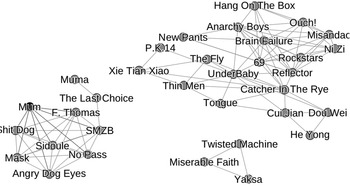
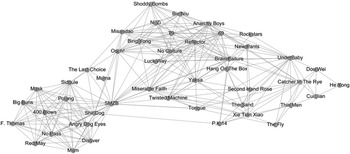
Each node in the network below thus represents one band, and a relation between the nodes exists if the bands played a concert together, or if they shared members. These networks were designed using punk promotional materials of the 1990s, memoirs and interviews with the bands. A graphic representation using the social network analysis allows us to better visualise the mutual dependence of various actors of the punk scene and the way resources are shared between the actors, since ‘their social relations can hold part of these resources or represent means of access to these same resources held by others. They constitute a portion of the “relational capital” of these individuals and the “social capital” of the collectives’ (Lazega Reference Lazega2014, p. 7).
Figure 1 shows the Chinese punk network in 1997, clearly separated by two main poles, Beijing (right) and Wuhan (left). Bands from other cities came to Beijing in order to play concerts, including P.K.14 (from Nanjing), Xie Tian Xiao (from Shandong) and Tongue (Shetou 舌头, from Xinjiang). The networks in Wuhan and Beijing are very dense since many of these bands shared members. For instance, there was a shortage of drummers in Wuhan in the 1990s, and Zhu Ning, SMZB's original drummer, had to play for five bands, sometimes playing five times on the same night. Musicians played in different bands in Beijing too, mostly in the Wuliao Jundui 无聊军队 (the ‘Boredom Contingent’, the first Beijing punk collective) network. The originality of the Beijing network is due to the role of the ‘alternapunk’ band UnderBaby, which was well placed in the network. UnderBaby was positioned among the new punk scene, represented by the Wuliao Jundui (the four bands Brain Failure 脑浊, Anarchy Boys 无政府主义男孩, 69 and Reflector 反光镜) network, the old rock ’n’ roll scene (Cui Jian, and Dou Wei) and the emergent garage and indie rock scene of the 1990s (Catcher in the Rye, the Fly, Tongue and Xie Tian Xiao). Indeed, UnderBaby and the Wuliao Jundui have the highest number of ties in the network (degree) at 11. Thus, UnderBaby and the Wuliao Jundui are the most central nodes in this first figure. More importantly, the most interesting property of the network is the ‘betweenness centrality’ of a band, which measures the number of times a node lies on the shortest path through other nodes; in other words, betweenness centrality indicates which band assumes the role of the ‘broker’ (a bridge between different bands). Here, UnderBaby has the highest value for betweenness centrality in the Beijing network, at 48, while SMZB has the highest betweenness centrality in the Wuhan network, at 14 (see Table 1).
Chinese punk network in 1997.

The degree and betweenness centrality of the top bands in 1997

The network features are consistent with the role of UnderBaby: UnderBaby provided the first rehearsal place for the Beijing punk community and was the first punk band to play alongside Beijing rockers at CD Café, and was also the first to appear in a compilation of Chinese rock bands (China Fire II). At the same time, however, the Wuliao Jundui was also developing its own network with the establishment of the Scream Club, where a new generation of punk rockers was playing and developing ties with emergent skinhead and ska-punk bands (including Misandao 蜜三刀, Ni Zi 逆子 and Ouch! 哎吆).
A major shift in centrality appeared in 2000 (Figure 2), when Wu Wei and Zhu Ning from SMZB came back to Wuhan after spending some time in Beijing, at the Midi School of Music, where they developed ties with Midi-based rock bands, such as Yaksa (Yecha 夜叉), Miserable Faith (Tongku de Xinyang 痛苦的信仰) and Twisted Machine (Niuqu de jiqi 扭曲的机器).Footnote 4 The multiplicity of bands in both Wuhan and Beijing created new network centres. In 2000, the Wuliao Jundui became the centre of the Beijing punk network, while SMZB played a brokerage role, creating connections with Beijing punk communities and the Changsha music scene (including bands like The Last Choice and Muma). Ideas, contacts, information and innovation were travelling across the network more rapidly. SMZB had the highest degree, at 27, and the highest betweenness centrality, at 340, followed by Wuliao Jundui and UnderBaby (see Table 2). UnderBaby was still an important node in the punk network, and its betweenness centrality was still higher than that of Wuliao Jundui because of its ties with the rock ’n’ roll community, but the centre of the network gradually shifted towards the Wuliao Jundui and SMZB.
Chinese punk network in 2000.

The degree and betweenness centrality of the top bands in 2000

As Crossley demonstrated, the density of the network, and the role of brokerage within it, are essential components for the creation of a music world. The density of the networks in Beijing and Wuhan allowed bands to exchange information, members, performance opportunities and even instruments more easily. SMZB in Wuhan and UnderBaby in Beijing were essential in creating opportunities for the bands to perform; as Crossley puts it, they ‘reduced the costs for subsequent bands, for example, by doing the work of persuading landlords and audiences that live rock music in pubs was a good idea. They created a resource (venues and audiences) which other bands could share’ (Reference Crossley2015, p. 83). In the Russian indi music context, Marco Biasioli (Reference Biasioli2020) has put into practice Crossley's analytical framework and found out that the Muscovite indi network was also very dense, thus allowing the emergence of a new music world. While Crossley's model helps us visualise a music world as a network where actors must cooperate to mobilise resources, it fails to explain, concretely, how a music scene is invested in by different kinds of participants, and how these spaces of socialisation are created. Biasioli has to rely on other external factors to explain the territorialisation of indi music in Russia: ‘In this operation, the young Muscovites were aided by political, public and private actors. These contributed in creating new resources and urban spaces designed on a Western blueprint that the community utilised as hubs for cultural production and network creation’ (Biasioli Reference Biasioli2020, p. 309). If Crossley's work helps us understand how a critical mass is attained, we need ethnographic work, interviews and archives to explain how punk musicians and enthusiasts interacted with each other, mobilised resources and occupied spaces.
A tale of two cities: grounding punk in Beijing and Wuhan
On 14 February 1997, the recently opened Nian Hua bar (年华, also known as the ‘Here and Now’) hosted a show for Valentine's day in Beijing, featuring the first all-female rock band of the 1980s, Cobra (Yanjing she 眼镜蛇), the grunge band Catcher in the Rye and the hardcore punk band 69, with the presence in the audience of the rocker Dou Wei and the famous pop-star Wang Fei (Faye Wong).Footnote 5 On another night in 1997 you could also see a jam session with Dou Wei playing the guitar and Gao Yang, from the alternapunk band UnderBaby, playing the drums.Footnote 6 How did Beijing punk bands succeed in finding venues in a short period of time, and how come different generations of Chinese musicians, from 1980s rockers and pop-stars to 1990s grunge and punk-rockers, shared a stage together? As a collective action, punk has to occupy spaces, to rehearse, to perform and to socialise with like-minded individuals. As pointed out by Becker (Reference Becker, Bennett and Peterson2004), an artistic network needs a physical space to develop:
A physical place that has been socially defined: defined by its expected uses, by shared expectations about what kinds of people will be there to take part in those activities, and by the financial arrangements that underlie all of this. And defined further by a larger social context that both provides opportunities and sets limits to what can happen. A place, so defined, can be as large as a city […] or as small as a night club or concert hall. (p. 20)
In her analysis of the Balinese underground scene of the mid-1990s, Emma Baulch highlights the role of space in the localisation process of the punk subculture in Indonesia. Balinese alternapunks hung out in malls, since they were barred from performing in pubs, and domestic spaces, before having ‘access to and control over local territories and, in turn, control over other resources of cultural productions’ (Baulch Reference Baulch2007, p. 178). In the Beijing case, the early punk bands hung out in the brothers’ Gao house, who formed UnderBaby in 1995. The Gao brothers transformed a room adjacent to their parents’ Beijing duck restaurant at Baihua'r hutong into a rehearsal room, which soon became the rehearsal space of the earliest Beijing punk bands:
The furniture was sparse. A wobbly metal shelf next to the door held some cassette tapes and a dusty umbrella. Next to the cot, an old couch sat with rips all over it, some by age, some on purpose. The walls were the typical Beijing chalky whitewash on grey concrete randomly decorated with magazine posters of rock and roll centerfolds and Chinese graffiti. The second room was split by a curtain of plastic strings for a door. I poked my head in to see a generic beat-up drum set and a large homemade amp with a blown woofer. There were two microphone stands ready at attention and a collection of patch cables slithering along the concrete floor. The room had a spare twin-size mattress leaning up against a sink that had been installed as an afterthought. The mattress took up half of the wall space in room. It gave me a new perspective on how incredibly small this room was to be a rehearsal space for one person, much less a three-piece band. (O'Dell Reference O'Dell2011, p. 22)
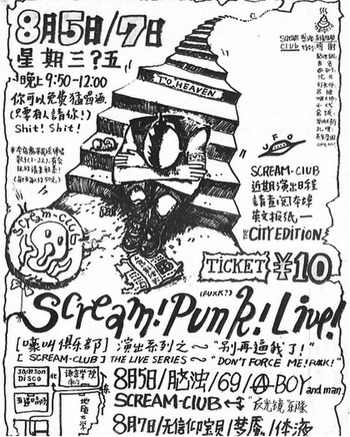
The Gao brothers’ tiny rehearsal room was the centre of Beijing punk during the mid-1990s, and many punk fans hung out around Baihua'r hutong, eventually becoming musicians themselves. A new generation of Beijing punk bands grew in the shadow of UnderBaby and Catcher in the Rye, eventually embodying Beijing's new punk movement. The access to performing spaces is also linked to UnderBaby and their connection to the rock community of the 1980s. UnderBaby started by performing during rock parties of the early 1990s, at CD Café for instance, alongside Cui Jian, Dou Wei and He Yong. The inclusion of UnderBaby's first song, ‘All the same’, in the China Fire II compilation, further indicates their close relation to the Chinese rock scene. As the social network of early Beijing punk bands in 1997 was centred around UnderBaby, they were able to share their performance opportunities with the nascent punk scene, which hung out in their rehearsal space at Baihua'r hutong. Newly formed Beijing punk bands, such as Brain Failure, Anarchy Boys, 69 and Reflector, started by performing at CD Café, Angel's Bar and Nian Hua Bar, which were all rock ’n’ roll strongholds, but welcomed new grunge, punk and metal bands. Yet a space exclusively dedicated to punk music was needed for the punk community to develop, and also to diffuse the tension between the different musical genres, as Ao Tian, a participant of the 1990s Beijing punk scene, recalls: ‘before the creation of a punk bar, punk bands didn't have a lot of venues to perform. They had to share the stage with metal bands, which frequently descended into fights. Every week, punks and metalheads used to fight each other’ (interview with Ao Tian, Beijing, 25 January 2013). The four newly formed punk bands mentioned earlier were at the heart of a bar opened in late 1997 and closed in 1999 called the Scream Club (Haojiao julebu 嚎叫俱乐部: see Figure 3), which was managed by Lü Bo, an artist from Shandong. Located in the university district of Wudaokou, the Scream Club was situated near the late Angel's Bar. Bars that provided punks a stage to play in Beijing were often closed after a while owing to police raids and the inability to obtain a performance licence (see also Amar Reference Amar2020).Footnote 7 As in any other authoritarian state, control over space for underground music communities was difficult to achieve. According to David O'Dell, police raids and administrative pressure slowly decreased at the end of the 1990s thanks to the interest of foreign press and payment of bribes to the local authorities. The Scream Club served as a safe space and the headquarters of these four punk bands, which constituted the Wuliao Jundui (‘Boredom Contingent’), a name that represented the Chinese late 1990s zeitgeist, and given to the four bands by Tina, an Italian exchange student and the singer of the band ‘Rock Star’.Footnote 8 The manager of the Scream Club eventually created his own music label in 1999 called Scream Records, which published punk and alternative music albums under the supervision of Wang Di, a rocker and musician of the first Chinese rock band Bu Dao Weng. In 1999, Scream Records released the first album of Wuliao Jundui, a double CD with the four punk bands, and a live record of their 1998 Christmas performance at the Scream Club.
Poster of a concert by the Wuliao jundui at Scream Club (May 1999).

Wuliao Jundui's double CD had an enormous impact on Chinese punk and remains a reference for young Chinese bands. Reflector's song ‘Scream’ (Haojiao 嚎叫), included in the Wuliao Jundui double CD, highlights the importance of this bar for the Beijing punk community:

The territorialisation of Beijing punk was made possible by the creation of specific venues focused on punk music and the mobilisation of resources shared by punk bands and punk enthusiasts. The relative indifference of the authorities was also allowed by the social background of Beijing punk enthusiasts. While the Beijing scene was fairly diverse, several punk musicians and enthusiasts came from military families, such as musicians from Reflector, 69 or Joyside, and participants such as the writer Chun Shu. As a participant of the scene in the 1990s, herself a daughter of a military official, noted: ‘Kids from military families had less pressure than the others. They were also introduced to foreign culture earlier, the militaries could see foreign movies that were otherwise censored’ (interview with Mela, Beijing, 19 June 2015). This is not specific to Chinese punk and, for instance, in another context, the birth of rock music in Taiwan was supported by children of the KMT (Kuomintang, Chinese nationalist party, who flew to Taiwan after its defeat in 1949) military personnel, who were protected from arbitrary incarcerations (Hsiung Reference Hsiung2020).
On the contrary, the early Wuhan punk community was considered as more working class than the Beijing punk scene. Many Wuhan punks’ parents were factory workers, participants were often estranged from their families after dropping out of high school, and some of them (such as several musicians from 400 Blows) came from Hubei rural areas. As one participant remembers, ‘the Wuhan scene was poor. We had no money, no education, even our equipment was poor. But we had an incredible energy’ (interview with Zhang Hai, 20 May 2013). Moreover, early Wuhan punks were not familiar with the Chinese rock ’n’ roll tradition. One anecdote told by Wu Wei, the lead singer of SMZB, is very indicative:
I was in Beijing, touring with SMZB for our first demo. At a punk show, a friend showed me a man. He said: ‘It's Cui Jian! The godfather of Chinese rock, you have to talk to him!’ I didn't know who Cui Jian was, but I went to him, and gave him our demo album. He called me the next day, he wanted to meet me, so I found his albums and I listened to it. When I saw him, I told him: ‘I have to confess, I didn't know who you were. I just listened to your tapes, and it's very good!’ Cui Jian looked surprised, and left. It was my first and last interaction with him. (Interview with Wu Wei, Changsha, 22 December 2012).
How did a punk scene emerge in a city with no rock ’n’ roll tradition, where punk enthusiasts shouldn't have beeen able to mobilise enough resources to perform? As Wu Wei remembers, the beginnings of Wuhan punk were chaotic:
In the 1990s, we had no choice but to go to KTV [karaoke parlours]. We discussed with the KTV boss, he let us organize the concert. The boss thought he would sell alcohol to the audience, but everybody was bringing their own beer, we were too poor to order drinks. The music was too loud and he didn't make any money, so he would tell us not to come again! (Interview with Wu Wei, Tianjin, 12 December 2012)
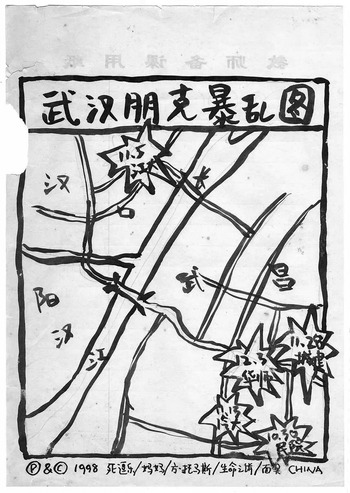
Wuhan punks didn't have dedicated spaces to perform, they had to turn to KTVs, which were considered as spaces outside the scope of the government, and where illicit activities were usually practised (Fung Reference Fung2009). Punks had a strong connection with the ‘secret societies’ (hei shehui 黑社会, see Boretz Reference Boretz2010) which control the Wuhan nightlife. Early punk figures were indeed part of this underworld, and used their connections to secure spaces for punks to rehearse and perform, as one participant recalls: ‘of course, some punks are really well known in the underworld! We call this one “laoda” [老大, big brother], all the bosses know and respect him. One day, someone from the punk circle got his wallet stolen, the laoda called the boss of the neighbourhood, and we got the wallet back!’ (interview with Z., Wuhan, 6 January 2015). Wuhan punks also performed in the many universities located in the district of Wuchang (see Figure 4), since they possessed a stage and equipment and many audience members were studying at universities. One student remembers: ‘we organized a show for SMZB in our university. SMZB began to play, but after one song the principal came to pull the plug. It was too loud and “obscene” for the university’ (interview with D., Wuhan, 25 May 2013).
Punk concert poster in Wuhan (1998).

The connection to the underworld thus allowed Wuhan punks to mobilise resources that were otherwise beyond reach, such as musical instruments. Some instruments were too expensive for the Wuhan punks, but there are other ways to acquire an instrument, as Becker pointed out: ‘artists without money can steal; successful artists often admit, or brag, that they stole in their less successful days’ (Becker Reference Becker2008, p. 75). This was the case in the early days of Wuhan punk – an anecdote also featured in Wang Shuibo's 2015 documentary, Never Release My Fist:
Wu Wei wanted a guitar really badly. Every day he went to a music store to try it, with a screwdriver in his pocket. After a week, he managed to dismantle the guitar and left the store, the guitar hidden in his coat. (Interview with Z., Wuhan, 21 March 2013)
Wuhan punks couldn't only rely on these connections, they had to create new spaces for the punk community to perform and hang out. Kang Mao, the singer of the all-female punk band No Pass (and later leader of the band SUBS after her relocation to Beijing), opened with two friends the bar ‘Boy Toys’, where punks regularly played. Zhu Ning, the first drummer of SMZB, also opened a venue in Wuhan that lasted six months, which was a fruitful experience. After coming back from a tour in Europe, Zhu Ning opened the VOX in 2005, Wuhan's most well-known live venue, still open today. If Wuhan punk is now territorialised, the link to secret societies still defines their relationship to space and the authorities. As one participant told me, ‘we are afraid of the police, and the police are afraid of us’ (interview, Wuhan, 14 June 2014), to explain why police raids were infrequent in their neighbourhood. The protection brought by the secret societies is better explained by an observation when I was conducting my research:
I was drinking a beer in a bar managed by punks in Wuhan. As it was in May, the weather started to be nicer, so I sat on the patio, next to four bare-chested men in their fifties – which was incongruous since the majority of the customers were in their twenties. We started a conversation, which revolved around the figure of Mao and the presence of foreigners in Wuhan, before singing altogether ‘The Moon Represents My Heart’ (Yueliang daibiao wo de xin 月亮代表我的心) by Teresa Teng. The manager of the bar came directly to their table and offered them bottles of beer and whisky ‘on the house’. After they left, the manager informed me that they were members of the neighbourhood's ‘secret society’, one of them was even a retired police officer. Since they have a good relationship, the bar provides them with free drinks, and in return the punks don't have to pay the mandatory ‘protection fee’ imposed on the other bars of the neighbourhood. (Observation, Wuhan, 24 May 2013)
In the mid-1990s, punks in Beijing and Wuhan succeeded in controlling performance spaces and punk hangouts, allowing the punk scene to develop in these two cities. As we saw, the ways these two communities gained control over spaces were very different, Beijing punks mobilising resources created by the rock community of the capital, while Wuhan punks had to negotiate their spaces in the underworld. Space is nonetheless only one – essential – component of music world making. With control over space, punks can foster a community, create new identities and cooperate.
Creating a collective punk identity in China
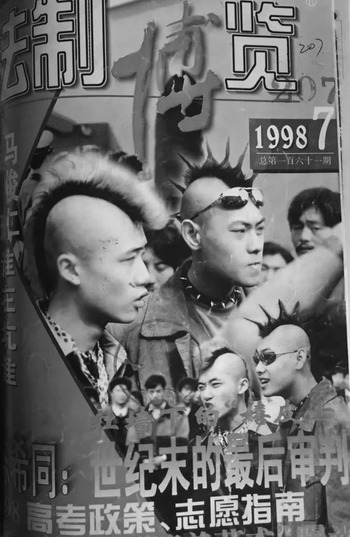
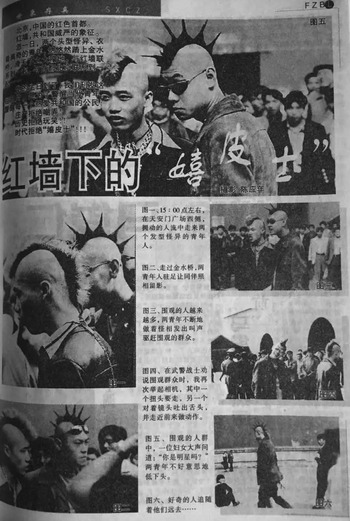
With control over space, punks had control over their own identities and the conventions that bind them together. As Emma Baulch points out in the Balinese case, ‘participants’ control over performance space and the existence of distinct punk hangouts served as mutually reinforcing facets around which solidarity cohered. This solidarity was expressed in public through distinct dance and dress styles’ (Reference Baulch2007, p. 153). Identities, solidarity and underground institutions were created in the spaces controlled by the punks. Style – an essential component of punk identity – was discussed and adopted during punk performances. The provocative dress of the Beijing punks and their colourful mohawks caught the attention of the public. In 1998 the official newspaper Legality Vision (Fazhi Bolan 法制博览) published on its frontpage photos of two musicians of the early Beijing punk band Anarchy Boys walking in front of Tiananmen (see Figures 5 and 6). In the article, the newspaper warns its readers against these ‘ridiculous hippies’:
Hippies in Tiananmen!
Beijing, the red capital of China.
One day, two young people with weird hairdos and wearing strange clothes, are calmly taking a walk on the bridge in front of Tiananmen. They are the most ridiculous people on earth.
It's time for the Communist Party anniversary, we are publishing this photo in order to warn young people, to warn all the citizens who sincerely love the People's Republic of China:
Dignity rejects these provocations!
History rejects this childishness!!
This era rejects these hippies!!!
The hippy style was, at the time, well known by the Chinese authorities and unequivocally rejected as a degenerate product of Western modernity. In their song ‘Mistake’ (Cuowu 错误) released in 1999, Anarchy Boys made fun of this article and people who mistakenly take Chinese punks for hippies:

Cover of Legality Vision (Fazhi Bolan), 1998, no. 7.

Article on Anarchy Boys in Legality Vision (Fazhi Bolan), 1998, no. 7.

During concerts, the symbols of punk identity were discussed and practised. For instance, during a concert in Changsha, Lao Ma, the bassist of SMZB, directly spoke to the audience while performing, telling them to stop making the sign of the horns (associated with the metal scene): ‘Stop doing that! It's not punk. You have to do that [he raises his fist]’ (observation, Changsha, 22 December 2012).
New infrastructures associated with the underground music scene were created in the wake of the emergence of punk-rock in China. As mentioned earlier, the Scream Club became Scream Records, and produced the first albums of the Beijing punk scene. In Wuhan, the VOX and later the Wuhan Prison, a bar associated with the punk community, also produced the albums of the local punk scene. Fanzines – non-professional publications produced by music enthusiasts – were also essential to the circulation of punk ideas, concerts and opportunities. The short-lived Wuhan fanzine Chaos Wuhan gave its readership news from foreign and local bands, and allowed the Wuhan punk community to connect with the wider international punk and anarchist movements. Many other rock and punk fanzines were created at the end of the 1990s, most of them in cities outside Beijing and Wuhan, connecting the many isolated underground music communities. The musician and music critic Yan Jun published in 1998 in Lanzhou his fanzine Sub Jam, introducing underground bands from Chinese provincial cities. Between 1998 and 1999 he also published several issues of Punk Generation (Pengke shidai 朋克时代) in Guangzhou, helped by the official magazine Music Heaven (Yinyue tiantang 音乐天堂), edited by the rock critic Yang Bo. In 1999, a new fanzine entitled So Rock! (Wo ai yaogunyue 我爱摇滚乐) started in the city of Shijiazhuang, eventually becoming a monthly magazine distributed all over China, accompanied by a cassette tape (and later a CD), each featuring 10 songs or so of Chinese rock, punk or metal bands, participating in the apparition of a public space based on the exchange of ideas about punk-rock music. As Gao Hu, the singer of Miserable Faith, recalls: ‘a long time ago, there was this magazine called Freedom Music [Ziyou yinyue 自由音乐], when we were living in Shucun [a neighbourhood in Beijing where punk-rock bands and independent artists lived in the 1990s] with Tongue, Wood Pushing Melon [Mu tui gua 木推瓜], Ruins [Feixu 废墟] and Glorious Pharmacy [Meihao yaodian 美好药店], we always hung out to discuss the magazine issue. It was really like a cultural salon [wenhua shalong 文化沙龙]’ (Zhang and Chen Reference Zhang and Chen2018, p. 68). These publications, independent labels, bars and hang out spaces provided the necessary tools to foster fruitful interactions between punk-rock enthusiasts, allowing them to discuss the meaning of punk, its style and symbols, the ideology behind one's inscription into this particular subcultural genre, in order to re-territorialise this imported music world into the Chinese context. As Emma Baulch rightly noted in the Balinese case, ‘although foreign/local dialectics were increasingly conflated […] it is nonetheless possible to qualify instances of the localization of reggae, death metal, and punk by considering participants’ access to and control over local territories and, in turn, their control over other resources of cultural production. In all of the scenes we have examined, localization was achieved by drawing global texts into territories over which they had control’ (Reference Baulch2007, p. 178).
This process of territorialisation described in the Chinese punk scene can also be found in other spaces and time. The way Chinese punks have locally absorbed social and musical practices from afar while creating their own punk scene can be compared with underground hip-hop practices in Hong Kong, as studied by Eric Kit-wai Ma. Ma uses the term ‘translocal spatiality’ to describe the Hong Kong hip-hop music scene – which ‘refers to the dynamic between localised lifeworlds in faraway sites’ (Ma Reference Ma2002, p. 133). According to Ma, local Hong Kong youth tapped into translocal symbols – CDs, posters and styles from foreign bands – to make sense of their local situation and to ‘negotiate a life project different from those offered by mainstream discursive institutions such as schools and the media’ (p. 138). These translocal spaces are also connected to a wide range of other sites – tattoo parlours, bars, live venues, rehearsal rooms – which constitute the local music scene as defined by O'Connor, ‘something that takes work to create. It requires local bands that need places to live, practice spaces and venues to play […] A scene also needs infrastructure such as record stores, recording studios, independent labels, fanzine’ (O'Connor Reference O'Connor2002, p. 233). As we have seen throughout this article, Chinese punks, both in Beijing and Wuhan, were able against all odds to create their own punk scene, appropriating references from abroad and establishing a local underground infrastructure comprising live venues, bars, rehearsal rooms, labels, fanzines and tattoo shops.
Conclusion
If a Chinese punk music world emerged in the mid-1990s, the analysis of its development both in Beijing and Wuhan has shown that an apparently similar subculture can surface in very different social and cultural contexts. While the punk scenes in Beijing and Wuhan were faced with similar constraints owing to the nature of the Chinese political regime, the conditions of their emergence were quite different. While a large portion of Beijing punks came from middle-class backgrounds, Wuhan punks pride themselves on their working-class condition. Beijing punks could mobilise resources created by the rock community of the 1980s, and were helped by artistic entrepreneurs who opened bars and labels dedicated to the punk subculture. As for the Wuhan punk community, their connection to the nightlife underworld allowed them to mobilise resources that were otherwise inaccessible. The Chinese case shows that explanations concerning the birth of punk cannot be centred only on social and economic conditions or individual charisma. While Crossley's work is essential in finding how a critical mass of people interested in punk music is achieved, it does not account for the way people interact with each other and mobilise resources. If punk music is a collective action, it needs spaces, cooperation and identity building in order to bloom. In Beijing and Wuhan, punks succeeded in controlling spaces, where they could discuss the meaning of foreign punk symbols and their adaptation to their local situation.
Acknowledgements
I would like to express my gratitude to the two anonymous reviewers, for an inspiring and fruitful scientific conversation. I am also thankful to Sebastian Veg and Judith Audin for their comments on earlier drafts, as well as Sandra and Dino for their proofreading.