Introduction
The term ‘patient journey’ refers to the experiences and processes a patient undergoes during the course of their disease and its treatment. In previous studies, we explored the patient journey of adults with gradual-onset acquired hearing impairment.Reference Manchaiah, Stephens and Meredith1, Reference Manchaiah and Stephens2
Sudden-onset hearing loss is a relatively uncommon condition and it is usually unilateral. The incidence has been estimated to range from five to 20 per 100 000 people per year.Reference Byl3 The severity of hearing loss can range from mild to total deafness. It is often associated with tinnitus, vertigo and aural fullness.Reference Mentel, Kaftan, Wegner, Reimann and Gurtler4–Reference Nosrati-Zarenoe, Arlinger and Hultcrantz6 Various aetiologies have been identified for this condition, the most common being viral infection and vascular disease. However, the diagnosis for the majority of patients remains ‘idiopathic’.Reference Chau, Lin, Atashband, Irvine and Westerberg7
There is spontaneous recovery in a significant proportion of individuals, with great variation in the reported degree of recovery (50 to 68 per cent for all types of sudden-onset hearing loss).Reference Mattox and Simmons8, Reference Heiden, Porzsolt, Biesinger and Hoing9 To date, there is no standard or universally agreed treatment for this condition. However, in general it is agreed that approximately one-third of patients show complete recovery, approximately one-third show partial recovery and approximately one-third show persistent hearing loss.Reference Carlsson, Hall, Lind and Danermark10
Due to the abrupt onset of this disorder, it can be a very frightening experience and can have a significant impact on psychosocial aspects of the individual's life. Associated consequences include poor quality of life, perceived disability associated with tinnitus and hearing loss, reduced social interaction, and depression.Reference Carlsson, Hall, Lind and Danermark10–Reference Mösges, Köberlein, Erdtracht and Klingel12 In general, the literature on psychosocial aspects of sudden-onset hearing loss is very limited.
The aim of the present study was to explore the patient journey of adults with sudden-onset acquired hearing impairment, and to develop a patient journey template.
Method
Data collection
This study was conducted during 2010–2011 in Wales, and received ethical approval from the Research Ethics Committee, College of Human and Health Sciences, Swansea University.
Data were collected in two main stages.
In stage one, data were collected from experienced audiologists, using the Ida Institute patient model (basic template), to obtain professional perspectives on the patient journey. Sixteen audiologists (six men and 10 women) from Wales participated. Their mean age was 42.3 years (range, 28 to 55 years), and their mean duration of audiological experience was 16.5 years (range, four to 30 years). All the audiologists had had at least one experience of dealing with adults with sudden-onset acquired hearing impairment.
The audiologists were given the empty template shown in Figure 1, and were asked to list their opinions as to what experiences adult patients with sudden-onset acquired hearing impairment might have (before, during and after hearing assessment), in the form of a timeline. They worked in small groups, discussing their experiences and writing down all relevant stages and experiences on adhesive notes, and then attaching these notes onto the empty template.
Baseline template for the ‘patient journey’.

In stage two, data were collected from four adults with sudden-onset acquired hearing impairment, through semi-structured interviews. These individuals were recruited from hard of hearing support groups based in south Wales, using a convenience sampling strategy.Reference Marshall13Table I shows these patients' demographic information.
Patient demographic information

Y = years; HL = hearing loss; F = female; M = male; unilat = unilateral; bilat = bilateral; R = right ear
The participants were first asked to tell the story of their experiences with hearing impairment. The interviewer then asked questions related to the topics that had arisen during the patient's narrative. This was followed by broad questions to explore the patient's general problems. Finally, more direct questions were asked, to obtain an in-depth understanding of the patient's experiences.
Interviews lasted approximately 60–90 minutes, and were recorded using portable digital recorders in order to facilitate checking of the researcher's notes.
It proved impossible to identify and recruit a larger number of participants from the surrounding area, within the time frame available for the study.
Data analysis
The data were examined using thematic analysis.Reference Braun and Clarke14 The raw data collected from the audiologists were read repeatedly by the researchers and content codes were assigned. These codes were further analysed to identify themes and subthemes. This information was then used to develop a representation of the professionals' perspectives of the patient journey (Figure 2).
Representation of professionals' perspectives on stages of the ‘patient journey’ for sudden-onset acquired hearing impairment. GP = general practitioner; TV = television

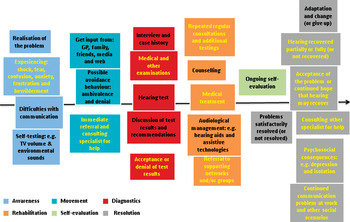
The patient interview data (i.e. notes and voice recordings) were further analysed to identify the fundamental themes, stages and milestones of the patients' experiences. A representation of the patients' perspective on the patient journey was developed based on the themes and stages identified (Figure 3). The process mapping model was used to represent the stages of the patient journey, in the form of a timeline.Reference Damelio15
Representation of patients' perspectives on stages of the ‘patient journey’ for sudden-onset acquired hearing impairment. GP = general practitioner; TV = television

Results
Figure 2 shows a representation of the audiologists' perspectives on the patient journey (stages unique to patients with sudden-onset versus gradual-onset acquired hearing loss are indicated by yellow text). Figure 3 shows a representation of the patients' perspectives on the patient journey (stages unique to patients with sudden-onset versus gradual-onset acquired hearing loss are indicated by purple text).
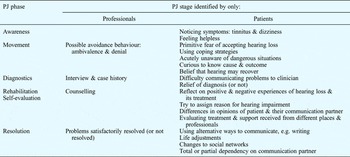
Six overall phases were identified: awareness, movement, diagnostics, rehabilitation, self-evaluation and resolution. Table II shows the stages and milestones, within each phase, which were identified only by patients and only by audiologists.
Differences in professionals' add patients' perspectives

PJ = ‘patient journey’
The six overall phases are discussed below.
Awareness
The person may realise they have a hearing loss, typically with a rapid onset. They may experience other symptoms such as tinnitus and dizziness. They may self-test to see if they have hearing loss. They may experience various feelings such as shock, fear, confusion and anxiety. They may also experience significant communication difficulties.
The following patient quote gives an example of an event from this phase.
My wife and I were in Italy for a holiday. On the first night we were sitting in a restaurant for dinner. My right ear went totally deaf. It was as if….Somebody has switched off the light….as sudden as that… .
Thus, the patient explains how he lost his hearing, and this can give an idea about the abrupt nature of onset of the condition.
Another patient described the following.
I don't think I would have noticed the deafness straight away if I had not picked up the telephone. Not only I had lost my hearing, I think I had lost my mind. Because, I went on lying and I reported a fault in my telephone when I could not hear.
This description shows that patients with unilateral sudden-onset hearing loss may not have a straightforward awareness of hearing loss.
Some incidents of hearing and communication difficulties may prompt patients to test their own hearing.
If there was a river outside, I would jump in it. I couldn't come to terms with this tinnitus.
Other associated conditions, such as tinnitus and balance problems, can add to the effects of hearing loss, making it even harder for the individual to cope. The above quote indicates that the patient experienced significant psychological and emotional effects as a result of their symptoms.
Movement
Even though patients have realised that their hearing is not right, they may initially have a deep fear of accepting this hearing loss, and may use coping strategies to deal with communication difficulties. However, they may receive input from family and friends and, as a result, decide to get help from a specialist. They may also be unaware of dangerous situations when they occur, and curious to know the cause and likely outcome of their condition; furthermore, they may believe that their hearing might recover.
One of the worst things is, not feeling safe. Imagine, you are passing the busy car park and you can't hear a car pulling out. It is so quiet, you can't hear anything…
The above quote shows that patients with sudden-onset hearing loss may experience difficulty immediately adjusting to not hearing some day-to-day sounds, and may be unaware of dangerous situations when they occur.
Basically, my wife was my ears. I wouldn't go anywhere without her.
A common strategy of patients with hearing loss is dependence on their communication partners. In patients with sudden-onset hearing loss, this stage can be seen in all the phases of the patient journey.
Diagnostics
In the diagnostic phase, patients may consult specialists for help and may undergo various medical, audiological and other investigations. They may experience difficulty communicating their problems to professionals; discussion of results and treatment recommendations may be accepted or denied.
I woke up in the hospital. I had a stroke and I could no longer hear…the consultant said it may be temporary hearing loss…He said don't be frightened, it is temporary and we don't know. He sent me for a hearing test every day on the machine…He kept his word for three years. It may seem strange though….We accepted that man's words, rather than our experiences…psychology works, that helped, that white light…The hope was better than reality…
The above quote demonstrates several phases, including awareness, movement, diagnostics and self-evaluation.
Rehabilitation
During this phase, patients may continue to visit various professionals for regular testing, and may receive both medical and audiological treatment and management. In many cases, they may also be referred to various support networks and groups for help.
I was treated in the hope that there was a blood clot in the ear and…then for few months I was totally deaf…Social services gave me some help…and then later I was put on a cochlear implant programme.
The above description demonstrates multiprofessional involvement in patient management and rehabilitation.
Self-evaluation
In this phase, patients may take a lot of time to reflect on the experiences they have had. They may reflect on the positive and negative experiences of hearing loss and its treatment, try to assign a reason for their hearing impairment, and may also evaluate the treatment and support received from different sources and professionals. Discussing this with their communication partners may lead to possible differences.
The only positive thing I could think of is that I can cope with it. I am determined to cope with it…I am going to get on with my life. I have to…Otherwise it is going to drag me down…It does at times, but I think I should put myself together now…as I realise it could have been worse…Also, we do get more sympathetic of other people, when they have got other problems.
This quote shows the mixed feelings this patient has about her hearing loss. Even though hearing loss may have many negative consequences, each individuals' ability to overcome its psychological impact will influence how they cope with it.
Resolution
In this phase, the patients may start to accept their hearing loss and begin to adapt to changes. However, in some cases they may still believe that their hearing will recover, or alternatively may give up adapting to new changes. They may make several life adjustments, including finding alternative ways to communicate (e.g. by writing) and changing their social networks. They may also experience repeated psychological consequences such as depression and isolation, and may have continued difficulties with communication, leading to partial or total dependency on communication partners.
We were on holiday. We were on a table of six and this quite distressed me. A waitress came over to me with meals. She looked at me and smiled and I smiled back. She put the meal in front of me. She said something obviously and I don't know what she said. The person next to me said you have got Jim's meal. Because I couldn't hear what she said, I felt very silly…I do feel stupid at times.
I am going visual now. I am painting paintings and I am working over there all the time now…I do floral arrangements…Because I can't get the concentration to listen to what you are saying now…So, it's all visual.
The above descriptions indicate the continued communication problems and life adjustments that patients experience. These problems may occur in various situations, including work and social scenarios. They may also influence the life adjustments the patient makes.
Discussion
Key findings
We identified six key phases that patients with sudden-onset acquired hearing impairment are likely to go through. These include awareness, movement, diagnostics, rehabilitation, self-evaluation and resolution. Figure 4 shows these six phases as a patient journey template for adults with sudden-onset acquired hearing impairment. These phases were identified by analysing the perspectives of both patients and professionals. There were some commonalities and differences between these two perspectives. The main differences were in the self-evaluation phase: various elements of this phase which were reported by the patients were not reported by the professionals. This could have resulted from differences in educational background and experience.Reference Hunt and Arar16
‘Patient journey’ template, showing the main phases of the patient journey for adults with sudden-onset acquired hearing impairment.

As might be expected, the absence of a pre-awareness stage was the main difference in the patient journey described by patients with sudden-onset versus gradual-onset acquired hearing impairment. This is because of the abrupt onset of the former condition. Moreover, patients with these two conditions may have overlapping stages and milestones, and may not follow the exact phase sequence shown in our patient journey template. Some stages may occur in more than one phase (e.g. total or partial dependency on communication partners). In addition, patients with sudden-onset acquired hearing impairment generally had a more rapid progression from one phase to the next, compared with patients with gradual-onset hearing impairment.
Even though our template may provide a good outline of the patient journey, our patient interview data highlighted the fact that each individual patient journey is unique. Patient interview data emphasised the psychosocial and emotional impact of hearing loss, and indicated that these varied significantly between patients. For this reason, the patient journey template may not necessarily provide in-depth insights into the unique experiences of each individual patient. We believe that an ideographic approach may be useful to help patients obtain a deeper understanding of the uniqueness of their experience.
Chiossoine-Kerdel et al. Reference Chiossoine-Kerdel, Baguley, Stoddart and Moffat11 emphasised that careful thought should be given to audiological rehabilitation of this patient group. This view is also supported by Carlsson et al.,Reference Carlsson, Hall, Lind and Danermark10 who indicated that patients with sudden hearing loss face complex issues and may need extended audiological rehabilitation and a multidisciplinary approach in order to take account of medical, social and psychological factors. Our findings emphasise the need for continued audiological and psychosocial support for patients with sudden-onset acquired hearing impairment.
Study strengths and weakness
The main study limitation was the small number of participants, which did not allow us to check for data saturation. The patient journey template developed may have some milestones missing. For this reason, our findings should be treated as preliminary, and cannot be generalised.
An additional limitation may be that the source of the selected from sample was self-help groups, which may not represent the whole spectrum of individuals with sudden-onset acquired hearing impairment. Individuals who do not go to self-help groups may have different perspectives on their journey, and may experience different adjustment problems when learning to live with hearing impairment.
In addition, the researchers' knowledge of the patient journey may have influenced the analysis to a certain degree.
Nevertheless, the data presented provide some new, exploratory ideas in the area of ear and hearing healthcare, and enable a description of the perspectives of both patients and professionals.
Clinical applicability
We believe that our patient journey template could help hearing healthcare specialists to better understand patients' experiences, and may also represent useful counselling tools. In addition, our template could also be used for training purposes.
• A ‘patient journey’ template for sudden-onset acquired hearing impairment was developed, based on audiologists' and patients' perspectives
• Professionals' and patients' perspectives differed most in the self-evaluation phase
• The perspectives of sudden-onset versus gradual-onset hearing loss patients differed in that the former reported no pre-awareness phase
• The patient journey template derived could be used as a baseline, but in-depth history-taking is still important to understand each patient's unique experience
However, careful attention should be given to each individual patient, in order to better understand the individual impact of sudden-onset hearing impairment and to develop appropriate medical, audiological and psychosocial management strategies which are tailored to each patient's needs. Thus, our patient journey template should be used as a baseline; it is important to take a detailed case history in order to understand each patient's unique experience.
Further research is required to obtain a deeper understanding of the patient journey for individuals suffering sudden-onset acquired hearing impairment, to analyse data from a larger sample, and also to help determine how age, gender, personality, and socioeconomic and ethnic background can influence patients' perspectives.
Acknowledgements
The authors sincerely thank all the volunteers who took part in the study. The authors acknowledge the Ida Institute for permitting reproduction of the baseline patient journey template.