The global spread of multidrug-resistant (MDR) Enterobacteriaceae continues to threaten children worldwide.Reference Lukac, Bonomo and Logan 1 , Reference Logan 2 MDR Enterobacteriaceae can be introduced into the intensive care unit (ICU) environment by colonized children and subsequently spread to other critically ill pediatric patients, resulting in devastating consequences. This is a particular concern with organisms producing extended-spectrum β-lactamases (ESBLs), plasmid-mediated AmpC β-lactamases (pAmpCs), and carbapenemases because genes encoding these enzymes are generally carried on mobile genetic elements, facilitating patient-to-patient transmission. These organisms have been implicated in a number of outbreaks in the ICU setting.Reference Cantey, Sreeramoju and Jaleel 3 – Reference Huang, Zhuang and Du 7 Because of frequent transfer to and from acute-care facilities, pediatric patients hospitalized in the ICU may introduce and propagate the spread of resistant pathogens across a variety of healthcare settings.
Most reports regarding the molecular characterization of ESBLs, pAmpCs, and carbapenemases in children in the United States focus on clinical isolates. In a study at Seattle Children’s Hospital from 1999 to 2007, 1% of isolates displayed broad-spectrum β-lactamase production, predominantly pAmpCs (bla CMY) and ESBLs (bla TEM).Reference Qin, Zerr and Weissman 8 , Reference Weissman, Adler, Qin and Zerr 9 Similarly, 1% of Escherichia coli or Klebsiella spp. isolates recovered from children in Utah from 2003 to 2007 were ESBL producers.Reference Blaschke, Korgenski, Daly, LaFleur, Pavia and Byington 10 Investigators at Texas Children’s Hospital found that ~7% of Enterobacteriaceae clinical isolates from 2010 to 2011 were ESBL producers, with CTX-M variants predominating.Reference Chandramohan and Revell 11 The burden of colonization of MDR Enterobacteriaceae in US children admitted to critical care units and subsequent acquisition from the ICU environment has not been previously described. Unless colonization prevalence is periodically enumerated and appropriate control measures are implemented when necessary, we may continue to observe an increase in MDR Enterobacteriaceae infections among children, as there will be inadequate “source control.” We sought to evaluate the prevalence and molecular characteristics of MDR Enterobacteriaceae (ie, ESBL, pAmpC, and carbapenemase) colonization upon PICU admission and the frequency of new MDR Enterobacteriaceae acquisition during PICU hospitalization in the absence of contact isolation precautions specific for these organisms.
METHODS
Study Setting and Participants
The Johns Hopkins Hospital contains a 40-bed PICU that routinely cares for children in Baltimore, Maryland, as well as the greater mid-Atlantic region hospitalized with life-threatening acute illnesses. Patients recovering from cardiothoracic surgery; solid organ transplant surgery; major neurosurgical; urologic and orthopedic surgeries; and ear, nose and throat surgery also receive their postoperative care in the unit. The Johns Hopkins Hospital PICU is the designated “shock trauma” and burn unit for critically injured children in the state of Maryland.
The unit is comprised entirely of single-patient rooms. Routine surveillance cultures are collected from the nares for methicillin-resistant Staphylococcus aureus (MRSA) and the rectal region for vancomycin-resistant Enterococcus (VRE) upon admission and weekly thereafter for all children admitted to the PICU. There is no routine surveillance for MDR Enterobacteriaceae in the PICU. Gowns and gloves are worn when entering the rooms of pediatric patients colonized or infected with organisms such as MRSA, VRE, Clostridium difficile, MDR Gram-negative organisms (from clinical isolates), and/or respiratory viruses. Hand hygiene and environmental cleaning compliance are monitored and reported to the unit at monthly intervals.
Identification of Multidrug-Resistant Gram-Negative Colonization
Rectal surveillance swabs (BD CultureSwab, Becton Dickinson Diagnostics, Sparks, MD) were obtained upon PICU admission and weekly thereafter until PICU discharge for all children admitted to the Johns Hopkins Hospital PICU between July 16, 2014, and January 15, 2015. The initial rectal swab was obtained on the day of PICU admission and subsequent weekly swabs were obtained every Wednesday for all patients until discharge from the PICU. Each swab was processed in real time and inoculated into T-soy broth containing a 30-µg ceftriaxone disk and incubated at 37°C. Within 48 hours of inoculation, 100-µL broth samples with visible turbidity were plated on MacConkey agar with a 30-µg ceftriaxone disk and incubated at 37°C overnight. All recovered isolates within the zone of inhibition underwent routine identification and antimicrobial susceptibility testing using the Phoenix Automated System (Becton Dickinson Diagnostics). Confirmatory testing of potential ESBLs and AmpCs using the ESBL Etest (bioMérieux, Durham, North Carolina) and AmpC Etest (bioMérieux), respectively occurred for Enterobacteriaceae with ceftriaxone MICs of ≥2 µg/mL. Enterobacteriaceae resistant to any carbapenem (eg, ertapenem, meropenem, or imipenem-cilastatin) were further characterized using the Modified Hodge Test (MHT) and/or the metallo-β-lactamase Etest (bioMérieux), as appropriate.
Detection of β-lactamase Genes
All MDR Enterobacteriaceae isolates resistant to ceftriaxone were further evaluated using molecular methods. If a child was colonized with an ESBL in addition to an AmpC-producing Enterobacteriaceae, that child was categorized as having an ESBL-producing Enterobacteriaceae. If a child was colonized with carbapenemase-producing Enterobacteriaceae in addition to an ESBL and/or AmpC-producing Enterobacteriaceae, that child was categorized as having carbapenemase-producing Enterobacteriaceae.
Genomic DNA was extracted from isolates using the DNeasy Blood & Tissue Kit (Qiagen, Valencia, CA). The identification of β-lactamase-encoding genes in isolates was assessed utilizing a DNA microarray-based assay Check-MDR CT103XL kit (CheckPoints, Wageningen, Netherlands), according to the manufacturer’s protocol, 12 The CheckPoints assay can detect the following β-lactamase genes: (1) ESBLs (CTX-M-1 group, CTX-M-2 group, CTX-M-8 & -25 group, CTX-M-9 group, TEM wild type, TEM-type ESBL, SHV wild type, and SHV-type ESBL and (2) pAmpCs (CMY I/MOX, ACC, DHA, ACT/MIR, CMY II, and FOX); and (3) carbapenemases (KPC, NDM, VIM, IMP, GES, GIM, SPM, and OXA-variants).Reference Blaschke, Korgenski, Daly, LaFleur, Pavia and Byington
Multi-Locus Sequence Typing (MLST)
MLST is a nucleotide sequence-based approach for the characterization of bacteria that provides a highly discriminating typing system particularly for E. coli and K. pneumoniae associated with clonal outbreaks.Reference Tartof, Solberg, Manges and Riley 13 , Reference Diancourt, Passet, Verhoef, Grimont and Brisse 14 Gene amplification and sequencing of 8 housekeeping genes of E. coli (dinB, icdA, pabB, polB, putP, trpA, trpB, and uidA) and 7 housekeeping genes of K. pneumoniae (rpoB, gapA, mdh, pgi, phoE, infB, and tonB) were performed as previously described,Reference Tartof, Solberg, Manges and Riley 13 Reference Diancourt, Passet, Verhoef, Grimont and Brisse - Reference Mathers, Peirano and Pitout 15 and allele and sequence types were determined according to the MLST database of the Institut Pasteur (http://www.pasteur.fr/mlst).
Repetitive Sequence-Based PCR (rep-PCR)
To assess clonal relatedness, rep-PCR was performed on E. coli, K. pneumoniae, and Citrobacter spp. isolates.Reference Pitout, Campbell, Church, Wang, Guttman and Gregson 16 Genomic DNA was extracted from bacterial isolates using an UltraClean Microbial DNA Isolation Kit (MO BIO Laboratories, Carlsbad, CA). PCR amplification was performed using a Diversi-Lab fingerprinting kit (bioMérieux). Rep-PCR amplicons were then separated by electrophoresis on microfluidic chips and analyzed with an Agilent 2100 Bioanalyzer (AgilentTechnologies, Santa Clara, CA). Resulting band patterns were compared using Pearson’s correlation; isolates with >95% similarity were considered to be of the same strain type.
Molecular Typing for Enterobacter Species
Because MLST is only recently being used to characterize Enterobacter spp. and an accepted universal database does not exist, sequence typing of the highly conserved hsp60 gene was used to evaluate the genetic relatedness of Enterobacter species, as previously described.Reference Hoffmann and Roggenkamp 17 , Reference Kiedrowski, Guerrero and Perez 18
Phylogenetic Group Classification
All E. coli strains were assigned to 1 of the 4 main phylogenetic groups (A, B1, B2, or D) to illustrate evolutionary relatedness using a previously described multiplex PCR-based method.Reference Clermont, Bonacorsi and Bingen 19
Protected Health Information
All swabs were given a de-identified number upon collection and were only linked with patient identifiers after the 6-month study period was completed. Neither clinical staff nor patients were aware of swab results; thus, identification of colonization with MDR Enterobacteriaceae did not impact isolation precautions or treatment decisions. Data were stored in a secure REDCap database and all data analysis was descriptive in nature. This study was approved by the Johns Hopkins University School of Medicine Institutional Review Board, and a waiver of informed consent was granted.
RESULTS
Description of Cohort
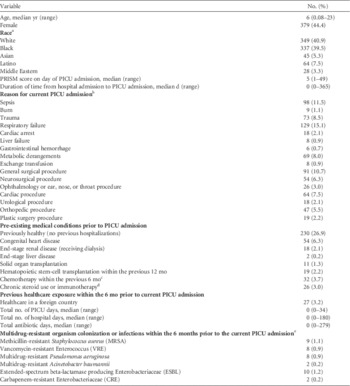
A total of 854 admission rectal swabs were obtained from 859 unique children admitted to the PICU during the study period. The median age was 6 years (range, 1 month to 23 years) and 45% of children were female (Table 1). Approximately 27% of children were previously healthy. The median Pediatric Risk of Mortality III Score (PRISM III) upon admission was 5 (range, 1–49). Furthermore, 22% of the cohort was on contact isolation for reasons unrelated to the present study, as healthcare providers and patients were unaware of their MDR Enterobacteriaceae status based on study results. The median duration of the current PICU admission was 4 days (range, 1–143 days).
Characteristics of 854 Children Admitted to the Pediatric Intensive Care Unit (PICU) During a 6-Month Period

a Race included only if a single race was identified in the medical records.
b Patients categorized into a single reason for admission.
c Patients who received both chemotherapy and hematopoietic stem cell transplantation (HSCT) only categorized as HSCT.
d Excludes patients receiving immunotherapy for solid organ transplant, HSCT, or chemotherapy.
e Multidrug-resistant (MDR) P. aeruginosa defined as P. aeruginosa nonsusceptible to at least 1 drug in at least 3 of the following 5 categories: extended-spectrum cephalosporins, fluoroquinolones, aminoglycosides, carbapenems, piperacillin-tazobactam; MDR A. baumanii defined as A. baumanii nonsusceptible to at least 1 drug in at least 3 of the following 6 categories: Extended-spectrum cephalosporins, fluoroquinolones, aminoglycosides, carbapenems, piperacillin-tazobactam, or ampicillin-sulbactam (http://www.cdc.gov/nhsn/pdfs/ps-analysis-resources/phenotype_definitions.pdf).
Overview of Phenotypic Analysis upon PICU Admission
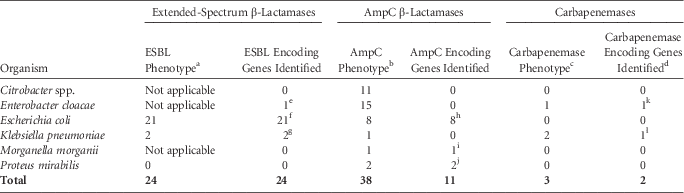
The prevalence of MDR Enterobacteriaceae (based on a positive ESBL Etest, AmpC Etest, MHT, or metallo-β-lactamase Etest) isolated from admission swabs was 7.6% (n=65). ESBLs, AmpCs, and carbapenemases were identified in 2.8% (n=24), 4.4% (n=38), and 0.4% (n=3) of children, respectively (Table 1). The MDR Enterobacteriaceae identified included E. coli (n=29), Enterobacter cloacae (n=17), and Citrobacter species (n=11), K. pneumoniae (n=5), Proteus mirabilis (n=2), and Morganella morganii (n=1).
Overview of Genotypic Analysis upon PICU Admission
All isolates that were resistant to ceftriaxone underwent molecular analysis, regardless of the results of phenotypic testing. The overall prevalence of MDR Enterobacteriaceae colonization on admission based on genotypic testing was 4.3% (n=37). ESBLs, pAmpCs, and carbapenemases were identified in 2.8% (n=24), 1.3% (n=11), and 0.2% (n=2) of children, respectively (Table 2).
Multidrug-Resistant Enterobacteriaceae Recovered Upon Pediatric Intensive Care Unit Admission Among 854 Children During a 6-Month Period

a Extended-spectrum β-lactamases (ESBLs) Etest positive (only performed on E. coli, Klebsiella spp., and P. mirabilis)
b AmpC Etest positive.
c Modified Hodge test or Metallo-β-lactamase Etest positive.
d If an isolate contained an ESBL gene in addition to an AmpC gene, it was categorized as an ESBL. If an isolate contained an ESBL and/or AmpC gene in addition to a carbapenemase gene, it was categorized as a carbapenemase.
e 1 isolate carried bla CTX-M-15.
f 12 isolates carried bla CTX-M-15, 2 isolates carried bla CTX-M-15 and bla TEM, 1 isolate carried bla CTX-M-15 and bla CMY II, 1 isolates carried bla CTX-M-2, 3 isolates carried bla CTX-M-9, 2 isolates carried bla CTX-M-32.
g 1 isolate carried bla CTX-M-15, 1 isolate carried bla SHV-238s, bla SHV-240k.
h 7 isolates carried bla CMY II, 1 isolate carried bla DHA.
i 2 isolates carried bla CMY II.
j I isolate carried blaDHA.
k 1 isolate carried a bla KPC-3.
l 1 isolate carried bla VIM-4 and bla CMY-4.
Overview of Phenotypic Analysis during the PICU Stay
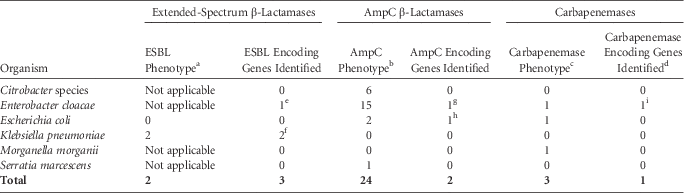
According to phenotypic testing (eg, ESBL Etest, AmpC Etest, MHT, MBL Etest), from a total of 157 children who received a second rectal swab, 29 children (18.4%) acquired an incident MDR Enterobacteriaceae during their PICU stay with a median time to colonization of 9 days (Table 3).
Incident Multidrug-Resistant Enterobacteriaceae Recovered From 157 Children Who Stayed More Than 1 Week in a Pediatric Intensive Care Unit Over a 6-Month Period

a Extended-spectrum β-lactamases (ESBL) Etest positive (only performed on E. coli, Klebsiella spp., and P. mirabilis).
b AmpC Etest positive.
c Modified Hodge test or metallo-β-lactamase Etest positive.
d If an isolate contained an ESBL gene in addition to an AmpC gene, it was categorized as an ESBL. If an isolate contained an ESBL and/or AmpC gene in addition to a carbapenemase gene, it was categorized as a carbapenemase.
e 1 isolate carried bla SHV-238.
f 1 isolate carried bla CTX-M-15 and bla CMY II and 1 isolate carried bla CTX-M-9.
g 1 isolate carried bla ACT/MIR.
h 1 isolate carried bla DHA.
i 1 isolate carried bla KPC-2, bla SHV, and bla ACT/MIR.
Overview of Genotypic Analysis during PICU Stay
From 157 children who remained hospitalized in the PICU for at least 7 days, 6 children (3.8%) acquired an incident MDR Enterobacteriaceae during their PICU stay. These 6 children became colonized with the following organisms: (1) 1 E. cloacae isolate producing an ESBL (bla SHV-238), (2) 1 E. cloacae isolate producing a carbapenemase, ESBL, and AmpC (bla ACT/MIR), (3) 1 E. cloacae producing a carbapenemase (bla KPC-2, bla SHV, bla ACT/MIC), (4) 1 K. pneumoniae isolate producing both an ESBL and AmpC (bla CTX-M-15, bla CMY11), (5) 1 K. pneumoniae isolate producing an ESBL (bla CTX-M-9), and (6) 1 E. coli isolate producing an AmpC (bla DHA).
ESBL-Producing Enterobacteriaceae
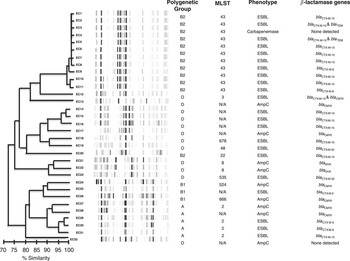
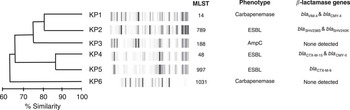
Figures 1 and 2 depict characteristics of E. coli and K. pneumoniae isolates producing ESBLs, respectively. Of the 27 ESBL-producing isolates, 25 (93%) carried a bla CTX-M gene, with bla CTX-M-15 being the most commonly detected CTX-M-type gene (68%). All E. coli ESBL-producing isolates (n=21), 3 of the 4 K. pneumoniae isolates, and 1 of the 2 E. cloacae isolates carried bla CTX-M genes. The remaining K. pneumoniae and E. cloacae isolates contained bla SHV-type genes. The predominant circulating clonal strain was ESBL-producing E. coli ST43 (Pasteur MLST scheme), which corresponds to ST131 in Achtman’s MLST. Co-expression of an ESBL and AmpC (bla CTX-M-15 and bla CMY II) occurred in 1 E. coli isolate and 1 K. pneumoniae isolate.
Genetic relatedness of Escherichia coli isolates from children admitted to a pediatric intensive care unit. For isolates identified as not available (N/A) for multilocus sequence typing (MLST), no match was identified in the MLST database. Phenotype is indicated according to results of ESBL Etest, AmpC Etest, modified Hodge test, or metallo-β-lactamase Etest.

Genetic relatedness of Klebsiella pneumoniae isolates from children admitted to a pediatric intensive care unit. For isolates identified as not available (N/A) for multilocus sequence typing (MLST), no match was identified in the MLST database. Phenotype is indicated according to results of ESBL Etest, AmpC Etest, modified Hodge test, or metallo-β-lactamase Etest.

During the study period, 1 child acquired an incident ESBL/AmpC. She became colonized with a K. pneumoniae isolate carrying both bla CTX-M-15 and bla CMY II genes 6 days after admission. Another patient became colonized with a K. pneumoniae carrying a bla CTX-M-9 6 days after PICU admission, and a third patient became colonized with an E. cloacae harboring a bla SHV-238 13 days after admission. All 3 of these children had underlying medical issues and had extensive antibiotic exposure during their time in the PICU. Their ESBL-producing isolates appeared unrelated to those identified in other children during the study period.
AmpC-producing Enterobacteriaceae
Based on the results of the AmpC Etest, 38 children (4.4%) had isolates producing AmpC-β-lactamases upon PICU admission. pAmpC β-lactamase genes were detected in E. coli (8 isolates), M. morganii (1 isolate), and P. mirabilis (2 isolates). Overall, 27 (71%) of these isolates, which included 15 E. cloacae, 11 Citrobacter spp., and 1 K. pneumoniae, were presumed to be chromosomally mediated AmpC-producing Enterobacteriaceae.
Based-on phenotypic characteristics, the majority of children with new MDR Enterobacteriaceae acquisition during their PICU stay became colonized with AmpC-producing organisms (n=24). Of the 24 isolates, 22 appeared to have chromosomally mediated AmpC β-lactamase resistance (Table 2). Of the presumed chromosomally mediated AmpC hyperproducers detected, 14 (64%) were E. cloacae. Results of hsp60 gene patterns for Enterobacter spp. evaluating relatedness of strains suggest that these isolates were not clonal. One child admitted for elective surgery became colonized with an E. cloacae producing a pAmpC (bla ACT/MIR) on day 8 of his PICU stay. Also on day 8 of his PICU stay, a different patient became colonized with an E. coli containing a bla DHA gene that appeared identical to that of another pediatric patient colonized with this organism at the time of PICU admission. Both patients were hospitalized during the same time period and were on contact isolation for the duration of their hospital stays for reasons unrelated to the presence of MDR-Enterobacteriaceae. Neither child developed a clinical infection in the subsequent 12 months with these organisms.
Carbapenemase-Producing Enterobacteriaceae
One child was colonized with a metallo-β-lactamase–producing organism upon PICU admission, and this organism was confirmed to contain a carbapenemase-producing gene using molecular testing. This patient had recently received medical care in Kuwait and was colonized with a metallo-β-lactamase-producing K. pneumoniae ST14 that carried bla VIM-4, bla CMY-4 genes, which had previously never been identified in a child hospitalized in the United States. Ultimately, this child succumbed to a ventilator-associated pneumonia from this organism.
Another pediatric patient was colonized with a KPC-3 producing E. cloacae identified upon hospital admission. This infant had a previous liver transplant and subsequently died of an intra-abdominal infection caused by this organism. Another 3 children had isolates that were MHT positive. On molecular analysis, 1 isolate carried bla ACT/MIR, another carried bla CTX-M-15, and a β-lactamase gene was not identified in the third. For the first 2 isolates, we assumed that they may have had a carbapenem-specific porin mutation in addition to their ESBL/AmpC-producing gene as both isolates were resistant to meropenem (minimum inhibitory concentrations of 4 µg/mL and 8 µg/mL, respectively). One child acquired a carbapenemase-producing E. cloacae after 12 days of hospitalization which carried bla KPC-2, bla SHV and bla ACT/MIR genes. He subsequently died from septicemia related to an intra-abdominal infection from this organism.
DISCUSSION
Our study indicates that approximately 4% of children admitted to the PICU were colonized with MDR Enterobacteriaceae (based on β-lactamase gene identification) and an additional 4% of children who remained in our PICU for at least 1 week became colonized with these organisms during their hospital stay, with a median time to MDR Enterobacteriaceae acquisition of 9 days. This is the first study evaluating the results of active surveillance for MDR Enterobacteriaceae in critically ill children in the United States.
We decided to focus on ESBLs, pAmpCs, and carbapenemases because these β-lactamase mechanisms of resistance are generally carried on mobile genetic elements facilitating their spread in ICUs. These resistance mechanisms have been implicated in a number of outbreaks.Reference Cantey, Sreeramoju and Jaleel 3 – Reference Huang, Zhuang and Du 7 Interestingly, in our study, only 1 transmission of an MDR Enterobacteriaceae occurred. We believe the low transmission rate may be due to good adherence to standard infection control practices. All of the patients in our study were hospitalized in private rooms. The nurse-to-patient ratio was consistently between one-to-one and one-to-two. There was an average of 91% hand hygiene compliance in the PICU during the study period. The incidences of both central line-associated bloodstream infections and catheter-associated urinary tract infections in our PICU were well below their national pooled means during the months the study was conducted. There was only one incident infection with Clostridium difficile in the PICU during the study period. These data suggest that there may be limited spread of MDR Enterobacteriaceae in the critical care setting with good adherence to appropriate infection control practices.
In our cohort, only about 20% of pediatric patients were on contact isolation during the study period. Others have explored the utility of contact isolation for patients colonized with MDR Enterobacteriaceae in the non-epidemic setting. Tschudin-Sutter et alReference Tschudin-Sutter, Frei, Dangel, Stranden and Widmer 20 evaluated the spread of ESBL-producing Enterobacteriaceae in a tertiary care institution. All patients hospitalized in the same room as a patient colonized or infected with ESBL-producing Enterobacteriaceae for at least 24 hours were screened for ESBL carriage. Transmission occurred in 1.5% of contact patients. The same group of investigators found that after discontinuing the policy of contact precautions for ESBL E. coli, transmissions remained below 3%.Reference Tschudin-Sutter, Frei, Dangel, Stranden and Widmer 21 Similarly, Ohmagari et alReference Ohmagari, Kurai, Yamagishi and Mikamo 22 found that the incidence of MDR Enterobacteriaceae did not change after the introduction of strict isolation practices. Han et alReference Han, Bilker and Nachamkin 23 evaluated the impact of a urine culture screening strategy for detecting ESBLs. Patients determined to be colonized or infected with ESBLs were placed on contact precautions. These investigators found that contact precautions did not impact nosocomial incidence rates with ESBL-producing pathogens when there was good compliance with standard precautions.
Traditional concerns about transmission of ESBLs focused on the healthcare setting, but more and more reports describe the community as an important reservoir for ESBLs.Reference Hilty, Betsch and Bogli-Stuber 24 – Reference Megged 27 In our cohort, 24 of the 27 ESBLs (89%) detected were identified from admission rectal swabs. Of these, 41% belonged to ST131, and all admission isolates carrying ESBLs carried a bla CTX-M-type gene. The rapid spread of ESBLs appears to be driven largely by the clonal expansion of ST131, with person-to-person transmission in the community being an important mode of spread.Reference Morgand, Vimont and Bleibtreu 28 ST131 appears to be efficiently transmitted in households. Madigan et alReference Madigan, Johnson and Clabots described 2 young children who presented to medical care for the treatment of ESBL infections from the same household.Reference Madigan, Johnson and Clabots 29 On further evaluation, all 6 household members were identified as carrying the same E. coli ST131 strain. Genetically identical ESBL strains have also been recovered from the diapers of children in common daycare settings.Reference Kaarme, Molin, Olsen and Melhus 30
Carbapenem-resistant Enterobacteriaceae have been identified throughout the United States but are most prevalent in the mid-Atlantic region,Reference Guh, Bulens and Jacob 31 which includes the state of Maryland where the present study took place. KPCs are the most prevalent carbapenemases identified in the United States, but both metallo-β-lactamases and OXA-types have been identified in a number of states, generally in patients who previously received medical care in foreign countries.Reference Guh, Bulens and Jacob 31 The incidence of CRE among US children remains low. A recent study reported that the proportion of carbapenem resistance in clinical isolates in patients under 18 years of age is under 1%.Reference Logan, Renschler and Gandra 32 Unlike ESBL-producing organisms, carbapenemase-producing organisms in US children have been limited to those with previous healthcare exposure.Reference Logan 2 , Reference Chiotos, Han and Tamma 33
Our study has a number of limitations to consider. First, as this was a single-center study, the prevalence and molecular mechanisms of MDR Enterobacteriaceae in our patient population may not be generalizable to patients hospitalized in other PICUs. Second, we only screened for MDR Enterobacteriaceae carriage in in the rectal region, where we believe the largest burden of Enterobacteriaceae exists. We may have underestimated the prevalence of these organisms if some children were colonized with these organisms in other body sites. Third, we did not evaluate for non-β-lactamase mechanisms of resistance such as those that relate to reduced outer membrane permeability, as we preferred to focus on resistance mechanisms with a high predilection for patient-to-patient transmission. Additionally, although the CheckPoints multiplex assay employed in our study includes a comprehensive list of β-lactamases, as with all available microarrays, it can only evaluate for previously characterized β-lactamase-producing genes included in the assay. Finally, as the duration of PICU stay for most children was relatively short, we realize that many children may not have had an “opportunity” to acquire an MDR Enterobacteriaceae. Although this is a limitation, the median PICU stays of our patients is representative of average PICU stays in US hospitals.Reference Marik and Hedman 34 , Reference Weissman 35
Despite these limitations, our study suggests that the transmission of MDR Enterobacteriaceae may be low in an acute care setting with rigorous adherence to standard precautions. A single assay to screen for all β-lactamase genes is not currently available. Even if such an assay existed, it would not detect common mechanisms of resistance seen in nonfermenting Gram-negative organisms (eg, loss or alterations of outer membrane porins, upregulation of efflux pumps, etc.) or resistance mechanisms common to Gram-positive organisms. Because no single, user-friendly, inexpensive, rapid screening method will detect all of the resistance mechanisms found in critical care units, it may be more prudent to focus efforts on reinforcing standard infection control practices.
ACKNOWLEDGMENTS
We would like to thank Pam Dodge, Claire Beers, and all the Johns Hopkins Hospital PICU nurses for their assistance with this study. This publication was made possible by support from the Sherrilyn and Ken Fisher Center for Environmental Infectious Diseases, Division of Infectious Diseases of the Johns Hopkins University School of Medicine. Its contents are solely the responsibility of the authors and do not necessarily represent the official view of the Fisher Center or Johns Hopkins University School of Medicine. R.A.B. was supported by funding from the VA Merit Review Board, NIH and VISN 10 GRECC. L.K.L. was supported by funding from the NIH (grant no. 5K08AI112506-02). All authors report no conflicts related to this study. We thank the platform for Genotyping of Pathogens and Public Health at the Institut Pasteur (Paris, France) for coding MLST alleles and profiles; available at http://www.pasteur.fr/mlst.