Inpatient Violence
The threat of violence is a major concern for all individuals working or receiving treatment in an inpatient psychiatric setting.Reference Quintal 1 For example, Silver and YudofskyReference Silver and Yudofsky 2 recorded over 3000 episodes of aggressive behavior (both verbal and physical) in a 20-month period in just 30 psychiatric inpatients. Fellow patients are not the only victims of such assaults. According to the Bureau of Labor Statistics, in 1999, 2637 nonfatal assaults on hospital workers occurred, which translates to a rate of 8.3 assaults per 10,000 workers. This contrasts to a rate of assault of 2 per 10,000 workers in all other industries. The victims of such assaults were typically nursing staff, primarily because they spend the most time with patients. While these numbers include all healthcare employees, the Department of Justice National Crime Victimization Survey for 1993 through 1999Reference Duhart 3 reported that the average annual rate for nonfatal violence for mental health professionals was 68.2 per 1000 compared to a rate of 12.6 for all occupations. While the Occupational Safety and Health Administration (OSHA) provided compelling reasons for these numbers (eg, increasing use of hospitals by police officers for the care of acutely disturbed violent individuals), the consequences are clear: many mental health professionals will at some point in their careers be the victim of an assault. The resultant loss of work and psychological trauma to both the providers and the patients is significant.Reference Hunter and Carmel 4 , Reference Duxbury and Whittington 5 Developing methods for reducing violence on inpatient psychiatric units is of paramount importance.
The Development of Risk Assessments
One major focus in forensic psychology and psychiatry over the past several decades has been the development of risk assessments to aid in the identification of those individuals most at risk of exhibiting violent behavior. Initially, these instruments were developed primarily to make informed decisions regarding when (or if) offenders could be safely released into the community. So called “first-generation” risk assessment consisted of unstructured, often uninformed, estimates of dangerousness, which were notoriously fallible and unreliable. This is primarily because mental health professionals placed an increased importance on idiosyncratic factors that may not bear any relationship to violence.Reference Skeem and Monahan 6 Monahan's monographReference Monahan 7 documents that when using this approach, mental health professionals were inaccurate 67% of the time. “Second-generation” risk instruments were developed in the 1980s and 1990s and employed statistical analyses to assess the mathematical relationship between person variables (eg, age, elementary school performance) and the measured outcome (violence or violent offending). Many of these instruments provided probability values that allowed mental health professionals to quantify the risk of recidivism or aggression. Aside from providing an artificial sense of accuracy (some authors suggest that these probability values, when applied to the individual, vary widely,Reference Hart, Michie and Cooke 8 although others argue that the mathematical equations to support such arguments are flawedReference Mossman and Sellke 9 ), most included primarily static or historical factors, which are not amenable to change.Reference Harris, Rice and Quinsey 10 , Reference Hanson 11 One static factor that has been researched extensively is the construct of psychopathy, typically operationalized by the Hare Psychopathy Checklist–Revised (PCL-R)Reference Hare 12 or one of its derivatives. This construct, when included in the risk instrument, often carries the most weight. However, because many believe the primary purpose of risk assessment is risk management,Reference Bloom, Webster, Hucker and DeFreitas 13 , Reference Hart 14 static factors in theory yield little information regarding management of risk. Additionally, these second-generation risk assessments were developed to identify those individuals who are more likely to become violent in the long-term. For example, the Violence Risk Appraisal Guide (VRAG)Reference Harris, Rice and Quinsey 10 , Reference Quinsey, Harris, Rice and Cormier 15 , Reference Rice, Harris and Lang 16 estimated the probability of violent offending at 7- and 10-year follow-up points. For inpatient psychiatry, static predictors of risk may only be useful if containment is a feasible method of risk management. The use of seclusion and restraints is often viewed as containment and nontherapeutic,Reference Hodgkinson 17 and their use is increasingly limited in most psychiatric facilities.Reference Maguire, Young and Martin 18 Because psychiatric hospitals typically endeavor to focus on treatment, not containment, risk instruments with exclusively static predictors were believed to hold little utility for the management of aggressive patients. Long-term risk, which was often the focus of earlier risk instruments, is generally of importance when release is being considered. Short-term risk of aggression is much more salient to administrators of acute psychiatric units and long-term care facilities. Recent research has suggested that factors related to community violence (and therefore representative of long-term risk) may be substantially different than factors related to institutional aggression (ie, short-term risk), although differences also may be related to the operational definition of violence.Reference Edens, Buffington-Vollum, Keilen, Roskamp and Anthony 19 , Reference Guy, Edens, Anthony and Douglas 20
“Third-generation” risk assessments were developed based on empirical literature describing the relationships between person variables and outcome. These tools contain both static and dynamic factors that place an individual at risk. These guided professional assessments, often termed structured professional judgment (SPJ) tools, contain items that have been empirically linked to aggression or offending (rather than statistically linked) and incorporate dynamic risk factors for 2 specific reasons: to provide information on how to manage risk and to provide a method for measuring change in risk as a result of treatment. As HartReference Hart 14 cogently noted, the goal of risk assessment ultimately is prevention of violence. Thus, assessment methods must include factors that are amenable to intervention.Reference Douglas and Skeem 21 Many SPJ tools include factors more traditionally associated with mental illness (eg, diagnosis, current symptoms), which are considered more dynamic, rather than antisocial traits, which could be viewed as more historical or static. Douglas and SkeemReference Douglas and Skeem 21 proposed various dynamic risk factors for further investigation, including impulsivity, anger, and substance use. More recently “fourth-generation” risk tools have been proposed as superior, as these assessments contain items that are dynamic as well as potentially protective, and they place a focus on the linkage between identified risk factors and proposed interventions. However, the utility of these instruments is still unclear.Reference Campbell, French and Gendreau 22 See Table 1 for a summary of the development of violence risk assessments.
A summary of the development of violence risk assessments

PCL-R: Hare Psychopathy Checklist–Revised; VRAG: Violence Risk Appraisal Guide; HCR-20: Historical–Clinical–Risk Management; START: Short-Term Assessment of Risk and Treatability.
The development of second- and third-generation risk instruments appears to have produced the desired results: many of these tools have been shown to provide improved accuracy over unguided clinical judgment when used in an appropriate fashion, especially as they relate to community violence. For reviews of the efficacy of risk assessment and its relationship to community violence, see for example Edens and Otto,Reference Edens and Otto 23 Quinsey etal,Reference Quinsey, Harris, Rice and Cormier 15 or Walters.Reference Walters 24 The strength of the relationship of these risk instruments in general, and psychopathy specifically, to community violence led investigators to extend the examination to the institutional setting. Institutional aggression is a common problem in both general and forensic psychiatric facilities, as well as in correctional facilities. While initial investigations supported a strong positive relationship between the PCL-R (a static risk factor) and institutional aggression,Reference Hare and McPherson 25 , Reference Hill, Rogers and Bickford 26 2 meta-analyses have indicated that the PCL-R is not as robust a predictor of institutional aggression as initially believed.Reference Guy, Edens, Anthony and Douglas 20 , Reference Walters 27 In addition to concerns regarding the utility of psychopathy within institutions, concerns also have been raised regarding the predictive validity of instruments such as the VRAG and the Historical–Clinical–Risk Management (HCR-20)Reference Webster, Douglas, Eaves and Hart 28 in relation to institutional violence.Reference Edens, Buffington-Vollum, Keilen, Roskamp and Anthony 19 Compared to the community violence literature, relatively few studies have examined the efficacy of these measures in identifying violence-prone individuals in inpatient settings. McNiel etalReference McNiel, Gregory, Lam, Binder and Sullivan 29 evaluated the utility of various structured risk instruments in identifying individuals who would exhibit aggression in the short-term (mean length of stay of the sample was 9.5 days). They found that the clinical scale of the HCR-20 was most associated with inpatient violence. In a sample of 97 male offenders, Kroner and MillsReference Kroner and Mills 30 found that the VRAG evidenced the strongest relationship with major institutional misconduct, whereas the HCR-20 total score evidenced the lowest, although no differences were statistically significant. In contrast, Doyle etalReference Doyle, Dolan and McGovern 31 found in a study of 87 mentally disordered offenders in a medium security facility that the PCL-SV was superior to the VRAG and the H scale of the HCR-20 in predicting serious aggression. In a sample of 154 forensic inpatients, McDermott etalReference McDermott, Edens, Quanbeck, Busse and Scott 32 found that the clinical and risk management subscales of the HCR-20, as well as hostility as measured by the Brief Psychiatric Rating Scale (BPRS), were most strongly associated with patient-directed aggression, whereas 2 subscales from the Novaco anger scale were most strongly associated with staff-directed aggression. Vitacco etalReference Vitacco, Gonsalves, Tomony, Smith and Lishner 33 found that both static and dynamic factors predicted inpatient aggression, although none exhibited incremental validity beyond any other. In a meta-analysis of 95 studies examining the utility of the PCL in both community and institutional settings, Leistico etalReference Leistico, Salekin, DeCoster and Rogers 34 found that the PCL exhibited greater utility in a psychiatric inpatient sample, as compared to an incarcerated correctional sample. The results of these studies suggest that there is some utility to including both static and dynamic risk factors in risk instruments as they relate to institutional aggression.
Consistent with Douglas and Skeem's suggestionReference Douglas and Skeem 21 and McDermott etal's research,Reference McDermott, Edens, Quanbeck, Busse and Scott 32 the extant literature offers considerable support for the contention that anger and hostility are risk factors for interpersonal aggression. For example, research has shown positive associations between anger scales and institutional misconduct among violent male offenders in prison.Reference Mills and Kroner 35 , Reference Mills, Kroner and Forth 36 In the MacArthur study of mental disorder and violence,Reference Monahan, Steadman and Silver 37 anger was a potent predictor of community violence, so much so that it was incorporated into the Classification of Violence Risk (COVR)Reference Monahan, Steadman and Appelbaum 38 as one of the 44 risk factors. More recently, Ullrich etal 39 found that anger was a critical component in the pathway between delusions and violence. Impulsivity also has been associated with a greater likelihood of acting out in controlled environments.Reference Fehon, Grilo and Lipschitz 40 – Reference Barratt 42 Recently, a prospective examination of the relationship of second- and third-generation risk instruments with institutional violenceReference McDermott, Edens, Quanbeck, Busse and Scott 32 found that one type of patient was responsible for the majority of the aggression exhibited toward both staff and other patients in a forensic facility: patients who scored high on risk instruments (including the PCL-R, the VRAG, and the HCR-20) and who also scored high on self-report measures of anger and impulsivity. Patients who scored high only on the risk instruments but not on measures of anger and impulsivity exhibited significantly lower rates of aggression. These data provide further support that both dynamic and static risk factors are useful in identifying potentially aggressive patients.
A Typology of Aggression
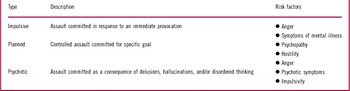
In addition to categorizing aggression as staff- or patient-directed, there is also evidence that institutional aggression can be categorized according to precipitating events and that the factors associated with each type of aggression may vary. In a study conducted in a state psychiatric hospital in New York, 3 primary motivations for assault were described: (1) impulsive—an assault committed in response to an immediate provocation and associated with agitation and loss of emotional control; (2) planned—a controlled assault committed for a specific goal; and (3) psychotic—assaults committed as a consequence of delusions, hallucinations, and/or disordered thinking.Reference Nolan, Czobor and Roy 43 Symptoms of mental illness, especially a major mental disorder, are necessarily associated with psychotic aggression by definition; psychotic symptoms are less likely to be linked to planned/predatory aggression. Quanbeck etalReference Quanbeck, McDermott and Scott 44 examined almost 1000 acts of aggression exhibited by both civil and forensic patients and found that a similar trichotomy applied, which they termed impulsive, organized, and psychotic. They also were able to delineate the underlying motivation for each type of aggression. For example, an act of organized aggression may be exhibited to achieve social dominance, whereas an act of impulsive aggression may be precipitated by the patient being denied a desirable item. Using this categorization scheme, impulsive/reactive assaults comprised the largest number of observed incidents of aggression (46%).Reference Quanbeck, McDermott and Scott 44 See Table 2 for a description of the typology of violence.
Typology of violence

Studies have been conducted to determine if traditional second- and third-generation risk instruments hold more utility in identifying individuals who are more likely to exhibit certain types of aggression. Some research suggests that planned/predatory aggression is more strongly related to psychopathic and antisocial attitudes.Reference Cornell, Warren and Hawk 45 , Reference Porter and Woodworth 46 In a sample of 152 male forensic patients, Vitacco etalReference Vitacco, Van Rybroek and Rogstad 47 found that anger and symptoms of mental illness, but not psychopathy, were associated with reactive aggression. In contrast, psychopathy, hostility, and anger were most associated with instrumental aggression. McDermott etalReference McDermott, Quanbeck, Busse, Yastro and Scott 48 found similar results: in a sample of 238 predominantly male forensic patients, psychopathy and anger were most strongly related to predatory aggression; the clinical and risk management scales of the HCR-20 and anger were most associated with impulsive aggression. Not surprisingly, symptoms of mental illness and impulsivity were most associated with psychotically motivated aggression. Interestingly, these relationships only held true when follow-up was limited to 6 months; longer follow-up attenuated most of the relationships.
In psychiatric facilities, the temporal occurrence of aggression is extremely important and may, at least in part, be associated with the type of aggression exhibited. The study by McDermott etalReference McDermott, Quanbeck, Busse, Yastro and Scott 48 demonstrated that various instruments may be differentially associated with various types of aggression at varying time points in the hospitalization. For long-term care facilities, imminent (defined as within the next 24 hours), short-term (variously defined as between 1 and 6 months), and long-term (defined in years) are all relevant in the treatment and management of psychiatric patients. For acute care inpatient psychiatric units, imminent aggression is most relevant, as most inpatient stays are extremely brief. Thus, the predictors of imminent aggression may be different from short-term aggression, which may also be quite different from the predictors of longer-term recidivism and offending. As an example, Woods and AlmvikReference Woods and Almvik 49 found that the Brøset Violence Checklist (BVC),Reference McNiel and Binder 50 which contains 6 items related to patient behavior/affect, was effective in identifying individuals at higher risk of aggression in the 24-hour period following the assessment. Other authors have determined that predictors of short-term versus long-term aggression may differ widely, and are especially dependent on the type of aggression.Reference McDermott, Quanbeck, Busse, Yastro and Scott 48
Although most standard risk instruments have been developed on forensic samples, recent research suggests that many risk instruments are applicable in both civil and forensic settings and that perhaps more important is the type of patient and the time frame under which the assessments are employed. This stands to reason, as most forensic commitments require a severe mental illness that has led to the impairment in legal reasoning. There are several validated risk assessment tools that were developed specifically to assess violence risk in the acute inpatient setting. Examples are the McNiel–Binder Violence Screening Checklist (VSC),Reference McNiel and Binder 50 the BVC,Reference Almvik, Woods and Rasmussen 51 and the Dynamic Appraisal of Situational Aggression (DASA).Reference Ogloff and Daffern 52
The VSC, which was developed at a university-based, locked, short-term psychiatric unit, is a screening tool that uses 4 variables to predict aggression and violence within 72 hours of inpatient admission. These 4 variables are a history of physical attacks or fear-inducing behavior within 2 weeks prior to admission, absence of suicidal behavior within 2 weeks of admission, schizophrenic or manic diagnosis, and male gender. An individual having a positive score on the VSC is 1.97 times more likely to engage in a physical attack or fear-inducing behavior. In addition, the VSC has demonstrated an ability to correctly classify 65% of patients as violent or nonviolent in a population of patients with a base rate of violent behavior of 41%.
The BVC was developed at the Norwegian maximum security unit at Brøset, which houses patients with mental disorders who were felt to be highly dangerous and difficult to manage. The checklist consists of 6 behaviors found to be most common during a 24-hour period prior to a violent incident, namely confusion, irritability, boisterousness, physical threats, verbal threats, and attacks on objects. The BVC has demonstrated 63% accuracy in predicting that violence will occur within the next 24 hours and 92% accuracy in predicting that violence will not occur. A randomized, controlled trial based in a Swiss psychiatric facility utilized the BVC as part of a violence risk reduction intervention during acute admission that resulted in a 41% risk reduction in severe events of inpatient aggression and a 27% risk reduction in the need for coercive measures against patients.
The DASA is a 7-item instrument, which contains 2 items from the HCR-20, 2 from the BVC, and 3 based on the authors’ own research. In the development study,Reference Ogloff and Daffern 52 the DASA evidenced an area under the curve (AUC) of .82 with all 7 items combined. The odds ratio of a patient scoring 7 (the highest score) compared to one scoring a 0 of committing an act of aggression within 24 hours was 29 (the patient was 29 times more likely to commit an act of aggression).
Many of these instruments that are used to identify patients likely to exhibit imminent aggression rely on observation of escalating behaviors. This suggests that these tools provide the greatest utility in identifying individuals at risk of exhibiting psychotically motivated or impulsive aggression. The SPJ instruments may be of more utility in identifying those individuals who are at risk of aggression later in their course of treatment, and again, aggression that may be viewed as impulsive or psychotically motivated. Static measures of risk appear to hold the greatest utility for identifying those individuals who are most likely to exhibit predatory aggression. In a direct assessment of this, Grann etalReference Grann, Belfrage and Tengstrom 53 found that static risk instruments were most efficacious in individuals with personality disorders. These same risk instruments held little utility for individuals with major mental disorders. They suggested that dynamic factors may be more useful for such individuals.
Integrating Risk, Typology, and Treatment
These data suggest that aggression exhibited in psychiatric facilities is multiply determined, and that no one intervention is likely to be effective in decreasing aggression, nor is one assessment instrument likely to be useful in delineating individuals more prone to acting aggressively. The research suggests that multiple issues are relevant with institutional aggression: the type of aggression, the time frame under which the aggression is exhibited, and patient characteristics. Consideration of all factors is necessary when developing appropriate interventions. Patients admitted with a major mental disorder and severe positive symptoms of psychosis are most appropriately evaluated with an instrument that carries utility in the short-term (within 24 hours). Interventions would necessarily be directed at reducing symptoms (eg, medication). Individuals admitted with a psychotic disorder, but not in an active phase, may be most appropriately evaluated with a SPJ tool to inform treatment. These tools can identify dynamic factors that are associated with aggression and provide opportunities for interventions. In contrast, individuals admitted with prominent severe personality disorders may be more at risk for exhibiting predatory aggression, which often occurs later in the hospitalization. Risk instruments that contain more static factors may be most useful in identifying those individuals who might require an increase in security versus those who could be more responsive to structured behavioral approaches.
Data from Quanbeck etalReference Quanbeck, McDermott and Scott 44 and McDermott etalReference McDermott, Quanbeck, Busse, Yastro and Scott 48 have consistently shown that impulsive aggression is the most common type exhibited. This type of aggression has consistently been more difficult to predict, lending support to the notion that other factors may be equally important. Johnson'sReference Johnson 54 cogent review of the literature on inpatient aggression concluded that staff and environmental characteristics may be as important as patient characteristics. As such, a combination of behavioral and environmental interventions may be most useful in decreasing this type of aggression. Aggression driven by the symptoms of a psychotic disorder can be most effectively managed with aggressive pharmacological treatment. Predatory aggression in institutions is a serious problem, especially in long-term care facilities. This type of aggression appears to be exhibited by those patients least likely to have a major mental disorder. Data suggest that individuals with more antisocial and psychopathic tendencies are the patients responsible for the majority of predatory/instrumental aggression. Strict behavioral interventions with appropriate physical design barriers may be the most useful approach for these individuals.
Conclusion
As psychiatric institutions move toward more data-driven methods of treatment, facilities are exploring methods for identifying and treating individuals at higher risk of committing institutional infractions. Recent research has indicated that developing a typology of aggressive incidents may provide insight both into precipitants to assaults as well as appropriate interventions to reduce such aggression. Further, characteristics of patients may be as useful as categorizing types of assaults. Patients presenting with severe psychotic disorders may be most appropriately assessed for risk with an instrument that addresses the probability of aggression in the short-term. Patients presenting with severe personality disorders such as antisocial personality disorder or psychopathy may be more appropriately evaluated using instruments that capture static factors that are most associated with aggression in the long term. The extant literature is clear: both static and dynamic risk factors are useful and may be differentially related to the type of patients exhibiting aggression as well as the type of aggression exhibited. Careful consideration of which instruments can provide the most utility for which individuals, as well as the purpose of the risk assessment, is of paramount importance.
Disclosures
Barbara McDermott and Brian Holoyda do not have anything to disclose.