Introduction
Impulsivity is a key feature of various psychiatric disorders, including highly prevalent addictive disorders such as alcohol dependence (AD) (Hasin et al. Reference Hasin, Stinson, Ogburn and Grant2007). Impulsivity can be broadly defined as behavioural actions performed without adequate forethought and can be dissected into different independent domains (Evenden, Reference Evenden1999). Two widely recognized behavioural phenomena of impulsivity are: (1) impulsive decision making, resulting from an increased preference for (smaller) immediate reward over larger but delayed reward (delay discounting); and (2) motor impulsivity, reflecting the failure to inhibit a pre-potent but inappropriate response (Evenden, Reference Evenden1999). AD patients show impairments on both aspects of impulsivity (Petry, Reference Petry2001; Bjork et al. Reference Bjork, Hommer, Grant and Danube2004; Mitchell et al. Reference Mitchell, Fields, D'Esposito and Boettiger2005; Takahashi et al. Reference Takahashi, Ohmura, Oono and Radford2009; Claus et al. Reference Claus, Kiehl and Hutchison2011). However, whereas motor impulsivity is likely to be associated with the initial sensitivity to drug reward, impulsive decision making may be specifically involved in the persistence of drug abuse and in relapse after a period of abstinence (Diergaarde et al. Reference Diergaarde, Pattij, Poortvliet, Hogenboom, De Vries, Schoffelmeer and De Vries2008; MacKillop & Kahler, Reference MacKillop and Kahler2009; Stanger et al. Reference Stanger, Ryan, Fu, Landes, Jones, Bickel and Budney2011; Broos et al. Reference Broos, Diergaarde, Schoffelmeer, Pattij and De Vries2012a ). Therefore, ameliorating impulsive decision making could be an important target for the treatment of AD.
One of the most promising compounds for the treatment of impulsive decision making is modafinil, a wakefulness-promoting drug approved for the treatment of narcolepsy and widely used as a cognitive enhancer (Sahakian & Morein-Zamir, Reference Sahakian and Morein-Zamir2007; Greely et al. Reference Greely, Sahakian, Harris, Kessler, Gazzaniga, Campbell and Farah2008; Joos et al. Reference Joos, Docx, Schmaal, Sabbe and Dom2010). In the field of addiction, modafinil has been shown to reduce motor impulsivity in patients with methamphetamine dependence and pathological gambling (Zack & Poulos, Reference Zack and Poulos2009; Dean et al. Reference Dean, Sevak, Monterosso, Hellemann, Sugar and London2011), and promising clinical effects have been reported in cocaine and methamphetamine dependence (Hart et al. Reference Hart, Haney, Vosburg, Rubin and Foltin2008; Anderson et al. Reference Anderson, Reid, Li, Holmes, Shemanski, Slee, Smith, Kahn, Chiang, Vocci, Ciraulo, Dackis, Roache, Salloum, Somoza, Urschel and Elkashef2009; Shearer et al. Reference Shearer, Darke, Rodgers, Sladie, van Beek, Lewis, Brady, McKetin, Mattick and Wodak2009). To date, there have been only three studies that have investigated the neural mechanisms by which modafinil improves cognitive functioning in substance-dependent patients, showing enhanced performance following a single dose of modafinil, which was associated with increased prefrontal and limbic activity during learning in methamphetamine-dependent patients (Ghahremani et al. Reference Ghahremani, Tabibnia, Monterosso, Hellemann, Poldrack and London2011), and response inhibition and cognitive control in AD patients (Schmaal et al. Reference Schmaal, Goudriaan, Joos, Krüse, Dom, Van den Brink and Veltman2013a , Reference Schmaal, Joos, Koeleman, Veltman, Van den Brink and Goudriaan b ). However, the effects of modafinil on impulsive decision making in substance dependence have not been investigated as yet.
The present study therefore aimed to investigate the effects of a single dose of modafinil (200 mg) on impulsive decision making and its neural correlates in AD patients compared with healthy volunteers using functional magnetic resonance imaging (fMRI). A delay-discounting task (DDT) was employed to measure impulsive decision making. In this task, subjects were asked to choose between smaller immediate rewards and larger delayed rewards. Recent studies in healthy volunteers have provided a better understanding of the neural substrates underlying delay discounting. Specifically, the dorsolateral prefrontal cortex (DLPFC; including the superior and middle frontal gyrus) in addition to parietal brain regions appear to be involved in cognitive control during intertemporal choices, the anterior cingulate cortex (ACC) is activated in response to decision conflict and the ventral striatum, ventromedial prefrontal cortex (vmPFC) and posterior cingulate cortex (PCC) track the subjective value of rewards (McClure et al. Reference McClure, Laibson, Loewenstein and Cohen2004; Kable & Glimcher, Reference Kable and Glimcher2007; Wittman et al. Reference Wittmann, Leland and Paulus2007; Bickel et al. Reference Bickel, Pitcock, Yi and Angtuaco2009; Marco-Pallares et al. Reference Marco-Pallares, Mohammadi, Samii and Munte2010; Sripada et al. Reference Sripada, Gonzalez, Phan and Liberzon2011). Although some researchers have suggested that there are separate valuation systems for immediate and delayed rewards in which the value of delayed rewards is coded in frontoparietal regions and the value of immediate rewards in the ventral striatum, vmPFC and PCC (McClure et al. Reference McClure, Laibson, Loewenstein and Cohen2004), there are also studies indicating that activity in these latter regions represents the subjective value of rewards at all delays (Kable & Glimcher, Reference Kable and Glimcher2007, Reference Kable and Glimcher2010). With regard to substance dependence, altered recruitment of frontoparietal regions during delay discounting has been observed in methamphetamine- and cocaine-dependent patients compared with healthy controls (Monterosso et al. Reference Monterosso, Ainslie, Xu, Cordova, Domier and London2007; Meade et al. Reference Meade, Lowen, MacLean, Key and Lukas2011) and increased activation of these frontoparietal regions has been associated with delayed gratification in methamphetamine and AD patients (Hoffman et al. Reference Hoffman, Schwartz, Huckans, McFarland, Meiri, Stevens and Mitchell2008; Claus et al. Reference Claus, Kiehl and Hutchison2011). Based on these neuroimaging findings, the current study examined the extent to which modafinil induces changes in brain activation in and connectivity between regions relevant for delay discounting. We hypothesized that modafinil will reduce delay discounting accompanied by normalized activation and connectivity of brain regions known to be involved in cognitive control (lateral prefrontal cortex, lateral parietal cortex), conflict monitoring (ACC) and valuation of reward (ventral striatum, vmPFC, PCC).
Method
Subjects
A total of 20 male subjects meeting Diagnostic and Statistical Manual of Mental Disorders, fourth edition (DSM-IV; APA, 1994) criteria for alcohol dependence (AD group) were recruited from regional addiction treatment centres. In addition, 18 healthy controls (HC group), matched on sex, education and age were included. Exclusion criteria can be found in the online Supplementary material Methods section. A total of six AD patients were excluded from all analyses due to scanner artefacts or positive urine tests on alcohol or drugs. Overall, data from 32 participants (14 AD and 18 HC) were included in our statistical analyses. All subjects gave written informed consent to participate in this study, which was approved by the Medical Ethical Committee of the Academic Medical Center of the University of Amsterdam.
Design
We used a randomized double-blind placebo-controlled within-subjects cross-over design. Each subject participated in two sessions separated by 1 week. In the first session, subjects either received modafinil (200 mg) or placebo tablets. In the second session, subjects were crossed over to receive the opposite study medication. The study medication was administered 2 h before scanning, because peak plasma levels of modafinil occur at 2–4 h after a single dose (Robertson & Hellriegel, Reference Robertson and Hellriegel2003). A total of eight AD patients and nine HC subjects received modafinil in the first session and placebo in the second session.
Clinical assessments
All subjects were screened for the presence of Axis I psychiatric disorders using the Mini International Neuropsychiatric Interview-plus (Sheehan et al. Reference Sheehan, Lecrubier, Sheehan, Amorim, Janavs, Weiller, Hergueta, Baker and Dunbar1998). Education level was classified into one of seven categories according to the International Standard Classification of Educational Degrees (United Nations Educational Scientific and Cultural Organization, 1997). Subjects reported their level of income by selecting one of three categories (low, middle or high) of net income per month. The pre-morbid intelligence quotient (IQ) was assessed using the Dutch version of the National Adult Reading Test (Schmand et al. Reference Schmand, Bakker, Saan and Louman1991). Alcohol and drug consumption during the preceding 6 months was quantified using the time line follow back method (Sobell & Sobell, Reference Sobell, Sobell, Litten and Allen1992). In addition, the Alcohol Use Disorder Identification Test (AUDIT) was used to identify harmful patterns of alcohol consumption (Babor et al. Reference Babor, Kranzler and Lauerman1989). The Short Alcohol Withdrawal Scale, a 10-item self-report questionnaire to measure alcohol withdrawal symptoms (with a total score ranging from 0 to 30) was administered before each session (Gossop et al. Reference Gossop, Keaney, Stewart, Marshall and Strang2002). To investigate modafinil-induced neurophysiological side effects, a checklist assessing 15 possible side effects and potential stimulant effects of modafinil was used including symptoms such as headache, palpitations, nervousness, nausea, sweating and a dry mouth. Subjects were asked to rate these side effects on a scale from 0 (not at all) to 4 (severely). Craving was assessed using the Alcohol Urge Questionnaire (Bohn et al. 1995).
DDT
A DDT (Wittmann et al. Reference Wittmann, Leland and Paulus2007) was used to assess impulsive decision making reflected by an increased preference for (smaller) immediate rewards over (larger) delayed rewards. Subjects were asked to make a decision between a hypothetical immediate reward and a reward to be received in the future. The task consisted of six blocks of eight preference judgment trials. Each block had a specific delay (5, 30, 180, 365, 1095, 3650 days) and an associated reward magnitude between €476 and €524. Within each block, the future reward was fixed, whereas immediate reward magnitude was varied from trial to trial by successively narrowing the range according to a specific rule. This resulted in an indifference point for every block, at which the immediate and delayed rewards were equally preferred. For a detailed description of the task and the algorithm that was used to obtain the indifference points, see the online Supplementary material Methods section. By plotting the indifference points against each of the six delays, an estimation of the steepness of delay discounting could be obtained using the area under the curve (AUC) method (Myerson et al. Reference Myerson, Green and Warusawitharana2001). Smaller AUC values represent steeper discounting rates and thus higher impulsive decision making.
Imaging protocol
MRI data were obtained using a 3.0 T Intera MRI scanner (Philips Healthcare, The Netherlands) equipped with a sensitivity-encoding (SENSE) eight-channel receiver head coil. A gradient-echo echo-planar (EPI) sequence sensitive to blood oxygenation level-dependent (BOLD) contrast [repetition time (TR) = 2300 ms, echo time (TE) = 25 ms, matrix size = 64 × 64, voxel size = 2.29 × 2.29 × 3 mm, 38 slices, no gap] was used to acquire approximately 240 images. The three-dimensional T1-weighted images were collected using a gradient echo sequence (TR = 9 ms, TE = 3.5 ms, 170 slices, voxel size = 1 × 1 × 1 mm, matrix size = 256 × 256) for anatomical reference with the EPI data.
Data analysis
Behavioural data
Demographic, self-report (side effects, craving) and DDT performance (AUC) data were analysed using the Statistical Package for the Social Sciences version 16 (SPSS Inc., USA). Differences in baseline characteristics between groups were analysed using independent t tests. A repeated-measures analysis of variance was conducted to assess self-reported effects of modafinil and DDT performance with treatment (modafinil v. placebo) modelled as a within-subject factor and group (AD v. HC) as a between-subjects factor, including session order as a covariate. Income differed significantly between the groups (Table 1). We included income (low, middle, high) as a covariate in the analyses because delay discounting may be affected by income (Green et al. Reference Green, Myerson, Lichtman, Rosen and Fry1996; Kirby et al. Reference Kirby, Godoy, Reyes-Garcia, Byron, Apaza, Leonard, Pérez, Vadez and Wilkie2002; Reimers et al. Reference Reimers, Maylor, Stewart and Chater2009; Bickel et al. Reference Bickel, Jones, Landes, Christensen, Jackson and Mancino2010). The significance level was set to p < 0.05.
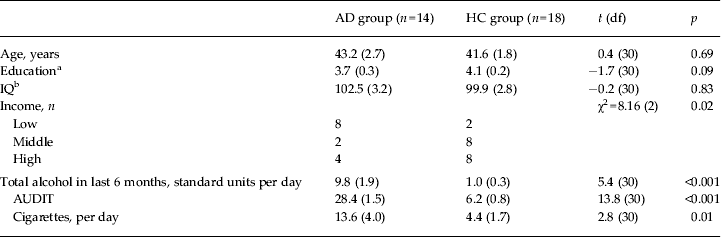
Demographic, clinical and substance use characteristics

Data are given as mean (standard error).
AD, Alcohol-dependent; HC, healthy control; df, degrees of freedom; IQ, intelligence quotient; AUDIT, Alcohol Use Disorder Identification Test; ISCED, International Standard Classification of Educational Degrees.
a Measured using the ISCED.
b Measured using the National Adult Reading Test.
Imaging data
Imaging data were analysed using Statistical Parametric Mapping (SPM8; Wellcome Trust Centre for Neuroimaging, UK). Functional images of each subject were realigned and unwarped, co-registered with the structural MRI image and segmented for normalization to a Montreal Neurological Institute (MNI) template. Finally, images were smoothed using an 8 mm full width at half maximum Gaussian kernel. Subject movement >3.5 mm in any direction resulted in exclusion of the data from further analysis.
Two main types of trial outcome were distinguished for each session: trials in which subjects selected the immediate reward and trials in which the subjects selected the delayed reward. In a first-level fixed-effects analysis, a statistical analytical design was constructed for each individual subject using the general linear model with the onset of the presentation of the trial, i.e. the display of the delayed and immediate reward options, until the subject made a response, convolved with a canonical haemodynamic response function. Subject-specific regressors were separately generated for: (1) selecting the immediate option (immediate choices); and (2) selecting the delayed option (delayed choices). To account for low-frequency signal drift a high-pass filter (1/128 Hz) was applied. Contrast images for immediate choices and delayed choices relative to an implicit baseline (no choice) were computed for each session. These contrast images were then entered into a second-level random-effects analysis using a full factorial design with treatment (placebo, modafinil) and condition (immediate choices, delayed choices) modelled as within-subject factors and group (AD v. HC) as a between-subjects factor, including session order and income as covariates, to investigate within-group effects of treatment and group × treatment interaction effects. Independent t tests, including covariates, were used to compare between-group effects on placebo and modafinil. We used MarsBaR (MARSeille Boîte À Région d'Intérêt; Brett et al. Reference Brett, Anton, Valabreque and Poline2002) to calculate the effect size of activity change within the regions obtained by these second-level analyses. The effect size measures were correlated with changes (modafinil > placebo) in AUC values in order to investigate the association between changes in brain activation and changes in behavioural performance.
To assess functional connectivity between brain regions associated with task performance that interacted with modafinil administration, we used a generalized form of psychophysiological interaction analyses (PPI; McLaren et al. Reference McLaren, Ries, Xu and Johnson2012); see the Supplementary material Methods section for details of the analyses.
We focused our imaging analyses on a priori regions of interest (ROIs) that have consistently been reported in previous neuroimaging studies using delay-discounting paradigms (McClure et al. Reference McClure, Laibson, Loewenstein and Cohen2004; Kable & Glimcher, Reference Kable and Glimcher2007; Wittman et al. Reference Wittmann, Leland and Paulus2007; Bickel et al. Reference Bickel, Pitcock, Yi and Angtuaco2009; Marco-Pallares et al. Reference Marco-Pallares, Mohammadi, Samii and Munte2010; Sripada et al. Reference Sripada, Gonzalez, Phan and Liberzon2011). These ROIs encompassed the lateral prefrontal cortex consisting of the superior frontal gyrus (SFG) and middle frontal gyrus, the lateral parietal lobe, the ACC extending to the supplementary motor area, the vmPFC, the PCC and the ventral striatum (online Supplementary Fig. S1). The six ROIs were selected from Nielsen and Hansen's volumes of interest defined in the Brainmap database (Nielsen & Hansen, Reference Nielsen and Hansen2002). Statistical tests had to meet p < 0.05, family-wise error (FWE) voxel-wise corrected for the spatial extent of the ROI separately for each of the six ROIs by using small volume correction as implemented in SPM (Worsley et al. Reference Worsley, Marrett, Neelin, Vandal, Friston and Evans1996) to be considered significant, unless indicated otherwise.
Results
Demographics and clinical assessments
Demographic, self-report and substance use characteristics are presented in Table 1. The AD group did not differ from the HC group with regard to age, educational level or IQ. AD patients smoked significantly more cigarettes than HC subjects. We did not include smoking as a covariate in subsequent analyses, because smoking behaviour was related to alcohol consumption during the past 6 months (r = 0.53, p = 0.05) and AUDIT scores (r = 0.47, p = 0.09). Therefore, including smoking as a covariate could also remove variance explained by problematic drinking. However, we did investigate whether there was a relationship between delay-discounting behaviour and number of cigarettes smoked, but no significant correlation between AUC values and number of cigarettes smoked was found (r = −0.09, p = 0.63).
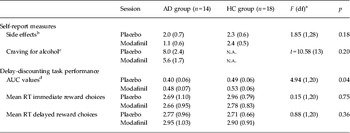
No serious adverse events were reported and self-reported withdrawal symptoms before the fMRI sessions were mild to absent (all below 10 on a scale from 0 to 30). Modafinil administration did not increase the number of side effects compared with the placebo condition. With regard to self-reported craving, we found no significant effect of modafinil (t 13 = 1.35, p = 0.20); see Table 2.
Effects of modafinil on self-report measures and delay-discounting task performance

Data are given as mean (standard error).
AD, Alcohol-dependent; HC, healthy control; df, degrees of freedom; n.a., not applicable, AUC, area under the curve; RT; reaction time.
a Results are presented for the treatment (placebo versus modafinil) × group (AD v. HC) interaction effect.
b Measured using a 15-item side effects checklist.
c Measured using the Alcohol Urge Questionnaire.
d Smaller values represent steeper discounting.
DDT performance
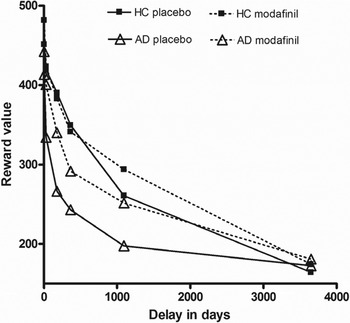
The repeated-measures analysis of covariance revealed a significant treatment effect (F 1,20 = 4.29, p = 0.05) and a significant treatment × group interaction effect (F 1,20 = 4.94, p = 0.04) on discounting delayed rewards (AUC values; Fig. 1 and Table 2). Post-hoc tests revealed that this effect was driven by a significant decrease in delay-discounting behaviour in the AD group after modafinil administration (F 1,8 = 9.3, p = 0.02), whereas modafinil had no effect in the HC group (F 1,12 = 0.01, p = 0.91). The AD and HC groups did not significantly differ in AUC values in the placebo (F 1,20 = 0.51, p = 0.48) or the modafinil condition (F 1,20 = 1.07, p = 0.31). For trials in which the immediate reward was chosen, no significant main effect of treatment, main effect of group or treatment × group interaction effect on reaction time was observed. With regard to trials in which the delayed reward was chosen, there was no main effect of group or group × treatment interaction effect, but there was a main effect of treatment on reaction time (F 1,20 = 4.21, p = 0.05), which was driven by a trend towards a slightly longer reaction time in the modafinil condition compared with the placebo condition across groups (t 31 = 1.76, p = 0.09).
Delay discounting in alcohol-dependent (AD) and healthy control (HC) subjects, separate for placebo and modafinil. Indifference points were plotted for each delay (in days) for AD and HC groups, separate for the placebo and modafinil conditions. There was a significant treatment × group interaction effect (F 1,20 = 4.94, p = 0.04) on area under the curve (AUC) values. Post-hoc tests revealed that this effect was driven by a significant increase in AUC values (i.e. reduced delay discounting) in the AD group, whereas modafinil had no effect in the HC group.

Across groups and within groups, baseline AUC values (placebo condition) and modafinil-induced changes in AUC values (AUC M > P) were not correlated with any of the demographic characteristics, severity of alcohol-related problems (AUDIT), amount of alcohol consumed in the past 6 months, abstinence duration, and baseline or modafinil-induced changes in craving or side effects.
Regional brain activations
Main effect of task
Main effects of task across sessions and groups for immediate and delayed choices are presented in online Supplementary Table S1 and Fig. S2. Replicating previous studies, areas of executive functioning (i.e. DLPFC and inferior prefrontal cortex and parietal cortex), conflict monitoring (ACC), limbic areas (striatum and thalamus) in addition to visual processing areas and middle temporal gyrus were activated during both the selection of the immediate and delayed reward option. In addition, the vmPFC, PCC, orbitofrontal cortex and lingual gyrus showed deactivation during the task. No significant differences in brain activation were found between immediate and delayed choices. Therefore, modafinil effects and group effects (AD v. HC on placebo and modafinil) were examined separately for immediate and delayed choices instead of immediate > delayed choices and vice versa.
Effects of modafinil on brain activation
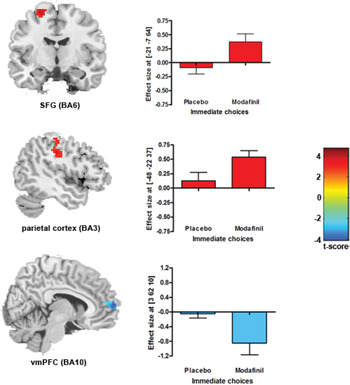
A significant group × treatment interaction effect was observed in the left SFG [rostral dorsolateral portion of Brodmann area (BA) 6] when selecting the immediate reward. Post-hoc tests comparing immediate choices in the modafinil condition with the placebo condition in each group showed a significant increase in activation in this left SFG (BA 6) region in addition to an increase in activation in a left lateral parietal region (LPC) in AD when selecting the immediate reward, as shown in Fig. 2. In addition, a significant modafinil-induced decrease in activation was found in the right vmPFC (BA 10). In HC subjects, no differences in brain activation between the modafinil and placebo conditions were found for immediate or the delayed choices. Post-hoc tests examining group differences in the placebo and modafinil condition when selecting the immediate reward revealed no significant differences at our a priori threshold (i.e. p < 0.05, FWE voxel-wise corrected for the spatial extent of each ROI). For exploratory purposes, we also applied a slightly more liberal threshold of p < 0.001 uncorrected, masked with our a priori defined ROIs to reduce the number of voxel-wise tests and hence the risk of type I error. Using this more liberal threshold, we found less activation in the left SFG (BA 6) in AD patients compared with HC subjects when selecting the immediate reward in the placebo condition. In the modafinil condition, there were no differences in brain activation between the AD and HC groups with regard to immediate choices. No group × treatment interaction effect was observed when selecting the delayed reward.
Modafinil-induced changes in brain activation during immediate choices in alcohol dependence (AD). Differences in neural activity between modafinil and placebo conditions during choices for immediate rewards in the AD group (statistical parametric maps and effect sizes at the peak voxels). Activity in regions displayed in red [left superior frontal gyrus (SFG) and parietal region] significantly increased after modafinil administration. Activity in the ventromedial prefrontal cortex (vmPFC) in blue significantly decreased after modafinil administration. The colour bar represents voxel T value. Coordinates on y axes are Montreal Neurological Institute coordinates. BA, Brodmann area.

For the AD group, we extracted the effect size of activity changes after modafinil administration during immediate choices (left SFG, left LPC and right vmPFC) to examine the correlation with the observed modafinil-induced changes in behavioural performance. No correlations between these modafinil-induced activity changes and reduction in discounting behaviour (AUC values) were found.
Changes in functional connectivity
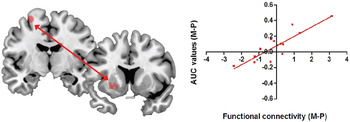
To examine whether modafinil-induced changes in functional connectivity of the SFG (BA 6), LPC and vmPFC with other brain regions during immediate choices were associated with the observed reduction in impulsive decision making (AUC values) in AD, PPI analyses were performed with the left SFG, left LPC and right vmPFC defined as seed regions by creating a 5 mm sphere centred at the peak voxel coordinates (SFG MNI coordinates: −21, −7, 64; LPC MNI coordinates: −48, −22, 37; vmPFC MNI coordinates: 3, 62, 10). We regressed the AD subjects’ PPI contrast images (immediate choices: modafinil > placebo) against their modafinil-induced changes in AUC values, including session order and income as covariates of no interest. For the LPC and vmPFC, we found no alterations in functional connectivity that were associated with changes in discounting behaviour. For the SFG, there was a significant positive correlation between connectivity strength of the SFG with the left ventral striatum extending into the putamen and changes in AUC values (Fig. 3), indicating that modafinil-induced reductions in delay discounting are accompanied by increased functional coupling of the left SFG with the left ventral striatum.
Correlation between increased functional connectivity and reduction in discounting after modafinil administration in alcohol dependence. Results of the regression analysis of modafinil-induced changes in effective connectivity against changes in discounting behaviour [area under the curve (AUC) values] revealed a significant effect of connectivity between the left superior frontal gyrus (SFG) (left brain slice) and left striatum (right brain slice). Improvement in delay-discounting behaviour was associated with an enhanced functional coupling between the left SFG and left (ventral) striatum. M, Modafinil; P, placebo.

Discussion
Our findings demonstrate beneficial effects of a single dose of modafinil on impulsive decision making in AD patients. These beneficial effects were accompanied by an enhanced recruitment of regions known to be involved in cognitive control (left SFG/BA 6 and left lateral parietal cortex) and decreased engagement of a region involved in tracking the subjective value of rewards (vmPFC) during choices for immediate rewards. In addition, the observed modafinil-induced decrease in delay discounting was specifically associated with an increased functional coupling between the left SFG and left ventral striatum.
The rostral dorsolateral portion of BA 6 including the SFG is part of the premotor cortex which is not only important in planning and execution of movements but is also active in cognitive tasks that do not involve any immediate overt movement (Hanakawa et al. Reference Hanakawa, Honda, Sawamoto, Okada, Yonekura, Fukuyama and Shibasaki2002; Abe et al. Reference Abe, Hanakawa, Takayama, Kuroki, Ogawa and Fukuyama2007). This part of the left BA 6 is largely connected to the dorsolateral PFC (Luppino et al. Reference Luppino, Rozzi, Calzavara and Matelli2003) and known to be involved in higher-order cognitive functions including future envisioning (Szpunar et al. Reference Szpunar, Watson and McDermott2007), reasoning (Golde et al. Reference Golde, von Cramon and Schubotz2010), regulation of perceptual conflict (Kim et al. Reference Kim, Chung and Kim2012) and complex mental calculations (Zago et al. Reference Zago, Pesenti, Mellet, Crivello, Mazoyer and Tzourio-Mazoyer2001). One may argue that these cognitive processes are all important for overruling short-sighted choices and consequently the ability to delay gratification. Indeed, neuroimaging studies examining delay discounting have implicated lateral prefrontal areas (McClure et al. Reference McClure, Laibson, Loewenstein and Cohen2004; Monterosso et al. Reference Monterosso, Ainslie, Xu, Cordova, Domier and London2007). In addition, we observed increased activation in the left lateral parietal cortex in AD patients after modafinil administration. Activation in these frontoparietal regions has been suggested to reflect biasing behaviour towards choosing the larger later reward rather than the smaller and sooner reward (McClure et al. Reference McClure, Laibson, Loewenstein and Cohen2004). Abnormalities of frontoparietal recruitment have been observed in substance dependence during delay discounting, including AD (Claus et al. Reference Claus, Kiehl and Hutchison2011), cocaine dependence (29) and methamphetamine dependence (Monterosso et al. Reference Monterosso, Ainslie, Xu, Cordova, Domier and London2007; Hoffman et al. Reference Hoffman, Schwartz, Huckans, McFarland, Meiri, Stevens and Mitchell2008). In the placebo condition, when selecting the immediate reward, the AD group compared with the HC group showed reduced activity in the exact same left SFG region where a modafinil-induced increase in activation was observed. Although this effect was only observed at a more liberal threshold, the current findings may suggest that modafinil normalizes frontal engagement during delay discounting in AD patients, thereby possibly increasing cognitive control.
Modafinil also reduced activation in the vmPFC in AD subjects, an area associated with the subjective valuation of reward (McClure et al. Reference McClure, Laibson, Loewenstein and Cohen2004; Kable & Glimcher, Reference Kable and Glimcher2007) in addition to self-referential processes as part of the ‘default mode network’ of the brain (for a review, see Buckner et al. Reference Buckner, Andrews-Hanna and Schacter2008). The vmPFC has repeatedly been shown to correlate with steeper discounting of delayed rewards (see, for example, Kable & Glimcher, Reference Kable and Glimcher2010; Mitchell et al. Reference Mitchell, Schirmer, Ames and Gilbert2011; Sripada et al. Reference Sripada, Gonzalez, Phan and Liberzon2011). Reduced activation during immediate choices in the modafinil condition could indicate that AD patients were less engaged in self-referential processes needed to valuate the immediate reward, whereas this area responded more strongly to the temptation of an instantaneous reward in the placebo condition.
The modafinil-induced reduction in vmPFC activation and enhanced activation of the dorsolateral BA 6 and lateral parietal cortex during immediate choices were not directly associated with the observed improvements in behavioural indices of delay discounting. However, an increased functional coupling between the left dorsolateral BA 6 and the ventral striatum was related to the increased ability to delay gratification by modafinil in AD subjects. Therefore it appears that modafinil exerts its impulsivity-reducing effects in AD subjects through enhancing connectivity between brain circuits instead of merely altering recruitment of individual brain regions. Anatomically, the striatum receives afferent (input) fibres from the rostral dorsolateral part of BA 6 (Tachibana et al. Reference Tachibana, Nambu, Hatanaka, Miyachi and Takada2004; Calzavara et al. Reference Calzavara, Mailly and Haber2007), which mainly release excitatory neurotransmitters such as glutamate. Previous work has indeed indicated that modafinil elevates glutamate release in the striatum (Ferraro et al. Reference Ferraro, Antonelli, O'Connor, Tanganelli, Rambert and Fuxe1998) and glutamine synthetase in frontoparietal regions (Touret et al. Reference Touret, Sallanon-Moulin, Fages, Roudier, Didier-Bazes, Roussel, Tardy and Jouvet1994) in rats. Increased structural and functional connectivity between the PFC and striatum have been related to increased cognitive control (Liston et al. Reference Liston, Watts, Tottenham, Davidson, Niogi, Ulug and Casey2006; Wolf et al. Reference Wolf, Sambataro, Vasic, Schonfeldt-Lecuona, Ecker and Landwehrmeyer2008; Hanlon et al. Reference Hanlon, Wesley, Stapleton, Laurienti and Porrino2011), indicating that modafinil improved impulsive decision making in AD subjects by enhancing prefrontal control over ventral striatal reward processing.
Of note, modafinil-induced changes in brain activation and connectivity were only observed during the selection of the immediate reward option. Enhanced SFG activation and SFG–ventral striatum connectivity in addition to decreased vmPFC activation during immediate choices by modafinil administration could reflect a more rational/deliberate instead of an impulsive decision when choosing the immediate reward, subsequently leading to an overall reduction in delay discounting. A study of Wittmann et al. (Reference Wittmann, Lovero, Lane and Paulus2010) indicated that ventral striatal activity is specifically associated with choosing the immediate reward and not the delayed reward, which might explain the currently observed increased prefrontal coupling with the ventral striatum only during immediate choices. However, whether separate neural systems are involved in the valuation of immediate and delayed rewards remains a topic of debate.
Interestingly, in our previous study examining the effects of modafinil on neural correlates of response inhibition in the same AD subjects, modafinil only improved performance on the stop signal task through enhanced brain activity and connectivity in AD patients with initial poor performance (Schmaal et al. Reference Schmaal, Joos, Koeleman, Veltman, Van den Brink and Goudriaan2013b ), whereas in the present study modafinil administration reduced delay discounting in the whole group of AD patients. These differential effects of modafinil are similar to the differential effects of amphetamine and atomoxetine on distinct forms of impulsivity (i.e. response inhibition and impulsive decision making) observed in preclinical studies (Baarendse & Vanderschuren, Reference Baarendse and Vanderschuren2012; Broos et al. Reference Broos, Schmaal, Wiskerke, Kostelijk, Lam, Stoop, Weierink, Ham, De Geus, Schoffelmeer, Van den Brink, Veltman, De Vries, Pattij and Goudriaan2012b ; Sun et al. Reference Sun, Cocker, Zeeb and Winstanley2012), suggesting a separate role for dopamine and noradrenaline transmission underlying these differential modafinil effects. There is consistent evidence that impulsivity is not a unitary construct, but rather is dissociable into different independent aspects including response inhibition and impulsive decision making (e.g. Broos et al. Reference Broos, Schmaal, Wiskerke, Kostelijk, Lam, Stoop, Weierink, Ham, De Geus, Schoffelmeer, Van den Brink, Veltman, De Vries, Pattij and Goudriaan2012b ). The distinct effects of modafinil on different cognitive domains fit the inverted U-shaped relationship between catecholamine neurotransmitter (including dopamine and noradrenaline) levels in the PFC and cognitive performance (Cools & D'Esposito, Reference Cools and D'Esposito2011). This inverted U-shaped curve implies that there is an optimum for catecholamine neurotransmitter levels to efficiently execute cognitive tasks, in which both excessive and deficient levels impair cognitive performance. Moreover, these optimum levels can be different for different cognitive tasks. This explains the often-observed differential effects of drugs influencing catecholamine transmission across different individuals that perform the same task or within the same individual across different tasks (Cools et al. Reference Cools, Barker, Sahakian and Robbins2001, Reference Cools, Barker, Sahakian and Robbins2003; Mehta et al. Reference Mehta, Manes, Magnolfi, Sahakian and Robbins2004).
No effects of modafinil on both behavioural and neural indices of delay discounting were found in HC subjects. These findings are consistent with previous observations that modafinil exerts its effects primarily in individuals that show poor initial performance on cognitive tasks (Spence et al. Reference Spence, Green, Wilkinson and Hunter2005; Hunter et al. Reference Hunter, Ganesan, Wilkinson and Spence2006; Kalechstein et al. Reference Kalechstein, De La Garza and Newton2010; Finke et al. Reference Finke, Dodds, Bublak, Regenthal, Baumann, Manly and Müller2010), probably also indicating that there was minimal room for improvement in the HC group.
It is important to stress that our results should be viewed in the light of some limitations. First, the groups were not adequately matched on smoking behaviour. We decided not to include smoking behaviour as a covariate because of its high association with alcohol-related problems and the risk of overcorrection resulting in a serious reduction of the variance in problematic drinking. However, we did show that behavioural performance was not associated with smoking behaviour. Nevertheless, it should be noted that the observed effects of modafinil in AD subjects may be partly due to alcohol-related smoking. In addition, at baseline (placebo) no significant differences in delay discounting (AUC) were found between the AD and HC group, although AD patients displayed nominally smaller AUC values than HC subjects, which may be explained by the relatively small sample size. Likewise, although modafinil induced robust changes in SFG activity as well as SFG-subcortical connectivity in AD patients, baseline SFG differences between groups were only evident at a slightly lower threshold, which is probably also due to limited power.
Taken together, the current study provides new insights into the neural correlates of the effect of modafinil on impulsive decision making. Moreover, our results indicate that modafinil can improve impulsive decision making, which is important for the treatment of AD since the inability to delay gratification has been shown to predict relapse into substance abuse (MacKillop & Kahler, Reference MacKillop and Kahler2009; Stanger et al. Reference Stanger, Ryan, Fu, Landes, Jones, Bickel and Budney2011). Boosting impulse control may help patients to resist the immediate rewarding properties of drinking alcohol and to take future negative consequences of alcohol use more into account. Modafinil may therefore constitute a useful adjunct in the treatment of AD. Future clinical trials are needed to substantiate this promise.
Supplementary material
For supplementary material accompanying this paper visit http://dx.doi.org/10.1017/S0033291714000312.
Acknowledgements
We thank the Netherlands Organization for Scientific Research for their financial support (ZonMW grant no. 31160003).
The authors assert that all procedures contributing to this work comply with the ethical standards of the relevant national and institutional committees on human experimentation and with the Helsinki Declaration of 1975, as revised in 2008.
Declaration of Interest
None.