

Introduction
Same-sex marriage (SSM) has become one of the most controversial social policy issues of our time. While debates over gay and lesbian rights have unfolded over several decades, only recently has SSM risen to the top of the social agenda in numerous European and American countries. These debates have resulted in the recognition of the right of same-sex couples to marry in approximately twenty countries, starting with the Netherlands in 2001. The process has been partly fueled by a change in public opinion in several Western countries (Pew Research Center 2017b), a change in attitudes that has been unmatched in its scope and speed by other social and moral issues. In the United States, for example, support for SSM has increased from 35 percent in 2001 to 62 percent in 2017 (Pew Research Center 2017a). Scholars have begun to analyze these changes in public opinion with attention to the variance that exists across demographic groups. Nevertheless, while we have learned much in the last decade about these attitudes in advanced industrialized democracies, we still know relatively little about public attitudes toward SSM elsewhere (Reference BrewerBrewer 2014).
Notoriously lacking from this scholarship are analyses of attitudes about SSM in Latin America, an absence that seems rather puzzling given that—despite widely and deeply held stereotypes that characterize it as conservative and machista—the region is at the forefront in the expansion of sexual minority rights. Indeed, by the end of 2016, SSM was legal in countries in which over 80 percent of Latin Americans live.Footnote 1 The scant scholarly attention might have been justified earlier given the lack of public opinion data on the subject. However, since the debate intensified in 2010 in the first Latin American countries to adopt SSM (Argentina and Mexico), we now have reliable cross-national polling data on attitudes on SSM in the region.Footnote 2
In this study, the first of its kind, we explore the evolution and variation of attitudes toward SSM in Latin America with attention to the role new media may play in shaping public opinion. As the debate over SSM has gone global, and as Latin Americans have become increasingly connected to the world through the expansion of information technology, it seems warranted to explore the extent to which exposure to debates over SSM is associated with individual attitudes. Research on attitudes toward SSM outside Latin America suggests that positive media coverage plays an important role in lowering prejudices and improving attitudes toward gay people (Reference RiggleRiggle 1996; Reference Schiappa, Gregg and HewesSchiappa, Gregg, and Hewes 2006), but we do not yet know how these relationships play out in Latin America. Latin America offers a unique opportunity to carry out such analysis given that it is the region outside the global North in which the debate over SSM has been the fiercest, while at the same time it offers a great deal of variance across variables that we know influence liberal attitudes, such as levels of economic development, democratic quality, and access to new media. It also exhibits a great deal of variance in support for SSM: from 10 percent in El Salvador to 67 percent in Uruguay (LAPOP 2012). We explore survey data from the AmericasBarometer for eighteen countries in 2010, 2012, and 2014 to examine the ways in which individual-level news consumption and Internet use interact with support for SSM, exploring four specific hypotheses. Our findings suggest that not only is Internet use associated with greater support for SSM, but that when Internet use and news consumption coincide, that association is amplified. Furthermore, Internet use is more strongly and positively associated with support for SSM in more connected societies.
New Media, Tolerance, and Support for SSM
Interest in exploring the relationship between mass media and social attitudes is not new. Indeed, the role media play in shaping social attitudes was central to modernization theory in the 1950s and 1960s. Influenced by the behavioral revolution in the social sciences during the postwar years, and adopting a teleological approach to the study of economic and political progression, modernization theorists argued that traditional values were one of the main obstacles to development. What was needed to foster development, according to their reasoning, was changing traditional values to “modern” values. Some of this work, such as that of Walt Rostow (Reference Rostow1959), emphasized the perceived dialectic relationship that exists between economic growth and political development: an acceleration of the former would lay the foundations for democracy and more “civic” societies, which would in turn foster further economic growth. In subsequent scholarly and policy debates, modernization theory was largely equated with these arguments.
While mass media have been less studied, some theorists focused on the role that they play in modernization and argued that it was the key agent in bringing about development. Daniel Lerner (Reference Lerner1958) saw mass media as the main catalyst for social change. Lerner argued that media exposed people who possess traditional values to the “modern” world, and that exposure in turn produced a desire to live in it. For him, media enabled the modernization process: “the importance of media in our theory is that it enlarges a person’s view of the world (‘opinion range’) and his capacity to imagine himself in new and strange situations (‘empathy’) in ways that will alter action” (Reference LernerLerner 1958, 96). This process, he suggested, fosters ideas of equality and tolerance through empathy; empathy induces action and thought that attempt to emulate modern life. A handful of empirical studies based on focus groups, interviews, or surveys of individuals in Latin America starting in the early1960s established an empirical link between media consumption and attitudes such as empathy and support for democracy, among others (e.g., Reference McNellyMcNelly 1966; Reference RogersRogers 1965; Reference BishopBishop 1973).
Lerner’s arguments were expectedly later criticized. For some, they did not consider the fact that access to mass communication can be highly unequal in some countries in the global South. Work on Latin America, for example, showed that, in rural areas, media are often dominated by elites (Reference Beltrán S.Beltrán 1976). It was also argued that the effects of mass communication on values were not as direct as Lerner had suggested. While agreeing with the main tenets of modernization, it was argued that in addition to media, other factors, such as literacy and travel, also contribute to the process (Reference RogersRogers 1965). More fundamentally, however, Lerner’s arguments, like other modernization arguments, were dismissed for their inherently normative bias as they saw modern societies as being superior (Reference SchillerSchiller 1969; Reference HedebroHedebro 1982).
Despite criticisms leveled against modernization theory, and its subsequent decline in prominence in the social sciences in the 1970s and 1980s, recent work by Ronald Inglehart and his collaborators has lent credence to some of its main tenets (Reference Norris and InglehartNorris and Inglehart 2009; Reference Inglehart and WelzelInglehart and Welzel 2005). Equipped with reliable longitudinal data newly available, this scholarship demonstrates that there exists an association between levels of economic development and the adoption of “self-expression” values, such as support for gender equality and tolerance for homosexuality. Indeed, some of this research shows that the role of the media appears to be important and suggests that mass media play a role in shaping social values. According to Pippa Norris and Inglehart (Reference Norris and Inglehart2009), access to news media and the adoption of liberal attitudes are related; as individuals internalize media messages, they ultimately change their worldviews (see also Reference Berggren and NilssonBerggren and Nilsson 2015). While they do not suggest monocausality, as Lerner had previously claimed, mass media is one of the factors, inter alia, that can have an effect on the development of socially liberal values.
That a relationship between exposure to mass media, particularly news media, and attitudes exists has been supported by additional scholarship, particularly in the United States (Reference Delli Carpini and KeeterDelli Carpini and Keeter 1996). Ben Brake and Peter Katzenstein argue that transnational technological interactions can lead to changing “beliefs, or alter our confidence in those beliefs because of new observations, interpretations, or repertoires in practice” (Reference Brake and Katzenstein2013, 747). In terms of tolerance for homosexuality, research supports the existence of that relationship (Reference Schiappa, Gregg and HewesSchiappa, Gregg, and Hewes 2006; Reference BrewerBrewer 2008; Reference RiggleRiggle 1996; Reference Berggren and NilssonBerggren and Nilsson 2015). Based on social contact theory, which suggests that individuals become more tolerant of groups as they interact with them, some scholars have shown that contact with “imagined” or “vicarious” communities that are diffused through mass media can have an effect on lowering prejudices and improving attitudes toward gay people (Reference RiggleRiggle 1996; Reference Schiappa, Gregg and HewesSchiappa, Gregg, and Hewes 2006). Yet, while we know much about these phenomena in the countries of the global North, we do not know how they play out in Latin America, especially regarding attitudes toward SSM. The absence of scholarship is partly due to the fact that since SSM had not been placed on national agendas, pollsters did not include survey questions that probed public support. This situation changed when debate in Argentina and Mexico in 2009 accelerated as legislatures in both countries began to discuss the issue, galvanizing support and opposition (Reference DíezDíez 2015). Pollsters began to include questions in surveys in 2010, and there now exist reliable survey data on support for SSM for most Latin American countries. The availability of such data allows us to explore the relationship between access to mass media and attitudes toward SMM in Latin America, a relationship that has not yet been explored.
Given the increased access most Latin Americans have had to media sources, fueled largely by the freer flow of goods and services resulting from globalization, and the fact that SSM has become over the last five years the main social issue associated with sexual rights in the region, it seems warranted to explore whether such a relationship exists. The region exhibits a great deal of variance on several aspects, such as economic development and democratic quality, that are known to be correlated with self-expression values (Reference InglehartInglehart 1988). Further, availability and Internet use have also expanded rapidly, if unevenly, throughout the region. Even among regional laggards—such as Nicaragua, Honduras, and Guatemala—Internet use increased from 10–11 percent of the population in 2010 to 17–23 percent in 2014. In the most developed economies of the region, such as Argentina, Chile, and Uruguay, Internet use during the same period increased from about 45 percent of the population in 2010 to 61–72 percent just four years later (ITU 2015). These changes in information and communication technology access and use are important not only because they provide insight into cross-national variation in individuals’ exposure to international information and the Internet, but also because the larger the national Internet market, the more likely that national news and information sources will develop to address the information needs of national populations.
Based on these insights from the extant literature on media consumption and liberal values such as social tolerance, we offer the following hypotheses related to support for SSM in Latin America:
Hypothesis 1: Individual news consumption is associated with a higher probability of supporting SSM.
We test this hypothesis by examining the association between how often individuals pay attention to the news and support for SSM. However, not all media are created equal, and access and content, as Lerner’s critics pointed out decades ago, can be controlled by sociopolitical elites. Even now, media ownership can be highly concentrated, particularly in less economically developed countries and subnational regions, and national media still often depend on the state for a significant portion of their advertising revenue (Reference Waisbord, Semetko and ScammellWaisbord 2012). A recent study in Singapore, for example, shows that exposure to traditional media (which is highly censored) has no effect on levels of support for SSM, whereas exposure to the Internet has a significant positive effect (Reference Chitra Panchapakesan and HoChitra Panchapakesan and Ho 2014). In Latin America, great variation in freedom of the press persists. Indeed, whereas countries such as Costa Rica and Uruguay are considered to possess a free press, others, such as Mexico and Venezuela, are not (Freedom House 2012). The other countries fall somewhere in between. We therefore hypothesize that exposure to different kinds of media will have a differentiated association with levels of support for SSM. Specifically, we assume that there exists freer access to content through the Internet than through traditional news sources:
Hypothesis 2: Individual Internet use will be associated with a higher probability of supporting SSM.
We were also interested in learning about the association of exposure to news with the Internet. The content to which Latin Americans are exposed through new media obviously varies: some individuals may use these types of media simply for entertainment or to communicate with friends, not to follow the news. We know that, in Latin America, tolerant attitudes toward homosexuality among adolescents are positively correlated with discussing politics and media exposure (Reference Chaux and LeónChaux and León 2016). While we know that individuals tend to select media channels that match their belief systems (Reference StroudStroud 2008), unintended exposure to different perspectives can also change individuals’ attitudes and opinions (Reference Li and LiuLi and Liu 2013). We assume, then, that if someone pays frequent attention to the news and they also frequently use the Internet, they are much more likely to encounter normalizing news than if they are frequent Internet users but do not pay attention to the news:
Hypothesis 3: The probability of supporting SSM will be highest among those who both follow the news and access the Internet frequently.
Finally, the association between individual Internet use and support for SSM is likely to vary across different levels of national Internet use, which is also correlated with levels of national economic development. Latin America is, after all, the region with the highest levels of inequality in the world, and we know that access to digital media is correlated with levels of economic prosperity, not only in Latin America (Reference Hawkins and HawkinsHawkins and Hawkins 2003), but globally (Reference Chinn and FairlieChinn and Fairlie 2007). In particular, in more developed economies in which a greater share of the population regularly uses the Internet, individual Internet use should have a stronger positive association with support for SSM. This is consistent with Norris and Ingelhart’s (Reference Norris and Inglehart2009) observation that new media helps disseminate self-expression values. To test this possibility, we advance a fourth, and final, hypothesis:
Hypothesis 4: Internet use is associated with higher levels of support for SSM in societies with more Internet access.
Measuring Support for SSM and Its Covariates
To test these hypotheses, we analyze three years of AmericasBarometer surveys conducted in eighteen countries of Latin America (LAPOP 2012), each including nationally representative samples (LAPOP 2010, 2012, 2014). The countries included are Argentina, Bolivia, Brazil, Chile, Colombia, Costa Rica, Dominican Republic, Ecuador, El Salvador, Guatemala, Honduras, Mexico, Nicaragua, Panama, Paraguay, Peru, Uruguay, and Venezuela. The sampling error across national samples is on average approximately ±2.5 percent. The dependent variable is each respondent’s answer to a question regarding how strongly they approve (or disapprove) of same-sex couples having the right to marry (or in Spanish, casarse). The original responses ranged from one (strongly disapprove) to ten (strongly approve) and were highly polarized at the two extremes in all countries. The responses were therefore recoded into a dichotomous measure of support for same-sex marriage. The variation in national support for SSM in 2010 and 2014 is illustrated in Figure 1. In all but the two countries with lowest support for SSM (Guatemala and Honduras), support either did not change significantly or increased significantly between 2010 and 2014.
Support for same-sex marriage in Latin America, 2010 and 2014.

In order to assess the relationship between media consumption on support for SSM, we include several individual- and country-level covariates. Table 1 summarizes the variable definitions and hypothesized association with SSM support. First, individual media consumption, which is expected to be associated with a higher probability of supporting SSM, is measured in three ways. Internet use is measured on a five-point scale, ranging from never using the Internet to daily Internet use. Similarly, news consumption is measured using a question asking how often respondents pay attention to the news, which ranges from never to daily on a five-point scale. We also include an indicator for those individuals who live in households with a computer.
Variable definitions and hypotheses.

Sources: Individual-level data and the percent Catholic or conservative Christian are from LAPOP (2010, 2012, 2014), recoded by the authors. Remaining country-level indicators are economic development (Reference Feenstra, Inklaar and TimmerFeenstra, Inklaar, and Timmer 2013), democracy (Reference Marshall, Gurr and JaggersMarshall, Gurr, and Jaggers 2014), and Internet use (ITU 2015).
At the country level, we account for the contextual effects of democracy in the year prior to the survey, using a country’s Polity IV score, which ranges from negative ten to positive ten for full democracy (Reference Marshall, Gurr and JaggersMarshall, Gurr, and Jaggers 2014). As an additional measure of the modernization thesis, we include level of economic development, using gross domestic product in 2005 USD per capita from the previous year (Reference Feenstra, Inklaar and TimmerFeenstra, Inklaar, and Timmer 2013). Finally, we also examine the levels of Internet penetration at the national level with the percentage of the population who uses the Internet (ITU 2015). Both economic and political development and Internet penetration are expected to be associated with a higher average baseline probability of supporting SSM in each country.
In addition to our core theoretical measures, we include a range of additional individual and country-level controls that are generally understood to influence support for SSM. In Latin America, national debates about the right to SSM are often framed by gay and lesbian activists and allies as an issue of human rights and democratic values (Reference DíezDíez 2015). Previous research has established that those who express support for democracy and democratic values are more likely to support SSM in Latin America (Reference Dion and DíezDion and Díez 2017). We include an indicator for support for democracy that measures the extent to which respondents agree that despite its problems, democracy is the best form of government, on a seven-point scale, which is a most common measure of respondents’ commitment to democracy and has been found to be highly correlated with other measures of democratic values (Reference Córdova and SeligsonCórdova and Seligson 2010; Reference SeligsonSeligson 2007).
Meanwhile, the primary opponents to SSM in Latin America have been Catholic and evangelical Protestant religious leaders, who have framed their opposition as one based on religious and traditional family values (Reference EncarnaciónEncarnación 2011, Reference Encarnación2016; Reference DíezDíez 2015). Furthermore, much of the research on cross-national attitudes has found that religious individuals express less support for SSM (Reference Olson, Cadge and HarrisonOlson, Cadge, and Harrison 2006, 346; Reference Andersen and FetnerAndersen and Fetner 2008; Reference Adamczyk and PittAdamczyk and Pitt 2009; Reference Sherkat, Powell-Williams, Maddox and de VriesSherkat et al. 2011, 174; Reference Akker, van der Ploeg and ScheepersAkker, Ploeg, and Scheepers 2013, 70–71). We measure subjective religiosity with a question on the importance of religion in the respondent’s life, ranging from “not at all” important to “very” important on a four-point scale. Those who identify as either Catholic or one of several conservative Christian denominations (evangelical, Church of Latter-Day Saints, or Jehovah’s Witness) are also expected to express less support for SSM than others, including nonbelievers, nonreligious believers, and those with other religious identities (Reference Brouwer, Gifford and RoseBrouwer, Gifford, and Rose 2013; Reference EncarnaciónEncarnación 2011, 114; Reference EncarnaciónEncarnación 2013, 706–708; Reference FriedmanFriedman 2012, 44–45; Reference Boas, Smith, Carlin, Singer and ZechmeisterBoas and Smith 2015; Reference Adamczyk and PittAdamczyk and Pitt 2009; Reference VaggioneVaggione 2010; Reference PettinicchioPettinicchio 2012, 543–546; Reference Akker, van der Ploeg and ScheepersAkker, Ploeg, and Scheepers 2013, 67–68). Finally, we include country-level measures to control for the proportion of respondents in a given country-year who self-identify as Catholic or one of several conservative Christian faiths (evangelical, Church of Latter-Day Saints, or Jehovah’s Witness).
Some literature has linked tolerance, including support for SSM, to both individual and national short-term changes in economic circumstances (Reference Persell, Green and GurevichPersell, Green, and Gurevich 2001; Reference Andersen and FetnerAndersen and Fetner 2008). We use two questions that ask respondents to evaluate the national economic situation and their personal economic situation compared to the prior year, and the responses range from worse (negative one) to better (positive one). Education also controls for socioeconomic status, and ranges from no formal schooling through some primary, secondary, or tertiary schooling. Older respondents are expected to be less supportive of SSM, given existing research (Reference Lewis and GossettLewis and Gossett 2008; Reference Andersen and FetnerAndersen and Fetner 2008; Reference Adamczyk and PittAdamczyk and Pitt 2009). Age is coded into a measure that groups respondents into half generations from under thirty, thirty-one through forty-five, forty-six through sixty, and over sixty. Women are also expected to be more likely to support SSM (Reference Wilcox, Wolpert, Rimmerman, Wald and WilcoxWilcox and Wolpert 2000). Those that are currently married or living together as if married (partnered) and those formerly partnered (separated, divorced, or widowed) are expected to be less likely to approve of the right to SSM than those who are single. Similarly, those with children or larger numbers of children are less likely to approve of SSM (Reference Adamczyk and PittAdamczyk and Pitt 2009). Finally, those who live in the national capital are expected to be more likely to support same-sex marriage (Reference Stephan and McMullinStephan and McMullin 1982; Reference FloresFlores 2014). We also control for ideological predisposition with respondents’ self-placement on a scale from one (right) to ten (left), and we expect those who identify themselves as more ideologically left to be more supportive of SSM.
Analytical Strategy and Results
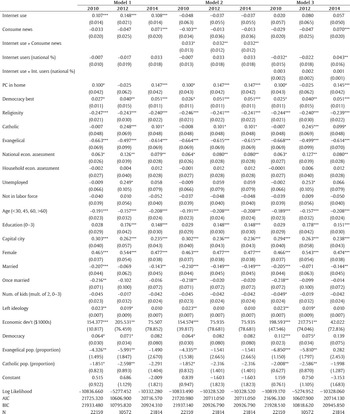
Two characteristics of the data shape our analytical and methodological strategy. First, due to the polarized distribution of support for SSM, the dependent variable is coded as a dichotomous measure of approval of SSM, requiring the use of logistic regression. Second, each survey respondent is nested within a particular country-year, which enables us to explore cross-national variations in the national baseline probability of approving of SSM as well as cross-national or temporal variations in individual-level regression coefficients. Given this data structure, we estimate mixed effects models that combine fixed effects (or estimates) for most variables while allowing the intercepts to vary (with random effects) by country-year of the survey. Estimates for three models across pooled samples of all respondents in 2010, 2012, and 2014 are included in Table 2. Slightly different specifications test the hypotheses outlined above. Models 1 and 2 include fixed estimates for individual-level and country-level covariates and random intercepts for each country-year, and Model 3 is the same, but random coefficients by country-year estimated for Internet use.
Mixed effects logistic regression models of support for SSM.

*p < .05; **p < .01; ***p < .001.
Note: All models include fixed estimates for all individual and country-level indicators and random effects for country-years. Model 3 also includes random coefficients for individual Internet use. Standard errors in parentheses. Models estimated using lme4 (Reference Bates, Maechler, Bolker and WalkerBates et al. 2014) in R (3.2.0).
Model 1 provides evidence to evaluate Hypotheses 1 and 2. The estimates suggest that paying attention to the news (Hypothesis 1) has a modest positive, but statistically insignificant, association with support for SSM. To describe the substantive size of the logistic regression coefficients, we refer to odds ratios, which describe the change in the odds of supporting SSM (as opposed to not supporting SSM) as a particular independent variable increases by one unit (continuous variables) or changes category (dichotomous variables). According to Model 1, each additional increase in attention to the news is only associated with less than 1 percent higher odds of supporting SSM, which is negligible.
However, additional insights are available when we consider the results disaggregated over time. We also estimated the three models in Table 2 separately for each year of data—2010, 2012, and 2014—and the results and figure are available in the appendix. The variation in the coefficient for attention to the news varies over time and is statistically significant in each of the separate years. Specifically, in both 2010 and 2012, attention to the news is associated with a lower probability of supporting SSM, and each increase in attention to the news is associated with 3.2 percent and 4.6 percent lower odds of support in each respective year. In contrast, in 2014, increased attention to the news is associated with higher probabilities of support, or about 7.3 percent higher odds. Even though we do not measure the content of news coverage directly, these findings would be consistent with changes in news coverage on SSM over time, particularly as SSM was legalized through legislation or the courts in several Latin American countries (Argentina, Brazil, Mexico, and Uruguay).
We also hypothesized that new media use would be positively associated with support for SSM (Hypothesis 2), perhaps even more strongly than news consumption. According to Model 1, individual Internet use is positively and significantly associated with the probability of supporting SSM. Each additional increase on the scale of Internet use increases the odds of supporting SSM by approximately 12.2 percent in the pooled sample. Figure 2 illustrates the substantive size of the effect of individual Internet use. These results indicate that individual exposure to the Internet, which is less likely to be filtered or constrained by government, is more consistently associated with a higher probability of SSM support than news consumption. Also, unlike news consumption, the relationship between Internet use and SSM support is consistently positive and significant even when we disaggregate the data by year (see appendix). Substantively, increased Internet use is associated with 11.2 percent, 15.9 percent, and 11.3 percent higher odds of support in 2010, 2012, and 2014, respectively.
Individual Internet use and support for same-sex marriage, 2010–2014.

To test our third hypothesis, that the combination of higher levels of Internet use is associated with particularly high probabilities of supporting SSM, Model 2 builds on Model 1 by adding an interaction between individual Internet use and paying attention to the news. The interaction is statistically significant, which means that the effect of Internet use varies significantly depending on how much a respondent pays attention to the news. As depicted in Figure 3, the predicted probabilities of supporting SSM are consistent with our expectation that those who pay attention to the news and use the Internet daily are much more likely to support SSM. We believe this is because those who both pay attention to the news and use the Internet daily are likely to encounter news online that helps diffuse global attitudes about SSM. Meanwhile, for those that use the Internet often, but who do not pay attention to the news, the Internet is likely to be a source of entertainment or social interaction, which are not necessarily associated with encountering new information related to SSM. This interaction between Internet use and news consumption is also evident and significant when the data are disaggregated by year (see appendix).
Individual Internet use, attention to the news, and support for same-sex marriage, 2010–2014.

Finally, to test Hypothesis 4 that national levels of Internet use will increase the association of individual Internet use with SSM support, we interact national Internet penetration with individual Internet use. In Table 2, Model 3, this interaction effect is statistically significant: the effect of individual Internet consumption is statistically different at different levels of national Internet penetration. However, this interaction does not reach standard levels of statistical significance when the data are disaggregated by year (see appendix). Figure 4 illustrates the predicted probabilities associated with this interaction between national and individual levels of Internet use. As expected, among those who never use the Internet, increased national rates of Internet use are not associated with an individual’s probability of supporting SSM. This suggests that people who never use the Internet are not any more or less likely to support SSM regardless of whether most other people are on the Internet. In contrast, for those who use the Internet every day, as a larger percentage of the national population is on the Internet, the probability of supporting SSM increases quite rapidly, such that the average probability of supporting SSM is about 0.30 for those who use the Internet daily in societies where about 60 percent of the population is online compared to about 0.25 when only 10 percent of the population is online. Put differently, when the proportion of the national population online is less than 18 percent, there is no significant difference in the probability of supporting SSM between those who are never online and those online daily.
National Internet penetration, Internet use, and same-sex marriage support, 2010–2014.

The model estimates also provide insights into the relationship between national-level characteristics, including economic development, quality of democracy, and religious identities, and the average baseline probability that respondents will support SSM. For example, higher levels of economic development are associated with statistically and substantively higher baseline probabilities of SSM support. Meanwhile, the effects of democratic quality are statistically significant but substantively small. Each additional increase in the quality of democracy increases the odds of supporting SSM by about 6 percent across Models 1–3. Higher proportions of evangelical and Catholic populations are associated with significantly lower baseline probabilities of supporting SSM. Together these results are generally consistent with notions that more economically developed, secular, and democratic societies express greater support for SSM.
Though not central to our research hypotheses, it is worth noting that the rest of our model results are consistent with expectations based on the extant literature. According to Models 1–3, each additional increase in expressed individual-level support for democracy is associated with approximately 4 percent higher odds of supporting SSM. Meanwhile, each additional increase in subjective religiosity is associated with about 21.5 percent lower odds of supporting SSM. Evangelical Christians have significantly lower (about 45 percent) odds of supporting SSM, compared to nonbelievers, nonreligious believers, and those of other religions (the reference category). The results also indicate that Catholics have about 9 percent higher odds of supporting SSM compared to the reference category. However, Catholics’ odds of supporting SSM vary over time. In 2010, the results indicate that Catholics had lower odds than those in the reference category of support and higher odds in 2012 and 2014 (see appendix). As an individual’s political ideology becomes more left, their odds of supporting SSM increase by a modest though statistically significant 1.6 percent.
Individual or household socioeconomic status is also related to support for SSM, though not always in robust or significant ways. For example, the odds of supporting SSM are significantly higher in households that have a personal computer (10 percent higher odds) and in households located in the capital city (30.8 percent higher odds). More positive subjective evaluations of the national and household economic situation are also significantly associated with higher odds of supporting SSM, though the increase in the odds is only about 8 percent for national and less than 1 percent for household evaluations. Employment status is not significantly associated with different probabilities of supporting SSM. The odds of supporting SSM also significantly increase, by about 10 to 11 percent, with each additional level of education completed.
Demographic characteristics are also useful for understanding which groups are more likely to support for SSM in Latin America. Younger, female, and single individuals are all statistically more likely to support SSM. Women have 62 percent higher odds of supporting SSM than comparable men. Single individuals have about 12 to 15 percent higher odds of expressing support for SSM than married or formerly married individuals. Meanwhile, each half generation of older individuals has about 17 percent lower odds of supporting SSM than the half generation below it. Individuals with more children also have significantly lower (by about 3 to 4 percent) odds of supporting SSM. None of these socioeconomic or demographic results are surprising, though they do demonstrate the robustness of findings established by other cross-national studies of attitudes toward SSM.
Discussion
While controlling for variables that are known to influence people’s attitudes on the issue, our study suggests that there exists a very strong association between media exposure and support for SSM in Latin America. The debate over SSM was placed at the top of national agendas in late 2009 as bills to reform civil codes allowing same-sex couples to marry were introduced to the Mexico City Legislative Assembly and the Argentine Chamber of Deputies. The introduction of these bills pitted the leaderships of socially conservative organizations, such as the Catholic Church, against liberal elites that supported the reforms. Given the contentious nature of the issue, media coverage of the debates was wide (Reference DíezDíez 2015), and such coverage inevitably meant higher individual exposure to the debate over SSM. It thus appears that the higher the exposure Latin Americans have to debates over SSM in the media, particularly digital media, everything else being equal, the more likely it is that they will side with the arguments advanced by proponents of SSM. Based on our analysis, it is likely that as Latin Americans are exposed to both sides of the argument, stereotypes and misconceptions regarding homosexuality and same-sex relationships are challenged, thereby increasing support. These results not only confirm what scholars have found elsewhere on that relationship (Reference Norris and InglehartNorris and Inglehart 2009; Reference Berggren and NilssonBerggren and Nilsson 2015), but they also lend further support to the argument that that there exists a relationship between media exposure and the development of liberal values more generally.
Nevertheless, the relationship between media exposure and such liberal values varies depending on the medium. Our analysis suggests that the relationship between Internet use and levels of support for SSM is much stronger than the one between attention to news in general and SSM support. By looking at levels of support for SSM when the debate got under way in 2010 and four years later (and in the pooled data) in the countries analyzed, it is clear that levels of Internet use are more strongly associated with individuals’ attitudes toward SSM. It could be inferred that this is simply because Latin Americans that use the Internet more frequently are simply more liberal. However, we have controlled for variables that are known to be associated with the holding of liberal views, such as levels of education, age, gender, support for democracy, religiosity, and political ideology. We know that Internet use in Latin America has steadily increased over the last decade, and that Internet exposure allows people access to a broader range of viewpoints and arguments. We also know that traditional media tends to be more filtered as government and corporate media outlets tend to favor certain sides of debates depending on ideological positioning. During the debates over SSM, for example, traditional newspapers took clear editorial lines on the issue in Argentina and Mexico (Reference DíezDíez 2015, 128–151, 163–195). Meanwhile, Internet use in Latin America exposes individuals to a broader range of opinion on this controversial issue, and our evidence indicates that such exposure is associated with higher levels of support for SSM. The results contribute to the debate over social-attitude formation and media control and influence. Scholars have challenged earlier modernization arguments which made a direct connection between media exposure and the development of liberal attitudes by showing that sociopolitical elites can control and filter the type of information to which individuals are exposed (Reference Beltrán S.Beltrán 1976). Our findings add support to these criticisms by showing that Internet use, which tends to be less filtered, is more significantly associated with increased support for SSM than traditional media exposure.
Our study also shows that there exists an important association between individuals who obtain their news on a regular basis through new media and the espousing of liberal values. The data we present suggest that Internet users who pay attention to the news daily in Latin America are the ones most likely to support SSM. The results are not surprising: these individuals are exposed to the broadest variety of news sources, which are likely to include international news outlets, and, as a result, the widest possible range of opinions regarding the right of gays and lesbians to marry. The results lend credence to the argument, derived from social contact theory, that increased exposure to gays and lesbians as well as to discussions about homosexuality and the merits of SSM may have a normalizing effect on individuals’ attitudes. Research also shows that such interaction can take place through mass media (Reference Berggren and NilssonBerggren and Nilsson 2015). Arguments in favor of SSM have primarily been advanced by gay and lesbians themselves. It is thus logical to expect that Latin Americans who pay daily attention to the news and regularly use the Internet are the most likely to encounter arguments in support for SSM from gays and lesbians, normalizing attitudes.
Our study also underlines the likely influence national political contexts can have on the relation between mass media consumption and support for SSM, and, in particular, democratic governance and economic development. These results suggest that in societies in which there exist more civil and political freedoms, and in which a wider range of state and nonstate actors are able to interact more freely and advance a wider range of opinions, individuals are more likely to support SSM. These results support one of the main tenets of modernization theory: the adoption of liberal values is higher in societies that are more democratic, independent of an individual’s news or media consumption. Democracy, then, seems to be one of the best predictors, regardless of whether individuals access traditional or new media, of the adoption of self-expression values.
Conclusion
While the debate over SSM in Latin America has attracted some scholarly attention over the last several years, the bulk of this work has looked at the broader political processes that have led to policy reform or stasis: very little attention has been placed on general support for SSM among Latin Americans. Yet, SSM has been one of the most controversial social policy issues in the hemisphere over the last decade, and the vast majority of Latin Americans now have access to this right. Latin America’s “gay rights revolution” (Reference EncarnaciónEncarnación 2013) has unfolded within a context of a generalized increase in the size of the middle class (partly fueled by the commodity boom), more integrated economies, and an unprecedented interconnectedness among people driven by advances in information technology. In this study, we have explored how some of these phenomena are interrelated by looking at the effect new media may have on Latin Americans’ support for SSM. Our results suggest that Internet use and news consumption are associated with greater support for SSM. Importantly, these results suggest that, among Latin Americans that both use the Internet and pay attention to the news more, the positive association is significantly amplified. The results also suggest that national political contexts are important on levels of support for SSM, and higher national levels of democracy, economic development, and Internet use are all associated with higher probabilities of supporting SSM.
Nevertheless, despite its contributions, the study has limitations that must be acknowledged. As is the case with survey data, there exists the potential risk of social desirability bias in individuals’ responses in face-to-face surveys. Moreover, the data we have used do not indicate what type of content is being consumed through the Internet or the type of news (e.g., liberal vs conservative) to which individuals are exposed. As a result, we do not know the association that may exist between the type of information they consume (liberal/conservative) and the development of more tolerant values. Further research is necessary to explore these relationships, especially given that fact that, over the last several years, conservative groups in the region have begun to rely increasingly more on social media outlets to influence attitudes in a variety of social issues. Whereas until recently social media tended to be associated with more liberal attitudes, this may have started to change due to expanded Internet access in many countries. Further research is therefore needed.
Appendix
Table 2 results in 2010, 2012, and 2014.

Note: All models include fixed estimates for all individual- and country-level indicators and random effects for countries in all Models and Internet use in Model 3. Standard errors in parentheses. Models estimated using lme4 (Reference Bates, Maechler, Bolker and WalkerBates et al. 2014) in R (3.2.0).
Predicted support for same-sex marriage by year. Predicted probabilities of supporting same-sex marriage calculated using the effects package (v3.0–3, Reference FoxFox 2003) in R (3.2.0) for Models 1–2 in the appendix.

Acknowledgements
We thank Edward Koning, Tamara Small, Aníbal Pérez-Liñán, Mathieu Poirier, and three anonymous reviewers for their very helpful suggestions on previous versions of this paper. We also thank the Latin American Public Opinion Project (LAPOP) and its major supporters (the United States Agency for International Development, the United Nations Development Program, the Inter-American Development Bank, and Vanderbilt University) for making the data available. All errors of interpretation and analysis are solely our own.




 Open access

