Introduction
For centuries, the territory and peoples that currently make up Afghanistan have played a major role in regional and long-distance trade. ‘Afghans’ have acted in influential ways as middlemen traders connecting different regional markets to one another, and they have also hosted, facilitated, and profited from the work of other communities of merchants and also of trade diasporas involved in the trade between South and Central Asia. Generations of merchants and itinerant traders have crossed Afghanistan's valleys and mountain passes, transporting and dealing in goods ranging from dried fruits and emeralds, to carpets and lapis lazuli. These merchants have delivered products to the plains and coastal littorals of South Asia, the bazaars of the great Islamicate cities of Central Asia, Bukhara, and Samarqand, as well as to Chinese cities, such as the capital of the T’ang dynasty, Xi’an, or Chang’an.Footnote 1 The significance of Afghans to Eurasian economic life has not been confined to their participation along the ancient routes of the so-called Silk Road. Travelling merchants also played a critical role in Afghanistan's relations with the wider world in more recent times. Afghanistan's national bank, for instance, was established by an Afghan trader called Abdul Majid Zabuli (d. 1998). Zabuli made much of his fortune in the 1920s by establishing textile factories in the Soviet Union and also trading cotton between the Soviet Union and Afghanistan during the years of the New Economic Policy.Footnote 2 In spite of trade's significance to the region's history, however, Afghan society continues to be popularly represented as being made up of ‘tribes’, who subscribe to static ‘honour codes’, and tenaciously cling to archaic tribal values. According to numerous anthropological studies of the tribal societies of Afghanistan and Pakistan, tribes people regard traders with hostility and locate them outside of their moral frontiers.Footnote 3 This hostility is often explained in terms of the extent to which tribal cultures that place a strong emphasis on egalitarian values, associate exchange with both poverty and unequal relations.Footnote 4 While recent historical work on the importance of ‘trading tribes’ to Afghanistan's social and economic history have begun to question the wider validity of this model,Footnote 5 the assumption that engagement in trade is a one-dimensional product of conflict and insecurity remains evident in much of the literature. This article is based upon intensive ethnographic research with Afghan traders in a variety of settings across the former Soviet Union conducted since 2006. It would be easy to assume that Afghans who live in the Soviet Union's successor states are relics of the country's Cold War past—‘refugees’ unable to return to their home country due to their support for the Communist government in the 1980s. As the article seeks to demonstrate, however, I have been discovering a much more complicated world than this, and one that is more reminiscent of historical studies of trading communities than recent work in the field of refugee studies. My fieldwork has focused on these peoples’ trading practices, the nature of their relations with the goods in which they deal, their social identities, everyday lives, families, and their modes of interacting with the communities amongst whom they live.
I have found two bodies of literature especially helpful in the consideration of the lives of my informants and friends. First, one of my central ethnographic aims is to bring attention to the varying roles played by people of Afghan background as merchants, traders, credit providers, and shopkeepers in settings across the former Soviet Union. Afghans who belong to very different social categories from one another trade, live, and work across this space, forge ties to one another in relation to their shared identification as ‘Afghans’, and deal in a diverse range of commodities and products. Afghan life in contexts as diverse as Dushanbe in Tajikistan and Odessa in Ukraine is poorly understood if framed only in terms of these people's status as ‘refugees’, ‘victims’, or ‘the displaced’, or, indeed, of people who trade solely in order to ‘survive’. Many people of Afghan background living across this range of settings do face, on a day-to-day basis, economic and legal problems resulting from their status as ‘refugees’. Yet they are connected to wider networks of trade and sociality that contest the relevance of the category of ‘refugee’ to understanding all aspects of their social worlds, everyday lives, and modes of social and economic action.
By exploring these networks of traders, my findings emphasize the analytical value of considering Afghans in territories across the former Soviet Union as forming an expansive yet under-recognized trade diaspora or network. The success of people of Afghan background in forming this network or diaspora raises wider questions about both the nature of such social formations and the region's economy. According to Curtin, the Industrial Revolution led to the ‘uniformization’ of the world's economies and, in so doing, rendered ‘the function of cultural brokerage fulfilled by the trade diasporas basically superfluous’.Footnote 6 By contrast, my ethnographic material suggests that a particular constellation of circumstances and events may continue to form the conditions in which trade diasporas emerge and flourish. As with other great ‘outstretched’ trading communities, such as the Chinese in South East Asia,Footnote 7 or the Hadhrami merchants of the Indian Ocean,Footnote 8 Eurasia's Afghans have built on historic modes of doing business while simultaneously and successfully adjusting to the ‘dictates’ of the ‘modern commercial world’.Footnote 9 In so doing, I suggest, they have also acted as powerful local agents of the region's globalization.
Secondly, my concern with the importance of documenting this trade network is also driven by analytical debates in anthropology. Until relatively recently, anthropologists have tended to assume that global capitalism is best understood from the perspectives of those marginal or peripheral to it (workers, subalterns, the poor, and the dispossessed), rather than capitalists themselves. Recent work in economic anthropology has sought to redress this imbalance, through detailed studies of so-called Western capitalism, bourgeois traders, and business people. Some of the most important work in this vein includes Yanagisako's path-breaking study of family firms in Como, Italy,Footnote 10 and Zaloom's comparative ethnography of the Chicago and London stock exchanges.Footnote 11 Ethnographic accounts of these locales, social groups, and sites have challenged older models that viewed such economic actors as being one-dimensionally motivated by utilitarian desires or, alternatively, driven by the logics of capitalism, and lacking human agency and affective capacities tout court. Instead, the best recent work in this field of study emphasizes how capitalists, like workers, are ‘made, not born’.Footnote 12 Additionally, these works have built on older and newer approaches to the market's relationship to moral sentiments, such as Adam Smith's Theory of Moral Sentiments, and Albert Hirschman's analysis of the wider currents in social thought about the market's relationship to morality and the sentiments that informed Smith's argument.Footnote 13 Thus anthropologists have documented the sentiments, skills, forms of self, and human capacities that are important to the work of capitalists,Footnote 14 and theorized how traders and other middlemen or brokers are not merely created by wider processes but also play an active part in the fashioning of the arbitrages from which they profit.Footnote 15
Another body of work in the social sciences related to my work with Afghan traders and merchants in Eurasia and beyond is concerned with trade's significance to people on the so-called peripheries or margins of the global capitalist economy. Many excellent studies across a range of disciplines, including anthropology and history, have explored how extra-Western trading groups and communities have adapted to the constraints of the global economy.Footnote 16 Other writing in a similar vein has focused on the ways in which trade is often pursued as a ‘survival strategy’ by people contending with the transformations in the orgazation of economy and society that global capitalism has led to, such as the ‘accidental Uzbek traders’ studied by Jeff Sahadeo in Russia.Footnote 17 This article seeks to make a modest contribution to this expanding body of work by nuancing the rather stark division on which it is premised between, on the one hand, Western, dominant or high-tech capitalism that is increasingly associated with particular constellations of skills, capacities, and sensibilities, and, on the other, the type of ‘peripheral capitalism’ that is depicted as being reactive to Western capitalism, and associated with trade as a last-ditch form of survival strategy. It seeks to do so by bringing attention to the capacities and skills of the Afghan traders with whom I work, as well as their wider influence in fashioning flows and circuits of both people and commodities.
Afghan merchants across Cold War boundaries
The traders with whom I have been working do not form a homogeneous ‘social group’, but are differentiated according to markers of status, wealth, and position in trading hierarchies; such forms of difference also intersect with, yet are never simply defined by, the traders’ ‘ethnic’ and linguistic identities. Traders identify with a wide range of ethnic groups, including Turkmen, Uzbek, Tajik, and Pashtun; yet most if not all trade and have business partnerships with men who identify with other communities.
Many of the traders worked for the Soviet-aligned Afghan ‘state’ (dawlat) in the 1980s, and were affiliated to the People's Democratic Party of Afghanistan (PDPA). The PDPA, a socialist political party, was established in Kabul on 1 January 1965 and, in 1978, with the help of the Afghan National Army, played a leading role in the overthrow of President Muhammad Khan Dauod during the Saur revolution. This event led later in that year to the establishment of the Democratic Republic of Afghanistan. With military and financial assistance from the Soviet Union, the People's Democratic Party of Afghanistan continued to hold power in Afghanistan until 1992. Membership of the party however was divided into those referred to as ‘Khalkis’ and as ‘Parchamis’: Khalki supporters tended to be from rural and ethnically Pashtun regions of the country, while Parchamis were often educated urban people in favour of socio-economic reforms.Footnote 18 While the Saur revolution saw the coming to power in Afghanistan of the Khalki politician Nur Muhammad Taraki, the country was led by leaders from the Parchami faction for the following thirteen years: Babrak Kamal (d. 1996) was President from 1979 to 1986, and Dr Najibullah (d. 1996) between 1986 and the collapse of the PDPA government in 1992.Footnote 19 After the collapse of the PDPA government in 1992, an assortment of mujahidin parties, organizations, and leaders that had fought the PDPA and its pro-Soviet agenda over the past decades came to power in Kabul. By 1995, however, rifts between rival mujahidin factions, notably the predominantly Tajik Jamiat-i Islami party (led by Burhanudin Rabbani, d. 2011) and the largely Pashtun Hizb-i Islami party (led by Gulbudin Hekmatyar), had resulted in the political fragmentation of Afghanistan, with rival commanders and parties controlling different cities, towns, and regions.Footnote 20 Against this backdrop of intense political fragmentation the Taliban emerged as a major force in Afghan politics. The Taliban established itself as a traditionalist Islamic movement seeking to enforce Islamic culture and promote shari’a law. It was initially made up largely of students from Islamic religious seminaries in Pakistan (madrasas) who had also often undergone military training, principally organized by paramilitary Islamist organizations in Pakistan's Federally Associated Tribal Areas (FATA)—a part of Pakistan's North-West that was designated a tribal area during British colonial rule and remains only loosely incorporated into Pakistan's legal system.Footnote 21 In later years, the Taliban also attracted the support of Islamist radicals from other regions of the world, especially the Arabian Gulf and the Muslim societies of the former Soviet Union, notably Chechnya and Uzbekistan.Footnote 22 The Taliban government fell in 2002 after a terrorist attack on New York and Washington orchestrated by Al Qaida led Western forces to invade Afghanistan on the grounds that the country's Taliban leadership was protecting terrorists and housing their military camps. This led to the establishment of the government of Hamid Karzai in Afghanistan, and also of the International Security and Assistance Force (ISAF), which was charged with maintaining the security of Afghanistan and training its security forces. ISAF was made up of members of the armed forces from a wide range of NATO-aligned countries, and increasingly found itself conducting an anti-insurgency campaign in the face of a resurgent Taliban. The Taliban had regrouped, especially in Pakistan's FATA, while also benefiting from growing levels of resentment by people in Afghanistan concerning high levels of government corruption, the nature of the internationally led reconstruction programme, and also perceived imbalances in the ethnic make-up of the country's leadership.Footnote 23
The past ideological and political affiliations of the traders with whom this article is centrally concerned reflect Afghanistan's modern political history and are as equally complex and diverse. Some worked as state officials; others were directly affiliated to the Afghan socialist party and trained in ‘Party Schools’ in Central Asia—still more were tied by bonds of kin, neighbourhood, and friendship to former state officials yet were themselves not employed by the state. In more recent years, however, and in the context of exile and migration, many of the traders have formed commercial relations with people from opposing political factions; these people openly reflect on their political pasts during the course of their daily lives and in the context of relationships that transcend past political divisions in a manner that reflects what Kwon refers to as the wider ‘decomposition of the Cold War’.Footnote 24 As an ex-officer in Afghanistan's former secret security service (the KHaD) remarked in Odessa (where he runs three market stalls selling handbags and women's shoes that he buys in the city's famed 7 km container market from an Afghan who imports these commodities from China) to a young man who worked in the same market (he was running a shop dealing in hardware), and whose father was a fighter with the Hizb-i Islami Islamist organization: ‘we used to be Hizbis and Khalkis but now we are one again’.
Interactions such as this point towards the ways in which the Afghan merchants with whom I have been working recognize, at least in particular contexts, the significance to their being of ‘a necessary heterogeneity and diversity’ and hold ‘a conception of identity which lives with and through, not despite, difference’.Footnote 25 Many Afghan traders also refer to being Afghan—which some but not all refer to using the contested term afghaniyat—less in terms of a narrowly ethnic or national ‘identity’ that is bounded, fixed, and static, than in a manner that posits the existence of a ‘broad arena for interaction among a diversity of peoples’.Footnote 26 that includes Afghanistan itself, the neighbouring contexts to which ‘Afghans’ travel, and many places beyond which are important sites of trade and sociality for the wider community. By bringing attention to the importance of such ideas about being Afghan to the everyday lives and networks of traders in the territories of the former Soviet Union, this article seeks to challenge the tendency in at least some scholarship to assume that Afghans are inherently factional and divided by tribal and ethno-national distinctions. At the same time, however, the mode of being Afghan described in this article is more complex than the forms of long-distance nationalism that scholars have observed among other overseas communities: for many of the traders I have come to know, it is the ability to be flexible and adaptable in the contexts across which they travel that informs their understanding of being Afghan, as opposed to rigidly maintaining a bounded Afghan national identity.
Cross-border traders and the ethnography of global trading networks
The research on which this article is based was conducted between 2006 and 2014.Footnote 27 It builds on my previous work with mobile communities of refugees, migrants, and cross-border traders carried out in the border regions of Afghanistan, Tajikistan, and Pakistan during the 2000s.Footnote 28 My former experiences of life across the borders of Tajikistan and Afghanistan with mobile traders were largely with men I had come to know during my earlier fieldwork in Chitral (a region of northern Pakistan) who were from the Afghan regions of Badakhshan and Panjshir. Most of these men were aligned to the anti-Soviet mujahidin and some had been among the first to flee Afghanistan in the early 1980s after their houses were attacked by Soviet aircraft. They began to relocate to Afghanistan's cities—Kabul, Jalalabad, and Mazar-i Sharif—after 2003. As I continued to visit Tajikistan, however, I also came to know traders from very different political, if not regional, backgrounds: many of these men, who worked in Dushanbe's bazaars, were former officials (afsar) and officers (sohib mansab) in the security forces during the pro-Soviet 1980s Afghan government. Most of them had lived in Tajikistan and other Central Asian countries since the collapse of the government which they had served in the early 1990s. I met and became friends with such traders in Dushanbe, Tajikistan, sometimes also travelling with them to Afghanistan, and being told stories of how they escaped from Afghanistan on the rise to power of ‘the mujahidin’.
During my interactions with traders of Afghan background in Dushanbe and connected locales I also met other traders visiting Central Asia from cities in Russia and Ukraine, as well as China. My informants told me about the towns and cities in these countries in which Afghans lived and worked. Their descriptions of such places allowed me to formulate a geography of the Afghan trading world that was made up of dispersed networks and individuals but also ‘central nodes of entrepreneurial and affective life’.Footnote 29 I thus extended my research on Afghan trading networks outside of Central Asia and into some of the great historic entrepôts of European–Asian trade, such as the Black Sea port city of Odessa in Ukraine, Moscow, and the inland trading city of Yiwu in eastern China. Critical to my conduct of multi-sited research in these distant and dispersed locales was the fact that Afghan traders in one context would often refer me to their friends and business associates in another. Thus, on visiting the Chinese city of Yiwu in 2013, I was able to spend time with an Afghan trader based in St Petersburg who was the relative of another trader with whom I had spent time in northern Tajikistan in 2012. In Yiwu I was also invited to spend time with an Afghan restaurateur and hotelier on the basis that he had been told on the telephone by one of my Odessa-based informants about my interests and visit to China. Similarly, in the Russian city of Rostov-on-Don, I was invited to Afghan gatherings and events because the same Odessa-based trader called one of his friends in the city and told him about my research and interests. While scattered and dispersed, Afghan traders create and sustain durable relationships that are critical to the exchange of knowledge and information about trading conditions in the locales in which they work. My central research strategy has been to follow these networks and the nodes at which they coalesce and, as far as possible, to have this process led by my informants who make up the network.
On the whole, my research has involved sitting in the shops and houses of traders observing their business practices, attending their social gatherings at restaurants, hotels, and houses, collecting life histories, and asking them questions about the particularities of their trading activities. Because most of my material is gleaned from such ongoing conversations, as opposed to discrete, formal, and structured interviews, I have not included the date and time of each of the encounters with traders discussed. I have also tended to make repeat visits to the major research sites principally in order to assess how my informants are responding to changes in the political and economic environment of the countries in which they work.
I learned Dari while conducting research in Chitral (1999–2003) and converse with most of the Afghan traders in that language. My fluency in Dari rather than Pashtu has no doubt meant that I am generally more openly received amongst ‘Farsiwans’, a term widely used to categorize speakers of Dari in Afghanistan, than by traders who identify themselves as being Pashtun. I have also spent a considerable amount of time in Dari-speaking communities in northern Afghanistan and this also enhances my reception amongst ethnically Tajik traders. Notwithstanding this imbalance in the data collected, many Dari-speaking traders have close Pashtun business associates, and I have developed long-lasting connections with Pashtu-speaking traders as well.
I have also gleaned significant insights into the worlds of the traders through being invited to spend time with them during their days off, and at community events, such as concerts held on the occasion of Eid and the Persian New Year (nauruz). Not all of the traders I have met have been willing to participate in the research. At one level, in many of the contexts in which Afghans work, the community is perceived by state authorities as being involved in illegal activities such as heroin and people trafficking. At another level, given that some of the traders have backgrounds in the country's security forces during the 1980s, demonstrating an interest in the life history of individuals can also lead to accusations of the researcher spying on the community. As a result, during the course of the research I often encountered individuals who were not willing to speak to me and encouraged their compatriots to do likewise. Indeed, while debates in anthropology about multi-sited fieldwork often assume that this type of fieldwork practice might result in less rich ethnographic material than traditional forms of spatially bounded fieldwork,Footnote 30 during the course of this research I have become aware of the extent to which many of my informants are more comfortable sharing information about their lives and practices when I make shorter visits. A potential reason for this is that a fieldworker who does not have strong ties to the wider community is perceived as posing less of a risk or threat to her/his informants than one known to the wider community.Footnote 31 During the course of the research therefore I have not asked my informants about the specific nature of their activities in Afghanistan during the 1980s. In addition, I have also avoided directly initiating discussion on the role played by Afghans in various forms of trafficking and illegal trade. As a result, the type of data that I have gathered is richer in relation to some domains of life (the nature of Afghan commodity trading practices) than others (such as the legal aspects of their work).
From Party School to Afghan bazaar: History and background of Afghan communities in the territories of the former Soviet Union
Thousands of Afghans were educated and trained thanks to bursaries and other forms of assistance in universities, polytechnics, and technical centres in the five Soviet-Central Asian republics, Ukraine, and Russia from the 1970s until the collapse of the PDPA government. Some stayed there and married local women; others returned to Afghanistan, served in the country's state and security forces, and then returned to the towns in which they had studied after Afghanistan's civil war in the early 1990s—the precise moment at which there was considerable scope for trading opportunities in the countries of the former Soviet Union. As Caroline Humphrey has documented, major opportunities for trade were created by the collapse of the Soviet Union.Footnote 32 More particularly, the outbreak of a nearly decade-long civil war in Tajikistan after 1991 led to the formation of ‘interstitial spaces within the larger economic structures’ in which Afghans were able to ‘carve their own niches of importance’.Footnote 33 The continuing importance of Afghan traders to Tajikistan after the cessation of the war rested partly on the ‘incumbency advantage’ that they derived from having carved out niches earlier.Footnote 34 Many traders who initially established themselves in Tajikistan used the profits they made in the country to move to settings elsewhere in the former Soviet Union such as Moscow, Kiev, Odessa, and Minsk. They deemed these settings as being more secure locations both for their trading activities and for their families given ongoing conflict in Tajikistan in the 1990s.
Afghans who turned to trade in Tajikistan and elsewhere in Central Asia, moreover, were not alien to the unique conditions that the region presented to them. Many of the men who now work as traders in Tajikistan were educated in Soviet universities and professional training institutes, both in Dushanbe and elsewhere in the Soviet Union. As a result, they enjoyed ties and relations with local people and state officials; many additionally engaged in trading activities during their stays as students in the Soviet Union. Before the Soviet Union's collapse, these men consequently possessed detailed knowledge about Soviet markets, states, and consumer preferences, acquiring forms of ‘entrepreneurial knowledge’ that were directly applicable to ‘the Soviet system itself’.Footnote 35 Afghans learned how to ‘exploit the socialist state and its resources through a pragmatic understanding of professional relations and particular hybrid understandings of the official plans, rules, laws, and institutions of the party state’.Footnote 36 In later years, this access to flows of information and power-holders, ‘insulated [them] from competition by the entry costs of potential rivals, the lower average cost afforded by its volume of business, the switching costs of its existing clients and suppliers, and obstacles to coordinating on an alternative network’.Footnote 37 Afghans were also perceived by local populations as being natural traders and merchants, not least because of the types of relations that local people had with them during the Soviet period. Local informants in Tajikistan, for example, repeatedly told me that ‘Afghan society’ accords such respect to traders that even warring parties cease their conflict if they see a trade convoy (kafilah) approaching the front line. It was in the context of all of these factors—economic, political, and cultural—that, in an otherwise ‘poor market situation’, Afghans in Tajikistan in the early 1990s came to enjoy the benefits to trading networks of ‘a degree of self-regulation and oligopolistic control’.Footnote 38
Of those traders who travelled to the newly independent states of the former Soviet Union in the 1990s, many moved on to Europe and sought refugee status, especially in Germany, the Netherlands, and the UK. Yet, in spite of this significant movement of Afghans out of the former Soviet Union from the early 1990s onwards, communities of Afghans have continued to be a vital feature of urban life across this space. The size of such communities varies: in smaller towns, such as Rostov-on-Don and Stavropol in southern Russia, or Khujand in northern Tajikistan, populations often stand at around 300 souls; in the bigger cities that are known by Afghans across this world as being nodes for their activities as traders, notably Odessa in Ukraine, Moscow and St Petersburg in Russia, and Dushanbe in Tajikistan, communities are often much larger, frequently in the tens of thousands.
Over the three decades that followed the collapse of the Soviet Union, migration between the former Soviet Union and Afghanistan continued: the territories of the shurawi (Soviet Union) continued to be associated and imagined by commercially able Afghans with access to capital (or sarmaiyah) through the lens of trading success. As a young, Odessa-based, Dari-speaking man from Kunduz in northern Afghanistan remarked to me and another of our friends (Aman, a Pashtu-speaking, Khalki-aligned former police officer in his fifties from Jalalabad): ‘we lost the chance of being educated when we left Afghanistan, and have come here not to sit in a detention centre and wait for a passport but to make some money and become something’.
Men who left Afghanistan in the early 1990s and then established themselves as merchants in the shurawi were frequently, although not always, joined by their family members. Afghans from very different backgrounds, notably those with a longer history of commercial life, such as the children of merchants who had been involved in the official barter economy between Afghanistan and the Soviet Union, also increasingly moved their capital and business operations to the region, considering it to be a good place not only to trade and work, but also to develop a good life. In much the same way as Filippo and Caroline Osella's Kerala informants consider the Gulf as an extension of India,Footnote 39 movements across these contexts are of a thick and durable enough nature for some people to remark that they consider the territories of the former Soviet Union to be an extension of Afghanistan. ‘I have never been abroad’ (ma kharij hich na raftim), one woman in her late forties who currently sells women's clothing in a neighbourhood market on the outskirts of Odessa, remarked to me, only seconds after describing how she had traded alongside her husband in several Central Asian countries, two cities in Russia, and, now, in Odessa in Ukraine.
A handful of these mobile Afghan merchants who travelled to the shurawi in the 1990s are known to have made very significant fortunes; they returned to Afghanistan with the commencement of the international intervention in 2001 in order to benefit from the economic opportunities opening up there—these men now run banks and airlines in Afghanistan. Two of their ilk are currently under house arrest in Kabul for their role in the corrupt practices of the Kabul Bank. Other successful if less wealthy traders hedged their bets. Maintaining a business in Moscow or St Petersburg, they would send one brother back to Afghanistan to either seek employment in the state or an NGO, or, more likely, to start a construction or import company, and another to China in order to open a trading office or transport company connected to their family business interests in both Russia and Afghanistan. A key way for men such as these to register their success is to say to their compatriots whom they meet during the course of trading sorties, ‘I have a life in both Moscow and Kabul.’
With the continuing instability in Afghanistan, communities of traders in the former Soviet Union are still being replenished with new migrants travelling to cities in the region both with the aim of trading there and of escaping Afghanistan. These include young men who were employed as translators for ISAF in the country, and had earned enough money doing so to establish a business in the shurawi. There are others who have connections of kin and friendship with established merchants living across the Commonwealth of Independent States who were willing to employ such trustworthy newcomers as sellers (furishondah) in their shops, or to give them goods on credit which could then be sold in retail markets. Those with significant amounts of capital might also have been invited to become a business partner (sharik) by an established merchant in Moscow, Kiev, or Odessa. These new migrants are now found across the political space, and add another historical layer to the groups of Afghan communities living across it. The trading activities of such individuals have been very successful, something that is often put down by more established Afghans in the region to the newcomers’ experience of Afghanistan and subsequent fearlessness and capacity for risk-taking.Footnote 40 Yet new traders also often complain that, unlike early waves of Soviet-sympathizing Afghans, they are not formally educated, speak poor Russian, and do not enjoy long-standing ties with local officials and ministries; for these reasons, they say, it is harder for them to establish durable businesses.
Importantly, in all the so-called ‘Afghan markets’ (afganskiy rynok; afghon bozor) that I have visited in the former Soviet Union,Footnote 41 I have also met men who have decided to leave their lives (and often families) in Western Europe in order to return to being an independent trader in contexts where they had previously worked. Moving from Slough and Rotterdam to Odessa, from Toronto and Utrecht to Moscow and Dushanbe, and from Oslo to Rostov-on-Don, these traders all claim that the shurawi-i sabiq (former Soviet Union) offers the possibility for a man to engage in free work (kor-i ozod) in a manner that is impossible in the tightly controlled markets of Western Europe and North America. Ali, for instance, is a Hazara from the dara-i Turkmen valley in Parwan. He worked as a taxi driver in Greenwich for five years; on earning British citizenship he travelled to Odessa to start a business in the sale of bags and suitcases that he purchases from a distant relative who imports them from China. The search for culturally acceptable forms of work and labour is not the only reason behind such moves; young Afghan men deported from countries in Western Europe to ‘home’ in Afghanistan often prefer to return once more to the cities in which they, or other family members, had initially learned to trade than to stay in Afghanistan itself: ‘after somebody has left Afghanistan and got used to life outside’, it is often remarked to me, ‘return is impossible’.
Yama: Pakistan, Turkmenistan, Tajikistan
In this section of the article I shall give some ethnographic texture to the types of patterns of mobility and commercial activity that I have described so far by recounting the life histories of one of my friends and informants, whom I call Yama, and who is currently based in the capital of Tajikistan, Dushanbe.
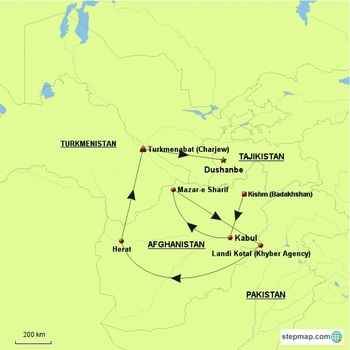
Over the past 20 years Yama has experienced Central Asia both as a space of fluidity and possibility and as bounded and restrictive on his daily life. Yama is in his mid-thirties. He was born in the northern province of Badakhshan, although his father left their home town in the 1970s and moved to Kabul. Yama told me that his father managed a government-run shop in Kabul; he was also involved in trading basic goods like cloth and clothes across the border and into Tajikistan. However, after the collapse of Dr Najibullah's government in 1992, Yama lost his entire family when a rocket hit their home. In the wake of this loss, he was taken in by friends of his family, who have treated him as their own son ever since. Yama's eldest adoptive brother also had connections with the PDPA government in Kabul (having served in the police force), so, when Dr Najibullah's government finally fell, the whole family moved from the city to Pakistan's tribal areas: Yama travelled with them. Yama's elder brother and the family lived in Pakistan's Federally Administered Tribal Areas for three years: eventually the family moved on by way of an overland route through Quetta, Kandahar, and Herat to Turkmenistan, a country for which it was easy to procure visas at the time. Yama, in his early teens, remained in Pakistan: he worked in the music store run by his elder brother for three further years—the family had made a livelihood bringing Pashtu-language music cassettes from Peshawar and then selling these in the tribal areas. At the request of the tribesmen, Yama and his brother bought illicit pornographic videos—a side-business that, Yama told me in Tajikistan, made him very popular indeed with the local tribesmen.
Yama talks about his time selling music and pornography in the tribal areas of Pakistan in more complex terms than those of either ‘survival’ or ‘coping’: both to me and to his fellow Afghans in Dushanbe, he often recounts stories of his creative ability to beguile the tribal people in whose midst he precariously lived. On one occasion, for example, Yama recounted how a young ‘tough’ (badmosh) had come to his shop and sought to force him to hand over all the money kept on the premises. Rather than giving the money, Yama claims to have punched the young man, knocking him to the floor—despite not only being several years younger but also many inches shorter and slimmer than his assailant. The wounded tough then went back to his home and brought his father back to the shop: armed with a Kalashnikov, the father intended to take revenge on the lowly Afghan shopkeeper who had insulted his son's pride. Yama relates, however, that the father looked directly at him and said ‘Where is Yama, the boy who beat my son?’ ‘It is I’, Yama replied, to a now incredulous father who, instead of meting out revenge, offered his hand for the young Yama to shake, saying: ‘Well done, if you can inflict such damage on my son you are a true man, and my son deserves no support from me.’
The decision to leave Khyber, Yama's elder brother told me, came about for two reasons. First, the family had stayed long enough in the town for some other Afghans also there to recognize them as being former officials in the PDPA government. Secondly, the rise to power of the Taliban in Afghanistan in 1995 made Pakistan more dangerous for them: there was an influx of men aligned to the mujahidin who were fleeing the Taliban and who might recognize Yama and his family as former state officials in the so-called ‘communist’ government. This change in political scenarios also meant, however, that it was now possible for the family to move through Afghanistan to Central Asia: most Taliban officials would not be able to recognize them as having served in or associated with the pro-Soviet regime.
Yama stayed in Pakistan alone for a further year after his brother left for Turkmenistan; eventually the brother returned to pick him up, the two men closed the shop in Landi Kotal, and travelled onwards to Turkmenistan. After a terrifying journey to Ashgabat by way of Kabul and Herat, during the course of which his elder brother was lucky to avoid arrest by a Taliban officer after bribing a Talib-official in Kabul, Yama embarked on business activities in Turkmenistan that were as unorthodox as those he had practised in Pakistan. He was based for several years in the town of Charjëw (today known as Turkmenabat), close to the border with Uzbekistan. While in Charjëw he met and befriended a man from Tajikistan who was from a region of the country—Gharm—that was involved in the civil war, and who had fled the country shortly after the start of the conflict. This man, Aziz, had married and settled in Turkmenistan, and the two men became business partners (sharik), trying their hands at several business ventures, including a pig farm to produce meat for the country's Russian population. Openly talking about past business failures in such a manner, far from demonstrating a person's lack of commercial acumen, instead reveals them to be a reliable and honest trading partner. Importantly, for this manner of business activity to work successfully the relationship between partners must always have priority over the search for profit—even if they lost money in their misplaced pig-farming adventure, Yama and Aziz, as shall now be explored, remain both friends and partners.
Both Yama and Aziz married women they had met in Turkmenistan: Yama an ethnically Uzbek woman from Charjëw, and Aziz a Russian. Today, both Yama and Aziz live in Dushanbe, and continue to engage in joint trading ventures: Yama imports tangerines to Tajikistan; Aziz distributes these across Tajikistan, sometimes taking truck loads to towns far from the capital and selling the fruits to market traders. In recent years, the declining value of Iranian currency due to international sanctions has enabled the two men to import Iranian fruit (especially kiwis, oranges, and pomegranates) to Dushanbe. Aziz, who holds a Tajik passport and, therefore, is able to acquire an Iranian visa relatively easily, travels to Mashad to purchase and arrange for transport of the goods. While in Mashad he stays with a man from the city who, like Yama and Aziz, had conducted business in Turkmenistan during the 1990s and also married a Turkmen woman. Trading partnerships, then, are often long term and durable, and built on relations established and reactivated in many different contexts; these partnerships are often maintained even while those who play an active role in them embark on highly mobile lives, and move in and out of trading relations with one another. In addition to the importance that mobile traders attach to their continual nurturing of relations with their families, long-term relations with trading partners are an important source of fixity in these men's otherwise fluid worlds.
Both Yama and Aziz's family arrangements are complex and inflected by their past trajectories of movement across national boundaries. Aziz now lives with his Russian wife—a Turkmen citizen who converted to Islam—in Dushanbe. Because she entered Tajikistan with no official documents, she has yet to secure either citizenship or registration as domiciled in the country and, therefore, is unable to leave: when Aziz travels intermittently to work in the construction industry in Moscow, he travels alone. For Yama, life in Turkmenistan became impossible. Although some Afghans living in Charjëw managed to get asylum in Canada or Europe, after the defeat of the Taliban government in 2001 many other Afghans were deported from Turkmenistan: some returned to Afghanistan and others moved elsewhere in Central Asia, especially Tajikistan, where business visas were still relatively easy to come by. Some of the men deported from Turkmenistan were married to Turkmen women whom they had met during their stays there, often of 15 years or more. According to a new ‘Marriage and Family Code’ introduced by the government of Turkmenistan in the spring of 2001, foreign citizens married to Turkmen women had to sign a special contract that needed to be ratified by officials and they were also required to pay $50,000 to the state: the payment was officially a guarantee to the state for the welfare of any children. News agencies close to the Turkmenistan government depicted this piece of legislation as being designed to protect ‘young women’ who ‘fell into the hands of rich Asians’ harems’ or who were duped by ‘wandering adventurers posing as rich foreign businessmen’.Footnote 42 Along with other Afghans Yama moved to Dushanbe, while his wife stayed in Charjëw: together with their two daughters aged six and eleven, Yama's wife tried to make a yearly visit to Dushanbe, travelling through Uzbekistan to reach Tajikistan. Yama and his wife did travel to Afghanistan together on one occasion; however, both found life in Yama's home town too restrictive. On several occasions, Yama has sought to travel to Turkmenistan to visit his family and check up on his house there, yet without any success. In July 2011 during tangerine off-season, I met Yama in Kabul where he had travelled with the aim of securing a visit visa for Turkmenistan from the country's embassy in Afghanistan: after two months staying in the home of his elder brother in the city (who had traded both in Turkmenistan and Tajikistan before returning to Kabul after ‘losing’ money) and with kin in his native village in the northern Badakhshan Province, Yama was not granted a Turkmen visa to visit his daughters and wife, even though the Afghan Foreign Ministry petitioned for one on his behalf. Eventually Yama began to worry that he might also not even be able to secure a visa to return to Tajikistan and resume his trading activities there, so he gave up his attempts to appeal again for his Turkmenistan visa in Kabul and returned to Dushanbe, holding out hope that a Turkmen visa would be issued to him in Dushanbe and that he would be able to travel to his family taking an overland route through Kazakhstan. When I visited him in Dushanbe during the autumn of 2012 he had still to be issued with a Turkmenistan visa despite having sought the assistance of the UNHCR and the International Organization for Migration; in addition, his wife, for reasons he did not elaborate to me, had not brought his children to visit him in Dushanbe for over two years. ‘Is it surprising that I have changed and that my thoughts are bad: I am a man without fate or a destiny (odami besarneveshta),’ he remarked bitterly to me.
Summary of Yama's migrations, 1975–2013.

Having addressed the general patterns of movement and trade involving Afghans in the spaces of the former Soviet Union, and documenting in finer detail the case of one trader with whom I am especially well acquainted, the next sections of the article explore some of the key aspects for people of Afghan background that being a commodity trader in the shurawi-i sabiq entails. These include the relationships between the traders and the commodities and goods in which they deal; the skills and sentiments required to make a good trade; and the moral and ethical aspects of being a global commodity trader in the world today.
Trading practices and goods
A long history exists of people of Afghan background occupying important commercial roles in Russia and the territories of the former Soviet Union. Afghans, for instance, were suppliers of fruit at great trade fairs, such as that at Nizhniy Novgorod in the nineteenth century. By the 1980s, the Soviet Union was Afghanistan's largest trading partner and became a ‘clearing house’ for Afghan exports and imports. The Soviet Union also provided Afghanistan with credits that could be used for buying Soviet goods and repaid with Afghan exports.Footnote 43 Unofficially, Afghan students or mahsil studying in the Soviet Union engaged in a multiplicity of trading activities: a favoured small-scale practice was to bring with them South Asian-made jeans that they then sold secretly to Russian buyers. Afghans are also widely recognized in the region as people who are expert commodity traders, and this, as is the case with trading communities elsewhere, has brought with it the danger that the communities in which they live think of them as being rich yet not honest workers. Even the small-scale practice of bringing jeans into the Soviet Union came with major risks attached: Afghans have told me how they were attacked and robbed on trains in Soviet Central Asia by local people who assumed that all Afghans were puldor or rich.
After the collapse of the Soviet Union, most if not all Afghan men living in its former territories began to make a living trading in the bazaars that mushroomed in the wake of the end of the state-regulated economy. The activities of these Afghan merchants varied from context to context depending on the particular niches that were open to being filled. In mountainous Tajikistan, for example, traders of Afghan background established themselves as the major importers of foodstuffs, including wheat, flour, confectionary, sugar, and, most recently, citrus fruits (tangerines, kiwis, pineapples), from both Iran and Pakistan.
In Russia and Ukraine, Afghan traders were early pioneers in the import of cheap Chinese goods: initially they brought these goods (stationery, toys, hardware, clothing, souvenirs, construction materials, and electronic goods) from the city of Urumqi in western China, to which they travelled by a combination of train and road, before returning overland in trucks with the Chinese-made goods they had purchased. By the late 1990s and early 2000s, however, Afghan merchants based in Russia and Ukraine had established trading offices (daftar-i tijorati) and transport companies (shirkat-i transporti) in Yiwu, the eastern Chinese city that had emerged as a key centre of the trade in cheap goods.Footnote 44 These offices are often staffed by a close family member with experience in the particular type of business activity that the family had chosen to invest in. The men that I met in Yiwu in April 2013, who run transport companies and trading offices, and are from a politically sensitive region of Afghanistan called Ghorband, for example, all told me that they had gained expertise as transporters during the early 1990s, at which point they were moving goods by the kilo across and around Afghanistan. One of these men, who ran a trading company in Moscow for several years, and now owns and runs a factory in Yiwu that produces silver jewellery for the Russian market, told me that his father had engaged in the official credit-based trade with the Soviet Union in the 1970s and 1980s.Footnote 45
Adaptation to changing scenarios: from modern day tax farmer to reviled ‘black heads’
The traders have had to adapt and respond to the changing political and economic conditions characterizing the different environments in which they have worked; such conditions have included growing resentment of Afghan merchants who have increasingly been depicted by officials and in some public settings as being wealthy profiteers. Afghans were stereotyped in the Soviet Union's Central Asian states as the archetypally violent and barbaric ‘Other’Footnote 46 increasingly, however, they are defined as ‘rich’ (puldor) yet ‘inferior’ (past) Asians in terms of their behaviour, outlook, and attitudes, especially in the intimate domains of family life. I am often asked by officials in Tajikistan, for example, why I like to spend time with people from an ‘inferior nation’ (millat-i past)—some even ask me what work I have with ‘bad-smelling’ (bad buy) Afghans. Educated Dushanbe folk, however, hold very different images of ‘the Afghan’ which centre around the notion that Afghans are encouraged from birth to seek money and wealth. Firuza, a law professor in one of the city's universities, told me, for example, that ‘Afghan parents put a mixture of honey (asal) and raisins (maviz) in their children's mouths on the very day they are born to help ensure that they become rich; by contrast, she went on, ‘Tajik people feel shame if they are market traders (sawdagor).’ On reporting this woman's comments to two of my Afghan friends in the city, I was told that the remarks were offensive to them because the woman had suggested that Afghans used illicit magic (jodu) to become wealthy: ‘the reasons Afghans are traders is because they are poor and taught how to work in markets from childhood. The Tajiks use more magic than anyone else—you just have to look at their arms that are covered in amulets (tumar) to realise that!’
During the 1990s, some of my informants even told me that mobile Afghan merchants were used by border officials to collect bribes from locals travelling on buses—they were compelled, in other words, to acts as a sort of modern-day version of the tax farmer. More recently, marriages between Afghan men and local women have also been targeted by legislation in Turkmenistan and Tajikistan which has required foreign men to make their wives the official owners of their property and businesses. As we saw above, the Marriage and Family Code introduced by the government of Turkmenistan in the spring of 2001 contributed to Yama's separation from his local wife. In 2011 a comparable piece of legislation was brought to law by the government of Tajikistan: foreigners marrying Tajik women must have lived in the country for one year and must sign a prenuptial agreement committing them to provide housing for their spouse.Footnote 47 As foreigners can only buy property after having lived for five years in the country, the legislation was interpreted in the media as being designed to ensure that the home of foreign men married to Tajik women is registered to a Tajik national; in turn, this would ensure that fewer Afghan ‘businessmen’ could earn Tajik citizenship through marriage. Afghans in Tajikistan also claim that they are often framed by local officials for a variety of crimes, including, most frequently, drug smuggling and sexual molestation, and they do so in a way that recalls the treatment of peripatetic merchants in other settings ranging from Central Europe to South East Asia.Footnote 48
Increasingly rigid boundaries between the Central Asian states have also affected the ability of Afghans to trade in places that had become vibrant trading hubs for them in the last two decades: the decline of the Afghan trading community in the northern Tajik city of Khujand has arisen, for instance, due to tightening controls over and repeated closure to commercial traffic of the Tajikistan–Uzbekistan border due to frequent diplomatic skirmishes between these two neighbouring countries. This situation is also narrowing the profit margins of Afghans who trade in goods such as tangerines between Tajikistan and Kazakhstan—the alternative route to Alma Ata by way of Kyrgyzstan is considerably more costly for them.
These pressures are equally intense in Russia and Ukraine as in the Central Asian Republics. In Russia and Ukraine my informants also reflect different types of policy towards migrants, as well as major shifts in local attitudes towards ‘foreigners’. On the one hand, many Russia-based Afghans depict themselves as having a favoured status in the country as compared to migrants from the former Soviet Central Asian Republics. I have often been told by traders in Russia that ‘the Russian police leave Afghans alone’, and even that the central node of Afghan trading activities in Russia—the Sevastopol Hotel in Moscow, the rais or leader of which is a former head of an important division of the Afghan secret services during the 1970 and 1980s—is said by many merchants to whom I have spoken as having been a gift by President Vladimir Putin to Afghans. They purposefully leave open and debate the question of whether the gift was made in recognition of past wrongs done to the country or anticipation of future loyalty.
On the other hand, however, there is considerable recognition that the favoured status of Afghans in the new Russia is undergoing considerable changes. Over the past three years, for example, many Afghan traders and families have left cities in Russia that had become hostile both to immigrants and to their trading activities, and moved to contexts where everyday life and earning a living through trade are seen as being both safer and easier. In Odessa, for instance, I have met several traders who left the Russian city of Volgograd, where there have been several incidents of violence directed against Afghans, including at least one murder, and moved their trading operations to Ukraine. Similarly, I have also interviewed Afghan traders in Odessa who have moved to the city from elsewhere in Ukraine, such as the western city of Lviv, because they say that people there are increasingly nationalist and hostile towards foreigners, or the so-called ‘black heads’. The Odessa-based merchants also acquire information about the tenor of life for Afghans in the rest of the country by making enquiries of their compatriots who continue to live elsewhere in Ukraine on the occasions that they make trips to Odessa to procure stocks for their shops and stalls. Traders in Odessa in turn are also facing growing economic pressures: the wholesale markets in which they work are increasingly threatened by multi-national commodities dealing in cheap Chinese-made goods; and the prospect of Ukraine joining either a European Union or Russian-led trading union also raises the spectre of competition with powerful transnational businesses. As a result, some traders are leaving Ukraine, especially for Germany and Sweden; others, as we shall now see, are diversifying their business interests.
Placing capital, placing people: trading skills
In important respects the networks of Afghan traders who are the focus of this article bear comparison with studies of other great trading communities. Historical studies of Hadhrami trading networks from the Yemen and trader-migrants from the Middle East in Asia, the Americas, and West AfricaFootnote 49 exemplify the ways in which such communities are geographically scattered across a great range of different places, and their businesses therefore often span multiple national boundaries. ‘In general’, trade ‘operates by making a profit from the differences between the state of affairs in one place and that of another’.Footnote 50 The geographic dispersal of Afghan traders means that they have in-depth knowledge of changing political and economic conditions across a great expanse of the world, the ability to share information about changing conditions, and, importantly, the desire and will to do so. In addition, as was also historically the case with Middle Eastern trading networks, Afghans are involved in a wide range of commercial activities, including commodity trading, real estate investment, and, in some instances, the cultivation of agricultural land. If Afghans are comparable to such ‘outstretched’ trading communities, then in important respects, the community differs from South Asian communities of bazaar capitalists that have been the focus of sustained historical scholarship. Most importantly, the social, professional, and ethno-linguistic identities of Afghan traders are more fluid and open than those of the mercantile South Asian networks highly determined by caste, region, and kinship.Footnote 51 As we have seen, moreover, the professional activities of many Afghan traders are not confined to commercial activities alone: many move within and between the domains of politics, commerce, and intellectual pursuits across the course of their life histories.Footnote 52 This is important for the wider arguments of this article because it is this fluidity that is also evident in the notion of being Afghan that people belonging to these trading networks also advance. At the same time, this also points more generally towards trade as a diverse set of capacities for arbitrating across different worlds, rather than a narrow type of commercial activity.
One of my informants (Karim), for instance, left his home in Kabul as an 18-year-old to study in Dushanbe's polytechnic institute, before fleeing Tajikistan on the eruption of civil war in the country in 1992, and moving to Ukraine, where he lived for several years in Kiev, before shifting to Odessa, where he now runs a business in leather, purses, and wallets. Karim travels to Guangzhou in southern China to commission the manufacture of the bags according to designs that are suitable for customers in Ukraine (who, he says, are very difficult to understand); after their production, which takes several months, he arranges for them to be shipped to Odessa. This is a tricky operation because it is difficult to calculate the length of time it will take for the Chinese factories to produce the goods, yet he must also receive them in time for the festivals of Christmas, New Year, and Valentine’s, when sales in the items in which he deals are at their optimum. A busy year in the period up to 2008 might have seen him importing 15 container loads of goods from China; since I first met him in 2010, the number has been more in the region of 4–8 container loads. It's easy to assume that the enormous global trade in such commodities is overwhelmingly organized remotely through multinational companies, online purchasing, and electronic money transfers, and that the shipping of the goods involves merely their computerized movement from one international container port to another.Footnote 53 For traders such as Karim this image could not be further from the truth. As many of the goods in which he deals are copies and thus illegal counterfeits,Footnote 54 he has to have close ties with custom officials in Odessa. These are mediated through an Afghan trader in the city who runs a customs clearance business. However, even the most long-standing of ties between traders and officials cannot resolve all the problems that the business activities of Afghans are likely to face. For example, at certain periods of the year a significant backlog of container ships in the ports of Odessa and Illychivsk is likely. As a result, the incoming are often required to harbour temporarily in neighbouring Romania. Such redirections are dreaded by traders in Odessa: EU customs officials, I am told, are permitted to open containers docked in EU ports and search for any counterfeit goods they hold. According to Karim, any illegal goods discovered are burned in Romania and the only evidence traders get to see of their long-awaited goods is photographs of their destruction.
In Odessa Karim both sells the bags wholesale and also distributes them on a credit basis to shopkeepers and stall-holders, often Afghans whom he knows and trusts, and who run retail businesses across the country, especially in another of the country's great wholesale markets, the Akademik Barabashoyeva in the eastern city of Kharkov (a former capital of Ukraine). This market supplies Kharkov's large population, and is also a feeder point for smuggled goods to be transported into Russia. Karim sends some of his goods to Afghan friends and associates who run shops and stalls in Moscow's many out-of-town wholesale markets. Doing so requires him to deal with Ukrainian and Russian smugglers who move the goods across the border between the two countries, thereby avoiding the Russian Federation's custom tariffs. At the same time, Karim, like many other Afghan merchants in both Ukraine and Russia, is concerned that his trading activities will be affected by the emergence of bigger and more formal companies in the region. In order to respond to this he has recently entered into a business partnership (sharik) with an Iran-based Afghan he first met in China (where his partner is married to a Hui or Chinese Muslim), and who exports a particular type of sand used in the making of metal moulds from Iran to China. This trade continued despite international sanctions on Iran; my friend also admits to bringing from China, in containers full of purses and wallets, the occasional carton of high-quality Chinese cigarettes, which are smoked by the increasing numbers of Chinese business people active in Odessa's market.
As I now explore, being a successful trader is about more than just having the ability, networks, and access to information that are necessary for moving goods and capital across borders. For one thing, traders must demonstrate the ability to choose a context in which to trade that suits their available capital (sarmaiyah). Different contexts are ranked by the traders in relation both to the possibilities a context offers for a life well lived and the amount of investment required to have a successful operation: to trade with any success in Moscow, for instance, a man is said to require a capital investment of $200,000, while a trade of sorts in Dushanbe, Tajikistan, can be launched with as little as $10,000.
More than knowing their financial means, however, traders must learn to recognize how different contexts are more or less suitable for different categories of actor. In the Chinese city of Yiwu, I sat with a group of Afghan traders (one based in Moscow, another in St Petersburg, a further in Odessa, and several who worked as transport and commercial agents across China including the cities of Chengdu and Urumqi). Another man present was Imtiaz, a Pashtu-speaker from Peshawar, who has now learned Dari during the many years he has spent with Afghans in China, and doesn't take offence when they introduce him to their compatriots by the nickname (takhalus) they have given him—‘ISI’. On that evening, as the thunderous sound of the 1,500 containers that the city's authorities proudly say leave Yiwu for international ports each day interrupted our conversations, the men were in the process of advising one of their friends, who runs an Afghan transport company in Chengdu, where it would be a good idea to send his younger brother, currently based in Kabul, to work. ‘If he is less than 18,’ said the St Petersburg-based merchant, ‘it would be a mistake to send him to Russia: Russia has the best alcohol and the most beautiful women in the world, he could lose $200,000 in less than a month. Those who send young property (mol) to work are making a big mistake. There are even rumours that Russian women buy Afghan boys to sleep with.’
Between a well-lived life and a good life: the moral work of trade
The final section of this article focuses on the insight that a consideration of the everyday working lives of the traders, and their modes of reflecting on these, offer into debates within and beyond anthropology concerning the relationship between morality and ethics. It is interesting to address these debates in relation to ethnographic material on the individuals who make up the Afghan trading network because it is easy and tempting to dismiss such people as either immoral profiteers or those one-dimensionally driven simply by self-interest.Footnote 55
By contrast, the Afghan traders with whom I interact continually make complex moral judgements about their activities. At one level, they claim not to trade in particular types of goods. Abdul, for instance, is an Afghan commission worker of ethnic Turkmen background who plies his trade between Mazar-i Sharif, and Kyrgyzstan and Tajikistan. When I met with him in Dushanbe and Mazar-i Sharif between 2008 and 2010, he often told me that he would deal in any product other than heroin. Similarly, a transporter in Yiwu told me that he refused to ship Chinese-made foodstuffs to Afghanistan even if Afghan merchants visiting the city asked him to do so: ‘the country's people already have enough problems’, he told me. It is not surprising that traders of Muslim background seek to signal themselves as being part of economies that are moral, in the sense that actors within them make decisions about their trading practices in relation to collective definitions of good and bad commodities. More interesting, however, are the ways in which these traders think and talk about the nature of their work, its relation to leading ‘the good life’, living a ‘well-lived life’, and where best to seek to achieve these ethical ambitions.
Recent work in anthropology questions the assumption that trade is mostly thought about in traditional Asian societies as being a form of immorality. ‘Moneyed exchange’, far from always being automatically considered by communities as ‘a parasitical activity corrosive of feeling and moral life’, is viewed in some of Asia's great traditions as being ‘morally benign’ if not actually ‘a prerequisite of ordered sociality’.Footnote 56 Gabriele vom Bruck, in her study of religious scholars of the Zaydi doctrinal tradition in Yemen, shows that both tribesmen and scholars in the country depicted themselves as being hostile to trade and traders; in their everyday lives, however, scholars and some tribespeople evinced a multiplicity of constructs concerning the economy's relationship to their social identities.Footnote 57
Similar dynamics are at play in the shifting ways in which mobile Afghans morally evaluate their work as traders. My informants often recount to me how their fathers, especially those who were employed in the state (dawlat) or armed forces (nizomi), used to beat them severely if they so much as caught sight of their school-going sons sitting in a shop. These same people remark that they have grown accustomed (odat kardim) to their way of making a living. More importantly, they frequently say that their own fathers, while being unreservedly hostile to trade at some level, often demonstrated considerable flexibility in the type of evaluations they made of their sons’ decisions to work as traders. An Odessa-based Afghan trader who had studied at a Party School in Tashkent, before going on to study physics at a university in Leningrad (a course he gave up to be with his sister who gained a scholarship to study medicine in Odessa), remarked to me that, on one of his return visits to his Kabul home during the 1990s, his father had told him that after having ‘brought a higher education diploma home he would then be free to earn a living however he chose’.
At a more particular level, my informants’ evaluations of their moral lives reflect subtle elaborations of values of personal independence, and associated ethics of autonomy. The traders I know seek to maintain marginal positions in relation to complex commercial economies by adopting a stance of non-engagement, and through the avoidance of long-term obligation. Yet traders are also often ambiguous about the nature of their work and of their attempts to live autonomous lives. The different value judgements people make about being a trader reflect both the complexity of Asian cultural ideas about trade, commerce, and moneyed exchange, and also the flexibility of the social and moral constructs these Afghans hold about their economic activities.
In some contexts, for example, the traders I know say that it is the situation in their home country that has compelled them to ‘eat the shame’ of becoming ‘shop keepers in the land of strangers’ (dukondor dar mulk-i mardum). At the same time, positive moral qualities are also attached to being a trader: trade is a form of ‘free’ or ‘independent’ work (kor-i ozod). From this perspective, working in the markets of the former Soviet Union (shurawi-i sabiq) is a morally superior way of making a living than the type of working lives that they say Afghans living in Western Europe inhabit. For instance, Seyyid, a man from Kabul in his mid-forties and from a family of Afghan religious notables, is currently based in Khujand where he married a Tajik wife. He sells tangerines in the winter months to Afghan merchants based in Kyghzstan but lived for many years in Minsk (where he lost, I was told by a man who had worked with him in Belorussia and now lives in Ukraine, a considerable sum of money in casinos). Seyyid remarked to me: ‘Here in the shurawi with $20,000 you can do something to pass time and make a living independently; in London, to be the boss of bosses (rais-i raisho) amongst the Afghans is to be a taxi driver.’
The emphasis placed by Afghan traders on personal independence, autonomy, and non-dependence on others, inevitably also results in the production of yet further moral ambiguities in the everyday lives of the traders. In this, as in other marginal communities such as those theorized by Day et al., the ideal of autonomy in the sense of freedom from others can only be achieved through specific kinds of interactions with and dependencies on others, be those others Afghan traders, local communities or family members either at home in Afghanistan or living diasporic lives elsewhere.Footnote 58
One particular tension in the lives of Afghan traders can be summed up as that between striving to lead a good life (something that involves being the sole breadwinner and providing for the family), and living a ‘life well lived’ (an ethical ideal shaped more in terms of a person's capacity to live an autonomous life free from the claims of others). This tension is especially visible in the types of choices and reflections the traders make about where it is possible to follow such different types of moral life. A family's security and well-being might best be achieved through migration to Europe or the Americas, or even, in some circumstances, return to Afghanistan, yet these are not the contexts in which most of the traders with whom I have interacted think it is easy to live ‘a life well lived’. As Baryalai, an ethnically Uzbek Afghan from the eastern region of Faryab, who works in markets both in Moscow and Rostov-on-Don, put it to a Dul Agha, a young trader in his twenties who had recently returned to Moscow from Toronto in order to start a business in the Sevastopol Hotel, ‘If I had my way, I’d send my family to Toronto and then come back to work in Rostov—then we would all be content.’
The complex ways in which the traders think about the relationship between their working and family lives reveals much about the role of the family or kinship to their collective fortunes and success. In studies of business communities bounded by shared identification with caste, kinship, or religion, ties of kin are often held as being paramount to business success (especially among non-Western capitalists). Yet emphasizing kinship's centrality to the fashioning of trust in such communities is also orientalizing: it attributes the success of such communities to some core of unchanging familial values and social structures. As Yanagisako has demonstrated, moreover, it is frequently also ethnographically wrong to associate non-Western capitalists with kin, and their Western counterparts with more contract-based forms of relations: the Chinese employees of Italian family firms in China with whom she worked were shocked by the preferential treatment their Italian bosses gave to their Italian kin above their more qualified Chinese employees.Footnote 59
This assumption of kinship's centrality to the production of the forms of trust on which transnational trading networks rely also overlooks the extent to which the best anthropological writing on kinship recognizes how this is always an ambivalent relation.Footnote 60 The most sophisticated anthropological work on family firms emphasizes, indeed, how far sentiments of ‘betrayal and estrangement’ are as important to the organizational dynamics of business communities as those of ‘trust and kinship solidarity’.Footnote 61 Trust and betrayal, in other words, are of equal importance to the expansion and division of firms, and, thus, the creation of new ones. Focusing on the role played by idioms and ties of kin in forging bonds of trust between traders has attracted attention away from the analysis of how traders maintain and sustain relations with one another even in the face of persistent transgressions of trust. The capacity of particular trading networks to continually refashion ties of trust in the face of such breakdowns is what allows them to balance ‘the rational of maximizing economic gain’ with the ‘continuity’ that ‘underlies their transnational trading activity’.Footnote 62
My informants freely talk about how their brothers or even parents have repeatedly acted in a way that has led them to fail in their trading activities. Yama, whom we met earlier, for example, told me how his adoptive elder brother (Mirza) had told him that a company in Dushanbe was sending Afghans to live in Sweden; Yama gave Mirza a very significant sum of money ($20,000) in the hope that this would facilitate his travel to Sweden. Some months later, however, Yama discovered that Mirza had used part of the cash to pay a Tajik people smuggler to take him and his own son to Russia using an overland route, and the remainder to enable them to start a trading operation there.
Diasporic trading families also embody the tensions that arise out of these processes; one domain of Afghan family life in which such tensions are especially visible is in the nature of relations between fathers and sons. At one level, sons often characterize their fathers as having placed their trust (ehtibar) in them by handing over to them the family's trading interests, for example, in Dushanbe. At another level, however, this masks anxieties that fathers hold about what their sons will get up to in Tajikistan (or wherever) when they are on their own: there is a persistent concern that unattended sons will throw money away on ‘luxury’ (ayashi), by going to restaurants and discos, and spending money on their girlfriends. ‘My son left to Tajikistan with $40,000 from a petrol pump business,’ one Panjshiri man told me in the Badakhshani border town of Ishkashim, ‘and he came back to Baghlan with nothing: all down to luxury (ayashi), I suppose.’ Fathers and elder brothers, then, must take strategic steps to ensure that their sons and younger siblings do not go astray while serving as their trading outposts or representatives. One way of reducing the risk of a lone son throwing away piles of hard-earned family cash in Dushanbe is to deploy ‘cousins’ (bacheh-i koko—the sons of paternal uncles) to keep an eye on the activities of their kin; if a son has gone too far astray he might even be withdrawn from one context and dispatched to another country where there are fewer opportunities for ayashi, such as Iran.Footnote 63
It is not only through acts of outright deceit that kinship's place in Afghan trading activities is visibly ambiguous. Kinship's ambiguous place in my informants’ trading fortunes might involve parents calling upon their sons to get married, or recognizing their kinship obligations at an inappropriate time, or by spending their money on commercially unsound projects. Importantly, in contrast to ethnographic work on migrant families that differentiates between the resentment with which young and less established migrants view the claims placed upon them by the family, with the increasingly confident and managerial role with which older and established migrants relate to their kin, the ambiguity of kinship relations is a more long-lasting element of my informants’ lives. In their memories of receiving ‘the call’, traders emphasize their ability to withstand the pressure placed upon them by their fathers to return home, but to crumble when the dreaded handset was handed to their mother. Wasih, in his mid-fifties and the father of four children, who now sells soaps in Khujand, remembered the event in the following terms:
I was selling cigarettes in Tashkent in 2003; perhaps doing a business of $500 per day. Then my father called. He said ‘there is peace in Afghanistan, come home son’. I said, ‘dear father, if you insist, I will come but I am leaving my family here, and not bringing them back’. He said, ‘if you are not bringing your family to Kabul then stay there’. He then handed the handset to my mother, ‘Oh my son’, she said, ‘you are our life and honour, we know nothing about you, not even if you are alive or dead: come home’. We returned to Kabul. In two years I had nothing. I invested money in a gold business and lost everything. I had no option but to come here to Khujand and start work again from zero (az sefr sheru kardam). I will never go to Afghanistan again. Afghanistan will only be a place for life if someone drops a nuclear bomb on the country and in some 200 years a new generation emerges there.
Conclusion
Afghans are involved in a wide range of economic activities across a range of Eurasian countries, and this underscores their significance to local and national economies and to patterns of consumption. As many anthropological and historical studies have shown, consumption practices offer a unique window into understanding processes of social and cultural transformation. More broadly, these aspects of everyday life are also critical to understanding the ways in which identities and subjectivities are created, enacted, and embodied in relation to goods and commodities available in the marketplace.Footnote 64 Anthropologists of the former Soviet world have revealed great diversity in people's modes of incorporating the range of commodities that became available during the so-called ‘transition’ into their worlds: there was both refusal and desire to incorporate Western goods into households, revealing the multiple ways in which local populations responded to the Soviet Union's demise.Footnote 65 Central Asia, moreover, is a region that has been characterized by several scholars as having become a ‘market of identities’ after 1991.Footnote 66 Less recognized are the forms of agency evinced by the merchants who make complex decisions to bring goods and commodities to particular communities and thereby both ‘create the sites of consumption in which these practices take place’ and ‘influence global events’.Footnote 67 Those studies that do exist analyse the agency of such actors in terms of their exhibiting a mastery of neo-liberal ‘enterprise culture’ and being celebrated nationally and globally as upper-class cosmopolitans as a consequence.Footnote 68 Recognizing the agency of Afghan traders in Tajikistan's marketplace of identity, by contrast, brings light to a narrative of Central Asia's globalization that moves beyond the so-called transition to capitalism and shows, instead, how such transformations are informed by regional movements and ‘assemblages and networks’ of actors from across Cold War frontiers.Footnote 69
These dynamics and forms of flexibility are also visible in the self-understandings of the merchants themselves. The Afghan traders I have discussed in this article are people whose lives are geared less towards making a homogenous ‘Islamic space’, fashioning an exclusively ‘Afghan’ transnational diasporic identity or a globally oriented form of ‘Muslim network’, than men who value their capacity to profit from arbitrages between different types of spaces. They are individuals who embody connections to one another that are as much about trade and pragmatism as they are about being Muslim, ‘international Muslims’, in short, who ‘play different parts of the world off against others’.Footnote 70 As one merchant from the city of Jalalabad who now sells Chinese-made clothes in a bazaar in Odessa, given to him on credit by another Afghan merchant, remarked to me, ‘We Afghans are on our way to becoming truly international: we have people in the UN and men of international stature such as Ashraf Ghani—by comparison the Ukrainians have been reduced to sifr (zero).’