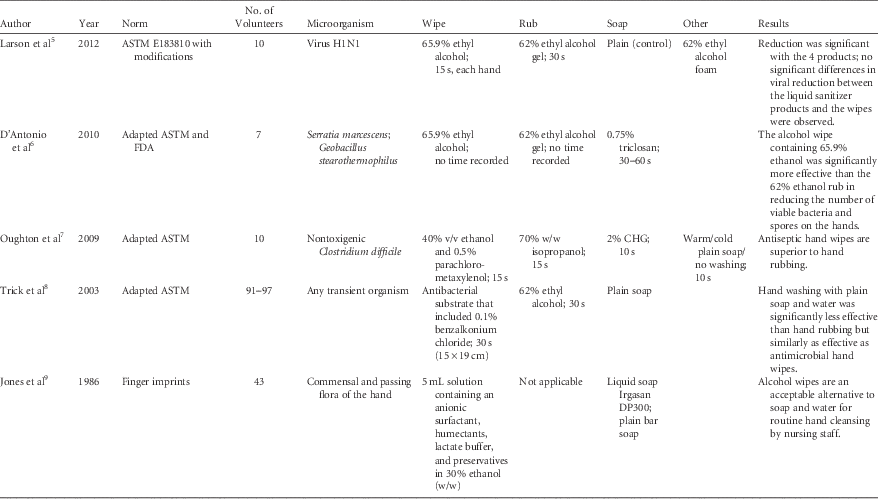
According to the World Health Organization (WHO) and the Centers for Disease Control and Prevention (CDC), rubbing with an alcohol-based hand rub (ABHR) formulation is the gold standard to prevent cross-transmission and healthcare-associated infections.Reference Pittet, Allegranzi and Boyce 1 , Reference Boyce and Pittet 2 Hand rubbing is mostly a task for healthcare professionals (HCPs), but patients are increasingly invited to perform hand hygiene as well.Reference Stewardson, Iten and Camus 3 , Reference Boyce and Pittet 4 Hand wipes are perceived as easy to use, and they could be considered an alternative to hand rubbing with ABHR. Alcohol-impregnated hand wipes are increasingly promoted and brought to the market, but often without accurate testing. Recent studies have investigated their antimicrobial efficacy (Table 1)Reference Larson, Cohen and Baxter 5 – Reference Jones, Rowe, Jackson and Pritchard 9 ; however, due to the absence of test norms for hand wipes, methods were not comparable and results were contradictory. The objective of this study was to compare the efficacy of hand wiping (with wipes with or without alcohol) to hand rubbing (with ABHR) in reducing bacteria on the hands of healthy volunteers.
Studies Testing Hand Wipes Against Handrub and Hand Washing

NOTE. ASTM, American Society for Testing and Materials; FDA, US Food and Drug Administration; CHG, chlorhexidine gluconate.
MATERIALS AND METHODS
Study Design and Sample Size
The efficacy of hand wiping and hand rubbing to reduce bacteria on hands was tested using a noninferiority design and in agreement with the European Norm (EN) 1500. 10 In this study, 20 volunteers from the University of Geneva Hospitals with expertise in hand hygiene acted as test individuals. None of the volunteers had a skin condition affecting the hands, and no jewelry was worn during testing. Each volunteer was expected to perform 4 hand-cleansing procedures, but the sequence of techniques was assigned randomly using a computer-generated list: (1) hand rubbing with 3 mL isopropanol 60% (v/v) using the WHO method; (2) hand wiping with cotton wipes (21.5×18.5 cm, 100% cotton) containing 3 mL isopropanol 60% (v/v); (3) hand wiping with polypropylene wipes (20×20 cm, 100% polypropylene, Tristel, Newmarket, UK) containing 3 mL isopropanol 60% (v/v); or (4) hand wiping with dry polypropylene wipes (without alcohol). The volunteers wiped their hands for 30 seconds (15 seconds for each hand) beginning with the palm, followed by the thumbs and the fingers, and ending with the back of the hand.
Hand Cleansing Methods
In agreement with EN 1500, volunteers washed their hands with soap and water, immersed their fingers to the mid metacarpals for 10 seconds in a bacterial suspension of Escherichia coli ATCC 10536 (~2.0×10⁸ to 2.0×10⁹ colony-forming units [CFU]/mL), and dried their hands for 3 minutes at room temperature. Baseline microbiological sampling was performed by rubbing the fingertips of the dominant hand for 1 minute in 10 mL tryptone soy broth. The broth was serially diluted, and 1 mL aliquots were spread on tryptic soy agar plates, which then were incubated in 36°C±1°C for 24–48 hours. Colony-forming units were counted and converted to log10 for reporting. After each baseline sampling, 1 of 4 hand-cleansing procedures was performed randomly. To assure complete hand coverage and a correct and uniform procedure, one of the investigators (J.O.) performed the technique together with the volunteers simultaneously.
Data Analysis
The log10 reduction of bacterial contamination was determined by calculating the difference between the baseline and after each hand-cleansing procedure. A generalized linear mixed model (GLMM) with random intercepts for each volunteer, considering repeated measures design, was used to assess the efficacy of the different wiping procedures compared to hand rubbing (control). Statistical analyses were performed using R studio version 3.0.2 software (R Foundation for Statistical Computing, Vienna, Austria). Our hypothesis was that hand wiping would not be inferior to hand rubbing. The definition of noninferiority in EN 1500 was met when the difference of reductions was less than log10 0.6.
RESULTS
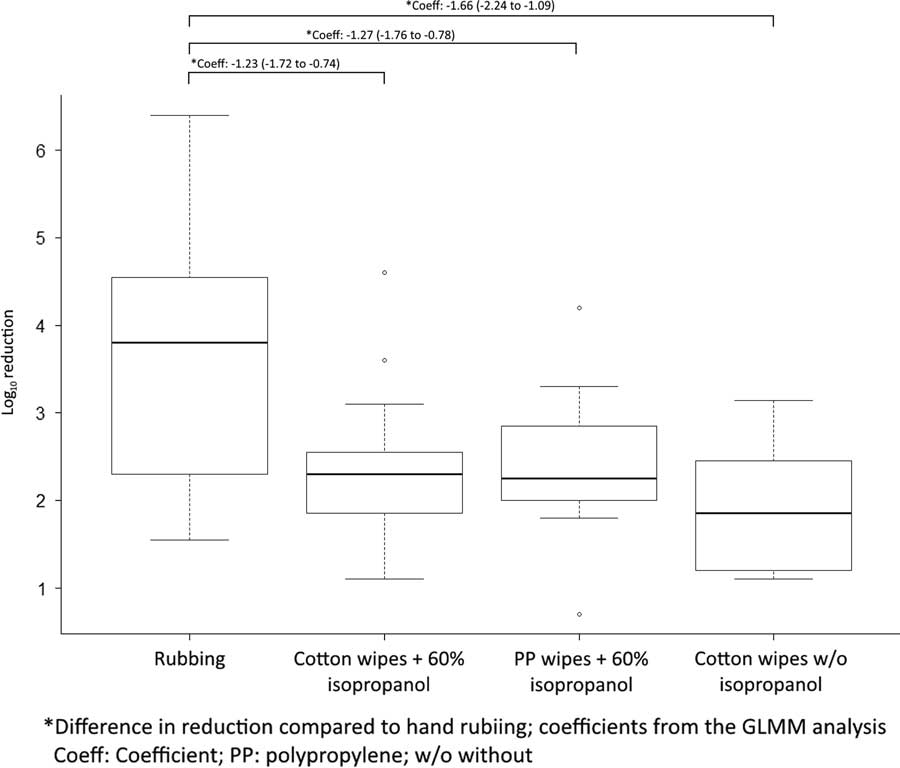
Of the 20 volunteers, 12 carried out all 4 hand-cleansing procedures; 8 volunteers did not carry out wiping with dry wipes. A total of 72 hand-cleansing procedures were analyzed. Overall, hand rubbing with 3 mL isopropanol 60% reduced bacterial loads by a mean of log10 3.62 CFU/mL (95% confidence interval [CI], 0.82–6.42). Hand wiping with polypropylene wipes containing 3 mL isopropanol 60% reduced bacterial loads by a mean of log10 2.39 CFU/mL (95% CI, 0.95–3.82), and hand wiping with cotton wipes containing 3 mL isopropanol 60% reduced bacterial loads by a mean of log10 2.35 CFU/mL (95% CI, 0.76–3.93). Dry polypropylene wipes reduced bacterial loads by a mean of log10 1.92 CFU/mL (95% CI, 0.52–3.33) (Figure 1). All hand-cleansing procedures using wipes were significantly inferior to hand rubbing. The coefficient compared to hand rubbing for polypropylene wipes containing 3 mL isopropanol 60% was −1.23 (95% CI, −1.72 to −0.74). For cotton wipes containing 3 mL isopropanol 60%, this coefficient was −1.27 (95% CI, −1.76 to −0.78), and for dry polypropylene wipes, it was −1.66 (95% CI, −2.24 to −1.09) (Figure 1). No wipe performed significantly better than any other wipe.
Reductions of Escherichia coli on hands after hand rubbing and 3 methods of hand wiping.

DISCUSSION
This is the first study to test the antimicrobial efficacy of hand wipes applying the EN 1500 norm. 10 Our results show that hand cleansing with alcohol-based impregnated hand wipes is less effective than hand rubbing with ABHR. Our findings support both the CDC and WHO recommendations to abstain from the use of hand wipes as an alternative for hand rubbing as a hand hygiene practice.Reference Pittet, Allegranzi and Boyce 1 , Reference Boyce and Pittet 2
Because no approved methodology for testing hand wipes has been promoted, we attempted to standardize the technique by comparing hand wiping with the hand rubbing procedure (ie, the current standard for hand hygiene). Close monitoring of our volunteers’ hand-cleansing procedures ensured that hand surfaces were fully covered and that procedures were uniform. Individual differences among volunteers were considered by applying the GLMM model in the statistical analyses.
Our study has several limitations. First, we exclusively tested E. coli. However, E. coli is standard in EN 1500 testing, making comparisons between products, agents, procedures, and techniques possible. Furthermore, E. coli is one of the most common microorganisms responsible for community infections and a significant pathogen in hospitals. Some reports using different microorganisms, such as influenza virus H1N1Reference Larson, Cohen and Baxter 5 and transient organisms, are in line with our results in the sense that hand wiping was not superior to hand rubbing.Reference Trick, Vernon and Hayes 8 On the other hand, our findings contrast with reports testing Serratia marcescens Reference Oughton, Loo, Dendukuri, Fenn and Libman 7 and nontoxogenic Clostridium difficile. Reference Oughton, Loo, Dendukuri, Fenn and Libman 7 Future studies should test organisms such as Staphylococcus aureus and Pseudomonas spp. Importantly and as previously shown, the concentration of applied microorganisms can influence the efficacy of wipes. Second, we tested only 1 ABHR as a comparator. However, the formulation contained 60% isopropyl alcohol, which is the reference standard in EN 1500 testing. The effectiveness of antimicrobial hand wipes has been shown to be similar to that of hand washing with unmedicated soap and water but significantly less effective than hand rubbing with 62% ethyl alcohol.Reference Trick, Vernon and Hayes 8 Additional work is needed to establish the inferiority of hand wipes. Finally, the threshold of bacterial reduction on hands to limit transmission is not knownReference Bellissimo-Rodrigues, Pires, Soule, Gayet-Ageron and Pittet 11 ; thus, we cannot directly link the inferiority results to the amount of reduced transmission of microorganisms between individuals.
In conclusion, this study demonstrates that hand rubbing is superior to hand wiping. However, a note of caution is justified when recommending hand wiping for hand hygiene, even if there is no conclusive evidence against their use. Further research is needed either to prove inferiority or noninferiority to hand rubbing. Furthermore, hand wipes are not biodegradable and are more expensive than ABHRs, providing an unequivocal advantage of ABHR in most situations.
ACKNOWLEDGMENTS
Financial support: No financial support was provided relevant to this article.
Potential conflicts of interest: All authors report no conflicts of interest relevant to this article.