





Introduction
Healthcare associated infections (HAIs) are preventable infections that are associated with increased costs, length of stay, and mortality. Reference Yousif, Jamal and Raad1,Reference Roberts, Scott and Hota2 One intervention aimed at reducing bloodstream infections (BSI) is daily bathing with 2% chlorhexidine (CHG), which has been endorsed as a best practice by the Society for Healthcare Epidemiology of America and the Infectious Diseases Society of America, Reference Buetti, Marschall and Drees3 particularly in the intensive care unit (ICU) setting for the prevention of central line-associated bloodstream infections (CLABSIs).
Although multiple trials have demonstrated CHG bathing reduces bloodstream infections in ICU patients, Reference Huang, Septimus and Kleinman4–Reference Milstone, Elward and Song6 this benefit seems to be most strongly concentrated in settings with relatively higher incidences of CLABSIs, such as ICUs where the baseline incidence is ≥0.8 CLABSIs per 1,000 central line days. Reference Denkel, Schwab and Clausmeyer7 Investigations in non-traditional settings, including ICUs in middle income countries, Reference Tomazini, Besen and Gales8 ICUs with lower incidences of CLABSIs, Reference Noto, Domenico and Byrne9 and non-ICU settings Reference Rupp, Cavalieri and Lyden10,Reference Huang, Septimus and Kleinman11 have reported mixed results, but observational studies have been suggestive of a reduction in BSI when CHG is implemented for high risk patients in non-traditional settings. Reference Musuuza, Guru and O’Horo12
Implementation of large-scale infection prevention (IP) interventions poses additional challenges in rural hospitals, which face limited access to infectious diseases/IP resources, Reference Talbot, Baliga and Crapanzano-Sigafoos13 competing clinical duties, Reference Rebmann, Alvino, Mazzara and Sandcork14 lower patient volume, Reference Kornelsen, Cameron and Stoll15 and challenges with staff retention and training. Reference Encinger, Vasa, Musil and Sheffield16,Reference Chapman, Buccheri and Mohotti17 CHG bathing may be particularly sensitive to these barriers, as it relies on daily performance by frontline staff for every eligible patient. In non-ICU units, a mixed-methods study found CHG adherence varied with training and supplies used, and indication-based eligibility created staff confusion. Reference Musuuza, Roberts and Hundt18 Along these lines, investigators of a large trial of ICU patients suggested site-level factors (eg, protocols and staffing) may have accounted for the lack of observed benefits in their trial, Reference Tomazini, Besen and Gales8 leaving uncertain whether trial benefits hold across a decentralized system serving a predominantly rural population.
The objective of this study is to examine the impact of daily CHG bathing on the incidence of CLABSI and bloodstream infections with methicillin-resistant Staphylococcus aureus (MRSA-BSI) following roll-out across a large decentralized healthcare system serving a predominantly rural population.
Methods
Study design and setting
In this quasi-experimental ecologic study, we analyzed hospitalwide HAI rates before and after implementation of CHG bathing across a large, decentralized, Appalachian, hospital system. The West Virginia University Medicine (WVUM) healthcare system consists of 21 hospitals, including one academic hospital, 9 community hospitals, 9 critical access hospitals, and 2 small (fewer than 75 beds) hospitals not meeting critical access designation; 14 of these hospitals are located in rural areas (per the Federal Office of Rural Health Policy, 19 ) though the remaining 7, including our academic medical center, are not located in a rural area. Due to sparse monthly event counts, the 11 critical access and small hospitals were analyzed as a single composite cohort throughout, although the remaining 10 facilities (1 academic, 9 community) were modeled individually.
WVUM began implementing CHG bathing system wide in August 2023, and by the end of September 2023, all facilities in the system had adopted CHG bathing for high-risk patients. We therefore defined three time periods: before CHG implementation (February 2022 to July 2023; 18 months), during implementation (August 2023 to September 2023; 2 months), and after CHG implementation (October 2023 to March 2025; 18 months). Data from the implementation (rollout) period were excluded from all analyses because facilities were at varying stages of adoption during this time.
Before implementation, we have limited data on existing CHG practices at each facility. After implementation, all patients over two months of age and without a CHG contraindication within an ICU and/or with a central line were eligible for daily CHG bathing (see supplemental methods for details on CHG implementation and adherence during initial implementation).
Data sources and outcomes
We utilized facility-level surveillance data that are reported to the National Healthcare Safety Network (NHSN) for the 21 hospitals in the WVUM system. Our primary outcome was each hospital’s (or for the 11 combined critical access/small facilities, the composite cohort’s) risk-adjusted monthly HAI incidence (CLABSI and LabID MRSA-BSI) among all patients admitted to any department of the hospital. Surveillance was conducted by local infection preventionists at each facility; the details of the NHSN’s definitions for each respective HAI are described elsewhere. 20 All data was aggregated at the hospital-month level. To address sparse data among smaller facilities, data from the 11 critical access and small hospitals were combined into a single composite cohort unit per month. 21 We confirmed that this composite cohort did not systematically bias the model estimates in a sensitivity analysis (see supplementary methods for details).
Variables and risk adjustment
For each hospital-month, we utilized three variables provided by NHSN to calculate the Standardized Infection Ratio (SIR): The number of observed infections (raw monthly counts of each facility’s HAIs), the predicted number of infections (using the 2022 NHSN baseline 22 ; see supplementary methods for details), and the denominator (total number of device-days or patient-days at risk during that month).
Because the crude infection counts (or rates per patient-day at risk) fail to account for variations among hospitals (eg, hospital type, teaching status) or variations over time (eg, patient census or case-mix), we incorporated the NHSN’s predicted number of infections as an offset in our models. This allowed us to control for risk-adjusted patient volume during the study period and model the facility-level SIR before and after implementation of CHG bathing.
Statistical methods
We conducted a pre- to post-analysis comparing the 18 months before and after CHG implementation (excluding a two-month rollout period during which facilities were in the process of implementing CHG). The incidence of CLABSI and MRSA-BSI were assessed using negative binomial generalized linear mixed effects models for each of their respective HAIs. To adjust for facility-specific predicted risks and model the SIR, we incorporated the natural logarithm of NHSN’s predicted infections as an offset in each model. We used hospital-level random intercepts to account for repeated measures and any facility level effects that were not captured by NHSN (such as local hospitals IP practices).
The results of the models are presented as incidence rate ratios (IRR) with 95% confidence intervals, representing the ratio of the postintervention SIR to the preintervention SIR. We evaluated for any significant preexisting trends of HAIs in the preimplementation period in a separate analysis of the preimplementation data, using the month as the predictor (offset for the risk-adjusted predictions made by NHSN).
A P-value of <0.05 was considered statistically significant. All analyses were performed using R version 4.3.1 (R Foundation for Statistical Computing) using the glmmTMB package Reference Brooks, Kristensen and vanBenthem23 (version 1.1.7).
Results
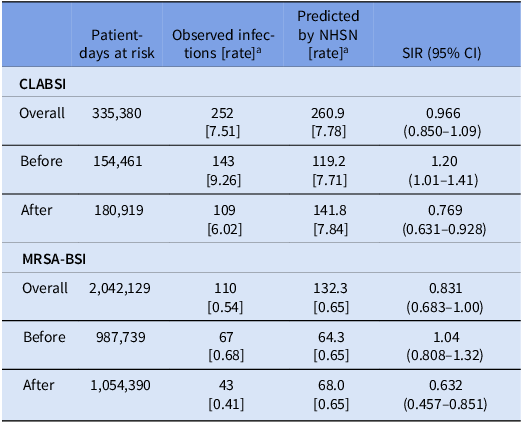
Our study spanned 38 months (February 2022 to March 2025), of which 36 were included in the analysis (after excluding the two-month rollout period when individual facilities were implementing CHG bathing; August and September 2023). During this time, there were 2,042,129 patient days, during which there were 335,380 central line-days. The aggregate preimplementation SIR for CLABSI (1.20; 95% confidence interval [95% CI]: 1.01–1.41) was slightly larger than for MRSA-BSI (1.04; 95% CI: 0.808–1.32), but both HAIs demonstrated similar magnitudes of reductions in the postintervention period (CLABSI: 0.769 [95% CI: 0.631–0.928]; MRSA-BSI: 0.632 [95% CI: 0.457–0.851]); Table 1.
Aggregate rates of healthcare associated infections, before and after implementation of CHG bathing

Table 1. Long description
The table has four rows and three columns. It compares patient-days at risk, observed infections, and predicted by NHSN for CLABSI and MRSA-BSI before and after the implementation of CHG bathing. Row 1: CLABSI Overall, 335,380 Patient-days at risk, 252 Observed infections [7.51], 260.9 Predicted by NHSN [7.78], 0.966 SIR (95% CI: 0.850-1.09). Row 2: CLABSI Before, 154,461 Patient-days at risk, 143 Observed infections [9.26], 119.2 Predicted by NHSN [7.71], 1.20 SIR (95% CI: 1.01-1.41). Row 3: CLABSI After, 180,919 Patient-days at risk, 109 Observed infections [6.02], 141.8 Predicted by NHSN [7.84], 0.769 SIR (95% CI: 0.631-0.928). Row 4: MRSA-BSI Overall, 2,042,129 Patient-days at risk, 110 Observed infections [0.54], 132.3 Predicted by NHSN [0.65], 0.831 SIR (95% CI: 0.683-1.00). Row 5: MRSA-BSI Before, 987,739 Patient-days at risk, 67 Observed infections [0.68], 64.3 Predicted by NHSN [0.65], 1.04 SIR (95% CI: 0.808-1.32). Row 6: MRSA-BSI After, 1,054,390 Patient-days at risk, 43 Observed infections [0.41], 68.0 Predicted by NHSN [0.65], 0.632 SIR (95% CI: 0.457-0.851).
NHSN, national healthcare safety network; SIR, standardized infection ratio; 95% CI, 95% confidence interval; CLABSI, central line-associated bloodstream infections; MRSA-BSI, Methicillin-resistant Staphylococcus aureus bloodstream infection.
a Rates are expressed as occurrences per 10,000 days at risk. Overall numbers exclude the two month rollout period.
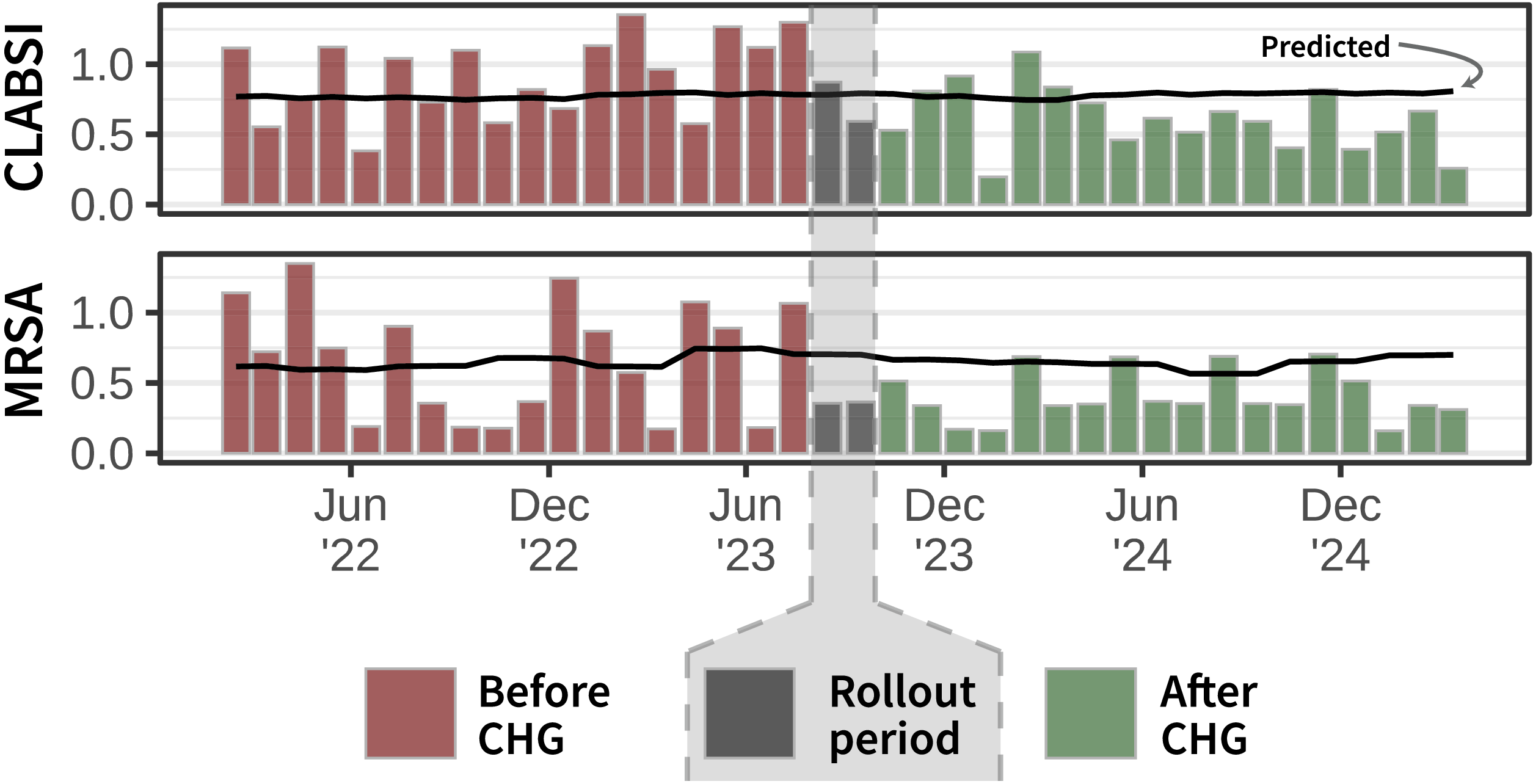
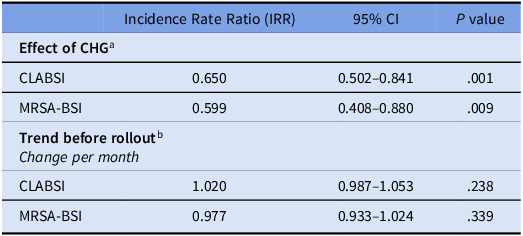
The risk adjusted incidence for both HAIs also decreased in the postimplementation period (Figure 1). After adjusting for hospital-level variation in the mixed-effects models, CHG bathing was significantly associated with a 35.0% reduction in CLABSI (95% CI: 15.9% to 49.8% reduction) and a 40.1% reduction in MRSA-BSI (95% CI: 12.0% to 59.2% reduction), as shown in the upper portion of Table 2.
Observed vs predicted HAI rates over time The bar graphs depict each month’s observed HAIs, which can be compared with the solid black line (which shows the rate of HAIs predicted by NHSN). Rates are expressed as infections per 1,000 central line days (for CLABSI) or per 10,000 patient days (for MRSA). The rates for both observed and predicted infections are aggregated across all hospitals by month. HAI, healthcare associated infections; CLABSI, central line-associated bloodstream infections; MRSA, Methicillin-resistant Staphylococcus aureus; NHSN, National Healthcare Safety Network.

Adjusted estimates of healthcare associated infections in relation to implementation of CHG bathing

Table 2. Long description
A table with four rows and three columns comparing the incidence rate ratios (IRR) and confidence intervals (CI) for healthcare-associated infections (HAIs) before and after the implementation of CHG bathing. The table is divided into two sections: the effect of CHG and the trend before rollout. The first section includes rows for CLABSI and MRSA-BSI, with IRR values of 0.650 and 0.599, respectively, and their corresponding 95% CI ranges and P values. The second section shows the change per month for CLABSI and MRSA-BSI before the rollout, with IRR values of 1.020 and 0.977, respectively, and their corresponding 95% CI ranges and P values.
95% CI, 95% confidence interval; CLABSI, central line-associated bloodstream infections; MRSA-BSI, Methicillin-resistant Staphylococcus aureus bloodstream infection.
a Represents the ratio of the SIR in the postintervention period to the SIR in the preintervention period.
b Estimates represent the change in the SIR during each month of the preintervention period; values greater than 1 indicate the SIR was increasing with each additional month (prior to the intervention).
We used separate models to investigate secular/preexisting temporal trends in HAIs prior to CHG implementation, shown in the bottom portion of Table 2. During the preimplementation period, there was no statistically significant linear trend in CLABSI or MRSA-BSI detected in relation to time (P = .238 and 0.339, respectively), though the MRSA-BSI trend was slightly below one.
Lastly, we did a sensitivity analysis excluding the composite small-facilities cohort from the analysis. The results of this sensitivity analysis were essentially identical to the primary analysis (available in supplementary materials).
Discussion
Following implementation of CHG bathing in high-risk patients, we found a significantly decreased incidence of CLABSI (35% reduction) and MRSA bloodstream infections (40% reduction). As the benefit of CHG bathing in ICU patients is well established in trials, our study instead addresses whether this same benefit is realized when CHG bathing is operationally implemented across a decentralized healthcare system of 21 hospitals serving a largely rural Appalachian population.
The magnitude of reduction observed in this study is consistent with the findings in prior cluster-randomized trials of ICU patients Reference Huang, Septimus and Kleinman4–Reference Denkel, Schwab and Clausmeyer7 (supplemental table 3.1), suggesting our CHG was implemented effectively enough to achieve its expected effect; the reduction in MRSA-BSI similarly mirrors the reduction in all-cause BSI seen in these ICU trials. As these trials were largely restricted to ICU patients, the current evidence for CHG in non-ICU patients is derived primarily from the ABATE Infection trial, Reference Huang, Septimus and Kleinman11 in which the benefit for BSI was confined to a posthoc subgroup of patients with medical devices (including central lines, midlines, and lumbar drains). Although our non-ICU population who received CHG similarly included patients with central lines or midlines, the ecological design of our study cannot determine whether these patients contributed to the reductions we observed.
CHG implementation
The practical implementation of CHG bathing can substantially impact adherence based on factors such as staff training, supplies provided, auditing/monitoring, and the clarity of eligibility criteria, particularly outside of the ICU Reference Musuuza, Roberts and Hundt18 (where proportionally fewer patients may be eligible for CHG), and site-specific factors may influence whether trial benefits translate into practice. Reference Tomazini, Besen and Gales8 Several features of our rollout were consistent with addressing these barriers: The system-level IP program supported implementation at every facility, including small and critical access. Eligibility was defined by simple, broad criteria (ICU patients or a line of any type), which may have reduced the ambiguity that indication-based eligibility created for staff in other studies. Reference Musuuza, Roberts and Hundt18 Adherence was monitored through the EMR and regularly fed back to facilities, a practice also identified as a facilitator of CHG implementation. Reference Musuuza, Roberts and Hundt18 Even so, the adherence to CHG was incomplete, rising from approximately 60% shortly after rollout to 80% within the first year (supplemental figure 2.2).
Our estimates therefore reflect partial, real-world uptake and may underestimate the effect of fully adherent bathing. Because all facilities received the same implementation approach, it is challenging to determine which of these features contributed to the observed reductions. Nevertheless, our findings suggest that CHG bathing can achieve reductions comparable to those in randomized trials when implemented across a decentralized health system serving a predominantly rural population.
Strengths and limitations
This study has several strengths. We included over two million patient-days, across a decentralized and heterogenous, Appalachian, healthcare system serving a predominantly rural patient population. Although this systemwide implementation was not randomized, our findings reflect the real-world considerations when implementing IP interventions at scale. By including a balance in size of hospitals (including 9 community hospitals and 9 critical access hospitals), our findings support the generalizability of CHG bathing across our health system.
This study also has limitations. The absence of a control group leaves the possibility of unmeasured confounding from other interventions, as is inherent to quasi-experimental studies. Although we did not find any significant preintervention trends in the incidence of these HAIs (see supplemental material), the point estimate for MRSA-BSI was slightly less than one (0.977), so the MRSA-BSI finding should be interpreted more cautiously than the CLABSI finding. Similarly, we are unable to report data on MRSA clinical culture rates and therefore cannot exclude that changes in the underlying MRSA burden contributed to the observed reduction in MRSA-BSI, although the NHSN SIR partially accounts for this by adjusting for community-onset MRSA prevalence.
Second, this was an ecologic analysis using hospital-level surveillance data. We did not analyze patient level data, so the ecological design cannot distinguish which groups benefited most from CHG bathing. However, by leveraging NHSN’s robust method of risk adjustment for each HAI, we were able to model the SIR, allowing our results to be generalized to other institutions that may have a different case-mix. Similarly, this study was not designed to compare the effect of CHG bathing between rural and non-rural facilities. Although the health system predominantly serves a rural population, several facilities (including the academic medical center) are located in urban areas, and our pooled estimates may not reflect the effect in any single setting.
Third, although each outcome was modeled separately, CLABSI and MRSA bacteremia are not mutually exclusive outcomes, so the observed reductions may partially overlap and should not be interpreted as fully independent findings.
Fourth, the intervention population did not align perfectly with the outcome population. The outcomes were measured at a hospital level (risk adjusted incidence of HAIs), but the intervention was only applied to a subset of patients (ICUs and non-ICU patients with a central line). The definition of a “central line” was broadly defined for this intervention (to reduce ground-level confusion among providers regarding eligible patients, and to expand CHG access; see supplemental materials) and some hospitals also chose to expand daily CHG bathing to a wider population (eg, patients with foley catheters; later in the study some hospitals went to whole-house CHG bathing).
Finally, although our system-level IP team is unaware of other major IP initiatives occurring at a local level during the study period, given the decentralized nature of our health system, we cannot exclude the possibility that individual facilities undertook local IP efforts that were not reported to or tracked by the system-level program.
In conclusion, implementation of daily CHG bathing for high-risk patients across a large, decentralized health system serving a predominantly rural population was associated with significant reductions in CLABSI and MRSA bloodstream infections. These findings support CHG bathing as a scalable IP strategy in reducing bloodstream infections and highlight the need for further investigation into which populations (ICU vs non-ICU) benefit the most.
Supplementary material
The supplementary material for this article can be found at https://doi.org/10.1017/ice.2026.10603.
Acknowledgements
Artificial intelligence (ChatGPT 5.5, OpenAI; Claude Sonnet and Opus 5.5, Anthropic) were used in the process of drafting this manuscript for editorial (syntax, grammar) and organizational (flow, framing) support. Gemini (3.1 pro preview; Google) was used for assistance with developing and troubleshooting the Bayesian reconstruction (supplemental methods only), but otherwise the analysis (in the main text) was developed by the authors without substantive input from AI.
Author contributions
Hunter Ratliff: Methodology, formal analysis, writing (original draft preparation). Matthew Lokant: Project administration, writing (review and editing). Janina-Marie Huss: Data curation, project administration. Michael Edmond: Supervision, writing (review and editing). Michael Stevens: Conceptualization, supervision, writing (review and editing).
Financial support
None reported.
Competing interests
All authors report no conflicts of interest relevant to this article.
Research transparency and reproducibility
To support reproducibility, all analytic code and documentation is available under the Open Science Framework. Because the data set consists of facility-identifiable hospital-month data accessed via NHSN, the authors do not have permission to share the data publicly. Data is available on request to qualified researchers with appropriate approvals from the relevant data-governing parties.


 Open access

