INTRODUCTION
Rice (Oryza sativa L.), the leading cereal crop of the world, is the staple food of more than half of the world population. World's rice demand was projected to increase by 25% from 2001 to 2025 to keep pace with population growth (Maclean et al., Reference Maclean, Dawe, Hardy and Hettel2002). India alone would require 113.3 million tonnes to fulfil its domestic demand by 2021–22 and a supply demand gap is pegged at 8.98 million tonnes (Mittal, Reference Mittal2008). These startling facts reveal that meeting the ever increasing rice demand in a sustainable way would be a great challenge. Eastern India accounts for 58% of the total rice area in India (Adhya et al., Reference Adhya, Singh, Swain and Ghosh2008) and the crop is mainly grown during wet season. However, the crop productivity is very low (2.46 Mg ha−1) (GOI, 2014) as the crop experiences several abiotic stresses such as drought, submergence and water logging along with cyclonic disturbances in coastal areas during the wet season. A second rice crop can be raised in these areas, as the winter is moderate and bright sunshine prevails during the dry season. However, limited availability of good quality irrigation water has restricted the cultivation of dry season rice in many areas (Saha et al., Reference Saha, Rao and Poonam2011).
One of the approaches to address these issues is cultivation of rice under aerobic systems in dry season. Using rice aridity index map, Mandal et al. (Reference Mandal, Mandal, Raja and Goswami2010) reported that most of the eastern and south eastern regions of India are moderate to highly suitable for aerobic rice. These systems can reduce water use up to 44% relative to conventionally transplanted systems by reducing percolation, seepage and evaporative losses, resulting in higher water productivity (Dari et al., Reference Dari, Sihi, Bal and Kunwar2017; Liu et al., Reference Liu, Hussain, Zheng, Peng, Huang, Cui and Nie2015). In spite of their advantages, aerobic rice systems have failed to gain popularity among farmers. The adoption and sustainability of the aerobic rice systems is threatened by heavy weed infestation (Chauhan, Reference Chauhan2012) and grain yield losses of 50–91% were reported due to weed infestation (Rao et al., Reference Rao, Johnson, Sivaprasad, Ladha and Mortimer2007).
For successful adoption of aerobic rice, suitable strategies for effective and economical weed control need to be developed. Manual weeding involves huge costs and therefore, herbicides can be used to replace manual weeding. Control of weeds by applying recommended pre-emergence herbicides is often not successful in aerobic rice due to emergence of late flushes of weeds. The time window for the application is very narrow for pre-emergence herbicides and sometimes, farmers miss the optimum application time (Mahajan and Chauhan, Reference Mahajan and Chauhan2015). Mahajan and Chauhan (Reference Mahajan and Chauhan2013) revealed that sequential applications of pre- and post-emergence herbicides provided better control of early and late flushes of weeds than the sole application in direct-seeded rice. However, there is a need to reduce the herbicide load in the environment. Excessive use of herbicides may have negative effects on the environment and human health (Jurewicz and Hanke, Reference Jurewicz and Hanke2008). There are concerns about toxicity of some of the herbicides on soil biota (Briggs, Reference Briggs1992), as it may reduce soil fertility and system productivity in long run. Therefore, application of herbicides at low rate/dose is desirable for cost, safety, health and environmental reasons. Low-dosage high-efficacy post-emergent herbicides with a broad spectrum of weed control are expected to be an intervention to suppress weeds during the critical period of crop–weed competition.
It has already been established that direct seeding rice is subject to much higher weed pressure than transplanted rice (Chauhan et al., Reference Chauhan, Awan, Abugho, Evengelista and Yadav2015). Under aerobic systems (which involves direct seeding as a component), the weed pressure and competition depends greatly on how the crop is established (Singh et al., Reference Singh, Bhushan, Ladha, Gupta, Rao and Sivaprasad2006). The aerobic rice can be established by line sowing, broadcasting and spot seeding. Establishment methods have differential effects on weed occurrence, crop growth and rice yield. However, there is limited knowledge about herbicide efficacy under different crop establishment methods (continuous row sowing, broadcasting and spot seeding) particularly in aerobic rice (Singh et al., Reference Singh, Bhushan, Ladha, Gupta, Rao and Sivaprasad2006). Then, we hypothesized that proper choice of establishment method and herbicide will result in higher weed control efficiency and higher crop yield. Therefore, the present study was conducted to recognize the role of establishment methods and herbicides in suppressing the weeds in aerobic rice.
MATERIALS AND METHODS
Site description
The field investigation was carried out at the Research Farm of the ICAR-National Rice Research Institute, Cuttack (20.5°N, 86°E and 23.5 m above mean sea-level), India, during the consecutive dry seasons of 2013 and 2014. The soil of the experimental field was Aeric (Endoaquept) with sandy clay loam in texture, slightly acidic to neutral in reaction with pH 6.8 (using 1:2.5, soil: water suspension), total carbon 0.78%, available nitrogen 218 kg ha−1, available P 17.4 kg ha−1 and available K 118 kg ha−1. The soil test was based on samples taken from the upper 20 cm of the soil before sowing in 2013.
Experimental design
The experiment was laid out in a split-plot design with three replications. Three establishment methods viz., continuous row sowing in 15 cm apart rows, spot seeding at 15 × 15 cm spacing and broadcasting were assigned to the main plots and five weed management treatments as the sub plots. The post-emergence herbicides used were flucetosulfuron, 1-[3-[(4,6-dimethoxypyrimidin-2-yl)carbamoylsulfamoyl]pyridin-2-yl]-2-fluoropropyl] 2-methoxyacetate (ICH-110 10% SG, Indofil Industries Ltd., Mumbai, India), applied at 25 g a.i. ha−1, bispyribac-sodium, sodium 2,6-bis(4,6-dimethoxypyrimidin-2-yloxy)benzoate (Nominee Gold 10% SC; PI Industries, Gurgaon, India), applied at 30 g a.i. ha−1, and azimsulfuron, 1-(4,6-dimethoxypyrimidin-2-yl)-3-[1-methyl-4-(2-methyl-2H-tetrazol-5-yl)pyrazol-5-ylsulfonyl] urea (Segment 50% DF; E.I. DuPont India Pvt. Ltd., Gurgaon, India), at 35 g a.i. ha−1. In the present experiment, we compared the efficacy of early post-emergence herbicide (flucetosulfuron and bispyribac-sodium) with late post-emergence herbicide (azimsulfuron). Flucetosulfuron is recommended mainly for controlling broadleaf weeds, along with grass weeds and sedges in rice. This herbicide is yet to be registered by Central Insecticides Board and Registration Committee, Department of Agriculture and Cooperation, India. Azimsulfuron is a broad spectrum sulfonylurea herbicide recommended to suppress major grass weeds along with broadleaf weeds and sedges. Bispyribac-sodium is widely used as post-emergence herbicide in Indian subcontinent to suppress grass weeds along with some sedges, which are predominant under aerobic condition.
From earlier study, it was found that late post-emergence herbicide suppressed the weeds effectively in aerobic rice and azimsulfuron applied at 15 days after sowing (DAS) showed very good efficacy (91% weed control efficiency) against complex weed flora, particularly late emergent grass weed Leptochloa chinensis (Saha et al., Reference Saha, Munda, Patra, Adak and Singh2015). In recent years, L. chinensis has become the major weed in the late vegetative stage of rice crop. To compare the efficacy of early and late post-emergence herbicides, azimsulfuron was applied 15 DAS, about one week after the application of flucetosulfuron (7 DAS) and bispyribac-sodium (8 DAS). Early post-emergence herbicides were applied at 2–3 leaf stage and late post-emergence herbicide was applied at 3–4 leaf stage of weeds. Along with herbicides, weed-free and weedy checks were assigned to the sub-plots. In the weed-free plots, weeds were removed at 15, 30, 45, and 60 DAS to keep the treatment weed-free.
Crop management and herbicide application details
The field was prepared by ploughing thoroughly with disc plough followed by harrowing with rotavator to get a fine tilth for ensuring easy movement of seed drill on dry soil. The gross plot size was 5 m × 6 m and the net plot size used for harvesting was 4 m × 5 m. The pre-soaked seeds of rice variety ‘Pyari’ (110 days duration, Indica type) was sown using a seed rate of 40 kg ha−1 on January 14 and 15 during 2013 and 2014, respectively. Continuous sowing at 15 cm apart, rows was done by manual paddy seed drill developed at ICAR-National Rice Research Institute (Formerly Central Rice Research Institute) and spot seeding was done manually using dibbler. For spot seeding, 3–4 seeds were placed in each spot spaced at 15 cm× 15 cm to maintain the seed rate of 40 kg ha−1. First irrigation was given after seeding on the same day. Irrigation was applied at an interval of 5–6 days just after disappearance of water from the field using the alternate wetting and drying method of irrigation (IRRI, 2009). All herbicides were applied at saturated soil moisture using a knapsack sprayer fitted with a flat fan nozzle at a spray volume of 350 L ha−1 and spray pressure of about 200 kPa. A full dose of P2O5 (50 kg ha−1) and K2O (50 kg ha−1) were applied before sowing at the final land preparation and N (100 kg ha−1) was applied in three equal splits, at 15, 35 and 55 DAS. All the other recommended agronomic and plant protection measures were adopted to raise the crop.
Field measurements
Weed species were identified within 0.5 m × 0.5 m quadrats placed randomly at two places in each plot. Weed density was measured at 30 and 60 DAS. Weeds were cut at the ground level, washed with tap water and oven dried at 70°C for 48 h, before weighing. Weed control efficiency (%) was computed using the equation given below:
 $$\begin{equation}
WCE = \left[ {{\raise0.7ex\hbox{${\left( {x - y} \right)}$} \!
/ \!\lower0.7ex\hbox{$x$}}} \right] \times 100
\end{equation}$$
where x = weed dry weight in weedy check and y = weed dry weight in treated plot.
Grain yield of rice along with other yield components were recorded at harvest at 14% moisture content in seed. Sampling was done from an area of 1 m2 in each plot to determine above ground total dry weight (total biomass) and yield components. Panicles m−2 were counted manually. Filled grains of 10 randomly selected panicles were counted to determine number of grains per panicle. Biomass (sum of straw dry weight and grain dry weight) was calculated using grain and total dry weight of each treatment. Weed index (WI) was computed by using the following equation:
 $$\begin{equation}
WI = \left[ {{\raise0.7ex\hbox{${\left( {x - y} \right)}$} \!
/ \!\lower0.7ex\hbox{$x$}}} \right] \times 100
\end{equation}$$
where x = yield in weed-free plot and y = yield under treatment for which WI is to be calculated.
Statistical analyses
Data for both years (i.e. 2013 and 2014) were presented separately and analysed using analysis of variance (SAS Software packages, SAS EG 4.3). Means of treatments were compared based on least significant difference (LSD) test at P ≤ 0.05. Weed density and biomass data were subjected to square root transformation and the transformed values were used in analysis. Path analysis was conducted to evaluate direct and indirect effects of panicle numbers m−2, number of grains per panicle, crop biomass, weed dry matter production, weed control efficiency of herbicides and WI on grain yield. The response variable i.e. grain yield and six predictor variables viz., panicle numbers m−2, number of grains per panicle, crop biomass, weed dry matter production, weed control efficiency of herbicides and WI, were used for deriving path coefficient by SAS EG 4.3.
RESULTS
Weed flora
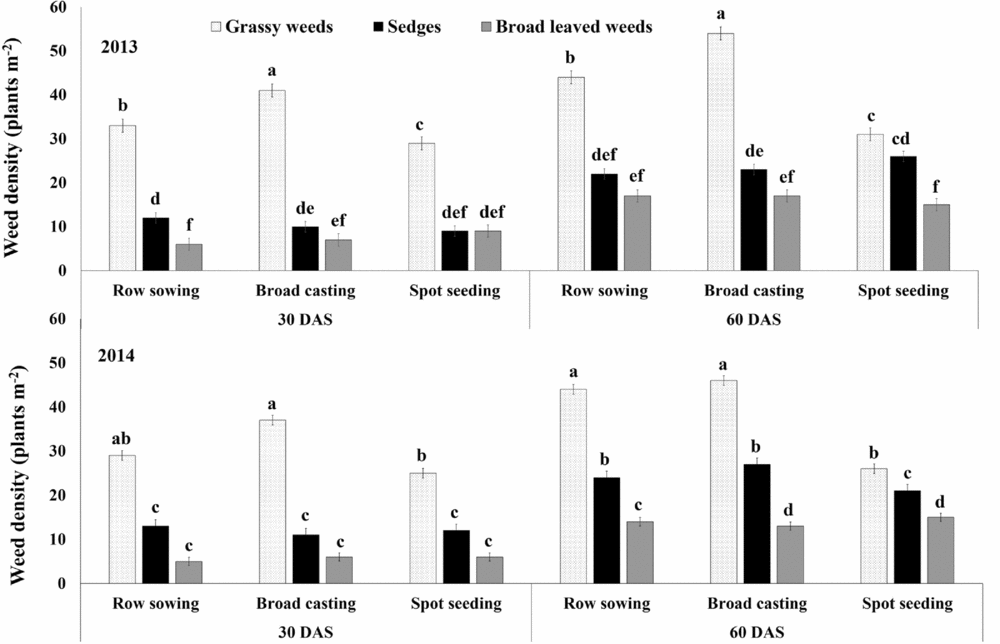
The weed flora was mainly dominated by grass weeds throughout the crop growth period and across the establishment methods. The three grass weeds (E. colona, L. chinensis, D. sanguinalis) constituted 65% (103 plants m−2) of total weeds (158 plants m−2) in 2013 (Supplementary Table S1(available online at https://doi.org/10.1017/S0014479717000576)). Similar trend was observed in 2014. The infestation by grass weeds was as 66% (41 plants m−2) and 69% (37 plants m−2), in 2013 and 2014, respectively, in broadcasted rice at 30 DAS (Figure 1 and Table S1). Echinochloa colona (L.) link was the predominant grass weed species at this stage. At 60 DAS, the density of grass weed species was 42–43% of total weed density in spot seeding, 53–54% in row sowing and 54–57% in broadcasting (Figure 1). L. chinensis (L.) Nees and D. sanguinalis (L.) Scop. were the dominant grass weed species at 60 DAS (Tables S1 and S2). Other weeds included sedges viz., Cyperus difformis L. and Fimbristylis miliacea (L.) Vahl. and broad-leaved weeds viz., Sphenoclea zeylanica Gaertn. and Ludwigia octovalvis (Jacq.) P. H. Raven. Sporadic and scattered appearance of broad-leaved weeds viz., Cleome viscosa L., Euphorbia hirta L., Physalis minima L., Eclipta prostrata L., Phyllanthus niruri L. and Scoparia dulcis L. were also recorded in the weedy plots at 60 DAS (Table S1).
Weed density in weedy check plots grown under different rice establishment methods at 30 and 60 DAS. Vertical bars indicate standard error and bars with at least one letter common are not statistically significant using least significant difference at P ≤ 0.05.

Among the establishment methods, broadcasted rice recorded highest total weed density at 30 DAS (Figure 1 and Table S1). Owing to inter-row space, row sowing recorded significantly higher total weed density compared to spot seeding at 60 DAS. Among the herbicides, flucetosulfuron-treated plots recorded the maximum number of grass weeds. The interaction effects of rice establishment methods and weed management on total weed density were significant (P ≤ 0.05). For example, azimsulfuron application recorded 18%, 13% and 11% of weeds in weedy check plots under broadcasting, row sowing and spot seeding at 30 DAS, respectively (Figure 1).
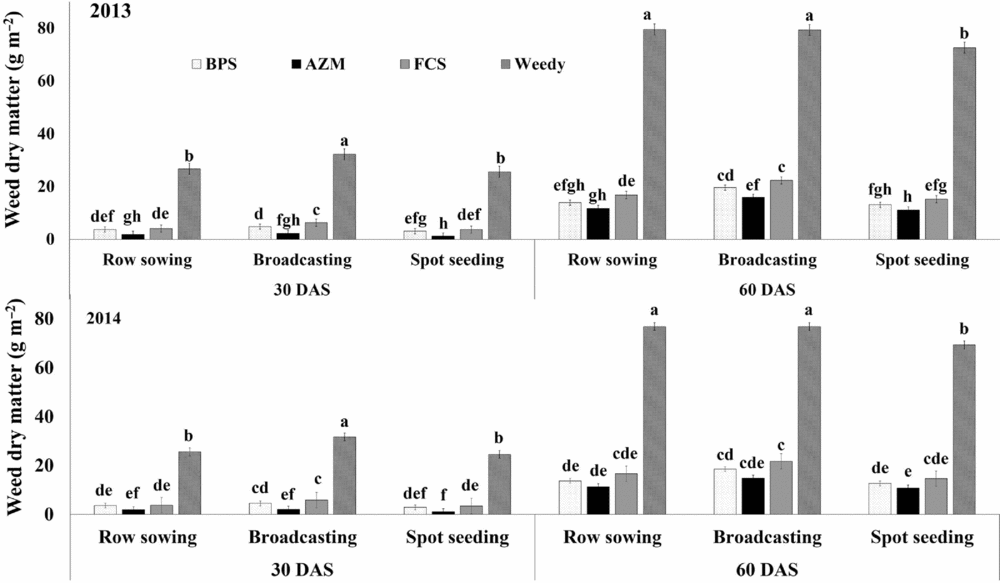
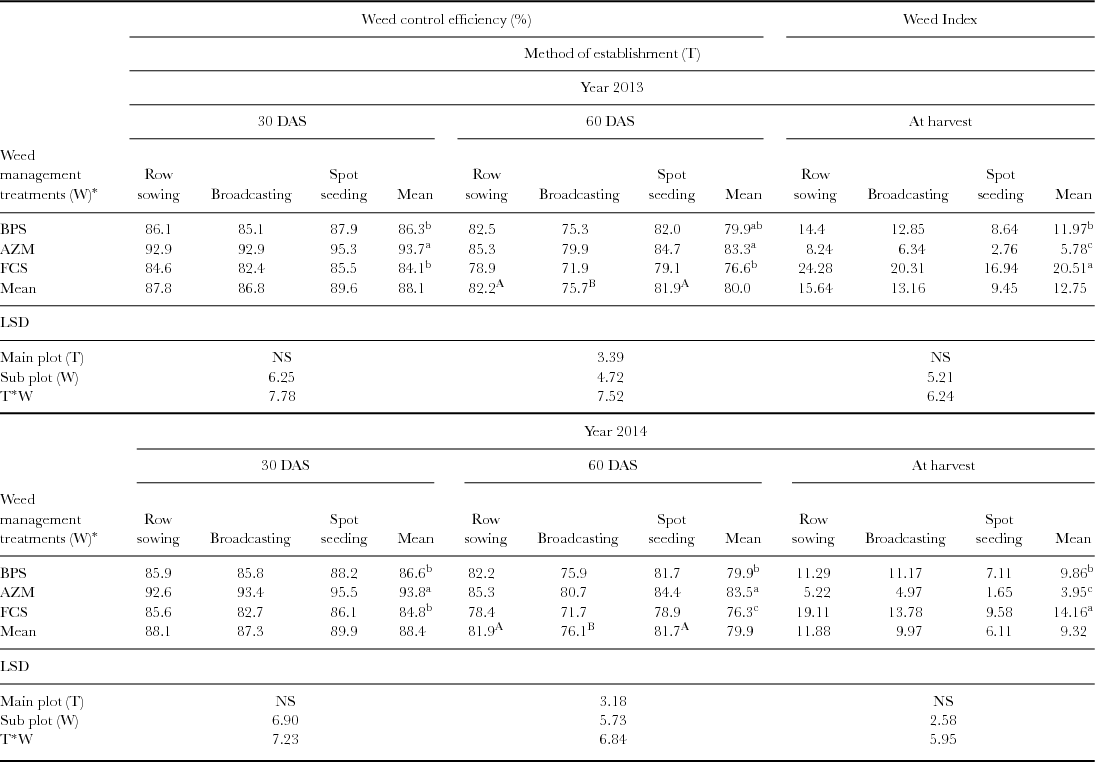
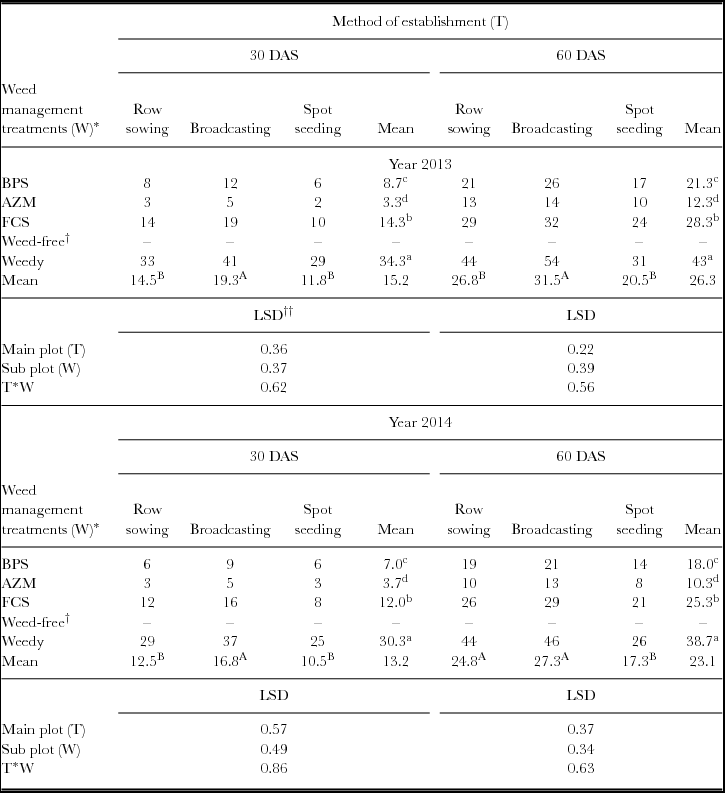
Total dry matter production (biomass) of weeds recorded similar trend as weed density (Figures 1 and 2). Weed dry weight was lowest in spot seeding and highest in broadcasting at 30 DAS and the highest weed dry matter (79.3 and 76.8 g m−2 during 2013 and 2014, respectively) was obtained at 60 DAS in the weedy check plots (Figure 2). All the herbicides showed higher weed control efficiency at 30 DAS, being highest in azimsulfuron (93.8%) followed by bispyribac-sodium (86.6%) and flucetosulfuron (84.8%) (Table 1). At 60 DAS, the herbicide treatments recorded a similar trend. Among the establishment methods, row and spot seeding recorded weed control efficiency at par and significantly higher than broadcasting (Table 1). The interaction between the establishment methods and herbicides treatments was found to be significant at 60 DAS. Like weed control efficiency, WI also recorded a significant interaction between the establishment methods and herbicides treatments (Table 1).
Weed dry matter (g m−2) under different establishment methods and weed management treatment sat 30 and 60 DAS. Vertical bars indicate standard error and bars with at least one letter common are not statistically significant using least significant difference at P ≤ 0.05.

Effect of establishment methods and weed management treatments on weed control efficiency (%) and weed index at different growth stages of rice. Means are separated by least significant difference (LSD). The LSD value under interaction compares establishment method means at same weed management treatment.

*BPS– Bispyribac Sodium (30 g a.i. ha−1); AZM – Azimsulfuron (35 g a.i. ha−1); FCS – Flucetosulfuron (25 g a.i. ha−1).
Means with at least one letter common (upper case for ‘T’ and lower case for ‘W’) are not statistically significant using least significant difference at P ≤ 0.05.
Effect on yield parameters
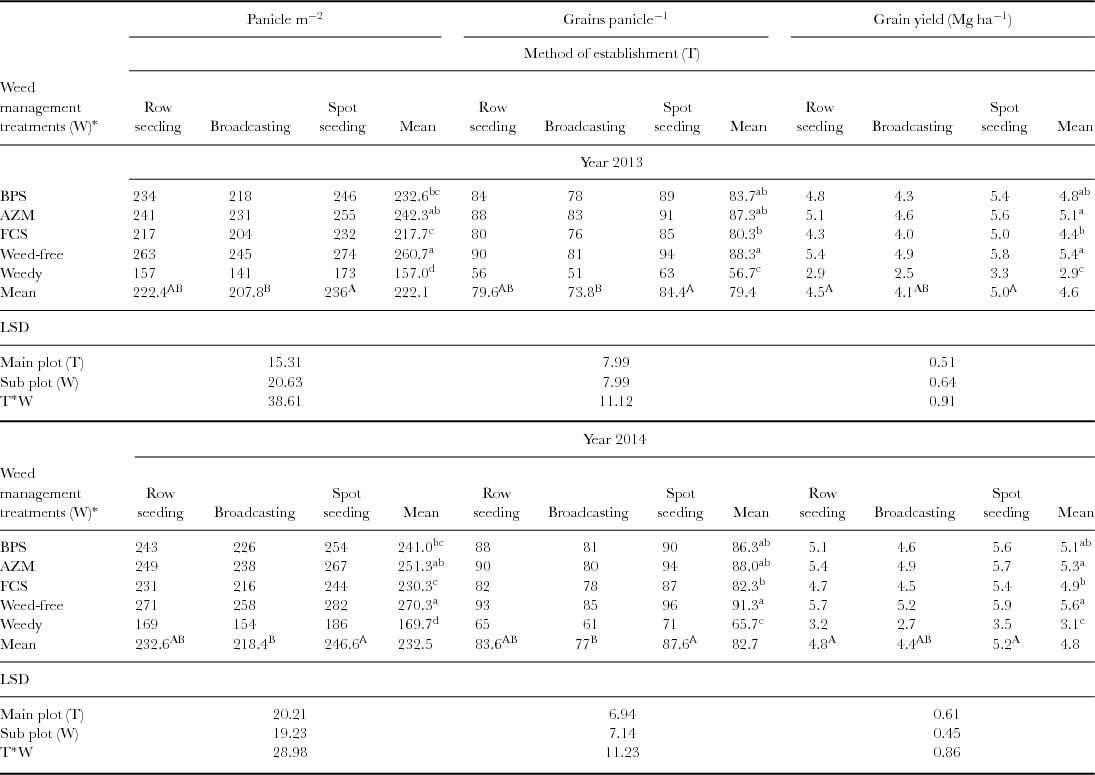
Among the establishment methods, the number of panicles m−2 (mean of two years) was significantly higher in spot seeding (241.3) compared to broadcasting (213.1) (Table 2). Azimsulfuron-treated plots recorded about 51% higher panicles compared to weedy plots, which contributed greatly to achieving higher grain yield. Being strictly governed by genetic factors, grains panicle−1 did not vary significantly due to establishment methods. However, weedy plot recorded significantly lower grains panicle−1 compared to the herbicide treatments in the sub plots. The highest grain yield (5.1 Mg ha−1) was obtained with spot seeding, which was at par with row sowing (4.7 Mg ha−1) and significantly higher than broadcasting (4.2 Mg ha−1). Among the herbicide treatments, the highest grain yield (mean of two years) was obtained with application of azimsulfuron (5.2 Mg ha−1), which was at par with grain yield of 5.5 Mg ha−1 recorded under weed-free conditions (Table 2). Yield loss due to weeds in weedy check was 45% compared to weed-free control and there was about 5% yield reduction in azimsulfuron-treated plots compared to weed-free check. Flucetosulfuron was least effective in controlling weeds among the herbicides and there was about 15% yield reduction compared to weed-free check (Table 2).
Effect of establishment methods and weed management treatments on yield attributes and grain yield of rice. Means are separated by least significant difference (LSD). The LSD value under interaction compares establishment method means at same weed management treatment.

*BPS– Bispyribac Sodium (30 g a.i. ha−1); AZM – Azimsulfuron (35 g a.i. ha−1); FCS – Flucetosulfuron (25 g a.i. ha−1).
Means with at least one letter common (upper case for ‘T’ and lower case for ‘w’) are not statistically significant using least significant difference at P ≤ 0.05.
The path analysis suggested panicles m−2, grains panicle−1, crop biomass and weed control efficiency had a positive combined direct and indirect effect on yield during both the years of experiment (Table S3 and Figure S1). On the other hand, weed dry matter and WI had significant effect on grain yield (–0.6185 and –0.6925, for weed dry matter and weed index, respectively) at P < 0.0001 indicating a very strong negative correlation with yield. The path analysis revealed that the highest combined direct and indirect contribution to seed yield was made by crop biomass. Path coefficients of weed dry matter, weed control efficiency and WI revealed the negative direct effect on grain yield. The weakest direct effect (mean of two years) was from panicles m−2 (0.0566). The highest combined indirect effect (mean of two years) on yield was from weed dry matter via weed control efficiency (0.6355), while the effect of weed control efficiency via crop biomass (–0.4375) made the weakest contribution (Table S3).
DISCUSSION
Effect on weeds
Across the establishment methods and herbicide treatments, E. colona was the most dominant species in the early vegetative stage and L. chinensis in late vegetative stage (Table S1). Dominance of E. colona was documented to occur in dry-seeded rice and aerobic rice systems in 24 rice growing countries (Rao et al., Reference Rao, Johnson, Sivaprasad, Ladha and Mortimer2007). L. chinensis is emerging as a new weed due to lack of continuous submergence in rice crop and rice grown in light or medium textured soils is severely infested with this weed. The dominance of L. chinensis, an annual grass of aquatic and semi-aquatic environment (Manidool, Reference Manidool, Mannetje and Jones1992) in aerobic rice indicated its morpho-physiological plasticity to adapt to diverse environments in rice–rice cropping sequence. However, the variation in density of L. chinensis and E. colona under different establishment methods in aerobic rice system has not been reported elsewhere. Digitaria sanguinalis was reported as a predominant species during flowering stage of the rice crop (Mahajan and Chauhan, Reference Mahajan and Chauhan2011) as recorded in our study (Table S2).
The highest total weed densities were observed in the broadcasting while the lowest densities occurred in the spot seeding (Figure 1 and Table S1). The uneven stand and poor crop establishment in broadcasted crop resulted in severe weed pressure at the early stage resulting higher crop-weed competition in comparison to spot seeding and row seeding (Ichikawa, Reference Ichikawa2000). The congenial micro environment of rhizosphere in spot seeding resulted in early emergence and fast growth, which offered competition in favour of the crop and ultimately helped in smothering the grass weed flora in aerobic rice (Singh et al., Reference Singh, Singh, Singh, Yadav, Sinha, Johnson and Mortimer2011).
Significant reductions in total weed biomass were recorded with azimsulfuron regardless of establishment methods (Figure 2), with higher weed control efficacy of azimsulfuron being found under spot seeding. The variable response of weeds to the application of the same herbicide provided insights into how the establishment methods of rice can influence the efficacy of herbicides. Mahajan and Chauhan (Reference Mahajan and Chauhan2015) reported higher efficacy of azimsulfuron in row-seeded aerobic rice when compared to other herbicides such as pendimethalin, bispyribac-sodium and fenoxaprop. Bispyribac-sodium, the most widely used herbicide for control of grass weeds in rice, was less effective in controlling late emergent L. chinensis because it emerged after application of herbicide. Bispyribac-sodium has minimal translocation and a large amount is retained in the treated area (plant leaves) (Martini et al., Reference Martini, Burgos, Noldin, De Avila and Salas2015), indicating that the residue left in the soil only gets absorbed by weed roots if weeds have extensive roots. This could be one reason for relatively poor efficacy of bispyribac-sodium in controlling L. chinensis (Table S2). Abeysekera and Wickrama (Reference Abeysekera, Wickrama and Toriyama2005) reported the lowest efficacy of bispyribac-sodium as compared to cyhalofop butyl, propanil, fentrazmide+propanil and quinclorac against L. chinensis. Weed density was significantly higher in the flucetosulfuron-treated plots due to poor control of grass weed species (Table 3). At 60 DAS, the grass weed density was as high as 79% of the total weed population in the flucetosulfuron-treated plots in spot seeding (Table 3 and Table S1). Poor control of weeds and poor herbicidal efficacy of flucetosulfuron without adjuvants was already reported by Kim et al. (Reference Kim, Shin, Lee, Lim, Lim and Kim2013).
Effect of establishment methods and weed management treatments on dominant grassy weed (E. colona, L. chinensis and D. sanguinalis) density (plants m−2) at 30 and 60 days after sowing (DAS). Means are separated by least significant difference (LSD). The LSD value under interaction compares establishment method means at same weed management treatment.

*BPS– Bispyribac Sodium (30 g a.i. ha−1); AZM – Azimsulfuron (35 g a.i. ha−1); FCS – Flucetosulfuron (25 g a.i. ha−1)
† Weed-free – No weed count was recorded since weed removed manually at 15, 30, 45 and 60 days after sowing (DAS).
†† Calculated using square root transformed values.
Means with at least one letter common (upper case for ‘T’ and lower case for ‘W’) are not statistically significant using least significant difference at P ≤ 0.05.
Higher efficacy of azimsulfuron compared to bispyribac-sodium and flucetosulfuron in different establishment methods ensured that the herbicide was effective to suppress the weeds at late vegetative stages in aerobic rice fields (Table 1). Gradual and persistent degradation of azimsulfuron in soil might have helped in suppressing the weeds for longer period of time. The slow degradation of azimsulfuron was aided by neutral pH (pH 6.8) of the experimental soil (Boschin et al., Reference Boschin, D'agostina, Antonioni, Locati and Arnoldi2007). Accordingly, Pinna et al. (Reference Pinna, Zemam and Pusino2007) reported faster degradation of azimsulfuron in acid soils compared to neutral and slightly alkaline soil. Again, in aerobic (unflooded) soils, azimsulfuron was characterized as exhibiting moderate to high persistence (EFSA, 2010a), which also indicates prolonged availability of azimsulfuron in soil. Bispyribac-sodium is low to moderately persistent in aerobic rice field, whereas it is moderately to highly persistent in anaerobic flooded paddy soils (EFSA, 2010b). As the residual effect is generally associated with higher persistence, bispyribac-sodium is more likely to control weeds for longer periods in transplanted rice than in aerobic rice. High weed control efficiency of azimsulfuron in spot seeding indicated that the efficacy of herbicide was further influenced by crop establishment techniques (Table 1). Bispyribac-sodium was applied as early as 8 DAS when the crop was too small to cover the space between the plants, which led to its rapid photo-transformation and photo-degradation enabling the weeds to emerge in the second flush. Suppression of grass weeds (weed control efficiency 98.5%) along with complete control of sedges and broad-leaved weeds in the plots treated with azimsulfuron at 60 DAS was also reported by Saha et al. (Reference Saha, Rao and Poonam2011). Suppression of late flushes of weeds resulted in higher efficacy of azimsulfuron (Tables 2 and S2).
Effect on yield parameters
Crop established by broadcasting showed reduction in panicle numbers m−2 and reduction in grains per panicle was also recorded in broadcasted crop under weed-free conditions, compared to spot-seeded crop (Table 2). This finding indicates that rice plants faced severe competition from weeds due to uneven crop establishment in broadcasted crop. There was highly significant and negative correlation between weed dry matter with panicles numbers m−2 (r = –0.78, P < 0.0001) and grains per panicle (r = –0.76, P < 0.0001). A negative effect of weed growth on development of yield attributes in rice plants has been reported earlier (Labrada, Reference Labrada1996). There was 45% reduction in yield due to weed competition in weedy plots over weed-free plots (Table 2). Mahajan and Chauhan (Reference Mahajan and Chauhan2013) reported increased rice yield (228% more than the weedy check) following a sequential application of pendimethalin (pre-emergence) and azimsulfuron. An increase in yield to such a great extent has not been reported by any previous study with single spray of azimsulfuron. Spot seeding recorded higher yields compared to other establishment methods, but increase in yield with azimsulfuron application was only 68% over the weedy check (Table 2). In our study, the maximum yield increase over the weedy check was obtained in azimsulfuron-treated plots with broadcast seeding. This indicated that crop establishment by spot seeding helped in enhancing the rice crop growth even in the weedy check plots that suppressed the weed considerably. It further implies that broadcasting and row sowing encourage weed growth and would require more intensive care to produce equivalent yields as that of spot seeding. The correlation of weed dry matter production with panicle numbers m−2 (r = –0.78, P < 0.0001), number of grains per panicle (r = –0.76, P < 0.0001), total biomass (r = –0.87, P < 0.0001) and grain yield (r = –0.76, P < 0.0001) of rice was highly significant and negative (Table S3). The path analysis revealed that the highest combined direct and indirect contribution to grain yield was made by crop biomass (Figure S1). Mahmood et al. (Reference Mahmood, Khaliq, Ihsan, Naeem, Daur, Matloob and El-Akhlawy2015) reported similarly that crop biomass had maximum contribution to grain yield of rice. The combined direct and indirect effect of weed dry matter on yield was negative and the negative direct and indirect effect of weeds through weed dry weight is attributed to the impact of excessive weed growth hampering the overall development of rice crop.
CONCLUSION
Both row seeding (spot or continuous) combined with azimsulfuron application was effective in achieving good yield compared to broadcast seeded aerobic system. Although azimsulfuron was more effective in weed suppression than bispyribac-sodium, its effect was not reflected in grain yield. On the other hand, weed seed production in bispyribac–sodium-treated plots would be increased and make weed control difficult in successive years. It may be concluded from the present study that yields in row sowing and spot seeding were similar and the same was confirmed when comparing yields in plots treated with bispyribac-sodium and azimsulfuron. Considering the prevalence of weeds and grain yield of rice, azimsulfuron in spot seeding can be recommended for achieving higher grain yield in aerobic rice.
Acknowledgement
We express our thanks to Director, ICAR- National Rice Research Institute, Cuttack, India for all financial and technical support.
SUPPLEMENTARY MATERIAL
To view supplementary material for this article, please visit https://doi.org/10.1017/S0014479717000576