Introduction
Although anxiety and depressive disorders have been shown to be associated with stressful life events (Newman & Bland, Reference Newman and Bland1994; Kessler, Reference Kessler1997; Kendler et al. Reference Kendler, Karkowski and Prescott1998, Reference Kendler, Karkowski and Prescott1999; Gillespie et al. Reference Gillespie, Whitfield, Williams, Heath and Martin2005; Hammen, Reference Hammen2011), few studies have examined whether both disorders are associated with different types of events. In their pioneering work, Finlay-Jones & Brown (Reference Finlay-Jones and Brown1981) hypothesized that depressive disorders arise specifically from loss events whereas anxiety disorders arise specifically from danger events. According to these authors, loss events typically refer to events including death or separation from a valued person, in addition to loss of health, jobs, career opportunities or material possessions. By contrast, danger events typically refer to events that have the potential to trigger a specific future crisis. Although the extent of a loss event's unpleasantness is immediately evident, the extent of a danger event's unpleasantness is initially uncertain as it may or may not entail specific negative consequences. This suggests that exposure to loss events may primarily trigger grief or depression whereas exposure to danger/threat events may primarily trigger fear or anxiety.
Finlay-Jones & Brown (Reference Finlay-Jones and Brown1981) investigated 164 women attending a general practitioner (GP) in London and found that, consistent with their hypotheses, the report of a recent severe loss was associated with the onset of depression whereas the report of a recent severe danger was associated with the onset of anxiety. In addition, more cases of depression than of anxiety reported a severe loss event whereas more cases of anxiety than of depression reported a severe danger event. However, the link between danger and anxiety was only specific within 3 months before onset, and both danger and loss events were associated with the onset of co-morbid depression and anxiety. Eley & Stevenson (Reference Eley and Stevenson2000) came to similar conclusions by showing that loss events were linked to depression but not anxiety whereas threat events were linked to anxiety but not depression. Kendler et al. (Reference Kendler, Hettema, Butera, Gardner and Prescott2003) found that ‘pure’ anxiety was predicted by danger and loss whereas ‘pure’ depression and co-morbid anxiety and depression were predicted by loss and humiliation.
However, these findings were partially inconclusive and marked by methodological difficulties (e.g. selective samples and retrospective designs), which impede the generalization of findings and inferences on differential effects of event types (Kraemer et al. Reference Kraemer, Kazdin, Offord, Kessler, Jensen and Kupfer1997). Moreover, previous studies were mostly based on principles of the Life Events and Difficulties Schedule (LEDS; Brown & Harris, Reference Brown and Harris1989) and additional studies using alternative life event measures might be useful to clarify whether danger and loss events are linked differently to anxiety and depression. Resolving this question would contribute to an improved understanding of etiological similarities and differences between anxiety and depression (Brown et al. Reference Brown, Harris and Eales1993; Roy et al. Reference Roy, Neale, Pedersen, Mathe and Kendler1995; Kendler, Reference Kendler1996; Watson, Reference Watson2005; Beesdo et al. Reference Beesdo, Pine, Lieb and Wittchen2010) and help to identify high-risk groups for targeted preventive interventions. Given that especially frequent and severe stressful life events were found to be linked to psychopathology (Kessler, Reference Kessler1997; Kendler et al. Reference Kendler, Karkowski and Prescott1998), we strived to further examine whether associations of danger and loss events with anxiety and depression increase with higher number and severity of event types.
Aims and hypotheses
In the current study we aimed to examine prospective longitudinal associations between different life event types and subsequent onset of anxiety and depressive disorders in a representative community sample of adolescents and young adults. We hypothesized that loss events would specifically predict incident depression, danger events would specifically predict incident anxiety, and respectively mixed events would specifically predict incident co-morbid anxiety and depression. A higher number and severity of danger, loss and mixed events should increase the hypothesized associations between event types and psychopathology.
Method
Sample
Data came from the Early Developmental Stages of Psychopathology Study (EDSP), a 10-year prospective-longitudinal study with one baseline (T0, 1995, n = 3021, response rate 70.8%) and three follow-up investigations (T1, 1996–1997, n = 1228, response rate 88.0%; T2, 1998–1999, n = 2548, response rate 84.3%; T3, 2003, n = 2210, response rate 73.2%). The sample was drawn randomly from the Munich area (Germany), participants were aged 14–24 years at baseline and 21–34 years at last follow-up. As the EDSP focuses on early developmental stages of psychopathology, 14–15-year-olds were sampled at twice the probability of individuals aged 16–21 years, and 22–24-year-olds were sampled at half this probability. Details on sampling and sample weights have been reported previously (Wittchen et al. Reference Wittchen, Perkonigg, Lachner and Nelson1998b ; Lieb et al. Reference Lieb, Isensee, von Sydow and Wittchen2000). The EDSP has been approved by the Ethics Committee of the Medical Faculty of the Technische Universität Dresden (No: EK-13811). All participants aged ⩾18 years provided written informed consent; for respondents younger than 18 years, parental consent was provided.
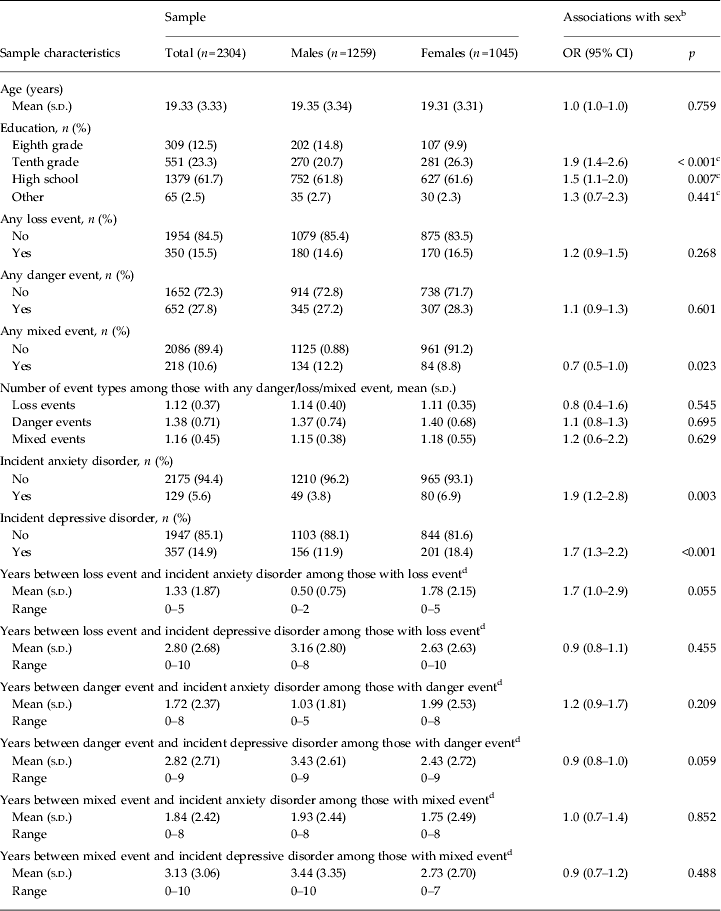
Because the current study focused on incident anxiety and depression as the diagnostic outcome, the present analyses are based on a subsample of individuals with no baseline anxiety and/or depressive disorder, who participated in at least one follow-up assessment (n = 2304). Cases with anxiety and/or depression at baseline (n = 542; 19.6%) were excluded. Sample characteristics are presented in Table 1.
Sample characteristics of the total sample, males and females

OR, odds ratio; CI, confidence interval; s.d., standard deviation.
a Unweighted number of participants (weighted percentages, means and standard deviations).
b 0 = male, 1 = female.
c Reference group: eighth grade.
d Slightly smaller numbers of participants because of missing age of onset information.
Diagnostic assessment
Diagnostic information was assessed repeatedly using the lifetime (baseline) and interval version (follow-up assessments) of the Computer-Assisted Personal Interview (CAPI) version of the Munich-Composite International Diagnostic Interview (DIA-X/M-CIDI; Wittchen & Pfister, Reference Wittchen and Pfister1997). The M-CIDI is an updated version of the World Health Organization's CIDI version 1.2 (WHO, 1990) with additional questions to cover DSM-IV and ICD-10 criteria. The M-CIDI can be used to assess symptoms, syndromes and diagnoses of 48 mental disorders along with additional information on onset, duration, and clinical and psychosocial severity. Detailed descriptions of psychometric properties have been presented elsewhere (Reed et al. Reference Reed, Gander, Pfister, Steiger, Sonntag, Trenkwalder, Sonntag, Hundt and Wittchen1998; Wittchen et al. Reference Wittchen, Lachner, Wunderlich and Pfister1998a ).
The current study focused on follow-up incidences of depression (comprising major depressive disorder and dysthymia) and anxiety (comprising social phobia, panic disorder, agoraphobia and generalized anxiety disorder, GAD) (see Table 1). For social phobia, the impairment criterion was only applied to participants aged ⩾18 years (Wittchen et al. Reference Wittchen, Lieb, Schuster, Oldehinkel and Rapoport1999). Specific phobias were disregarded because of the early age of onset, which had occurred mostly prior to baseline (Beesdo et al. Reference Beesdo, Pine, Lieb and Wittchen2010). Obsessive–compulsive disorder, post-traumatic stress disorder and bipolar disorder were disregarded because of inconsistent findings in structural models (Cox et al. Reference Cox, Clara and Enns2002; Kessler et al. Reference Kessler, Chiu, Demler and Walters2005; Watson, Reference Watson2005; Slade & Watson, Reference Slade and Watson2006).
Assessment of life events
Life events were assessed at baseline using the Munich Event List (MEL; Maier-Diewald et al. Reference Maier-Diewald, Wittchen, Hecht and Werner-Eilert1983), a questionnaire-like procedure for the assessment of positive and negative short-term events and chronic conditions in 11 areas of life. The MEL contains 83 items (74 specific event categories and nine open categories) that ask about the occurrence of specific life events within a particular time interval. In the EDSP, participants were asked to indicate the presence of each life event in yearly intervals from 1995 to 1999, the year of interview. Detailed descriptions and psychometric properties of the MEL have been presented previously (Wittchen et al. Reference Wittchen, Essau, Hecht, Teder and Pfister1989; Friis et al. Reference Friis, Wittchen, Pfister and Lieb2002).
For the present study, 21 psychologists rated each MEL event category on the dimensions danger and loss. This is different from the rating procedure for danger and loss events used by Finlay-Jones & Brown (Reference Finlay-Jones and Brown1981). Our expert rating differs conceptually from the original rating procedure because no contextual information was collected or was available to our raters. Raters were instructed to mark event categories as loss if they referred to death or separation of a valued person, loss of physical health or loss of jobs, career opportunities or material possessionsFootnote 1 Footnote †. Subsequently, raters were asked to rate the severity of event categories marked as loss on a scale from 1 (little loss) to 6 (extreme loss). Raters were instructed to mark event categories as danger if they were likely to trigger specific future problems. To prevent raters from marking all event categories judged as loss additionally as danger (because a loss event may entail an emotional crisis for the affected individual), raters were instructed to not mark event categories as danger if the respective event was merely likely to trigger an emotional crisis because of its loss character. Subsequently, raters were asked to indicate the severity of event categories marked as danger on a scale from 1 (little danger) to 6 (extreme danger) by judging how severe the most likely future problem would be. Each event category was rated on both dimensions. Inter-rater reliability was 0.86 for loss ratings and 0.71 for danger ratings.
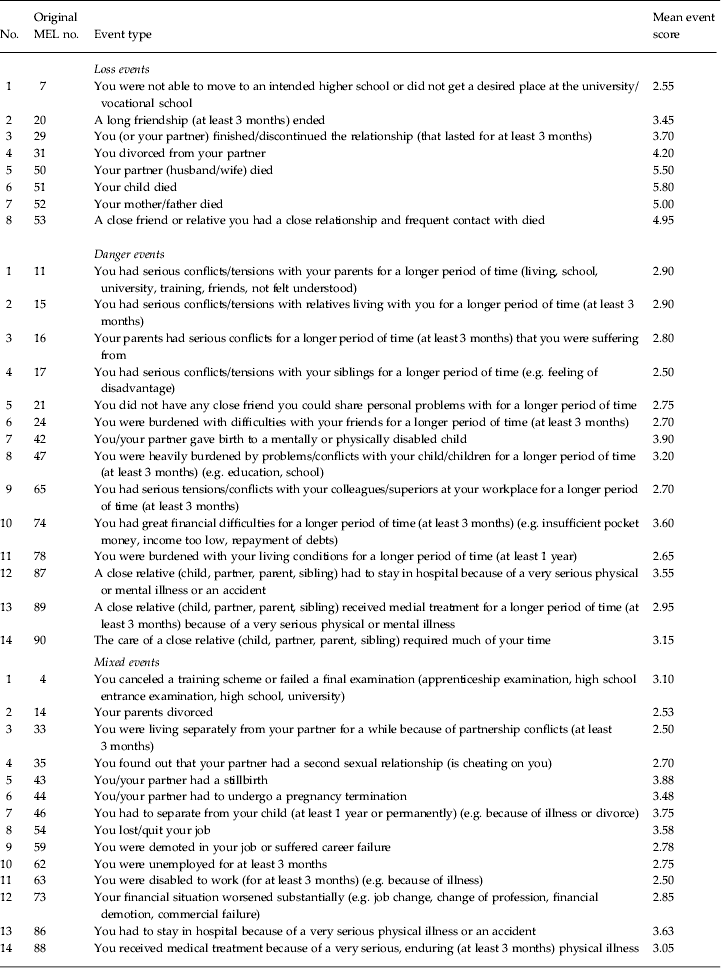
In a second step, each event category was classified as loss, danger or mixed event category type. To be consistent with previous studies (Finlay-Jones & Brown, Reference Finlay-Jones and Brown1981; Eley & Stevenson, Reference Eley and Stevenson2000; Kendler et al. Reference Kendler, Hettema, Butera, Gardner and Prescott2003), event categories scoring low on both dimensions (mean rating score < 2.5 on both loss and danger) were excluded and only event categories with mean rating scores of 2.5 or higher on at least one dimension were considered. Paired t tests were conducted to reveal whether ratings on both dimensions for individual event categories differed from each other [95% confidence interval (CI)]. Event categories with significantly differing means on both dimensions were classified as loss or danger event types whereas event categories not differing on both dimensions were classified as mixed event types. That is, danger, loss and mixed event types were mutually exclusive and no event category could be classified as more than one event type. Table 2 presents event categories classified as loss, danger and respectively mixed event types along with their mean severity scores. For ‘pure’ loss event types and ‘pure’ danger event types, the mean loss rating score or mean danger rating score was used to indicate severity, whereas for mixed event types, the mean of both loss and danger rating score was used. To determine the test–retest reliability of danger, loss and mixed event types, a 1-year follow-up rating was conducted among a subsample of the original raters (n = 15). Test–retest reliability was 0.71 for loss, 0.65 for danger and 0.61 for mixed event types.
Outline of all MEL event categories classified as danger, loss or mixed event types

MEL, Munich Event List.
The current analyses considered three binary variables (any loss event, any danger event and any mixed event) and six dimensional variables (number of loss events, number of danger events and number of mixed events along with weighted number of loss events, weighted number of danger events and weighted number of mixed events) (see Table 1). The variables weighted number of loss, danger or mixed event consider number and severity of event types (each event category was weighted with its main event score of the expert rating). Consistent with Finlay-Jones & Brown (Reference Finlay-Jones and Brown1981) and Eley & Stevenson (Reference Eley and Stevenson2000), information on the year prior to baseline was used for the current work.
Statistical analyses
The software package Stata version 12.1 (StataCorp, 2011) was used for all analyses. Data [percentages, odds ratios (ORs)] are weighted to match the original distribution of the sampling frame; frequencies are unweighted.
Analyses refer to associations (ORs) between life event types during the year prior to baseline and incident anxiety and depression at follow-up (cumulated information from T1, T2 and T3). Only participants with no lifetime history of anxiety or depression at baseline and at least one follow-up assessment (n = 2304) were included into analyses.
First, associations between any event types (any loss event, any danger event and any mixed event) and incident anxiety and depression were tested using simple logistic regressions. In addition, we graphically assessed intervals between event types at baseline and incident disorders at follow-up. Whenever age of reported onset at follow-up was lower than age at baseline, age of onset was recoded to age of baseline.
Second, analyses were repeated using numbers of events types (number of loss events, number of danger events and number of mixed events) and weighted numbers of event types (weighted number of loss events, weighted number of danger events and weighted number of mixed events) as predictors. To assess whether (weighted) numbers of event types were non-monotonically related to incident disorders, outcomes were regressed on both the linear and the squared term of (weighted) numbers (because this is sensitive for identifying non-linear associations).
Third, to assess whether the hypothesized associations between event types and anxiety/depression were specific, multinomial logistic regressions were fit using the following mutually exclusive predictor and outcome groups: predictor group: (0) no danger, loss or mixed event, (1) ‘pure’ loss event (excludes cases with danger or mixed events), (2) ‘pure’ danger event (excludes cases with loss or mixed events), (3) loss/danger/mixed event (includes cases with mixed events or more than one event type); outcome group: (0) no anxiety and no depression (no incident anxiety disorder and no incident depressive disorder at follow-up), (1) anxiety but no depression (incident anxiety disorder but no incident depressive disorder at follow-up; that is ‘pure’ anxiety), (2) depression but no anxiety (incident depressive disorder but no incident anxiety disorder at follow-up; that is ‘pure’ depression), (3) anxiety and depression (incident anxiety disorder and incident depressive disorder at follow-up; that is co-morbid anxiety and depression).
Scores for any event types, numbers of event types and weighted numbers of event types were standardized (mean = 0, standard deviation = 1). All analyses were adjusted for sex and age (age at last completed assessment).
Ethical standards
The authors assert that all procedures contributing to this work have been approved by the Ethics Committee of the Medical Faculty of the Technische Universität Dresden (No. EK-13811) and comply with the Helsinki Declaration of 1975, as revised in 2013.
Results
Associations between event types and incident anxiety and depression
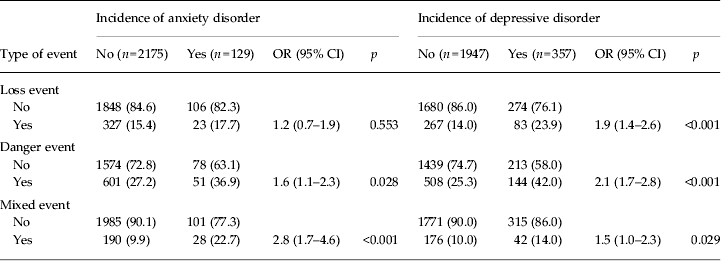
Table 3 presents associations between any event types and incident anxiety and depression: any loss event predicted incident depression only (OR 1.9), any danger event predicted incident anxiety (OR 1.6) and depression (OR 2.1), and any mixed event predicted incident anxiety (OR 2.8) and depression (OR 1.5).
Associations between type of event and follow-up incidence of anxiety or depression (n = 2304)

OR, Odds ratio; CI, confidence interval.
aUnweighted number of participants (weighted percentages, means and standard deviations).
Simple logistic regressions with any loss, danger or mixed event as predictors, adjusted for sex and age.
Figure 1 shows time intervals between any event types at baseline and incident disorders at follow-up. In those with danger, loss or mixed events at baseline, incidence rates for anxiety and depression at follow-up were highest shortly after baseline and decreased with time.
Time intervals between (a) loss events and incident anxiety, (b) loss events and incident depression, (c) danger events and incident anxiety, (d) danger events and incident depression, (e) mixed events and incident anxiety and (f) mixed events and incident depression in those with respective events at baseline and incident disorder at follow-up.

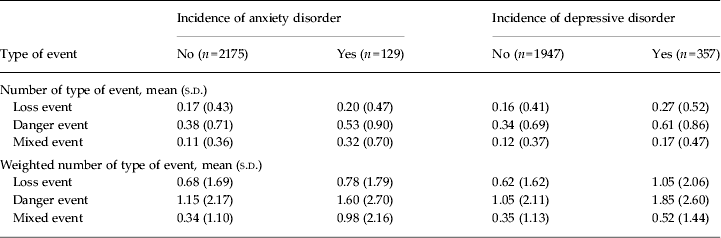
Table 4 presents means and standard deviations for numbers and weighted numbers of event types by incident anxiety and depression.
Numbers and weighted numbers of type of event by follow-up incidence of anxiety or depression (n = 2304)

Examining associations between linear numbers (LN)/linear weighted numbers (LWN) of event types and incident anxiety and depression revealed the following results: LN and LWN of loss events only predicted incident depression (LN, OR 1.2 per standard deviation, 95% CI 1.1–1.4, p < 0.001; LWN, OR 1.2, 95% CI 1.1–1.4, p < 0.001). LN and LWN of danger events predicted incident anxiety (LN, OR 1.2, 95% CI 1.0–1.5, p = 0.030; LWN, OR 1.2, 95% CI 1.0–1.4, p = 0.034) and incident depression (LN, OR 1.4, 95% CI 1.2–1.6, p < 0.001; LWN, OR 1.4, 95% CI 1.2–1.6, p < 0.001). LN and LWN of mixed events predicted incident anxiety (LN, OR 1.4, 95% CI 1.3–1.7, p < 0.001; LWN, OR 1.4, 95% CI 1.3–1.7, p < 0.001) and incident depression (LN, OR 1.2, 95% CI 1.0–1.3, p = 0.019; LWN, OR 1.2, 95% CI 1.0–1.3, p = 0.016).
Only for the associations between squared numbers (SN) and squared weighted numbers (SWN) of danger events and incident depression did the squared term predict the outcome beyond the linear term (SN, OR 0.9, 95% CI 0.9–1.0, p = 0.018; SWN, OR 0.9, 95% CI 0.8–1.0, p = 0.016). In particular, danger events predicted an increased risk of depression for zero to three danger events (danger severity scores from 0 to 8) and a decreased risk for four or more danger events (danger severity scores >8). All other associations of event types with anxiety and/or depression were found to increase monotonically with a higher number and greater severity of the respective event types.
Specificity between event types and incident anxiety and depression
To assess whether associations between event types and incident anxiety and depression were specific, we used mutually exclusive groups, that is ‘pure’ danger events, ‘pure’ loss events and respectively mixed events as predictors and no anxiety and depression, ‘pure’ anxiety, ‘pure’ depression and co-morbid anxiety and depression as outcome. As shown in Table 5, ‘pure’ loss events only predicted incident ‘pure’ depression (OR 2.4 per standard deviation). ‘Pure’ danger events predicted incident ‘pure’ anxiety (OR 2.3) and ‘pure’ depression (OR 2.5). Mixed events predicted incident ‘pure’ anxiety (OR 2.9), ‘pure’ depression (OR 2.4) and co-morbid anxiety and depression (OR 3.6).
Associations a of ‘pure’ loss events, ‘pure’ danger events and mixed events with follow-up incidence of no anxiety disorder (AD) and no depression disorder (DD), AD but no DD, DD but no AD, and co-morbid AD and DD (n = 2304)

OR, Odds ratio; CI, confidence interval.
a Multinomial logistic regression, adjusted for sex and age. Reference group: no danger, loss and mixed event.
b Excludes cases with danger or mixed events.
c Excludes cases with loss or mixed events.
d Includes cases with mixed events or more than one event type.
Discussion
This study revealed the following core findings: (1) loss events predicted incident depression only, (2) danger events predicted incident anxiety and depression, and (3) mixed events predicted incident anxiety, depression and co-morbid anxiety and depression.
Loss events and depression
We found that loss events only predicted incident depression and that a higher number and greater severity of loss events increased this association monotonically. This suggests that loss events specifically increase the risk for depression but not the risk for anxiety, probably because loss events primarily trigger immediate distress but hold no (or little) potential for specific future problems. It is further noteworthy that (with one exception) all event categories classified as loss in our study were related to death of or separation from significant others, and it seems that this form of interpersonal loss is highly specific in predicting depression.
Our finding that loss events are associated with incident depression complies with previous research (Finlay-Jones & Brown, Reference Finlay-Jones and Brown1981; Eley & Stevenson, Reference Eley and Stevenson2000; Kendler et al. Reference Kendler, Hettema, Butera, Gardner and Prescott2003). However, Finlay-Jones & Brown (Reference Finlay-Jones and Brown1981) found that loss events were associated with both depression and co-morbid anxiety and depression, and Kendler et al. (Reference Kendler, Hettema, Butera, Gardner and Prescott2003) showed that loss events were linked to depression, anxiety and co-morbid anxiety and depression although, in their study, the link was strongest for depression, intermediate for co-morbid disorders and weakest for anxiety.
These differences in findings may lie in the fact that earlier studies distinguished between (non-mutually exclusive) danger and loss events whereas the present study distinguished between ‘pure’ danger events, ‘pure’ loss events and respectively mixed events. Moreover, assessment of life events differed considerably between our and previous studies: in previous studies, life events were assessed along with contextual data that were fundamental for the categorization of event types. By contrast, life events in our study were assessed using a checklist with specified events classified as danger, loss or mixed events independent of contextual data.
Danger events and anxiety
We further found that danger events predicted both incident anxiety and depression. Although the association with anxiety increased monotonically for a higher number and greater severity of danger events, the association with depression increased for zero to three danger events (event severity scores between 0 and 8) and decreased for four or more danger events (event severity scores higher than 8). These results suggest that danger events are non-specifically related to anxiety and depression when considering a lower number and severity of danger events, but specifically related to anxiety when considering a higher number and severity of danger events, possibly because high levels of danger especially indicate an increased likelihood of unfavorable future consequences.
Our finding for any danger event to predict both anxiety and depression complies with Finlay-Jones & Brown (Reference Finlay-Jones and Brown1981), who found that danger events were linked to anxiety and depression. However, in contrast to our findings, Finlay-Jones & Brown (Reference Finlay-Jones and Brown1981) revealed that danger events were additionally associated with co-morbid anxiety and depression, whereas Eley & Stevenson (Reference Eley and Stevenson2000) and Kendler et al. (Reference Kendler, Hettema, Butera, Gardner and Prescott2003) found that danger events were associated with anxiety but not with either depression or co-morbid anxiety and depression.
These differences may be explained partially by the fact that, in our study, a higher number and a greater severity of danger events were associated with incident anxiety only. In addition, event types in our study were established without using contextual information, which may have resulted in fewer specific event categories and contributed to broader associations of danger events with both anxiety and depression. However, further research is needed to examine more closely the associations of danger events with depression and co-morbid anxiety and depression.
Mixed events and co-morbid anxiety and depression
We also found that mixed events predicted all outcome patterns, namely incident anxiety, depression and co-morbid anxiety and depression. A higher number and greater severity of mixed events increased these associations. It is particularly noteworthy that, in the multinomial model, only mixed events and neither ‘pure’ danger nor ‘pure’ loss events predicted co-morbid anxiety and depression, probably because mixed events indicate both immediate distress and potential unfavorable long-term consequences. These findings are in accordance with Finlay-Jones & Brown (Reference Finlay-Jones and Brown1981), who found that more co-morbid cases than anxiety cases or non-cases reported both danger and loss events at any period of time.
Strengths and limitations
This study firstly examined prospective-longitudinal associations of danger and loss events with incident anxiety and depression in a representative sample of adolescents and young adults.
However, the following limitations need to be considered: first, life events at baseline and psychopathology at each wave were assessed retrospectively and recall may have been biased (Andrews et al. Reference Andrews, Anstey, Brodaty, Issakidis and Luscombe1999). Second, only moderate/severe danger and loss events were included in the analyses and hence dissimilar associations may exist between milder life events and anxiety and/or depression. Third, no contextual information was used for the categorization of danger, loss and mixed events, although contextual data might have influenced how participants perceived and responded to specific types of life events. Fourth, our study focused on considerably longer time intervals between event types and incident disorders than previous studies, although we did find that, consistent with previous research (Surtees & Ingham, Reference Surtees and Ingham1980; Kendler et al. Reference Kendler, Karkowski and Prescott1998; Wainwright & Surtees, Reference Wainwright and Surtees2002), incidence rates for anxiety and depression in those with any danger, loss or mixed event at baseline were highest shortly after baseline and decreased with time. Nevertheless, we were unable to assess systematically the duration of risk periods of danger, loss and mixed events for incident anxiety and depression. Fifth, the study sample contained adolescents and young adults from a relatively wealthy area in Germany, and hence the generalizability of findings, especially to other age groups, may be limited.
Conclusions
We found loss events to specifically predict incident depression, danger events to predict incident anxiety and depression, and mixed events to predict incident anxiety, depression and their co-morbidity. Thus, although associations between danger events and anxiety and also mixed events and co-morbid disorders were non-specific, our findings suggest partly distinct etiologies for anxiety and depression. Future research is required to replicate our findings and focus on temporal associations between exposure to different event types and incidence of anxiety and depression.
Acknowledgments
This work is part of the EDSP and is funded by the German Federal Ministry of Education and Research (BMBF) project nos 01EB9405/6, 01EB 9901/6, EB01016200, 01EB0140 and 01EB0440. Some of the fieldwork and analyses was also supported by grants from the Deutsche Forschungsgemeinschaft (DFG; LA1148/1-1, WI2246/1-1, WI 709/7-1 and WI 709/8-1). The first author (Eva Asselmann) was funded by a doctoral stipend of the German National Academic Foundation (Studienstiftung des Deutschen Volkes).
Principal Investigators were H.-U. Wittchen and R. Lieb. Core staff members of the EDSP group are: K. von Sydow, G. Lachner, A. Perkonigg, P. Schuster, M. Höfler, H. Sonntag, T. Brückl, E. Garczynski, B. Isensee, A. Nocon, C. Nelson, H. Pfister, V. Reed, B. Spiegel, A. Schreier, U. Wunderlich, P. Zimmermann, K. Beesdo-Baum, A. Bittner, S. Behrendt and S. Knappe. Scientific advisors were J. Angst (Zurich), J. Margraf (Basel), G. Esser (Potsdam), K. Merikangas (National Institute of Mental Health, Bethesda), R. Kessler (Harvard, Boston) and J. van Os (Maastricht).
Declaration of Interest
Dr Wittchen is on the advisory board and has received grant support to his institution from Servier, Novartis, Lundbeck, Pfizer, Sanofi, and Hoffmann-La Roche.