Catecholaminergic polymorphic ventricular tachycardia is a rare disease characterized by lethal ventricular tachycardia triggered by physical or emotional stress without structural cardiac pathology. There are two main forms, the autosomal dominant form owing to ryanodine mutation and the autosomal recessive form caused by the calsequestrin mutation. Calmodulin and triadin mutations have also been reported in a small number of cases in recent years. Reference O’Callaghan, Hancox and Stuart1 Triadin mutation is also called a type of malignant long QT syndrome (LQTS17). However, cases do not fully reflect either long QT syndrome and catecholaminergic polymorphic ventricular tachycardia. The combination of these two disease with the atypical form has been named triadin knockout syndrome. Triadin knockout syndrome has been defined as a disease with transient long QT interval, T wave abnormalities, and extremely severe fatal cardiac arrhythmias in young children. Reference Altmann, Tester and Will2 The number of cases reported all around the world regarding this malignant syndrome, which has become known in the last decade, is below 50. Reference Clemens, Tester and Giudicessi3 In this report, we wanted to share the characteristics of our two cases who presented with sudden cardiac arrest and were diagnosed with triadin knockout syndrome.
Case 1
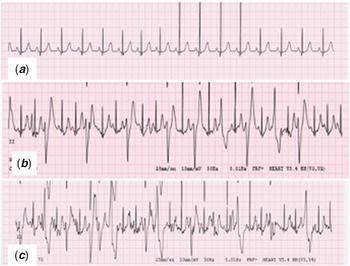
A 7.5-year-old male patient was referred to our clinic with a history of recurrent syncope and aborted cardiac arrest. There was no family history of sudden death, syncope, or arrhythmia. In the evaluation, physical examination, electrocardiography (QTc: 419 ms, no T wave negativity), echocardiography, and 24-hour rhythm Holter monitoring were normal. The patient was subjected to exercise stress test. Although the patient’s resting electrocardiography was normal, exercise testing revealed frequent polymorphic premature ventricular beats that transformed into bidirectional ventricular tachycardia at stage 4 (Fig 1). Catecholaminergic polymorphic ventricular tachycardia was diagnosed. Epicardial intracardiac defibrillator implantation was performed. Genetic analysis revealed a homozygous mutation of c.531_533delinsGG, p.(Lys179Asnfs * 44) frameshift variant in TRDN(NM_006073) gene by next-generation sequencing method. He has been followed up uneventfully for 5 years with propranolol (3 mg/kg/day) and flecainide (100 mg/m2/day). Neither ventricular tachycardia nor intracardiac defibrillator therapy was observed. The family was informed about the sympathectomy, but the family did not approve of performing a sympathectomy.
Exercise stress test of case 1, ( a ) basal electrocardiography, ( b ) bidirectional ventricular premature beats (VES) is observed at the third minute of the exercise, and ( c ) non-sustained bidirectional ventricular tachycardia at the 9th minute.

Case 2
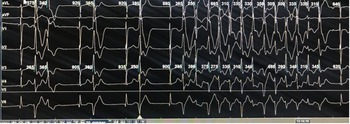
A 4.5 year-old, male patient, presented with aborted sudden death due to ventricular fibrillation. The patient also had a history of syncope during exercise. In her family history, her parents were married to first-degree cousins, and her four siblings had a history of sudden cardiac death associated with exertion between the ages of 6 and 12 years. Physical examination was normal, there was borderline QTc prolongation on electrocardiography (QTc: 455–460 ms, T wave negativity was not detected. The exercise stress test could not be performed on due to the patient age. An adrenaline provocation test was performed by the Ackermann protocol. Adrenaline 0.025 mcg/kg/minute infusion was started after 10 minutes of rest. The infusion rate was increased at 5-minute intervals. Bidirectional ventricular extrasystoles started at a dose of 0.1 mcg/kg/minute. Bidirectional non-sustained polymorphic ventricular tachycardia was observed at a dose of 0.2 mcg/kg/min (Fig 2), and the infusion was terminated. The patient was diagnosed with catecholaminergic polymorphic ventricular tachycardia, and cardiac sympathectomy and intracardiac defibrillator implantation were performed. In genetic analysis, c.568dupA, pII190Asnfs * 2 frameshift variant homozygous mutation was detected in TRDN(NM_006073) gene by next-generation sequencing method. There has not been any event with the treatment of propranolol 3 mg/kg/day and flecainide 100 mg/m2/day for 1 year.
Bidirectional non-sustained ventricular tachycardia attack during the adrenaline test (at a dose of 0.2 mcg/kg/minute) of case 2.

Discussion
Triadin is a transmembrane protein responsible for calcium homeostasis along with RYR2 and CASQ2 in the sarcoplasmic reticulum. Reference O’Callaghan, Hancox and Stuart1 Triadin mutation was first reported as a malignant arrhythmogenic phenotype in 2012. Reference Clemens, Tester and Giudicessi3 Later, Altman et al. defined it as a type of long QT syndrome with life-threatening arrhythmias, especially in young children (LQTS17). In 2015, homozygous TRDN mutation was named triadin knockout syndrome with malignant arrhythmias affecting especially infants and young children. Reference Altmann, Tester and Will2 Although it progresses with extremely malignant arrhythmias, very few cases have been reported. Reference Sarquella-Brugada, Fernandez-Falgueras and Cesar4 The international triadin knockout syndrome registry defined it as an aggressive arrhythmogenic phenotype that transient QT prolongation, recurrent ventricular arrhythmias, and T wave inversion in precordial leads. Reference Clemens, Tester and Giudicessi3 Skeletal muscle weakness has also been reported in some patients. Reference Engel, Redhage and Tester5 Homozygous, compound heterozygous forms have been reported. Reference O’Callaghan, Hancox and Stuart1,Reference Altmann, Tester and Will2,Reference Sarquella-Brugada, Fernandez-Falgueras and Cesar4,Reference Rooryck, Kyndt and Bozon6–Reference Rossi, Gigli and Gamberucci8 However, the cases do not show the typical features of catecholaminergic polymorphic ventricular tachycardia or long QT syndrome and are considered to be a highly lethal overlap arrhythmogenic phenotype with ventricular fibrillation and cardiac arrest. Reference Sarquella-Brugada, Fernandez-Falgueras and Cesar4 Almost all of the cases are under 10 years of age, and the mean age at the first cardiac event has been reported as 3 ± 2 years. Reference Altmann, Tester and Will2,Reference Clemens, Tester and Giudicessi3 Similarly, our patients were younger than 10 years of age, and when both were evaluated for cardiac arrest. The triadin knockout syndrome registry evaluated the phenotypic characteristics of 21 patients, and cardiac arrest (81%) or syncope (24%) was reported in 20 patients. Mild muscle weakness were reported in 29%, T wave negativity in 84%, and transient QTc prolongation (>480 ms) in 53%. Ventricular ectopia was detected in eight of nine patients who underwent an exertion test. Intracardiac defibrillator implantation was performed in 68% of the patients, and a history of recurrent cardiac events was reported in 78% of them despite different treatment strategies. Reference Clemens, Tester and Giudicessi3 While the QTc interval was 455–460 ms in the initial electrocardiography in one of our patients, it returned to normal during the follow-up. In our other patient, the QTc interval was normal during admission and follow-up. T wave inversion was not seen our patients. Muscle weakness, which is reported at a low rate in the literature, was not observed in our patients. There are no clear recommendations for the treatment of triadin knockout syndrome (TCOS) yet. Beta-blocker, intracardiac defibrillator implantation is applied to almost all patients, and some patients additionally received flecainide, calcium channel blocker, and underwent left cardiac sympatic denervation. However, despite all treatments, the frequency of cardiac events is high (78%). Reference Clemens, Tester and Giudicessi3 In both of our patients, no cardiac events were detected under beta-blocker and flecainide combination therapy. Although there are patients in the literature who have reported events with the combination of beta-blockers and flecainide, Walsh et al. described two patients who did not experience any cardiac events after beta-blocker and flecainide treatment. Reference Clemens, Tester and Giudicessi3,Reference Walsh, Stuart and Schlecht7 Almost 2/3 of these patient also had cardiac sympathetic denervation.. Unfortunately, one of our patients did not agree to have sympathetic denervation procedure.
In conclusion; TCOS is a rare overlap syndrome characterized by highly lethal arrhythmias and defined as a fatal form of long QT syndrome and catecholaminergic polymorphic ventricular tachycardia that affects young children. It has distinctive features from catecholaminergic polymorphic ventricular tachycardia by presenting with cardiac arrest at a younger age, T wave negativity, and muscle weakness. Because of the different presentations of the disease, definitive distinction is possible with genetic testing. Since lethal arrhythmias are frequently described, genetic testing is very important in these patients. Detection of a TRDN mutation may be a guide for a more detailed evaluation of patients, aggressive treatment plan, and close follow-up.
Financial support
This research received no specific grant from any funding agency, commercial or not-for-profit sectors.
Conflicts of interest
None.
Ethical standards
Not applicable.
Informed consent
Informed consent was obtained from all parents of participants included in this case report.