INTRODUCTION
Zoobotryon verticillatum (Delle Chiaje, Reference Delle Chiaje1822), commonly known as ‘spaghetti bryozoan’, is a stoloniferous fouling bryozoan capable of forming massive colonies. It has been recorded in temperate and warm regions around the world. Originally described from Naples, Italy, as Hydra verticella (Delle Chiaje, Reference Delle Chiaje1822, Plate XLVII, figures 1 & 2), where ‘nell’estate si sviluppa straordinariamente sui pali degli stabilimenti balneari dando folti cespugli di colonie lunghe ed estese' (Zirpolo, Reference Zirpolo1922: 128, as Z. pellucidum). In the port of Genova, Italy, it is found only in the summer months (Relini, Reference Relini1966), whereas in the Venice Lagoon it is ‘restricted to the stations that are close to the warm water outlet of the power station’ (Occhipinti-Ambrogi, Reference Occhipinti-Ambrogi2000: 311). It is found mostly in harbours (Ryland, Reference Ryland1965; Ganapathi & Satyanarayana Rao, Reference Ganapathi and Satyanarayana Rao1968; Ardizzone & Riggio, Reference Ardizzone and Riggio1981; Gordon & Mawatari, Reference Gordon and Mawatari1992; Hewitt et al., Reference Hewitt, Campbell, Thresher, Martin, Boyd, Cohen, Currie, Gomon, Keough, Lewis, Lockett, Mays, McArthur, O'Hara, Poore, Ross, Storey, Watson and Wilson2004; Ramadan et al., Reference Ramadan, Kheirallah and Abdel-Salam2006; Carlton & Eldredge, Reference Carlton and Eldredge2009). In the past decade it has extended its range to once remote islands such as the Azores (Amat & Tempera, Reference Amat and Tempera2009), Madeira (Wirtz & Canning-Clode, Reference Wirtz and Canning-Clode2009), the Canary Islands (Minchin, Reference Minchin2012) and the mid-Pacific Palmyra Atoll (Knapp et al., Reference Knapp, Godwin, Smith, Williams and Bell2011).
The species has long been known from Alexandria harbour (Ehrenberg, Reference Ehrenberg1828; O'Donoghue & De Watteville, Reference O'Donoghue and De Watteville1939; El-Komi, Reference El-Komi1992, Reference El-Komi1998; Abdel-Salam & Ramadan, Reference Abdel-Salam and Ramadan2008) and Suez (Ehrenberg, Reference Ehrenberg1828). In the early 1950s ‘petites colonies de deux cm de hauteur établies sur des Algues brunes du genres Padina’ of Z. verticillatum were reported from Latakia, Syria (Gautier, Reference Gautier1956: 560, as Z. pellucidum) and in the early 1960s Lipkin & Safriel (Reference Lipkin and Safriel1971) recorded it ‘occurring sometimes in huge colonies’ in Mikhmoret, Israel, in the vicinity of the naval school's harbour. However, subsequent studies of the bryozoan fauna in the Levantine Basin have failed to record Z. verticillatum in Israel, including summertime sampling in the port of Ashdod that found other alien bryozoans (Powell, Reference Powell1969; d'Hondt, Reference d'Hondt1988), Lebanon (Bitar & Bitar, Reference Bitar and Bitar2001), Turkey (Ünsal & d'Hondt, Reference Ünsal and d'Hondt1979) and Cyprus (Koçak et al., Reference Koçak, Balduzzi and Benli2002).
In the course of a recent survey in a marina in Ashdod, on the southern Mediterranean coast of Israel, long gelatinous strands of unfamiliar seaweed-like organism were noted festooning the bottom of a small fishing vessel that has lain idle at the marina for the previous three weeks. Upon examination it was identified as Z. verticillatum.
RESULTS
SYSTEMATICS
CTENOSTOMATIDA Busk, 1852
VESICULARIIDAE Hincks, 1880
Zoobotryon Ehrenberg, 1831
Zoobotryon verticillatum (Delle Chiaje, Reference Delle Chiaje1822)
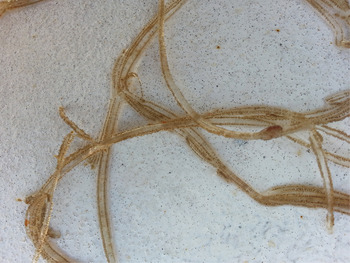
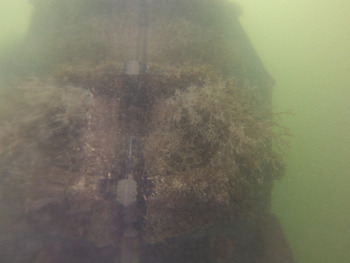
(Figures 1 & 2)
Zoobotryon verticillatum: Mediterranean Sea, Israel, Ashdod, 20 July 2013: on a hull of a fishing vessel (photograph by R. Gevili).

Zoobotryon verticillatum: Mediterranean Sea, Israel, Ashdod, 9 September 2013: on the hull of support vessel ‘Rotem’ (photograph by R. Gevili).

Hydra verticillata Delle Chiaje, Reference Delle Chiaje1822, pl. XLVII, figure 1.
Zoobotryon pellucidus Ehrenberg, Reference Ehrenberg1828, pl. III, figure 10.
Zoobotryon verticillatum Soule, Reference Soule and Osburn1953: 742, pl. 79, figure 3.
MATERIAL EXAMINED
Mediterranean Sea: Israel, Ashdod, 20 July 2013, 31°47N 34°37E; voucher specimens were preserved in 96% ethanol and deposited in the Steinhardt National Collection of Natural History, Zoological Museum at Tel Aviv University (TAU BR25001).
DIAGNOSIS
Zoobotryon verticillatum is an erect uncalcified bryozoan, with colonies resembling transparent gelatinous strings ‘up to 1 m long’ (Gordon & Mawatari, Reference Gordon and Mawatari1992) or to 2.4 m long (Yanamura, Reference Yanamura1975), composed of irregularly branching zooid-bearing stolons (Figure 1). Zooids ovoid, 0.5–1.0 mm long, cluster on either side of the 1–2 mm thick stolon. The eight tentacled polypides have large stomach gizzards. Settlement occurs in summer.
REMARKS
Bryozoans are common components of marine biofouling communities and as such have achieved global spread by shipping and aquaculture (Ryland, Reference Ryland1965). Zoobotryon verticillatum is one of the most ubiquitous fouling bryozoans, occurring in many ports and considered a warm water cosmopolitan species. Authors have regarded it a cryptogenic species of unknown native origin (Floerl et al., Reference Floerl, Inglis and Gordon2009), a native to the Caribbean Sea (Winston, Reference Winston1995), a native to the Mediterranean Sea (Cranfield et al., Reference Cranfield, Gordon, Willan, Marshall, Battershill, Francis, Nelson, Glasby and Read1998) or to have arrived in the latter with shipping by the 18th Century or early 19th Century (Carlton & Eldredge, Reference Carlton and Eldredge2009). It is challenging to distinguish introduced species from naturally widespread ones. However, criteria for establishing a status of a species as an alien appraise its range, association with possible vectors, prevalence in artificial environments, and ‘sudden’ appearance, and Z. verticillatum meets them all. It occurs worldwide in tropical and warm-temperate waters, mostly in ports and marinas, or anthropologically altered areas such as shell farming bays and lagoons (Mawatari & Kobayashi, Reference Mawatari and Kobayashi1954; Occhipinti-Ambrogi, Reference Occhipinti-Ambrogi2000), and it has been identified in vessel biofouling communities. Recent publications record its ‘sudden’ materialization in disjunct locations, and though conspicuous and distinctive, several surveys of the bryozoan fauna along the Levant coastline conducted over the past half century have failed to record it. On a subsequent dive at the Ashdod marina on 9 September 2013, an ‘EDT Marine’ support vessel ‘Rotem’ 72947 supplying the offshore gas fields, with home port in Limassol, Cyprus, was photographed shrouded in a profuse growth of Z. verticillatum (Figure 2). Intriguingly, the harbour master recalled similar summertime growths over the past five years. In the warm waters of the western Atlantic and Caribbean Sea Z. verticillatum inhabits seagrass meadows, mangroves, oyster reefs and rocky shores, in addition to fouling man-made habitats (Osburn, Reference Osburn1940; Winston, Reference Winston1995, Reference Winston2004; Bouzon et al., Reference Bouzon, Brandini and Rocha2012). Okenia zoobotryon (Smallwood, 1910) is a Caribbean goniodoridid opisthobranch known to live, feed and reproduce exclusively on Z. verticillatum (Valdés & Ortea, Reference Valdés and Ortea1995; Winston, Reference Winston1995; Robinson, Reference Robinson2004; Ortea et al., Reference Ortea, Moro and Espinosa2009). It stands to reason that organisms exhibiting such specialized interaction have been closely evolved. Therefore, it is suggested that Z. verticillatum is a native to the Caribbean and an invasive alien elsewhere (including the Mediterranean Sea) notwithstanding Naples is its type location. Molecular studies may provide further evidence as to its origin and history of invasion.
ACKNOWLEDGEMENTS
Thanks to Frédéric Mineur, Mediterranean Institute of Oceanography, Marseille, France, and to Kevin Tilbrook, Museum of Tropical Queensland, Australia, for their valuable comments, and to Susan Lynch, American Museum of Natural History, New York, for information about the literature. Marine Master Yoram Greenberg has been generous with information.
FINANCIAL SUPPORT
Partial support for this research was provided by the European Community's Seventh Framework Programme (FP7/2011-2015) for the project Vectors of Change in Oceans and Seas Marine Life, Impact on Economic Sectors (VECTORS) (B.S.G.).