Psychosis, after its onset, has a debilitating course, and early intervention in the pre-morbid phase of the disease is important (Solis, Reference Solis2014). Increased scientific interest and research in identifying individuals at the pre-morbid phase of psychosis led to the development of the operationally defined criteria of ‘clinical high-risk (CHR)’. This has gained wide recognition over the last two decades (McGlashan, Walsh, & Woods, Reference McGlashan, Walsh and Woods2010; Schultze-Lutter, Ruhrmann, Berning, Maier, & Klosterkotter, Reference Schultze-Lutter, Ruhrmann, Berning, Maier and Klosterkotter2010; Yung et al., Reference Yung, Yuen, McGorry, Phillips, Kelly, Dell'Olio and Buckby2005). The ongoing progression in this field is not only in identifying these people but also in predicting psychosis through behavioral and biological markers. Several individualized risk calculators (RC) were developed from large cohort programs such as the second phase of the North American Prodrome Longitudinal Study (NAPLS-2) (Cannon et al., Reference Cannon, Yu, Addington, Bearden, Cadenhead, Cornblatt and Kattan2016) and the Shanghai At Risk for Psychosis (SHARP) study (Zhang et al., Reference Zhang, Xu, Li, Woodberry, Kline, Jiang and Wang2019a, Reference Zhang, Xu, Tang, Li, Tang, Cui and Group2019b). RC aims to assess personal risk and enable an accurate early diagnosis of psychosis. However, these tools have not yet been widely used as an intervention guide for the CHR population, largely because most RC measurements only predict the risk level, but cannot analyze the causes of individual risk formation, which is the basis of clinical treatment.
The use of antipsychotic drugs as the preferred treatment for CHR individuals remains controversial (Liu & Demjaha, Reference Liu and Demjaha2013) because of unnecessary and unethical antipsychotic exposure in a number of individuals (about 2/3) (Fusar-Poli et al., Reference Fusar-Poli, Bonoldi, Yung, Borgwardt, Kempton, Valmaggia and McGuire2012, Reference Fusar-Poli, Borgwardt, Bechdolf, Addington, Riecher-Rossler, Schultze-Lutter and Yung2013) who do not develop psychosis. However, previous randomized controlled trials (RCTs) (McGlashan et al., Reference McGlashan, Zipursky, Perkins, Addington, Miller, Woods and Breier2006; McGorry et al., Reference McGorry, Yung, Phillips, Yuen, Francey, Cosgrave and Jackson2002; Woods et al., Reference Woods, Breier, Zipursky, Perkins, Addington, Miller and McGlashan2003) on the use of antipsychotics for treating CHR individuals showed that antipsychotics seem to be effective in reducing the severity of attenuated symptoms and can potentially delay or prevent psychosis in the short-to-medium term. Early recognition of which CHR individuals may benefit from the early use of antipsychotics is vital. However, so far, little research has been conducted on this issue. On the other hand, there is currently no evidence to favor any one treatment (including antipsychotics) for the prevention of psychosis onset in CHR individuals (Bosnjak Kuharic, Kekin, Hew, Rojnic Kuzman, & Puljak, Reference Bosnjak Kuharic, Kekin, Hew, Rojnic Kuzman and Puljak2019; Davies et al., Reference Davies, Cipriani, Ioannidis, Radua, Stahl, Provenzani and Fusar-Poli2018; Fusar-Poli et al., Reference Fusar-Poli, Davies, Solmi, Brondino, De Micheli, Kotlicka-Antczak and Radua2019). A common view is that it is likely due to the one-size-fits all approach which does not account for the high clinical heterogeneity of CHR populations (Fusar-Poli et al., Reference Fusar-Poli, Cappucciati, Bonoldi, Hui, Rutigliano, Stahl and McGuire2016a, Reference Fusar-Poli, Cappucciati, Borgwardt, Woods, Addington, Nelson and McGuireb). As a result, the rationale for developing a precision medicine approach which is tailored to individual characteristics appears reasonable and feasible for psychosis prevention.
In a recent report, we developed and validated SHARP-RC (Zhang et al., Reference Zhang, Tang, Li, Woodberry, Kline, Xu and Wang2021) for individualized prediction of psychosis over a 2-year period. This can be used to assess the overall risk probability that a CHR individual will develop full psychosis. Additionally, it can include personal risk components that contribute to the overall estimated risk. Four risk components can be generated by applying SHARP-RC: negative symptoms (RC-NS), general function (RC-GF), cognitive performance (RC-CP), and positive symptoms (RC-PS). The present study aimed to evaluate whether these four risk components can help clinicians determine who would benefit from antipsychotic treatment. We hypothesized that there is only a small group of CHR individuals with a particular risk component pattern that could benefit from early antipsychotic treatment.
Methods
Sample and cohort study design
The data reported here were collected as part of the SHARP cohort study, an early psychosis identification program at the Shanghai Mental Health Center (SMHC) in China. A series of longitudinal studies were conducted to enroll and follow-up CHR individuals starting at 15 Feburary 2011 (first subject recruited), so as to explore risk factors in individuals with CHR who may be more likely to convert to psychosis. The authors assert that all procedures contributing to this work comply with the ethical standards of the relevant national and institutional committees on human experimentation and with the Helsinki Declaration of 1975, as revised in 2008. The SHARP study represents a collaboration between the Beth Israel Deaconess Medical Center (BIDMC) in the USA (Boston, Massachusetts) and the SMHC in China. The Research Ethics Committees at the SMHC and the BIDMC approved these studies. Details of the SHARP design, implementation, assessments, methods, and sample characteristics are reported elsewhere (Zhang et al., Reference Zhang, Li, Tang, Niznikiewicz, Shenton, Keshavan and Wang2018, Reference Zhang, Tang, Li, Woodberry, Kline, Xu and Wang2021, Reference Zhang, Xu, Li, Woodberry, Kline, Jiang and Wang2019a, Reference Zhang, Xu, Tang, Li, Tang, Cui and Group2019b).
The CHR individuals from all over China were identified from those who were initially looking for mental health services at SMHC, which is China's largest outpatient medication-management and psychotherapy-providing mental health clinic. The CHR individuals enrolled in the SHARP program is an ongoing early identification program for psychosis, implemented at one site, the SMHC in China. The sample for the current analysis was recruited and assessed during 2011–2016. Three main characteristics of the SHARP sample should be mentioned. First, all CHR individuals in the SHARP sample were psychotropically naïve when they were recruited. They had not received treatment of any kind for a psychiatric disorder. Second, they had no history of drug (such as methamphetamine) abuse or dependence, which was one of the exclusion criteria in the current study. Third, more than 70% of the SHARP sample began to receive antipsychotics after their first outpatient visit, but very few received non-pharmaceutical therapies such as psychotherapy.
All participants provided written informed consent at the recruitment stage of the study. Subjects younger than 18 years of age had their consent forms signed by their parents, but they also expressed consent themselves. A total of 400 individuals with CHR were identified by face-to-face interviews using the Structured Interview for Prodromal Syndromes (SIPS). (Miller et al., Reference Miller, McGlashan, Rosen, Somjee, Markovich, Stein and Woods2002, Reference Miller, McGlashan, Rosen, Cadenhead, Cannon, Ventura and Woods2003) Among these, 289 (72.3%) had a risk estimate completed using the SHARP-RC at baseline and after 2-years. Overall, 208 individuals who were treated with antipsychotics for at least 2-weeks were included in the current analysis. These patients had a mean age of 18.7 years. The majority were women (53.8%). Thirty-nine (18.8%) patients developed psychosis within 2 years (Table 1).
Baseline demographic, clinical, cognitive, and estimated risk characteristics of individuals with Clinical High-Risk who were treated with antipsychotics

Significant P values are bolded.
a Family History: at least one first-degree relative with psychosis.
b GAF: the global assessment of function.
Measurements
Individuals with CHR were identified based on the SIPS (Miller et al., Reference Miller, McGlashan, Rosen, Cadenhead, Cannon, Ventura and Woods2003), which consists of 19 items that assess four symptom domains: positive symptoms, negative symptoms, disorganized symptoms, and general symptoms. In our previous studies (Zhang et al., Reference Zhang, Li, Woodberry, Seidman, Zheng, Li and Wang2014, Reference Zhang, Li, Woodberry, Xu, Tang, Guo and Wang2017), the Chinese version of SIPS (Zheng et al., Reference Zheng, Wang, Zhang, Li, Li and Jiang2012) developed by the SHARP team, also demonstrated good inter-rater reliability (intraclass correlation coefficient: r = 0.96, p < 0.01 for SIPS total score) and validity (26.4% of the subjects converted to psychosis in the following 2 years) in China. The first author received SIPS certification at Yale University-sponsored SIPS training and had extensive experience in Chinese CHR research projects. The global assessment of function (GAF) was used to measure the participants' global psychological, social, and occupational functioning.
The Chinese version of the Measurement and Treatment Research to Improve Cognition in Schizophrenia (MATRICS) Consensus Cognitive Battery (MCCB) (Shi, He, Cheung, Yu, & Chan, Reference Shi, He, Cheung, Yu and Chan2013) was used to assess cognitive performance, which was one of the factors included in the SHARP-RC. The MCCB assessment was administered according to the standardized guidelines provided in the test manual. Consistent with the original version of the MCCB (Kern et al., Reference Kern, Nuechterlein, Green, Baade, Fenton, Gold and Marder2008; Nuechterlein et al., Reference Nuechterlein, Green, Kern, Baade, Barch, Cohen and Marder2008), the Chinese version included the following eight subtests in the present study: (1) Part A of Trail Making Test, (2) Brief Assessment of Cognition in Schizophrenia Symbol Coding Test, (3) Category Fluency Test, (4) Continuous Performance Test-Identical Pairs, (5) Spatial Span of the Wechsler Memory Scale-III, (6) Hopkins Verbal Learning Test-revised, (7) Brief Visuospatial Memory Test-Revised, and (8) Neuropsychological Assessment Battery Mazes. Of these, (1), (2), and (7) were used to calculate personal risk in SHARP-RC.
The SHARP-RC
As reported in the previous paper (Zhang et al., Reference Zhang, Tang, Li, Woodberry, Kline, Xu and Wang2021), the SHARP-RC was designed to help better understand and stratify psychosis risk and improve the decision-making in terms of prevention measures. Four factors were generated by the exploratory factor analysis of 14 clinical and cognitive variables from SIPS and MCCB measurements. Factor 1 was labeled ‘negative symptoms’ (RC-NS) with high loading coefficients (>0.35) for N1-Social-Anhedonia, N2-Avolition, N3-Expression-of-Emotion, N4-Experience-of-Emotions-and-self, N5-Ideational-Richness, D4-Impairmentin-Personal-Hygiene. Factor 2 was labeled ‘general function’ (RC-GF) with high loading coefficients for a Drop-in-GAF-score, Current-GAF, N6-Occupational-Functioning. Factor 3 was labeled ‘cognitive performance’ (RC-CP) with high loading coefficients for Trail-Making-Test, Brief-Assessment-of-Cognition-in-Schizophrenia, Brief-Visuospatial-Memory-Test. Factor 4 was labeled ‘positive symptoms’ (RC-PS) with high loading coefficients for Total-Positive-Symptoms, D2-Bizarre-Thinking. The model of SHARP-RC was developed for predicting conversion to psychosis by using four factors as predictors.
Criteria for grouping and outcome
The clinical and cognitive variables were entered into the SHARP-RC by two people independently. A new variable of the risk ratio for each CHR and the 4 risk components (RC-NS, RC-GF, RC-CP, and RC-PS) was constructed. The level of risk is also an important factor. We further grouped CHR individuals into either the higher-risk or low-risk group, based on their SHARP-RC estimated risk score. The study of SHARP-RC development has found that in CHR youths with SHARP-RC estimates higher than 20%, the estimates had excellent sensitivity (84%) and good specificity (63%) for the prediction of psychosis. Therefore, according to the level of risk, the higher-risk group included CHR individuals with SHARP-RC estimated risk scores that were 20% or higher. The low-risk group included CHR individuals with risk scores that were lower than 20%.
Individual risk components were generated by SHARP-RC, which included the four factors presented as percentages. These four factors are not only used for the calculation of psychosis risk but also provide critical information on individual risk composition, which may be valuable for clinicians making early decisions regarding antipsychotic prescriptions. According to the highest proportion of the four risk components (the Top-1 in proportion), CHR individuals were divided into four groups. For example, the RC-NS group in the Top-1 in proportion represents that the RC-NS component had the largest proportion of CHR individuals in this group. Similarly, according to the components in the top two proportions among the four risk components (the Top-2 in proportion), CHR individuals were divided into six groups (RC-NS&RC-GF, RC-NS&RC-CP, RC-NS&RC-PS, RC-GF&RC-CP, RC-GF&RC-PS, and RC-CP&RC-PS).
The primary focus of this cohort study was the rate of conversion to psychosis. Conversion was determined using the POPS (Presence of Psychotic Symptoms in SIPS) criteria (McGlashan et al., Reference McGlashan, Walsh and Woods2010). Conversion was identified when the subject showed a level-6 positive symptom (severe and psychotic) that was either dangerous, disorganized, or occurred on an average of at least 1 h a day, 4 days a week.
Follow-up procedures
All CHR Individuals were informed that the study involved a group of clinical and cognitive assessments at baseline, with follow-ups every 6 months over at least a 2-year period. The research staff were independent of the routine clinical treatment procedure at SMHC. Both individuals with CHR and their caregivers were informed that they could contact the interviewer and clinicians at any time to ask questions and request progress reports regarding the patients' medical conditions. Except for those who desired no further contact, CHR individuals were re-assessed with SIPS by telephone or through face-to-face interviews. The outcome determination was based primarily on face-to-face (n = 124) or telephone interviews (n = 84), depending on the wishes of the CHR individuals. For information regarding antipsychotic usage, participants were asked to report the details of their medication usage at every follow-up visit. This information was confirmed by their family members and verified using clinician reports and medical records.
Statistical analysis
Means and standard deviations (s.d.) were used to describe continuous variables. Counts and percentages were used to describe categorical variables. Demographic, baseline clinical, cognitive features, and antipsychotics exposures were collected for the overall sample. CHR individuals were classified into conversion and non-conversion groups, and risk component characteristics were compared between the groups. According to the risk components distribution in the converters and non-converters, there seemed to be a pattern, that is CHR individuals with higher proportions of RC-NS and RC-CP had an increased risk for conversion, while, those subjects with higher proportions of RC-PS and RC-GF had a decreased risk for conversion. Based on prior clinical experience, RC-NS and RC-CP primarily reflect characteristics associated with negative symptoms; in contrast, RC-PS and RC-GF primarily reflect characteristics associated with positive symptoms. Therefore, the ratio of RC-PS plus RC-GF to RC-NS plus RC-CP was assumed to be a balance index of the positive/negative clinical features. As a result, a new index of the factors ratio (FR) is computed as a measure of the symptomatic balance toward the ‘positive’ and ‘negative’ clinical characteristics, was determined and applied for differentiating between converters and non-converters. Survival analysis (Kaplan–Meier) methods and Log-rank tests were performed to illustrate the relationship of the FR to either conversion or non-conversion over time. Based on the analysis described above and our findings, we propose that a subgroup of CHR individuals at higher risk (estimated risk score ⩾20%) and FR >1 are more likely to benefit from antipsychotic usage.
Results
Medication exposure
In total, 208 CHR individuals treated with antipsychotics received daily olanzapine-equivalent doses (Leucht, Samara, Heres, & Davis, Reference Leucht, Samara, Heres and Davis2016) of 8.7 mg, with a mean administration duration of 58.4 weeks. A total of 176 individuals (84.6%) received antipsychotic monotherapy. The four most commonly used antipsychotic in current sample were aripiprazole (n = 57, 27.4%), olanzapine (n = 41, 19.7%), risperidone (n = 32, 15.4%) and amisulpride (n = 29, 13.9%).
Estimated risk and risk components
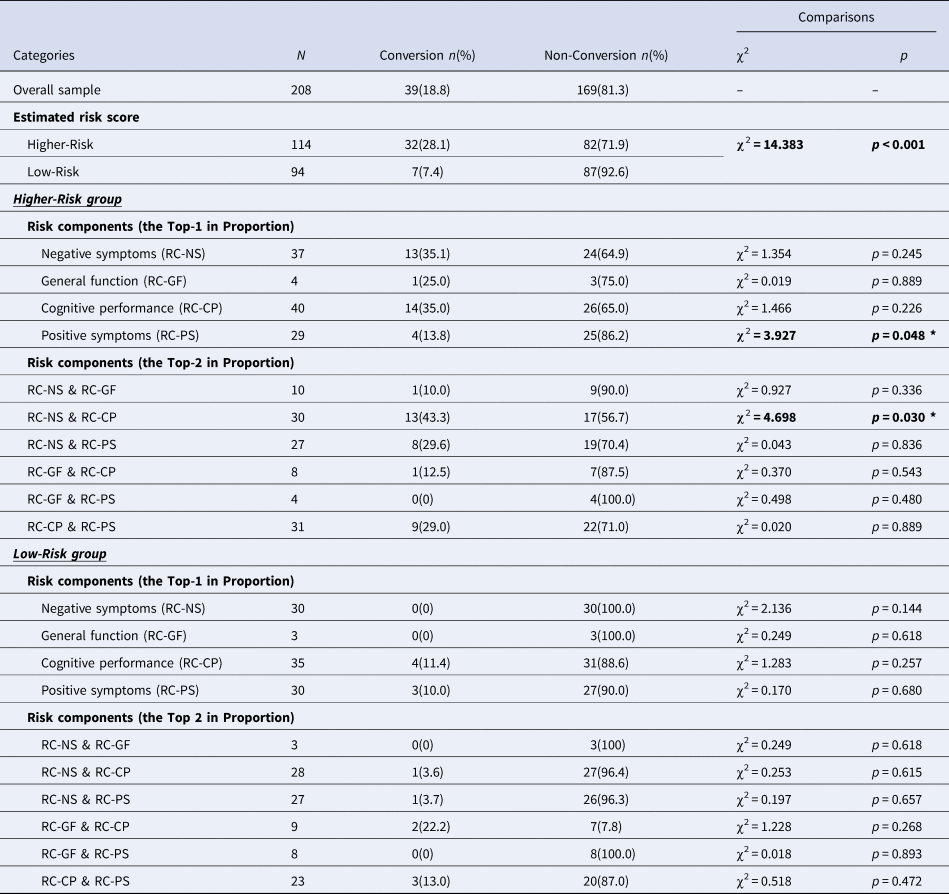
According to the cut-off point (20%) (Zhang et al., Reference Zhang, Xu, Li, Woodberry, Kline, Jiang and Wang2019a) of the estimated risk score, CHR individuals were stratified into the higher-risk (> = 20%) or low-risk group (<20%). We examined the risk components distribution in the converters and non-converters in both subgroups. As shown in Table 2, in the higher-risk group, CHR individuals with the highest proportion of RC-PS had the lowest conversion incidence, while subjects with higher proportions of RC-NS and RC-CP had an increased risk for conversion.
Risk component characteristics of clinical high-risk individuals treated with antipsychotics who converted and did not convert to psychosis

Note: The higher-risk group included CHR individuals with estimated risk scores that were 20% or higher; the low-risk group included CHR individuals with estimated risk scores that were lower than 20%. The Top-1 in Proportion: the component with the highest proportion among 4 risk components. The Top 2 in Proportion: the components in the top 2 proportion among the 4 risk components.
Significant P values are bolded.
Factors ratio
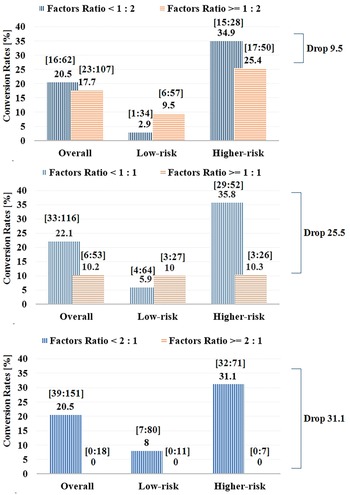
The characteristics of the risk components which are presented in Table 2 further hint that the FR may be able to differentiate converters from non-converters. Figure 1 illustrates the trend in the higher-risk group that, as the FR increased, the conversion rates decreased.
Conversion rates in antipsychotic treated clinical high-risk individuals with different factor ratios. Note: Factors ratio (FR): the ratio of risk components of positive symptoms (RC-PS) plus general function (RC-GF) to risk components of negative symptoms (RC-NS) plus cognitive performance (RC-CP), i.e. FR = [RC-PS + RC-GF]/[RC-NS + RC-CP]. [A: B]: A is the number of converters; B is the number of non-converters. The higher-risk group included CHR individuals with estimated risk scores that were 20% or higher. The low-risk group included CHR individuals with estimated risk scores that were lower than 20%.

Survival analysis
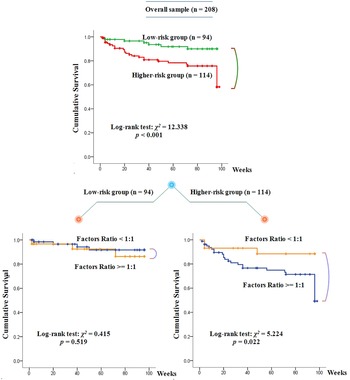
Kaplan–Meyer survival curves were constructed for the overall sample, with the higher-risk and low-risk groups separated. The higher-risk and low-risk groups were further divided by the FR (>1, v. < = 1). Figure 2 shows that the conversion rate was significantly lower in those who had an FR>1 in the higher-risk group.
Kaplan–Meyer survival curves for psychosis conversions between the factors ratio groups. Note: Factors ratio (FR): the ratio of risk components of positive symptoms (RC-PS) plus general function (RC-GF) to risk components of negative symptoms (RC-NS) plus cognitive performance (RC-CP), i.e. FR = [RC-PS + RC-GF]/[RC-NS + RC-CP]. The higher-risk group included CHR individuals with estimated risk scores that were 20% or higher. The low-risk group included CHR individuals with estimated risk scores that were lower than 20%.

Summarized profile for those that potentially benefit from antipsychotic treatment
Our analysis revealed that CHR individuals at a higher-risk and an FR>1 could potentially benefit from antipsychotic treatment. This group covered less than 15% of all CHR individuals and were characterized by lower general function and more severe symptoms. In particular, positive symptoms (such as hallucinations and delusions) and disorganized symptoms (odd behavior of appearance and bizarre thinking) were more prevalent. These individuals also had a poorer cognitive performance on the Brief Assessment of Cognition in Schizophrenia symbol coding test (Table 3).
Characteristics of clinical high-risk individuals who may benefit from antipsychotic treatment

a Potential Beneficiaries: CHR individuals at higher-risk (Estimated risk score>20%) and FR>1. Factors ratio (FR): the ratio of risk components of positive symptoms (RC-PS) plus general function (RC-GF) to risk components of negative symptoms (RC-NS) plus cognitive performance (RC-CP), i.e. FR = [RC-PS + RC-GF]/[RC-NS + RC-CP].
b Family History: at least one first-degree relative with psychosis.
c GAF: the global assessment of function.
Discussion
To our knowledge, this is the first study to apply an individualized RC to assist clinician's decision-making in prescribing antipsychotic treatment to CHR individuals. Additionally, this study has the largest CHR sample on long-term antipsychotic treatment. Our study found that those CHR individuals at higher risk, with predominantly positive symptoms and general function impairments, could potentially benefit from antipsychotic treatment. Through the application of SHARP-RC, these criteria were operationally defined as the estimated overall risk score higher than 20% and an FR [(RC-PS + RC-GF)/(RC-NS + RC-CP)] higher than 1. Less than 15% of SHARP samples met these conditions. Those individuals treated with antipsychotics were associated with lower conversion rates (reduced by about 25%, Fig. 1).
Interestingly, when these risk components were used alone or in combination (see Table 2), the majority of comparisons of the conversion rates were not significant. When FR was applied, the conversion rate decreased significantly as FR increased (see Fig. 1). In other words, a single dimension of the clinical feature appeared insufficient to guide the use of antipsychotics in this highly heterogeneous CHR population. Future research should consider that the integration of more dimensions, especially the addition of biological markers, may be beneficial for the precise intervention of antipsychotics.
Our result delineates some of the gaps between real clinical practice and the guidelines' recommendations on antipsychotic administration for the CHR population. Generally, antipsychotic treatment has not been recommended as first-line therapy for CHR individuals and should be reserved for use after the failure of psychological interventions (Morrison et al., Reference Morrison, French, Walford, Lewis, Kilcommons, Green and Bentall2004) or potential neuroprotective agents, such as the omega-3 long-chain polyunsaturated fatty acids (Amminger et al., Reference Amminger, Nelson, Markulev, Yuen, Schafer, Berger and McGorry2020). Even if the medication was needed for this clinical population, antidepressants would perhaps be more suitable for initiating treatment than antipsychotics. A previous study (Fusar-Poli et al., Reference Fusar-Poli, Frascarelli, Valmaggia, Byrne, Stahl, Rocchetti and McGuire2015) compared the conversion rates between antidepressants and antipsychotics in addition to cognitive behavioral therapy (CBT) sessions in a longitudinal cohort. They found that antidepressants plus CBT intervention was associated with a reduced risk of conversion to psychosis, as compared with the antipsychotics plus CBT intervention. Considering that many interventions other than antipsychotics were available, more than 70% of the CHR individuals in the current sample had antipsychotics initiated after their first visit. Compared with other naturalistic studies (Fusar-Poli et al., Reference Fusar-Poli, Frascarelli, Valmaggia, Byrne, Stahl, Rocchetti and McGuire2015) and reviews (Fusar-Poli et al., Reference Fusar-Poli, Salazar de Pablo, Correll, Meyer-Lindenberg, Millan, Borgwardt and Arango2020) reporting that only approximately 17% of CHR individuals were exposed to antipsychotics, it became especially important to develop a better way to identify potential antipsychotic beneficiaries so as to reduce unnecessary antipsychotic administration in China. For instance, a recent study (Fusar-Poli et al., Reference Fusar-Poli, De Micheli, Patel, Signorini, Miah, Spencer and McGuire2020a) demonstrated that CHR individuals who developed psychosis (despite antipsychotic treatment) had worse outcomes compared with patients who initially presented in first-episode groups. Our previous study (Zhang et al., Reference Zhang, Xu, Wei, Tang, Hu, Cui and Wang2020) provided evidence that early use of antipsychotics for the CHR population may be effective in reducing the severity of positive symptoms; however, this may not be the best approach in terms of long-term remission.
There are several possible explanations for the superiority of antipsychotics in CHR individuals with significant positive symptoms and general function impairments. First, in those with post-onset psychosis, antipsychotics are often effective for treating positive symptoms but have little impact on negative symptoms and cognitive deficits. This is highly consistent with findings from meta-analytic studies (Harvey, James, & Shields, Reference Harvey, James and Shields2016; Leucht et al., Reference Leucht, Corves, Arbter, Engel, Li and Davis2009). Second, the mechanism action of antipsychotics (Miyamoto, Miyake, Jarskog, Fleischhacker, & Lieberman, Reference Miyamoto, Miyake, Jarskog, Fleischhacker and Lieberman2012; Seeman, Reference Seeman1992), which primarily targets the modulation of the dopamine D2 receptors, is more relevant to positive symptoms. Third, the general function in SHARP-RC was assessed using the GAF score, which is primarily affected by the severity of positive symptoms. Once the proportion of CP and CG increases, the proportion of CN and CC decreases. Unfortunately, these domains are recognized as core features of severe psychosis and lack responsiveness to antipsychotic treatment (Harvey et al., Reference Harvey, James and Shields2016; Thornton, Van Snellenberg, Sepehry, & Honer, Reference Thornton, Van Snellenberg, Sepehry and Honer2006).
Our results revealed that, in general, CN and CC were high in our cohort, but the proportion of potential antipsychotic beneficiaries was low. A previous study by Leucht et al. (Hafner, Riecher-Rossler, Maurer, Fatkenheuer, & Loffler, Reference Hafner, Riecher-Rossler, Maurer, Fatkenheuer and Loffler1992) found that around 70% of patients with schizophrenia develop primarily negative symptoms before the onset of positive symptoms. Similar findings were reported regarding cognitive impairment (Seidman et al., Reference Seidman, Giuliano, Meyer, Addington, Cadenhead, Cannon and North American Prodrome Longitudinal Study2010, Reference Seidman, Shapiro, Stone, Woodberry, Ronzio, Cornblatt and Woods2016). However, there are no particularly effective treatments for negative symptoms and cognitive impairment. This may be the main reason that antipsychotics only benefit a small subgroup of CHR individuals.
Our study has several limitations. Our dataset was designed and collected to assess the association between risk factors and outcomes in CHR individuals, not to address medication-related research questions. Therefore, no data are available regarding side-effects and tolerance to antipsychotics even though the prescription and administration of antipsychotics were carefully recorded during the follow-up assessments. As in other real-world observational studies, our data may have been subject to selection bias. Although we performed tripartite checks-involving the individuals with CHR, family members, and medical records to confirm the medical treatment details, our approach was less accurate than other strict methods, such as pill counts and self-report. All individuals with CHR in our database were Chinese and recruited at only a single site. This single-site design may increase sample homogeneity and continuity. It could also limit the generalizability of the findings. However, the SMHC is the largest psychiatric service center in China, serving over 1 000 000 outpatients per year, and provides professional treatment for patients throughout the country. Of the sample, approximately half were not from Shanghai.
Conclusion
Currently, there are no national clinical guidelines or policy strategies in China related to reducing inappropriate antipsychotic use in the CHR population. Based on our SHARP findings, we propose a strict antipsychotic prescription strategy that focuses only on CHR individuals with predominantly positive symptoms as assessed by individualized risk estimates. This could help to reduce the inappropriate use of antipsychotics.
Acknowledgements
This study was supported by Ministry of Science and Technology of China, National Key R&D Program of China (2016YFC1306800), National Natural Science Foundation of China (81671329, 81671332, 81971251), Science and Technology Commission of Shanghai Municipality (19441907800, 19|ZR1445200, 17411953100, 16|JC1420200, No.2018SHZDZX01, 19410710800, 19411969100, 19411950800), The Clinical Research Center at Shanghai Mental Health Center (CRC2018ZD01, CRC2018ZD04), Project of the Key Discipline Construction, Shanghai 3-Year Public Health Action Plan (GWV-10.1-XK18), Shanghai Municipal Science and Technology Major Project (No.2018SHZDZX01) and ZJLab, Shanghai Clinical Research Center for Mental Health (19MC1911100). This study was also supported by an R21 Fogarty/NIMH(1R21 MH093294-01A1), and by a U.S.-China Program for Biomedical Collaborative Research (R01) (1R01 MH 101052-01).
Conflict of interest
None of the authors had a conflict of interest.