Introduction
Suffering seems inevitable for patients with life-threatening diseases, and its alleviation has been a priority of medical care. Distress is considered a natural and understandable response to threatening situations, and professionals should try to ease emotional discomfort of patients and their relatives (Callahan, Reference Callahan2000; NICE, 2004).
Addressing the emotional, spiritual, and social needs of patients is especially important in the final stages of life (OMS, 2007; SECPAL, 2002). Numerous studies conducted in the context of people with advanced diseases demonstrated the importance of the psychosocial dimensions of care and the effectiveness of psychosocial care itself (Gómez-Batiste et al., Reference Gómez-Batiste, Mateo-Ortega and Lasmarías2017; Mateo-Ortega et al., Reference Mateo-Ortega, Gómez-Batiste and Limonero2013, Reference Mateo-Ortega, Gómez-Batiste and Maté2018). To provide quality palliative care (PC), it is essential to determine the factors that influence well-being. Nonetheless, psychological care needs vary as a function of the specific disease trajectory and stage (Murray et al., Reference Murray, Kendall and Boyd2005). We thus must first detect the presence of distress using reliable validated instruments (Vodermaier et al., Reference Vodermaier, Linden and Siu2009) to ensure the best methods are used (Evidence-Based Medicine Working Group, 1992). A proper evaluation of the numerous causes of distress requires a holistic assessment and an understanding that their particular circumstances can vary (Bayés et al., Reference Bayés, Limonero and Barreto1995, Reference Bayés, Arranz and Barbero1996, Reference Bayés, Limonero and Barreto1997; Cassell, Reference Cassell1982).
Patients suffer when they perceive themselves to be powerless to fight against symptoms or conditions that threaten their well-being (Bayés et al., Reference Bayés, Arranz and Barbero1996). Importantly, patients’ perception is dynamic during the disease process. Despite the complexity of end-of-life (EOL) patients, and given such ever-changing needs, there is a notable lack of specific instruments to evaluate patients’ needs and determine their level of distress. Thus, noninvasive, simple, reliable, and specific instruments to evaluate and monitor these changes thus allowing professionals to respond appropriately are necessary.
Currently available instruments include the Edmonton Symptom Assessment System (Bruera et al., Reference Bruera, Kuehn and Miller1991), the Detection of Emotional Distress questionnaire (Maté et al., Reference Maté, Mateo and Bayés2009), the Palliative Assessment Schedule (Ewing et al., Reference Ewing, Todd and Rogers2004), the Observational Scale for the Assessment of Depression in Palliative Care (Comas et al., Reference Comas, Calafell and Limonero2004), the European Organization for Research and Treatment of Cancer Quality of Life Questionnaire Core 15 Palliative (EORTC QLQ-C15-PAL; Groenvold et al., Reference Groenvold, Petersen and Aaronson2006), the Distress Thermometer (DT) (Holland, Reference Holland1999), screening for depression (Chochinov et al., Reference Chochinov, Wilson and Enns1997), and the Missoula-VITAS Quality of Life Index-revised (Schwartz et al., Reference Schwartz, Merriman and Reed2005).
Most screening instruments to detect emotional distress in cancer patients differentiate between those with and without depression or anxiety (Vodermaier et al., Reference Vodermaier, Linden and Siu2009). However, no single tool has emerged as the gold standard; thus, clinicians are obliged to use instruments that only indirectly assess suffering. This scenario prompted our group to develop an instrument to better assess psychosocial needs and emotional distress. We named this new tool the Instrumento de Evaluación de Necesidades Psicosociales y Espirituales del Enfermo al Final de Vida (ENP-E) in Spanish and the Psychosocial and Spiritual Needs Evaluation Scale in English. This document describes the development of the tool including the validation processes and results.
Methods
Development and validation of this instrument was conducted for eight years (2009–2017) in two phases. During the first phase, the initial version of the questionnaire was created and both the content and face validity were assessed. In the second phase, we evaluated the psychometric properties of the questionnaire.
Phase 1: Design and evaluation of content and face validity
A team of six PC experts (three psychologists, one social worker, two physicians) developed the instrument and planned the validation procedures. Steps were as follows:
1. Literature review. We searched electronic databases (Medline, Scopus, and Cochrane), guidelines, manuals, and doctoral dissertations from 1990 to 2009. The key words for the search were: “palliative care,” “palliative medicine,” “end-of-life,” “psychosocial needs,” “spiritual needs,” “distress,” “psychological distress,” “psychological assessment,” “psychosocial assessment,” “spiritual assessment,” “social needs,” “social assessment,” and the Spanish equivalents of all these terms.
2. Determination of the tool's criteria. We established criteria included in similar scales (Bayés et al., Reference Bayés, Limonero and Fernández-Abascal1999, Reference Bayés, Die Trill and López Imedio2000; Limonero et al., Reference Limonero, Mateo and Maté-Méndez2012, Reference Limonero, Maté and Mateo2016) to ensure the questionnaire would: (1) provide therapeutic effects while avoiding any iatrogenic effects; (2) be understandable and include aspects relevant to patients; (3) be brief and easy to administer by experienced and less-experienced professionals; (4) assess only the time period immediately before administration; (5) allow clinicians to monitor the course of distress as the disease progresses and new symptoms/situations likely to cause suffering or imminent death arise; (6) facilitate referral, if necessary, to specialized psychosocial care for in-depth evaluation and treatment; and (7) formulate questions in nontechnical language used by patients.
3. Establishment of a theoretical frame of reference to guide the tool development. We used the “threats-resources” model (Bayés et al., Reference Bayés, Arranz and Barbero1996), partly based on Lazarus and Folkman's Transactional Model of Stress (Lazarusand Folkma, Reference Lazarus and Folkman1984), to consider a range of suffering-related factors in EOL patients.
4. Establishment of a content validity plan using the Delphi methodology. Thirty PC experts (psychologists, social workers, physicians, and nurses) assessed content validity and were asked to rate three aspects of the questionnaire. The first aspect was item validity. Participants rated each question on a Likert-type scale with six response options (excellent, good, fair, poor, very poor, unnecessary) in terms of: (1) wording clarity, (2) adequacy of the response options, (3) appropriateness for patient's profile, and (4) which dimension the question evaluated. In this sense, participants selected from a drop-down menu which of the following dimensions they believed the question belonged to: emotional wellbeing, social support, spirituality, and information. Second, the overall rating for the instrument was evaluated by using an open question format. Participants were asked whether the dimensions the tool intended to assess were sufficiently covered, if all the necessary dimensions were considered, and if the experts would eliminate any dimension or question. The third aspect was an evaluation of the instructions on the same 6-point Likert scale described previously in terms of (1) wording clarity; (2) adequacy; and (3) length. In an open response section, participants could provide recommendations to modify the instructions.
5. Establishment of a plan to incorporate the view of patients in the assessment of the face validity of the instrument. Twenty patients were asked to rate the questions using a 6-point Likert scale (excellent, good, fair, poor, very poor, unnecessary) in terms of: (1) wording clarity; (2) adequacy of the response options; and (3) the appropriateness and relevant of questions for other patients in similar situations. They also could include observations for each question.
6. To finalize the content validation process, we modified the questions based on the feedback received. Thus, the new, improved version of the questionnaire incorporated all relevant suggestions from both groups.
Phase 2: Construct validation
Once the final version of the questionnaire completed, we assessed construct validity with a descriptive, observational, multicenter, cross-sectional study designed to include a representative sample of patients who would voluntarily participate in the validation process. Inclusion criteria were: (1) diagnosis of advanced/terminal cancer; (2) age ≥18; (3) informed consent; and (4) receiving treatment from psychosocial and PC teams. Exclusion criteria were: (1) presence of conditions that would impede the patient to complete the questionnaire; (2) cognitive impairment (Pfeiffer test score >3) (Martínez de la Iglesia et al., Reference Martínez de la Iglesia, Duenas Herrerob and Onis Vilchesa2001); or (3) refusal to provide informed consent.
Patient recruitment lasted 3 months until the estimated sample size of 150 patients was achieved. Patients were receiving treatment by a psychosocial team under the auspices of “la Caixa” Foundation care program for people with advanced diseases (Gómez-Batiste et al., Reference Gómez-Batiste, Lasmarías, Amblas, Gómez-Batiste and Connor2017) and recruited from the PC units at 19 hospitals participating in the study during the 3 days following hospital admission.
The following variables were collected:
1. Descriptive variables included in the medical history: socio-demographic data and socio-family characteristics; diagnosis, treatment; comorbidities; patient/family level of understanding of the diagnosis and prognosis at admission; spiritual beliefs; and admission and discharge data.
2. Variables obtained from the assessment instruments. All patients completed the ENP-E with these evaluation scales:
A. Hospital Anxiety and Depression Scale (HADS), Spanish version (Tejero et al., Reference Tejero, Guimera and Farre1986).
B. Quality of life item (item 15) from the EORTC QLQ-CI5-PAL (Groenvold et al., Reference Groenvold, Petersen and Aaronson2006).
C. Distress Thermometer (Holland, Reference Holland1999).
D. Subjective perception of the passage of time (Bayés et al., Reference Bayés, Limonero and Barreto1995, Reference Bayés, Limonero and Barreto1997).
Statistical analysis
Data were collected and analyzed using the Statistical Package for the Social Sciences (version 20.0) and all tests of statistical significance were at p < 0.05. Results were analyzed as follows: (1) descriptive analysis of the sample variables; (2) descriptive analysis of the sample losses; (3) convergent validity: analysis of the intraclass correlation index based on the relation between the ENP-E scores and those obtained on the validated scales; (4) internal consistency of the ENP-E: Cronbach's alpha index and temporal stability; (5) analysis of the questionnaire's structure using exploratory factor analysis with varimax rotation; (6) the discriminative capacity according to the area under the receiver operating characteristic (ROC) curve (Burgueño et al., Reference Burgueño, García-Bastos and González-Buitrago1995); ROC curves help to visually analyze the relation between a test's sensitivity and specificity to identify the cases who are candidates for psychosocial treatment and indicate how well the model distinguishes between whether the patient demonstrates psychosocial needs; and (7) any cases not assessed because of study withdrawal or other reasons must be clearly indicated.
Data were collected at three points: during the pilot study, which involved a group of patients and hospitals to analyze the goodness-of-fit; during the study phase, when instruments were administered; and during a final test-retest phase in which 50 patients, selected according to prognosis and cognitive status, completed the ENP-E a second time (4–5 days after the first administration) to determine the test-retest reliability of the instrument.
Ethical approval
The research protocol for this study was approved by the Ethics and Clinical Research Committees of the Catalan Institute of Oncology (Ref. PR209/10) and adhered to Spanish Law 15/1999 governing the protection of personal data.
Results
Phase 1: Content validation
Thirty professionals participated (60% of total invited): five physicians (17%), five nurses (17%), six social workers (21%), and 14 psychologists (45%). Overall, participants rated questions positively: the wording of the questions was considered good or excellent in 85.5% of cases (5-point Likert scale); 88.8% of participants believed it was appropriate or very appropriate to ask patients about this subject, none considered it to be inappropriate, and 2.3% considered it unnecessary. They made two specific recommendations: (1) 100% of professionals advised reducing the number of questions, and (2) some suggested changing the format from a verbal-numerical scale of 0–10 to a Likert-type scale, easier for patients to understand and adaptable to a conventional interview.
Face validity
Given the minimal changes recommended, we modified the response format before asking patients (n = 20) to assess face validity. Percentages of patients who considered questions on the four dimensions to be either clear or very clear were: emotional, well-being dimension, 86% (6% no response); social support, 88.3% (5.9% no response); spiritual, 80% (5% no response); and information, 92% (5.5% no response). None of the questions were considered unclear.
When asked if the questions might help people in a similar situation, answers were: 45% “very much”; 45% “somewhat”; 10% “neither a lot nor a little”; and none responded “very little” or “not at all.” Regarding the appropriateness of questions, one patient considered them not suitable, one gave a neutral response, and the rest considered questions appropriate. When asked if they would modify any of the questions, most patients said “no” (73% on the emotional dimension, 71% on the socio-familiar dimension, 70% on the information dimension, and 65% on the spiritual dimension). Patients who recommended changes mostly indicated a perception that the question's content was already covered in previous enquiries on the same dimension.
After careful evaluation, we eliminated the questions considered redundant. Based on evidence regarding the relationship between patient facial expressions and emotions (Ekman et al., Reference Ekman, Matsumoto, Friesen, Ekman and Rosenberg1998), we added a question for healthcare professionals to indicate if they observed external signs of distress in the patient. If so, type of distress should be described as: (1) facial expression and behavior indicating: grief, fear, irritation, or nervousness; (2) isolation, silence, refusal to accept visits, and/or lack of pastimes; (3) external signs of needing company/attention or constant complaining; and (4) changes in nighttime behavior. The final version of instrument contained 14 direct questions (Appendix).
Phase 2: Construct validation
It was performed in the pilot phase (21 patients) and in the formal study (129 patients). One patient's data were rejected because it was incomplete. The ENP-E was administered by a psychologist in 127 cases (85.2%), a social worker in 17 cases (11.4%), and a physician in 5 cases (3.4%). These professionals had substantial experience in PC, with 48 (32%) having >5 years of experience and 37 (24%) >10 years.
Patient characteristics
The sample was equally divided between men (n = 73) and women (n = 76). The median age was 72 (range, 33–93) for men and 73 (43–93) for women. Marital status was married (49%), single (16.8%), separated or divorced (7%), or widowed (20%). All patients had advanced cancer, mainly colon (15.4%), lung (15.4%), pancreatic (8.7%), breast (8.1%), or stomach (4.7%). Most patients had metastatic (69.8%) or locoregional (13.4%) disease; cancer was localized, or the information was not available (4%).
The primary caregiver was mostly the patient's partner (41.6%), son, or daughter (25.5%). For the rest, it was a sibling (4.7%), parent (2%), or another relative (5.4%).
Although most patients (67.1%) had no history of tobacco, alcohol, or drug abuse, 16% had a smoking record and 10.7% alcoholism. Addiction to hashish, marijuana, or other drugs was uncommon (1.4%).
Most patients had no history of psychiatric illness (79.9%); however, 12.8% had a depressive disorder record and 2% anxiety. Only three patients (2.1%) had a history of adjustment or psychotic disorders.
The mean Barthel index (Mahoney et al., Reference Mahoney and Barthel1965) was 57 (SD = 26.1). The median functional status score on the Palliative Performance Scale (Anderson et al., Reference Anderson, Downing and Hill1996) was 54.5 (SD = 17.4). Most patients knew their diagnosis (79%) or were partially aware of it (16.8%); however, five patients (3.4%) did not know the diagnosis. Most either understood the prognosis (49.7%) or suspected it (31.5%); by contrast, 8.7% did not know their prognosis, whereas seven patients (4.7%) neither knew nor suspected the prognosis.
Patient expectations for treatment were symptom improvement (28.2%), stabilization (24.8%), or absence of suffering (20.1%); some hoped for a cure (6%), whereas 11.4% hoped to die in peace. Patients who reported religious beliefs were mostly Christian (81.9%); 8.1% of patients reported not having religious or spiritual beliefs.
Main reasons for study dropout were death (24.2%), hospital discharge because of clinical improvement (19.5%), or transfer to another program (2.7%).
Internal structure of the ENP-E scale
The Kaiser-Meyer-Olkin test (= 0.75) and the Bartlett test of sphericity (p < 0.01) were used to measure sample adequacy. Responses to the ENP-E were analyzed using principal component analysis with varimax rotation. On the Kaiser test, four factors had eigenvalues >1, which accounted for 58.4% of the total variance. Factor 1 (“emotional, well-being”) explained 27.8% of the total variance and loaded on five separate items: B1, B2, B3, B4, and B12. Factor 2 (“social support”), explained 11% of the total variance, and also loaded on five items: B5, B7a, B7b, B10, and B11. Factor 3 (“spirituality”) explained 9.8% of the variance, and loaded on two items, B8 and B9. Finally, factor 4 (“information”) explained 9.1% of the variance and loaded on only one item: B6.
Reliability testing
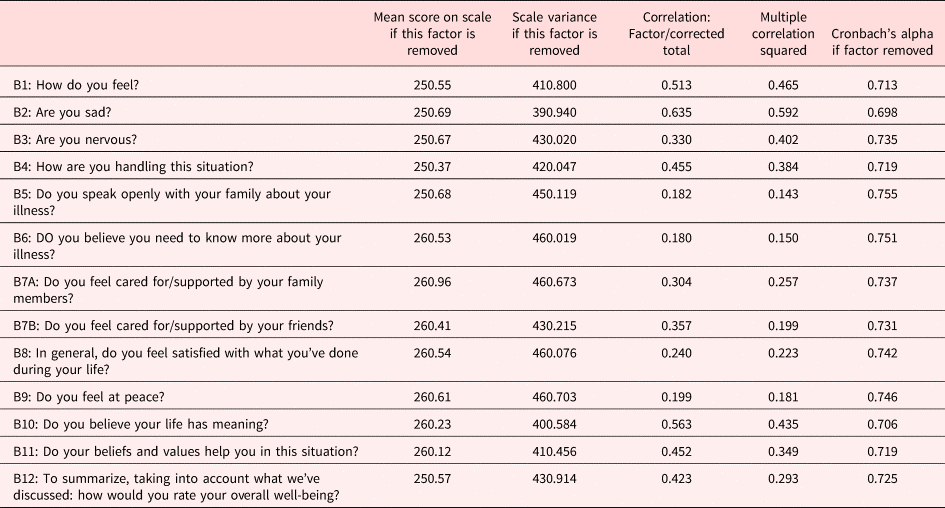
Cronbach's alpha was 0.74. Results were considered adequate, and no variables were excluded (Table 1). The Cronbach's alpha values for the first, second, and third dimensions were, respectively, 0.77, 0.64, and 0.48. The fourth dimension contained one item only and therefore internal consistency was not calculated. The overall Cronbach's alpha for the scale was 0.75. Temporal stability (test-retest reliability) was determined by calculating the intraclass correlation coefficient; retest resulted in a score of 0.71 (p < 0.01).
Analysis of internal consistency of the ENP-E scale

ENP-E, Instrumento de Evaluación de Necesidades Psicosociales y Espirituales del Enfermo al Final de Vida.
Criterion-related validity
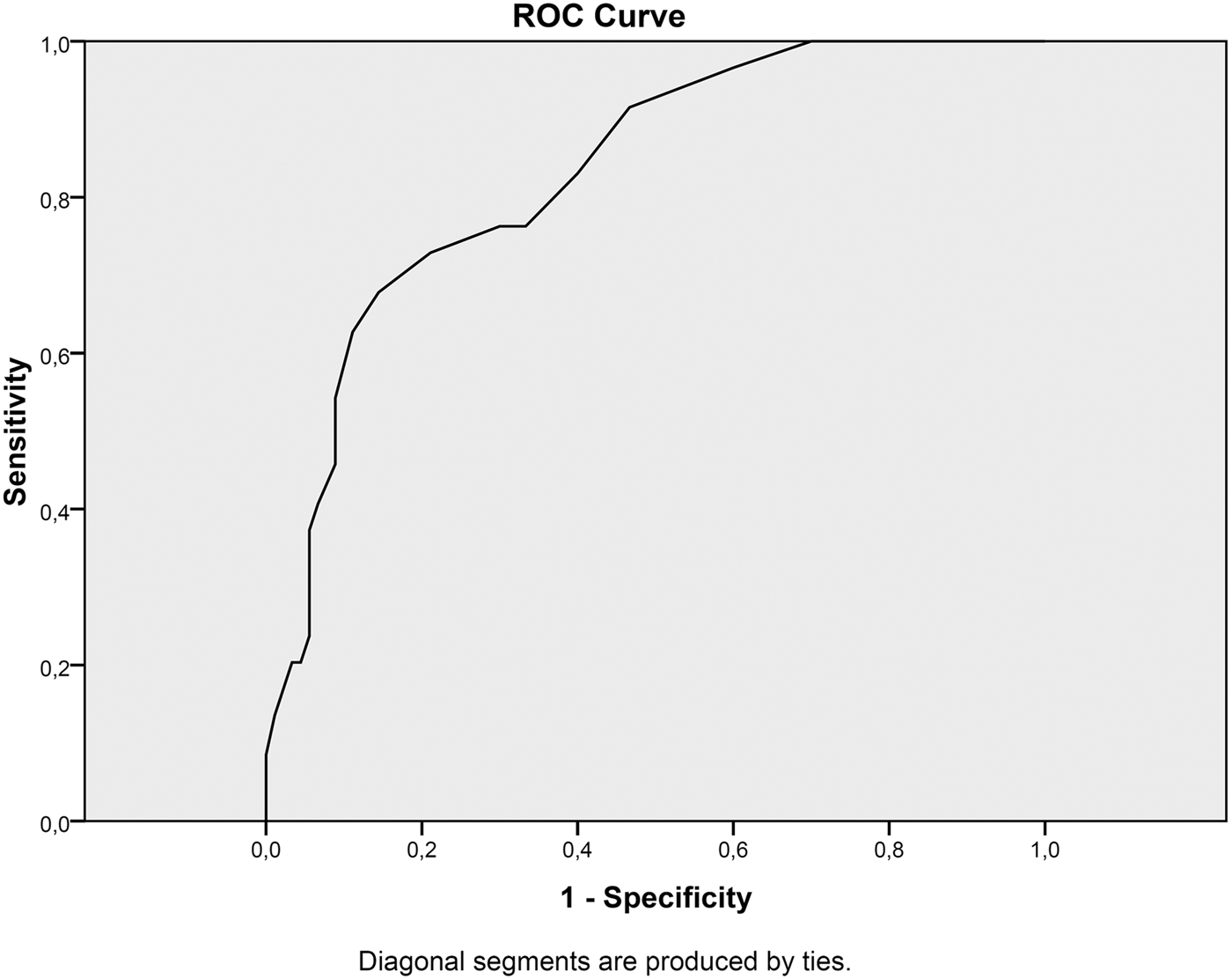
It was established by correlating the ENP-E scale with other instruments to assess emotional wellbeing (Table 2). The ENP-E was positively correlated with the HADS, DT, and Time Perception (TP), with a particularly strong correlation with the HADS (0.667). Conversely, the ENP-E was negatively correlated with the QLQ-15. To establish the clinical value of the ENP-E, ROC (Burgueño et al., Reference Burgueño, García-Bastos and González-Buitrago1995) curves were plotted to determine the optimum cutoff point to establish the need for psychosocial care. Considering the combination of values from the HADS (HADS >17), together with QLQ-C15-PAL score (≤3), the score on the DT (>5), and the degree of suffering (long time perception), the reference variable was constructed to indicate whether the value is positive or not. Comparison of this variable with the scores from the ENP-E revealed an area under the curve of 0.82 (p < 0.01), with a 95% confidence interval of 0.767, 0.897 (Figure 1). The cutoff score on the curve that provided the best relation between sensitivity and specificity was 28, yielding a sensitivity (i.e., the capacity to identify patients with psychosocial needs) of 74.6% and a specificity (i.e., ability to detect false positives) of 74.4%. Thus, scores ≥28 points indicate need for specialized psychosocial treatment. These analyses indicated that regardless of whether the patients were considered to have psychosocial needs, there were no significant differences (p > 0.05) regarding the presence of worries between patients with or without psychosocial needs (based on the ENP-E cutoff score). Consequently, worries were not considered in the total score. Patients who exhibited external signs of emotional distress had greater psychosocial needs (t = –4.28; df = 145; p < 0.01). The statistical analyses showed there are five key questions (1, 2, 4, 10, and 12) that discriminate better than others. Scores ≥4 for any of these questions become possible warning signs of psychosocial-spiritual needs.
ROC curve. ROC, receiver operating characteristic.

Intraclass correlation matrix

ENP-E, Instrumento de Evaluación de Necesidades Psicosociales y Espirituales del Enfermo al Final de Vida; EORTC QLQ-15, European Organization for Research and Treatment of Cancer Quality of Life Questionnaire Core 15 Palliative; HADS, Hospital Anxiety and Depression Scale.
*p < 0.01.
Discussion
Our study determines the value of the ENP-E to holistically assess psychosocial and spiritual needs. It is a comprehensive but brief and easy questionnaire that demonstrates adequate internal consistency. The total score cutoff point allows clinicians to identify those patients who would benefit from psychosocial and/or spiritual/religious interventions. Moreover, because the scale can distinguish different dimensions, professionals can select the most appropriate therapeutic strategy and monitor psychosocial needs after treatment is completed to better manage patients based on the questionnaire outcomes.
The ENP-E has proved to have good temporal reliability, although given the instability in EOL patients, test-retest stability is probably not crucial. In addition to its good psychometric properties, the ENP-E also addresses relevant aspects for patients, and simply evaluating these psychosocial factors could have a therapeutic function in and of itself (Limonero et al., Reference Limonero, Maté and Mateo2016).
Although the educational level of the sample was highly variable, most patients understood and completed the ENP-E. Importantly, the clinical value of the ENP-E is supported by the relatively short time required to complete it, in addition to patient-perceived clarity of questions. Also, it can be administered repeatedly to provide current information on patients’ level of emotional distress, which can be evaluated longitudinally to determine the influence of healthcare interventions over time on patients’ psychosocial needs.
Finally, assessment of patient concerns could provide valuable data to identify the specific factor(s) affecting emotional distress levels. Presence or absence of these factors could potentially serve as an indicator for referral to a specialist. For patients and their families, it could foster discussion of psychosocial-spiritual issues.
Clinical implications
The highly specific nature of the ENP-E contrasts with most instruments to assess emotional distress, which mainly test for the presence or absence of depression or anxiety. The ENP-E provides data on a range of clinical aspects, thus offering relevant information to individualize patient care. Test results showed some questions discriminate better than others. Scores ≥4 for any of these key questions become symptoms of psychosocial-spiritual needs.
Study limitations
We excluded patients with communication or cognitive problems; however, it is likely that many patients will present such limitations. It would be necessary to determine if this scale can be used in such populations. Moreover, this study was conducted in hospitals in Spain, and the generalizability of this tool in other settings and populations is unknown. Finally, the English version of the questionnaire was not validated.
Study strengths and conclusions
The ENP-E was developed including the perspectives of patients and professionals. Research was conducted in PC units with heterogeneous patient populations, thus increasing the likelihood that this instrument can be applied in diverse clinical settings.
In conclusion, the ENP-E scale is a novel tool that helps to identify the presence of unmet psychosocial and spiritual needs in advanced cancer patients. The routine use of this scale would allow clinicians to provide a systematic, holistic assessment of psychosocial needs and to monitor them over time. This would, in turn, permit the delivery of comprehensive, highly-individualized interventions to improve the effectiveness of PC for EOL patients.
Acknowledgments
We express our deep gratitude to all the healthcare professionals and patients who contributed to making this study possible. We specifically thank “la Caixa” Banking Foundation for their commitment in the implementation of the Program of Comprehensive Care for people with advanced illnesses and their families in Spain. The authors also thank Bradley Londres, who provided support in terms of language editing and translation of the original text in Spanish into English.
Conflicts of interest
The authors declared no potential conflicts of interest with respect to the research, authorship, and/or publication of this article.
Supplementary Materials
To view supplementary materials for this article, please visit https://doi.org/10.1017/S1478951518000652.