INTRODUCTION

Yazaki, Anthology of Kaneko Misuzu, 125. Kaneko Misuzu was a children's poet born in Senzaki, Nagato City (1903–1930). Among her 512 poems published, 13 of them have a title related to fishing or whaling, and many others include references to fishing. Significant attention was given to her work when Nagato City celebrated the centenary of her birth and established Kaneko Misuzu Museum in 2004. All poems quoted in this paper are from Yazaki, Anthology of Kaneko Misuzu, and the translations are the author's own.
Kayoiura (Kayoi) is a small fishing village located at the most easterly point of Omijima Island, Nagato City, Japan.2
Omi-jima: Blue Ocean Island. The city of Nagato was originally established in 1954 (including Kayoi), and three towns were amalgamated into Nagato in 2005. Nagato's current population is 22,834 (Nagato City, Data of Nagato). Extensive amalgamation reflects Japan's highly aging and declining population in remote areas (Kaso phenomenon).
In Japan there are 6366 small islands besides the four main islands.
The number of fishing households is 48; motorized boats: 208; fishing business: 176. Many of the privately owned boats are under 5 tons and classified as category 3 boats. Related industries are food processing (mainly dried fish product), net mending, and boat repairing (Nagato City, Data of Nagato, 2005). There is one grocery store and one guest house in Kayoi. The fish products are mostly dried fish and fish cake. Main fish species are squid, bream, yellowtail, sardine, and grunt. Other methods include long-line fishing, fixed shore net fishing, towed net fishing, and free diving.

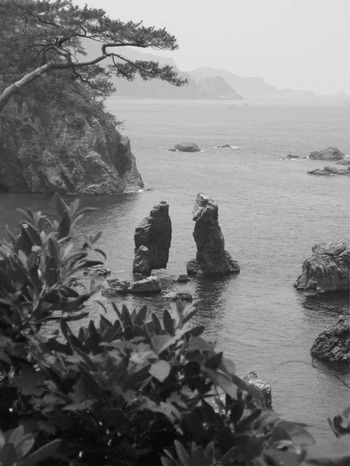
View from Omijima Island.
The island can be circumnavigated by boat in about an hour and a half. Steep cliffs, caves, and various rock formations are visible from the boat, indicating the little agricultural land available on the island. The surrounding area is often dubbed Ocean Alps after the writer Yokoyama Kenzo, who wrote, “Alps are not necessarily on land. They also exist in the ocean. We can call this spectacular scenery Ocean Alps.”5
Yokoyama (1872–1943) traveled through the region from 1915 to 1918 and published “Travelling through Choshu” (Choshu Yuranki) in 1930. Nagato Historic Society, History of Nagato. Available at http://www6.ocn.ne.jp/∼omijima/yokoyama.htm (accessed August 10, 2006).
CULTURAL PROPERTIES OF KAYOI
Whaling, specifically community-based coastal whaling, began in the Choshu-Kitaura region in 1672, having been initiated by the thirteenth Lord Mori of the Choshu Clan. It was a form of premodern whaling operated by whaling groups (kujira-gumi).6
Defined as koshiki hogei (

, old-style whaling).
- Kayoi: from 1673
- Setourazaki: now Senzaki, from 1672
- Kawajiri: from 1698
At that time in Japan, whaling was in operation at four major locations:
- Kishu: Taiji, central east Honshu Island
- Tosa: Muroto, Shikoku Island
- Seikai: Yobuko, Ikutsuki, Kyushu Island
- Choshu-Kitaura: the smallest
Whaling groups operated in this region until 1897 when the modern methods began that use various sorts of explosive devices, foremost of which was the Norwegian Method. Setourazaki was the place the first modern whaling company Nihon Enyo Gyogyo (Japan Far Sea Fishery) equipped with the Norwegian Method was established in 1898; however, the transition made the premodern method unviable and the Setourazaki Group dissolved in 1894. The Kawajiri Group followed suit in 1897, as did the Kayoi Group in 1898.
Today, more than 100 years since the end of premodern whaling, the region is scattered with temples, shrines, and monuments related to this particular form of whaling. In Omijima and the Kayoi area in particular, various cultural properties exist, six of which are nominated as important cultural properties:
A whale tomb (Important Historic Sites, National)
The family residence of whaling group head Hayakawa (Important Cultural Properties, National)
A mortuary tablet and funeral register books for whales (Tangible Folk Cultural Properties, Yamaguchi Prefecture)
140 items of whaling equipment (Important Tangible Folk Cultural Properties, National)
Whaling songs (Intangible Folk Cultural Properties, Nagato City).
The mortuary tablet and funeral register books are housed in the Kogan-ji Temple, the whaling equipment in the Nagato Whale Museum (Kujira Shiryokan), and the tomb on the hill behind the museum overlooking the bay in the Seian-ji temple ground. The museum, Kogan-ji Temple, and Hayakawa residence are all on the foreshore of Kayoi overlooking Kayoi Bay. Today, the Kogan-ji Temple is central to this fishing community not only for properties regarded as important cultural heritage but because the worship and dedication are part of the community's everyday life. The temple also houses a Jizo statue dedicated to whales.7
Jizo (Ksiti-garbha) in Japanese or Dizang in Chinese translated as earth treasury is a Mahayana Buddhist Bodhisattva, who give unlimited mercy with the earth's power for those who suffer. JAANUS, 2006, http://www.aisf.or.jp/∼jaanus/ (accessed September 25, 2006).
Established in 1175 by Honen. One of the major Buddhist sects in Japan. Prayers are nenbutsu: namu amidabutsu (

). It pays homage to Amida, the central deity of the Pure Land sects, Jodo-shu

, and Jodo-shinshu

. It is believed that those who have a deep faith in Amida and repeatedly recite the Namu Amidabutsu can be born into the Pure Land. JAANUS, 2006, http://www.aisf.or.jp/∼jaanus/ (accessed September 25, 2006).
This article presents the cultural properties of the former whaling community as important cultural heritage that expresses spirituality and ethics valued by the current community as their cultural heritage. It is significant that although whaling in the community ceased more than 100 years ago, the importance of the cultural heritage is still evident. The spirituality of the whaling community is communicated and expressed as gratitude, sympathy, and guilt. Thus prayers reflect an ironic but undeniable reality of human dependence on other lives and sympathy for the whale species in particular.
Whaling is no doubt one of the most contentious issues in today's environmental debates, where divisive arguments cover a wide range of issues. Although any study on whaling would play some role in the debate, this article intends to recognize the significance of the spirituality and ethics expressed in the tangible and intangible heritage and acknowledge the vital role this has in our understanding of sustainability.9
Interviews were carried out with nuns and priests at four temples, community members including the head of the whaling museum, members of women's associations, a curator at Kaneko Misuzu Museum, and members of the Society for Whaling Songs.
SPIRITUALITY AND RECIPROCITY AS IMPORTANT INTANGIBLE HERITAGE FOR SUSTAINABILITY
With a series of landmark events and meetings beginning with the UN Conference on Environment and Development (1972), a global rise in consciousness about sustainability is undeniable.10
Stockholm Declaration of the United Nations Conference on Human Environment, 1972; Convention on International Trade in Endangered Species, 1973; Rio Declaration on Environment and Development, 1992.
Low, Global Ethics and Environment, 1.
My previous work focused on subsistence communities that have maintained sustainable relationships with the natural environment.12
Kato, “Waiting for the Tide, Tuning in the World”; “Community, Connection and Conservation”; “Love You to Death.”
UNESCO Convention for Safeguarding of the Intangible Cultural Heritage 2003, article 2.
In arguing for a sustainable relationship with the natural world, I propose giving a particular focus to the spirituality expressed in the cultural properties and associated practices, of which one fundamental quality is a sense of reciprocity. Reciprocity, as Abram defines, is “the ceaseless give and take, the flow that moves in two directions” and is “the foundation of any real ethics: give unto others as you would have them give unto you.”14
Abram, “Reciprocity,” 81.
First, reciprocity contains dialogical quality. Plumwood suggests that spirituality should contain “a certain kind of communicative capacity that recognizes the elements that supports our lives”15
Plumwood, Environmental Culture, 220.
Plumwood, Environmental Culture, 229–30.
Plumwood, Environmental Culture, 230.
Booth and Harvey, “Ties that Bind,” 136.
Booth and Harvey, “Ties that Bind,” 136.
Second, reciprocity contains sensory and experiential quality. Rose, in referring to the Australian indigenous peoples' relationship with their country, writes, “People say that country knows, hears, smells, takes notice, takes care, is sorry or happy. Country is not a generalized or undifferentiated type of place…. Rather, country is a living entity with a yesterday, today, and tomorrow, with a consciousness and a will toward life.”20
Rose, Nourishing Terrains, p. 7.
Abram, “The Ecology of Magic,” 38–39.
Third, reciprocity contains a place-specific quality, which also overlaps with bioregional concepts.22
Berg and Dasmann, “Reinhabiting California.”
Such connectivity may be articulated by terms such as to live in place, reinhabiting (Taylor “Respect for Nature”; Berg and Dasmann, “Reinhabiting California”), insideness (Relph, “Place and Placelessness”), and sense of place (Clifford).
Leopold, A Sand County Almanac, 204; Norberg-Schulz in Hay, Main Currents in Western Environmental Thoughts, 156.
Seamon in Hay, Main Currents, 157.
Identity is not connected to nature as a general abstract category but to particular areas of land, just as the connection one has to close relatives in highly particularistic and involves special attachments and obligations not held to humankind in general. And in complete contrast to Western views of land and nature as only accidentally related to self and as interchangeable means to human satisfaction, the land is conceptualised as just as essentially related to self as kin are, and its loss many be as deeply grieved for and felt as the death of kin.26
Plumwood, “Plato and the Bush,” 531.
Place-based spirituality may be expressed as a commitment to conservation—to care for and maintain the specific quality of a place.
Reciprocity in Japanese Cultural Context
In the Japanese context, one example of cultural practice that expresses reciprocity through offering is the Buddhist concept of kuyo, a concept central to the spirituality expressed through the cultural properties discussed in this article. Kuyo literally means offering and nurturing in honoring Buddha, deities, and spirits of all beings. Offerings can be in a form of things (flower, food, incense, and candles), prayers, and religious training.27
Two, three, four, five, six, and ten kinds of offerings can be made. Kuyo is translated from Sanskrit puja or pooja (http://en.wikipedia.org/wiki/Reverence; accessed August 10, 2006) meaning reverence or worship in Hinduism (Encyclopedia of Japanese Folklore Culture, http://www.bankoku-needle.co.jp/japanese/story/kuyou.html/; accessed August 10, 2006).
Many fauna examples include bears, monkeys, serow, crayfish, and river fish. Japanese agricultural scientist Sato (Animal Welfare) asserts that hunter-gatherers tend not to discriminate flora, fauna, and its surroundings; and hunters in particular must have an intimate understanding of the entire ecosystem, to which they maintain profound consideration to all beings, including insects and plants that are normally excluded from Western concepts for their low level of suffering.
Including the one erected in Nanyo City (1825) designated as the City's Folklore Cultural Property.
Held on February 8 or December 18. Needles are placed in soft objects such as bean curd to give them a rest after hard work.
JAPAN AND WHALING
Whales
The Japanese character for fish

is a pictorial derived from the shape of a fish. As a fish-radical, it combines with other components, creating fish names (e.g., sardine

, salmon

), fish-related terms (e.g., fin

, scales

), and fish dishes such as

and

(sushi), demonstrating that fish and sea products have been an integral part of Japanese diet and thus its culture. This radical is also used to refer broadly to sea life, including sea mammals and cartilaginous fish such as shark

,

dolphin

(

), orca (

), stingray (

), and walrus (

) as well as crocodile (

). The character whale

(kujira) consist of

and

, which means enormous.
31
is 1016 in number. The character is used for capital cities such as Tokyo (

) and Kyoto (

).

or

, smooth/beautiful back, force/energy) in Japanese. Whales are also referred to as isana or isa, also written as

, a brave fish.
It is generally understood that prehistoric whaling did exist in Japan. Whale bones have been found in archaeological sites and middens, and the small amount at each site suggests opportunistic use of drifting whales rather than an active hunt. One site, however, does possibly suggest an active hunt.32
Tsugume-no-hana Jomon Archaelotical Site, Nagasaki.
Isana-tori, or catching of isana, is a symbol for ocean in waka Japanese poetry. In Japan's oldest anthology of poems, Manyo-shu, 12 poems make references to isana-tori.33
Isana (

). Manyo-shu, literally collection of ten thousand leaves, was compiled by a series of compilers, the last of whom is believed to be Otomo no Yakamochi, starting around 600 until the last dated entry of 756.
The novel received one of Japan's major literary prizes, Akutagawa Prize, in 1986.
Translated by Murakami in 1993. C. W. Nicol is now is a Japanese citizen and recognized as a conservationist.
Whales clearly have an economic value. As the saying goes, “One whale blesses seven villages.” Records also show that in some regions fishermen regarded whales as a guardian ebisu because whales were known to bring schools of fish (e.g., cod and herrings) into the bay, thus creating a prosperous catch.36
Ebisu (

,

,

,

), also Kotoshiro-nushi-no-kami (

), is one of the Seven Gods of Fortune (shichifukujin), which originated in Japan. Sometimes it is referred to as a brother of Hiruko (

), a sun god.
In 1794 an antiwhaling petition was made for these reasons (Nakazono, The Chronology of Whaling).
Whaling and Controversy
Today Japan engages in small-type coastal whaling and scientific whaling, both of which are controversial in the international arena. The small-type coastal whaling (STCW, kogata hogei) is defined as “whaling of primarily Minke whales and other small-type cetaceans such as Baird's beaked whale (tsuchi), pilot whales (gondo) and Risso's dolphins (hana-gondo).” Small-type whaling boats are less than 48 feet equipped with a 50-mm harpoon. Operators must register with the Fisheries Agency, the Ministry of Agriculture, Forestry and Fisheries. Currently, nine licenses are held (i.e., nine ships) by eight operators (shitei gyogyo—certified fishery); but only five have been in operation since the International Whaling Commission (IWC) moratorium came into effect in 1988 that banned the commercial hunt of Minke, the second smallest among the IWC regulated 13 baleen whales.38
Japan has been requesting a quota of 50 minke whales in the interim until the moratorium is lifted. Before the moratorium, the STCW were taking coastal large-scale whales: humpback (zato), right (semi), and sperm (makko) if they came into the areas (nearing whale, drifting whale).
Scientific whaling under the IWC special permit has been in operation since 1988 following the international moratorium of commercial whaling and is no doubt the most contentious in all the whaling debate.39
For example, Heazle, Scientific Uncertainty; Catalinac and Chan, “Japan, the West and the Whaling issue”; Day, The Whale War; Sumi, “The Whale War”; Wilkinson, “The Use of Domestic Measures.”
The endangered fin whale was added in 2005. Japan plans to increase it to 50 and also hunt up to 50 Humpback whale (vulnerable).
The Institute of Cetacean Research, available at http://www.icrwhale.org/ (accessed July 2, 2006).
The whaling controversy extends to a wide range of issues:
Ethics toward other species42
See Singer and Regan, Animal Rights; Lynge, Arctic Wars; Cohen and Regan, Animal Rights Debate.
IWC's Scientific Committee and its evaluation of stock recovery43
See for example, Scheiber, “Historical Memory”; Stoett, The International Politics.
IWC “changing the rules of the game halfway”44
See the Wall Street Journal, June 30, 1992; New York Times, July 7, 1992.
Sustainable harvest of wildlife as an energy- and resource-efficient way of food production45
See Freeman, “Energy, Food”; Nagasaki, “On the Whaling Controversy”; Misaki, “Japanese World View.”
An antiwhaling stance representing the former whaling nations' “collective guilt46
Hoy, “The Savage Harvest,” 46.
Integrity and legitimacy of IWC47
Scheiber, “Historical Memory,” 10.
Depletion of stock and intergenerational equity48
Scheiber, “Historical Memory,” 12.
Question of including whales in the moral community49
Scruton, “The Beauty of the Beasts.”
Definition of subsistence
In regard to Japanese whaling in particular, controversy focuses on the legitimacy of, and necessity for, the lethal method of scientific whaling, the nature of the science itself, the claimed cultural right to maintain whale meat as essential diet, which is criticized by many, for example as “solipsistic nonsense.”50
Cherfas, The Hunting of the Whale. See also Hoy, “The Savage Harvest”; Ham, “Time Again to Save the Whales?” Smyth, “Whale Meat and Greed”; Danaher, “Whaling: A Conflict.”
McKee asserts that a science-based conservation strategy must preclude an emotional or misapplied moral consideration of protectionism in establishing appropriate management for renewable natural resources.51
Protectionists' emotional debates have been criticized for being “less interested in defending animals than in attacking the people who look after them.”52Scruton, “The Beauty of the Beasts.”
McKee, “Conservation for the Future,” 1.
Bridgewater, Australian IWC Commissioner, 1991.
Sumi, “The Whale War,” 319.
A claim was made by the Japanese government during the IWC meeting in Australia in 2000.
One view that deserves correction is an assumption that Japan engages in merciless killing because it sees whales as a fish “not deserving of special treatment.”57
Hirata, “Why Japan Supports Whaling,” 144. Hirata offers two reasons for Japan's persistence on whaling: the lack of congruence between the antiwhaling norm and domestic cultural values, and the hegemonic decision-making on this issue by the government agencies.
Premodern Whaling in Choshu-Kitaura
The literature related to the historical development and current state of Japanese whaling is numerous both in Japanese and English.58
See works by scholars such as Fukumoti, Nakazono, Kalland, Nakazono, and Freeman.
Stage 1: Bow and arrow method
Stage 2: Handheld harpoon
Stage 3: Net method
Stage 4: Explosive harpoon method (bomb lance)
Stage 5: Norwegian method59
Fukumoto, History of Japanese Whaling.
This model was revised by many other researchers.60
See Nakazono, The Chronology of Whaling; Yashiro, History of Japanese Whaling Culture; Takahashi, Cultural History of Whaling.
Early period (prehistoric) starting with the Jomon period
Premodern period: starting around 1570 and divided as early (handheld harpooning method), middle (net-harpooning method from 1675–1684 and 1830–1843 when the decline of stock became evident), and late (from 1844–1847 when industry declined seriously)
Modern period (from 1899/1906 when the Norwegian method was introduced)61
Nakazono, The Chronology of Whaling.
Large-type coastal whaling (LTCW) lasted from 1606 (Taiji) for 382 years when the global moratorium of commercial whaling came into effect in 1988.
Whaling is first recorded in Kayoi in 1673 following the establishment of the group Kujira Tsuki-gumi (whale harpooning group) in 1672 with the Okiura group in 1681 and the Kawauchi group in 1698.62
Okiura was a place name and Kawauchi was a shrine in Kawajiri Bay.
Handheld Harpoon Method (Tsukitori)
The earliest record of whaling is the Seikai Keigei-ki, (Western Sea Whaling, 1720), which states that around the central east coast of Japan whales were hunted by 7 to 8 boats using handheld harpoons.63
Nakazono, The Chronology of Whaling.
Tsuki refers to

(thrusting with sharp tip); sashite refers to

(harpooner), and gumi or kumi refers to

(groups).
Hazashi (

,

) each literally mean a person who aims at fins, sits on waves, and thrusts with knife. It refers to those who harpoon, jump on whales, and tie rope (hanakiri, or nose cutting). In some regions hanakiri was done by young apprentices or sashi-suifu (

, thrusting sea-man). Apprentices typically started as a taki (cook).
Net-harpoon whaling (circa 1675)
It is generally believed that Taiji in Wakayama is the birthplace of the net-harpoon whaling method (1677), spreading gradually to the western regions. With this method, nets were thrown to slow and weaken the whale being chased and driven toward the shore. The documents held by local whaling family Hayakawa in Kayoi shows that a whaler Hayakawa Seibei devised a net method using O-plant between 1672and 1673 having realized that the straw ropes initially used were too weak.66
O-plant (

) means karamushi or Chinese silk plant (Boehmerid nivea).
Nationally, only two private residences related to fishing are listed as National Important Cultural Property. The other is the house of a herring fisher Sasanami Residence in Hokkaido built in the early nineteenth century (nominated in 1993).
Transition to modern whaling (1899)
Nihon Toyo Gyogyo formed in Senzaki in 1899 and was the beginning of modern whaling (Norwegian method). Their ship Choshu-maru caught the first whale (fin) in the Korean sea, but the ship was wrecked in 1902. The company changed its name several times to Toyo Gyogyo in 1905 after acquiring a Russian ship during the Russo-Japanese War (1904–5), Toyo Hogei in 1909, and Nihon Hogei (1934). In 1937 it became a whaling division within Nihon Suisan (Nissui) founded in 1911, and the ship Tonan-maru was launched for its first Antarctic whaling. Japan's overseas stations included South Georgia Island (1963–1967), Newfoundland (1966–1967), Brazil (1959–1976), Canada (1966–1967), Taiwan, Chile (1963–1968), Peru (1967–78). The LTCW continued for 382 years from its conception in Taiji in 1606 until the global moratorium on commercial whaling came into effect in 1988. The seven fleets that went to Antarctic in 1964 and 1965 were reduced to three or four between 1968 and 1975. In 1975 11 LTCW ships and 8 STCW ships were in operation. The three major whaling companies went through a substantial restructuring between 1975 and 1976, merging to form the single company Nihon Kyodo Hogei, which sent one fleet to the Antarctica. The year 1977 saw a further reduction of the IWC quota. The company was dissolved in 1987 when Japan terminated commercial whaling; and it was renamed as Nihon Kyodo Senpaku (Kyodo Senpaku) in 1988, which now conducts scientific whaling.68
The Institute of Cetacean Research conducts scientific research overseen by the Fisheries Agency of Japan.
WHALING-RELATED CULTURAL PROPERTIES
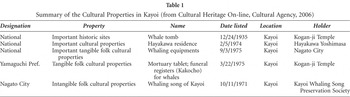
This section gives details of those cultural properties summarized in Table 1.
Summary of the Cultural Properties in Kayoi (from Cultural Heritage On-line, Cultural Agency, 2006)

PROPERTIES AT THE KOGAN-JI TEMPLE
At the Kogan-ji Temple, there are three volumes of funeral register books, a mortuary tablet, and a jizo statue for whales. The temple holds an annual memorial service dedicated to whales and all sea life. The tomb and tablet together with the register books were erected in 1692 by the fifth head priest of the Kogan-ji Temple, Shoyo Shonin. The priest built a Kannon altar in Seigetsu-an, where he retired at the age of 51 years in 1679 and started conducting memorial services for whales. For 13 years he preached the need to commemorate whale spirits. The priest passed away at the age of 106 years in 1734, but the service continues to the present day. The tablet is now placed in Kogan-ji temple where the annual service is held in early May. The 5-day service is now reduced to one and no fishing is allowed on that day. When the IWC annual meeting was held in Shimonoseki in 2002, the conference delegates attended the memorial service.
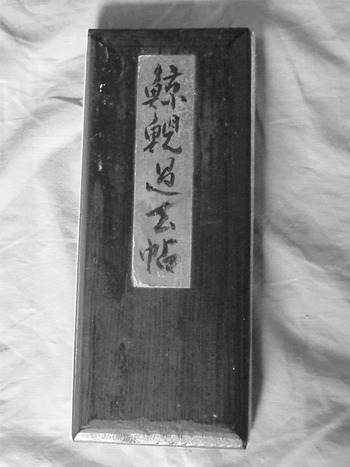
Kakocho (Funeral Register Book) for Whales
It is a Buddhist practice that one would receive kaimyo after having gone through the required training; but today, because not many do so, it is commonly understood that kaimyo is given to the deceased.69
Kaimyo (

) is the discipline name (as opposed to personal name) given to trainees by their masters as a sign of commitment. Jodo-shin-shu school uses monyo (

). Today kaimyo is generally understood to be Shigo-kaimyo (

, literally name after death).
The existing kakocho is believed to be the second volume of the four that existed and is registered as Yamaguchi Prefecture Tangible Folklore Property.
70Its first volume has been lost and the third and fourth volumes are replicas made in the Showa Era (1926–1989).

) is in black on gold paper.
71The symbol for female whale is

;

is used for male and female whales today, and

is no longer in use.

Funeral register.
The register follows the same format as the human register: kaimyo consisting of four characters selected by the priest of the temple; the date and location caught; the whaler's name; and the whale's kind, size and sex. It is customary that those who have gone through a 5-day training (both male and female) to receive the character

(honor) in their kaimyo, and often the character

(graceful) is used for females. If used, they (i.e.,

,

) appear in the second and third place in the name, respectively. The characters frequently used in kaimyo are

(large),

(sound),

(shore),

(ocean),

(blessing),

(prayer), as well as those indicating seasons (

, winter;

, spring;

, snow) and time (

, morning). Some examples of the names are as follows:

On May 25, 2006, a 4-meter female Minke whale was tangled in the fixed net owned by a local fishery group. A service was given and the new register book was started by the young priest of the Hogan-ji Temple, who explained his reasons:
I visited the site several times and consulted with the prayer book thoroughly before deciding on a name:

(chigu myoshin). It is adopted from one of the Jodo Scriptures (Tetsu Sentaku Shu Vol. 2, Jodo 2) from the saying that an infant should never leave its mother. It implies, and I hope it reflects my wish, that the whale's soul would not leave Buddha's side and remain in his care.
72Personal communication, interview data (10 Nov., 2006).
Whale Tombs and Mortuary Tablets
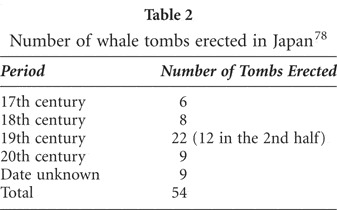
Today 54 tombs are recorded in Japan as specifically designated for whales, 9 of which are not dated. Among them, the Kogan-ji whale tomb is specifically designated for fetuses found in mother whales. Tombs so dedicated to the unborn are rare, and only a few examples exist elsewhere.73
One is in Enoshima, buried with the hazashi's clothes, and the other is in Muroto, buried with child's clothes (Nakazono, The Chronology of Whaling).
Although your life as a whale was terminated with the mother's life, it was not our intention to take your life. We'd rather have freed you into the ocean, but you'd not be able to survive on your own in the harsh environment. Therefore we pray that you receive the virtue of impermanence like us human beings.74

. One of the three donors differ from those for tomb. The two families are closely associated, and this is considered to honor both families.
A mortuary tablet for whales (height: 77.5 cm on a base of 22.4 cm × 15.2 cm) carries the same inscription as the whale tomb on the front. On the rear side, the date is inscribed (May 12, 1693) and the names of the contributors: two priests and three donors.75
The Era is Genroku (1688–1703) 5.
Eko in Jodo-shu and hoe in Jodo Shin-shu. Eko may be commonly referred to as kuyo (see earlier section) Reciprocity in Japanese cultural context (p. 289).
A memorial for the whales

[END POEM]
The oldest tomb is dated 1671 (Kumano, Mie) and the greatest number of monuments were erected during the Genroku Era (1688–1703). It is worth noting that that period coincided with the transition from handheld harpooning to the more efficient net method, by which territories occupied by each group became clearer. The greatest number of tombs were erected during the nineteenth century when the whale stocks suffered a serious decline. This was the time a jizo was erected in Kayoi (Table 2).
Number of whale tombs erected in JapanFrom Nakazono, The Chronology of Whaling, 164.

DECLINE OF WHALING AND A JIZO STATUE
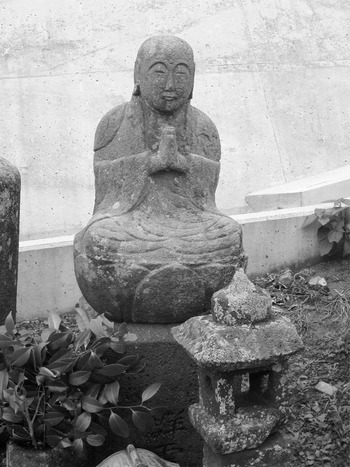
Situated in the graveyard of Kogan-ji Temple, a jizo sits with a slight smile. The inscription on the base (height 74 cm, base 80 cm) reads: “Jizo for the spirits of whales and fish spirits.” Only two of this kind exist in Japan, the other is believed to be in Ikutsuki, Kyushu. Jizo (Ksiti-garbha) in Japanese is a popular Mahayana Buddhist Bodhisattva, who give unlimited mercy with the earth's power for those who suffer. Today jizo may be seen along the roadside or in temples dedicated to unborn infants and those who died young (mizuko, water child).

Jizo statue.
This jizo statue was erected in 1863 by the 13th head of the Hayakawa clan, one of the major whaling groups of the village. It was during the late premodern whaling period in Japan when decline of the stock became evident, starting generally in 1844 to 1848. In Kayoi the peak of the whaling was in 1846 when 5 right whales were caught on November 29 and 24 were caught within 6 months. The estimated price of one whale was then 10 silver kan.79
One hundred seventy ryo. Estimated to be approximately 34 million yen today.
Nakazono, The Chronology of Whaling.
The period coincided with the time when intensive hunting took place in the so-called Japan grounds81
Since approximately 1820, the Japan Ground was defined as longitude 150 to 179, latitude 28 to 35 or the triangular area marked by Hawaii, Hokkaido, and Ogasawara islands (Osumi, “Japan Coastal Whaling”).
Ships were referred to as kurofune (black ships). Yokohama celebrated the 150 anniversary of the treaty in 2004.
Kato, “Around the time Japan.”
Nuns' Prayers and Annual Memorial Service: Obii-sama—Nuns at Hosen-an
In Ohibi village adjacent to Kayoi is the Hosen-an Nunnery established during the successive years of three head priests of the Saien-ji Temple: Hogan, Hoju, and Hodo (1779–1863), now referred to as sanshi or the three great masters in the community. The three head priests preached the need to plead for forgiveness for the killing, from which the establishment of the nunnery originated.
Because this coastal village has little farming land, it has no choice but hunting (fish) for livelihood.
Although the intention of those whose livelihood involves killing is wrong, it is justifiable to beg forgiveness for killing. It is not justifiable to allow killing just because it is for livelihood. Such judgment of right or wrong would determine whether one reaches the Pure Land…. if one must kill, cruel killing must be avoid as much as possible. Methods such as large net fishing, fixed net fishing and night fishing and shooting of birds must be prohibited.84
[end prayer]
At the graveyard of the three masters, the burial of 241 nuns is recorded. Today (2006), two nuns reside in the nunnery, both 83 years old. The nuns are well-respected by the community and affectionately referred to as obii-sama (honorable nuns). The two nuns, one of them the head nun (anju-sama), were in good health, but both had a slight hearing impairment and one difficulty in kneeling down. She kept apologizing for being seated on a chair. Their kaimyo names were Ejo and Jiko, meaning blessing purity and nourishing light, respectively. They received these names when they entered the nunnery with a certificate and a book of principles in a ceremony “to farewell this world.”85
An honorific suffix, -sama refers to personal names. Personal communication.
Rules included restrictions on food with distinct smell such as onion, leek, garlic, and chives; male visitors must be met at the front entrance by all nuns present and leave as soon as they finish their business; no males, even priests, are allowed after 6 PM (this applies to all visitors) not to mention staying overnight, including their fathers. Today the nuns still prepare all meal themselves, and male visitors are allowed inside.
Both of the two Hosen-an nuns entered the nunnery at the age of 13 years, which is younger than others (commonly approximately ages 15–20). It was believed to be “an honour for the family if they can afford to have one of their daughters become a nun” and not a practice to reduce the number of children, because their lifetime source of livelihood must be provided either in the form of a rice field, mountain, or any other food source.87
Approximately 60 kg (2 hyo, or rice bags) of rice per annum was the standard estimate.
Personal communication, interview data (12 Nov., 2006).
The head nun was the middle of three girls and one elder brother. Her brother had lost his eyesight because of malnutrition and her father also fell ill, and thus she was “told to go into nunnery because [she] was the second girl.”89
Personal communication, interview data (12 Nov., 2006).
Personal communication, interview data (12 Nov., 2006).
Personal communication, interview data (12 Nov., 2006).
Personal communication, interview data (12 Nov., 2006).
Personal communication, interview data (12 Nov., 2006).
The nuns are highly regarded by the community for their devotion and the meticulous service they give to all ancestors of every villager. The nuns give three services a day: at 4 AM, 9:30 AM and 1:30 PM, each lasting for 1 to 2 hours.94
The nuns refer to each service as morning, daytime, or evening service.
Prayers are given to whales (keigei gunrei), dolphins (koto gunrei), fish (gyorin gunrei), and all earth creatures that may have been killed during farming (kosaku-chu datsumei).95
Keigei are male and female whales; gunrei are spirits of the group. The gei character is no longer in use today.
Personal communication.
Women's close affiliation with mammal species like whales is also illustrated by Bell (Ngarrindjeri Wurruwarrin), who writes about women's intimate association with the protective nature of whales, especially with their calves. “Whales Weep Not” by Lawrence also expresses such affiliation: “And enormous mother whales lie dreaming suckling their whale-tender young and dreaming with strange whale eyes wide open in the waters of the beginning and the end.” Day also points out in The Whale War that it is difficult to argue against the existence of nurture, attachment, and succor with species such as whales and dolphins when they show sympathy towards others in trouble. Prohibition on killing of mother whales no doubt relates to the maintenance of stock, but it also expresses respect for particular kind of female spirituality. Many folk stories describe a violation of prohibition leading to disasters such as storms and shipwrecks. Women's close affiliation with whales and other sea mammals is one important means for extending sympathy to the entire ecosystem. This point deserves further investigation.
INTANGIBLE HERITAGE VALUES: GRATEFULNESS, SYMPATHY, GUILT, AND PRAYERS AS INTANGIBLE HERITAGE FUNDAMENTAL TO SUSTAINABILITY
The object of empathy is understanding. The object of sympathy is the other person's well-being98
Wispé, The Psychology of Sympathy.
What is maintained by the current community in Kayoi is the spirituality of the former whaling community. It communicates a sense of reciprocity expressed in a form of prayers—nuns prayers and prayers of those who worship that expressed by the cultural properties. Prayers contain gratitude, sympathy, lament, guilt, and a plea for forgiveness. Overall, the hardship and emotional suffering of the former whaling community is clear, and their expression of ethics is particularly significant. This is because, as suggested at the outset, they bear the conflicting and undeniable reality of human dependence on other lives: conflicts between livelihood needs and resource depletion; killing and respect for lives; and gratitude and guilt, which many urban environmentalists can sidestep.
Two aspects are particularly significant. One is that the cultural properties and related practices are maintained and valued by today's community as their cultural heritage, acknowledging the ethics in the current fishery practice even though they no longer engage in whaling. The life of the remote community is not easy, but the whale-related culture provides the community with a clear sense of identity and some avenues for economic development.99
Cultural activities such as guided walks and seminars are initiated by the Whale Museum.
It is now more than 15 years since Kalland questioned whether Japanese whaling had reached “the end of an era.”100
Kalland, Japan's Whaling.
Callicott, Earth's Insights, 22.
Callicott, Earth's Insights, 3.
Day, The Whale War, 199.
As with the beginning, I conclude this article with a poem by Kaneko Misuzu, Whaling104
Yazaki, Anthology of Kaneko Misuzu, 28–30.

[end poem]
POSTSCRIPT
Memorial for Right Whales
“A monument for Right Whales” with a statue of a right whale on top is situated in Hakodate, Hokkaido, Japan. It was erected by a former chief gunner of Toyo Whaling Company in 1957 when he was 83 years old.105
Whaling started in Hakodate toward the end of the Edo era. Edo (now Hoddaido) was made a territory twice; and whaling was a high interest of the Tokugawa sovereign, who sent surveyors to the Etorof Islands area with the assistance and experience of the Hirado feudal clan. Interest in whaling was renewed when the port of Hakodate was opened in 1854. American whalers frequently entered the port, thus introducing the modern Western method of whaling. Whaling survey continued and techniques from Russian and American methods were adopted (e.g., Nakahama Manjiro or John Manjiro who had learned American method taught in the area). However, as whaling declined after the introduction of petroleum in 1859 in Pennsylvania and the subsequent crash of whale oil price, western whaling in Hakodate did not eventuate.
We engaged in whaling for 26 years from 1908 and we took 2000 some whales. Although among the groups of whales were mothers and calves, many of them were taken. The guilt of taking of the precious lives of these whales was truly regrettable. I have for some time preached the need to formally acknowledge this regretful act, and my desire to do it grew stronger since the passing of my wife.
I have lost three of my children and the anguish of the loss is unbearable. The mercilessness of this world is felt even stronger now in my old age. My wish is to commemorate the spirits of all living things and I therefore erect this monument to wish for the peaceful resting of all whale spirits taken by humans.
[end inscription]
It is explained at the back of the statue that this monument was erected to commemorate the taking of the right whales, because of their good taste, to the extent of near extinction, and it was feared this whale would not be sighted for some time. The gunner's sense of regret is clear particularly in that he was awarded a gold watch for his achievement in the hunt.