INTRODUCTION
Since the early 20th Century, there has been a steady increase of non-native fish species along the Levantine shores and in fish markets (Galil, Reference Galil2000). The colonization of the Mediterranean by Indo-Pacific and Red Sea species, known as lessepsian migration, is an ongoing process that began in 1869, following the opening of the Suez Canal (Por, Reference Por1978; Golani, Reference Golani1998); since then, more than 70% of non-indigenous decapods and about 63% of exotic fish occurring in the Mediterranean have made their way into the Mediterranean through the Suez Canal (Bella, Reference Bella2000; Galil & Zenetos, Reference Galil, Zenetos and Leppakoski2002). As a result, the canal has become the main pathway for alien species into the Mediterranean. The most common pattern of development for the colonizers has been a gradual increase to large, self-sustaining populations (Bariche et al., Reference Bariche, Harmelin-Vivien and Quingnard2003).
The first lessepsian migrant, Atherinomorus lacunusos, was recorded off Iskenderiye (Ben-Tuvia, Reference Ben-Tuvia1953). Since then, more than 70 new records of allochthonous fish species have been described in the Mediterranean (Golani & Sonin, Reference Golani and Sonin1992). For some species there is clear evidence of a recent, rapid extension of their geographical range into the Mediterranean basin (Bilecenoglu et al., Reference Bilecenoglu, Taskavak and Kunt2002; Azzurro & Andaloro, Reference Azzurro and Andaloro2004). Saurida undosquamis was first caught off Israel in 1952; only three years later 266 tons of this species were landed by local trawlers, constituting almost 20% of the total trawler catch (Ben-Yami & Glaser, Reference Ben-Yami and Glaser1974).
Whether this reflects natural expansion of the spatial distribution of these species (e.g. due to a warming trend of water temperature), or the extension of maritime traffic, or is the result of a more intense scientific investigation, is still an open question (Galil, Reference Galil2000).
Recent studies have focused the attention on the biology and/or ecology of lessepsian migrants along the Mediterranean coasts (Torcu & Mater, Reference Torcu and Mater2000; Bariche et al., Reference Bariche, Harmelin-Vivien and Quingnard2003, Reference Bariche, Letourneur and Harmelin-Vivien2004; Ismen, Reference Ismen2006). However, there is a lack of quantitative data on the abundance of these species and their importance for local fisheries. The aims of this paper are to determine the relevance of lessepsian species to the catch composition of the artisanal fishery and to assess the ecological characteristics of the colonizers and their response to the new environmental conditions. This information could represent an important reference point for future studies on the presence and abundance of Red Sea species in the Levantine basin.
MATERIALS AND METHODS
Data on fisheries were collected at the port of Tyre, which hosts the largest fleet along the Lebanese coast south of Beirut.
Data on catch composition were collected monthly from February 2005 to December 2006. Fishing ground surveys were conducted three times a week at the landing site between 0730 and 1100 hours. During each sampling day, the following data were collected on a sub-sample of the active vessels:
– species caught;
– landing by species for each fishing methods (recorded as kg vessel d−1);
– gear characteristics (type, mesh size);
The SIMPER procedure (SIMilarity PERcentage analysis) was used to identify those species typifying the catch of each group of gear (Clarke, Reference Clarke1993). The observed differences between gear were tested using an analysis of similarity randomization test (ANOSIM, Clarke, Reference Clarke1993). These statistical analyses were conducted in PRIMER v.5 software (Clarke & Gorley, Reference Clarke and Gorley2001).
RESULTS
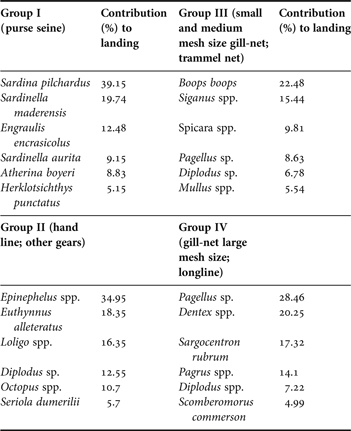
About 2/3 of the fleet used mainly standing nets (both trammel net and gill-net with different mesh sizes), 20% bottom longlines, while purse seines and other fishing gear (floating longlines, traps and spear gun) are less used. The overall densities of faunal composition showed significant differences (ANOSIM: R = 0.69; P < 0.01) among gear. The SIMPER procedure identified the percentage contribution of typical species composition to within-group similarity calculated for the four groups of gear identified (Table 1). Gill-nets large mesh size and longline were characterized by a well defined group of benthopelagic species inhabiting shelf and deeper shelf (Pagrus spp., Dentex spp. and Epinephelu spp.). Boops boops and different species of the genus Siganus, Diplodus, Spicara and Pagellus typified trammel net and small and medium mesh size gill-net catch. The main differences between the two groups of trammel-combined nets were related mostly to the rank order of the most typical species.
Percentage contribution of the first six typifying species (over 4.5%) to within-group similarity, for the main fishing activities used by artisanal fishery in Tyre, as assessed by similarity percentage analysis (SIMPER).

The catch of purse seine net was characterized by pelagic species like Sardina pilchardus, Sardinella maderensis and Engraulis encrasicolus.
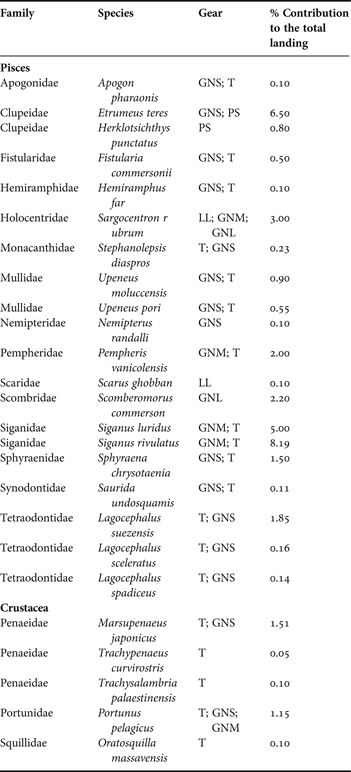
Overall, 25 lessepsian species, representing 17 families and contributing to 37% in weight to the total landings in the area were recorded.
Siganidae, which include both Siganus luridus and S. rivulatus, exploited mainly by trammel net (3.83 kg vessel d−1; Standard Deviation SD±7.26) and small and medium mesh size gill-net (7.71 kg vessel d−1; SD±9.38) contributed to the total landing of Tyre's vessels with 13% in weight (Table 2).
Percentage contribution of lessepsian species in the catch composition.

Gear codes: T, trammel net; GNS, gill-net small mesh size; GNM, gill-net medium mesh size; PS, purse seine; LL, longline; GNL, gill-net large mesh size.
Invasive mullids Upeneus moluccensis and U. pori exploited by small mesh-size gill-net (0.18 kg vessel d−1; SD±0.43) and trammel net (0.15 kg vessel d−1; SD±0.28), comprised 32% of the mulled catch off the coast of south Lebanon at depths of below 50 m. The Red Sea obtuse barracuda, Sphyraena chrysotaenia, outnumbered the native sphyraenids, S. sphyraena, in inshore gill-nets (0.60 kg vessel d−1; SD±0.19) and trammel net catches (0.32 kg vessel d−1; SD±0.21).
The small pelagic Herklotsichthys punctatus constituted around 15% of the purse seine landing (6 kg vessel d−1; SD±15). Another pelagic species, the round herring Etrumeus teres, exploited mainly by small mesh-size gill-net (2.32 kg vessel d−1; SD±6.11), contributed 2.5% to the total landing weight.
The pufferfish Lagocephalus suezensis, L. sceleratus and L. spadiceus represented common by-catch of trammel net (0.08 kg vessel d−1; SD±0.54) and small mesh-size gill-net (0.12 kg vessel d−1; SD±0.32). The sweeper Pempheris vanicolensis (1.07 kg vessel d−1; SD±2.41) and the cornet fish Fistularia commersonii (0.30 kg vessel d−1; SD±0.7) comprise an important component of the by-catch of small mesh-size gill-net throughout the year. The threadfin bream Nemipterus randalli, a recent invader that was caught by small mesh-size gill-net, represented a new by-catch along the Lebanese coasts.
Spanish mackerel Scomberomorus commerson has become abundant in recent years. The species is exploited by large mesh size gill-net (2.13 kg vessel d−1; SD±3.10), mainly during cold periods (from November to March), and represented 5% of the total catch.
Longline (0.58 kg vessel d−1; SD±1.95) and gill-net (0.51 kg vessel d−1; SD±0.95) by-catch was composed of the crepuscular squirrelfish Sargocentron rubrum. More recently, the parrotfish Scarus ghobban represented another important by-catch species of the longline (0.08 kg vessel d−1; SD±1.15).
Among crustaceans, Marsupenaeus japonicus (0.16 kg vessel d−1; SD±0.77), Trachypenaeus curvirostris (0.09 kg vessel d−1; SD±0.2) and Trachysalambria palaestinensis (0.09 kg vessel d−1; SD±0.35) comprised most of the trammel net prawn catch (around 70%) off the southern Lebanese coasts. Catches of the swimming crab P. pelagicus (1.20 kg vessel d−1; SD±1.37) represented about 1.5% of total landing and are currently increasing.
DISCUSSION
Results clearly evidence the importance of lessepsian species in terms of diversity and abundance beyond the catch composition of the Tyre fishing fleet. Several migrants have now become common in the local landing and market, characterizing the fish community of south Lebanon coasts as a mixed Mediterranean–Red Sea composition. The weight percentage of lessepsian species observed in the study area (around 37%) is higher than the overall percentage (14%) of lessepsian fish reported in 2002 for the entire eastern Mediterranean (Golani et al., Reference Golani, Orsi-Relini, Massutí and Quignard2002), suggesting that new species are now well established.
The success of lessepsian migrant fish in the colonization of the eastern Mediterranean could be the result of occupation of an unsaturated niche and of out-competing local species on resources such as food and shelter (Golani, Reference Golani1998). Invasive species, in fact, may alter the evolutionary pathway of native species by competitive exclusion, niche displacement, predation, and other ecological and genetic mechanisms (Mooney & Cleland, Reference Mooney and Cleland2001). For example, the success of the herbivore siganids Siganus luridus and Siganus rivulatus in the temperate waters of the Mediterranean has been attributed to the low competition with other herbivores (Lundberg & Golani, Reference Lundberg and Golani1995). Conversely, in the Red Sea, siganid populations are constrained to low abundance levels and confined to restricted habitats (Bouchon-Navaro & Harmelin-Vivien, Reference Bouchon-Navaro and Harmelin-Vivienm1981), probably due to interspecific competition with acanthurids and scarids (Bariche et al., Reference Bariche, Harmelin-Vivien and Quingnard2003). Prior to lessepsian migrations, Sarpa salpa and Sparisoma cretense were the only native herbivorous species in the Mediterranean (Bauchot & Hureau, Reference Bauchot, Hureau and Whitehead1986; Quignard & Pras, Reference Quignard, Pras and Whitehead1986). As stated by Bariche et al. (Reference Bariche, Letourneur and Harmelin-Vivien2004) siganids now represent 80% of the abundance of herbivorous fish in the eastern Mediterranean coastal waters, whereas the endemic S. cretense and the sparid Sarpa salpa represent, respectively, only 20% and 0.2% of the total.
The presence of the parrotfish Scarus ghobban, recently recorded in the Mediterranean (Goren & Aronov, Reference Goren and Aronov2002), could have a direct effect on the population of the native co-familial Sparisoma cretense: both species, in fact, feed on seaweeds, seagrasses and detritus (Sano et al., Reference Sano, Shimizu and Nose1984; Ochavillo et al., Reference Ochavillo, Dixon and Aliño1992). Similarly, Apogon pharaonis has been found to be a successful colonizer affecting the population structure of native Mediterranean Apogon imberbis in all the eastern Mediterranean (Gucu et al., Reference Gucu, Bingel, Avsar and Uysal1994). Apogon pharaonis, a species with no commercial value representing a common by-catch of standing nets, has showed a steady increase in abundance.
Conversely, trophic separation does not play an important role in resource partitioning between goatfish (Mullidae) and lizardfish (Synodontidae). Co-existence between colonizing (Upeneus moluccensis, Upeneus pori) and indigenous mullids (Mullus barbatus, Mullus surmuletus) is presumably linked to spatial segregation (Golani & Galil, Reference Golani and Galil1991). Golani (Reference Golani1994) suggested that niche partitioning of eastern Mediterranean mullets is achieved on the bathymetric axis: lessepsian mullets occupy shallow waters (20–30 m) whereas indigenous species dominate greater depths. Ismen (Reference Ismen2006) stated that in the north-eastern Mediterranean, 98% of the total biomass of Upenus pori were trawled from waters less than 50 m deep with a marked increase during the more recent years.
Evidence of niche displacement between indigenous and Red Sea competitors has also been reported for the lessepsian lizardfish Saurida undosquamis and the indigenous Synodus saurus. Both species are primarily piscivorous, and niche partitioning occurs primarily on a depth basis (Golani, Reference Golani1993): Saurida undosquamis may in fact colonize deeper bottoms than their native Mediterranean counterparts.
Some lessepsian species, under new environmental conditions, occupy similar ecological niches in the Red Sea and in the Levantine Mediterranean basin. This is the case for the nocturnal species Pempheris vanicolensis, which occupies overhangs in shallow waters in both seas, and Sargocentrum rubrum, which take shelter in cavities during the day from shallow waters down to 30 m (Golani & Diamant, Reference Golani and Diamant1991). It is difficult to determine whether the colonizers displaced the local species or whether the latter were occupying the same bathymetric niche prior to its confamilial's colonization. As reported by Golani (Reference Golani1998), the indigenous meager, Argyrosomus regius, was once one of the most common commercial species in Israel; since the 1980s, this species has almost completely disappeared in local catches while, simultaneously, the lessepsian migrant narrow-barred Spanish mackerel Scomberomorus commerson has considerably increased its abundance. Both species are mainly piscivorous and may utilize the same resources.
Similarly, the expansion of the pelagic round herring Etrumeus teres seems to have accelerated in the last decade; this could have a direct effect on the population of native clupeids (Sardinella maderensis and Sardinella aurita) as well as on local fisheries. Since 1990 E. teres is caught in large numbers off the Israeli coast and it is caught regularly in the Gulf of Antalya (Yilmaz & Hossucu, Reference Yilmaz and Hosucu2003).
Several causes have been put forward to explain the success of lessepsian migrants (Por, Reference Por1978; Boudouresque, Reference Boudouresque and Sandlund1999; Galil & Zenetos, Reference Galil, Zenetos and Leppakoski2002). The eastern Mediterranean Sea is characterized by low fish diversity (Fredj & Meinardi, Reference Fredj and Meinardi1989) that could in part explain the success and the steady increase of lessepsian migrants. It is evident that successful colonization can only be established where the overlap between the environmental conditions in the source and target areas is within colonizer tolerance. Since the two environments are not identical, the colonizing population will respond to the new selective pressures by diverging from its mother population, thus becoming better adapted to the new habitat.
Evidently, the immigration of Red Sea fish species from the Suez Canal is a continuous process, and the probability of suitable species of fish entering and colonizing the Mediterranean region increases over time. Recently, the record of the tropical migrants Nemipterus randalli, previously unknown by local fishermen, indicates a recent rapid colonization of this newly species along the Lebanese coast (Lelli et al., Reference Lelli, Colloca, Carpentieri and Russell2008).
As reported by this study, the increasing percentage of Red Sea species found in the landing composition of the Lebanese fishery indicates that at least some resistant species have established viable populations. The ecological role of such newly settled species within the coastal ecosystem and their impact on local populations need to be the object of future research. As stated by Verlaque & Fritayre (Reference Verlaque and Fritayre1994), marine biological invasions are becoming a reality with sometimes devastating effects. At the same time, it is important to study the genotypic and phenotypic changes of these new populations driven by natural selection through the interactions with indigenous populations and in response to the new abiotic environment.
ACKNOWLEDGEMENTS
This study is part of the project: ‘Socio-economic development of the fishing community of Tyre, Lebanon’ promoted by the Italian NGO ‘Ricerca e Cooperazione’ in collaboration with Caritas Lebanon and co-financed by the Italian Ministry of Foreign Affairs.