Venous thromboembolism, including deep venous thrombosis and pulmonary embolism, is a rare event in the paediatric population. Nevertheless, it is increasing in frequency.Reference Raffini, Huang, Witmer and Feudtner 1 Furthermore, a recent paediatric retrospective series suggests that, in the setting of pulmonary embolism, mortality may be as high as 21%.Reference Biss, Brandao, Kahr, Chan and Williams 2
We are not aware of any published prospective cohort studies in paediatric pulmonary embolism; as such, high-quality observational evidence on long-term outcomes remains limited. Whereas numerous studies have described acute cardiac manifestations including right ventricular dysfunction,Reference Hsiao, Yang, Wang, Lee, Lin and Liu 3 – Reference Kasper, Konstantinides, Geibel, Tiede, Krause and Just 6 and have established its predictive capacity for adverse outcomes in adults with pulmonary embolism,Reference Kline, Steuerwald, Marchick, Hernandez-Nino and Rose 7 , Reference Konstantinides 8 cardiac findings and their potential prognostic importance have received little attention in children. We therefore sought to determine acute and chronic cardiac findings and long-term thromboembolic outcomes following acute pulmonary embolism in children, via an institution-based combined retrospective-prospective inception cohort study.
Methods
Subjects
With the approval of the Colorado Multiple Institutional Review Board (05-0339), consecutive children who ranged in age from birth to 21 years and who had received a diagnosis of acute pulmonary embolism were enrolled and followed up in this mixed retrospective-prospective inception cohort study at the Children's Hospital Colorado between March, 2006 and January, 2011, with the exception of 11 patients diagnosed with acute pulmonary embolism before March, 2006 – for whom data were retrospectively collected before this date and prospectively thereafter. Signed informed consent – and child assent, as appropriate – was provided. There were no exclusion criteria beyond the aforementioned eligibility criteria.
Data collection
The following clinical data were prospectively collected: demographics; presenting signs, including tachycardia and hypoxaemia, as defined by room-air oxygen saturation of less than 90%; thromboembolism characteristics, including pulmonary arterial distribution and presence/absence of concomitant deep venous thrombosis; thromboembolic risk factors, including trauma, sepsis, oral contraceptive pill use, presence of a central venous catheter, prolonged immobility – other than for trauma – congenital heart disease, congenital stenosing vascular anomaly, inflammatory conditions, malignancy, and inherited and acquired thrombophilias; antithrombotic treatments, administered in accordance with the 7th and 8th American College of Chest Physicians guidelines,Reference Monagle, Chan, Massicotte, Chalmers and Michelson 9 , Reference Monagle, Chalmers and Chan 10 or institution-based clinical care pathways in the case of lytic interventions; serial imaging findings for pulmonary embolism, performed clinically at 3–6 months post event and again at 1 year if persistent at 3–6 months; recurrent thromboembolism; and death. Thrombophilia testing was performed as previously described.Reference Calhoon, Ross, Pounder, Cassidy, Manco-Johnson and Goldenberg 11
The criteria for administration of systemic tissue plasminogen activator for massive pulmonary embolism included the presence of echocardiographic criteria of severe right ventricular dysfunction or the presence of haemodynamic instability, as defined by requirement for any inotropic support in a patient without underlying primary cardiac disease or the requirement for any new/increase in inotropic support in a patient with underlying primary cardiac disease. Discontinuation of the tissue plasminogen activator infusion occurred when there was no further evidence of severe right ventricular dysfunction seen by echocardiogram or when 96 hours post-initiation of the infusion had been reached or if major bleeding concerns, severe headache, or neurologic changes were present.
The criteria for administration of local tissue plasminogen activator for deep venous thrombosis included the presence of a completely veno-occlusive proximal limb thrombus with either phlegmasia cerulean dolens – tense oedema accompanied by inability to walk or move the limb because of pain – or adversely prognostic plasma biomarkers – the combination of plasma factor VIII activity greater than or equal to 150 units per decilitre and D-dimer concentration greater than or equal to 500 nanograms per millilitre. Dosage and more specific information on the route of administration of thrombolytic therapies has been described in detail in two previous publications.Reference Goldenberg, Durham, Knapp-Clevenger and Manco-Johnson 12 , Reference Goldenberg, Branchford, Wang, Ray, Durham and Manco-Johnson 13 At the Children's Hospital Colorado, an institution-wide, electronic medical record-based diagnostic evaluation and management pathway is used for patients with suspected acute pulmonary embolism. Within this clinical pathway, echocardiographic evidence of right ventricular dysfunction is defined by the following parameters: tricuspid regurgitation velocity (greater than 3 metres per second or estimates of right ventricular pressure greater than 50% of systemic blood pressure), presence of septal flattening, and presence of right ventricular dilation. Serial echocardiographic data were reviewed retrospectively with a paediatric cardiologist (Shelley D. Miyamoto). Echocardiogram and 12-lead electrocardiogram data were grouped by time into acute (less than 72 hours), sub-acute/early chronic (1–6 months), and late chronic (greater than 1 year) time periods, with the first study within each time period uniformly chosen for analysis. The tricuspid regurgitation velocity was measured by Doppler when present, except in cases of trivial tricuspid regurgitation where a complete Doppler signal could not be obtained. Electrocardiogram findings of interest with regard to right ventricular dysfunction were ST/T segment changes, the classic S1Q3T3 phenomenon (S wave in lead 1 greater than 1.5 millimetres, Q wave in lead III greater than 1.5 millimetres, and negative T wave in lead III), and voltage criteria for right ventricular hypertrophy. Echocardiogram and electrocardiogram data of patients with congenital heart disease were excluded.
Statistical methods
Summary statistics were reported descriptively, using non-parametric methods. Distributions of data were compared between groups by Mann–Whitney U-test. Frequencies (proportions) were compared by chi-square or Fisher's exact test, as appropriate. Inferential statistics employed two-sided testing, with a p-value of less than 0.05 considered to be statistically significant. All statistics were performed using SAS version 9.1 statistical software (SAS Institute, Cary, North Carolina, United States of America).
Results
Demographic and presenting characteristics
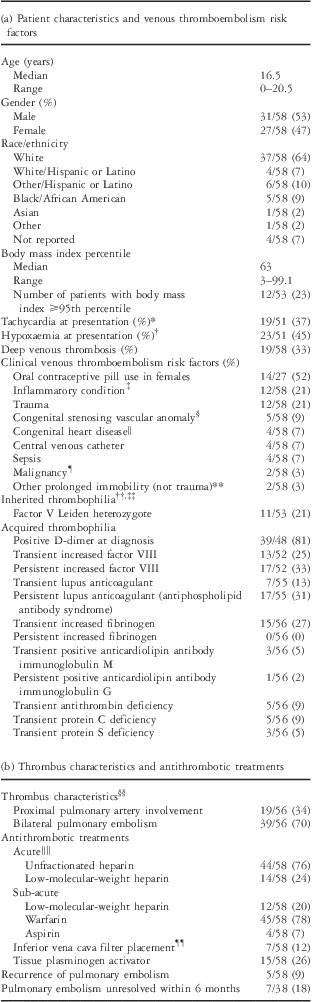
The cohort comprised 58 consecutively enrolled children with acute symptomatic pulmonary embolism. Table 1 summarises demographic data and clinical findings at acute pulmonary embolism presentation. The median age was 16.5 years ranging from birth to 21 years. Gender distribution was balanced. In all, 23% of patients were obese, as defined by a body mass index greater than or equal to the 95th percentile. Acute pulmonary embolism presentation included hypoxaemia in 23 patients (45%) and tachycardia in 19 patients (37%). Concurrent deep venous thrombosis was identified in 19 patients (33%). Symptoms of pulmonary embolism included acute onset/worsened shortness of breath, pleuritic chest pain, haemoptysis, and/or unexplained new/increased oxygen requirement, but were not systematically collected or scored given the absence of a validated tool for the same.
Demographic data and clinical findings among 58 children with acute pulmonary embolism.

*Tachycardia as defined by age and heart rate range from Pediatric Emergency Guidelines at the Children's Hospital Colorado
†Hypoxaemia as defined by room-air saturation of less than 90% in a paediatric population in Colorado at higher elevation
‡Inflammatory condition: one patient with autoimmune lymphoproliferative syndrome, one patient with Stevens–Johnson syndrome, three patients with systemic lupus erythematosis, five patients with antiphospholipid antibody syndrome, two patients with inflammatory bowel disease
§Congenital stenosing vascular anomaly: four patients with May–Thurner syndrome and one patient with Paget—Scroetter syndrome
∥Congenital heart disease: one patient with atrial septal defect, one patient with hypoplastic left heart syndrome, one patient with bicuspid aortic valve, and one patient with tetralogy of Fallot
¶Malignancy: one patient with acute lymphoblastic leukaemia with recent asparaginase, one patient with T-cell leukaemia
**Other prolonged immobility: one patient with orthopaedic surgery (tibial realignment) and one patient with meningomyelocele and chronic immobility
††Prevalence of inherited protein S, Protein C or antithrombin deficiency, and prothrombin gene mutation was each 0%
‡‡Not all patients had undergone testing for all aspects of the thrombophilia panel as evidenced by denominators in data collection
§§There were two patients whose acute imaging was unavailable
∥∥First agent used in the acute period is shown
¶ ¶3/7 inferior vena cava filters were retrievable
Prothrombotic clinical risk factors
The most prevalent prothrombotic clinical risk factors included oral contraceptive pill use in 14 of 27 female patients (52%); presence of a chronic inflammatory condition in 12 patients (21%), including primary antiphospholipid antibody syndrome, systemic lupus erythematosus, ulcerative colitis, and others; and trauma in 12 patients (21%). Additional diagnoses included congenital stenosing vascular anomaly (May–Thurner anomaly or Paget–Schroetter syndrome in five patients, that is, 9%), presence of a central venous catheter in four patients (7%), congenital heart disease in four patients (7%), and sepsis in four patients (7%), among others.
Laboratory thrombophilia testing
Plasma D-dimer levels were obtained at presentation in 48 patients (83%) and were found to be elevated in 39 (81%) of these. The complete results of D-dimer and thrombophilia testing are shown in Table 1. Heterozygous factor V Leiden was identified in 11 patients (21%), and 17 (31%) of the patients met the criteria for antiphospholipid antibody syndrome.Reference Miyakis, Lockshin and Atsumi 14 It is noteworthy that only seven patients (13%) had acute antiphospholipid antibodies, such that a considerable number of cases of the syndrome were characterised by a delayed onset of these antibodies. Of the 14 female patients (50%) on oral contraceptive pills, seven had factor V Leiden and five (36%) had antiphospholipid antibody syndrome. A total of 30 patients (58% of those tested) had acutely elevated factor VIII levels. Of these patients (33%) in whom initial elevated factor VIII levels were found, 17 had persistently elevated factor VIII on subsequent laboratory testing.
Imaging characteristics
Nearly all patients were diagnosed with acute symptomatic pulmonary embolism via spiral computed tomography pulmonary angiography; two patients with known underlying cardiac disease – one patient with hypoplastic left heart syndrome following the Norwood procedure and one with tetralogy of Fallot with stenosis of a right ventricular outflow tract stent – were diagnosed by cardiac catheterisation obtained owing to worsening oxygen saturations and respiratory distress. In all, 19 patients (34%) had proximal pulmonary artery involvement and 39 (70%) had bilateral pulmonary embolism.
Antithrombotic treatment
Nearly all patients received therapeutic anticoagulation. A total of 15 patients (26%) underwent acute thrombolysis with tissue plasminogen activator. Of the patients, seven received systemic tissue plasminogen activator only, six received local tissue plasminogen activator only via catheter-directed pharmacomechanical thrombolysis, and two received initial systemic tissue plasminogen activator followed by local salvage therapy. Acute anticoagulation consisted of intravenous unfractionated heparin in 44 patients (76%) and low-molecular-weight heparin by twice-daily subcutaneous injection in 14 patients (24%). Sub-acute treatment consisted of warfarin in 45 patients (78%), low-molecular-weight heparin in 12 patients (20%), and aspirin monotherapy in one patient (2%) with underlying cardiac disease; a combination of aspirin and anticoagulation was used in three patients (5%). There were seven patients (12%) who underwent inferior vena caval filter placement, including three retrievable filters.
Serial echocardiographic and electrocardiographic findings
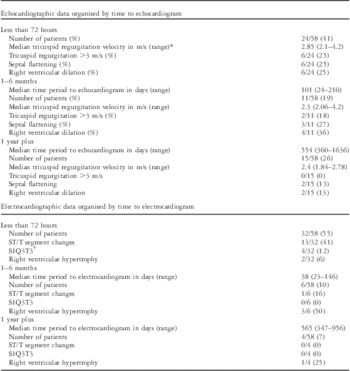
Among the 24 patients who underwent echocardiography in the acute period (first 72 hours post event), 14 patients had a measurable tricuspid regurgitation velocity with a median tricuspid regurgitation velocity of 2.9 metres per second ranging from 2.1 to 4.2 metres per second; Table 2. Parameters of acute right heart dysfunction – tricuspid regurgitation velocity greater than 3 metres per second, septal flattening, and right ventricular dilation – were each present in six (25%) of these children. Of the 24 patients, four (17%) had only one echocardiographic parameter of acute right heart dysfunction, five (21%) had two echocardiographic parameters, and one patient (4%) had all three parameters. During the sub-acute and early chronic periods (1–6-month follow-up interval post event), among the 11 patients studied, five had a measurable tricuspid regurgitation velocity with a median tricuspid regurgitation velocity of 2.3 metres per second ranging from 2.1 to 4.2 metres per second. Tricuspid regurgitation velocity greater than 3 metres per second, septal flattening, and right ventricular dilation were present during this time period in two (18%), three (27%), and four (36%) patients, respectively. Among the 15 patients evaluated in the late chronic period – greater than 1 year post event – seven patients had a measurable tricuspid regurgitation velocity, none had a tricuspid regurgitation velocity greater than 3 metres per second, and septal flattening and right ventricular dilation were each present during this time period in 13% of the patients.
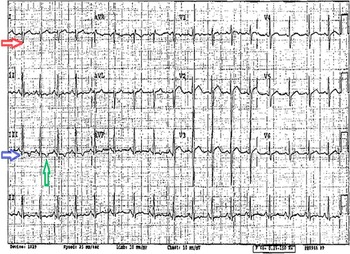
With regard to electrocardiogram findings (Table 2), of the 32 patients studied in the acute period 13 patients (41%) had ST/T segment changes, four patients (12%) showed the classic S1Q3T3 pattern (Fig 1), and two patients (6%) met voltage criteria for right ventricular hypertrophy. Of the 32 patients, nine (28%) had only one electrocardiographic finding of acute right heart strain, five (16%) had two findings, and none of the 32 patients had all three electrocardiographic findings. Electrocardiography was infrequently performed in long-term follow-up.
Natural history of echocardiographic and electrocardiographic findings over time in children after acute pulmonary embolism.

*Median tricuspid regurgitation velocity: not all patients had a measurable tricuspid regurgitation velocity (some patients had physiologic/trivial tricuspid regurgitation)
†S1Q3T3 criteria used: S wave in lead 1 = first negative deflection after R wave greater than 1.5 millimetres, Q wave in lead III = first negative deflection after P wave and before any R wave greater than 1.5 millimetres, associated with negative T wave in lead III
Classic S1Q3T3 pattern on an electrocardiogram in a child with acute pulmonary embolism in whom right heart strain was evident at presentation. Red arrow denotes S wave in lead 1 greater than 1.5 millimetres. Blue arrow denotes Q wave in lead III greater than 1.5 millimetres. Green arrow denotes negative T wave in lead III.

Overall, 20 of the 58 patients (34%) had either echocardiogram or electrocardiogram findings of right heart dysfunction in the acute time period, seven (12%) had findings in the sub-acute and early chronic time period, and only three (5%) had findings in the late chronic time period. The percent agreement between abnormal electrocardiogram findings – any of the three aforementioned findings – and abnormal echocardiogram findings – any of the three aforementioned parameters – for acute right heart dysfunction was low, at 24%.
Of the patients who had proximal pulmonary artery involvement and underwent acute echocardiograms, 50% had right ventricular dilation versus only 7% of patients without proximal pulmonary artery involvement (Fisher's p-value is equal to 0.04). There was no significant association with proximal pulmonary artery involvement and other acute echocardiographic or electrocardiographic parameters of interest.
A total of 38 patients had an echocardiogram performed. The seven patients (18%) who had studies in the non-acute time period had a prior paired acute echocardiogram performed. There was only one patient who had all three time period echocardiogram studies. A total of 37 patients had an electrocardiogram performed. The five patients (14%) who had studies in the non-acute time period had a prior paired acute electrocardiogram performed. No patient had an electrocardiogram in all three study periods.
Outcomes
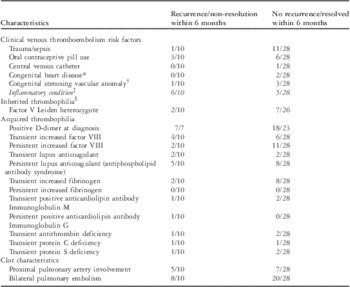
The median follow-up duration was 13.3 months ranging from 0.5 to 56 months. There were no pulmonary embolism-related deaths. The overall mortality was 1.6%, representing one child with a history of meningomyelocele and prolonged immobility whose cause of death was indeterminate and occurred at least 3 years after pulmonary embolism diagnosis. There were five patients (9%) who developed symptomatic recurrent pulmonary embolism in follow-up, two of whom also had non-resolution of pulmonary embolism on repeat imaging at 6 months post event. An additional five patients showed non-resolution of pulmonary embolism 6 months post event, among 38 patients with repeat imaging during this period (overall risk of non-resolution, 18%). Findings of evaluation for putative prognostic factors for recurrence/non-resolution of pulmonary embolism are displayed in Table 3, and the presence of an underlying non-infectious chronic inflammatory condition – lupus, ulcerative colitis – was identified as an adverse prognostic indicator, with a prevalence of 60% among patients with recurrence/non-resolution versus 18% among those with resolution and no recurrence (p-value less than 0.05). None of the laboratory thrombophilias, and neither echocardiogram nor electrocardiogram findings of right heart dysfunction, was found to be associated with these thromboembolic outcomes.
Characteristics of patients with recurrence and non-resolution of pulmonary embolism within 6 months as compared with those without recurrence and with resolution of pulmonary embolism within 6 months.

*Congenital heart disease: one patient with atrial septal defect, one patient with hypoplastic left heart syndrome, one patient with bicuspid aortic valve, and one patient with tetralogy of Fallot
†Congenital stenosing vascular anomaly: four patients with May–Thurner syndrome and one patient with Paget–Scroetter syndrome
‡Inflammatory condition: one patient with autoimmune lymphoproliferative syndrome, one patient with Stevens–Johnson syndrome, three patients with systemic lupus erythematosis, five patients with antiphospholipid antibody syndrome, two patients with inflammatory bowel disease
§Prevalence of inherited protein S, Protein C or antithrombin deficiency, and prothrombin gene mutation were each 0%
Italicised text indicates statistically significant differences p < 0.05
Discussion
In the present work, we describe the natural history of acute and chronic cardiac findings and long-term thromboembolic outcomes following acute pulmonary embolism in children via a mixed retrospective-prospective cohort study. The findings demonstrate that in paediatric pulmonary embolism, acute right heart strain is common, but death and chronic cardiac dysfunction both appear to be rare following aggressive antithrombotic management, which included thrombolysis in 16% of patients for occlusive iliofemoral deep venous thrombosis and/or massive pulmonary embolism. Symptomatic recurrent pulmonary embolism occurred in 9% of the patients, and non-resolution of pulmonary embolism was determined at 6 months in 18%; these thromboembolic outcomes were significantly associated with the presence of an underlying non-infectious chronic inflammatory condition such as lupus or ulcerative colitis.
The rates of recurrent pulmonary embolism and non-resolution of pulmonary embolism determined here are similar to those in a recent paediatric series by Biss et alReference Biss, Brandao, Kahr, Chan and Williams 2 from the Hospital for Sick Children. At the same time, in considering outcomes in our cohort, it is important to note that acute thrombolytic therapy was instituted in a large minority (26%) of children, and nearly all children received anticoagulant therapy for a minimum of 3 months. In addition, the underlying demographic characteristics and pulmonary embolism risk factors in our cohort differ somewhat from that of Biss et alReference Biss, Brandao, Kahr, Chan and Williams 2 , in that median age was higher, an indwelling central venous catheter was less common, and oral contraceptive pill use was more frequent. The latter two risk factors were similar in frequency, however, to a recent report of paediatric pulmonary embolism by Rajpurkar et alReference Rajpurkar, Warrier and Chitlur 15 . Lastly, with regard to thrombophilic abnormalities, the frequencies of factor V Leiden and antiphospholipid antibody syndrome were each higher than reported by Biss et alReference Biss, Brandao, Kahr, Chan and Williams 2 , and may represent important pulmonary embolism risk factors among children without indwelling central venous catheters, particularly adolescent females taking estrogen-containing oral contraceptives.
Echocardiographic parameters of interest for right ventricular dysfunction in the setting of adult pulmonary embolism include right ventricular enlargement and hypokinesis, septal flattening, evidence of pulmonary hypertension by tricuspid regurgitation velocity, and myocardial Doppler tissue imaging including the measurement of the right ventricular myocardial performance index.Reference Konstantinides 8 In the present paediatric cohort study, each of the three echocardiographic parameters of right heart dysfunction employed in the hospital-wide clinical care pathway for acute pulmonary embolism at the Children's Hospital Colorado (tricuspid regurgitation velocity greater than 3 metres per second, septal flattening, and right ventricular dilation) was found to be present acutely in 25% of children with pulmonary embolism, but was infrequent in follow-up. Although numerous adult studies have discussed acute and chronic cardiac sequelae of pulmonary embolism,Reference Hsiao, Yang, Wang, Lee, Lin and Liu 3 – Reference Konstantinides 8 , Reference Pengo, Lensing and Prins 16 – Reference Vanni, Polidori and Vergara 23 we can find no such published data in children by which to compare our findings. Rydman et alReference Rydman, Larsen, Caidahl and Alam 5 and co-workers reported that right ventricular dysfunction is common acutely following onset of pulmonary embolism in adults but normalises by 3 months’ follow-up. Similarly, Hsiao et al showed frequent abnormalities of right ventricular systolic and diastolic function in adults with acute pulmonary embolism using myocardial Doppler tissue imaging and the right ventricular myocardial performance index, which normalised with optimisation of anticoagulant therapy.Reference Hsiao, Yang, Wang, Lee, Lin and Liu 3 , Reference Hsiao, Lee, Chang, Yang, Lin and Huang 4
Several adult studies have also investigated the prognostic value of the electrocardiogram in the setting of pulmonary embolism.Reference Geibel, Zehender, Kasper, Olschewski, Klima and Konstantinides 19 , Reference Kucher, Walpoth, Wustmann, Noveanu and Gertsch 21 – Reference Vanni, Polidori and Vergara 23 Electrocardiogram findings useful in the diagnostic evaluation for acute pulmonary embolism in adults include right bundle branch block and S wave in lead I, a Q wave in lead III, and inverted T wave in lead III; these comprise the classic S1Q3T3 pattern, which was observed in 12% of our cohort acutely. Vanni et alReference Vanni, Polidori and Vergara 23 evaluated the prognostic value of the electrocardiogram among patients with acute pulmonary embolism and normal blood pressure, and found that a right ventricular strain pattern on the electrocardiogram was associated with adverse short-term outcome and added prognostic value to echocardiographic signs of right ventricular dysfunction.
Strengths of the present study include the prospective nature of patient follow-up and non-cardiologic data collection in the cohort, and the adjudicated review of all echocardiogram studies with a paediatric cardiologist. Limitations of the current work include the single-institutional setting of the cohort, the relatively small number of children in whom follow-up echocardiographic imaging and electrocardiogram was performed, and the retrospective nature of the echocardiographic and electrocardiographic data extraction. We did not evaluate the prognostic value of acute echocardiogram and electrocardiogram findings because of the fact that findings of acute heart strain often triggered more aggressive therapy (thrombolytic), which serves as a confounding factor with respect to thromboembolic outcomes. In addition, we restricted our outcomes analysis to death and thromboembolic end points (resolution and symptomatic recurrence); functional end points (pulmonary function testing, 6-minute walk) or quality-of-life assessments were not included, given the limited experience in the use of these measures, particularly in a paediatric pulmonary embolism population. Lastly, sudden death secondary to pulmonary embolism may have been missed because of one or more of the following: pulmonary embolism was not suspected; pulmonary embolism was suspected, but confirmatory testing could not be performed before death; and/or autopsy was not performed or data were not available. Future studies should seek to systematically employ the above-mentioned additional clinically relevant functional end points/outcomes, once standardised and validated.
Notwithstanding its limitations, this study is important in describing acute and chronic cardiac findings and thromboembolic outcomes following pulmonary embolism in children. It is unique in identifying potential prognostic factors for adverse thromboembolic outcomes. Further prospective studies are warranted to longitudinally evaluate functional end points in paediatric pulmonary embolism, in order to inform the development of future risk-stratified therapeutic approaches designed to optimise long-term outcomes.