1. INTRODUCTION
Hypersonic Cruise Vehicles (HCVs) are an area of active and intense research that may provide a launch platform for a second-stage rocket and enable rapid global manoeuvres. Transfer Alignment (TA) is a critical process initialising the Inertial Navigation System (INS) of tactical guided munitions using accurate information before release. These technologies have addressed hypersonic airframes, engines, and systems development, which deal with the extreme thermal loads and strong vibration that the vehicles are exposed to in near-space (McClintona et al., Reference McClintona, Rauscha, Shaw, Methac and Natfield2005). Accurate estimates of initial navigation information for a weapon require filtering algorithms with inertial measurement matching techniques (Rong et al., Reference Rong, Zhi, Jianye and Lijuan2016). Moreover, filtering algorithms are undergoing changes in terms of complexity and implementation patterns.
Recently, many Gaussian approximation filtering techniques with derivative-free aspects have drawn attention for their accuracy and stability (Jia et al., Reference Jia, Xin and Cheng2012; Jia and Xin, Reference Jia and Xin2013). The class of Gaussian approximation filters based on Sparse-Grid Quadrature (SGQ) rules includes Sparse-Grid Quadrature using a Gauss-Hermite Filter (SGQ-GHF), Sparse-Grid Quadrature using Moment Matching Filter (SGQ-MMF), and Sparse-Grid Quadrature sampling strategy that adopts the Kronrod-Patterson rule Filter (SGQ-KPF). An accurate system model and statistical characteristics are needed for these conventional filters. However, HCVs enduring ultra-high dynamic manoeuvers in flight show differences from the common low dynamic vehicles with incorrect statistical characteristics of noise and uncertain models (Chang et al., Reference Chang, Li and Hu2015). Incorrect statistical parameters and models cause filter divergence and jeopardise the optimality of estimation. Thus, there is a need to develop robust non-linear filters that will enable significant improvements over fixed filters through a recursive filter process.
The optimal H∞ filter is more robust against model uncertainty; trials to minimise the influence of the worst possible disturbances on the estimation errors have been reported (Grimble and Ahmed, Reference Grimble and Ahmed1990). H∞ solutions for the non-linear filtering problem have been proposed using three different strategies, which derive filtering algorithms according to various objectives (Piché et al., Reference Piché, Sarkka and Hartikainen2012; Xiong et al., Reference Xiong, Liu, Liu, Kai and Liu2011), described as norm-bounded uncertainties (Ishihara et al., Reference Ishihara, Terra and Campos2006), external disturbances (Jia and Xin, Reference Jia and Xin2013; Li and Jia, Reference Li and Jia2010; Chen et al., Reference Chen, Cheng, Dai and Liu2015; Xiong et al., Reference Xiong, Zhang and Liu2008; Xie et al., Reference Xie, Yeng, Soh and de S1994), and multiplicative noise (Piché et al., Reference Piché, Sarkka and Hartikainen2012; Xiong et al., Reference Xiong, Liu, Liu, Kai and Liu2011). Although the filter algorithms were devised for non-linear systems, they adopt linear filtering strategies for non-linear systems with the linearized approximations of non-linear functions, such as the extended H∞ filter (Ishihara et al., Reference Ishihara, Terra and Campos2006; Huang et al., Reference Huang, Patwardhan and Biegler2012; Reif and Unbehauen, Reference Reif and Unbehauen1999; Souto et al., Reference Souto, Ishihara and Araujo2009; Seo et al., Reference Seo, Yu, Park and Gyu2006). The extended H∞ filter is characterised by inherent disadvantages due to the structure of an Extended Kalman Filter (EKF). The unscented H∞ filter and the sparse-grid quadrature H∞ filter have been also proposed (Jia et al., Reference Jia, Xin and Cheng2012; Grimble and Ahmed, Reference Grimble and Ahmed1990; Ishihara et al., Reference Ishihara, Terra and Campos2006; Li and Jia, Reference Li and Jia2010). Most of these filters cannot cope with misalignment model uncertainty between the aircraft INS and the weapon INS in a perfect TA. Although Xiong's thesis on robust filters (Xiong et al., Reference Xiong, Liu, Liu, Kai and Liu2010) was taken into consideration for misalignments in satellite attitude determination, the non-linear robust filter embedded an EKF into the H∞ structure. It is numerically intractable to overcome the limitations of the EKF; however, to our knowledge, they have not been proposed in the H∞ setting (Souto et al., Reference Souto, Ishihara and Araujo2009). The Robust Sparse-Grid Quadrature Filtering (R-SGQF) approach using the solution to the problem described is derived from the work of Xiong et al. (Reference Xiong, Liu, Liu, Kai and Liu2010), Reif and Unbehauen (Reference Reif and Unbehauen1999) and Wang and Balakrishnan (Reference Wang and Balakrishnan2002) on the related H∞ robust estimation strategies. The proposed filter differs from the above algorithms in the way that the objective is to guarantee an optimised upper bound on the estimation error variance by using a set of deterministic quadrature point-based techniques and two robust factors. The close relationship between the Lyapunov and the Riccati matrix equations plays a key role here.
This paper proposes the R-SGQF in an attempt to design a new type of non-linear filter which is robust with norm-bound model uncertainties and an arbitrary accuracy level. Additionally, various quadrature point-based techniques, including the Unscented Transformation (UT) and SGQ rule, are used as well, in the same robust framework, to project the quadrature point-based robust filters, and their performances are compared via TA with large-azimuth misalignment angles for HCVs.
This paper is organised as follows. In Section 2, modelling of an HCV's TA is established. In Section 3, the R-SGQF is constructed for non-linear discrete systems. In Section 4, the recursive algorithm's convergence property is demonstrated and the parameters of the filter are derived appropriately. The performance of the TA using the R-SGQF is demonstrated in Section 5. Finally, some conclusions are provided in Section 6.
2. MODELLING OF AN HCV'S TRANSFER ALIGNMENT
Inertial measurement matching techniques will be addressed to evaluate and report attitude misalignment between the aircraft INS reference axes and the air-launched weapon INS. TA in velocity and attitude matching requires the vehicle to manoeuvre with only a brief wing-rock of the order of seconds. Unfortunately, these methods do not always guarantee accuracy, due to the flexure and vibration between the weapon INS and the aircraft INS. TA will encounter non-linearity modelling uncertainty problems in situations of an unknown initial heading of the master and incorrect statistical characteristics of non-white, non-Gaussian noise (Chattaraj et al., Reference Chattaraj, Mukherjee and Chaudhuri2013).
The TA modelling of large misalignment angles in the launch inertial frame is facilitated by a process-model.
 $${\bi x}_{{\bi k}}={\bi f}({\bi x}_{{\bi k}-1})+{\bi G}_{{\bi k}-1}{\bi w}_{{\bi k}-1}$$
Considering the following system (Xiong et al., Reference Xiong, Liu, Liu, Kai and Liu2010), the TA process formulation is detailed as follows,
 $$\matrix{\dot{\phi}^{{\bi i}}=-{\bi C}^{-1}_{{\bi w}}{\bi C}^{\,\hat{{\bi i}}}_{{\bi b}}\varepsilon_{{\bi g}} -{\bi C}^{-1}_{{\bi w}}{\bi C}^{\,\hat{{\bi i}}}_{{\bi b}}\lambda_f-{\bi C}^{-1}_{{\bi w}}{\bi C}^{\,\hat{i}}_{{\bi b}}{\bi w}_{{\bi g}} \cr \delta\dot{{\bi V}}^{\,{\bi i}}=({\bi I}-{\bi C}^{\,{\bi i}}_{\hat{{\bi i}}}){\bi C}^{\,\hat{{\bi i}}}_{{\bi b}}\,{\bi f}^{{\bi b}}_{{\bi ib}}+{\bi C}^{\,{\bi i}}_{\hat{{\bi i}}}{\bi C}^{\,\hat{{\bi i}}}_{{\bi b}} \nabla_{{\bi a}} + {\bi C}^{\,{\bi i}}_{{\bi c}}\delta {\bi G}^{{\bi c}}+{\bi C}^{\,{\bi i}}_{\hat{{\bi i}}}{\bi C}^{\,\hat{{\bi i}}}_{{\bi b}}{\bi w}_{{\bi a}} \cr \delta \dot{{\bi S}}^{{\bi i}}=\delta {\bi V}^{\,{\bi i}}\quad \dot{\varepsilon}_{{\bi g}}={\bi 0}\quad \dot{\nabla}_{{\bi a}}={\bi 0}\quad \dot{\mu}^{{\bi i}}={\bi 0} \cr \dot{\lambda}_f=\dot{\lambda}_f\quad \ddot{\lambda}_f=-(2\beta \dot{\lambda}_f+\beta^2\lambda_f)+{\bi w}_\eta}$$
where  ${\bi x}_{{\bi k}}=[\phi^{{\bi i}} \delta {\bi V}^{\,{\bi i}} \delta {\bi S}^{{\bi i}} \varepsilon_{{\bi g}} \nabla_{{\bi a}} {\bf \mu}^{{\bi i}} \lambda_{{\bi f}} \dot{\lambda}_{{\bi f}}]^{{\bi T}}\in {\bi R}^{24\times 1}$. ϕi is the misalignment angle vector of the weapon INS platform frame with respect to the computing frame.
 $\delta {\bi V}^{i}$ and
 $\delta {\bi S}^{i}$ are the state of velocity error vector and position error vector respectively.
 $\varepsilon_{g}$ is gyro repeatability and
 $\nabla_{{\bi a}}$ is the accelerometer repeatability.
 ${\bf \mu}$ is the strapdown inertial sensor static misalignment vector. λf and
 $\dot{\lambda}_{{\bi f}}$ are the flexible body rate due to wing flexure of the dynamical wing and its acceleration is modelled as a Gauss-Markov process.
 $\hat{{\bi i}}$ is the weapon INS computer launched inertial i-frame.
 ${\bi C}^{-1}_{{\bi w}}$ is the transformation matrix determined by the misalignment angles.
 ${\bi C}^{\,\hat{{\bi i}}}_{{\bi b}}$ are the Direction Cosine Matrices (DCM) conducted by the physical misalignment and time varying angular change between the master and slave INS (Marthinus et al., Reference Marthinus2013)
 ${\bi C}^{\,{\bi i}}_{\hat{{\bi i}}}$ is a DCM from the
 $\hat{{\bi i}}$-frame to the i-frame determined by the misalignment angles.
 ${\bi f}^{{\bi b}}_{{\bi ib}}$ is the vector of the accelerometer of the weapon body frame with respect to the inertial frame. β is the characteristic parameter of angular vibration white noise. g in the subscript stands for gyro and a in the subscript stands for accelerometer.
 $\delta {\bi G}^{C}$ is the vector of the gravitational acceleration error with respect to the inertial frame and
 ${\bi w}_{{\bi k}}=[{\bi w}_{{\bi g}}\ {\bi w}_{{\bi a}}\ {\bi 0}\ {\bi 0}\ {\bi 0}\ {\bi 0}\ {\bi 0}\ {\bi w}_{\eta}]^{{\bi T}}\in {\bi R}^{24\times 1}$, 0 is a zero vector.
The measurement update is modelled by:
 $${\bi z}_{{\bi k}}={\bi h}({\bi x}_{{\bi k}})+{\bi v}_{{\bi k}}$$
The measurement model of the TA can be written as follows:
 $$\left[\matrix{ {\bi z}_{\phi} \cr {\bi z}_{{\bi v}}}\right] = \left[\matrix{{\bi H}_{{\bi angular}} \cr {\bi H}_{{\bi v}}} \right]+{\bi v}_{{\bi k}}$$
where  ${\bi z}_{{\bi k}}=[{\bi z}_{\phi} \quad {\bi z}_{{\bi v}}]^{{\bi T}}\in {\bi R}^{6\times 1}$ and
 ${\bi H}_{{\bi angular}}$ is derived from
 ${\bf z}_{{\bi D}}$ as follows:
 ${\bf z}_{{\bi D}}=\hat{{\bi C}}^{{\bi i}}_{{\bi bm}}(\hat{{\bi C}}^{{\bi i}}_{{\bi bs}})^{{\bi T}}=\hat{{\bi C}}^{{\bi i}}_{{\bi bm}}\hat{{\bi C}}^{{\bi bs}}_{{\bi bm}}\hat{{\bi C}}^{{\bi bm}}_{{\bi i}}{\bi C}^{\,{\bi i}}_{\hat{{\bi i}}}$, bs is the weapon Inertial Measurement Unit (IMU) and bm is the aircraft IMU, in which
 $\hat{{\bi C}}^{{\bi bs}}_{{\bi bm}}=\hat{{\bi C}}^{{\bi bs}}_{{\bi bh}}\hat{{\bi C}}^{{\bi bh}}_{{\bi bm}}={\bi C}_{1}(\vartheta_{1}){\bi C}_{2}(\vartheta_{2}){\bi C}_{3}(\vartheta_{3})$ corresponds to a misalignment
 ${\bf \vartheta} = {\bf \mu} + {\bf \lambda}_{{\bi f}}+{\bf \varsigma}=[{\rm \vartheta}_{1},{\rm \vartheta}_{2}, {\rm \vartheta}_{3}]^{{\bi T}}$ between master and slave INS. ς is the angular vibration white noise. Thus
 ${\bf z}_{{\bi D}}$ is rearranged as
 $$\eqalign{{\bf z}_{{\bi D}}&=\hat{{\bi C}}^{\,{\bi i}}_{{\bi bm}}\hat{{\bi C}}^{\,{\bi bs}}_{{\bi bh}}\hat{{\bi C}}^{\,{\bi bh}}_{{\bi bm}}\hat{{\bi C}}^{\,{\bi bm}}_{i}{\bi C}^{\,i}_{\hat{i}}\approx \hat{{\bi C}}^{\,{\bi i}}_{{\bi bm}}\hat{{\bi C}}^{\,{\bi bs}}_{{\bi bh}}\hat{{\bi C}}^{\,{\bi bm}}_{i}{\bi C}^{\,i}_{\hat{i}}+{\bi V}_{{\bi m}}= \hat{{\bi C}}^{\,{\bi i}}_{{\bi bm}}\hat{{\bi C}}^{\,{\bi bs}}_{{\bi bh}}\hat{{\bi C}}^{\,{\bi bm}}_{i}{\bi C}^{\,i}_{\hat{i}}+{\bi V}_{{\bi m}} \cr &= \left[\matrix{ {\bf Z}_{{\bi D}^{00}} &{\bf Z}_{{\bi D}^{01}} &{\bf Z}_{{\bi D}^{02}} \cr {\bf Z}_{{\bi D}^{10}} &{\bf Z}_{{\bi D}^{11}} &{\bf Z}_{{\bi D}^{12}} \cr {\bf Z}_{{\bi D}^{20}} &{\bf Z}_{{\bi D}^{21}} &{\bf Z}_{{\bi D}^{22}}} \right]_{3\times 3}}$$
The measurement of attitude error vector is given as follows:
 $${\bi H}_{{\bi angular}}=\left[\arctan\left({Z_{{\bi D}^{10}} \over Z_{{\bi D}^{00}}}\right)-\arcsin(Z_{{\bi D}^{20}}) \arctan\left({Z_{{\bi D}^{21}} \over Z_{{\bi D}^{22}}}\right)\right]^{\rm T}$$
 ${\bf z}_{\Phi}={\bi C}^{\,{\bi i}}_{{\bi bm}}({\bi C}^{\,{\bi i}}_{{\bi bs}})^{{\bi T}}$ and the measurement vector of the attitude error
 ${\bi z}_{\phi}$ is formulated with
 ${\bf z}_{\Phi}$ in a similar manner to Equation (5).
The measurement of velocity error vector (Savage, Reference Savage2014) is described as
 $${\bi z}_{{\bi v}} = \hat{{\bi V}}^{\,{\bi i}}_{{\bi bs}} - \hat{{\bi V}}^{\,{\bi i}}_{{\bi ms}} = \hat{{\bi V}}^{\,{\bi i}}_{{\bi bs}} - \hat{{\bi V}}^{\,{\bi i}}_{{\bi bm}} - \hat{{\bi C}}^{\,{\bi i}}_{{\bi bm}}({\bi w}^{{\bi bm}}_{{\bi ibm}}\times){\bi L}_{{\bi arm}}$$
 $${\bi H}_{{\bi v}}=[\delta {\bi v}^{{\bi i}}_{{\bi x}}\quad \delta {\bi v}^{{\bi i}}_{{\bi y}}\quad \delta {\bi v}^{{\bi i}}_{{\bi z}}]^{{\bi T}}$$
 ${\bi w}^{{\bi bm}}_{{\bi ibm}}$ is the vector of gyro of the aircraft body frame with respect to the inertial frame and
 ${\bi L}_{{\bi arm}}$ is static bending (lever arm) of the airframe.
 ${\bi v}_{{\bi k}}$ is the measurement noise of the weapon's IMU.
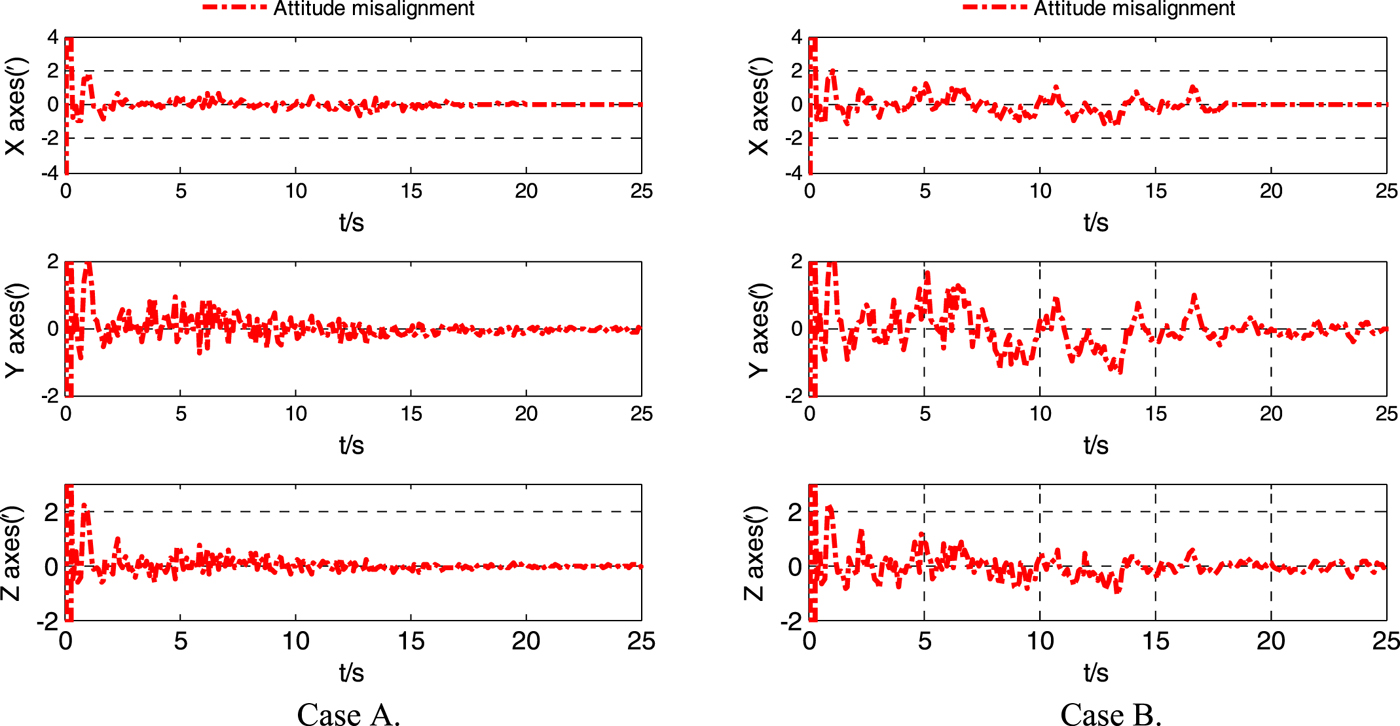
According to these system models for TA, two cases of different dynamic simulations over fixed SG-GHQF are illustrated in Figure 1, with statistical characteristics of the noise and an accurate system model. Sensor errors and misalignment angles are given as follows.
Attitude misalignment angles of simulation with correct statistical characteristics of noise and accurate system models.

Ring Laser Gyro (RLG) for Case A: The gyroscope drift repeatability error is  $0{\cdot}01^{\circ}/\hbox{h}$ and random walk error is
 $0{\cdot}001^{\circ} \sqrt{h}$. The accelerator bias repeatability error and random walk error are
 $1\times 10^{-4}\,\hbox{g}$ and
 $5\times 10^{-5}\,\hbox{g} \cdot \sqrt{s}$, respectively. Misalignment angles are assumed to be
 $50^{\circ}/20^{\circ}/20^{\circ}$.
Micro-Electromechanical System (MEMS) for Case B: The gyroscope repeatability drift is  $25^{\circ}/\hbox{h}$ and random drift is
 $3^{\circ}/\sqrt{h}$. The accelerator repeatability error and random walk error are
 $2\times 10^{-3}\,\hbox{g}$ and
 $2\times 10^{-3}\,\hbox{g} \sqrt{s}$, respectively. Misalignment angles are assumed to be
 $30^{\circ}/30^{\circ}/30^{\circ}$.
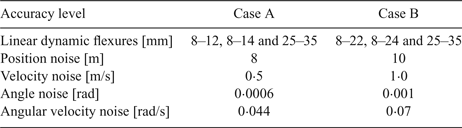
Figure 1 shows the results: simulated misalignment angles show convergent consistency. This method may be sufficient for vehicles provided with adequate performance margins. However, the complex interactions in an air-breathing missile between such issues as scramjet propulsion, high temperature structures, materials, and others become significant, especially when the aircraft is manoeuvring. The uncertain dynamic errors resulting from flexures and vibrations between the weapon INS and the aircraft INS are illustrated in Table 1 in two groups.
Dynamic flexure variation and 1σ Standard Deviation of the terms with vibration noise.

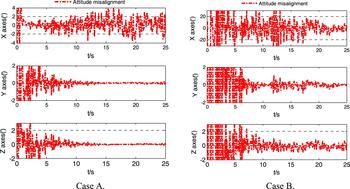
Figure 2 shows the results of attitude misalignment angles with incorrect statistical noise characteristics caused by uncertain flexures and vibrations, in which the model uncertainties introduced by flexures and vibrations are considered as incorrect statistical noise. The estimation performances of attitude misalignment angles deteriorate for a conventional filter, which require a tightly integrated design process to achieve the optimal performance necessary to meet space access mission objectives. The objective of this research was to develop a robust non-linear filter against modelling uncertainty due to flexures and vibrations.
Attitude misalignment angles of simulation with incorrect statistic characteristics noise.

3. THE NON-LINEAR R-SGQF
This problem arises when the uncertainties of the system are governed by non-linear functions and the observations are non-linear functions, as commonly occurs in HCV navigational systems. This section deals with the question of estimation in non-linear systems with uncertainties in the dynamic process and in the observations.
3.1. Notion and Problem Statement
Consider the following uncertain discrete-time non-linear system (Xiong et al., Reference Xiong, Liu, Liu, Kai and Liu2010)
 $${\bi x}_{{\bi k}}={\bi f}({\bi x}_{{\bi k}-1})+\Phi({\bi x}_{{\bi k}-1})\eta_{{\bi k}-1}+{\bi G}_{{\bi k}-1} {\bi w}_{{\bi k}-1}$$
 $${\bi z}_{{\bi k}}={\bi h}({\bi x}_{{\bi k}})+\Psi({\bi x}_{{\bi k}})\upsilon_k+{\bi v}_{{\bi k}}$$
where  ${\bi x}_{{\bi k}} \in \hbox{R}^{n}$ is the state at time k, and
 ${\bi z}_{{\bi k}} \in \hbox{R}^{m}$ is the measurement. The non-linear system dynamic and measurement models
 ${\bi f}({\bi x}_{{\bi k}})$ and
 ${\bi h}({\bi x}_{k})$ are assumed to be bounded derivatives.
 ${\bi G}_{k} \in \hbox{R}^{n\times p}$ is parameterised by the vector
 ${\bi w}_{k}$.
 ${\bi w}_{k} \in \hbox{R}^{p}$ and
 ${\bi v}_{k} \in \hbox{R}^{m}$ are uncorrelated white noises with zero means and known covariance matrices,
 $$E[w_kw^{{\bi T}}_j]=Q_k\delta_{kj}\quad E[v_{k}v^{{\bi T}}_j]=R_k\delta_{kj}$$
where  ${\bf \delta}_{kj}$ denotes the Kronecker delta function, which is equal to unity for k=j and zero elsewhere.
 $\Phi ({\bi x}_{k-1})\eta_{k-1}$ and
 $\Psi({\bi x}_{{\bi k}})\upsilon_{k}$ represent the model uncertainties, where
 $\Phi ({\bi x}_{k-1}) \in \hbox{R}^{n\times n}$ and
 $\Psi ({\bi x}_{k})\in \hbox{R}^{m\times m}$ are known time-varying matrix functions that satisfy
 $${\bi E}[\Phi({\bi x}_{k-1})\Phi^{{\bi T}}({\bi x}_{k-1})]\le \bar{\Phi}_k\bar{\Phi}_k^{{\bi T}}$$
 $${\bi E}[\Psi({\bi x}_{k})\Psi^{{\bi T}}({\bi x}_{{\bi k}})]\le \bar{\Psi}_{{\bi k}}\bar{\Psi}_{{\bi k}}^{{\bi T}}$$
It is reasonable to assume that the model uncertainties are bounded for a physical process with finite energy. The matrices  $\bar{\Phi}_{{\bi k}}$ and
 $\bar{\Psi}_{{\bi k}}$ can be obtained by analysis of the whole system. Considering TA,
 $\bar{\Phi}_{{\bi k}}$ and
 $\bar{\Psi}_{{\bi k}}$ can be estimated using the estimation information about the accuracy of the sensor and the misalignment angle value.
Those unknown vectors  $\eta_{k} \in \hbox{R}^{n}$ and
 $\upsilon_{k} \in \hbox{R}^{m}$ satisfy the following conditions:
 $$\eta_{{\bi k}}\eta_{{\bi k}}^{{\bi T}}\le {\bi q}_{{\bi k}}{\bi I}\quad \upsilon_{{\bi k}}\upsilon_{{\bi k}}^{{\bi T}}\le {\bi u}_{{\bi k}}{\bi I}$$
where q k and u k are scalars on the order of the precision of the INS sensor.  ${\bi I}$ is an identity matrix of appropriate size.
For the system above, we consider a generalised SGQ non-linear recursive formulation, as follows (Jia et al., Reference Jia, Xin and Cheng2012; Jia and Xin, Reference Jia and Xin2013; Chen et al., Reference Chen, Cheng, Dai and Han2014; Reference Chen, Cheng, Dai and Liu2015; Heiss and Winschel, Reference Heiss and Winschel2008).
 $$\eqalign{\hat{{\bi x}}_{{\bi k}\vert {\bi k}-1} & =\sum^{{\bi N}_{{\bi p}}}_{{\bi i}=1}\omega_{{\bi i}}\chi_{{\bi i,k\vert k}-1}=\sum^{{\bi N}_{{\bi p}}}_{{\bi i}=1}\omega_{{\bi i}}\, {\bi f}({\bi A}\xi_{{\bi i}} + \hat{{\bi x}}_{{\bi k}-1})\quad {\bi g} = 1,2,\ldots,({\bi NUM}{+}1/2) \cr &=\left. {\bi f}(\hat{{\bi x}}_{{\bi k}-1})+{1 \over 2!}\left[\sum^{{\bi n}}_{{\bi j}=1}\left({\bi a}_{1{\bi j}}{\partial \over \partial {\bi x}_1}+\cdots+{\bi a}_{{\bi nj}} {\partial \over \partial {\bi x}_{{\bi n}}}\right)^2\right]{\bi f}({\bi x})\right\vert _{{\bi x}=\hat{{\bi x}}_{{\bi k}-1}} \cr &\quad +\cdots+ {\Theta_{{\bi SGQ}} \over (2{\bi g})!} \left. \left[\sum^{{\bi n}}_{{\bi j}=1}\left({\bi a}_{1{\bi j}} {\partial \over \partial {\bi x}_1}+\cdots+{\bi a}_{{\bi nj}}{\partial \over \partial {\bi x}_{{\bi n}}}\right)^{2{\bi g}}\right]{\bi f}({\bi x}) \right\vert _{{\bi x}=\hat{{\bi x}}_{{\bi k}-1}}+\sum^{{\bi N}_{{\bi P}}}_{{\bi i}=1}\omega_{{\bi i}}\varsigma_{{\bi i}}}$$
 $$\eqalign{\hat{{\bi z}}_{{\bi k}\vert {\bi k}-1}&=\sum^{{\bi N}_{{\bi p}}}_{{\bi i}=1}\omega_{{\bi i}}{\bi h}(\tilde{\gamma}_{{\bi i}})=\sum^{{\bi N}_{{\bi p}}}_{{\bi i}=1}\omega_{{\bi i}} {\bi h}({\bi B}\xi_i+\hat{{\bi x}}_{{\bi k}\vert {\bi k}-1}) \cr &=\left.{\bi h}(\hat{{\bi x}}_{{\bi k}\vert {\bi k}-1})+ {1 \over 2!}\left[\sum^{{\bi n}}_{{\bi j}=1}\left({\bi b}_{1j} {\partial \over \partial {\bi x}_1}+\cdots+{\bi b}_{{\bi nj}} {\partial \over \partial {\bi x}_{{\bi n}}}\right)^2\right]{\bi h}({\bi x})\right\vert _{{\bi x}=\hat{{\bi x}}_{{\bi k}\vert {\bi k}-1}} \cr &\quad +\cdots+ {\Theta_{{\bi SGQ}} \over (2{\bi g})!} \left.\left[\sum^{{\bi n}}_{{\bi j}=1}\left({\bi b}_{1{\bi j}}{\partial \over \partial {\bi x}_1}+\cdots+{\bi b}_{{\bi nj}} {\partial \over \partial {\bi x}_{{\bi n}}}\right)^{2{\bi g}}\right]{\bi h}({\bi x})\right\vert _{{\bi x}=\hat{{\bi x}}_{{\bi k}\vert {\bi k}-1}}+\sum^{{\bi N}_{{\bi P}}}_{{\bi i}=1}\omega_{{\bi i}}\varsigma_{{\bi i}}}$$
 $$\hat{{\bi x}}_k =\hat{{\bi x}}_{k\vert {\bi k}-1}+{\bi K}_{{\bi k}}({\bi z}_{{\bi k}}-\hat{{\bi z}}_{k\vert {\bi k}-1})$$
where  $\hat{{\bi x}}_{k\vert {\bi k}-1}\in \hbox{R}^{n}$,
 $\hat{{\bi x}}_{{\bi k}}\in \hbox{R}^{n}$ and
 $\hat{{\bi z}}_{k\vert {\bi k}-1}\in \hbox{R}^{m}$ are the predictions of the state, a posteriori estimation of the state, and the measurement, respectively. Moreover,
 ${\bi N}_{p}$ is the total number of the quadrature points (ξi, ωi), which can be determined by numerical rules, such as the sparse-grid quadrature rule, the Gauss-Hermite Quadrature (GHQ) rule), the Moment Matching (MM) method, the Kronrod-Patterson (KP) rule (Jia et al., Reference Jia, Xin and Cheng2012), or the UT rule (Julier, Reference Julier2002). NUM is the algebraic accuracy of the sparse-grid quadrature point set. ζi represents the cross-terms of the different components of ξi (Chen et al., Reference Chen, Cheng, Dai and Han2014).
 ${\bi AA}^{{\bi T}}={\bi P}_{xx,k\vert k}\quad {\bi A}=[{\bi a}_{ij}]_{n\times n}, {\bi BB}^{{\bi T}}={\bi P}_{xx,k\vert k-1}$ and
 ${\bi B}=[{\bi b}_{ij}]_{n\times n}$ (
 $i,j=1,2,\ldots,n$).
 $\vartheta_{SGQ}=1\times 3\times \ldots \times (2g-1)$.
Here,  ${\bi K}_{{\bi k}}\in \hbox{R}^{n\times m}$ is a time varying Kalman gain matrix, to be determined; and the estimation error and its covariance matrix are defined as
 $$\tilde{{\bi x}}_{{\bi k}\vert {\bi k}}={\bi x}_{{\bi k}\vert {\bi k}}-\hat{{\bi x}}_{{\bi k}\vert {\bi k}}$$
 $${\bi P}_{{\bi xx,k\vert k}}=\hbox{E}[\tilde{{\bi x}}_{{\bi k}\vert {\bi k}}\tilde{{\bi x}}^{{\bi T}}_{{\bi k}\vert {\bi k}}]$$
First, being concerned with the design of a R-SGQF for uncertain system Equations (9)–(10) and the structure of the filter Equations (14)–(16), a sequence of positive definite matrices  $\Sigma_{{\bi k}\vert {\bi k}}$ (0≤k≤l) should be constructed that satisfy
 $${\bi P}_{{\bi xx,k\vert k}}\le \Sigma_{{\bi k}\vert {\bi k}}$$
The gain  ${\bi K}_{k}$ is designed by minimising the upper bound of the estimation error
 ${\bf \Sigma}_{{\bi k}\vert {\bi k}}$.
Second, we chose the matrix  ${\bf \Sigma}_{{\bi k}\vert {\bi k}}$ so as to satisfy the following inequality
 $${\sum^{{\bi n}}_{{\bi k}=0}\Vert {\bi x}_{{\bi k}}-\hat{{\bi x}}_k\Vert ^2_{\Sigma^{-1}_{{\bi k}\vert {\bi k}}} \over \Vert {\bi x}_0-\hat{{\bi x}}_0\Vert ^2_{\Sigma^{-1}_{0\vert 0}}+ \sum^{{\bi n}}_{{\bi k}=0}(\Vert \bar{{\bi w}}_k\Vert ^2_{\bar{{\bi Q}}_k^{-1}}+\Vert \bar{{\bi v}}_k\Vert ^2_{\bar{{\bi R}}_{{\bi k}}^{-1}})}\le {\rm \gamma}^2$$
where  $\bar{{\bi Q}}_{k}= {\hat{{\bi Q}}_{k} \over 2\,+\,4{\rm \gamma}^{2}}$,
 $\bar{{\bi R}}_{k}= {\hat{{\bi R}}_{k} \over 2\,+\,4{\rm \gamma}^{2}}$,
 $\bar{{\bi w}}_{k}=\Phi({\bi x}_{{\bi k}-1})\eta_{{\bi k}}+{\bi w}_{{\bi k}-1}$,
 $\bar{{\bi v}}_{{\bi k}}=\Psi({\bi x}_{{\bi k}}){\bf \mu}_{{\bi k}}+{\bi v}_{{\bi k}}$.
 $\hat{{\bi Q}}_{k}$ is the calculated system noise covariance matrix and
 $\hat{{\bi R}}_{{\bi k}}$ is the calculated measurement noise covariance matrix (Xiong et al., Reference Xiong, Zhang and Chan2006).
3.2. Error Covariance matrix and Solution
In this section, we derive the error covariance matrix  ${{\bi P}}_{{\bi xx,k\vert k}}$. First, we define the prediction error formulation and its covariance matrix as
 $$\tilde{{\bi x}}_{{\bi k}\vert {\bi k} -1}= {\bi x}_{{\bi k}} - \hat{{\bi x}}_{{\bi k}\vert {\bi k}-1}$$
 $${\bi P}_{{\bi xx}, {\bi k}\vert {\bi k}-1} = {\bi E}[\tilde{{\bi x}}_{{\bi k}\vert {\bi k}-1} \tilde{{\bi x}}^{{\bi T}}_{{\bi k}\vert {\bi k}-1}]$$
Substituting Equation (9) and Equation (14) into Equation (21)
 $$\eqalign{\tilde{{\bi x}}_{{\bi k}\vert {\bi k}-1} &= {\bi f}({\bi x}_{{\bi k}-1})+ \Phi ({\bi x}_{{\bi k}-1})\eta_{{\bi k}} + {\bi w}_{{\bi k}-1} - \sum_{{\bi i}=1}^{{\bi N}_{{\bi p}}} \omega_{{\bi i}}\, {\bi f}({\bi A}\xi_i + \hat{{\bi x}}_{{\bi k}-1}) \cr &= {\bi f}({\bi x}_{{\bi k}-1})+\Phi({\bi x}_{{\bi k}-1})\eta_{{\bi k}} + {\bi w}_{{\bi k}-1} - \left\{{\bi f}(\hat{{\bi x}}_{{\bi k}-1}) + {1 \over 2!}\left.\left[\sum_{{\bi j}=1}^{{\bi n}} \left({\bi a}_{1{\bi j}} {\partial \over \partial {\bi x}_1} +\cdots + {\bi a}_{{\bi nj}} {\partial \over \partial {\bi x}_{{\bi n}}}\right)^2\right]{\bi f}({\bi x})\right\vert _{{\bi x}={\hat{{\bi x}}_{{\bi k}-1}}}\right. \cr &\quad +\left.\cdots {\Theta_{{\bi SGQ}} \over (2{\bi g})!}\left[\sum_{{\bi j}=1}^{{\bi n}} \left({\bi a}_{1{\bi j}} {\partial \over \partial {\bi x}_1} + \cdots + {\bi a}_{{\bi nj}} {\partial \over \partial {\bi x}_n}\right)^{2{\bi g}}\right]{\bi f}({\bi x})\vert _{x=\hat{{\bi x}}_{{\bi k}-1}}\right\} \cr &= {\bi f}({\bi x}_{{\bi k}-1})+\Phi({\bi x}_{{\bi k}-1})\eta_{{\bi k}} + {\bi w}_{{\bi k}-1}-\left\{{\bi f}(\hat{{\bi x}}_{{\bi k}-1})+ {{\bi D}^2_{\tilde{{\bi x}}_{{\bi k}-1}}{\bi f} \over 2!} + {{\bi D}^4_{\tilde{{\bi x}}_{{\bi k}-1}}{\bi f} \over 4!} + \cdots {{\bi D}^{({\bi 2g})}_{\tilde{{\bi x}}_{{\bi k}-1}}{\bi f} \over (2{\bi g})!}\right\}\quad {\bi g} = 1,2,\ldots}$$
The quadrature point  ${\bi x}_{{\bi k}-1}$ used in the SGQF can be denoted as
 ${\bi x}_{{\bi k}-1} = \hat{{\bi x}}_{{\bi k}-1} - \tilde{{\bi x}}_{{\bi k}-1}$, expanding
 $f({\bi x}_{{\bi k}-1})$ at
 $\hat{{\bi x}}_{{\bi k}-1}$ (Chen et al., Reference Chen, Cheng, Dai and Liu2015). The Taylor series of
 $f({\bi x}_{{\bi k}-1})$ through non-linear transformation is then (Lewis, Reference Lewis1986)
 $${\bi f}({\bi x}_{{\bi k}-1}) = {\bi f}(\hat{{\bi x}}_{{\bi k}-1}) + {\bi D}_{\tilde{{\bi x}}_{{\bi k}-1}}\, {\bi f}+ {{\bi D}^2_{\tilde{{\bi x}}_{{\bi k}-1}}{\bi f} \over 2!} + {{\bi D}^3_{\tilde{{\bi x}}_{{\bi k}-1}}{\bi f} \over 3!} + \cdots$$
Substituting Equation (24) into Equation (23), we have (Simon, Reference Simon2006; Welch and Bishop, Reference Welch and Bishop2001)
 $$\tilde{{\bi x}}_{{\bi k}\vert {\bi k}-1} = {\bi F}_{{\bi k}} + {{\bi D}^3_{\tilde{{\bi x}}_{{\bi k}-1}}{\bi f} \over 3!} + {{\bi D}^5_{\tilde{{\bi x}}_{{\bi k}-1}}{\bi f} \over 5!}\cdots\, \cdots + {{\bi D}^{(2{\bi g}+1)}_{\tilde{{\bi x}}_{{\bi k}-1}}{\bi f} \over (2{\bi g}+1)!} + \cdots + \Phi ({\bi x}_{{\bi k}-1})\eta_{{\bi k}} + {\bi G}_{{\bi k}-1} {\bi w}_{{\bi k}-1}$$
where
 $$\eqalign{{\bi F}_{{\bi k}} &= {\partial \over \partial {\bi x}} {\bi f}({\bi x})\left\vert _{{\bi x}=\hat{{\bi x}}_{{\bi k}-1}} = \left. {\bi D}_{\tilde{{\bi x}}_{{\bi k}-1}} {\bi f} = \sum_{j=1}^n \left({\bi a}_{1j} {\partial \over \partial {\bi x}_1} + \cdots + {\bi a}_{{\bi nj}} {\partial \over \partial {\bi x}_n}\right)\right]{\bi f}({\bi x})\right\vert _{{\bi x}=\hat{{\bi x}}_{{\bi k}-1}} \cr {{\bi D}^{{\bi i}}_{\tilde{{\bi x}}_{{\bi k}-1}}{\bi f} \over {\bi i}!} &= {1 \over {\bi i}!}\left[\sum^n_{j=1}\left({\bi a}_{1{\bi j}} {\partial \over \partial {\bi x}_1}+\cdots +{\bi a}_{{\bi nj}} {\partial \over \partial {\bi x}_n}\right)^{{\bi i}}\right] {\bi f}({\bi x})\vert _{{\bi x}=\hat{{\bi x}}_{{\bi k}-1}} = \sum^{\infty}_{{\bi i}=1} {1 \over {\bi i}!}\sum^n_{j=1}\left(\tilde{{\bi x}}_{{\bi k}-1,{\bi j}} {\partial \over \partial {\bi x}}\right)^{{\bi i}} {\bi f}({\bi x})\vert _{{\bi x}=\hat{{\bi x}}_{{\bi k}-1}}}$$
To study the robust stability of the R-SGQF, it is necessary to choose a suitable strategy for the state estimation. Although this non-linear estimation problem is hard to solve in general, there are various practical approximation methods available, e.g., Reif and Unbehauen (Reference Reif and Unbehauen1999), Babacan et al. (Reference Babacan, Ozbek and Efe2008) and Huang et al. (Reference Huang, Patwardhan and Biegler2013). The most useful one is the proof of the stability of the EKF (Boutayeb et al., Reference Boutayeb, Rafaralahy and Darouach1997; Boutayeb and Aubry, Reference Boutayeb and Aubry1999) and Unscented Kalman Filter (UKF) (Xiong et al., Reference Xiong, Zhang and Chan2006; Li and Xia, Reference Li and Xia2013; Reference Li and Xia2015), which have achieved the broadest acceptance for practical application. Boutayeb et al. (Reference Boutayeb, Rafaralahy and Darouach1997), Boutayeb and Aubry (Reference Boutayeb and Aubry1999) and Xiong et al., (Reference Xiong, Zhang and Chan2006) have established local convergence of error dynamics by introducing auxiliary matrices to a version of non-linear filter. Motivated by these results, we used an unknown instrumental diagonal matrix  ${\bf \beta}_{k}= \hbox{diag} (\beta_{1,k}, \beta_{2,k}, \ldots, \beta_{n,k})$ to consider those residuals and let
 $\varphi({\bi x}_{{\bi k}-1},\hat{{\bi x}}_{{\bi k}-1})$ be the higher order terms. Then Equation (25) can be rearranged as
 $$\tilde{{\bi x}}_{{\bi k}\vert {\bi k}-1} = \beta_{{\bi k}}{\bi F}_{{\bi k}}\tilde{{\bi x}}_{{\bi k}-1} + \Phi({\bi x}_{{\bi k}-1})\eta_{{\bi k}} + \varphi({\bi x}_{{\bi k}-1},\hat{{\bi x}}_{{\bi k}-1})+{\bi G}_{{\bi k}-1}{\bi w}_{{\bi k}-1}$$
There are constants  $\delta_{\varphi}$,
 $\varepsilon_{\varphi} \in \hbox{R}\geq 0$, such that
 $\Vert {\bi x}_{{\bi k}} - \hat{{\bi x}}_{k-1\vert k-1}\Vert \leq \delta_{\varphi}$,
 $\Vert \varphi({\bi x}_{{\bi k}-1},\hat{{\bi x}}_{{\bi k}-1})\Vert \leq \varepsilon_{\varphi} \Vert {\bi x}_{{\bi k}} - \hat{{\bi x}}_{{\bi k}-1\vert {\bi k}-1}\Vert ^{2}$. Let
 $\utilde{{\bi w}}_{{\bi k}-1}$ be defined by the equation:
 $\utilde{{\bi w}}_{{\bi k}-1} =\varphi({\bi x}_{{\bi k}-1},\hat{{\bi x}}_{{\bi k}-1}) + {\bi G}_{{\bi k}-1}{\bi w}_{{\bi k}-1}$.
Remark 1
The predicted means in the EKF are only up to third order accuracy with its true mean, and the UKF up to the fifth order accuracy. The SGQF can achieve higher accuracy than the UKF. It is noted that the higher accuracy level introduced by the SGQF makes the error negligible and βk satisfies the following condition:  $-1 \le \beta_{k}\le 1$ (Huang et al., Reference Huang, Patwardhan and Biegler2013). Substituting Equation (26) into Equation (22), we have the covariance matrix
 $$\eqalign{{\bi P}_{{\bi xx,k}\vert {\bi k}-1} &= {\bi E}\{[\beta_{{\bi k}} {\bi F}_{{\bi k}} \tilde{{\bi x}}_{{\bi k}-1} + \Phi({\bi x}_{{\bi k}-1})\eta_{{\bi k}} + \utilde{{\bi w}}_{{\bi k}-1}][\beta_k {\bi F}_k\tilde{{\bi x}}_{{\bi k}-1}+ \Phi({\bi x}_{{\bi k}-1})\eta_{{\bi k}}+ \utilde{{\bi w}}_{{\bi k}-1}]^{{\bi T}}\} \cr &= {\bi E}\{(\beta_{{\bi k}} {\bi F}_{{\bi k}}\tilde{{\bi x}}_{{\bi k}-1})(\beta_{{\bi k}} {\bi F}_{{\bi k}}\tilde{{\bi x}}_{{\bi k}-1})^{{\bi T}}\} + {\bi E}\{(\Phi({\bi x}_{{\bi k}-1})\eta_{{\bi k}})(\Phi({\bi x}_{{\bi k}-1})\eta_{{\bi k}})^{{\bi T}}\} \cr &\quad + {\bi E}\{\utilde{{\bi w}}_{{\bi k}-1}\utilde{{\bi w}}^{{\bi T}}_{{\bi k}-1}\}+ {\bi E}\{(\beta_{{\bi k}} {\bi F}_{{\bi k}}\tilde{{\bi x}}_{{\bi k}-1})(\Phi({\bi x}_{{\bi k}-1})\eta_{{\bi k}})^{{\bi T}}\} + {\bi E}\{(\Phi({\bi x}_{{\bi k}-1})\eta_{{\bi k}})(\beta_{{\bi k}} {\bi F}_{{\bi k}}\tilde{{\bi x}}_{{\bi k}-1})^{{\bi T}}\} \cr &\quad + {\bi E}\{(\beta_{{\bi k}}{\bi F}_{{\bi k}}\tilde{{\bi x}}_{{\bi k}-1})\utilde{{\bi w}}^{{\bi T}}_{{\bi k}-1}\} + {\bi E}\{\utilde{{\bi w}}_{{\bi k}-1}(\beta_{{\bi k}} {\bi F}_{{\bi k}} \tilde{{\bi x}}_{{\bi k}-1})^{{\bi T}}\} + {\bi E}\{(\Phi({\bi x}_{{\bi k}-1})\eta_{{\bi k}})\utilde{{\bi w}}^{{\bi T}}_{{\bi k}-1}\} \cr &\quad + {\bi E}\{(\utilde{{\bi w}}_{{\bi k}-1})(\Phi({\bi x}_{{\bi k}-1})\eta_{{\bi k}})^{{\bi T}}\}}$$
We define
 $$\tilde{z}_{{\bi k}\vert {\bi k}-1} = {\bi z}_{{\bi k}} - \hat{{\bi z}}_{{\bi k}\vert {\bi k}-1}$$
Substituting Equation (10) and Equation (15) into Equation (28), we have (Simon, Reference Simon2006; Welch and Bishop, Reference Welch and Bishop2001)
 $$\eqalign{\tilde{{\bi z}}_{{\bi k}\vert {\bi k}-1}&={\bi h}({\bi x}_{{\bi k}}) + \Psi ({\bi x}_{{\bi k}})\upsilon_k + \nu_k \cr &\quad - \left\{{\bi h}(\hat{{\bi x}}_{{\bi k}\vert {\bi k}-1}) + {1 \over 2!}\left.\left[\sum^{{\bi n}}_{{\bi j}=1}\left({\bi a}_{1{\bi j}} {\partial \over \partial {\bi x}_1}+\cdots + {\bi a}_{{\bi nj}} {\partial \over \partial {\bi x}_{{\bi n}}}\right)^2\right]{\bi h}({\bi x})\right\vert _{{\bi x}-\hat{{\bi x}}_{{\bi k}\vert {\bi k}-1}}\right. \cr &\quad \left. +\cdots + {\Theta_{{\bi SGQ}} \over (2{\bi g})!}\left.\left[\sum^{{\bi n}}_{{\bi j}=1}\left({\bi a}_{1{\bi j}} {\partial \over \partial {\bi x}_1}+\cdots + {\bi a}_{{\bi nj}} {\partial \over \partial {\bi x}_{{\bi n}}}\right)^{2{\bi g}}\right]{\bi h}({\bi x})\right\vert _{{\bi x}=\hat{{\bi x}}_{{\bi k}\vert {\bi k}-1}}\right\}}$$
We expand  ${\bi h}({\bi x}_{{\bi k}})$ in a Taylor series about
 $\hat{{\bi x}}_{{\bi k}\vert {\bi k}-1}$. The Taylor series of
 ${\bi h}({\bi x}_{{\bi k}})$ through non-linear transformation is then (Lewis, Reference Lewis1986; Julier, Reference Julier2002)
 $${\bi h}({\bi x}_{{\bi k}})={\bi h}(\hat{{\bi x}}_{{\bi k}\vert {\bi k}-1}) + {\bi D}_{\tilde{{\bi x}}_{{\bi k}\vert {\bi k}-1}}{\bi h} + {{\bi D}^2_{\tilde{{\bi x}}_{{\bi k}\vert {\bi k}-1}}{\bi h} \over 2!} + {{\bi D}^3_{\tilde{{\bi x}}_{{\bi k}\vert {\bi k}-1}}{\bi h} \over 3!}+\cdots$$
Substituting Equation (30) into Equation (29), we have
 $$\tilde{{\bi z}}_{{\bi k}\vert {\bi k}-1}={\bi H}_{{\bi k}}\tilde{{\bi x}}_{{\bi k}\vert {\bi k}-1}+ {{\bi D}^{3}_{\tilde{{\bi x}}_{{\bi k}\vert {\bi k}-1}}{\bi h} \over 3!}+ {{\bi D}^{5}_{\tilde{{\bi x}}_{{\bi k}\vert {\bi k}-1}}{\bi h} \over 5!} \cdots\ \cdots + {{\bi D}^{(2{\bi g}+1)}_{\tilde{{\bi x}}_{{\bi k}\vert {\bi k}-1}}{\bi h} \over (2{\bi g}+1)!}+\cdots+\Psi({\bi x}_{{\bi k}})\upsilon_{{\bi k}}+{\bi v}_{{\bi k}}$$
where
 $$\eqalign{{{\bi D}^{{\bi i}}_{\tilde{{\bi x}}_{{\bi k}\vert {\bi k}-1}}{\bi h} \over {\bi i}!} &= {1 \over {\bi i}!}\left[\sum^{{\bi n}}_{{\bi j}=1}\left({\bi a}_{1{\bi j}} {\partial \over \partial {\bi x}_1}+\cdots + {\bi a}_{{\bi nj}} {\partial \over \partial {\bi x}_{{\bi n}}}\right)^{{\bi i}}\right]{\bi h}({\bi x})\vert _{{\bi x}=\hat{{\bi x}}_{{\bi k}\vert {\bi k}-1}} \cr &= \sum^{\infty}_{{\bi i}=1} {1 \over {\bi i}!}\sum^{{\bi n}}_{{\bi j}=1}\left(\tilde{{\bi x}}_{{\bi k}\vert {\bi k}-1,{\bi j}} {\partial \over \partial {\bi x}}\right)^{{\bi i}} {\bi h}({\bi x})\vert _{{\bi x}=\hat{{\bi x}}_{{\bi k}\vert {\bi k}-1}}}$$
A diagonal matrix  $\alpha_{k}=\hbox{diag} (\alpha_{1,k},\ \alpha_{2,k},\ \ldots,\ \alpha_{n,k})$ is adopted to take those residuals into account and achieve an accurate equation. Let
 $\vartheta({\bi x}_{{\bi k}},\hat{{\bi x}}_{{\bi k}\vert {\bi k}-1})$ be the higher order terms. Equation (31) can be rearranged
 $$\tilde{{\bi z}}_{{\bi k}\vert {\bi k}-1}=\alpha_{{\bi k}}{\bi H}_{{\bi k}}\tilde{{\bi x}}_{{\bi k}\vert {\bi k}-1}+\Psi({\bi x}_{{\bi k}})\upsilon_{{\bi k}}+\vartheta({\bi x}_{{\bi k}},\hat{{\bi x}}_{{\bi k}\vert {\bi k}-1})+{\bi v}_{{\bi k}}$$
There are constants  $\delta_{\vartheta},\varepsilon_{\vartheta} \in \hbox{R}\geq 0$, such that
 $\vert {\bi x}_{{\bi k}}-\hat{{\bi x}}_{{\bi k}\vert {\bi k}-1}\vert \leq \delta_{\vartheta}, \vert \vartheta({\bi x}_{{\bi k}}, \hat{x}_{{\bi k}\vert {\bi k}-1})\vert \leq \varepsilon_{\vartheta}\vert {\bi x}_{{\bi k}} - \hat{{\bi x}}_{{\bi k}\vert {\bi k}-1}\vert ^{2}$.
Let  $\utilde{{\bi v}}_{{\bi k}}$ be defined by the equation:
 $\utilde{{\bi v}}_{{\bi k}} = \vartheta({\bi x}_{{\bi k}},\hat{{\bi x}}_{{\bi k}\vert {\bi k}-1})+{\bi v}_{{\bi k}}$. Note that αk has the same characteristics as βk.
Using Equations (16), (17), (27), and (32), the estimation error is represented as
 $$\tilde{{\bi x}}_{{\bi k}}=(I-{\bi K}_{{\bi k}} \alpha_{{\bi k}}{\bi H}_{{\bi k}})\tilde{{\bi x}}_{{\bi k}\vert {\bi k}-1}-{\bi K}_{{\bi k}}(\Psi({\bi x}_{{\bi k}})\upsilon_{{\bi k}}+ \utilde{{\bi v}}_{{\bi k}})$$
Substituting Equation (33) into Equation (18), the covariance matrix  ${\bi P}_{{\bi xx,k\vert k}}$ can be obtained
 $$\eqalign{{\bi P}_{{\bi xx,k\vert k}}&={\bi E}\{[({\bi I}-{\bi K}_{{\bi k}}\alpha_{{\bi k}}{\bi H}_{{\bi k}})\tilde{{\bi x}}_{{\bi k}\vert {\bi k}-1}-{\bi K}_{{\bi k}}(\Psi({\bi x}_{{\bi k}})\upsilon_{{\bi k}}+\utilde{{\bi v}}_{{\bi k}})] \cr &\quad [({\bi I}-{\bi K}_{{\bi k}}\alpha_{{\bi k}}{\bi H}_{{\bi k}})\tilde{{\bi x}}_{{\bi k}\vert {\bi k}-1}-{\bi K}_{{\bi k}}(\Psi({\bi x}_{{\bi k}})\upsilon_{{\bi k}}+ \utilde{{\bi v}}_{{\bi k}})]^{{\bi T}}\} \cr &={\bi E}\{(({\bi I}-{\bi K}_{{\bi k}}\alpha_{{\bi k}}{\bi H}_{{\bi k}})\tilde{{\bi x}}_{{\bi k}\vert {\bi k}-1})(({\bi I}-{\bi K}_{{\bi k}}\alpha_{{\bi k}}{\bi H}_{{\bi k}})\tilde{{\bi x}}_{{\bi k}\vert {\bi k}-1})^{{\bi T}}\} \cr &\quad +{\bi E}\{({\bi K}_{{\bi k}}\Psi({\bi x}_{{\bi k}})\upsilon_{{\bi k}})({\bi K}_{{\bi k}}\Psi({\bi x}_{{\bi k}})\upsilon_{{\bi k}})^{{\bi T}}\}+{\bi E}\{({\bi K}_{{\bi k}} \utilde{{\bi v}}_{{\bi k}})({\bi K}_{{\bi k}}\utilde{{\bi v}}_{{\bi k}})^{{\bi T}}\} \cr &\quad -{\bi E}\{(({\bi I}-{\bi K}_{{\bi k}}\alpha_{{\bi k}}{\bi H}_{{\bi k}})\tilde{{\bi x}}_{{\bi k}\vert {\bi k}-1})({\bi K}_{{\bi k}}\Psi({\bi x}_{{\bi k}})\upsilon_{{\bi k}})^{{\bi T}}\}-{\bi E}\{({\bi K}_{{\bi k}}\Psi({\bi x}_{{\bi k}})\upsilon_{{\bi k}})(({\bi I}-{\bi K}_{{\bi k}}\alpha_{{\bi k}}{\bi H}_{{\bi k}})\tilde{{\bi x}}_{{\bi k}\vert {\bi k}-1})^{{\bi T}}\} \cr &\quad -{\bi E}\{(({\bi I}-{\bi K}_{{\bi k}}\alpha_{{\bi k}}{\bi H}_{{\bi k}})\tilde{{\bi x}}_{{\bi k}\vert {\bi k}-1})({\bi K}_{{\bi k}}\utilde{{\bi v}}_{{\bi k}})^{{\bi T}}\}-{\bi E}\{({\bi K}_{{\bi k}}\utilde{{\bi v}}_{{\bi k}})(({\bi I}-{\bi K}_{{\bi k}}\alpha_{{\bi k}}{\bi H}_{{\bi k}})\tilde{{\bi x}}_{{\bi k}\vert {\bi k}-1})^{{\bi T}}\} \cr &\quad +{\bi E}\{({\bi K}_{{\bi k}}(\Psi({\bi x}_{{\bi k}})\upsilon_{{\bi k}})({\bi K}_{{\bi k}}\utilde{{\bi v}}_{{\bi k}})^{{\bi T}}\} +{\bi E}\{({\bi K}_{{\bi k}}\utilde{{\bi v}}_{{\bi k}})({\bi K}_{{\bi k}}(\Psi({\bi x}_{{\bi k}})\upsilon_{{\bi k}})^{{\bi T}}\}}$$
There exists the uncertainty  ${\bi v}_{k}$ in Equation (33); thus, we are unable to provide a definite value of the covariance matrix
 ${\bi P}_{xx,k\vert k}$. The aim is to find an upper bound for
 $\Sigma_{{\bi k}\vert {\bi k}}$ and then obtain the filter parameter, K k.
3.3. R-SGQF design
The next presented theorem is a sufficient condition that exists for R-SGQF with an optimised upper bound of error variance.
Theorem 1
Let conditions Equations (11)–(13) hold for the uncertain system Equations (9)–(10). Let  $\gamma \gt 1 \varepsilon \gt 0$; there exist the Lyapunov and Riccati matrix Equations (35) and (36), and gain matrix Equation (37) that minimise the bound on the error variance in Equation (34):
 $$\eqalign{\Sigma_{{\bi k}\vert {\bi k}-1}&=(1+2\varepsilon)(1-\gamma^{-2})^{-1}\sum_{{\bi i}=1}^{{\bi N}_{{\bi p}}}\omega_{i}(\chi_{{\bi i,k\vert k}-1}-\hat{{\bi x}}_{{\bi k}\vert {\bi k}-1})(\chi_{{\bi i,k\vert k}-1}-\hat{{\bi x}}_{{\bi k}\vert {\bi k}-1})^{{\bi T}} \cr &\quad +(2+\varepsilon^{-1}){\bi q}_{{\bi k}}\bar{\Phi}_{{\bi k}}\bar{\Phi}_{{\bi k}}^{{\bi T}}+(2+\varepsilon^{-1}){\bi G}_{{\bi k}-1}\hat{{\bi Q}}_{{\bi k}-1}{\bi G}_{{\bi k}-1}^{{\bi T}}}$$
 $$\eqalign{\Sigma_{{\bi k}\vert {\bi k}}&=(1+2\varepsilon)(1-\gamma^{-2})^{-1}\left\{\Sigma_{{\bi k}\vert {\bi k}-1}-{\bi K}_{{\bi k}}\left[\sum_{{\bi i}=1}^{{\bi Np}}\omega_{{\bi i}}({\bi h}(\tilde{\gamma}_{{\bi i}})-\hat{{\bi z}}_{{\bi k}\vert {\bi k}-1})({\bi h}(\tilde{\gamma}_{{\bi i}})-\hat{{\bi z}}_{{\bi k}\vert {\bi k}-1})^{{\bi T}}\right]{\bi K}_{{\bi k}}^{{\bi T}}\right\} \cr &\quad +{\bi K}_{{\bi k}}[(2+\varepsilon^{-1}){\bi u}_{{\bi k}}\bar{\Psi}_{{\bi k}}\bar{\Psi}_{{\bi k}}^{{\bi T}}+(2+\varepsilon^{-1})\hat{{\bi R}}_{{\bi k}}]{\bi K}_{{\bi k}}^{{\bi T}}}$$
 $$\eqalign{{\bi K}_{{\bi k}}&=(1+2\varepsilon)(1-\gamma^{-2})^{-1}\sum_{{\bi i}=1}^{{\bi N}_{{\bi p}}}\omega_{{\bi i}}(\tilde{\gamma}_{{\bi i}}-\hat{{\bi x}}_{{\bi k}\vert {\bi k}-1})({\bi h}(\tilde{\gamma}_{{\bi i}})-\hat{{\bi z}}_{{\bi k}\vert {\bi k}-1})^{{\bi T}}\left\{(1+2 \varepsilon)(1-\gamma^{-2})^{-1} {\sum_{{\bi i}=1}^{{\bi N}_{{\bi p}}}}\right. \cr &\quad \times \sum_{{\bi i}=1}^{{\bi N}_{{\bi p}}}\omega_{{\bi i}}({\bi h}(\tilde{\gamma}_{{\bi i}})-\hat{{\bi z}}_{{\bi k}\vert {\bi k}-1})({\bi h}(\tilde{\gamma}_{{\bi i}})-\hat{{\bi z}}_{{\bi k}\vert {\bi k}-1})^{{\bi T}}}$$
with the initial value  $\Sigma_{{\bf 0\vert 0}}={\bi P}_{{\bi xx},{\bf 0\vert 0}}>0,\ {\bi P}_{{\bi xx,k\vert k}}$ has a positive-definite solution for 0≤k≤l.
Then the matrix  $\Sigma_{{\bi k}\vert {\bi k}}$ is the upper bound for
 ${\bi P}_{{\bi xx,k\vert k}}$, that is,
 $${\bi P}_{{\bi xx,k\vert k}}\leq\Sigma_{{\bi k}\vert {\bi k}},\quad \forall 0\leq {\bi k}\leq {\bi l}$$
The recursive equations of the nonlinear Gaussian approximation filtering can be written as follows.
Initialisation sampling
 $$\gamma_{{\bi i,k}-1}={\bi A}\xi_{i}+\hat{{\bi x}}_{{\bi k}-1};\quad {\bi AA}^{{\bi T}}={\bf \Sigma}_{{\bi k}-1\vert {\bi k}-1}\quad {\bi i}=1,2,\cdots,{\bi N}_{{\bi p}}$$
Time update
 $$\chi_{{\bi i,k\vert k}-1} ={\bi f}(\gamma_{{\bi i,k}-1})$$
 $$\hat{{\bi x}}_{{\bi k}\vert {\bi k}-1} =\sum_{{\bi i}=1}^{{\bi N}_{{\bi p}}}\omega_{{\bi i}}\chi_{{\bi i,k}\vert {\bi k}-1}$$
 $$\Sigma_{{\bi k}\vert {\bi k}-1} =\sum_{{\bi i}=1}^{{\bi N}_{{\bi p}}}\omega_{{\bi i}}(\chi_{{\bi i,k\vert k}-1}-\hat{{\bi x}}_{{\bi k}\vert {\bi k}-1})(\chi_{{\bi i,k\vert k}-1}-\hat{{\bi x}}_{{\bi k}\vert {\bi k}-1})^{{\bi T}}+\hat{{\bi Q}}_{{\bi k}-1}^{\ast}$$
where
 $$\eqalign{\hat{{\bi Q}}_{{\bi k}-1}^{\ast} & =[(1+2\varepsilon)(1-\gamma^{-2})^{-1}-1]\sum_{{\bi i}=1}^{{\bi N}_{{\bi p}}}\omega_{{\bi i}} (\chi_{{\bi i,k\vert k}-1} - \hat{{\bi x}}_{{\bi k}\vert {\bi k}-1})(\chi_{{\bi i,k\vert k}-1}-\hat{{\bi x}}_{{\bi k}\vert {\bi k}-1})^{{\bi T}} \cr &\quad + (2+\varepsilon^{-1}){\bi q}_{{\bi k}}\bar{\Phi}_{{\bi k}}\bar{\Phi}_{{\bi k}}^{{\bi T}} + (2+\varepsilon^{-1}){\bi G}_{{\bi k}-1}\hat{{\bi Q}}_{{\bi k}-1}{\bi G}^{{\bi T}}_{{\bi k}-1}}$$
Resampling
 $$\tilde{\gamma}_{{\bi i}}={\bi S}\xi_{{\bi i}}+\hat{{\bi x}}_{{\bi k}\vert {\bi k}-1};\quad {\bi SS}^{{\bi T}}={\bf \Sigma}_{{\bi k}\vert {\bi k}-1}$$
Measurement update
 $$\hat{{\bi z}}_{{\bi k/k}-1}=\sum_{{\bi i}=1}^{{\bi N}_{{\bi p}}}\omega_{{\bi i}}{\bi h}(\tilde{\gamma}_{{\bi i}})$$
 $${\bf \Sigma}_{{\bi zz,k\vert k}-1}=\sum_{{\bi i}=1}^{{\bi N}_{{\bi p}}}\omega_{{\bi i}}({\bi h}(\tilde{\gamma}_{{\bi i}})-\hat{{\bi z}}_{{\bi k}\vert {\bi k}-1})({\bi h}(\tilde{\gamma}_{{\bi i}})-\hat{{\bi z}}_{{\bi k}\vert {\bi k}-1})^{\bi T}$$
 $$\hat{{\bi R}}_{{\bi k}}^{\ast}=(2+\varepsilon^{-1}){\bi u}_{{\bi k}}\bar{\Psi}_{{\bi k}}\bar{\Psi}_{{\bi k}}^{{\bi T}}+(2+\varepsilon^{-1})\hat{{\bi R}}_{{\bi k}}$$
 $$\Sigma_{{\bi xz,k}\vert {\bi k}-1}=\sum_{{\bi i}=1}^{{\bi N}_{{\bi p}}}\omega_{{\bi i}}(\tilde{\gamma}_{{\bi i}}-\hat{{\bi x}}_{{\bi k}\vert {\bi k}-1})({\bi h}(\tilde{\gamma}_{{\bi i}})-\hat{{\bi z}}_{{\bi k}\vert {\bi k}-1})^{\bi T}$$
 $${\bi K}_{{\bi k}}=(1+2\varepsilon)(1-\gamma^{-2})^{-1}\Sigma_{{\bi xz,k\vert k}-1}[(1+2\varepsilon)(1-\gamma^{-2})^{-1}\Sigma_{{\bi zz,k\vert k}-1}+\hat{{\bi R}}_{{\bi k}}^{\ast}]^{-1}$$
 $$\hat{{\bi x}}_{{\bi k}\vert {\bi k}}=\hat{{\bi x}}_{{\bi k}\vert {\bi k}-1}+{\bi K}_{{\bi k}}(z_{{\bi k}}-\hat{{\bi z}}_{{\bi k}\vert {\bi k}-1})$$
 $$\Sigma_{{\bi k}\vert {\bi k}}=(1+2_{\varepsilon})(1-\gamma^{-2})^{-1}[\Sigma_{{\bi k}\vert {\bi k}-1}-{\bi K}_{{\bi k}}\Sigma_{{\bi zz,k\vert k}-1}{\bi K}_{{\bi k}}^{{\bi T}}]+{\bi K}_{{\bi k}}\hat{{\bi R}}_{{\bi k}}^{\ast}{\bi K}_{{\bi k}}^{{\bi T}}$$
4. STABILITY ANALYSIS OF R-SGQF
The estimation error resulting from the proposed R-SGQF will be investigated based on the Lemma and assumptions as (Agniel and Jury, Reference Agniel and Jury1971; Reif et al., Reference Reif, Günther, Yaz and Unbehauen1999).
Lemma 1
Assume that  $\lbar_{{\bi k}}$ is a stochastic process, and that there is a stochastic process
 ${\bi V}(\lbar_{{\bi k}})$ as well as real numbers
 ${\bi v}_{\min},\ {\bi v}_{\max} \gt 0,\ \hbar \gt 0$ and
 $0 \lt \lambda \leq 1$ such that ∀ k,
 $$\matrix{{\bi v}_{\min}\Vert \lbar_{{\bi k}}\Vert^2 \leq {\bi V}(\lbar_k)\leq {\bi v}_{\max}\Vert \lbar_{{\bi k}}\Vert^2 \cr {\bi E}\lsqb {\bi V}(\lbar_{{\bi k}})\vert \lbar_{{\bi k}-1}\rsqb -{\bi V}(\lbar_{{\bi k}-1})\leq \hbar - \lambda {\bi V}(\lbar_{{\bi k}-1})}$$
are fulfilled. Then, the stochastic process is bounded in a mean square, that is,
 $${\bi E} \vert \lbar_{{\bi k}}\vert^{2} \leq {{\bi v}_{\max} \over {\bi v}_{\min}}{\bi E}\{\vert \lbar_{0}\vert ^{2}\}(1-\lambda)^{{\bi k}}+ {\hbar \over {\bi v}_{{\min}}}\sum_{{\bi i}=1}^{{\bi k}-1}(1-\lambda)^{{\bi i}}$$
We define
 $$\bar{{\bi F}}_{{\bi k}} = \beta_{{\bi k}}F_{{\bi k}}\quad \bar{{\bi H}}_{{\bi k}}=\alpha_{{\rm k}}{\bi H}_{{\bi k}}$$
 $$\bar{{\bi W}}_{{\bi k}} =\Phi({\bi x}_{{\bi k}-1})\eta_{{\bi k}}+\utilde{{\bi w}}_{{\bi k}}\quad \bar{{\bi V}}_{{\bi k}}=\Psi({\bi x}_{{\bi k}})\upsilon_{{\bi k}}+ \utilde{{\bi v}}_{{\bi k}}$$
Substituting Equations (26), (54), and (55) into Equation (33), it can be rearranged as:
 $$\tilde{{\bi x}}_{{\bi k}}=({\bi I}-{\bi K}_{{\bi k}}\bar{{\bi H}}_{{\bi k}})\bar{{\bi F}}_{{\bi k}}\tilde{{\bi x}}_{{\bi k}-1}+({\bi I}-{\bi K}_{{\bi k}}\bar{{\bi H}}_{{\bi k}})\bar{{\bi W}}_{{\bi k}}-{\bi K}_{{\bi k}}\bar{v}_{{\bi k}}$$
Assumption 1
There are non-zero positive real numbers  ${\bf \varepsilon}_{max}$,
 $\hat{{\bi q}}_{min}$,
 $\hat{{\bi q}}_{max}$,
 ${\bi q}_{max}$,
 ${\bi r}_{min}$,
 $\hat{{\bi r}}_{min}$,
 $\hat{{\bi r}}_{max}$,
 $\hat{{\bi g}}_{min}$,
 $\hat{{\bi g}}_{max}$,
 ${\bf \varphi}_{max}$, and
 ${\bf \psi}_{max}$, and the following inequalities are fulfilled for every k≥0
 $$\matrix{{\bf \varepsilon}_{\min}{\bi I}\leq\Sigma_{{\bi k}\vert {\bi k}}\leq\varepsilon_{\max}{\bi I}, &\hat{{\bi q}}_{\min}{\bi I}\leq\hat{{\bi Q}}_{{\bi k}} \leq\hat{{\bi q}}_{\max}{\bi I}, &\hat{{\bi r}}_{\min}{\bi I}\leq\hat{{\bi R}}_{{\bi k}}\leq\hat{{\bi r}}_{\max}{\bi I} \cr {\bi g}_{\min}\leq\vert {\bi G}_{{\bi k}}\vert \leq {\bi g}_{\max}, &{\bi q}_{{\bi k}}\bar{\Phi}_{{\bi k}}\bar{\Phi}_{{\bi k}}^{{\bi T}}\leq{\bf \varphi}_{\max}{\bi I}, &{\bi u}_{{\bi k}}\bar{\Psi}_{{\bi k}}\bar{\Psi}_{{\bi k}}^{{\bi T}}\leq{\bf \psi}_{\max}{\bi I} \cr {\bi Q}_{{\bi k}}\leq {\bi q}_{\max}{\bi I}, &{\bi r}_{\min}\leq {\bi R}_{{\bi k}}{\bi I}}$$
Then there are real numbers  $0\lt \lambda \leq 1$ and ℏ>0, such that
 $${\bi E}\{\vert \tilde{{\bi x}}_{{\bi k}}\vert \}\leq {\varepsilon_{\max} \over \varepsilon_{\min}}{\bi E}\{\vert \tilde{{\bi x}}_{0}\vert ^{2}\} (1-\lambda)^{{\bi k}}+ {{\hbar} \over \varepsilon_{\min}}\sum_{{\bi i}=1}^{k-1}(1-\lambda)^{{\bi i}}$$
Assumption 2
There exist two terms
 $$\det({\bi I}-{\bi K}_{{\bi k}}\bar{{\bi H}}_{{\bi k}})\neq\, 0\quad \det(\bar{{\bi F}}_{{\bi k}})\neq\, 0$$
Theorem 2
Consider the non-linear stochastic system described by Equations (9)–(10) and R-SGQF given by Equations (39)–(51). Under Assumptions 1 and 2, the sufficient conditions to ensure stability of proposed R-SGQF are demonstrated.
 $$\left(1+ {1 \over 2}{\rm \gamma}^{-2}\right)(1-{\rm \gamma}^{-2})\leq(1+2\varepsilon)$$
Due to space constraints, no proof is detailed. It can be proved according to Xiong et al. (Reference Xiong, Liu, Liu, Kai and Liu2010) using Lemma 1 and Assumptions 1 and 2.
Theorem 3
Consider the nonlinear stochastic system described by Equations (9)–(10) and R-SGQF given by Equations (39)–(51). Under the assumption  $\gamma>1,\ \varepsilon \gt 0$, we chose the matrix
 $\Sigma_{{\bi k}\vert {\bi k}}$ the terms in Equation (51) to satisfy the relation in Equation (20).
For proof of this theorem, see Appendix.
5. ANALYSIS OF R-SGQF
5.1. System model
The procedure is evaluated for the attitude and velocity match method, which is applied through the R-SGQF. The dynamic uncertainty model of the TA is written in the form of Equation (9), where the second term on the right-hand side represents the dynamic model uncertainty.  $\Phi({\bi x}_{{\bi k}-1})\eta_{{\bi k}-1}$ is set to
 $$\eqalign{\Phi({\bi x}_{{\bi k}-1})_{24\times 24}=\left\{\matrix{ \Phi(\phi^{{\bi i}})_{3\times 2} & {\bf 0} \cr \Phi(\nabla_{{\bi a}})_{3\times 2} & {\bf 0} \cr {\bf 0} & {\bf 0}}\right\},\ \Phi(\phi^{{\bi i}})_{3\times 2}=\left\{\matrix{ \phi_{{\bi z}}^{{\bi i}} & -\phi_{{\bi y}}^{{\bi i}} \cr -\phi_{{\bi z}}^{{\bi i}} & \phi_{{\bi x}}^{{\bi i}} \cr \phi_{{\bi y}} & -\phi_{{\bi x}}}\right\}, \cr \Phi(\nabla_{{\bi a}})_{3\times 2}=\left\{\matrix{ \nabla_{{\bi az}} & -\nabla_{{\bi ay}} \cr -\nabla_{{\bi az}} & \nabla_{{\bi ax}} \cr \nabla_{{\bi ay}} & -\nabla_{{\bi ax}}}\right\} }$$
and  $\eta_{{\bi k}-1}\in {\bi R}^{24\times 1}$ is independent zero-mean Gaussian white noise that satisfies
 ${\bi E}[\eta_{{\bi k}}\eta_{{\bi k}}^{{\bi T}}]\leq {\bi q}_{{\bi k}}{\bi I}$.
The bounds of the state model parameter uncertainties in the R-SGQF should be determined by the performance of the INS sensors, where  $\eta_{{\bi k}} = [\eta_{{\bi g}}\ \eta_{{\bi a}}\ {0}]^{{\bi T}}\in \hbox{R}^{24},\eta_{{\bi g}}\in \hbox{R}^{3},\eta_{{\bi a}}\in \hbox{R}^{3},{\bi E}[\eta_{{\bi g}}\eta_{{\bi g}}^{{\bi T}}]\leq {\bi q}_{{\bi g,k}}{\bi I},{\bi q}_{{\bi g,k}}=1/(1+\varepsilon^{-1}){\bi w}_{g}, {\bi E}[\eta_{{\bi a}}\eta_{{\bi a}}^{{\bi T}}]\leq {\bi q}_{{\bi a,k}}{\bi I},{\bi q}_{{\bi a,k}}=1/(1+\varepsilon^{-1}){\bi w}_{{\bi a}}$.
The measurement model of the TA is written in the form of Equation (10) as follows:
 $$\left\{\matrix{ {\bi z}_{\phi} \cr {\bi z}_{{\bi v}}}\right\} = \left\{\matrix{ {\bi H}_{{\bi angular}} \cr {\bi H}_{{\bi v}}}\right\}+\Psi({\bi X}_{{\bi k}}){\bi v}_{{\bi k}}+{\bi v}_{{\bi k}}$$
The second term on the right-hand side in Equation (61) represents the dynamic model uncertainty, and the equation is defined by (Rondeau and Jorris, Reference Rondeau and Jorris2013; Hounkpevi and Yaz, Reference Hounkpevi and Yaz2007; Hu et al., Reference Hu, Wang, Gao and Stergioulas2012).
 $$\Psi({\bi x}_{{\bi k}})_{6\times 6}=\left\{\matrix{ \Psi_{\phi}\times & {\bf 0} \cr {\bf 0} & {\bf 0}}\right\}\ \Psi_{\phi}\times=\left\{\matrix{ 0 & \mu_{{\bi xy}} & \mu_{{\bi xz}} \cr \mu_{{\bi yx}} & 0 & \mu_{{\bi yz}} \cr \mu_{{\bi zx}} & \mu_{{\bi zy}} & 0}\right\}_{3\times 3}$$
where μij (Savage, Reference Savage2007) is the misalignment error for the i axis angular rate sensor coupling b frame j axis angular rate into the sensor input (for i≠ j).  ${\bf \upsilon}_{{\bi k}}=[{\bf \upsilon}_{\phi}{\bf \theta}]^{{\bi T}}\in \hbox{R}^{6},\ {\bf \upsilon}_{\phi}\in \hbox{R}^{3},0$ is a zero matrix, 0 is a scalar, and
 ${\bi E}[{\bf \upsilon}_{\phi}{\bf \upsilon}_{\phi}^{{\bi T}}]\leq {\bi u}_{{\bi k}}{\bi I},{\bi u}_{{\bi k}}= {1 \over 1\,+\,\varepsilon^{-1}}{\bi w}_{g}$.
 ${\bi w}_{{\bi k}}$ and
 ${\bi v}_{{\bi k}}$ are independent zero-mean Gaussian white noise that satisfy
 ${\bi E}[{\bi w}_{{\bi k}}{\bi w}_{{\bi k}}^{{\bi T}}]={\bi diag}[{\bi w}_{{\bi gx}}^{2},{\bi w}_{{\bi gy}}^{2},{\bi w}_{{\bi gz}}^{2},{\bi w}_{{\bi ax}}^{2},{\bi w}_{{\bi ay}}^{2},{\bi w}_{{\bi az}}^{2},0\cdots 0,\ {\bi w}_{\eta {\bi x}}^{2},{\bi w}_{\eta {\bi y}}^{2},{\bi w}_{\eta {\bi z}}^{2}]\quad E[{\bi v}_{{\bi k}}{\bi v}_{{\bi k}}^{{\bi T}}]={\bi diag}[\sigma_{f}^{2}{\bi I}\sigma_{v}^{2}{\bi I}]$.
5.2. System Simulation Conditions
The simulation was implemented using the missile described in Pehlivanoğlu and Ercan (Reference Pehlivanoğlu and Ercan2013). The static arms along the longitudinal, lateral, and normal directions of the aircraft are 0·15 m, 0·15 m and 0·3 m in incorrect mounting and manufacturing tolerances of the weapon on the aircraft respectively. Two groups of dynamic error from vibrations and flexures are designed in Case A and in Case B, as Table 1 shows. The TA was designed with the Robust Sparse-Grid Quadrature Filter (R-SGQF).
5.3. System Simulation Results
5.3.1. Attitude errors comparison of R-SGQ-GH
In this section, we present TA simulation results for an HCV manoeuvre lasting 30 s, performed at Mach 5 and a 50 km altitude (Rondeau and Jorris, Reference Rondeau and Jorris2013). A rapid roll around the aircraft's longitudinal axis is executed during the fast TA followed by a roll back. This manoeuvring generates severe flexure and vibrations, acting as dynamic uncertainty. A dynamic uncertainty model was calculated based on the bounds of the state and measurement parameter uncertainties.
The first sampling strategy SGQ-GHF uses the sparse-grid technique to extend the one-dimensional Gauss-Hermite quadrature points to collocate the multi-dimensional quadrature points. The second method utilises the moment matching which we termed SGQ-MMF (SGQ-MMFI and SGQ-MMF2). The third sampling strategy is SGQ-KPF.
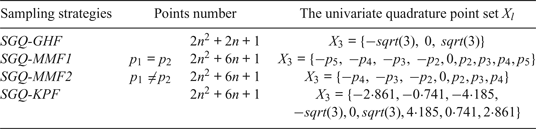
Table 2 shows the univariate quadrature point set for accuracy level L=3. The equations of SGQ-GHF and SGQ-KPF point locations ωi and weights ξj are shown in Equations (63) and (64), respectively, as follows. The equations for SGQ-MMF1 and SGQ-MMF2 point locations and weights are not illustrated here due to space constraints.
Univariate quadrature point set for accuracy level L=3.

 $$\eqalign{\omega_{i}&=\left\{\matrix{-n^{2}/2-5n/6+1\quad i=1 \cr -n/2+1/2 \quad i=2,\ldots,2n+1 \cr 1/6\quad i=2n+2,\ldots,4n+1 \cr 1/4\quad i=4n+2,\ldots,2n^{2}+2n+1} \right. \cr \xi_{i} &=\left\{\matrix{[0,0,\ldots,0]^{{\rm T}}; & i=1 \cr [0,\ldots,-1,\ldots,0]^{{\rm T}}; & i=2,\ldots,n+1 \cr [0,\ldots,1,\ldots,0]^{{\rm T}}; & i=n+2,\ldots,2n+1 \cr [0,\ldots,-\sqrt{3},\ldots,0]^{\rm T}; & i=2n+2,\ldots,3n+1 \cr [0,\ldots,\sqrt{3},\ldots,0]^{\rm T}; & i=3n+2,\ldots,4n+1 \cr [0,\ldots,-1,\ldots,-1,\ldots,0]^{\rm T}; & i=4n+2,\ldots,n(n-1)/2+4n+1 \cr [0,\ldots,-1,\ldots,1,\ldots,0]^{\rm T}; & i=n(n-1)/2+4n+2,\ldots,n(n-1)+4n+1 \cr [0,\ldots,1,\ldots,-1,\ldots,0]^{\rm T}; & i=n(n-1)+4n+2,\ldots,3n(n-1)/2+4n+1 \cr [0,\ldots,1,\ldots,1,\ldots,0]^{\rm T}; & i=3n(n-1)/2+4n+2,\ldots,2n(n-1)+4n+1} \right.}$$
 $$\eqalign{\omega_{i}&= \left\{\matrix{\left\{\matrix{ {(1\,+\,(\omega_2)^2)(n^2\,-\,3n\,+\,2) \over 2} \cr -(n^2-n)\omega_2 + n\omega_4} \right\} & i=1 \cr -(1-\omega_{2})\omega_{3}(n-1)+\omega_{5} & i=2,\ldots,2n+1 \cr \omega_{6} & i=2n+2,\ldots,4n+1 \cr \omega_{7} & i=4n+2,\ldots,6n+1 \cr \omega_{8} & i=6n+2,\ldots,8n+1 \cr \omega_{3} \cdot \omega_{3} & i=8n+2,\ldots,2n^{2}+6n+1}\right. \cr \xi_{i}&=\left\{\matrix{[0,0,\ldots,0]^{{\rm T}}; & i=1 \cr [0,\ldots,\pm \sqrt{3},\ldots,0]^{{\rm T}}; & i=2,\ldots,2n+1 \cr [0,\ldots,\pm 4{\cdot}185,\ldots,0]^{{\rm T}}; & i=2n+2,\ldots,4n+1 \cr [0,\ldots,\pm 0{\cdot}741,\ldots,0]^{{\rm T}}; & i=4n+2,\ldots,6n+1 \cr [0,\ldots,\pm 2{\cdot}861,\ldots,0]^{{\rm T}}; & i=6n+2,\ldots,8n+1 \cr [0,\ldots,\pm\sqrt{3},\ldots,\pm\sqrt{3},\ldots,0]^{{\rm T}}; & i=8n+2,\ldots,2n^{2}+6n+1}\right.}$$
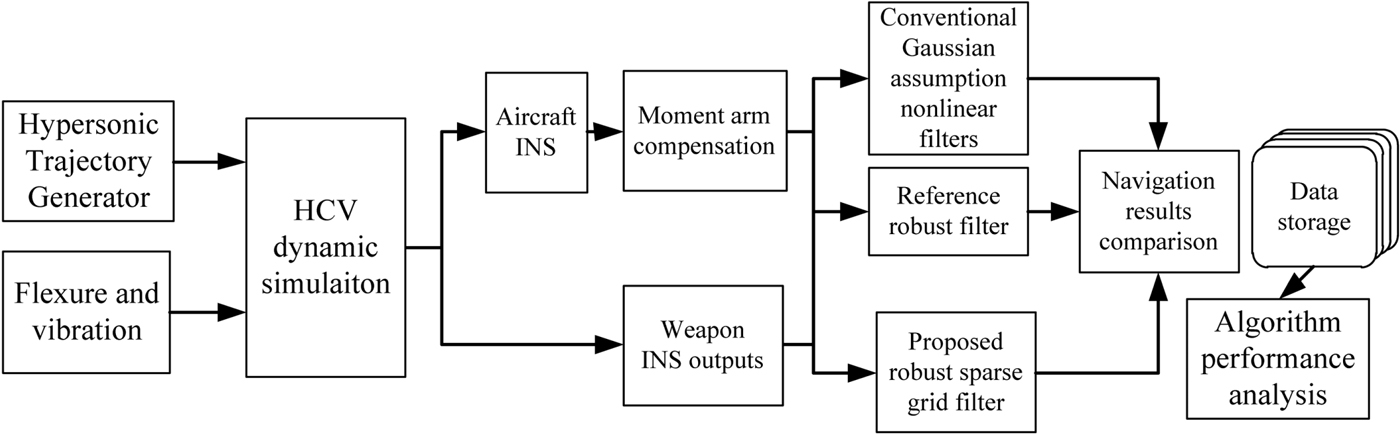
To confirm the proposed R-SGQF based on the quadrature point collocation sampling strategy, a number of simulations were conducted. Figure 3 shows the simulation scheme.
Simulation scheme.

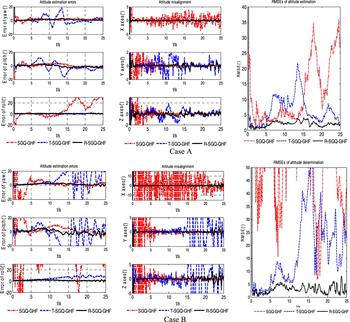
The R-SGQ-GHF was compared to the reference robust filter (Babacan et al., Reference Babacan, Ozbek and Efe2008) and a conventional filter (SGQ-GHF). The exponential weight was introduced in the robust EKF by Babacan et al. (Reference Babacan, Ozbek and Efe2008) and was applied to the sparse-grid quadrature using a Gauss-Hermite Filter (T-SGQ-GHF) in this section. The results of attitude estimation errors and attitude misalignment angles for the two cases are presented in Figure 4. The broken red lines are the curves of SGQ-GHF, and the dashed blue lines are the curves of T-SGQ-GHF and the solid black lines are the curves of R-SGQ-GHF for γ=500 and  $\varepsilon = 0{\cdot}001$ which calculated according to the dynamic uncertainty model contained in Equations (60)–(62).
Attitude estimation error and attitude misalignment angle comparisons of the R-SGQ-GHF filters.

As Figure 4 shows, the proposed R-SGQ-GHF can effectively control the influence of outliers in flexure and vibration uncertainty. Attitude estimation errors in Figure 4 were just beginning to converge in all filters at the first stage due to the reduced influence of relatively small vibrations and flexures. Shortly after that, however, the serious uncertainty in these dynamic errors from vibrations and flexures resulted ultimately in poor performance of the SGQ-GHF. T-SGQ-GHF degraded severely due to lack of parameter optimisation of exponential weight against model uncertainty. The attitude estimation errors and attitude misalignment angles of the missile cause severe error propagation in SGQ-GHF and T-SGQ-GHF. The amplitudes of attitude error and Root Mean Square Errors (RMSEs) of R-SGQ-GHF based on model parameter uncertainties with the robust algorithm of the TA are significantly smaller than SGQ-GHF due to incorrect statistical characteristics and T-SGQ-GHF modified by an exponential weight factor. It can be concluded that the attitude manoeuvre of the missile was estimated very well by the proposed R-SGQ-GHF, despite persistent unknown model parameter uncertainty.
5.3.2. Comparison of the Robust Sparse-grid Quadrature Kalman Filter in different Gaussian approximations
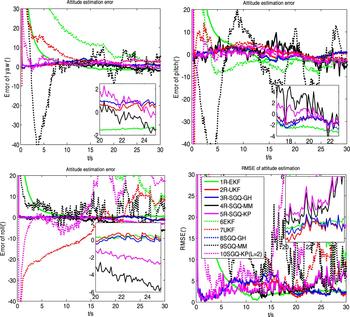
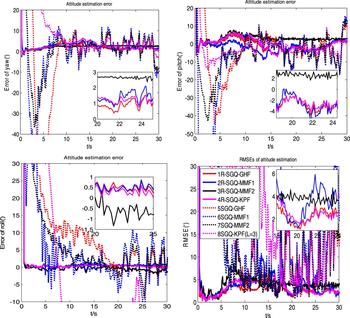
The R-SGQF in different Gaussian approximations including the R-SGQ-GHF, the R-SGQ-MMF, and the R-SGQ-KPF was studied in comparison with the corresponding conventional filters. Moreover, the EKF and the R-EKF, and the UKF and the R-UKF were compared to the proposed algorithm R-SGQFs in Case A. Two simulation examples demonstrated the performance of the proposed filtering in accuracy level L=2 and L=3, respectively. Large azimuth misalignments were  $50^{\circ}/20^{\circ}/20^{\circ}$, respectively. The attitude estimation errors for the R-SGQF are shown in Figures 5 and 6. SGQ-MMF1 tuneable parameters are p 1=p 2 and SGQ-MMF2 is with
 $p_{1}\neq\, p_{2}$ in L=3. The broken lines represent non-robust filtering curves, and the solid lines correspond to the curves of robust filtering attitude error.
Attitude estimation error comparisons of the R-SGQF, the SGQF in Leve1 2, the R-EKF and EKF.

Attitude estimation error comparisons of the R-SGQFs and the SGQFs in Leve13.

A dynamic transformation was used to feed the filter with uncertainty inherent in inertial sensor outputs and outliers in flexure and vibration. For severe uncertainty, the conventional non-linear filters were inadequate. The EKF, UKF and those SGQFs (broken lines) jumped out of the window coordinates. The results obtained with the conventional non-linear filters may be severely degraded by model uncertainty, caused by flexures, vibrations and misalignment.
However, the advantages of the proposed algorithm hold only when the uncertainties in the extemal measurement and state prediction are bounded within the range of assumptions, and the performance of the R-SGQFs (the solid lines) degraded gradually. As can be seen in Figures 5 and 6, the four solid curves (the R-SGQFs) show good agreement. Thus, these results suggest that the proposed R-SGQFs may provide more accuracy and stability, lessening the impact of uncertainties.
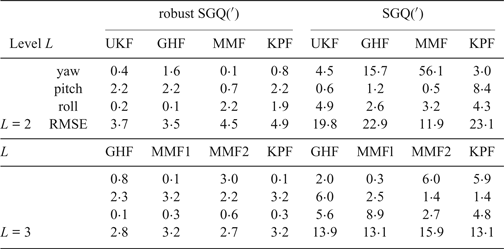
The means of the errors in yaw, pitch and roll, together with the norm of the RMSE error in levels 2 and 3 are listed in Table 3. It can be seen from Table 3 that the means of the norm of the RMSE robust SGQ UKF/GHF/MMF/KPF in level L=2 are 3·7′/3·5′/4·5′/4·9′, and those of GHF/MMF1/MMF2/KP in level L=3 are 2·8′/3·2′/2·7′/3·2′; thus, the corresponding conventional filters are higher, by up to one order of magnitude. Apparently, all the R-SGQFs exhibited more accurate results than the corresponding non-robust SGQFs and the R-SGQFs were more effective than the SGQFs in suppressing the unfavourable effects of the uncertainties. All R-SGQFs in level L=3 performed better than the corresponding filters in level 2 and the EKF.
Performance comparison of the R-SGQFs and the SGQFs.

6. CONCLUSIONS
A novel R-SGQF using a Riccati equation method was developed in this study. The proposed R-SGQF can achieve robustness to the model parameter uncertainty and higher levels of estimation accuracy. The R-SGQF is computationally efficient, providing an arbitrary level of accuracy by selecting a new set of quadrature points. The R-SGQF can greatly improve the transient performance against model uncertainty, compared with the conventional non-robust SGQF and a reference robust filter (Babacan et al., Reference Babacan, Ozbek and Efe2008). The stability and convergence of the R-SGQF algorithm that we present are guaranteed when the parameter uncertainties are norm-bounded. The simulation results for the TA in HCVs demonstrate that the unfavourable effects of flexure, vibrations, and misalignment can be partly eliminated and the attitude error degraded gradually when using the R-SGQF. In the future, we plan to extend our approach to more complex problems, such as robust state estimation for stochastic disturbance and intermittent measurements that occur simultaneously in non-Gaussian noise. However, it remains a challenge to achieve optimal filtering.
ACKNOWLEDGEMENT
The authors thank the Associate Editor and the anonymous reviewers for their valuable suggestions on improving the text. This work was supported by the National Science Foundation of China (No. 61374215, No. 61304529); the Project Supported by the Foundation of Key Laboratory of Micro-Inertial Instrument and Advanced Navigation Technology, Ministry of Education, China (SEU-MIAN-201702); the Key Scientific Research of Henan Province Education (No. 17B590001), Doctoral Foundation of Henan University of Technology (No. 2016BS005), the Key Scientific Research of Henan Science and Technology Department (No. 172102210214) and the Food Public Welfare Project (20153003).
APPENDIX. PROOF OF THEOREM 3
Select
 $${\bi V}_{{\bi k}}(\tilde{{\bi x}}_{{\bi k}})=\Vert {\bi x}_{{\bi k}}-\hat{{\bi x}}_{{\bi k}}\Vert _{\Sigma_{{\bi k}\vert {\bi k}}^{-1}}^{2}=\tilde{{\bi x}}_{{\bi k}}^{{\bi T}}\Sigma_{{\bi k}\vert {\bi k}}^{-1}\tilde{{\bi x}}_{{\bi k}}$$
where  $\Sigma_{{\bi k}\vert {\bi k}}$ is the solution to Equation (51). Considering Assumption 1, we have the following inequality for
 ${\bi V}_{{\bi k}}(\tilde{{\bi x}}_{{\bi k}})$
 $${1 \over \varepsilon_{\max}}\Vert \tilde{{\bi x}}_{{\bi k}}\Vert \leq {\bi V}_{{\bi k}}(\tilde{{\bi x}}_{{\bi k}})\leq {1 \over \varepsilon_{\min}}\Vert \tilde{{\bi x}}_{{\bi k}}\Vert $$
Then we focus on verifying the requirement Equation (52) for the application of Lemma 2. And the upper bound on  ${\bi E}[{\bi V}(\lbar_{{\bi k}})\vert \lbar_{{\bi k}-1}]-{\bi V}(\lbar_{{\bi k}-1})$ is verified as follow.
Substituting Equation (56) into Equation (A1), the Lyapunov function is rearranged:
 $$\eqalign{{\bi V}_{{\bi k}}(\tilde{{\bi x}}_{{\bi k}})&=\tilde{{\bi x}}_{{\bi k}}^{{\bi T}}\Sigma_{{\bi k}\vert {\bi k}}^{-1}\tilde{{\bi x}}_{{\bi k}} \cr &=\tilde{{\bi x}}^{{\bi T}}_{{\bi k}-1}\bar{{\bi F}}_{{\bi k}}^{{\bi T}}({\bi I}-{\bi K}_{{\bi k}}\bar{{\bi H}}_{{\bi k}})^{{\bi T}}\Sigma_{{\bi k}\vert {\bi k}}^{-1}({\bi I}-{\bi K}_{{\bi k}}\bar{{\bi H}}_{{\bi k}})\bar{{\bi F}}_{{\bi k}}\tilde{{\bi x}}_{{\bi k}-1}+\bar{{\bi W}}^{{\bi T}}_{{\bi k}}({\bi I}-{\bi K}_{{\bi k}}\bar{{\bi H}}_{{\bi k}})^{{\bi T}} \cr &\qquad \Sigma_{{\bi k}\vert {\bi k}}^{-1}({\bi I}-{\bi K}_{{\bi k}}\bar{{\bi H}}_{{\bi k}})\bar{{\bi W}}_{{\bi k}}+\bar{{\bi V}}_{{\bi k}}^{{\bi T}}{\bi K}_{{\bi k}}^{{\bi T}}\Sigma_{{\bi k}\vert {\bi k}}^{-1}{\bi K}_{{\bi k}}\bar{{\bi V}}_{{\bi k}} \cr &\quad +\tilde{{\bi x}}_{{\bi k}-1}^{{\bi T}}\bar{{\bi F}}_{{\bi k}}^{{\bi T}}({\bi I}-{\bi K}_{{\bi k}}\bar{{\bi H}}_{{\bi k}})^{{\bi T}}\Sigma_{{\bi k}\vert {\bi k}}^{-1}({\bi I}-{\bi K}_{{\bi k}}\bar{{\bi H}}_{{\bi k}})\bar{{\bi W}}_{{\bi k}}+\bar{{\bi W}}^{{\bi T}}_{{\bi k}}({\bi I}-{\bi K}_{{\bi k}}\bar{{\bi H}}_{{\bi k}})^{{\bi T}}\Sigma_{{\bi k}\vert {\bi k}}^{-1}({\bi I}-{\bi K}_{{\bi k}}\bar{{\bi H}}_{{\bi k}})\bar{{\bi F}}_{{\bi k}}\tilde{{\bi x}}_{{\bi k}-1} \cr &\quad -\tilde{{\bi x}}_{{\bi k}-1}^{{\bi T}}\bar{{\bi F}}_{{\bi k}}^{{\bi T}}({\bi I}-{\bi K}_{{\bi k}}\bar{{\bi H}}_{{\bi k}})^{{\bi T}}\Sigma_{{\bi k}\vert {\bi k}}^{-1}{\bi K}_{{\bi k}}\bar{{\bi V}}_{{\bi k}}-\bar{{\bi V}}_{{\bi k}}^{{\bi T}}{\bi K}_{{\bi k}}^{{\bi T}}\Sigma_{{\bi k}\vert {\bi k}}^{-1}({\bi I}-{\bi K}_{{\bi k}}\bar{{\bi H}}_{{\bi k}})\bar{{\bi F}}_{{\bi k}}\tilde{{\bi x}}_{{\bi k}-1} \cr &\qquad -\bar{{\bi W}}_{{\bi k}}^{{\bi T}}({\bi I}-{\bi K}_{{\bi k}}\bar{{\bi H}}_{{\bi k}})^{{\bi T}}\Sigma_{{\bi k}\vert {\bi k}}^{1}{\bi K}_{{\bi k}}\bar{{\bi V}}_{{\bi k}}-\bar{{\bi V}}_{{\bi k}}^{{\bi T}}{\bi K}_{{\bi k}}^{{\bi T}}\Sigma_{{\bi k}\vert {\bi k}}^{-1}({\bi I}-{\bi K}_{{\bi k}}\bar{{\bi H}}_{{\bi k}})\bar{{\bi W}}_{{\bi k}}}$$
Noting the positive scalar γ>1, the matrix inequalities
 $$\eqalign{&\tilde{{\bi x}}^{{\bi T}}_{{\bi k}-1}\bar{{\bi F}}^{{\bi T}}_{{\bi k}}({\bi I}-{\bi K}_{{\bi k}}\bar{{\bi H}}_{{\bi k}})^{{\bi T}}\Sigma^{-1}_{{\bi k}\vert {\bi k}}({\bi I}-{\bi K}_{{\bi k}}\bar{{\bi H}}_{{\bi k}}) \bar{{\bi W}}_{{\bi k}} + \bar{{\bi W}}_{{\bi k}}^{{\bi T}}({\bi I}-{\bi K}_{{\bi k}}\bar{{\bi H}}_{{\bi k}})^{{\bi T}}\Sigma^{-1}_{{\bi k}\vert {\bi k}}({\bi I}-{\bi K}_{{\bi k}}\bar{{\bi H}}_{{\bi k}}) \bar{{\bi F}}_{{\bi k}}\tilde{{\bi x}}_{{\bi k}-1} \cr &\quad \leq {\gamma^{-2} \over 4}\tilde{{\bi x}}^{{\bi T}}_{{\bi k}-1}\bar{{\bi F}}^{{\bi T}}_{{\bi k}}({\bi I}-{\bi K}_{{\bi k}}\bar{{\bi H}}_{{\bi k}})^{{\bi T}} \Sigma^{-1}_{{\bi k}\vert {\bi k}}({\bi I}-{\bi K}_{{\bi k}}\bar{{\bi H}}_{{\bi k}})\bar{{\bi F}}_{{\bi k}}\tilde{{\bi x}}_{{\bi k}-1}+4\gamma^2\bar{{\bi W}}^{{\bi T}}_{{\bi k}}({\bi I}-{\bi K}_{{\bi k}}\bar{{\bi H}}_{{\bi k}})^{{\bi T}} \Sigma^{-1}_{{\bi k}\vert {\bi k}}({\bi I}-{\bi K}_{{\bi k}}\bar{{\bi H}})\bar{{\bi W}}_{{\bi k}}}$$
 $$\eqalign{&{-}\tilde{{\bi x}}_{{\bi k}-1}^{{\bi T}}\bar{{\bi F}}_{{\bi k}}^{{\bi T}}({\bi I}-{\bi K}_{{\bi k}}\bar{{\bi H}}_{{\bi k}})^{{\bi T}}\Sigma_{{\bi k}\vert {\bi k}}^{-1}{\bi K}_{{\bi k}}\bar{{\bi V}}_{{\bi k}}-\bar{{\bi V}}_{{\bi k}}^{{\bi T}}{\bi K}_{{\bi k}}^{{\bi T}}\Sigma_{{\bi k}\vert {\bi k}}^{-1}({\bi I}-{\bi K}_{{\bi k}}\bar{{\bi H}}_{{\bi k}})\bar{{\bi F}}_{{\bi k}}\tilde{{\bi x}}_{{\bi k}-1}\leq {\gamma^{-2} \over 4}\tilde{{\bi x}}_{{\bi k}-1}^{{\bi T}}\bar{{\bi F}}^{{\bi T}}_{{\bi k}}({\bi I}-{\bi K}_{{\bi k}}\bar{{\bi H}}_{{\bi k}})^{{\bi T}} \cr &\qquad \Sigma^{-1}_{{\bi k}\vert {\bi k}} ({\bi I}-{\bi K}_{{\bi k}}\bar{{\bi H}}_{{\bi k}})\bar{{\bi F}}_{{\bi k}}\tilde{{\bi x}}_{{\bi k}-1}+4\gamma^2\bar{{\bi V}}^{{\bi T}}_{{\bi k}}{\bi K}_{{\bi k}}^{{\bi T}}\Sigma^{-1}_{{\bi k}\vert {\bi k}}{\bi K}_{{\bi k}}\bar{{\bi V}}_{{\bi k}}}$$
 $$\eqalign{&{-}\bar{{\bi W}}^{{\bi T}}_{{\bi k}}({\bi I}-{\bi K}_{{\bi k}}\bar{{\bi H}}_{{\bi k}})^{{\bi T}}\Sigma^{-1}_{{\bi k}\vert {\bi k}}{\bi K}_{{\bi k}}\bar{{\bi V}}_{{\bi k}}-\bar{{\bi V}}_{{\bi k}}^{{\bi T}}{\bi K}^{{\bi T}}_{{\bi k}}\Sigma^{-1}_{{\bi k}\vert {\bi k}}({\bi I}-{\bi K}_{{\bi k}}\bar{{\bi H}}_{{\bi k}})\bar{{\bi W}}_{{\bi k}}\leq\bar{{\bi W}}^{{\bi T}}_{{\bi k}}({\bi I}-{\bi K}_{{\bi k}}\bar{{\bi H}}_{{\bi k}})^{{\bi T}}\Sigma^{-1}_{{\bi k}\vert {\bi k}}({\bi I}-{\bi K}_{{\bi k}}\bar{{\bi H}}_{{\bi k}}) \cr &\qquad \bar{{\bi W}}_{{\bi k}}+\bar{{\bi V}}_{{\bi k}}^{{\bi T}}{\bi K}^{{\bi T}}_{{\bi k}}\Sigma^{-1}_{{\bi k}\vert {\bi k}}{\bi K}_{{\bi k}}\bar{{\bi V}}_{{\bi k}}}$$
 $$\eqalign{&{\bi V}_{{\bi k}}(\tilde{{\bi x}}_{{\bi k}})\leq [({\bi I}-{\bi K}_{{\bi k}}\bar{{\bi H}}_{{\bi k}})\bar{{\bi F}}_{{\bi k}}\tilde{{\bi x}}_{{\bi k}-1}+({\bi I}-{\bi K}_{{\bi k}}\bar{{\bi H}}_{{\bi k}})\bar{{\bi W}}_{{\bi k}}-{\bi K}_{{\bi k}}\bar{{\bi V}}_{{\bi k}}]^{{\bi T}}\Sigma_{k\vert k}^{-1}[({\bi I}-{\bi K}_{{\bi k}}\bar{{\bi H}}_{{\bi k}})\bar{{\bi F}}_{{\bi k}}\tilde{{\bi x}}_{{\bi k}-1} \cr &\qquad +({\bi I}-{\bi K}_{{\bi k}}\bar{{\bi H}}_{{\bi k}})\bar{{\bi W}}_{{\bi k}}-{\bi K}_{{\bi k}}\bar{{\bi V}}_{{\bi k}}] \cr &\quad =(1+ {1 \over 2}\gamma^{-2})\tilde{x}_{k-1}^{{\bi T}}\bar{{\bi F}}_{{\bi k}}^{{\bi T}}({\bi I}-{\bi K}_{{\bi k}}\bar{{\bi H}}_{{\bi k}})^{{\bi T}}\Sigma_{{\bi k}\vert {\bi k}}^{-1}({\bi I}-{\bi K}_{{\bi k}}\bar{{\bi H}}_{{\bi k}})\bar{{\bi F}}_{{\bi k}}\tilde{{\bi x}}_{{\bi k}-1}+(2+4\gamma^{2})\bar{{\bi W}}_{{\bi k}}^{{\bi T}}({\bi I}-{\bi K}_{{\bi k}}\bar{{\bi H}}_{{\bi k}})^{{\bi T}} \cr &\qquad \Sigma_{{\bi k}\vert {\bi k}}^{-1}({\bi I}-{\bi K}_{{\bi k}}\bar{{\bi H}}_{{\bi k}})\bar{{\bi W}}_{{\bi k}}+(2+4\gamma^{2})\bar{{\bi V}}_{{\bi k}}^{{\bi T}}{\bi K}_{{\bi k}}^{{\bi T}}\Sigma_{{\bi k}\vert {\bi k}}^{-1}{\bi K}_{{\bi k}}\bar{{\bi V}}_{{\bi k}}}$$
Noting  $\hat{{\bi R}}^{\ast}_{{\bi k}} \gt 0,\ {\bi P}_{{\bi xx,k\vert k}-1}\leq\Sigma_{{\bi k}\vert {\bi k}-1}$ and
 ${\bi P}_{{\bi xx,k\vert k}}\leq\Sigma_{{\bi k}\vert {\bi k}}$, we thereby conclude that:
 $$\eqalign{&\{{\bi I}-{\bi K}_{{\bi k}}\bar{{\bi H}}_{{\bi k}}\}{\bi P}_{{\bi k}\vert {\bi k}-1}\{{\bi I}-{\bi K}_{{\bi k}}\bar{{\bi H}}_{{\bi k}}\}^{{\bi T}}+{\bi K}_{{\bi k}}{\bi R}_{{\bi k}}{\bi K}_{{\bi k}}^{{\bi T}}<({\bi I}-{\bi K}_{{\bi k}}\bar{{\bi H}}_{{\bi k}})\Sigma_{{\bi k}\vert {\bi k}-1}({\bi I}-{\bi K}_{{\bi k}}\bar{{\bi H}}_{{\bi k}})^{{\bi T}}+{\bi K}_{{\bi k}}\hat{{\bi R}}_{{\bi k}}^{\ast}{\bi K}_{{\bi k}}^{{\bi T}}\leq\Sigma_{{\bi k}\vert {\bi k}}}$$
 $$\eqalign{&\Sigma_{{\bi k}\vert {\bi k}}^{-1}\lt [({\bi I}-{\bi K}_{{\bi k}}\bar{{\bi H}}_{{\bi k}})\Sigma_{{\bi k}\vert {\bi k}-1}({\bi I}-{\bi K}_{{\bi k}}\bar{{\bi H}}_{{\bi k}})^{{\bi T}}+{\bi K}_{{\bi k}}\hat{{\bi R}}_{{\bi k}}^{\ast}{\bi K}_{{\bi k}}^{{\bi T}}]^{-1}<({\bi I}-{\bi K}_{{\bi k}}\bar{{\bi H}}_{{\bi k}})^{-T}\Sigma_{{\bi k}\vert {\bi k}-1}^{-1}({\bi I}-{\bi K}_{{\bi k}}\bar{{\bi H}}_{{\bi k}})^{{\bi T}}}$$
 $$\eqalign{&\left(1+ {1 \over 2}\gamma^{-2}\right)\tilde{{\bi x}}^{{\bi T}}_{{\bi k}-1}\bar{{\bi F}}_{{\bi k}}^{{\bi T}}({\bi I}-{\bi K}_{{\bi k}}\bar{{\bi H}}_{{\bi k}})^{{\bi T}} {\Sigma_{{\bi k}/{\bi k}}^{-1}}({\bi I}-{\bi K}_{{\bi k}}\bar{{\bi H}}_{{\bi k}})\bar{{\bi F}}_{{\bi k}}\tilde{{\bi x}}_{{\bi k}-1}\left(1+ {1 \over 2}\gamma^{-2}\right)\tilde{{\bi x}}^{{\bi T}}_{{\bi k}-1}\Sigma_{{{\bi k{\rm /}k}-1}}^{-1}\tilde{{\bi x}}_{{\bi k}-1}}$$
Note Equation (42) and recognise
 $$\eqalign{\Sigma_{{\bi k}\vert {\bi k}-1}&=\sum_{{\bi i}=1}^{{\bi N}_{{\bi p}}}\omega_{{\bi i}}(\chi_{{\bi i,k\vert k}-1}-\hat{{\bi x}}_{{\bi k}\vert {\bi k}-1})(\chi_{{\bi i,k\vert k}-1}-\hat{{\bi x}}_{{\bi k}\vert {\bi k}-1})^{{\bi T}}+\hat{{\bi Q}}_{{\bi k}-1}^{\ast}=(1+2\varepsilon)(1-\gamma^{-2})^{-1} \cr &\quad \times \bar{{\bi F}}_{{\bi k}}\Sigma_{{\bi k}-1\vert {\bi k}-1}\bar{{\bi F}}_{{\bi k}}^{{\bi T}}+(2+\varepsilon^{-1})q_{{\bi k}}\bar{\Phi}_{{\bi k}}\bar{\Phi}_{{\bi k}}^{{\bi T}}+(2+\varepsilon^{-1}){\bi G}_{{\bi k}-1}\hat{{\bi Q}}_{{\bi k}-1}{\bi G}_{{\bi k}-1}^{{\bi T}}}$$
The process noise covariance matrix is required to be large enough and plays a similar role to the measurement noise covariance matrix in ensuring the conditions  $\hat{{\bi Q}}_{{\bi k}-1}^{\ast}>0$. It yields:
 $$\Sigma_{{\bi k}\vert {\bi k}^{-1}}^{-1}<(1+2\varepsilon)^{-1}(1-\gamma^{-2})\bar{{\bi F}}_{{\bi k}}^{-{\bi T}}\Sigma_{{\bi k}-1\vert {\bi k}-1}^{1}\bar{{\bi F}}_{{\bi k}}^{-1}$$
Substituting Equation (A12) into Equation (A10) the first term on the right-hand side is obtained:
 $$\eqalign{&\left(1+\displaystyle {1 \over 2}\gamma^{-2}\right)\tilde{{\bi x}}_{{\bi k}-1}^{{\bi T}}\bar{{\bi F}}_{{\bi k}}^{{\bi T}}(I-{\bi K}_{{\bi k}}\bar{{\bi H}}_{{\bi k}})^{{\bi T}}\Sigma_{{\bi k}\vert {\bi k}}^{-1}(I-{\bi K}_{{\bi k}}\bar{{\bi H}}_{{\bi k}})\bar{{\bi F}}_{{\bi k}}\tilde{{\bi x}}_{{\bi k}-1}\leq\left(1+ {1 \over 2}\gamma^{-2}\right)(1+2\varepsilon)^{-1} \cr &\qquad (1-\gamma^{-2})\tilde{{\bi x}}_{{\bi k}-1}^{{\bi T}}\Sigma_{k-1\vert k-1}^{-1}\tilde{{\bi x}}_{{\bi k}-1}}$$
Using Lemma 2, the second term on the right-hand side of Equation (A7) can be rewritten as
 $$(2+4\gamma^{2})\bar{{\bi W}}_{{\bi k}}^{{\bi T}}({\bi I}-{\bi K}_{{\bi k}}\bar{{\bi H}}_{{\bi k}})^{{\bi T}}\Sigma_{{\bi k}\vert {\bi k}}^{-1}({\bi I}-{\bi K}_{{\bi k}}\bar{{\bi H}}_{{\bi k}})\bar{{\bi W}}_{{\bi k}}\leq(2+4\gamma^{2})\bar{{\bi W}}_{{\bi k}}^{{\bi T}}Q_{{\bi k}}^{-1}\bar{{\bi W}}_{{\bi k}}$$
Use Equation (49) and Equation (51), and we can conclude that
 $$\eqalign{\bar{{\bi H}}_{{\bi k}}=\Sigma_{{\bi k}\vert {\bi k}-1}^{-1}\Sigma_{{\bi xz},{\bi k}\vert {\bi k}-1}\quad {\bi K}_{{\bi k}}={\bf \Sigma}_{{\bi k}\vert {\bi k}}\bar{{\bi H}}_{{\bi k}}\hat{{\bi R}}_{{\bi k}}^{\ast - 1}}$$
 $$(\hat{\bi R}_{\bi k}^{\ast -1} {\bi K}_{\bi k} \Sigma_{{\bi k}\vert {\bi k}} {\bi K}_{\bi k}^{\bi T} \hat{\bi R}_{\bi k}^{\ast -1})^{-1} = \hat{\bi R}_{\bi k}^{\ast} {\bi K}_{\bi k}^{-T}\Sigma_{{\bi k}\vert {\bi k}}^{-1} {\bi K}_{\bi k}^{-1}\hat{\bi R}^{\ast}$$
From Equation (A15) and Equation (A16), Equation (51) leads to
 $$(\Sigma_{{\bi k}\vert {\bi k}})^{-1} \lt ((1 + 2\varepsilon)(1 - \gamma^{-2})^{-1}\Sigma_{{\bi k}\vert {\bi k}-1} + {\bi K}_{\bi k} \hat{\bi R}_{\bi k}^{\ast} {\bi K}_{\bi k}^{\bi T})^{-1}$$
Using inequality Equation (A17), Equation (A16) also leads to
 $$\eqalign{&(\hat{{\bi R}}_{{\bi k}}^{\ast -1}{\bi K}_{{\bi k}}\Sigma_{{\bi k}\vert {\bi k}}{\bi K}_{{\bi k}}^{{\bi T}}\hat{{\bi R}}_{{\bi k}}^{\ast -1})^{-1}=\hat{{\bi R}}_{{\bi k}}^{\ast}{\bi K}_{{\bi k}}^{-T}\Sigma_{{\bi k}\vert {\bi k}}^{-1}{\bi K}_{{\bi k}}^{-1}\hat{{\bi R}}^{\ast} \lt \hat{{\bi R}}_{{\bi k}}^{\ast}{\bi K}_{{\bi k}}^{-{\bi T}}((1 + 2\varepsilon)(1-\gamma^{-2})^{-1} \cr &\quad \Sigma_{{\bi k}\vert {\bi k}-1}+{\bi K}_{{\bi k}}\hat{{\bi R}}_{{\bi k}}^{\ast}{\bi K}_{{\bi k}}^{{\bi T}})^{-1}{\bi K}_{{\bi k}}^{-1}\hat{{\bi R}}_{{\bi k}}^{\ast}}$$
Now, by using the matrix inversion lemma, for example, (Lewis, Reference Lewis1986, Appendix 2, P.347) we have
 $$(\hat{{\bi R}}_{{\bi k}}^{\ast})^{-1} \gt {\bi K}_{{\bi k}}^{\bi T} ((1 + 2\varepsilon)(1-\gamma^{-2})^{-1}\Sigma_{{\bi k}\vert {\bi k}-1} + {\bi K}_{\bi k} \hat{\bi R}_{\bi k}^{\ast}{\bi K}_{\bi k}^{\bi T})^{-1} {\bi K}_{\bi k}$$
Substituting Equation (A19) into Equation (A18), we have
 $$\hat{{\bi R}}_{{\bi k}}^{\ast-1}{\bi K}_{{\bi k}}\Sigma_{{\bi k}\vert {\bi k}}{\bi K}_{{\bi k}}^{{\bi T}}\hat{{\bi R}}_{{\bi k}}^{\ast-1}\leq \hat{{\bi R}}_{{\bi k}}^{\ast-1},$$
Using Equation (A15) and Equation (A18), the third term on the right-hand side of Equation (A7) can be expressed as follows:
 $${\bi E}\{(2+4\gamma^{2})\bar{{\bi V}}_{{\bi k}}^{{\bi T}}{\bi K}_{{\bi k}}^{{\bi T}}\Sigma_{{\bi k}\vert {\bi k}}^{-1}{\bi K}_{{\bi k}}\bar{{\bi V}}_{{\bi k}}\vert \tilde{{\bi x}}_{{\bi k}-1}\}\leq(2 + 4\gamma^{2})\bar{{\bi V}}_{{\bi k}}^{{\bi T}}\hat{{\bi R}}_{{\bi k}}^{\ast-1}\bar{{\bi V}}_{{\bi k}}$$
noting that the right side of Equation (A1) is equal to  $V_{{\bi k}}(\tilde{{\bi x}}_{{\bi k}})$ in Equation (A3).
We substitute Equation (A3) into Equation (A1) to obtain:
 $$\eqalign{&\Vert {\bi x}_{{\bi k}}-\hat{{\bi x}}_{{\bi k}}\Vert _{\Sigma_{{\bi k}\vert {\bi k}}^{-1}}^{2}=\tilde{{\bi x}}_{{\bi k}}^{{\bi T}}\Sigma_{{\bi k}\vert {\bi k}}^{-1}\tilde{{\bi x}}_{{\bi k}}=[({\bi I}-{\bi K}_{{\bi k}}\bar{{\bi H}}_{{\bi k}}) \bar{{\bi F}}_{{\bi k}}\tilde{{\bi x}}_{{\bi k}-1}+({\bi I}-{\bi K}_{{\bi k}}\bar{{\bi H}}_{{\bi k}})\bar{{\bi W}}_{{\bi k}} \cr &\qquad -{\bi K}_{{\bi k}}\bar{{\bi V}}_{{\bi k}}]^{{\bi T}}\Sigma_{{\bi k}\vert {\bi k}}^{-1}[({\bi I}-{\bi K}_{{\bi k}}\bar{{\bi H}}_{{\bi k}})\bar{{\bi F}}_{{\bi k}}\tilde{{\bi x}}_{{\bi k}-1}+({\bi I}-{\bi K}_{{\bi k}}\bar{{\bi H}}_{{\bi k}})\bar{{\bi W}}_{{\bi k}}-{\bi K}_{{\bi k}}\bar{{\bi V}}_{{\bi k}}] \cr &\quad =\tilde{{\bi x}}_{{\bi k}-1}^{{\bi T}}\bar{{\bi F}}_{{\bi k}}^{{\bi T}}({\bi I}-{\bi K}_{{\bi k}}\bar{{\bi H}}_{{\bi k}})^{{\bi T}}\Sigma_{{\bi k}\vert {\bi k}}^{-1}({\bi I}-{\bi K}_{{\bi k}}\bar{{\bi H}}_{{\bi k}})\bar{{\bi F}}_{{\bi k}}\tilde{{\bi x}}_{{\bi k}-1}+\bar{{\bi W}}_{{\bi k}}^{{\bi T}}({\bi I}-{\bi K}_{{\bi k}}\bar{{\bi H}}_{{\bi k}})^{{\bi T}}\Sigma_{{\bi k}\vert {\bi k}}^{-1}({\bi I}-{\bi K}_{{\bi k}}\bar{{\bi H}}_{{\bi k}})\bar{{\bi W}}_{{\bi k}} \cr &\qquad +\bar{{\bi V}}_{{\bi k}}^{{\bi T}}{\bi K}_{{\bi k}}^{{\bi T}}\Sigma_{{\bi k}\vert {\bi k}}^{-1}{\bi K}_{{\bi k}}\bar{{\bi V}}_{{\bi k}} \cr &\qquad +\tilde{{\bi x}}_{{\bi k}-1}^{{\bi T}}\bar{{\bi F}}_{{\bi k}}^{{\bi T}}({\bi I}-{\bi K}_{{\bi k}}\bar{{\bi H}}_{{\bi k}})^{{\bi T}}\Sigma_{{\bi k}\vert {\bi k}}^{-1}({\bi I}-{\bi K}_{{\bi k}}\bar{{\bi H}}_{{\bi k}})\bar{{\bi W}}_{{\bi k}}+\bar{{\bi W}}_{{\bi k}}^{{\bi T}}({\bi I}-{\bi K}_{{\bi k}}\bar{{\bi H}}_{{\bi k}})^{{\bi T}} \cr &\qquad \Sigma_{{\bi k}\vert {\bi k}}^{-1}({\bi I}-{\bi K}_{{\bi k}}\bar{{\bi H}}_{{\bi k}})\bar{{\bi F}}_{{\bi k}}\tilde{{\bi x}}_{{\bi k}-1}-\tilde{{\bi x}}_{{\bi k}-1}^{{\bi T}}\bar{{\bi F}}_{{\bi k}}^{{\bi T}}({\bi I}-{\bi K}_{{\bi k}}\bar{{\bi H}}_{{\bi k}})^{{\bi T}} \cr &\qquad \Sigma_{{\bi k}\vert {\bi k}}^{-1}{\bi K}_{{\bi k}}\bar{{\bi V}}_{{\bi k}}-\bar{{\bi V}}_{{\bi k}}^{{\bi T}}{\bi K}_{{\bi k}}^{{\bi T}}\Sigma_{{\bi k}\vert {\bi k}}^{-1}({\bi I}-{\bi K}_{{\bi k}}\bar{{\bi H}}_{{\bi k}})\bar{{\bi F}}_{{\bi k}}\tilde{{\bi x}}_{{\bi k}-1}-\bar{{\bi W}}_{{\bi k}}^{{\bi T}}({\bi I}-{\bi K}_{{\bi k}}\bar{{\bi H}}_{{\bi k}})^{{\bi T}}\Sigma_{{\bi k}\vert {\bi k}}^{-1}{\bi K}_{{\bi k}}\bar{{\bi V}}_{{\bi k}} \cr &\qquad -\bar{{\bi V}}_{{\bi k}}^{{\bi T}}{\bi K}_{{\bi k}}^{{\bi T}}\Sigma_{{\bi k}\vert {\bi k}}^{-1}({\bi I}-{\bi K}_{{\bi k}}\bar{{\bi H}}_{{\bi k}})\bar{{\bi W}}_{{\bi k}}}$$
Using Equations (A4)-(A18), Equation (A22) can be rearranged
 $$\eqalign{&\Vert {\bi x}_{{\bi k}}-\hat{{\bi x}}_{{\bi k}}\Vert _{\Sigma_{{\bi k}\vert {\bi k}}^{-1}}^{2}\leq\left(1+ {1 \over 2}\gamma^{-2}\right)(1-\gamma^{-2})^{2}\tilde{{\bi x}}_{{\bi k}-1}^{{\bi T}}\Sigma_{{\bi k}-1\vert {\bi k}-1}^{-1}\bar{{\bi x}}_{{\bi k}-1}+(2+4\gamma^{2}) \cr &\quad \bar{{\bi W}}_{{\bi k}}^{{\bi T}}Q_{{\bi k}}^{-1}\bar{{\bi W}}_{{\bi k}}+(2+4\gamma^{2})\bar{{\bi V}}_{{\bi k}}^{{\bi T}}{\bi R}_{{\bi k}}^{-1}\bar{{\bi V}}_{{\bi k}}}$$
For γ>1, it yields:
 $$(1+\gamma^{-2}/2)(1-\gamma^{-2})^{2} \lt 1-\gamma^{-2}$$
Equation (A4) is rewritten as
 $$\eqalign{&\Vert {\bi x}_{{\bi k}}-\hat{{\bi x}}_{{\bi k}}\Vert_{\Sigma_{{\bi k}\vert {\bi k}}^{-1}}^{2}\leq(1-\gamma^{-2})\tilde{{\bi x}}_{{\bi k}-1}^{{\bi T}}\Sigma_{{\bi k}-1\vert {\bi k}-1}^{-1}\tilde{{\bi x}}_{{\bi k}-1}+\bar{{\bi W}}_{{\bi k}}^{{\bi T}}\bar{Q}_{{\bi k}}^{-1}\bar{{\bi W}}_{{\bi k}}+\bar{{\bi V}}_{{\bi k}}^{{\bi T}}\bar{{\bi R}}_{{\bi k}}^{-1}\bar{{\bi V}}_{{\bi k}} \cr &\quad =(1-\gamma^{-2})\Vert {\bi x}_{{\bi k}-1}-\hat{{\bi x}}_{{\bi k}-1}\Vert _{\Sigma_{k-1\vert k-1}^{-1}}^{2}+\Vert \bar{{\bi W}}_{{\bi k}}\Vert _{\bar{Q}_{{\bi k}}^{-1}}^{2}+\Vert \bar{{\bi V}}_{{\bi k}}\Vert _{\bar{{\bi R}}_{{\bi k}}^{-1}}^{2}}$$
where
 $$\bar{Q}_{{\bi k}}= {\hat{{\bi Q}}_{{\bi k}} \over 2+4\gamma^{2}},\bar{{\bi R}}_{{\bi k}}= {\hat{{\bi R}}_{{\bi k}} \over 2 + 4\gamma^{2}},$$
For k=1, 2, we add up both sides of Equation (A25)
 $$\Vert {\bi x}_{{\bi k}}-\hat{{\bi x}}_{{\bi k}}\Vert _{\Sigma_{{\bi k}\vert {\bi k}}^{-1}}^{2}\leq \Vert {\bi x}_{0} - \hat{{\bi x}}_{0} \Vert _{\Sigma_{0}^{-1}}^{2}-\gamma^{-2}\sum_{{\bi k}=0}^{{\bi n}-1}\Vert {\bi x}_{{\bi k}}-\hat{{\bi x}}_{{\bi k}}\Vert _{\Sigma_{{\bi k}\vert {\bi k}}^{-1}}^{2}+\sum_{{\bi k}=1}^{{\bi n}}(\Vert \bar{{\bi W}}_{{\bi k}}\Vert _{\bar{Q}_{{\bi k}}^{-1}}^{2}+ \Vert \bar{{\bi V}}_{{\bi k}}\Vert _{\bar{{\bi R}}_{{\bi k}}^{-1}}^{2})$$
For γ>1, we conclude  $\gamma^{-2}\sum_{{\bi k}=0}^{{\bi n}}\Vert {\bi x}_{{\bi k}}-\hat{{\bi x}}_{{\bi k}}\Vert _{\Sigma_{{\bi k}\vert {\bi k}}^{-1}}^{2}\leq \Vert {\bi x}_{0}-\hat{{\bi x}}_{0} \Vert _{\Sigma_{0\vert 0}^{-1}}^{2}+\sum_{{\bi k}=1}^{{\bi n}}(\Vert \bar{{\bi W}}_{{\bi k}}\Vert _{{\bar{{\bi Q}}_{{\bi k}}^{-1}}}^{2}+\Vert \bar{{\bi V}}_{{\bi k}}\Vert _{\bar{{\bi R}}_{{\bi k}}^{-1}}^{2})$
Equation (20) is satisfied and Theorem 3 is proved.
Remark 2
When γ>1  $\varepsilon \gt 0$, there exists
 $(1+ {1 \over 2}\gamma^{2})(1-\gamma^{-2})\leq 1+2\varepsilon$. The parameter γ can be taken for disturbance attenuation grade and must be chosen to be rather large. The parameters ε could be used to optimise the filtering performance and ε is sufficiently small to ensure the accuracy of the estimator in Xie et al. (Reference Xie, Yeng, Soh and de S1994).