Introduction
Post-traumatic stress disorder (PTSD) is one of the most common pathological disturbances following the exposure to a trauma (Foa et al. Reference Foa, Stein and McFarlane2006). The number of studies on trauma and PTSD has been increasing in the past decades. There is a growing consensus that great individual differences exist in terms of post-trauma long-term responses (Bonanno et al. Reference Bonanno, Brewin, Kaniasty and La Greca2010; Bonanno & Mancini, Reference Bonanno and Mancini2012). Commonly observed PTSD trajectories in previous trauma studies include ‘resistance’ (minimal or no symptoms over time), ‘chronic dysfunction’ (moderate or severe symptoms over time), ‘delayed dysfunction’ (initially minimal/no symptoms followed by elevated symptoms), ‘recovery’ (initially moderate/severe symptoms followed by a gradual return to pre-trauma functioning) and ‘relapsing/remitting’ (symptoms displaying a cyclical course) (Hull et al. Reference Hull, Alexander and Klein2002; Adams & Boscarino, Reference Adams and Boscarino2006; Norris et al. Reference Norris, Tracy and Galea2009; Kronenberg et al. Reference Kronenberg, Hansel, Brennan, Osofsky, Osofsky and Lawrason2010; Armour et al. Reference Armour, Shevlin, Elklit and Mroczek2012; Self-Brown et al. Reference Self-Brown, Lai, Thompson, McGill and Kelley2013). For example, Pietrzak et al. (Reference Pietrzak, Van Ness, Fried, Galea and Norris2013) followed a sample of 206 hurricane victims at 3, 6 and 15 months after the disaster and reported three PTSD trajectories, i.e. resistant, delayed dysfunction and chronic dysfunction. Koenen et al. (Reference Koenen, Stellman, Stellman and Sommer2003) investigated 1377 Vietnam veterans over a 14-year period and revealed that PTSD time course displayed three different patterns of chronic dysfunction, recovery and relapsing/remitting. Inconsistent findings in the set of PTSD trajectories across studies may be attributed to differences in the types and severities of disasters, the sample characteristics, the assessments for PTSD, and the follow-up durations and intervals.
Potential predictors of PTSD symptoms post-disaster have also been extensively investigated (Norris et al. Reference Norris, Friedman, Watson, Byrne, Diaz and Kaniasty2002; Furr et al. Reference Furr, Comer, Edmunds and Kendall2010; Kirsch et al. Reference Kirsch, Wilhelm and Goldbeck2011; Trickey et al. Reference Trickey, Siddaway, Meiser-Stedman, Serpell and Field2012). Well-documented predictors can be divided into the following categories. First, factors pertaining to the degree of traumatic exposure, such as injury to self or loved ones, bereavement, property damage, perceived life threats and psychophysical distress during the disaster, community destruction, and other hardship during/after the disaster, are proven critical for the development of PTSD (Ahmad et al. Reference Ahmad, Feder, Lee, Wang, Southwick, Schlackman, Buchholz, Alonso and Charney2010; Cénat & Derivois, Reference Cénat and Derivois2014). Second, pre-existing individual characteristics such as female gender, ethnic minority, low socio-economic status, and history of psychopathology and traumatic exposure are also associated with elevated risk of PTSD symptoms (Brewin et al. Reference Brewin, Andrews and Valentine2000). Furthermore, factors that occur after the disaster and thus may affect the individual's responses post-disaster, such as perceived social support, coping strategies, self-efficacy, optimism/hope and other psychological resources, exert considerable influence on the onset and severity of PTSD symptoms as well (Cohen & Wills, Reference Cohen and Wills1985; La Greca et al. Reference La Greca, Silverman, Lai and Jaccard2010; Zheng et al. Reference Zheng, Fan, Liu and Mo2012).
On 12 May 2008, an 8.0-magnitude earthquake shocked Wenchuan County of Sichuan Province in China. It was the strongest earthquake since the 1950 Tibet earthquake in China in the last 100 years. Before 2008, there was a dearth of studies identifying the epidemiology of PTSD and related predictors among Chinese samples. Ever since the Wenchuan earthquake, there have been more and more studies looking into such issues. A large number of these studies have specifically focused on adolescent survivors (Fan et al. Reference Fan, Liu, Zheng and Cui2010, Reference Fan, Zhang, Yang, Mo and Liu2011; He et al. Reference He, Xu, Zhu, Wang and Wang2011; Ma et al. Reference Ma, Liu, Hu, Qiu, Wang, Huang, Wang, Zhang and Li2011; Geng et al. Reference Geng, Fan and Zhang2012). However, the majority of existing studies were cross-sectional and assessed PTSD at a given time point. Only a few studies have longitudinally examined the changes of PTSD symptoms among the Wenchuan earthquake adolescent survivors (Chen et al. Reference Chen, Wang, Zhang and Shi2010; Liu et al. Reference Liu, Yang, Ye, Zeng, Xiang and Yuan2010, Reference Liu, Wang, Shi, Zhang, Zhang and Shen2011; Zhang et al. Reference Zhang, Ran, Li, Ou, Gong, Li, Fan, Jiang and Fang2012). For example, Chen et al. (Reference Chen, Wang, Zhang and Shi2010) followed 203 adolescent survivors at 6 and 12 months after the earthquake and reported the PTSD prevalence rates of 21.2% and 19.2%, respectively. They also verified the effect of earthquake exposure on the risk of developing PTSD. In a sample of 548 adolescent survivors, Zhang et al. (Reference Zhang, Ran, Li, Ou, Gong, Li, Fan, Jiang and Fang2012) found that the PTSD rate decreased from 9.7% at 6 months post-earthquake to 1.3% at 12 months and to 1.6% at 18 months and factors associated with PTSD across time points were depressive symptoms, female gender and sibling number. A common drawback of these longitudinal studies is that they merely evaluated the time-varying changes of the overall sample prevalence of PTSD, but not the individual variances in the PTSD time course.
No existing study has examined the heterogeneity in PTSD developmental trajectories and related predictors among Chinese adolescent earthquake survivors. The present study aimed to add to the literature by providing such data. Three specific objectives were: (a) to examine the PTSD prevalence rates among 1573 adolescent survivors at 6, 12, 18 and 24 months after the Wenchuan earthquake; (b) to identify the heterogeneous PTSD symptom trajectories; and (c) to explore the predictors of heterogeneous trajectories.
Method
Participants
Participants were sampled from a junior high school (grades 7−9) and a senior high school (grades 10−12) in Dujiangyan, one of the cities most affected by the earthquake. Only 7th and 10th graders were voluntarily recruited for this study so that participants could be followed for at least 2 years before they graduated. The two selected schools are both public schools with a large number of enrollments, and students come from a variety of socio-economic backgrounds. Thus, the sample could be considered representative of the high school student population in the district. A total of 1573 adolescents (n of 7th graders = 216, initial mean age = 12.30, s.d. = 0.53 years; n of 10th graders = 1357, initial mean age = 15.44, s.d. = 0.67 years) participated in the initial survey conducted 6 months after the earthquake and they were all followed-up by 12, 18 and 24 months. However, not all participants provided complete data on all measures at each of the follow-up surveys, i.e. 1436 participants provided it after 12 months, 1288 after 18 months and 1315 after 24 months.
Procedure
This study was approved by the Human Research Ethics Committee of South China Normal University. Written informed consent was obtained from both the participating students and their parents. At about 6 months (10–17 November 2008), 12 months (18–22 May 2009), 18 months (23–27 November 2009) and 24 months (17–21 May 2010) after the earthquake, self-administered questionnaires were distributed to target students with the assistance of trained interviewers who were psychological professionals from South China Normal University. Students were informed that they could feel free to withdraw from the study at any time.
Measures
Adolescents’ demographics and earthquake exposure were assessed by self-designed questionnaires. Demographic information included gender, grade and sibling number. Earthquake exposure was assessed by four items: (1) death, disappearance and/or injury of family members; (2) house damage; (3) property loss; and (4) direct witness of traumatic events. The first item included five choices: 1 = death of a family member; 2 = disappearance of a family member; 3 = serious injury of a family member; 4 = moderate injury of a family member; and 5 = none of the above. The other three items were rated on a five-point Likert scale with 1 representing the highest level of exposure and 5 representing the lowest.
The Posttraumatic Stress Disorder Self-Rating Scale (PTSD-SS) (Liu et al. Reference Liu, Ma and Liu1998) was used to assess PTSD symptoms at all four surveys. The PTSD-SS was developed according to the diagnostic criteria of PTSD set by the Diagnostic and Statistical Manual of Mental Diseases, fourth edition (DSM-IV) and the Chinese Classification of Mental Disorders. It contains 24 items, each rated on a five-point Likert scale from 1 (‘not at all’) to 5 (‘extremely severe’). A cut-off total score of 50 has been suggested to identify probable PTSD. Psychometric properties of the PTSD-SS have been described in the Chinese population (Liu et al. Reference Liu, Ma and Liu1998). In our study, Cronbach's α was 0.94, 0.95, 0.95 and 0.96 at 6, 12, 18 and 24 months, respectively.
The Adolescent Self-Rating Life Events Checklist (ASLEC; Liu et al. Reference Liu, Liu, Yang and Zhao1997) was used to measure the severity of negative life events at 6 and 24 months after the earthquake. It consists of 26 items, clustering into six dimensions: interpersonal conflicts; academic pressure; being punished; personal loss; physical health problems; and others. Each item was rated within a time-frame of the last 6 months on a five-point Likert scale, from 1 (‘not at all’) to 5 (‘extremely severe’). Item scores were added up to generate a total score. The ASLEC has demonstrated acceptable reliability (Cronbach's α = 0.85) and construct validity in the Chinese adolescent population (Liu et al. Reference Liu, Liu, Yang and Zhao1997). In our study, Cronbach's α was 0.87 and 0.89 at 6 and 24 months, respectively.
The Social Support Rate Scale (SSRS; Xiao, Reference Xiao1994) was used to assess adolescents’ perceived social support at 6 and 24 months after the earthquake. It includes 10 items, clustering into three dimensions: objective support; subjective support; and utilization of social support. Item scores were added up to generate a total score. The SSRS has satisfactory internal consistency in the Chinese population, with a Cronbach's α ranging between 0.89 and 0.94 (Xiao, Reference Xiao1994). In our study, Cronbach's α was 0.76 and 0.80 at 6 and 24 months, respectively.
The Simplified Coping Style Questionnaire (SCSQ; Xie, Reference Xie1998) was used to measure adolescents’ coping style. Since the coping style has usually been conceptualized as a stable predisposition (Terry, Reference Terry1994), the SCSQ were administered only once at 6 months after the earthquake. The SCSQ is a 20-item scale with two subscales: positive coping (12 items); and negative coping (eight items). Respondents rated each item on a four-point scale to indicate how often they used a particular strategy to deal with a problem or stressful situation, from 0 (‘never’) to 3 (‘often’). The subscale score was generated by averaging item scores on that subscale, with a higher score indicating more frequent use of the coping style. Acceptable reliability (Cronbach's α for positive/negative coping = 0.89/0.78) and construct validity have been reported in the Chinese population (Xie, Reference Xie1998). In our study, Cronbach's α was 0.76 for positive coping and 0.65 for negative coping.
Data analysis
Of the 1573 target participants, 0.9, 11.5, 18.3 and 16.4% had missing data on PTSD symptoms at 6, 12, 18 and 24 months, respectively. To clarify the missing data mechanism, we used χ2 to compare the PTSD prevalence rates at each wave between participants who provided complete data across all waves and those who had missing data in at least one wave. There was no significant difference in PTSD prevalence rates between these two groups at any wave (6 months: χ1 2 = 1.05, p = 0.31; 12 months: χ1 2 = 1.61, p = 0.21; 18 months: χ1 2 = 0.34, p = 0.60; 24 months: χ1 2 = 0.38, p = 0.64), suggesting that the attrition was unrelated to PTSD symptoms and the data were missing randomly (Rubin, Reference Rubin1976). The expectation-maximization algorithm was then applied for handling missing data.
Because some categories within the four items of earthquake exposure had very few participants, we recorded the first three items into three categories, with the original categories 1 and 2 being combined into a new category 1, the original categories 3 and 4 into a new category 2, and the original category 5 remaining unchanged, and recorded the last item ‘direct witness of traumatic events’ into two categories (1 = yes and 2 = no). Negative life events, social support, positive coping and negative coping were recoded into three categories, with low and high categories defined by the 27th and 73rd percentile.
We used χ2 analyses to compare the PTSD prevalence rates between different groups of demographic characteristics and exposure severity for each wave. Different patterns of PTSD trajectories were established through grouping participants based on time-varying changes of developing PTSD (i.e. reaching the clinical cut-off on the PTSD-SS). We expected to detect five trajectories that were commonly observed in previous research, i.e. resistance, recovery, chronic dysfunction, delayed dysfunction and relapsing/remitting. Multivariate logistic regressions were used to examine predictors for the occurrence and trajectories of PTSD symptoms.
Results
Sample characteristics
Among 1573 participants, 720 were boys and 853 were girls. The majority of the participants had no siblings (82.8%) and were senior high school students (86.3%). Of the participants, 13.7% reported injured family members and 12.8% reported dead or missing family members. House damage (42.5% for severe damage plus 47.4% for moderate damage) and property loss (21.4% for severe loss plus 68.3% for moderate loss) were common. Of the participants, 61.3% directly witnessed traumatic events.
We performed χ2 analyses comparing negative life events, social support and coping style between participants of different genders and sibling situations. Significant results were that females relative to males had higher negative coping (χ2 2 = 15.75, p < 0.001) and more negative life events at both 6 months (χ2 2 = 12.25, p < 0.01) and 24 months (χ2 2 = 8.16, p < 0.05) post-earthquake, and participants having no siblings had greater social support (χ2 2 = 6.60, p < 0.05) at 24 months post-earthquake than those having siblings.
Prevalence of PTSD symptoms
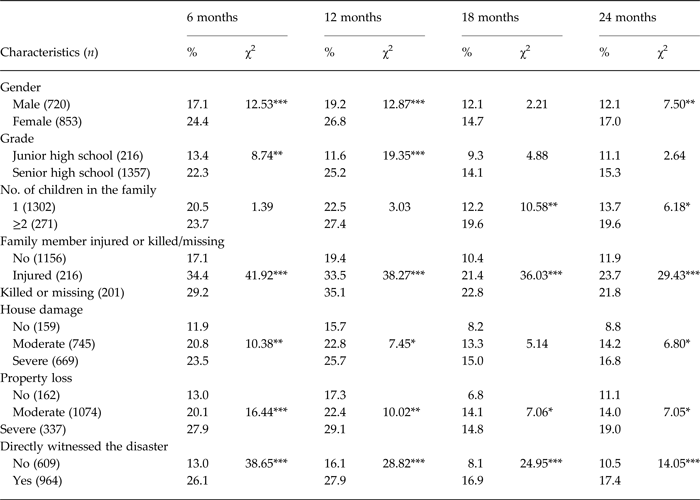
The prevalence of PTSD symptoms at 6, 12, 18 and 24 months was 21.0, 23.3, 13.5 and 14.7%, respectively. The differences in PTSD prevalence were significant between 6 and 12 months (χ1 2 = 5.1, p < 0.05) and between 12 and 18 months (χ1 2 = 98.1, p < 0.001), but not between 18 and 24 months (χ1 2 = 2.7, p > 0.05; see Fig. 1). Table 1 presents the differences in PTSD prevalence at each wave between different groups of demographic characteristics and exposure severity.
Prevalence rates and scores of post-traumatic stress disorder (PTSD) symptoms at four follow-ups after the Wenchuan earthquake. Statistics t and χ2 represent differences between two adjacent waves. For scores of symptoms, values are means, with standard errors represented by vertical bars. * p < 0.05, *** p < 0.001.

Prevalence of PTSD symptoms at four follow-ups by demographics and earthquake exposure (n = 1573)

PTSD, Post-traumatic stress disorder.
* p < 0.05, ** p < 0.01, *** p < 0.001.
Trajectories of PTSD symptoms
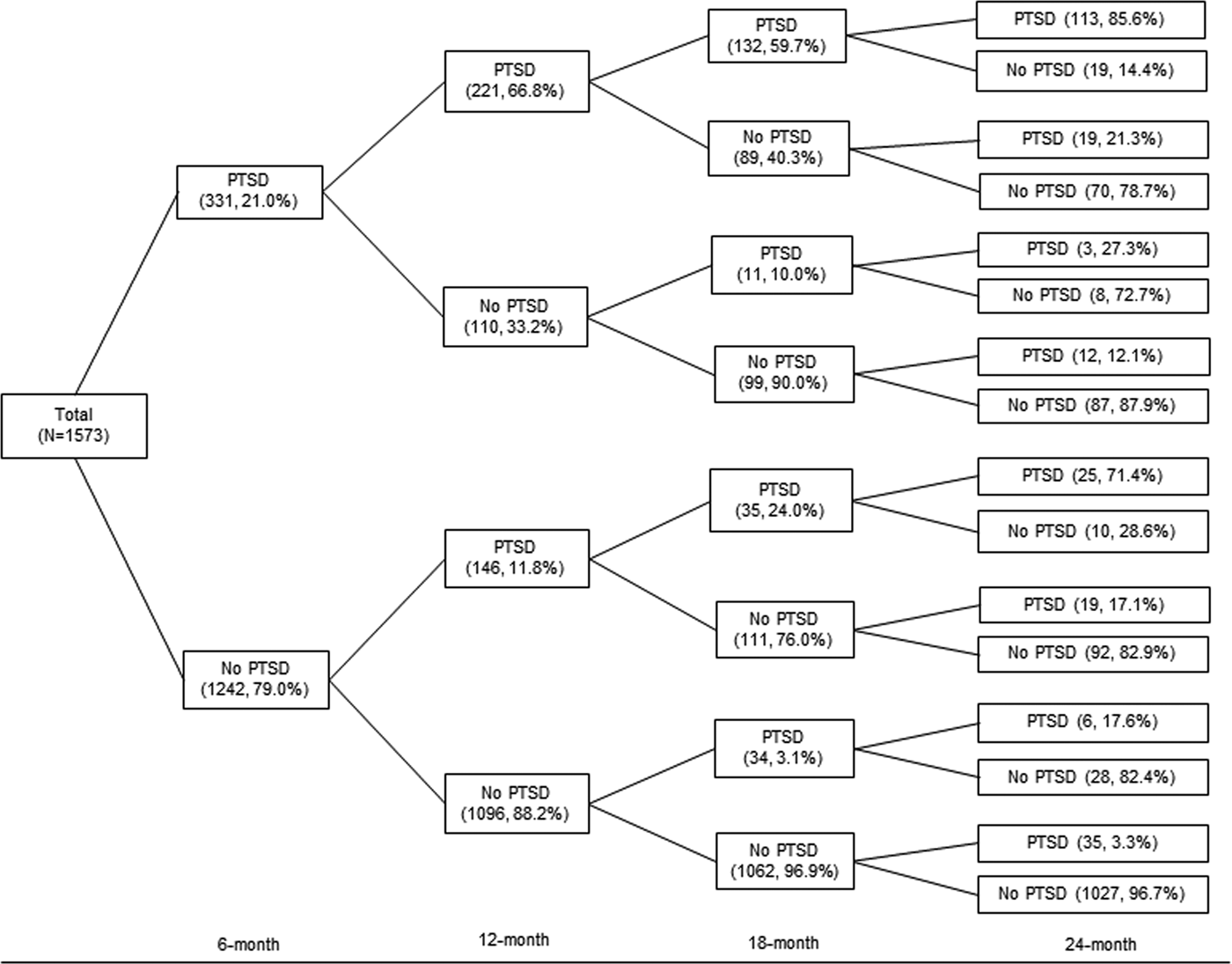
Through examining the heterogeneity in participants’ PTSD symptom changes across four waves, we identified five groups of PTSD trajectory, i.e. resistance, chronic dysfunction, recovery, delayed dysfunction and relapsing/remitting (Figs 2 and 3). The resistance group, comprising 65.3% of the sample, was characterized by participants’ PTSD-SS scores being below the cut-off of 50 at all four follow-ups. The chronic dysfunction group (7.2% of the sample) was characterized by participants’ PTSD-SS scores being equal to or above the cut-off value at all four follow-ups. The recovery group (20.0% of the sample) was characterized by participants’ PTSD-SS scores being equal to or above the cut-off value at 6, 12 and/or 18 months but below the cut-off at 24 months. The delayed dysfunction group (4.2% of the sample) was characterized by participants’ PTSD-SS scores being below the cut-off value at 6, 12 and/or 18 months but equal to or above the cut-off value afterward. The relapsing/remitting group (3.3% of the sample) was characterized by participants’ PTSD symptoms fluctuating and showing a cyclical course across the follow-up period.
Change patterns of post-traumatic stress disorder (PTSD) symptoms after the Wenchuan earthquake. Values represent numbers and percentages of adolescents screened as having PTSD symptoms at each wave.

Trajectories of post-traumatic stress disorder (PTSD) symptoms after the Wenchuan earthquake.

Predictors of PTSD trajectory membership
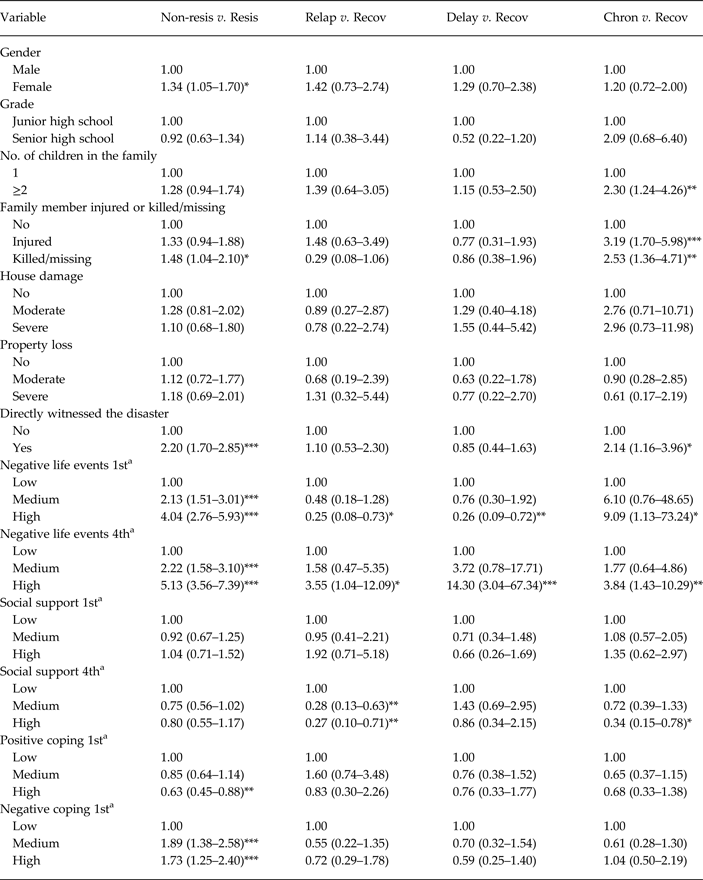
Multivariate logistic regressions were used to examine significant predictors of PTSD trajectory membership. Since our major interest was to explore the factors associated with increased likelihood of developing resistance and recovery, we first set the resistance group as the referent group and compared it with a ‘non-resistance’ group which was formed by combining the other four groups, and then set the recovery group as the referent group and compared it with each of the chronic dysfunction, delayed dysfunction and relapsing/remitting groups. As shown in Table 2, the likelihood of developing PTSD symptoms in at least one wave (‘non-resistance’) would increase if the adolescents were females [odds ratio (OR) 1.34, 95% confidence interval (CI) 1.05–1.70], suffered family members’ death/missing (OR 1.48, 95% CI 1.04–2.10), witnessed traumatic scenes during the earthquake (OR 2.20, 95% CI 1.70–2.85), experienced more post-earthquake negative life events (OR for medium v. low = 2.13–2.22; OR for high v. low = 4.04–5.13), and adopted less positive coping (OR for high v. low = 0.63, 95% CI 0.45–0.88) and more negative coping (OR for medium v. low = 1.89, 95% CI 1.38–2.58; OR for high v. low = 1.73, 95% CI 1.25–2.40).
Risk and protective factors of PTSD symptom trajectory groups

Data are given as odds ratio (95% confidence interval).
Non-resis, Non-resistance (including all other groups except the resistance group); Resis, resistance group; Relap, relapsing/remitting group; Recov, recovery group; Delay, delayed dysfunction group; Chron, chronic dysfunction group.
a 1st = 6 months after the earthquake; 4th = 24 months after the earthquake.
* p < 0.05, ** p < 0.01, *** p < 0.001.
As compared with the recovery group: (a) adolescents in the relapsing/remitting group experienced fewer negative life events at 6 months post-earthquake but more such events at 24 months (OR for high v. low = 0.25–3.55), and received less social support at 24 months post-earthquake (OR for medium v. low = 0.28, 95% CI 0.13–0.63; OR for high v. low = 0.27, 95% CI 0.10–0.71); (b) the likelihood of developing delayed dysfunction was greater for those reporting a lower level of negative life events at 6 months post-earthquake but a higher level at 24 months (OR for high v. low = 0.26–14.30); (c) adolescents having siblings (OR 2.30, 95% CI 1.24–4.26), suffering family members’ injury/death/missing (OR for injury v. no = 3.19, 95% CI 1.70–5.98; OR for death/missing v. no = 2.53, 95% CI 1.36–4.71), having witnessed traumatic scenes during the earthquake (OR 2.14, 95% CI 1.16–3.96), encountering more negative life events at 6 and 24 months post-earthquake (OR for high v. low = 3.84–9.09) and having less social support at 24 months post-earthquake (ORs for high v. low = 0.34, 95% CI 0.15–0.78) were more likely to develop chronic dysfunction.
Discussion
To our knowledge, the present study is the first longitudinal research that investigated the heterogeneous trajectories and predictors of PTSD symptoms among Chinese adolescent earthquake survivors. Our findings suggested that the overall severity of PTSD symptoms increased in 6–12 months and then declined to a stable level in 12–24 months. The study revealed five trajectories of PTSD symptoms, i.e. resistance, recovery, relapsing/remitting, delayed dysfunction and chronic dysfunction. Gender, grade, sibling number, earthquake exposure, post-earthquake negative life events, coping style and social support were significant predictors of distinct trajectories.
The prevalence of PTSD symptoms at 6, 12, 18 and 24 months was 21.0, 23.3, 13.5 and 14.7%, respectively. These rates were relatively higher than those in previous longitudinal studies that examined PTSD prevalence changes among adolescents exposed to the Wenchuan earthquake. For example, the rates of PTSD at 6 and 12 months were reported as 8.8% and 5.7% in Liu et al. (Reference Liu, Yang, Ye, Zeng, Xiang and Yuan2010) and 11.2% and 13.4% in Liu et al. (Reference Liu, Wang, Shi, Zhang, Zhang and Shen2011). The discrepant results may be attributed to different PTSD assessments (e.g. Trauma Symptom Checklist for Children or PTSD Checklist-Civilian Version were used in previous studies), or varying severities of samples’ earthquake exposure owing to different sampling locations. Our results also indicated that PTSD symptoms tended to be most severe at 12 months, suggesting an ‘anniversary reaction’ in the time course of PTSD symptoms. Such an anniversary reaction could be explained by Ehlers & Clark's (Reference Ehlers and Clark2000) cognitive model of PTSD, which posits that a trauma experience bears highly salient perceptual information and thus is represented in memory as a strong associative network of representations of stimulus perceptual features and related emotional, behavioral and physiological responses and interactive links among them. Accordingly, stimuli (such as the anniversary) having a resemblance to the perceptual information of the trauma experience can easily trigger the trauma memory, which would in turn induce as strong stress symptoms as the original trauma did. This highlights the importance of providing the adolescents with more intensive mental health intervention around the anniversary date.
The PTSD symptom trajectories showed that the majority of the adolescents (65.3% for resistance) exhibited very mild or no symptoms throughout the 2-year period post-earthquake. This is consistent with the findings of some meta-analyses (Foa et al. Reference Foa, Stein and McFarlane2006; Bonanno et al. Reference Bonanno, Brewin, Kaniasty and La Greca2010), that approximately more than half of the people exposed to a trauma exhibit acute stress responses only immediately after the trauma (which is normal) and maintain a stable trajectory of euthymia and healthy functioning. Of the current sample, 20.0% displayed a recovery trajectory. This proportion seemed larger than those reported by other studies that observed recovered PTSD following a trauma, such as 11.4% in survivors of the 1999 Mexican flood over a 2-year follow-up (Norris et al. Reference Norris, Tracy and Galea2009, study 1), and 8.4% in professional responders affected by World Trade Center terrorist attacks over a 8-year follow-up (Pietrzak et al. Reference Pietrzak, Feder, Singh, Schechter, Bromet, Katz, Reissman, Ozbay, Sharma, Crane, Harrison, Herbert, Levin, Luft, Moline, Stellman, Udasin, Landrigan and Southwick2014). A relatively larger proportion of recovery in our study may be due to solid financial and emotional support from both the government and the civilians to help the earthquake victims in China. Of the current sample, 7.2% showed chronic dysfunction over the follow-up period. The prevalence of PTSD chronicity appeared higher (around 15−20%) in previous trauma studies (Hull et al. Reference Hull, Alexander and Klein2002; Norris et al. Reference Norris, Tracy and Galea2009; Pietrzak et al. Reference Pietrzak, Van Ness, Fried, Galea and Norris2013), especially in those that investigated traumatic events involving interpersonal violence. For example, Armour et al. (Reference Armour, Shevlin, Elklit and Mroczek2012) followed 255 Danish rape victims for 1 year post-rape and found as high as 35% of the sample consistently exhibiting moderate to severe PTSD symptoms. The discrepancy in the prevalence of PTSD chronicity across studies reflects a well-evidenced phenomenon that as compared with natural disasters or accidents, traumatic interpersonal events (e.g. rape, sexual molestation and childhood abuse) can devastate the victims’ affective and cognitive functioning to a larger extent and thus produce more enduring PTSD chronicity (Kessler et al. Reference Kessler, Sonnega, Bromet, Hughes and Nelson1995). Moreover, a small percentage of the current sample exhibited the trajectories of relapsing/remitting (3.3%) and delayed dysfunction (4.2%). Concerning the presence of these two PTSD trajectories, previous studies reported mixed findings. While some studies detected the relapsing/remitting (Koenen et al. Reference Koenen, Stellman, Stellman and Sommer2003) and delayed dysfunction patterns (Pietrzak et al. Reference Pietrzak, Van Ness, Fried, Galea and Norris2013, Reference Pietrzak, Feder, Singh, Schechter, Bromet, Katz, Reissman, Ozbay, Sharma, Crane, Harrison, Herbert, Levin, Luft, Moline, Stellman, Udasin, Landrigan and Southwick2014), others failed to observe such trajectories (Norris et al. Reference Norris, Tracy and Galea2009, study 1; Self-Brown et al. Reference Self-Brown, Lai, Thompson, McGill and Kelley2013). It is possible that differences in the types and severities of disasters, the sample characteristics, the measurements and the follow-up durations across studies caused the inconsistent results. The proportions of relapsing/remitting and delayed dysfunction in our study were comparable with those in previous studies (both values were around 5%) (Koenen et al. Reference Koenen, Stellman, Stellman and Sommer2003; Pietrzak et al. Reference Pietrzak, Van Ness, Fried, Galea and Norris2013, Reference Pietrzak, Feder, Singh, Schechter, Bromet, Katz, Reissman, Ozbay, Sharma, Crane, Harrison, Herbert, Levin, Luft, Moline, Stellman, Udasin, Landrigan and Southwick2014). These studies also substantiated that the presence of relapsing/remitting and delayed dysfunction trajectories were largely related to secondary stressors (such as life adversity) following the trauma.
The current study found demographic characteristics including gender, grade and sibling number to be significant predictors of PTSD symptoms. Female gender was associated with an elevated risk of belonging to the ‘non-resistance’ group. Much literature has identified female gender as a risk factor for PTSD (Brewin et al. Reference Brewin, Andrews and Valentine2000; Fan et al. Reference Fan, Zhang, Yang, Mo and Liu2011; Zhang et al. Reference Zhang, Ran, Li, Ou, Gong, Li, Fan, Jiang and Fang2012). Our data also revealed that females had higher negative coping and more post-earthquake negative life events than males, which may explain the observed effect of female gender on the risk of developing ‘non-resistance’. Other possible explanations for the gender effect are that females are more reactive to stress and have stronger perceptions of threat and loss of control than males (Dedovic et al. Reference Dedovic, Wadiwalla, Engert and Puessner2009), so that they could be more prone to be affected by a disaster. Similar to other studies (Bal & Jensen, Reference Bal and Jensen2007), senior high students were found more likely to report PTSD symptoms than younger students. Greater academic stress experienced by senior high students may explain this phenomenon. Furthermore, our study showed that adolescents being an only-child were more likely to develop the recovery trajectory relative to the chronic dysfunction trajectory. The only-children were also found having significantly greater social support at 24 months post-earthquake than those with siblings. Receiving more care and support from family members and other people would undoubtedly promote only-children's recovery process. Besides, previous research has evidenced in Chinese samples that only-children as compared with non-only-children are more likely to possess some positive personality traits like extraversion, optimism and gregariousness (Cui et al. Reference Cui, Gao and Wang1994). These traits could also facilitate recovery from a disaster.
Our study also examined the predictive effect of traumatic exposure on the PTSD trajectory membership. The Wenchuan earthquake caused huge damage and great loss because of its high magnitude. The injury/loss of a loved one could devastate adolescents’ affective attachment system. Direct witness of traumatic scenes might exert adverse effects on adolescents’ cognitive and emotional functioning. Both aspects of earthquake exposure were found to increase the risk of PTSD chronicity in the current study. Other than family members’ injury/loss and witness of traumatic events, however, house damage and property loss had no obvious influence on PTSD symptom trajectories. A possible reason could be that the government implemented timely and effective relocation measures and provided financial compensation for the affected population after the earthquake, therefore alleviating the potential adverse effects of house damage and property loss on mental health status (Ye et al. Reference Ye, Fan, Li and Han2014).
Consistent with previous trauma studies (Freedy et al. Reference Freedy, Saladin, Kilpatrick, Resnick and Saunders1994; Zheng et al. Reference Zheng, Fan, Liu and Mo2012), the current data verified that suffering more post-earthquake negative life events was a common risk factor for distinct PTSD trajectories. For example, increasing negative life events from 6 to 24 months contributed to delayed dysfunction. Besides, adolescents exhibiting chronic dysfunction consistently experienced a high level of negative life events across the follow-up period. Prior researchers asserted that individuals’ mental health following a disaster may be more susceptible to post-disaster negative life events rather than the disaster per se (McFarlane, Reference McFarlane1987). Negative life events have an additive effect and aggravate adolescents’ post-disaster stress reactions by further increasing the ongoing daily hassles and strains, thereby affecting adolescents’ recovery from disaster. Accordingly, adolescents who suffered more negative life events post-earthquake should be paid more attention to and provided with more mental health support.
Social support could also predict distinct PTSD trajectories in the current data. Specifically, greater social support was found to increase the likelihood of recovery relative to relapsing/remitting and chronic dysfunction. Previous research repeatedly verified social support as a significant protective factor for PTSD symptoms (Ahmad et al. Reference Ahmad, Feder, Lee, Wang, Southwick, Schlackman, Buchholz, Alonso and Charney2010; Feder et al. Reference Feder, Ahmad, Lee, Morgan, Singh, Smith, Southwick and Charney2013). These together highlight the crucial role of social support in facilitating adolescents’ positive adaptation to traumatic events. Furthermore, our study evidenced the importance of coping skills in predicting PTSD symptoms. Specifically, positive coping was found to increase the likelihood of resistance, which was in line with previous findings (Zheng et al. Reference Zheng, Fan, Liu and Mo2012). In contrast with the protective effect of positive coping, negative coping was a significant risk factor for PTSD symptoms. These results point out the importance of integrating coping trainings into post-earthquake psychological interventions.
It should be noted that this study has some limitations. First, all measures relied on self-reports rather than diagnostic interviews or other-reports, which may be susceptible to participants’ own mental states and thus cause reporting bias. Nevertheless, all measures are well established and widely used in psychopathological research and practice in China. In addition, a time-frame of the last 6 months was set for the ASLEC and SSRS, both administered at 6 and 24 months post-earthquake, which could help participants to provide more accurate responses by allowing them to recollect negative life events and social support in a relatively short period of time. Results regarding the effects of these two factors on PTSD trajectories should be explained taking into account the restriction of the time-frame. Second, although our sample size was large, only students in the 7th and 10th grades from the initial assessment were followed up. Future work can improve generalizability of the current results by including participants with more diverse demographic characteristics. Third, due to ethical issues, we could not administer the initial assessment until half a year after the earthquake, which left the prevalence and trajectories of PTSD symptoms during the first 6 months post-earthquake unknown.
Conclusion
In conclusion, this study made a unique contribution to the literature by examining PTSD developmental trajectories and related predictors in a large sample of Chinese adolescent survivors exposed to the Wenchuan earthquake. The prevalence of PTSD symptoms showed the anniversary reaction. Five PTSD symptom trajectories were found: resistance; recovery; relapsing/remitting; delayed dysfunction; and chronic dysfunction. Gender, grade, sibling number, family members’ injury/loss, direct witness of traumatic events, post-earthquake negative life events, coping style and social support were significant predictors for PTSD occurrence and trajectory membership. These results could inform mental health professionals regarding how to provide individualized and appropriate intervention for adolescent earthquake survivors.
Implications
-
1. Approximately 23% of adolescent survivors suffered from PTSD symptoms at 1 year and 15% at 2 years after the earthquake. Long-term clinical and psychosocial interventions are needed to improve survivors’ mental health.
-
2. PTSD symptoms among adolescent earthquake survivors showed an anniversary reaction, suggesting that more intensive mental health intervention should be provided around the anniversary date.
-
3. Although many adolescents remain euthymic or recovery over time, some adolescents exhibited chronic, delayed or relapsing symptoms, especially those with the risk factors such as being female, senior grade, having siblings, injury/loss of family members, direct witness of traumatic scenes, post-earthquake life adversity, negative coping style and poor social support, indicating the need of appropriate interventions for high-risk adolescents.
Acknowledgements
The study was funded by the National Natural Science Foundation of China (grant no. 31271096) and the Major Program of the National Social Science Foundation of China (grant no. 14ZDB159). The study was also supported by the Research Center for Crisis Intervention and Psychological Service of Guangdong Province, South China Normal University. The funding institutions had no role in the study design, data collection and analysis, decision to publish, or preparation of the manuscript. We thank Shijian Chen (South China Normal University), who kindly provided advice in data analysis. We also want to express our sincere gratitude to the Women's Federation of Chengdu, Sichuan Province, for their support.
Declaration of Interest
None.