Introduction
Feminist theories of rapeFootnote 1 have successfully complicated the universalizing tendencies in feminist analysis which comprehend rape as ‘a conscious process of intimidation by which all men keep all women in a state of fear’.Footnote 2 Examples of sexual violence in times of conflictFootnote 3 show how the violent encounter brings together the institutionalized forces sanctioned by various modes of social power linked to discourses of nationalism, religious identity, caste, ethnicity, sexuality and politics.Footnote 4 However, there has been less work on sexual violence perpetrated on men apart from some notable scholarship related to slaveryFootnote 5 and the events in Abu Ghraib.Footnote 6 Explorations on the role of gender within colonialism have shown how gender constitutes a trope for race and sexuality through the feminization of the colonized.Footnote 7 My attempt in this paper is not to theorize wartime sexual violence as a reflection of the collapse of ‘civilized’ order and return to ‘savage’ human behaviour. Rather, as an act which humiliates and disempowers the victim, rape and sexual assault provide a way of acting out historically established notions of power relationships and identities that are normally discussed and represented in less physical, material ways. Wartime rape and sexual violence can be discussed in generic terms—in all contexts, in all battles, as a means of physically acting out power relationships in a manner designed to disempower an ethnic group—but the details of how that disempowerment is understood and experienced is grounded firmly in the very particular framework of historical and racialized differences as they have evolved in a society and space at that time.
This paper examines the silence relating to sexual violations by the West Pakistani army of East Pakistani men in the context of the Bangladesh war of 1971. I do this by locating the accounts of male violations by the West Pakistani army within the historical and colonial discourses relating to the construction of the Bengali Muslim and its intertextual, contemporary citational references in photographs and interviews. By citational, I refer here to the circulation and traces of discourses related to the intertwined processes of gendering and racialization of wartime rape that can be found in different contexts and times. I draw on Judith Butler's and Marilyn Strathern'sFootnote 8 work on gender to extend the understanding of these processes through engagement with a complex set of performative practices, particularly that of the citational and intertextual contestations of history and identity. The intertextuality of historical discourses, interviews and photographs also disrupt and fixes gendered, racial and territorial inscriptions of subcontinental identities.
To move away from the notion that femininity invariably connotes the female body, Butler shows how bodies become gendered through the continual performance of gender and hence gender is performative and imitative.Footnote 9 Butler proposes that ‘gender is an identity tenuously constituted in time, instituted in an exterior space through a stylized repetition of acts’.Footnote 10 Rather than performance, she refers to performativity which is citational: it entails citing past practices, referring to existing conventions, reiterating known norms. Performativity makes it imperative to explore the processes through which the body is gendered. This point is similar to Strathern'sFootnote 11 idea of embodiment, which examines how gendered difference is produced and experienced in social transactions and discourse whereby the action and end become the gendered activity. As a result, the gendered activity is not linked to the male or female bodies, but to the process and final version of the activity. By gender Strathern means:
those categorizations of persons, artifacts [sic], events, sequences and so on which draw upon sexual imagery—upon the ways in which the distinctiveness of male and female characteristics make concrete people's ideas about the nature of social relationships.Footnote 12
In the case of the Bangladesh war of 1971, the gendered performativity of rape ensures the feminization and subordination of the raped and masculanization and domination of the rapist. To understand this gendered performativity of male rape and women through its citational practices, the historical discourses relating to the Bengali Muslim need to be examined.
Bangladesh: a brutal birth (1972)
Ties of Islam, the Bengalis were taught, bound them to the stranger who came as a brother, speaking not their soft, native tongue, but a strident Urdu. Were these their brothers, these tall, fairer men who despised their rice-and-fish-culture and scorned their plaintive boat songs? Were these the people to whom they had handed their post-colonial destiny?Footnote 13
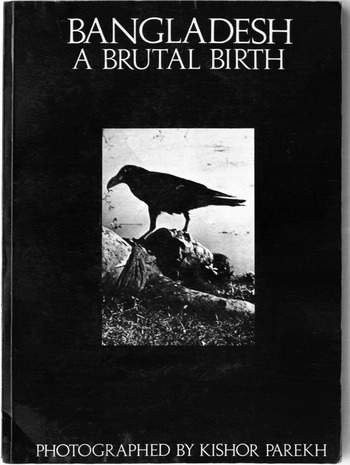
The post-colonial destiny of what was East Pakistan has undergone a double and disrupted trajectory through the liberation war in 1971 which lead to the formation of Bangladesh. In 1972, the publication of the book ‘Bangladesh: A Brutal Birth, Photographed by Kishor Parekh’ (Figure 1) brought together a startling set of photographs and became a moving document of the Bangladesh War. Kishor Parekh, who was Chief Photographer for the Hindustan Times in the mid 1960s in India, took these various photographs of the Bangladesh war ‘as a self-assigned and self-funded project’.Footnote 14 These photographs—taken over a span of two weeks—were published by Parekh himself. He printed 20,000 copies of the book all of which were purchased by the Indian Ministry of External Affairs for its own purposes of distribution. In the preface to the book, S. Mulgaokar, editor of the Hindustan Times in 1972, adds that ‘the dehumanization of Bangladesh defied imagination’ and that ‘these photographs describe the shudder of nine months lived at zero level’.
Cover of ‘Bangladesh: A Brutal Birth’ (Parekh 1972) Courtsey: Kishor Parekh estate.

In 1947, the independence of India from British colonial rule resulted in the creation of a new homeland for the Muslims of India by carving out the eastern and northwestern corners of the country, which came to be known as East and West Pakistan respectively. Reluctant to rely on religious allegiance alone, successive regimes in Pakistan embarked on a strategy of forcible cultural assimilation towards the Bengalis. In the above mentioned quote of Mulgaokar, found in the preface of Parekh's book, the prevailing discourses on the distinctions between the Bengali East Pakistanis and the West Pakistani army are emphasized in terms of language, physicality, food and aesthetic sensibilities. Over the years, various West Pakistani linguistic, administrative, military, civil and economic controls have led to the nine-month long liberation war in 1971. Thereafter East Pakistan became independent from West Pakistan and Bangladesh was formed. As a result of the war, it is thought that between 300,000 and 3 million civilians and around 50 intellectuals were killed, and many women were raped.Footnote 15 Significantly, after the war, instead of shrouding the issue of rape in silence, the Bangladeshi government publicly referred to the raped women as birangonas (‘war-heroines’) to prevent them from being socially ostracized, and attempted to rehabilitate them.Footnote 16
This paper draws from my research during the period 1997 to 1998 which ethnographically examines the public memories of sexual violence of the Bangladesh war of 1971.Footnote 17 During the initial few weeks of my fieldwork in Bangladesh, I increasingly realised that, unlike the common presumption that sexual violence during wartime is consigned to oblivion, there is no silence of the history of rape within the meta-narrative of the war of 1971. To the contrary, I found evidence of the constant invocation of the history of rape in state speeches and policies which eulogized the women raped as ‘war-heroines’, in documents dated 1972–1973 after the war and, in the 1990s, as exhibits in museums and as narratives of ‘real’ ‘war-heroines’ in newspapers.Footnote 18
Along with the prevalence of the rape of women in public memories, I also came across instances of male sexual violence which emerged in various interviews and photographs. A common narration was: in order to establish the religious identity of Bengali Muslim men during the war in 1971, Pakistani soldiers constantly checked that Bengali men were circumcised. Proof of their Muslim identity would be decided by the absent piece of skin on their penis. Following this procedure they would be spared and allowed to leave. To Pakistani soldiers, the non-circumcised penis was proof of Hindu identity and he might then be killed. Humiliation and gendering is intrinsic to both the processes of the rape of men and the checks on their penis. Nonetheless, they are not similar incidents and one incident does not necessarily lead to another. However there are various instances when the violation of men would be mentioned in passing and would seem as ‘thin’ evidence to scholars. The repetitiveness of these accounts is what makes these ‘thin evidences’ interesting to explore. In the documentation of sexual violence of the Bangladesh war however, there is no reference to instances of male sexual violence vis-à-vis the reiteration of the violent encounter of the ‘war-heroines’. It is important to point out that the phrase ‘absent skin’ should not be comprehended through a normative framework.Footnote 19 The absent skin standing in for the circumcised penis identifies in this context the positive personhood of the individual as Muslim.
The constant evocation of the rape of women during the Bangladesh war stands in contrast, to the silence relating to male rapes and violation during the war. One of the often cited reasons for the rape of the women during the war is that Pakistani soldiers wanted to improve the genes of the Bengali Muslim people and populate Bangladesh with ‘pure’ Muslims.Footnote 20 Bengali Muslims were also considered to be ‘Hinduized’, ‘half Muslims’ and ‘impure’, as evidenced in colonial discourses and documents of the eighteenth century. Here, acts of sexual violence during wars are framed within contexts of contestations of identity, historical and racialized differences. What are the relationships between historical discourses and the politics of identity with that of sexual violence during wars? In order to comprehend this triangulation: of sexual violence of men and women, the role of history and racialization intrinsic to these rapes and the silence relating to male rapes in independent Bangladesh vis-à-vis the reiteration of the rape of women, it is important to examine the process of gendering and racialization intrinsic to this violent encounter. As already suggested, the work of Butler and Strathern on gender and gendering allows an exploration of the historical contexts of the racialized discourses, that underwrite the sexual violation of women and men, its colonial and historical trajectories and its relationship to sexuality and masculinity.
This paper is based on discussions and interviews with liberation fighters, social workers and organizations working with raped women, as well as an examination of photographs and press reports after the war. The first section explores colonial and historical documents and their relationship with the discourses of wartime rape during 1971. It then examines how racialized, gendered and territorial inscriptions are made on the bodies of men through the search for the absent piece of skin on the male penis. The role of photographs and image-making is intrinsic to this discussion. Photography is important because it shows how the non-physical, discursive, historically established notions of power relationships and identities as put forward by West Pakistani authorities, can be redeployed to make a stronger case against the instances of sexual violence of the 1971 war by the Pakistanis, in independent Bangladesh. The particular framework of historical and racialized differences, as outlined by West Pakistan towards the East Pakistanis, has been subversively reinscribed in independent Bangladesh as a response to specific post-wartime contingencies. At the same time, the open semiotic of the photographs permits an exploration of the territorial identities within these images and leads us to the traces of the silence relating to male violations. Overall, the silence relating to male rapes and evocation of rape of women in independent Bangladesh suggests the need to explore the relationship between sexual violence during wars and the role of the state and sexuality in relation to masculinity within the context of these historical, gendered, racial and territorial connotations.
The Bengali Muslim gendered and racialized
As mentioned earlier, in the formation of Pakistan, Islam was the sole principle of nationhood unifying two widely disparate units, separated not only geographically but by sharp cultural and linguistic differences. The practice of ‘Islam’ among the Bengali Muslims bore the imprint of different historical and social forces and was fused with popular beliefs and practices. Islam and its observation was not static but was continuously reinterpreted based on which social class and during which period became its dominant carriers, spokesmen and representatives.Footnote 21 During the nineteenth and twentieth centuries British imperialists and Hindu and Muslim reformers—each for their own reasons—stressed Islam's foreignness, a move that further contributed to the notion that there was a certain tension between being Muslim and being a Bengali Muslim. ‘Orthodox’ Muslims in other parts of South Asia interpreted the practice of Islam in Bengal as too Bengali (perceived as Hinduized). Islamic revitalizing and purificatory movements in Bengal in the nineteenth and twentieth centuries launched a massive campaign against what they regarded as ‘innovations, accretions and deviations’ of ‘Indianized’, ‘half converts’, ‘nominal Muslims’ and therefore ‘unreliable co-religionists’.Footnote 22 In the light of these religious dynamics, successive regimes in Pakistan embarked upon a strategy of forcible cultural assimilation of Bengalis.Footnote 23 It is important to note that Bengali Muslims are differentiated among themselves and, at different points in time, various aspects of their multiple identities are stressed on the basis of diverse classes, ethnicity, use of language and practice of religion.Footnote 24
In 1971, the various horrific instances of rape during the Bangladesh war received a great deal of international and national attention. Bangladesh newspapers continued to give detailed accounts of the rapes until 1973. The ‘naturalization’ of rape during wars has been merely considered to be a ‘by-product’, a matter of poor discipline, the inevitable bad behaviour of soldiers ‘revved up’ and briefly ‘out of control’. CopelanFootnote 25 notes that ‘rape coupled with genocide inflicts multiple, intersectional harms’. As a result, it is critical to recognize the particularities emerging from the intersection of ethnic identities and gender violence and the racialized and gendered logics that come into play in the process within historical and colonial constructions. As mentioned earlier, in the context of West Pakistani perceptions of ‘Islam in danger’Footnote 26 in Bangladesh, one of the often cited reasons about the prevalence of rape of Bangladeshi women by soldiers of the Pakistani army was purportedly to ‘improve the genes of the Bengali people’,Footnote 27 as Pakistan apparently considered the practice of Islam in Bengal as ‘inferior and impure’.Footnote 28 The aim was also to populate Bangladesh with a new race of ‘pure’ Muslims and dilute, weaken and destroy Bengali nationalism. The imposition of religious, territorial, racialized and gendered boundaries was primarily marked on women's bodies and the womb. Rape of women in Bangladesh was apparently justified by the notion of maal-e-gonemat (‘the booty of war’).Footnote 29 It became the essential means to change the racial makeup of the ‘Hinduized Muslim’, the Kafer,Footnote 30 who were seen to be small-boned, short, dark, lazy, effeminate, bheto (rice and fish-eating and cowardly), half-Muslim Bengalis of the river plains compared with broad-boned, tall, fair, wheat-eating, warrior-like, resilient, manly, brave Muslims of the rough topography of Pakistan. Parallels of this discourse may also be found in Anthony Mascarenhas’Footnote 31 account of the Bangladesh war as the story of simple, gentle Bengali people persecuted by more aggressive, militant and more Islamic Pakistan. He states:
In West Pakistan, nature has fostered energetic, aggressive people – hardy hill men and tribal farmers who have constantly to strive for a livelihood in relatively harsh conditions. They are a world apart from the gentle, dignified Bengalis who are accustomed to the easy abundance of their delta homeland in the east.
In his novel Shame, Salman Rushdie, in attempting to portray the West Pakistani disposition towards East Pakistanis, writes:
Savages, breeding endlessly, jungle-bunnies good for nothing but growing jute and rice, knifing each other, cultivating traitors in their paddies.. . .the appalling notion of surrendering the government to a party of swamp aborigines, little dark men with their unpronounceable language of distorted vowels and slurred consonants; perhaps not foreigners exactly, but aliens without a doubt.Footnote 32
The prevalence of these discourses in contemporary Bangladesh can also be found among Chinese businessmen who consider Bangladeshis as ‘slow, lazy and dull in the head’ as they have too much rice and sleep.Footnote 33 This collapsing of the tropes of food, landscape and physicality to distinguish Bengali Muslims and the Pakistani army is discursively similar to the Mulgaokar's quote in Parekh's bookFootnote 34 mentioned earlier. This construction of the racial and physiognomic make-up of the Bengali Muslims in Bangladesh has a long historical resonance. In 1579 when Mughal imperial forces took over Bengal, it was equated to a site of socio-political decay.Footnote 35 Its ‘enervating’ climate, and with livelihoods based on fishing, was seen to corrupt men and paving the way for conquest by more ‘virile’, ‘manly’ races. This linkage of Bengal's climate with the ‘debased’ behaviour of the people exposed to it was later adopted by British officials. As a result, Robert Orme writing in 1763 noted that:
the abundance of advantages peculiar to this country have concurred with a languor peculiar to the unelastic [sic] atmosphere of the climate, to debase all the essential qualities of the human race and notwithstanding the general effeminacy of character which is visible in all the Indians throughout the British empire, the natives of Bengal are still of weaker frame and more enervated disposition than those of any other province.Footnote 36
An exploration of the historical and colonial discourses of gendered racializationFootnote 37 shows how these constructions circulate and manifest in contemporary times and are applied in the case of sexual violence during wars. Drawing from Butler's idea of performativity, this is the gendered performativity of rape. As a citational practice, performativity reiterates past colonial discourses within new colonial contexts and contributes to processes of gendering. In Bangladesh, acts of sexual violence during the war are framed within contestations of Bengali and Islamic identity arising out of historical, racial, religious, cultural and ethnic differences between East and West Pakistan.
The ‘unnatural’ violation
After the war, from 1972 onwards, Bangladeshi newspapers and the fifteen volume manuscripts of the Liberation warFootnote 38 provided testimonial accounts of the vivid and horrific accounts of the rape of women. The description of the beauty of the body of the raped woman through ‘her fair skin, waist-length long dark hair’Footnote 39 not only horrifies the reader's sensibility, it also makes them aware of the gruesome loss of an idealized, beautiful Bengali woman who, otherwise, would have been available for ‘legitimate’ heterosexual motherhood. Vis-à-vis these innumerable instances and descriptions of sexual violence against women, there is no reference in the documents relating to the war to sexual violence perpetrated against men. However, in my interviews with liberation fighters, incidences of sexual violence of men during the Bangladesh war were cited in the following way:
Men were also raped during the Liberation War which is totally unnatural to Asian plains culture and society. Here, it is more natural to rape women during wars. Rape of men is more a culture of the frontiers. Khan Shahebs had the most number of young purush poricharika - boy servants. As a result thousands of such rapes happened. I know of two boys of eighteen years old who were raped.Footnote 40
References to the rape of men would often be made in the context of mentioning the silences in the histories of 1971. This is different from references to the rape of women which are often articulated as public secrecies,Footnote 41 secrets that need to be repeated as secrets. References to the male rapes are often enveloped in a zone of taboo, and liberation fighters would often add ‘I don't know whether I should be saying this’. The comment highlights that rape of women is ‘natural’ to ‘here’, that is, in Bangladesh and to the ‘plains’. This naturalization of rape during wars and of men's propensity to rape during wars reflects Veena Das's critical analysis of rape cases and laws in India. She analyses instances when laws justify rapes by men by reiterating that ‘men fall into a natural state when the ordering mechanisms of culture are absent’.Footnote 42 This point was also reiterated during my interview with Mrs Fulrenu Guho, Director of the Rehabilitation of Refugee Women in India in 1971:
During wars there is a tendency to take opportunity in case of an attractive woman. A man would kill a man as the man could otherwise kill him. But women cannot kill a man and above all if a man killed a woman that would be cowardice. But these men could express their masculinity by raping her and rape is like killing a woman.
As a result, the ‘natural’ act of raping a woman becomes an expression of masculinity. Following the Director's comment, if a man kills a woman it also breaches a man's masculinity and he becomes a coward. Also, here Guho accepts that the act of rape is intertwined with sexuality and masculinity and thus sexuality becomes central to the operations of masculinity. Thus she is referring to sexuality as a set of practices that inscribes gender as unequal in social life. This is similar to Catherine Mackinnon'sFootnote 43 position who comments that rape is not only a matter of individual lust but also an affirmation of women as objects of pleasure which underlines the power of men. If women as gender female are defined as sexual beings and violence is eroticized, then men violating women has a sexual component.
The issue of sexuality is profoundly expressed in the negation of same sex rape in ‘Asian plains culture’ in the liberation fighter's comment.Footnote 44 Further, the distinction that is made of the sexual practices prevalent in ‘plains’ and ‘frontier’ culture shows how the historically established notions of power relationships and identities as put forward by West Pakistani authorities to denigrate Bengali Muslims—namely of that of the discourse of ‘weak men of the Bengal plains’—is being redeployed in independent Bangladesh to highlight the naturalized ‘depravity’ of the perpetrators to make a stronger case for the instances of male sexual violence during the 1971 war. According to the interviewed liberation fighter, since the Khans are used to having young purush poricharika (boy servants who provide sexual services) in the ‘frontiers’ of North-West Pakistan, male sexual relationships are a common occurrence there and ‘naturally’ the male violations took place in East Pakistan. This is, however, not the case in the plains of Bengal and as a result the rapists have also indulged in an ‘unnatural’ sexual act of raping men, when it is ‘natural’ to only rape women in the plains. It is important to note here the construction of different masculinities of different ethnic and linguistic groups in Western Pakistan. In Bangladesh, narratives relating to wartime rape of Bangladeshi women during 1971, primarily consider Punjabi soldiers and generals to be the perpetrators. Pashtun and Baluchi soldiers are, however, identified as the good soldiers. However the violation of men is identified here as a practice prevalent in the frontiers ‘culture’ whose liminality allows for sexual relationships with and rape of male servants. What would be the consequence of these multiple Pakistani masculinities—the patriarchal Punjabi rapist soldier, the good Pashtun and Baluchi soldiers and the ‘depraved’ Khans of the frontiers who raped men—were they to encounter the ‘effeminate’ small Bengali men and women?
These accounts of male sexual violence would often be accompanied by narrations of sexual assault in terms of how Bangladeshi men were checked by the Pakistani army during the war. They are not similar incidents and one incident does not lead to another. While I am trying to avoid a collapse in the distinction between male rape and male sexual assault, the seamlessness with which both are narrated in ethnographic settings is significant and worth noting. In interviews and press reports, individuals from various socio-economic backgrounds, pointed out that the Pakistani army confirmed they were Muslims by inspecting whether they were circumcised. As mentioned earlier, this was an attempt to reconfirm the Muslim identity of the ‘Hinduized’ Bengali Muslims physically and seek the unity of East and West Pakistan based on religious unity. People would be asked to get out of public transport at checkpoints, show their ‘danti’ (identity) cards, undo their lungis (a sarong like cloth worn by poor men most of the time and by richer men within their homes) or trousers and were then checked by the roadside. If anyone was found to be non-circumcised, they were deemed to be Hindus and would be killed.
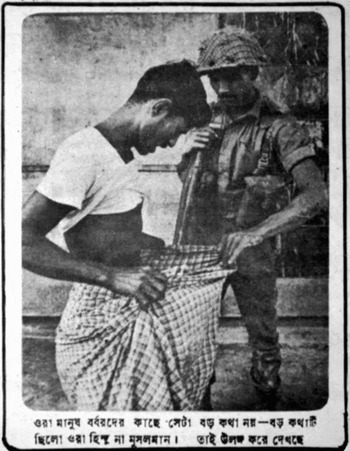
The presence or absence of the skin on the penis of men became a means through which religious, territorial, racialized and gendered boundaries were drawn on Bangladeshi men's bodies as evidenced through this photograph (Figure 2) taken by Kishor Parekh. Published in the Bangladeshi newspaper Doinik Bangla, Special Issue on Genocide, in December 1972, it had the caption: ‘That they are human is not important for these barbarians: what is important is whether they are Hindus or Muslims—so they are checking by making one naked’. Here, a Pakistani soldier is looking at the penis of the man by untying his lungi, to determine whether his skin is absent (circumcised) and that he is a Muslim. The man in the photograph might be a poor man as marked by the wearing of his lungi at all times and hence he is being checked by the Pakistani soldier in a public place, maybe by the side of a road, near a checkpoint. He could also be middle class and the soldier might have visited the man's home where he is subjected to this inspection. The soldier is marked by his helmet—an identifiable marker of the ‘military’—which is how the Pakistani army is referred to in rural Bangladesh.
Kishor Parekh's Photograph in Doinik Bangla: Genocide Issue, December 1972. Caption translation: That they are human is not important for these barbarians: what is important is whether they are Hindus or Muslims—so they are checking by making one naked.

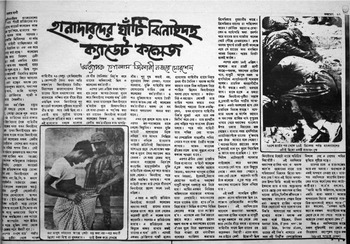
The expression of the man being checked shows his distraught state in this encounter, marked by violent surveillance, racialization and feminization. This photograph accompanied an article (Figure 3) with the title: ‘One of the bases of the Invaders was the Jhenaidah cadet college’ written by Professor Gholam Morshed.Footnote 45 The article goes on to describe how the members of the cadet college were attacked and fought against the Pakistani army in Jhenaidah, a western district of Bangladesh. The photograph accompanies the article but has no relevance to the text which makes no reference to the incidents of checks carried out on Bengali men. This widely-known photograph was circulated in other newspapers as evidence of the Pakistani army's discourse of checking the Bengali Muslims through their circumcised penis. Male wartime rapes by the Pakistani army are however predominantly narrated in oral accounts in innumerable conversations and interviews by individuals from different class backgrounds.
Article entitled Invader Armies base themselves in Jhenaidah Cadet College which accompanied Parekh's photograph in the Banglar Bani, Genocide Issue, December 1972.

The absent piece of skin
The search for the absent piece of skin on the penis is a proof of circumcision and of one's Muslim identity. Through this the Pakistani soldiers attribute a positive personhood to Bengali Muslims in East Pakistan and it ensures their membership to the ‘pure’ Muslim nation of Pakistan and the Muslim collective. Deepak Mehta, in his classic chapter on circumcision, shows how the circumcised body of the Muslim male is located in violent conflicts between Hindus and Muslims in contemporary India.Footnote 46 The term katua, (the cut, or circumcised one), is often used as a communal slur, by Hindus against Muslims in India. By being circumcised, Muslim men argue that the male body is socialized into a legitimate sexuality. During the Hindu-Muslim riots in Bombay in 1992–1993, the Muslim man was identified similarly, through his absent piece of skin on his penis (circumcision)Footnote 47 which could also lead to him being killed. The communal slur of katua, Mehta argues,Footnote 48 gives the temporal essence of menace, a deferred but inevitable aggression—the castration of the Muslim man in India. If men were found to be a katua during the Bombay riots, he would be ‘given the lathi (stick)’.Footnote 49 Here, the Muslim man gets hunted because of the wound of circumcision, a stigmatized mark of identity that he carries with him. Katua, as a result, identifies the savagery of the other, constitutes Muslims as inadequate males, animal-like and less than human. In the context of riots in India, the absent skin marks out the negative personhood of the Muslim man—the katua.
The photograph in Figure 3 shows that in East Pakistan/Bangladesh, the wound of circumcision is also the mark of identity of the other, the Bengali Muslim man, who is hunted for the mark he carries on him. Here, however, the attempt is to affirm his positive personhood, his Muslim identity and his membership in the ‘pure’ Muslim Pakistani nation, whose unity is threatened by the demand for independence by East Pakistan. The process of feminization that can be read through this image has resonance with the colonial constructions of Bengalis as lazy, effeminate, small, dark men. This also carries with it the traces of the colonial discourses which considered Muslims to be masculine while Hindus were deemed to be effeminate. In the riots in Bombay (India), this masculine Muslim needs to be demasculanized through the slur of the katua. In Bangladesh the already suspect feminized Bengali Muslim needs to be reconfirmed as a Muslim but in the process further feminized through violation. This contributes to Strathern's theorization of how gendered difference is produced and experienced in social transactions and discourse. Here the action and process of violation, terror and humiliation is manifested as a gendered activity, of feminization and racialization. The performativity of citational practices also genders the body in various ways.
Similar processes of feminization of colonized men through tropes of gender, race and sexuality is evident from the abusive techniques deployed at Abu Ghraib in 2004. Combining homophobic and homoerotic processes, Iraqi prisoners were gendered into a feminized passivity and vulnerability while their female American abusers are (re)-masculinized by their acts and images. This cannot be read as a simple foregrounding of race than gender as a determining category for domination or subjection to rape.Footnote 50 Here, ‘sexuality is a central and crucial component of the machinic assemblage that is American patriotism’.Footnote 51 Through the processes of gendering and gendered roles and tangled strands of racism, misogyny, homophobia, homo-eroticism, national arrogance, and hyper-masculinity of the American administration, Iraqi male prisoners were feminized. That an understanding of the discourses of construction of the colonized is significant becomes evident when we understand the sexual torture within these outsourced American prisons is ‘not only an example of power, but also as articulating a certain conception of sexual freedom that is instrumental in the accomplishment of military goals’Footnote 52 among the colonized Iraqis.
In East Pakistan/Bangladesh, the inspection often took place predominantly at checkpoints which become the terrains of anticipated violence. The slur of katua in the case of the Bombay riots, or the checks of circumcisions in East Pakistan, also allude to the possibility of the violence of castration. Dubravka ZarkovFootnote 53 has explored how the male Croat body is located within nationalist discourses on ethnicity, nationhood and statehood vis-à-vis the mutilated bodies of Muslim men in Croatia. Here the bodies of men stand in for the community instead of the women. It ensures a surveillance of the ethnic boundaries, which is bestowed to the penis and its multiple symbolisms. Zarkov notes:
The power to provide, to protect and to defend as well as to control and to define one's belonging to the ethnic group is symbolically vested in men. If there is a marker of ethnic boundary, then it is in the body part that will never be acknowledged as missing, and thus will never appear as a reason for honourable retirement from military or as a requirement for appropriate financial retribution—the penis.Footnote 54
Processes of interrogation of masculinity, emasculation also epitomize specific aspects of ethnicity. They are not only inadequate effeminate males with impure practices of religion and hence of a lower sexuality and ethnicity, they are also less than human, similar to those labelled ‘katua’. This is exemplified by the animal-like connotations of the Bengali Muslim, who is considered to be lazy, untrustworthy and conniving. The contrived animality allows him to be framed in behavioural terms as someone given to ruse and stratagem, similar to the Hutu constructions about the Tutsis in Rwanda.Footnote 55
The search for the absent piece of skin among Bengali Muslims by the Pakistani army shows how experiences of violence are translated into either a sense of community or the abrogation of what makes them human. Here ‘meaning is produced by that which is taken away’.Footnote 56 The attempt to identify who are the pure Muslims of the Pakistani nation through the scrutiny of circumcision affirms the collective. At the same juncture, it indicates the potential violence of castration which viciously engraves various gendered, racialized and sexualized identities upon the body of Bengali Muslim men and in the process denies them membership to the pure Pakistani nation. The making of this pure Muslim nation of Pakistan is, however, based on the decimation of the non-circumcised men who are equated to being Hindus. This is also an attempt to curb the sexuality of Hindu men, which seems to be of a greater threat to the Pakistani army. On the other hand, the effeminate, lazy, Hinduized Bengali Muslims, would always be suspect. They cannot be trusted and are considered to be animal-like, less of a Muslim, less of a man and less of a human. Violation of both men and women becomes an idiom of punishing the truant Bengalis who had ‘dared’ to seek independence. Though men and women are both being raped, the symbolism is different—one resulting in death and the other in sexual violence. Here gendered violence is coupled with historical discourses and is intrinsically intertwined with ethnicity and regionalism.
The gendered performativity of rape is ensured through the historical and colonial discourses relating to the construction of the Bengali Muslim and its intertextual, citational references in photographs and interviews relating to the wartime rape by the West Pakistani army. The bodies become gendered and racialized through the repetitive acts of sexual violence and surveillance of the absent skin on the penis. This citation of past colonial discourses relating to the feminization and racialization of the Bengali Muslims highlights the gendered performativityFootnote 57 of rape during collective violence like war and riots which ensures the gendering of both men and women's bodies as female, constituting them as political signs or territories on which political programmes become inscribed. In the following section I explore the open semiotic of photographs to show how the non-physical, historical and racial discourses, as propagated by the West Pakistani authorities and manifested in the sexual assaults of East Pakistani men, are subversively propagated in independent Bangladesh to make a stronger case against instances of wartime sexual violation by the Pakistani army during 1971. Whilst this paper has focused on inter-male power relationships and violations, the citationality and circulation in the photographs will highlight the role of forgetting of same-sex, male violations. The emphasis on memories of female rape, in turn, establishes the link between sexuality and the state in relation to masculinity.
‘Photograph [sic] is a certain but fugitive testimony’Footnote 58: the territorial semiotics of image
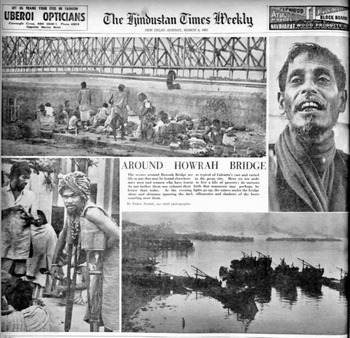
In the mid 1960s, when Kishor Parekh was working as Chief Photographer at the Hindustan Times he tried hard to establish the new genre of photo journalism based on the picture essays, as exemplified in his published collage of ‘Life around Howrah Bridge’, Calcutta, March 1962Footnote 59 (Figure 4). Parekh attempted to change the practice whereby the photographer was just an accompaniment to the journalist at a time when images were not valued editorially. His book of photographs on the Bangladesh warFootnote 60 was a similar exercise in this genre. The powers of his images were such that, as mentioned above, the External Ministry of the Indian government bought all 20,000 copies. This involvement of the Indian government, Parekh's connections as Chief Photographer of the Hindustan Times, and the endorsement of his book by the editor, Mulgaokar, by writing the preface, highlights how these images became significant for the Indian government as it made its case for its involvement and support of the Bangladesh war. ‘Brutal Birth’ is thus embedded not only in new genres of photo journalism but is also mobilized for the Indian nationalist paraphernalia and its support for the Bangladesh war.
Caption under this image by Pablo Batholemew (2008) on World Press Photo website: Life around Howrah Bridge, Calcutta, March 1962. An example of the introduction of picture essays in India in the early nineteen sixties. . .an hitherto unseen concept in Indian photojournalism. It was one of many photographic campaigns by Kishor Parekh. Courtesy: Kishor Parekh estate.

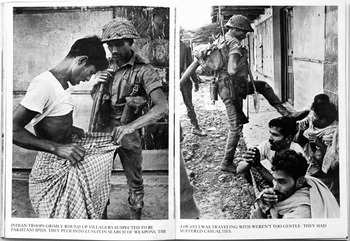
In an interview with Swapan Parekh—son of Kishor Parekh, who is in charge of his father's estate—I asked him how his father, as an Indian photographer had taken the photograph of the Pakistani army checking the circumcised Bengalis to confirm their religious identity. Swapan corrected me: he said it was a photograph of Indian army personnel checking the collaborators for weapons. This insight was validated by the caption under the photograph on the left in Figure 5 from Parekh'sFootnote 61 book. That the soldier in this photograph is Indian, is confirmed by Bangladeshi liberation fighters, because according to them, the SLR rifle in the image was a standard Indian army weapon during 1971. Pakistani soldiers carried Chinese rifles, including the AK 47, or G3 German rifles. The uncertainty of this image becomes apparent when it is accompanied by different captions. The alteration of the territorial link of the soldier as Pakistani or Indian also changes the discursive relationship of the soldier to the man being checked as a Bengali Muslim or a Pakistani spy respectively.
Kishor Parekh's photograph in his book, Bangladesh: A Brutal Birth (1972). Caption under the image on the left: Indian troops grimly round up villagers suspected to be Pakistani spies. They peer into Lungis in search of weapons. Courtsey: Kishor Parekh estate.

The photograph on the right shows the Indian soldiers kicking local collaborators and is accompanied by Parekh's caption: The jawans I was travelling with weren't too gentle: they had suffered casualties. Instead of the reiteration of the Bengali Muslim discourse through the checks on Bengali men, here the Bengali man is a collaborator. In place of the absent skin, by untying the lungi and ‘peering’ into them, the Indian soldier searches for weapons which might be used to resist the independence of Bangladesh. The differing territorial inscriptions enabled by the changed caption also highlight India's role in supporting Bangladesh independence and its attempt to root out ‘Pakistani spies’ by violating and humiliating them through these checks. The Pakistani soldier on the other hand seeks to search for the uncircumcised Hindu men and in the process humiliates and violates the ‘half Muslim’ Bengalis. Swapan Parekh was not aware of the different perspectives of this image which had become prevalent in Bangladesh.
The uncoded and open semiotic of the visual image is apparent here.Footnote 62 The uncertainty of the visual image shows how it does not represent a particular material referent. The image can have multiple interpretations according to the codes brought to it by its different viewers. Three signifiers in this image—the helmet, the rifle and the lungi—enable the seepage and different discursive readings by the various signifiers. The helmet of the soldier is a common marker of identifying the ‘military’—the Pakistani army in Bangladesh. That the helmet is also the mark of the army makes it part of the Indian soldier. Similarly the lungi marks the East Pakistani, either as the collaborator who is being checked for weapons by the Indian army or as those whose circumcision was checked by the Pakistani army to confirm their Muslim identity. The helmet, the rifle and the lungi allow various territorial and geo-political discourses to be mapped on the body of the soldier and the East Pakistani. What lies within the lungi, the absent skin or the weapon, is also part of the shifting territorial slippages, the politico-historical bases of different perceptual and visual regimes. Though Parekh and his work is endorsed by journalistic institutions and the Indian government through the mobilization of these images, the photographs of checking and kicking the collaborators however disrupt the saviour narrative of the ‘philanthropic’ Indian military. Parekh clarifies that they had suffered casualties and hence could not be gentle with the collaborators.
If Roland BarthesFootnote 63 argues that the irreducible essence of the photograph is in its affective power, then this photograph by Parekh has different affects for different audiences. The prevalent version of the photograph as found in Bangladesh in the Genocide Issue—and which identifies the figures in the image as the Pakistani soldier and the Bengal Muslim—plays out what BarthesFootnote 64 has referred to as the ‘studium’. Studium is the participation in the cultural, historical and politically transparent information of the photograph. The various historical discourses of the Bengali Muslim make the image recognizable and historically comprehensible to most Bangladeshis. The photograph with the caption by Parekh which identifies the soldier as Indian and the Bangladeshi as a collaborator arouses the still image from its flat immobility and brings into play Barthes punctum, that which breaks or punctuates the studium. Through this caption as punctum the image and its reference is disrupted, becomes animated and brings in the life external to the photograph.
The fact that Kishor Parekh's photograph was published immediately in the December 1972 Genocide Issue in Bangladesh with an altered caption to highlight prevalent and colonial discourses of racialization, sexualization and gendering, shows how the West Pakistani racial and historical discourses of denigration of the East Pakistanis is subversively deployed in independent Bangladesh by giving different meanings to these images, to the captions of these images, to the territorialities. The constructions relating to the ‘half Muslim’ Bengalis and its coupling with the issue of male violation and humiliation, is most strikingly highlighted through the image and its captions in the newspaper. This practice stands in contrast with the absolute silence of male violation in any official documentation of the Bangladesh war. The image with the altered caption is the only document which has made it possible to allude to and visualize those abuses which can only be found in interviews, oral accounts and anecdotes. The violation of Bengali men cannot be part of the national narrative, as both their powerful masculinity and their heterosexuality would be denied. It is easier to talk about the rape of women, which can thereby mobilize heterosexual men to join the guerrilla forces, defeat the Pakistani army, recover raped women and build the nation after the war. Here, on both sides, ‘war makers depend on particular ideas of masculinity’,Footnote 65 whereby heterosexuality is accorded the domain of the victor and perpetrator and emasculation, feminization and homosexuality that of the vanquished and the victim. The violated male body hence remains excluded from the national narrative.
My critique and focus on the post-nationalist memories of the history of rape during the war of 1971 could be easily read and appropriated by recent revisionist accountsFootnote 66 of Bangladesh's anyway unacknowledged genocidal history to say that ‘nothing happened in Bangladesh’ and it was all Bangladeshi propaganda. Instead, the focus on the silence of male rape and the open semiotic code, and multiple narratives of the same image allow us to examine the non-narrative, non-physical, citational quality of visual images and their subversive use in independent Bangladesh. Readings of the image and the altered caption thereby allow an identification of the silences and absent presences which can be alluded to but were kept silent in the official narrative. Through this the relationship between sexual violence, historical contexts, the state, sexuality in relation to masculinity is highlighted. Furthermore, it identifies how the relationships and sentiments that are linked to the image-making of the unacknowledged genocide of the Bangladesh war have given different meanings to these images, to the captions of these images. Here the performative locations, practices and checks conducted by the Pakistani and Indian soldiers locate them in varied gendered and racialized hierarchies. The signifiers of the helmet and the lungi cite differing territorial discursive connections and readings. The intertextuality of historical discourses, interviews and photographs also disrupts and fixes gendered, racial and territorial inscriptions.
Conclusion
Whilst historically few measures have been taken to address rape against women committed during armed conflict and post-conflict military histories, it has, however, been used as a weapon of war propaganda in different historical and political contexts: ‘Rape comes to light as part of competing diplomacies of war, illustrating the viciousness, “barbarism” of the conqueror or the innocence of the conquered’.Footnote 67
Incidents of sexual violence have often been used by governments and states to further national interests. During the partition of India in 1947, the ‘abduction’ and ‘recovery’ of women across Hindu and Muslim communities were dislocated from the status of events, pertaining to family and community. Instead, they became events marking the formation of the new nations of India and Pakistan where the kinship norms of purity and honour are articulated in a public discourse.Footnote 68 In Bangladesh, the eulogization of raped women as ‘war-heroines’, and their rehabilitation was also rooted in a modernist agenda and, according to social workers, it symbolized the dynamism of the new nation out of the ‘traditions and taboos of Muslim society’.Footnote 69
This paper has attempted to address the racialized and gendered discourses inscribed on the bodies of men and women through sexual violence during the Bangladesh war. Feminist theorizations of sexual violence rightfully analyse the role of power, domination and subordination in these violent encounters. However, there has been inadequate examination of male rapes. Here, the attempt has been not to explore only the experiences of these violations among men and women. It is important to examine the discourses and intertextuality and citationality of these various forces of history, politics and identity which give weight to these violent encounters and their varied gendered, racialized, sexualized and territorial inscriptions over time and during and after conflicts. I have drawn from Butler's and Strathern's work on performativity and gender to show how the process of gendering and intertextuality allows us to understand the process of feminization and masculanization intrinsic to various dynamics of identity and the violent encounter of male and female rapes.
Documents of various colonial and historical constructions reveal that Bengali Muslims were construed as Hinduized, effeminate, lazy, dark and conniving by British colonial officials—a construction which is also applied by the Pakistani army in the context of the sexual violation of Bangladeshi men and women. The discourse of genetic inscription in the act of sexual violence seems to suggest, an attempt to transform the very substance and personhood of Bengali Muslims into pure Muslims. In addition, this practice is also an attempt to leave behind a trace of the Pakistani soldier in the womb of the Bengali woman, with the hope that the children born would reflect later, in independent Bangladesh, the characteristics of their biological father and of the father embodied in the nation of Pakistan. This, I would argue, along with the earlier mentioned citationality of colonial discourses in the act of rape, renders the act of sexual violence during wars a racialized performance.
The eulogization of the raped women as ‘war heroines’ and the reiteration of the sexual violence towards women during the war, exist in a public discourse in Bangladesh, in a move that highlights the atrocities of the Pakistani army. The issue of male rape, however, remains undocumented in the history of the Bangladesh war. Sexual violence has not only enabled the feminization and racialization of the womb of the Bengali woman; in independent Bangladesh the discourse of feminization and racialization propagated by the Pakistani authorities is reiterated by consigning to oblivion accounts of the sexually violated Bengali man. While the notion of power is intrinsic to this process of sexual violation, a focus on power alone does not reveal the complex intersections between sexuality and the state in relation to masculinity. The processes of gendering thus allows an exploration of male and female sexual violence during wars vis-à-vis the post-war evocation of rape of women and the silence of traces of male violation. Through the reiterations and silences linked to various fractures in its racialized, gendered and territorial trajectories, the independent nation-state of Bangladesh re-centres legitimate sexuality in relation to its masculinities.
The traces of this violent encounter between men can be found in oral accounts. The visualization of these encounters was made possible with the open semiotic of the photograph by Kishor Parekh and the fixing of its meaning through the altered caption in 1972. As if this altered caption, the consequent discursive meaning, was the only means to keep a mark of the history of male violations which was bound to remain silent in independent Bangladesh. The shifting non-narrative terrain of this image allows a space from which dominant Bangladeshi national narratives on sexuality can be understood. At the same time, the West Pakistani racial and historical discourses that denigrate East Pakistanis have been subversively deployed in independent Bangladesh, to make the case for incidents of sexual violence by West Pakistan during the 1971 war, stronger. These myriad, interchangeable readings of territorial inscriptions of Pakistan, India and Bangladesh are, however, made possible by the presence of the repetitive, performative, citational signifiers of the helmet, the rifle and the lungi. The interchangeability of these territorial identities itself calls into question the borders and boundaries that exist in South Asia and compels us to ask whether there is a way to go beyond these territorial limits which the fractured history seems to disallow.