Introduction
Consanguineous marriage is a special form of assortative mating. Here members of a couple have at least one common ancestor. It is suggested that this type of marriage has been a long-standing social habit among populations (Saadat, Reference Saadat2007a, Reference Saadat2008a). Level of inbreeding depends on several factors, including demographic, religious, cultural and socioeconomic factors (Bittles, Reference Bittles2001; Saadat, Reference Saadat2007a).
This type of marriage has received a great deal of attention as a potential risk factor for many adverse health outcomes (Khlat & Khoury, Reference Khlat and Khoury1991; Al-Abdulkareem & Ballal, Reference Al-Abdulkareem and Ballal1998; Bittles, Reference Bittles2001; Bener & Hussain, Reference Bener and Hussain2006). Studies have shown a significantly higher incidence of malformation in offspring of consanguineous parents (Khlat & Khoury, Reference Khlat and Khoury1991; Abdulrazzaq & Bener, Reference Abdulrazzaq and Bener1997; Stoltenberg & Magnus, Reference Stoltenberg and Magnus1997; Becker et al., Reference Becker, Al-Halees, Molina and Paterson2001). Stillbirths and spontaneous abortions, infant death, as well as adult mortality have been shown to be positively correlated with consanguinity (Mokhtar & Abdel-Fattah, Reference Mokhtar and Abdel-Fattah2001). Consanguinity is also identified as a risk factor for several morbid conditions (Stoll et al., Reference Stoll, Alembik and Dott1994; Durkin et al., Reference Durkin, Khan and Davidson2000; Rittler et al., Reference Rittler, Liascovich and Lopez-Caelo2001). Based on ecological studies, it is reported that national IQ scores (Saadat, Reference Saadat2008b), incidence of suicidal burns (Saadat, Reference Saadat2005; Saadat & Zendeh-Boodi, Reference Saadat and Zendeh-Boodi2006) and child mortality rate (Saadat, Reference Saadat2007b) are correlated with level of consanguineous marriages.
Although consanguineous marriage has declined markedly in many parts of the Western world, it is still very common among countries in Africa and Asia (Khoury & Massad, Reference Khoury and Massad1992; Al-Gazali et al., Reference Al-Gazali, Bener, Abdulrazzaq, Micallef, Al-Khayat and Gaber1997; Khlat, Reference Khlat1988, Reference Khlat1989; Al-Abdulkareem & Ballal, Reference Al-Abdulkareem and Ballal1998; Bittles, Reference Bittles2001; Mokhtar & Abdel-Fattah, Reference Mokhtar and Abdel-Fattah2001; Saadat et al., Reference Saadat, Ansari-Lari and Farhud2004; Othman & Saadat, Reference Othman and Saadat2009).
Birth weight fits in a complex multifactorial framework of causality involving both genetic and environmental factors related to socioeconomic status (Clausson et al., Reference Clausson, Lichtenstein and Cnattingius2000; Spencer & Logan, Reference Spencer and Logan2002). Many attempts have been made to investigate the presence of an association between consanguinity and low birth weight, but previous studies have conflicting results. Although some researchers were unable to detect any effect of inbreeding on birth weight (Rao & Inbaraj, Reference Rao and Inbaraj1980; Asha-Bai & John, Reference Asha-Bai and John1982; Khlat, Reference Khlat1989; Al-Abdulkareem & Ballal, Reference Al-Abdulkareem and Ballal1998), a significant decrease in birth weight was identified by others (Sibert et al., Reference Sibert, Jadhav and Inbaraj1979; Kulkarni & Kurian, Reference Kulkarni and Kurian1990; Mumtaz et al., Reference Mumtaz, Tamim, Kanaan, Khawaja, Khogali, Wakim and Yunis2007; Badshah et al., Reference Badshah, Mason, McKelvie, Payne and Lisboa2008). This can partially be explained by differences in the population gene pools, methodological flaws, small sample size and poor allowance for potential confounders. Therefore, the association between consanguinity and birth weight remains inconclusive. Although numerous studies have found deleterious effects of inbreeding on birth weight of offspring, one question remains inadequately addressed: how does inbreeding lead to altered weight gain during the first year of life? Therefore, the objective of this study was to assess the effect of consanguinity on weight gain from birth to 12 months after birth in Shiraz (Fars province, southern Iran) where consanguinity is relatively high.
Methods
Data on consecutive live-born singleton newborns referred to a local health centre in Shiraz (Fars province, southern Iran) were collected. During the study period, a total of 250 singleton newborns were studied. The collected data covered socio-demographic characteristics (such as parental age at delivery and parental education), sex, birth order, weights from birth to 12 months after birth and consanguinity of marriages of parents. Data sources included direct interviews with mothers and also review of obstetric and nursery charts. Information on consanguinity was collected through direct interviews. Parental consanguinity was classified into five categories: double first cousin, first cousin, first cousin once removed, second cousin, beyond second cousin and unrelated marriages. The rate of consanguineous marriage was 40%. First cousin marriages were the most common (22.8%) type of matings. Considering the low prevalence of double first cousin, first cousin once removed, second cousin, and beyond second cousin marriages, only data for first cousin and unrelated marriages were used for the present study. Weights were measured, in grams, at five time intervals: at birth and at 3, 6, 9 and 12 months after birth. The other variables considered in the study as potential confounding variables were related to characteristics of the newborn and his/her parents.
Samples were excluded from the study if their parents were double first cousin, first cousin once removed, second cousin, and beyond second cousin marriages. As such, the study population consisted of a total of 207 newborns (57 offspring of first cousins, 150 offspring of unrelated marriages) that were included in the analysis.
To evaluate the association of suggested independent variables (consanguinity of marriages, sex, parental age at delivery, parental education and birth order) with offspring weight gain, repeated measurements analysis was used. Variables with p<0.30 in the univariate analysis were included in the final analysis. In the analysis, the following variables were used: type of marriage (0, unrelated marriage; 1, first cousin marriage), sex (0, female; 1, male), parental age at delivery (years), parental education (years) and birth order (0, nulliparous; 1, multiparous). Statistical analysis was performed using the Statistical Package for Social Sciences (SPSS Inc., Chicago, IL, USA) (version 11.5). A probability of p<0.05 was considered a statistically significant difference.
Results and Discussion
The rate of consanguineous marriage was 40%, which was similar to that previously reported for Iran (Saadat et al., Reference Saadat, Ansari-Lari and Farhud2004). First cousin marriages were the most common (22.8%) type of matings. Among Islamic countries, the most common form of consanguineous marriage contracted is between first cousins (Hafez et al., Reference Hafez, El-Tahan, Awadalla, El-Khayat, Abdel-Gafar and Ghoneim1983; Khlat, Reference Khlat1988; Saha & El-Sheikh, Reference Saha and El Sheikh1988; Khoury & Massad, Reference Khoury and Massad1992; Bittels et al., Reference Bittles, Grant and Shami1993; El-Hazmi et al., Reference El-Hazmi, Al-Swailem, Warsy, Al-Swailem, Sulaimani and Al-Meshari1995; Dawodu et al., Reference Dawodu, AbdulRazzaqm, Bener, Kappel, Liddle and Varghese1996; Rajab & Patton, Reference Rajab and Patton2000; Alper et al., Reference Alper, Erengin, Manguoglu, Bilgen, Cetin, Dedeoglu and Luleci2004; Gunaid et al., Reference Gunaid, Hummad and Tamim2004; Bener & Hussain, Reference Bener and Hussain2006; Wahab et al., Reference Wahab, Ahmad and Shah2006; Kerkeni et al., Reference Kerkeni, Monastiri, Saket, Guediche and Ben Cheikh2007; Othman & Saadat, Reference Othman and Saadat2009). Here data for first cousin and unrelated marriages were used.
In countries where marriage between close biological relatives is common, the highest levels of consanguineous marriages have generally been among communities with a low level of education, and these are more likely to be married and start childbearing at an earlier age (Tuncbilek & Koc, Reference Tuncbilek and Koc1994; Al-Abdulkareem & Ballal, Reference Al-Abdulkareem and Ballal1998). Since these factors are known to play an important role in weight gain of offspring, it was decided to include parental age at delivery, parental education and birth order in the analysis.
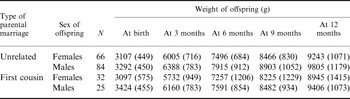
Table 1 shows the weight of the subjects from birth to 12 months after birth stratified according to their sex and types of parental marriages. In univariate analysis, there were significant associations between weight gain and sex (p<0.001), type of marriage (p=0.021) and paternal education (p<0.001). However, there was no significant association between weight gain and birth order (p=0.347), maternal education (p=0.128) and paternal (p=0.083) and maternal ages at delivery (p=0.259).
Means (SD) of birth weights and weight gains of offspring according to type of parental marriage and sex from birth to 12 months after birth

As mentioned in the Methods section, variables that were significant in the univariate analysis by p<0.30 (type of marriage, sex, paternal age and parental education) were included in the repeated measurements analysis of variance. Based on the results of the analysis, weight gain was associated with consanguineous marriage (p=0.018), sex of offspring (p=0.001) and paternal education (p<0.001). There was no interaction between type of marriage and sex (p=0.831). Offspring of consanguineous marriages showed lower weight gain in comparison with those of unrelated marriages during 3–12 months after birth.
There was significant difference between first cousin marriages in comparison with unrelated marriages for weight gain (p=0.018). It should be noted that the difference in birth weight was not significant between first cousin and unrelated marriages (p=0.460). In the literature, there is no consensus on the effect of consanguinity on birth weight (Rao & Inbaraj, Reference Rao and Inbaraj1980; Asha-Bai & John, Reference Asha-Bai and John1982; Khlat, Reference Khlat1989; Al-Abdulkareem & Ballal, Reference Al-Abdulkareem and Ballal1998). Our present result is not in concordance with reports of some investigators who reported a significant decrease in the mean birth weight of newborns of consanguineous parents (Sibert et al., Reference Sibert, Jadhav and Inbaraj1979; Kulkarni & Kurian, Reference Kulkarni and Kurian1990; Al-Awadi & Amin, Reference Al-Awadi and Amin1992; Dawodu et al., Reference Dawodu, AbdulRazzaqm, Bener, Kappel, Liddle and Varghese1996; Mumtaz et al., Reference Mumtaz, Tamim, Kanaan, Khawaja, Khogali, Wakim and Yunis2007; Badshah et al., Reference Badshah, Mason, McKelvie, Payne and Lisboa2008). Although there was no difference between offspring of first cousin marriages and unrelated marriages for birth weight, significant differences were observed from months 3 to 12 after birth. In other words, there was significant interaction between inbreeding and time (p=0.034). Based on our understanding the present study is the first to consider the effect of consanguinity marriage on offspring weight gain from birth to 12 months after birth.
Acknowledgments
The authors are indebted to the participants for their close cooperation. This study was supported by Shiraz University.