Roller–Crimpers and Terminating Cover Crops
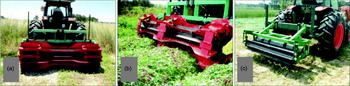
Rolled cover crops have been a primary research focus as a means to increase cover crop adoption and reduce tillage on organic farms in the southeastern USA. Rolling technology originated in Brazil where producers have been using rollers successfully for decades in no-till conservation systemsReference Derpsch, Roth, Sidiras and Köpke1. The Brazilian-type roller/crimper design (Fig. 1a) did not result in wide adoption in the USA in part due to vibration transferred to the tractor and operator as speed increased. To increase adoption, research has been conducted by the USDA-ARS National Soil Dynamics Laboratory since 1994 on new roller designs that are effective in terminating cover crop, but generate less vibration (Fig. 1b, c). Based on the success of the novel roller designs, new concepts for rollers/crimpers intended for vegetable production were developed, such as an elevated bed roller to terminate cover crops on row-tops and in furrows (Fig. 2).
Different roller types: (a) original Brazilian type straight bar roller, (b) curved bar roller–crimper and (c) smooth roller with crimping bar (U.S. patent no. 7,604,067 B1).

(a) Roller–crimper for elevated beds: one row and two furrows. (b) Roller for elevated beds: two rows and three furrows. (c) Two-stage roller/crimper designed to operate with smaller tractors (40 HP power source). The roller comprises a 30 cm diameter smooth drum which rolls down the cover crop and second small 15 cm diameter drum with six equally spaced 0.6 cm-thick crimping bars on the drum's perimeter. Depending on cover crop type and amount, crimping force can be adjusted by changing preloading force of two adjusting springs to obtain the best crimping characteristics for a particular cover crop. Patent pending—U.S. Patent no. 7,562,517 B1.

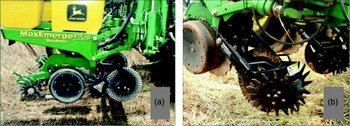
Both general principles and soil-type-dependent practices are needed for establishing cash crops in thick cover crop mulches. One general principle is the need to roll–crimp cover crops parallel to the cash crop planting direction because it minimizes or eliminates residue buildup on subsoiling and planting units. Previous research has documented that diagonal and perpendicular rolling directions will cause residue buildup, increase cleaning time of planting units from residue and decrease planting quality, i.e., skips in planting, ‘hair pinning’ and slow emergenceReference Kornecki, Raper, Arriaga, Schwab and Bergtold2. In addition, row cleaners mounted immediately prior to or after the cutting coulter (Fig. 3) can further enhance direct seeding and transplanting operations.
(a) John Deere no-till planter for planting cotton seeds into rye residue cover using DAWN™ row cleaners and (b) John Deere no-till planter with attached Yetter™ row cleaners.

Rollers have been shown to be beneficial by flattening the cover crop to provide a mat over the surface of the field and prevent multiple-direction lodging of cereal cover cropsReference Kornecki, Price, Raper and Arriaga3. Effectively killing cover crops without herbicides depends on the growth stage and species involved. The best growth stage for terminating cereal rye is from early milk to soft doughReference Ashford and Reeves4, late flowering for crimson cloverReference Parr, Grossman, Reberg-Horton, Brinton and Crozier5 (Trifolium incarnatum L.) and when pods are first seen in the upper five nodes of hairy vetchReference Mischler, Duiker, Curran and Wilson6 (Vicia villosa Roth). Rye is typically greater than 90% terminated after 3 weeks if rolling is performed at the optimal stageReference Ashford and Reeves4, Reference Kornecki, Price and Raper7, Reference Kornecki, Price, Raper and Bergtold8. Cover crops should be terminated 2–3 weeks prior to planting to restore soil moisture depleted by the cover cropReference Reeves9–Reference Price, Arriaga, Raper, Balkcom, Kornecki and Reeves11.
Weed Management Impacts of Reducing Tillage
For growers transitioning to and maintaining organic production, identifying effective weed control strategies can be the most problematic issue facedReference Archer, Jaradat, Johnson, Weyers, Gesch, Forcella and Kludze12–Reference Walz15. As with conventional systems, adequate weed control is crucial for achieving optimal yields in organic systems. Traditionally, organic producers have primarily relied upon mechanical methods to maintain sufficient weed control due to the lack of synthetic herbicide optionsReference Boyhan, Kelley, Langston, Sparks, Culpepper and Fonsah16. Whether through initial tillage, in-season cultivation, hand removal of weeds or flaming, mechanical means to inhibit weed growth are very effective tools for reducing weed pressure in organic systemsReference Boyhan, Kelley, Langston, Sparks, Culpepper and Fonsah16, Reference Singh, Granberry, Kelley, Boyhan, Sainju, Phatak, Sumner, Bader, Webster, Culpepper, Riley, Langston, Fonsah and Dris17. However, these practices degrade soil quality, require more labor, necessitate multiple field passes or may not fully control certain weed species. Several mechanical control tactics such as rotary hoeing or flex-tine harrowing can only destroy weeds at very early growth stagesReference Johnson and Mullinix18. Extensive cultivation with implements such as the rotary hoe can also damage cropsReference Place, Reberg-Horton and Burton19. Weather conditions, such as prolonged periods of precipitation, can also complicate mechanical control by delaying cultivation and allowing weeds to reach a growth stage that precludes effective control. Moreover, continuous tillage practices can increase soil erosion through water runoff in an agricultural system. Organic growers need additional weed control methods that are less time sensitive, less labor intensive and that enhance soil conservation and soil quality.
Mechanisms of weed control by mulches
Cover crops can stress weeds at multiple points in their life cycle, including reducing seedling establishment, minimizing growth and competitive ability and reducing or preventing production of propagulesReference Sarrantonio and Gallandt20. Emergence of small-seeded annual weeds is reduced with increasing rates of mulch residueReference Mohler and Teasdale21–Reference Teasdale and Mohler23. Some of the troublesome small-seeded broadleaf weeds common to the southeastern region include Palmer amaranth (Amaranthus palmeri S. Wats.), spiny amaranth (Amaranthus spinosus L.) and redroot pigweedReference Webster and Vencill24, Reference Webster and Webster25 (Amaranthus retroflexus L.). Physical impedance and light availability are important factors influencing weed establishment, especially with small-seeded weedsReference Teasdale and Mohler23, Reference Gallagher and Cardina26, Reference Gallagher and Cardina27, though other factors likely contribute to weed suppression, including allelopathyReference Putnam and Defrank22, Reference Burgos and Talbert28–Reference Reberg-Horton, Burton, Danehower, Ma, Monks, Murphy, Ranells, Williamson and Creamer30 and microclimate effectsReference Teasdale and Mohler31. Nitrogen immobilization may also be playing a role in soybean/rye systems because low N conditions can favor growth of N-fixing crops over non-N fixing weedsReference Wells, Reberg-Horton, Smith and Grossman32.
Cover crop productivity impacts on weed management
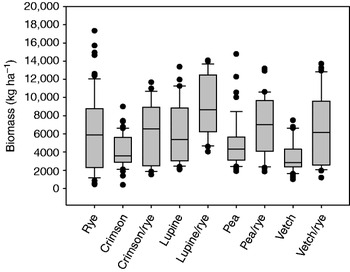
Hairy vetch produced 2340 kg ha−1 of dry biomass in Mississippi, but had little effect on reducing densities of smooth pigweedReference Koger and Reddy33 (Amaranthus hybridus L.). This level of biomass residue was likely insufficient to suppress weeds and likely degraded rapidly. In the northeastern USA, weed densities were reduced with cover crop residues between 6000 and 8500 kg ha−1, double the amount of documented growth in that regionReference Mohler and Teasdale21 (plots were supplemented with additional residues). Legume monocultures generally do not achieve that level of productivity in the southeastern USAReference Yenish, Worsham and York34 (Fig. 4). However, rye/legume mixes can produce significantly more biomass than legume monocultures (Fig. 4). Rye monocultures produce more biomass than other cover crops in AlabamaReference Reeves, Price and Patterson35, GeorgiaReference Schomberg, McDaniel, Mallard, Endale, Fisher and Cabrera36 and North CarolinaReference Yenish, Worsham and York34. Narrowleaf lupin (Lupinus angustifolius L.) is the only other winter cover crop that can reach biomass levels similar to rye but its sensitivity to frost damage limits its usefulness to the most southern parts of the region (Fig. 4). Mixtures of rye with winter legumes have shown increased weed suppression compared to winter legumes alone in Arkansas and may extend weed suppression benefits, as legume residues decompose more rapidly than ryeReference Burgos and Talbert37.
Productivity of legumes and legume/cereal mixes in the Southeast from 2008 to 2010. Figures come from a pooled analysis of trials in Georgia (GA) and North Carolina (NC). Box plots were created from nine site-years for all cover crops except for lupine and lupine/rye, with four to six replicates per site-year. Lupine data are from GA only (five site-years) due to extremely low productivity in NC. Crimson clover varieties: T. incarnatum L. ‘AU Sunrise’ in NC; ‘Dixie’ in GA. Vetch varieties: V. villosa Roth ‘AU Early Cover’ in NC; V. sativa L. ‘Cahaba White’ in GA. Winter pea varieties: P. sativum L. subsp. sativum var. arvense (L.) Poir ‘variety unstated’ in NC and GA. Narrow-leaf lupine varieties: L. angustifolius L. ‘TifBlue 78’ in NC and GA. NC data adapted from Parr et al.Reference Parr, Grossman, Reberg-Horton, Brinton and Crozier5. Rye (Secale cereale L.) at both locations was ‘Wrens abruzzi’ grown without added N fertility.

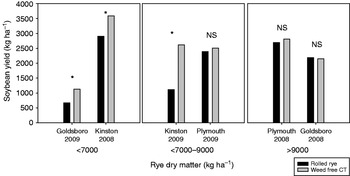
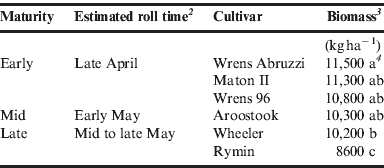
Traditionally, rye cover crops in the southeastern US are planted at relatively low seeding rates (60 kg ha−1) in late autumn, with minimal inputs, and are mowed prior to planting the summer crop. To maximize the weed control provided by a rye mulch, a more intensive cover crop management system is needed. Planting early, with higher seeding rates and adequate N fertility,Reference Kornecki, Price and Raper7, Reference Mirsky, Curran, Mortensen, Ryan and Shumway38 is needed to maximize the amount of rye biomass. Appropriate cultivar selection, long an under-studied component of cover crop systems, can also contribute to biomass production and affect the timing of the system (Table 1). While intensive management for a cover crop is uncommon, the potential economic value from improved weed control and higher crop yields would justify such investments. Relative to multiple spring tillage passes and repeated cultivations of the cash crop, more intensive cover crop management can be economically beneficial by comparisonReference Mischler, Duiker, Curran and Wilson6, Reference Smith, Barbercheck, Mortensen, Hyde and Hulting39. With adequate fertility, rye biomass yields can exceed 9000 kg ha−1; a level of biomass that affords excellent weed controlReference Mohler and Teasdale21, Reference Smith, Reberg-Horton, Place, Meijer, Arellano and Mueller40 (Fig. 5). However, substantial year-to-year variation in biomass production suggests that supplementary weed control will be necessary in some years.
Soybean yield in roll-crimped rye mulches. Treatments consisted of rolled rye mulch with no additional weed control measures (rolled rye) and a weed-free, conventionally tilled check treated with S-metoloachlor pre-emergence, imazethpyr post-emergence and hand weeding as needed. Adapted from Smith et al.Reference Smith, Barbercheck, Mortensen, Hyde and Hulting39.

Earliest roll times and productivity for rye (Secale cereale L.) cover crops in North Carolina. Rye was grown with 90 lb N applied to simulate maximal potential rye growth for each location.1
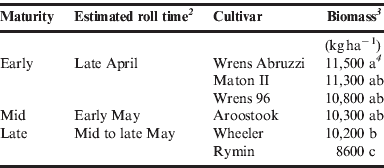
1 Adapted from Wells et al.Reference Wells, Reberg-Horton and Brinton62
2 Estimate based on average time each cultivar reached Feeke's stage 11.1 (milk).
3 Biomass values are averaged over three site-years in North Carolina.
4 Means followed by the same letter are not significantly different according to Fisher’s Protected LSD.
Supplementary weed control
Supplemental weed control options are limited when utilizing high-residue cover crop mulches. Most cultivators will not work in such a high-residue environment. One type of cultivator that is reportedly successful on a variety of soil types is the wide sweep cultivator mounted on a parallel linkageReference Smith, Reberg-Horton, Place, Meijer, Arellano and Mueller40, Reference Price, Patterson, Monks and Kelton41. Most models consist of a large, smooth coulter mounted ahead of a wide sweep cultivator that has one or two depth wheels located near each sweep. The angle of the sweep relative to the soil surface is generally adjustable. Running the cultivator completely flat, or parallel to the soil surface, severs weed root systems minimally disturbing residue and soil. However, rerooting is possible with wet conditions, particularly with smaller weeds.
Herbicide options are limited in number and efficacy in organic systemsReference Evans and Bellinder42, Reference Johnson, Mullinix and Boudreau43. Available herbicides used in the southeastern USA largely contain either clove oil or citric acid and are non-selective in natureReference Boyhan, Kelley, Langston, Sparks, Culpepper and Fonsah16. In addition to being costly, previous research has shown that these natural herbicides can be inefficient weed control methodsReference Johnson, Mullinix and Boudreau43. Under-leaf band spraying of nonselective herbicides would fit well into mulch systems, but the high cost and only partial effectiveness make them economically infeasible for corn and soybeans, though they may have a role in higher-value crops.
Fertility impacts of rolled cover crops
In the Southeast, the ideal time for successful roll kill of cover crops often occurs late in the spring and is not ideal for timely corn plantingReference Mischler, Duiker, Curran and Wilson6, Reference Teasdale, Devine, Mosjidis, Bellinder and Beste44, Reference Heiniger, Spears, Bowman and Dunphy45. It is now well understood that rolled termination of cover crops is most effective after plant anthesisReference Ashford and Reeves4. Susceptibility of legume cover crops to rolling has been shown to be significantly later than the traditional termination time for incorporated legumes, with rolling occurring in late-April for crimson clover varieties, mid-May for hairy vetch varieties and winter peas (Pisum sativum L. subsp. sativum var. arvense (L.)), and late-May for common vetch (Vicia sativa L.) and berseem clover (Trifolium alexandrinum L.)Reference Parr, Grossman, Reberg-Horton, Brinton and Crozier5. While late termination can delay corn planting, it can also result in significant increases in legume biomass N returned to the system due to having a longer period of time for spring growth and N accumulationReference Cooke, Gallagher, Kaye, Lynch and Bradley46–Reference Wagger48. Hairy vetch and crimson clover have been shown to average 4900 and 5500 kg ha−1, respectively, in North CarolinaReference Parr, Grossman, Reberg-Horton, Brinton and Crozier5, resulting in 150 and 120 kg N ha−1. A strong positive correlation has been found between the number of growing-degree days and vetch biomass productionReference Cooke, Gallagher, Kaye, Lynch and Bradley46, meaning that year-to-year variation in vetch production can be significant depending on planting date and winter temperatures.
Nitrogen mineralization from legume cover crops
Nitrogen delivery in rolled cover crop legume systems can differ significantly from green manure systems in which the cover crop is incorporated into the soilReference Hartwig and Ammon49. In particular, microbial function is affected by the change in plant quality that results from delayed termination, and by the change in decomposition kinetics due to the position of the rolled surface mulch in relation to soil decomposers.
The biologically driven, thus often delayed, termination time necessary in rolled systems is the first constraint that can potentially impact mineralization rate. As rolled cover crops are only successfully terminated at anthesis, plant quality and chemistry are expected to be distinctly different from earlier termination with herbicides. Decomposition and mineralization are microbial processes controlled in part by plant chemistry determinants. Such indicators include tissue C:N ratio, and cellulose, hemicelluloses, lignin and phenolic content. Ratios of C:N below 25 are assumed to release N soon after termination, but N mineralization slows with increasing hemicellulose, lignin and phenolic content, regardless of C:N ratioReference Ranells and Wagger50, Reference Palm and Sanchez51. Hairy vetch residue, having been found to have low hemicellulose concentrations and a C:N ratio of around 11, is known to release N faster than other residues in chemically terminated systemsReference Ranells and Wagger50. In rolled systems, C:N ratio has been shown to increase with later roll dates as plants age, with the lowest ratios in hairy vetch and winter pea varieties observed to range from 11 to 15:1 and crimson clover from 17 to 20:1Reference Parr, Grossman, Reberg-Horton, Brinton and Crozier5. Despite the relatively narrow gap in C:N ratios between crimson clover and hairy vetch, N release can be substantially slower from crimson cloverReference Parr, Reberg-Horton, Crozier and Grossman52.
The second constraint in rolled systems that could impact mineralization is the placement of the cover crop residue in relation to the decomposing soil microorganisms. Cover crop termination in organic systems is mechanical, often involving a combination of methods that may include tilling, mowing, undercutting and rolling/crimping; each differently affecting the ability of soil microorganisms to decompose and release biomass N. In general, residue incorporation buries plant tissue, placing it in close contact with decomposing soil microbes, and increases rate of decomposition and N release, which may lead to a lack of crop-N synchrony as N is released faster than crops can use itReference Gaskell and Smith53. Mowing or chopping residues increases residue surface area available to soil decomposers, increasing decomposition and reducing the overall biomass bulkReference Snapp and Borden54, Reference Swift, Heal and Anderson55. Previous work on no-till cover crop residues relying on chemical desiccation to terminate crops has been shown to increase N mineralization compared to untreated residuesReference Snapp and Borden54. Rolled cropping systems in the Southeast in particular provide a unique environment for cover crop residue decomposition. While the increased temperatures and moisture of southern climates may be favorable and hasten decompositionReference Schomberg and Steiner56, Reference Schomberg, Foster, Steiner and Stott57, the amount of soil-to-residue contact in rolled systems can also affect decompositionReference Swift, Heal and Anderson55, with position on the soil surface of rolled residue altering microbial access to residue and slowing N mineralization. Further, while surface residues can conserve soil water and prevent evaporation from the soil surface prior to canopy closureReference Baldwin and Creamer58, the exposed nature of surface mulches may slow decomposition as a result of reduced water content in the residue. Data on controls of N release in rolled cover crop legumes are scarce, and this is a topic that should be investigated further. Peak extractable soil N under rolled hairy vetch has been observed to occur at 4 weeks after termination, slower than is typical for incorporated residues in the region, but still earlier than peak N demand by cornReference Parr, Reberg-Horton, Crozier and Grossman52. Vetch/grass mixtures contain approximately the same amount of N as vetch monocultures, but mixtures can often release N more slowlyReference Ranells and Wagger50. Among legume species, variation in N release rates can be agronomically important. When terminated at anthesis, crimson clover release rates are notably slower than other legumesReference Ranells and Wagger50 and have even resulted in apparent net immobilization in rolled systemsReference Parr, Reberg-Horton, Crozier and Grossman52.
Future directions
Information on how high-residue systems are impacting on insect and disease management is mostly missing from southeast organic systems. One exception is a variety of studies in the Appalachian region on organic vegetable production with reduced tillageReference Overstreet, Hoyt and Imbriani59–Reference Hoyt and Walgenbach61, but equivalent work is missing in field crops. Anecdotally, three-cornered alfalfa hopper damage has been observed to be higher on soybeans in rolled rye in multiple states (Reberg-Horton, personal communication). While weed management has been a central area of inquiry in multiple states, long-term data on how these systems shift weed species composition are also lacking. A complete abandonment of tillage in organics is likely impossible, but the question of how much tillage can be removed from these systems without selecting for perennial weeds will require longer-term trials.
The next stage of organic research also needs to fine tune agronomic recommendations for growers. By all appearances, legume cover crop mulches should not be the sole source of N fertility for corn (Fig. 4). Methods and rates of supplementation need to be investigated. The combination of heavy residue and bulky organic amendments make these lines of work a nontrivial task. Another open question lies in how reliably cover crop mulches can provide enough residue to suppress weeds. Clearly, some winters are not conducive enough to cover crop growth for sufficient biomass. Farmers need tools to predict when biomass is insufficient so they can utilize off-field mulch amendments or a clean-till system instead. Ideally, models could assess cover crop biomass potential in the early spring when changing to a clean-till system is relatively easy. By late spring, even poor cover crop stands can be difficult to incorporate well enough to facilitate conventional cultivation.