Introduction
On 21st February 1977, farmers from Belorado, in the province of Burgos, positioned hundreds of tractors on the sides of the national road connecting the cities of Burgos and Logroño. In the following days, this conspicuous protest spread to a total of 28 provinces in the country and, according to various sources, mobilised between 40,000 and 100,000 tractors (Moyano Estrada, Reference Moyano Estada1984: 206–08; Arribas and González, Reference Arribas and González1984: 128–31; Langreo, Reference Langreo and García de León1996: 61–3).
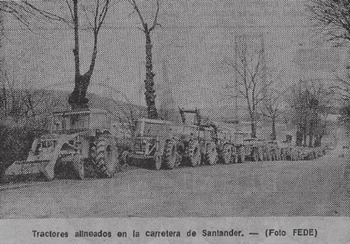
The tractor blockade came as a surprise to locals and foreigners alike. Not only because of itsmagnitude (Figure 1), but also because it was promoted by farmers with small and medium-sized holdings from the northern half of inland Spain, a social group which, as Luis Apostua – a prominent journalist and politician of the time – pointed out, was considered one of the social pillars of conservative Spain: ‘the men who have taken to the roads form the backbone of the classical Spanish right; the area of the protest has run from Navarra to Ciudad Real across the northern sub-plateau. This was the electoral map of the agricultural right in the 1930s’ (cited in Arribas and González, Reference Arribas and González1984: 131).
‘Tractors lined up on the Santander Road (Photo: FEDE)’, Diario de Burgos, 27th February 1977 <https://prensahistorica.mcu.es/es/catalogo_imagenes/grupo.do?path=1000460092&presentacion=pagina&posicion=10®istrardownload=0>.

The so-called ‘Tractor War’ was the most important agricultural protest of the Spanish Transition and, possibly, of recent Spanish history. However, farmers with small and medium-sized holdings in the northern half of inland Spain have received little attention from studies on agricultural mobilisation during the Transition. In fact, most of this work has focused on Andalusia, Catalonia and Galicia, peripheral regions with prominent progressive and/or nationalist political movements (Herrera González de Molina, Reference Herrera González de Molina2007; Díaz Geada, Reference Díaz Geada2011; Díaz Geada and Taboada Casteleiro, Reference Díaz Geada and Taboada Casteleiro2014; Fuentes Navarro and Cobo Romero, Reference Fuentes Navarro and Cobo Romero2016; Fernández Amador and Quirosa-Cheyrouze Muñoz, Reference Quirosa-Cheyrouze Muñoz and Fernández Amador2017; Ferrer González, Reference Ferrer González2018; Ferrer González and Puig Vallverdú, Reference Ferrer González and Puig Vallverdú2020). With the exception of a research project carried out on the region of Aragón (Sabio Alcutén, Reference Sabio Alcutén2001) and some references to Ciudad Real (González Madrid, Reference González Madrid and Ortiz Heras2008: 126–35), to date there are no studies on other important agricultural regions in the interior of the country (see Lanero and Míguez, Reference Lanero, Míguez and Lanero2013: 21). This is the case of Castile and Leon, which includes the nine provinces of the Duero River basinFootnote 1 and which was not only one of the epicentres of the ‘Tractor War’, but also one of the main focuses of the new agricultural unionism that emerged after Franco’s dictatorship (Fuente Blanco, Reference Fuente Blanco1990: 28).Footnote 2
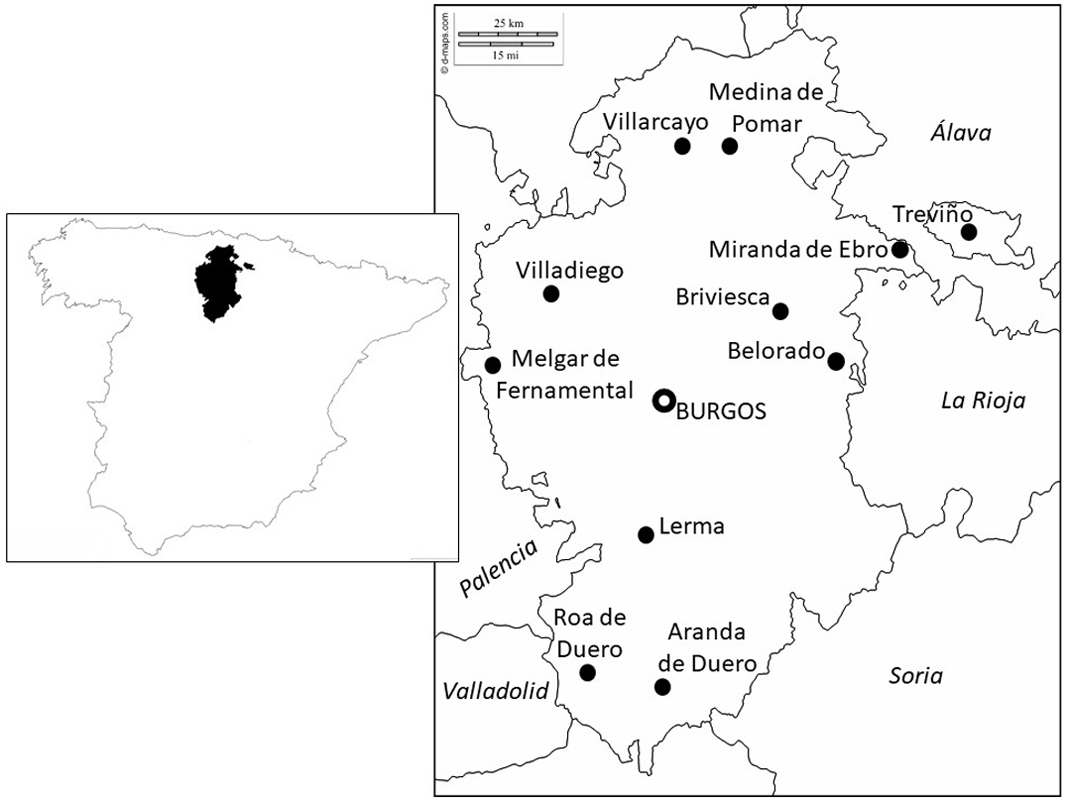
With this article, we hope to contribute to filling this historiographical gap by carrying out a study of the mobilisation and agricultural conflict in the province of Burgos (Figure 2) during the early years of the Transition (1975–80). This election has been motivated by two reasons.
Province of Burgos. Compiled by the author from <https://d-maps.com>.

First, because Burgos was a province that had an important agricultural sector. In 1980, it meant 20 per cent of provincial GDP, while it was only 9 per cent in the whole of Spain. Agriculture was predominant in central and southern regions of the province, mainly cereals dry-farming (these crops meant 60 per cent of provincial agricultural production), but also other crops such as sugar beet, potatoes or forage crops. However, livestock was predominant in northern mountainous areas of the province. Furthermore, provincial agriculture was based on small and medium-sized family farms: more than 75 per cent covered less than thirty hectares, and more than 50 per cent of the land was rented (Caja de Ahorros Municipal, 1980).
Second, because in Burgos province there was a clear conservative electoral dominance: the centre-right Central Democratic Union (Unión de Centro Democrático) won almost 48 per cent of the votes in the 1977 general elections and almost 53 per cent in the 1979 elections.
Our main aim is to show that, despite the conservative dominance, the agricultural sectors in the interior of the northern half of Spain also organised a notable agricultural union movement and a significant level of social conflict. Ultimately, they also played a part in the citizens’ mobilisation that fuelled the process of democratisation in Spain during the 1970s (Radcliff, Reference Radcliff2011).
To carry out this research we have used press articles from provincial newspapers (Diario de Burgos), regional newspapers (El Norte de Castilla) and national newspapers (El País); administrative documentation compiled from the Burgos Provincial Historical Archives (AHPB); and oral testimonies collected through interviews with key players.
The text is divided into four parts: firstly, we will provide a summary of the agricultural situation and the mobilisation of farmers in the province of Burgos during the last months of the dictatorship; secondly, we will analyse the ‘Tractor War’; thirdly, we will look more closely at the training and institutionalisation of Professional Agricultural Organizations (Organizaciones Profesionales Agrarias, OPAs); and finally, we will analyse the agricultural protests that took place from the tractor blockade of 1977 until 1980.
Agriculture in crisis, dissatisfied farmers
The fast-paced industrialisation of the Spanish economy from the 1950s onwards led to the crisis of the ‘traditional agrarian society’, which was manifested in three main ways: a greater dependence of Spanish farms on the vicissitudes of the international markets (which were beyond the control of the Spanish authorities); the mass emigration of farm workers (both day labourers and impoverished small farmers) to large cities or industrialised European countries, radically transforming the agricultural labour market; and the widespread introduction of machinery and chemicals in agriculture, often at the cost of significant investments by small and medium-sized farmers who ended up in debt (Abad and Naredo, Reference Abad, Naredo, Gómez Benito and González1997; Arnalte and Ceña, Reference Arnalte and Ceña1993).
From 1973 onwards, the Spanish agricultural sector also suffered the consequences of the economic crisis that spread throughout the industrialised countries, whose main effects on the Spanish economy were an increase in industrial unemployment, which blocked the movement of small-scale farmers out of the countryside, and a sharp rise in inflation, which was not compensated by the increase in agricultural prices set by the government. As a consequence, in the last two-thirds of the 1970s, Spanish farmers faced three main problems: rigidity in the land market that prevented them from increasing the size of their farms; high debt due to investments made to modernise their farms; and saturated international markets that led to a depreciation of agricultural prices. The main symptom of the agricultural crisis of the 1970s was an ‘income crisis’ for farmers, that is, the proportional decline in their incomes compared to those of workers in other productive sectors, which was significantly worsened by the effects of the 1979 oil crisis (Abad and Naredo, Reference Abad, Naredo, Gómez Benito and González1997; Arnalte and Ceña, Reference Arnalte and Ceña1993).
The farmers of Burgos were no strangers to these crises, as the President of the Provincial Government acknowledged in 1975:
Of the three economic sectors, the primary, secondary and tertiary sector, it is precisely the first, the agricultural sector, which is the most abandoned and forgotten, and which is far behind the income levels achieved by the other sectors.Footnote 3
The leaders of the vertical agricultural trade unionism publicly denounced these imbalances and demanded increases in agricultural prices. The government responded by creating a yearly round table for collective bargaining on agricultural prices with the participation of trade union representatives.Footnote 4 However, the farmers soon realised that these negotiations would not solve their problems and so the agricultural representatives left the first meeting in February 1976, ‘in protest at what they described as the ineffectiveness of this body in setting remunerative prices for the countryside’.Footnote 5
This situation generated unrest, and various groups of farmers began to express their demands outside the vertical bodies of agricultural representation. The main expression of this was the so-called ‘agricultural wars’, a series of protests to demand better prices for certain agricultural products by groups of farmers, many of whom depended on the large-scale agri-food industry. These included the ‘pepper war’ on the banks of the Ebro in 1973, during which the first tractor blockade in the country took place (Sartorius and Sabio, Reference Sartorius and Sabio2007 236); the ‘tomato war’ in Navarre, also in 1973; the ‘milk war’ on the Cantabrian coast between 1973 and 1974; an ‘asparagus war’ in Navarre and La Rioja between 1974 and 1975; and another ‘tomato war’ in Extremadura in 1975 (Alonso, Calzada, Huerta, Langreo and Viñas, Reference Alonso, Calzada, Huerta, Langreo and Viñas1976). The ‘agricultural wars’ broke the monopoly that the vertical trade unionism had over the farmers’ protest action, whose strategy was limited to demanding negotiations within the framework of the institutions; as an alternative, this led to the appearance of the first militant farmers’ associations under the influence of communist activists – the Communist Party of Spain (Partido Comunista de España, PCE), the Labour Party of Spain (Partido del Trabajo de España, PTE) – or members of progressive Catholic movements (Moyano Estrada, Reference Moyano Estada1984: 197–8; Sabio Alcutén, Reference Sabio Alcutén2006: 79–80).
In fact, in the early 1970s, various Rural Commissions (Comisiones Campesinas) were formed which, over time, led to the formation of Farmer’s and Livestock Producers’ Unions (Uniones de Agricultores y Ganaderos, UAGs) (Sartorius and Sabio, Reference Sartorius and Sabio2007: 234–5). In 1974 the Unió de Pagesos Footnote 6 was created in Catalonia (Ferrer González and Puig Vallverdú, Reference Ferrer González and Puig Vallverdú2020), which was the model that inspired other similar organisations in the rest of Spain, such as the UAG of Aragon, created at the beginning of 1976 after a ‘corn war’ (Sabio Alcutén, Reference Sabio Alcutén2001: 28–39), or, in Castile and Leon, the Farmers’ Union of Zamora (Unión de Campesinos Zamoranos), created at the end of the same year during conflicts over sugar beet.Footnote 7 Representatives of these organisations, which were still clandestine, held several Farmers’ Meetings from the end of 1975, which culminated in the formation, in December 1976, of the Coordinator of Farmers’ and Livestock Producers’ Organizations (Coordinadora de Organizaciones de Agricultores y Ganaderos, COAG), which integrated most of the Farmers’ Unions created during this period (Moyano Estrada, Reference Moyano Estada1984: 195–209).
In the province of Burgos there were also echoes of some of these ‘agricultural wars’, such as the ‘milk war’ of 1974 or the conflicts over sugar beet that affected several Castilian provinces between 1973 and 1974 (Alonso et al., Reference Alonso, Calzada, Huerta, Langreo and Viñas1976: 107–08, 123–31). Also, in May 1975, groups of farmers gave away several tonnes of potatoes in the capital city of Burgos and Aranda de Duero to protest against the large surpluses: ‘We are giving away potatoes because there is no one to buy them.’Footnote 8
However, unlike what happened in other parts of Spain, during these months no organisation similar to a Rural Commissions or UAGs emerged in Burgos. Nevertheless, in the heat of these conflicts, some people began to emerge, such as Leoncio Illera, a farmer from Aranda de Duero, who participated in the conflicts over sugar beet;Footnote 9 Pedro Puras, a vegetable grower from Belorado with links to the PCE, who participated in several farmers’ assemblies in 1975 and 1976;Footnote 10 José Antonio Rodrigo, a bank employee and PTE militant, who participated in the creation of the Rural Commissions in the neighbouring province of Valladolid;Footnote 11 or Carlos Andrés Pineda, a farmer who was in contact with grassroots Christian movements and who participated in meetings of farmers held at the Congregation of the Holy Spirit School College in Aranda de Duero.Footnote 12 All of them would play a key role in making Burgos one of the epicentres of the ‘Tractor War’.
The ‘Tractor War’
In the second half of 1976, a potato crisis began to develop in Spain due to high surpluses and low prices, which caused farmers in various regions to agree not to sell their produce.Footnote 13 This protest was supported by farmers in the Rioja Alta, a region bordering Belorado, who decided not to sell potatoes below 7.25 pesetas per kilo.Footnote 14 At a meeting held in the city of Burgos, agricultural representatives of the vertical unions from the Duero basin agreed ‘to raise and request from the Government that appropriate measures be taken as a matter of urgency, including possible exports … so that the farmer is guaranteed the minimum price of 7.70 pesetas per kilo’.Footnote 15 During the following months, the agricultural representatives continued to ask the government to authorise the export of potatoesFootnote 16 and, at the beginning of 1977, warned that: ‘If the export channel is not opened … there will be chaos among potato producers … the potatoes will remain unsold’.Footnote 17 In those days, the potato surplus was 700,000 tonnes, of which 130,000 tonnes were in the province of León and 100,000 tonnes in Burgos.Footnote 18 In mid-February, vertical union representatives met again to request the export of 60,000 tonnes of potatoes, but the Ministry of Trade only agreed to export 15,000.Footnote 19 The agricultural representatives of the vertical unions in La Rioja met to plan their response: ‘to send [a] strongly worded telegram of protest against the situation to the Ministries of Trade and Agriculture and the Presidency of the Government, to hold a new meeting with the provinces with similar problems in order to carry out a joint action, and to take steps in Madrid to obtain authorization to export potatoes in March’.Footnote 20
In other words, the agricultural representatives of the vertical unions insisted on the same negotiating strategy that they had pursued up to that point, but which was having little or no effect. However, by then it was already clear that not all farmers were satisfied with the action of the vertical representatives, and many of them, such as the farmers linked to the unions integrated into COAG, took the reins:
Just a few days ago, representatives of the State Farmers’ and Livestock Producers’ Coordinating Committee were in Madrid to try to discuss the issue of prices with the Minister of Agriculture. The Coordinating Committee is made up of 22 farmers’ organizations, almost all of which were created during the year of the changeover to democracy. They are free organizations, detached from the official trade unionism by which the employers in the sector feel less and less represented.Footnote 21
One of the main focal points of this mobilidation of protesting farmers was La Rioja where, as we have already seen, between 1973 and 1975 various ‘agricultural wars’ took place; and in 1976 the Union of Farmers and Livestock Producers of La Rioja (Unión de Agricultores y Ganaderos de La Rioja, UAGR), one of the founding organisations of the COAG, was created. In parallel with the action of the vertical agricultural unions, the UAGR organised its own assemblies to deal with the potato problem, where it was agreed ‘to adopt a hard line of tough measures’,Footnote 22 and in which Pedro Puras and other farmers from Belorado also took part.Footnote 23
However, the government did not authorise the assembly that was to be held on 18th February (Langreo, Reference Langreo and García de León1996: 61). In response, two days later, more than a thousand farmers met in Rodezno and voted unanimously to take the tractors out on the roads.Footnote 24 On the morning of the 21st February, hundreds of farmers from the Rioja Alta, accompanied by Belorado’s colleagues, parked their tractors on the hard shoulders of the national road linking Burgos and Logroño.Footnote 25
The government tried to stem the protests by authorising the export of 20,000 tonnes of potatoes.Footnote 26 It was too late. The problems of the Spanish countryside were accumulating and, in addition to the potato crisis, there was discontent because the government did not accept the price increases proposed by the agricultural representatives in the negotiations that were taking place in the same month of February,Footnote 27 and because the authorities did not authorise other assemblies of other unions, such as the UAG of Aragon.Footnote 28 Therefore, what was at first only a ‘potato war’, similar to other ‘agricultural wars’ that had taken place until then, became a ‘Tractor War’, where farmers not only demanded the improvement of the price of a particular crop, but also reforms in the whole of the government’s agricultural policy, including the structures of agricultural representation:
[T]he agricultural uprising that is dividing the country’s attention these days must be seen in the context of a spontaneous movement caused by the deplorable state of the rural environment, which has had to endure, little less than stoically, not only the burden of inflation and the industrial and urban development of this country, but has also been and continues to be manipulated by [vertical] organizations that have not demonstrated sufficient representativeness and identification with the authentic demands of the sector.Footnote 29
After the first protests of the farmers of La Rioja Alta and Belorado (and León),Footnote 30 it did not take long for thousands of other farmers in Spain to follow suit.
In Burgos, as we have seen, the tractor blockade started on the 21st February in Belorado, where the farmers took out six hundred tractors to demand:
-
1. Freedom to meet and organise our own union.
-
2. Full social security, covering both accidents at work and illness. Equality of benefits and allowances with those of the general scheme. Healthcare facilities in the head towns of the region.
-
3. Minimum guaranteed prices for agricultural products, stipulated by farmers and technicians in accordance with production costs.Footnote 31
On the 24th February, around 750 tractors joined the protest in Lerma and around 60 in the capital Burgos.Footnote 32 The farmers denounced the ‘prices of wheat, barley, sugar beet, pork and beef’ and demanded ‘the harvest of potatoes by the administration at 8.40 pesetas per kilogram; social security and freedom of association in the same way as other sectors’.Footnote 33
News of the demonstrations in Belorado and Lerma prompted farmers from other parts of the province to join the tractor blockade:
And we knew about it and … ‘Damn! They’ve got the tractors out! Well, let’s go and see.’ And first we went with the cars to see what that was … to Villalmanzo … And we went there. And then they decided: ‘We have to get the tractors out, so let’s go.’ And those of us from here went to Lerma.Footnote 34
On the 25th February, tractors began to be mobilised in Briviesca and Aranda de Duero;Footnote 35 and over the following days, the protest spread to the north of the province: Miranda de Ebro,Footnote 36 SedanoFootnote 37 and Medina de Pomar.Footnote 38 On 1st March, the civil governor acknowledged that there were six thousand tractors on the province’s roads,Footnote 39 although other sources put the figure as high as seven thousand.Footnote 40
The most important assembly took place between Lerma and the neighbouring village of Villalmanzo. This was both in quantitative terms, because the largest number of tractors in the whole province was concentrated there, between two and three thousand vehicles,Footnote 41 and also in qualitative terms, because the most numerous and representative assemblies were held in Villalmanzo, where hundreds of farmers from different parts of the province attended.Footnote 42 This had a lot to do with the action of José Antonio Rodrigo, a militant of the PTE, who organised and led the demonstrations and assemblies in Villalmanzo,Footnote 43 and for this reason, during the first days, he was the unofficial spokesperson of the farmers of the province, demanding: ‘the immediate negotiation of the price structure and the matter of Agricultural Social Security, and, at the same time, the development of farmers’ unionism’.Footnote 44 Finally, at the Villalmanzo assemblies a commission of farmers was elected who, together with representatives of the vertical union movement, met with the Minister of Agriculture in Madrid to try to reach an agreement that would put an end to the tractor blockade.Footnote 45
The scale of the protest in Burgos surprised everyone and caused various political sectors, from leaders of vertical unions to opposition groups, to attempt to take control of the farmers’ protests.
On the one hand, the Official Agricultural Chamber Unions (Cámara Oficial Sindical Agraria, COSA) of Burgos – the highest provincial body of vertical agricultural trade unionism – showed its support for the protest,Footnote 46 and its president, Fernando Redondo, declared: ‘The departure of the tractors onto the road began in Belorado due to the influence of Logroño. We immediately supported their demands. … I cannot say who instigated the departure of the tractors onto the road. But we are with them, as farmers and as the Official Chamber of Agricultural Unions.’Footnote 47
On the other hand, certain opposition parties also tried to take over the campaign. José Antonio Rodrigo, for example, took advantage of his influence in Villalmanzo to form a farmers’ union close to the PTE.Footnote 48 The PCE, in turn, tried to lead the protests of Burgos’s farmers from Madrid, through Alicia Langreo, a militant of the party who had considerable influence in the COAG, and who assumed the representation of the farmers from Burgos at the interview held in Madrid.Footnote 49
However, all these attempts to channel the ‘Tractor War’ were stopped by the farmers themselves. The demonstrators received with ‘scepticism and distrust’ the sudden interest shown by the COSA in their concerns, and described it as ‘an opportunistic manoeuvre by the Chamber, once we farmers are on the road’,Footnote 50 and, in Aranda de Duero, farmers booed the president of the COSA, Fernando Redondo.Footnote 51 The farmers also relegated to second place the activists of left-wing parties, such as José Antonio Rodrigo, who was removed from the leadership of the protest and replaced by a commission made up exclusively of farmers, including Manrique Carranza and Leoncio Illera. According to the latter:
When I had to face up to Rodrigo, it was a big deal. He was the boss at Villalmanzo. Nobody could get him to change his mind. And people began to arrive from one side and another, from another … to hold meetings. Of course, they chose me at that time … and by choosing me, well, bah! The PTE caused an uproar!Footnote 52
According to the press, the protest began to break up on the 2nd of March for two reasons: because many farmers felt that the state authorities had already heard their demands, and now they had to wait for their response; and because, after a change in the weather, it was necessary to sow their land urgently.Footnote 53 The first to withdraw, on the 2nd March, were the farmers of Briviesca.Footnote 54 The following day, the farmers from Castrojeriz and Melgar de Fernamental who were protesting in the capital, Burgos, followed their example.Footnote 55 Finally, between the 4th and 5th March, after an appeal by the COAG, all the tractors that remained in Burgos and the rest of Spain were removed from the roads.Footnote 56
The institutionalisation of the new agricultural unionism
The ‘Tractor War’ was a turning point in the development of Spanish agricultural unionism in the 1970s (Moyano Estrada, Reference Moyano Estada1984: 206–08) and, following this protest, hundreds of agricultural associations of different ideologies were set up on the fringes of vertical unionism. Many of them were legalised a few weeks later with the Law on Trade Union Freedom of April 1977. This is how the OPAs were born.
Essentially, two types of OPAs were created: the conservative Farmers’ and Livestock Producers’ Associations (Asociaciones de Agricultores y Ganaderos, ASAGAs) and the progressive Farmers’ or Livestock Producers’ Unions (UAGs). The ASAGAs were initiated by some leaders of the COSAs who wanted to take advantage of the prevailing discontent to reposition themselves in the new agricultural union landscape and thereby preserve their influence in the Spanish countryside (Moyano Estrada, Reference Moyano Estada1984: 230–1). The UAGs, as we have already seen, emerged during 1976–7 in connection with communist groups or progressive Catholic sectors (Moyano Estrada, Reference Moyano Estada1984: 197–8; Sabio Alcutén, Reference Sabio Alcutén2006: 79–80). The new OPAs soon embarked on a complex process of federations, confederations, mergers and/or absorptions, which led to the more than three hundred agricultural organisations that were legalised by the law of April 1977 being grouped into five major national OPAs: the National Confederation of Farmers and Livestock Producers (Confederación Nacional de Agricultores y Ganaderos, CNAG), made up of ASAGAs created under the umbrella of the COSAs; the National Centre for Young Farmers (Centro Nacional de Jóvenes Agricultores, CNJA) and the Union of Agricultural Federations of Spain (Unión de Federaciones Agrarias de España, UFADE), which brought together other conservative agricultural organisations with a reformist agenda; the Federation of Land Workers (Federación de Trabajadores de la Tierra, FTT), which was the agricultural section of the socialist trade union UGT; and the COAG, made up of the various UAGs (Moyano Estrada, Reference Moyano Estada1984).
This process was also reflected in Burgos, although with peculiarities, since while in most of Spain the agricultural unions that emerged between 1976 and 1978 were of a provincial or regional scope, in Burgos they were mostly on a district level, and were only later integrated into provincial organisations.
The first ASAGAs in the province were the ASAGA of Briviesca and its districtFootnote 57 and the ASAGA of the district of Roa.Footnote 58 These ASAGAs had a notable influence in their respective areas and even presented candidates for the 1979 municipal elections, as did the ASAGA of Briviesca.Footnote 59
Almost in parallel, various conservative agricultural groups, including the former president of the COSA, Fernando Redondo, created at the beginning of 1978 the Provincial Association of Farmers and Livestock Producers of Burgos (APAG), a provincial ASAGA, which in its statutes was defined as ‘a professional business association for the representation, management, defence, advocacy and promotion of the common, individual and collective interests of all its members’, among others aspects, ‘to demand respect, protection and encouragement for the right of private ownership of the means of production, essentially land’ and ‘to demand income parity in the agricultural sector with other sectors’.Footnote 60 The APAG presented itself in public in April 1978 defending ‘freedom of affiliation, professionalism, highly qualified representation and defence of the system of free enterprise and private property’, and held public events in the capital of Burgos and the main towns of the province: Aranda de Duero, Lerma, Salas de los Infantes, Pampliega, Castrojeriz, Melgar de Fernamental, Briviesca and Villarcayo.Footnote 61
The APAG would be the conservative OPA that represented Burgos farmers in supra-provincial OPAs such as the Regional Federation of Farmers and Livestock Producers of the Duero River Basin (Federación Regional de Agricultores y Ganaderos de la Cuenca del Duero), which brought together various ASAGAs from the provinces of Castile and Leon; and, at national level, UFADE.Footnote 62
The progressive agricultural sectors also formed their own unions. On the initiative of the PTE and José Antonio Rodrigo, the Farmers’ Union of Burgos (Sindicato Campesino de Burgos) was constituted at the beginning of March 1977, during the ‘Tractor War’ itself.Footnote 63 Although it was not legalised, it did hold some public events during the spring, such as the one that took place in May in Guzmán, near Roa.Footnote 64 Finally, in July 1977, the PTE group legalised the Union of Farmers and Livestock Producers of the Province of Burgos (Unión de Agricultores y Ganaderos de Burgos, UAG of Burgos), declaring itself to be a unitary, democratic, independent, working-class union.Footnote 65 Following its creation, the UAG of Burgos organised a campaign of meetings and assemblies in various towns of the province to attract members, as it did in February 1978 in ‘Riocerezo, Fuentecén, Atapuerca, La Horra, Estépar, Balcabado de Roa, Baños de Valdearados, Villaescusa, Campillo and Roa’, where, according to the press, about a thousand farmers attended.Footnote 66 As we were told by José Manuel de la Heras, head of the UAG of Burgos:
Every day, every week, we had meetings … people from here [in Aranda de Duero] met with people from Lerma, had dinner in a restaurant and planned the activities. We would ask the town councils for the hall and so on … because we had to ask, who were going to be the speakers, what they were going to talk about … We were going to meet up every day.Footnote 67
In contrast to the UAG of Burgos, the groups of farmers who had taken control of the assemblies in Villalmanzo (replacing José Antonio Rodrigo), created their own UAGs at the district level. In July 1977, the UAG of the district of Belorado submitted its statutes to the civil government; in September, the UAG of Aranda de Duero and its district; in October, the UAG of the district of Miranda de Ebro; in November, the UAG of the district of Lerma and the UAG of the district of Villadiego; and in January 1978, the UAG of the district of Treviño and the Puebla de Arganzón and the UAG of the district of Villarcayo.Footnote 68 Representatives of all these unions met in September 1977 to approve the statutes of a new provincial OPA that was named the Federation of Farmers and Livestock Producers’ Unions of the Province of Burgos (Federación de Uniones de Agricultores y Ganaderos de Burgos, FUAG).Footnote 69 The FUAG was the organisation that represented Burgos in the COAG, to the detriment of the UAG of Burgos, which, despite its efforts, was never accepted into the coordinating body:
The state organization [COAG] was created at the same time as the movements in the provinces. And there were people [from the UAG of Burgos] going there … I wasn’t going there, my brother was … we were going to Madrid wanting to join the COAG as a Farmers’ and Livestock Producers’ Union. And at the same time the people from the Federation were going … And that is where they said that, since it [the COAG] was most controlled by the Socialist Party, they were the ones who said that it was out of the question, that we [UAG of Burgos] would not.Footnote 70
Immediately, all of these new OPAs became the main representatives of Burgos farmers before the authorities and, as such, participated in meetings with various authorities to discuss different agricultural issues, such as the meeting held by ‘representatives of the provincial Farmers’ and Livestock Producers’ Union, the Federation of Farmers’ and Livestock Producers’ Unions of the province, and the Association of Farmers and Livestock Producers of Briviesca and its district’ with the Minister for Agriculture during his visit to Burgos in February 1978, where they discussed ‘various problems, including … those relating to agricultural price policy, the marketing and subsidizing of potato surpluses and others connected with the agricultural and livestock problems in Burgos’.Footnote 71
The institutionalization of the new OPAs – and their definitive recognition as legitimate spokespersons for farmers with the State – took place with the elections to the Agricultural Chambers in May 1978. The Agricultural Chambers were created in June 1977 as a body to manage the agricultural affairs of the municipality and whose members had to be elected by direct universal suffrage. However, apart from the way in which their members were elected, the Agricultural Chambers were in fact the heirs of the old Local Brotherhoods of vertical agricultural unionism, since they had the same bureaucratic functions and their former officials (secretaries). This led the progressive OPAs to reject the Agricultural Chambers, considering them as a continuation of Franco’s regime that overlapped with the free action of agricultural unions, and to demand, as an alternative, union elections similar to those in the industrial sector (Moyano Estrada, Reference Moyano Estada1984: 266–70; Herrera González de Molina, Reference Herrera González de Molina2009: 231–3).Footnote 72
This rejection led to a strong internal debate within the COAG (Moyano Estrada, Reference Moyano Estada1984: 268–9) over the call for elections to the Agricultural Chambers. On the one hand, there were unions (mainly the Unió de Pagesos) that believed that they should not participate in the elections because this would legitimise an anti-democratic body. On the other hand, there were unions, which, while rejecting the legitimacy of the Agricultural Chambers, thought it advisable to run for election to avoid being taken over by the conservative unions and, if they won, to strip them of their legitimacy. The FUAG adopted the latter position.Footnote 73 The UAG of Burgos also had this debate:
[W]e put candidates forward because we wanted something to change so badly that … but, of course, later on, analysing it over time, you see that this was a bit of a prolongation of the regime, it was not pure union freedom. But we said: ‘Well, it’s a step forward, then once we’re in, we’ll see if we can dismantle it …’. I remember that at that time we said: ‘If this is going to happen, and we don’t participate, we leave the whole field open to those who do want to get involved’, which were all the right-wing organizations.Footnote 74
The call for elections to the Agricultural Chambers further boosted agricultural union activity in the province. In fact, the OPAs organised meetings, assemblies and rallies where they presented their respective union programmes to the farmers.Footnote 75 These events, in turn, allowed farmers to get to know and assess the different organisational tendencies that coexisted in provincial agricultural unionism. An example of this union activity was the round table organised at the Roa television club, with the participation of Carlos Andrés Pineda, then president of the FUAG, José Antonio Rodrigo from the UAG of Burgos, and José Cabornero, president of the ASAGA of Roa.Footnote 76
Elections were held on 21st May 1978. In Burgos, almost 23,000 farmers were called to vote and they had to elect more than 3,100 representatives to form 384 Agricultural Chambers.Footnote 77 The FUAG presented 96 candidatures, compared to 58 from APAG and 29 from UAG of Burgos.Footnote 78 The predominance of the FUAG was also reflected in the results, with 403 representatives, compared to 108 from the UAG of Burgos and 82 from the APAG. However, what really characterised the elections in Burgos was the high abstention (51.5 per cent of the census did not vote) and the victory of the independent candidates (with more than 2,500 representatives),Footnote 79 two phenomena that also characterised the elections at national level.Footnote 80
With these results, the FUAG was able, in the first instance, to take over the presidency (with Manrique Carranza) and the two vice-presidencies of the Provincial Agricultural Chamber.Footnote 81 However, after a legal appeal, the Provincial Court acknowledged the validity of 240 ballots that had previously been invalidated because they were 4 millimetres wider than the model established by the Electoral College. This judicial decision led to the revocation of three FUAG members in favour of candidates from the ASAGA of Briviesca.Footnote 82 These changes, together with another FUAG member changing sides,Footnote 83 led to the formation of a new majority in the plenary session of the Agricultural Chamber, which gave the presidency to Eduardo Gutiérrez,Footnote 84 one of the candidates of the ASAGA of Briviesca.
With all their pros and cons, the elections to the Agricultural Chambers made two things possible: first, they were a school of democracy for the inhabitants of rural Spain and, as Herrera González de Molina (Reference Herrera González de Molina2012: 104) pointed out, ‘it served as a political apprenticeship in view of the municipal elections held a few months later [in April 1979] and certainly allowed the exercise of the vote to be freer’; and second, they made it possible to see the strength of the country’s various OPAs (Moyano Estrada, Reference Moyano Estada1984: 272–6; Herrera González de Molina, Reference Herrera González de Molina2007: 200).
The results of the elections certified the dominance of the FUAG within Burgos’s agricultural unionism. According to José Manuel de las Heras, of the UAG of Burgos: ‘Here in Burgos everyone was there, red, blue, yellow … everyone was in the Federation.’Footnote 85 We believe this occurred because despite its progressive origins, the FUAG was able to attract farmers with very different ideologies, who nevertheless shared a sense of dissatisfaction towards the government’s agricultural policies. A clear example is Bonifacio Ruiz, who in 1977 led the ‘Tractor War’ in Medina de PomarFootnote 86 and in 1978 was elected vice-president of the Provincial Agricultural Chamber representing the FUAG,Footnote 87 and later ran in the 1979 general elections as a candidate for the Senate for the conservative Democratic Coalition.Footnote 88
The FUAG was able to achieve this cross-cutting nature because it was the most independent and militant agricultural trade union in the province. It was independent because the FUAG was formed, as we have seen, from below, by the convergence of county unions led by farmers who, in principle, were not prominent party activists; unlike other trade unions, such as the UAG of Burgos and the APAG, who were steered ‘from above’ by prominent activists from political parties, such as José Antonio Rodrigo, from the UAG, who had been a candidate for the PTE in the 1977 elections, or Fernando Redondo, from the APAG, who had been a candidate for the right-wing Alianza Popular in the same elections. And it was militant because, as we shall see below, the FUAG was the provincial OPA behind the largest number of protests in defence of farmers’ interests.
The farmers’ protests in the province of Burgos between 1977 and 1980
Following their legalisation and institutionalisation, the OPAs (and especially the COAG), promoted new and continuous conflicts (Arribas and González, Reference Arribas and González1984: 134–7; Langreo, Reference Langreo and García de León1996: 63–8) motivated by different causes (Lanero and Míguez, Reference Lanero, Míguez and Lanero2013: 11–14): fiscal, mainly against the payment of the business quota of the Agricultural Social Security (SSA) (Sabio Alcutén, Reference Sabio Alcutén2006: 84–5; Sartorius and Sabio, Reference Sartorius and Sabio2007: 242–3; Cabana Iglesias and Lanero Táboas, Reference Cabana Iglesias and Lanero Táboas2009: 114–19; Ferrer González, Reference Ferrer González2014: 42–5); environmental, due to the environmental damages caused by the new industrial projects to crops (Cabana Iglesias and Lanero Táboas, Reference Cabana Iglesias and Lanero Táboas2009: 120–7; López Romo and Lanero Táboas, Reference López Romo and Lanero Táboas2011; Corral Broto, Reference Corral Broto and Lanero2018); and union-related, demanding freedom of association and against the Agricultural Chambers (Sabio Alcutén, Reference Sabio Alcutén2006: 88–91; Sartorius and Sabio, Reference Sartorius and Sabio2007: 245–8; Herrera González de Molina, Reference Herrera González de Molina2007: 219–24; Navarro Pérez, Reference Navarro Pérez, Quirosa-Cheyrouze and Fernández Amador2017). But without doubt, the most important and significant were the production disputes, where farmers demanded better prices for their products (Sabio Alcutén, Reference Sabio Alcutén2006: 80–4; Sartorius and Sabio, Reference Sartorius and Sabio2007: 237–42).
Several of these conflicts had repercussions in Burgos between 1977 and 1980, mainly due to the action of the FUAG, which, under the auspices of the COAG, became the OPA that monopolised the province’s agricultural protest.
The first protest with FUAG participation was the sit-in organised by COAG in front of the Moncloa Palace to request an interview with the President of the Government and to demand ‘profitable prices for farmers; agricultural social security on a par with other branches; a law on catastrophic damages to be applied in 1978 and 50 per cent of management positions in official rural organizations’, as well as rejecting ‘the decree on Agricultural Chambers and the continuation of the Minister of Agriculture at the head of the Department’.Footnote 89 The protest ended with the arrest of thirty members of the COAG, including two FUAG representatives, Ezequiel Sáiz and Benito Cigüenza.Footnote 90 At the same time, the COAG called on the various unions to organise demonstrations,Footnote 91 and the FUAG responded by organising a demonstration in Burgos on 25th November, which was attended by about four thousand people.Footnote 92
In February 1978, the COAG called for the occupation of the Agricultural Chambers ‘in protest against the possible approval by the Council of Ministers of the decree law on Agricultural Chambers’, considering it to be ‘a gag on the development of democratic unions in the countryside’,Footnote 93 and the FUAG sponsored the occupation of the offices of the Agricultural Chambers in Burgos and Aranda de Duero.Footnote 94
At the end of 1978, the FUAG started a campaign to stop paying the SSA contributionsFootnote 95 and to demand that ‘the agricultural sector be integrated into the General Branch, which is the only way to be included in the benefits that reach the rest of the sectors’.Footnote 96 In February 1980, the FUAG mobilised once again on the issue of the SSA coverage, and specifically to boycott a public embargo auction against a farmer from Treviño who owed several SSA payments.Footnote 97
Nevertheless, the most important agricultural protests led by the FUAG took place during the second half of 1979 and the beginning of 1980, against the backdrop of the 1979 petrol crisis, when the price of diesel increased from 8.5 pesetas/litre to 15 pesetas/litre, in breach of the agreements signed by the government itself in April 1979, which stipulated that the price of agricultural consumables could not increase by more than 9.5 per cent.Footnote 98 The COAG decided to call a ‘Day of struggle’ on 27th July to ‘get farmers to pay a maximum of ten pesetas for B diesel at the petrol station, set safeguard clauses for the increase in the price of fertilizers, and renegotiate agricultural prices’.Footnote 99 The protests spread to several regions of Spain, and, within Castile and León, to the provinces of León, Zamora and Burgos, where tractor blockades were organised.Footnote 100 The FUAG organised tractor blockades in the capital, Burgos, Belorado, and Aranda de Duero,Footnote 101 demanding:
-
1. A categorical NO to a 15 per cent increase in diesel fuel.
-
2. A renegotiation of agricultural prices, since, despite all the promises of no increase in agricultural costs, we are faced with an impact of no less than 25 per cent.
-
3. A categorical NO to the surcharges of the Agricultural Social Security and of course to the embargoes and penalties, practically unknown in the General Branch.Footnote 102
The COAG called for another ‘Day of Struggle’ on 7th December 1979 to protest against ‘the increase in fuel oil, fertilizers, insecticides and alleged breaches of agreements regarding olive groves, wine, milk and various other products’, which resulted in demonstrations, assemblies and gatherings in sixteen provinces.Footnote 103 The FUAG organised a demonstration in Burgos with ‘several hundred farmers’ who presented the following demands:
No to the system of the Government’s Economic Plan, which does not even mention the countryside, within its programme. No to the system of granting B diesel quotas to the farmer. We want a price of 10 pesetas at the pump and for consumption to be controlled through the professional farmer’s card. No to the embargoes that are being attempted due to the non-payment of last year’s agricultural social security receipts. Equality with the general branch of the Social Security system. Negotiation of the payment system via the National Institute of Social Insurance instead of through the Treasury, as has been the case up to now. Payment of old-age pensions to all the elderly. Inclusion of temporary disability in the benefits. No to the National Confederation of Agricultural Chambers (CONCA).Footnote 104
The COAG called for new protests at the beginning of 1980 because it was opposed to the diesel subsidy ‘being applied via Agricultural Chambers, and demanded that it be direct and at the pump’ and, furthermore, it considered the fertiliser subsidies insufficient, and organised tractor blockades in Catalonia, Extremadura, Navarre, Leon, Logroño, Ciudad Real and Levante.Footnote 105 The FUAG supported the protests and, from 4th February, organised tractor blockades in Villadiego, Belorado, Miranda de Ebro, Lerma, Aranda de Duero, Castrojeriz, Estépar and Burgos. According to the organisers, a total of 3,500 tractors were mobilised, and according to the authorities, 1,800. Finally, the farmers withdrew their tractors on 8th February after the agriculture minister promised to negotiate with the COAG.Footnote 106
However, a few days later, the government went back on its promise and announced that it would no longer negotiate with the COAGFootnote 107 and, also, that it would not convene the OPAs that year to collectively negotiate agricultural prices, but would instead call each of them separately to consultative meetings.Footnote 108 This decision was ‘basically a political gesture, with the clear objective of quashing the clearly representative farmers’ organizations’.Footnote 109 The OPAs were unable to respond jointly to the government’s request: some (CNJA, UFADE) decided to participate in the meetings from the outset; others (FTT, COAG) never attended; and a third (CNAG), which initially rejected the proposal, finally did participate.Footnote 110
The COAG, which until this point had been the most combative OPA, did not promote new mobilisations to protest the government’s decision either. This unresponsiveness had two causes: exhaustion after several months of mobilisation without result and, above all, the internal crisis that manifested itself in its First National Assembly, held on 30th March 1980,Footnote 111 which would eventually lead to the split between COAG and some of the most combative UAGs, such as the Farmers’ Union of León and the UAG of Navarra (Arribas and González, Reference Arribas and González1984: 137–43; Fuente Blanco, Reference Fuente Blanco1990: 150–1). This crisis closed the cycle of almost permanent protests that the COAG had led during the later years of the 1970s, and opened a period of moderation characterised by the predominance of a negotiating strategy (Arribas and González, Reference Arribas and González1984: 134–43).
In parallel to the COAG crisis, an internal crisis occurred in the FUAG. In fact, despite the fact that in 1979 the FUAG had managed to absorb the UAG of Burgos,Footnote 112 during the first half of the 1980s the FUAG experienced a gradual and progressive decline that led to a sharp drop in membership and resulted in several years of low activity.Footnote 113 This is why, after the tractor blockades of February 1980, the FUAG did not organise any further protests in the rest of 1980, nor in 1981 and 1982.
Conclusions
As we know, Spanish civil society played a leading role in a significant political and social movement during the Transition, in which, according to recent research, agricultural sectors also participated, mainly groups of farmers linked to progressive and/or nationalist political movements in peripheral regions such as Andalusia, Catalonia or Galicia.
This article shows that farmers from rural regions in the northern half of the country’s interior, which are predominantly conservative, also participated in this political and social movement. Taking the example of the province of Burgos, we have seen that farmers with small and medium-sized holdings in the interior of the country also managed to lead important social mobilisations, such as the ‘Tractor War’ of February 1977, and also to form progressive agricultural unions, such as the FUAG, which, against all odds, became the main agricultural organisation in the province and, as such, championed many agricultural conflicts during the first few years of the democracy. Through these conflicts and organisations, the farmers of Burgos were not only able to demand economic improvements that would solve the ‘income crisis’ they were suffering from, but also to claim political and social rights – mainly freedom of association – and thus actively participate in the citizens’ movements that the country witnessed during the transition to democracy.
In summary, the article serves to re-emphasise that, above and beyond monolithic and static perspectives, Spanish rural society was dynamic, and was far from uninvolved in the most important political and social processes that have taken place in the world during the contemporary period.
Acknowledgements
I would like to express my gratitude to everyone who gave me their testimonies (Pedro Puras, Domingo García, Manrique Carranza, César de la Fuente, Leopoldo Quevedo, Ezequiel Sáiz, José Manuel de las Heras, José Antonio López and Leoncio Illera). I would also like to thank the anonymous reviewers for their invaluable comments and suggestions.