Introduction
Venture capital (VC) has become an important funding source for small and medium enterprises (SMEs) and innovative enterprises. VC contributes to and supports technological innovation, sustainable development, gross domestic product (GDP), employment, and other aspects of the economy. VC is one of the critical driving forces of economic and industrial growth in developing countries (Dhochak & Sharma, Reference Dhochak and Sharma2015; Dushnitsky & Yu, Reference Dushnitsky and Yu2022; Ressin, Reference Ressin2022; Sun, Zhao, & Sun, Reference Sun, Zhao and Sun2020).
Although VC in China started late, it has developed rapidly (Chen, Reference Chen2022). By the end of 2020, more than 30,000 VC institutions were registered, and investment events completed 23,000 cases. The total VC fund size is currently 1.01 trillion yuan, surpassing that of the United States. High growth and returns make VCs more interested in pouring money into the Internet sector. After seeing successful cases, VCs are more inclined to invest in the number of new scientific and technological innovative enterprises in the Internet field in China and stimulate the enthusiasm of entrepreneurs and new companies in the Internet field (Dushnitsky & Yu, Reference Dushnitsky and Yu2022). As of 2020, investment in internet companies accounted for 25% of the total investment, and investment events accounted for 30%.
Bike sharing, which came to the public's attention in 2015, is considered a new opportunity for China. This new business model allows customers to temporarily use bicycles at self-service stations through online business platforms (Yu, Chen, Jiao, Zafari, & Muennig, Reference Yu, Chen, Jiao, Zafari and Muennig2018). It not only helps recycle resources, solves public needs for short-distance movement, relieves traffic congestion, and reduces carbon emissions, but the platform can also earn profits. As this new program seems a win-win, VC has taken a fancy to this ‘high potential’ business model. Approximately 200 institutions and individuals have invested in shared bicycle projects, with a cumulative investment of 25.8 billion yuan, setting a new historical record for China's VC investment in a single industry. Attempts continue to cultivate several new oligopolies in the shared bicycle field.
Due to the extremely high uncertainty of startup companies, investing in new enterprises also has fixed risks. Therefore, VC institutions will carefully consider some of their characteristics when selecting investment objects. At the same time, entrepreneurs will continue using their own characteristics and advantages as signals to release VCs to attract investors' attention. Before deciding to fund any proposal, a rigorous evaluation process is followed to ensure that the correct investment decisions are made and the associated risks are reduced (Zheng, Bai, & Cross, Reference Zheng, Bai and Cross2021). This is consistent with signaling theory's focus on reducing asymmetric information between two parties (Spence, Reference Spence2002).
Obtaining VC and choosing investment targets have consistently been two core issues entrepreneurs, and investment institutions have considered. Currently, many scholars determine the factors that influence VCs' investment decision-making process. The founder or management/founding team has been rated the most important factor by 95% of VCs. Business-related factors, such as the business model, product, market, financing, and industry, are also often mentioned (Bouzahir, Reference Bouzahir2018; Caviggioli, Colombelli, De Marco, & Paolucci, Reference Caviggioli, Colombelli, De Marco and Paolucci2020; Hall & Hofer, Reference Hall and Hofer1993; Kollmann & Kuckertz, Reference Kollmann and Kuckertz2010; MacMillan, Zemann, & Subbanarasimha, Reference MacMillan, Zemann and Subbanarasimha1987; Mitteness, Baucus, & Sudek, Reference Mitteness, Baucus and Sudek2012; Nigam, Benetti, & Johan, Reference Nigam, Benetti and Johan2020; Raza & Natarajan, Reference Raza and Natarajan2022; Silva, Reference Silva2004; Skalicka, Zinecker, Balcerzak, & Pietrzak, Reference Skalicka, Zinecker, Balcerzak and Pietrzak2023; Tyebjee & Bruno, Reference Tyebjee and Bruno1984). However, investments in the internet field have exhibited some unique characteristics with fast paces, intensive numbers, and massive values, making it difficult for investors to use basic investment criteria to ponder and make considered investment decisions. Instead, they rely more on signals from entrepreneurs to choose their investments quickly. However, it remains unclear what type of signals investors will receive to make quick investment decisions.
Acquiring VC by startups is often arduous (Revest & Sapio, Reference Revest and Sapio2012), as they usually belong to passively selected objects. Especially for internet startups, the rapid replication of their business models entails highlighting high-quality signals from entrepreneurs or enterprises when attracting VC. Therefore, it is necessary to analyze the investment standards of VC institutions from the perspective of enterprises. First, most existing studies have explored how to choose investment objects from the investor perspective, but very few have tested these investment criteria; that is, there is a survivor bias. Second, the investment standard in the existing research is too macro and does not consider the differences in investment decisions caused by industry differences. In particular, there is limited empirical evidence of the role of traditional investment standards in financing technology innovation enterprises in the rapidly developing internet field of emerging markets. As entrepreneurs compete fiercely for investment opportunities, obtaining accurate insights from existing studies is difficult. Third, the standards of VC that we are now familiar with are largely derived from studies of developed countries in Europe and the United States. Chinese venture investors are more inclined to seek enterprises with the strongest signal quality when the industry is hot and injects a large amount of capital in a short period of time to help entrepreneurs quickly seize market share, become head players, improve market valuation, and quickly obtain investment returns. In particular, internet-related industries follow this investment logic, hoping to replicate success. Moreover, the specific investment style, system, society, and interpersonal relationships in the European and US markets do not apply to the Chinese market. It is urgent to explore the unique VC standards in the Chinese political environment.
Therefore, to bridge this gap, this paper explores the type of signals sent by China's innovative technology startups in the internet field to attract VC. Specifically, we investigate the characteristics of enterprises and their founders as quality signals through econometric analysis of the data of 310 typical enterprise bike-sharing startups in China. These companies were founded during the VC investment boom in the sharing economy in approximately 2016 and are the most typical and representative of China's VC market and innovative internet tech startups.
The contributions of this study are as follows. First, we found two important signals missing from previous investment criteria studies: the founder's political background and the business group (BG) affiliation signal. We also identified a high-quality signal unique to VC in the internet domain – the timing of market entry. This paper advances the discussion of VC's new criteria and signaling theory and contributes to the existing VC financing literature (Kollmann & Kuckertz, Reference Kollmann and Kuckertz2010; Miloud, Aspelund, & Cabrol, Reference Miloud, Aspelund and Cabrol2012; Nigam, Benetti, & Johan, Reference Nigam, Benetti and Johan2020; Svetek, Reference Svetek2022; Zacharakis & Shepherd, Reference Zacharakis and Shepherd2005). Second, combining the investment results perspective and the theoretical knowledge of existing VC standards provides new practical evidence and theoretical inspiration for entrepreneurs to understand the new investment standards and increase the opportunity to attract VC. Third, this paper explains the public's doubts about the investment object selection of China's innovative internet tech startups and provides insights for scholars and entrepreneurs to understand China's VC market.
This paper unfolds as follows. Next, we present the research background and its importance. Then, we propose the research hypothesis based on a theoretical review of existing VC standards. Third, we present the data, analysis details, and results. Finally, we conclude by providing suggestions and insights.
Theoretical background
Theoretical foundation
Based on the resource-based view (RBV), various resources in an organization establish its uniqueness, creating irreplaceable competitive advantages (Zahra, Reference Zahra2021; Zhang, Chen, Xu, Gao, & Zhang, Reference Zhang, Chen, Xu, Gao and Zhang2021). Startups are different from old enterprises; a weak internal resource base and external resources (such as angel investors or VCs) can ensure that startups survive, and obtaining other resources (such as relationships, professional knowledge, or legal advice) can expand operations in the pursuit of profit and growth.
When a new enterprise shows its potential to provide a substantial return on investment, it indicates its access to external resources (Fried & Hisrich, Reference Fried and Hisrich1994). However, the future of any new enterprise is largely unknown, so they have to overcome the skepticism of external resource providers through various methods or means. New ventures are often short-lived and lack a track record to prove their ability; thus, outside investors have to rely on the new ventures' signals of competence or success to judge the value of their investment. The signaling theory proposed by Spence in 1974 explains this phenomenon of obtaining external resources for new enterprises well (Colombo, Reference Colombo2021; Connelly, Certo, Ireland, & Reutzel, Reference Connelly, Certo, Ireland and Reutzel2011; Nigam, Benetti, & Johan, Reference Nigam, Benetti and Johan2020; Steigenberger & Wilhelm, Reference Steigenberger and Wilhelm2018).
The signaling effect originally studied by Spence (Reference Spence1974) is the phenomenon in which high-quality job seekers distinguish themselves from low-quality job seekers through some activities or characteristics difficult for others to imitate (e.g., higher education background) in employee recruitment. In recent decades, since signaling theory has been used to explain some selection problems in society under incomplete information (Connelly et al., Reference Connelly, Certo, Ireland and Reutzel2011), scholars have adapted the theory to different disciplines. The signaling theory is particularly important in the research of the VC investment decision-making process. Scholars of management and entrepreneurship have found that certain signals reduce the uncertainty of VC for stakeholders, including social capital (Khoury, Junkunc, & Deeds, Reference Khoury, Junkunc and Deeds2013), networking and digital signals (Nigam, Benetti, & Johan, Reference Nigam, Benetti and Johan2020; Vismara, Reference Vismara2016), legitimacy (Delmar & Shane, Reference Delmar and Shane2004; Higgins & Gulati, Reference Higgins and Gulati2006), third-party affiliations (Colombo, Meoli, & Vismara, Reference Colombo, Meoli and Vismara2019; Hoenig & Henkel, Reference Hoenig and Henkel2015; Plummer, Allison, & Connelly, Reference Plummer, Allison and Connelly2016), top management teams (Beckman, Burton, & O'Reilly, Reference Beckman, Burton and O'Reilly2007), media (Courtney, Dutta, & Li, Reference Courtney, Dutta and Li2017), and reputation (Ebbers & Wijnberg, Reference Ebbers and Wijnberg2012; Jian & Lee, Reference Jian and Lee2011). To reduce opportunity costs and information asymmetry, VC firms spend considerable time and energy looking for and evaluating the quality and potential of these new ventures (Bollazzi, Risalvato, & Venezia, Reference Bollazzi, Risalvato and Venezia2019).
A number of empirical studies have demonstrated that signaling influences VC decisions in multiple ways (see the literature review by Colombo, Reference Colombo2021), particularly focusing on the IPO phase of financing. There are also many research results showing the investment standards of VC, such as founder or entrepreneurial team human capital, social capital, product and service characteristics, technical potential, market potential, market characteristics, and financial characteristics (Kollmann & Kuckertz, Reference Kollmann and Kuckertz2010; Miloud, Aspelund, & Cabrol, Reference Miloud, Aspelund and Cabrol2012; Zacharakis & Shepherd, Reference Zacharakis and Shepherd2005). However, with new industries such as the Internet (for example, online education, shared transportation, e-commerce social groups, and O2O food delivery), venture capitalists are keen to enter at the seed stage or even earlier (for example, when the idea is just mature, but the company has not yet been established or has just been established) for the chance to nurture an oligopoly in a new field of the future. Research on the relationship between signals and financial resource acquisition is largely absent. The lack of such research is surprising because, in the case of investment efficiency, it is difficult for investors to carefully select investment objects based on established investment standards, and high-quality signals released by investment objects become practically the only tool to obtain external financial resources. Based on the special market environment of the Internet and the characteristics of homogeneous industry investment, we believe that investors rely heavily on the legitimacy of individuals or new enterprises as important signals to reduce information asymmetry and investment uncertainty.
Research hypothesis
The signaling effect of entrepreneur characteristics
As an important signal representing the viability of startups, the personal characteristics of entrepreneurs will be first released to investors (Spence, Reference Spence1974). For investors, entrepreneur characteristics are a very useful indicator to predict the future performance of startups (Baum & Silverman, Reference Baum and Silverman2004). This is mainly because the knowledge and experience of entrepreneurs can increase the prepared entrepreneurial alertness (Shane, Reference Shane2000), helping the founder to prejudge the possible mistakes in the market, develop market-appropriate strategies, and reduce the risk and gap with the actual market. This role can reduce the risk of failure for venture enterprises and help them achieve success.
Based on the resource-based view (RBV), the human capital of entrepreneurs, as the basis for the growth of startups and the main source of internal resources (Agarwal, Campbell, Franco, & Ganco, Reference Agarwal, Campbell, Franco and Ganco2016), is irreplaceable and nonreplicable. Founders' human capital indicators, including prior entrepreneurial experience, specific industry experience, and educational level (Hsu, Reference Hsu2007; Shane & Stuart, Reference Shane and Stuart2002; Skalicka et al., Reference Skalicka, Zinecker, Balcerzak and Pietrzak2023; Tyebjee & Bruno, Reference Tyebjee and Bruno1984), are used to reflect their acquired knowledge and perceived skills and abilities, which can be released to investors as the most direct signal (Ko & McKelvie, Reference Ko and McKelvie2018).
There are several reasons why entrepreneurial experience signals can be received and recognized by investors. First, the transfer of experience and knowledge accumulated by entrepreneurs is considered the most effective way for the establishment to operate and for the business activities and crises of new organizations to survive and improve their results (Hashai & Zahra, Reference Hashai and Zahra2022). Second, the network of employees and customers acquired through previous ventures can be transferred to the new organization, reducing the uncertainty regarding its survival and growth (Shane & Khurana, Reference Shane and Khurana2003). Third, previous entrepreneurial experience cultivates the ability of entrepreneurs to bridge the gap between technological and commercial fields and brings new products to market (Fisher, Kuratko, Bloodgood, & Hornsby, Reference Fisher, Kuratko, Bloodgood and Hornsby2017). Even if previous ventures fail, entrepreneurs will learn from their experiences and reflect on their mistakes to prepare for future successes.
Industry experience as a high-quality signal mainly focuses on the following insights. First, by engaging in a specific industry, one acquires knowledge about various market characteristics and product prices, fee structures, value chains, or industry profitability (Dimov, Reference Dimov2010). Second, people with industry experience have implicit knowledge about customers and industry success and have important knowledge of customer characteristics, professional skills and technology, and social relationships between suppliers (Delmar & Shane, Reference Delmar and Shane2006; Ko & McKelvie, Reference Ko and McKelvie2018). Third, industrial experience enables entrepreneurs to better evaluate opportunities within the industry and improve their awareness of key actions or possible threats (Cassar, Reference Cassar2014).
Existing studies have demonstrated that founders' previous entrepreneurial and industry experience positively signal new ventures' access to financing. Zhang (Reference Zhang2011) also confirmed that serial entrepreneurs were more likely to receive financial support from investors due to the various human and social capital that they have accumulated. Entrepreneurs with entrepreneurial and industrial experience can reduce the uncertainty of VCs' evaluation of venture enterprises (Bouzahir, Reference Bouzahir2018). Entrepreneurship in the internet field is disruptive innovation. The founders' previous entrepreneurial and industrial experiences help enterprises reduce the risk of failure and provide an important signal for future entrepreneurial prospects. Therefore, we propose the following hypothesis:
Hypothesis 1-1: The entrepreneurial experience of entrepreneurs positively influences the financial resources of VC firms.
Hypothesis 1-2: The industrial experience of entrepreneurs positively influences the financial resources of VC firms.
The elements used as signals have been discussed by many scholars. One is the founder's characteristics (such as experience and education). This kind of signal's credibility or validity may be low because it is an internal behavior that intentionally affects external investors (Zhang, Zhang, Ren, & Jia, Reference Zhang, Zhang, Ren and Jia2020). Thus, signal theory extends to the second type: establishing connections with important organizations or actors, especially government actors. The credibility and validity of the signal may be improved when the receiver proves the quality of the enterprise based on characteristics other than its own. Because startups develop quickly, personal relationships between the founders or top management teams and the government are typically transferred to the business. Therefore, in the signaling model developed in this paper, the political background of the founder is considered a high-quality signal of connections with important organizations, proving the future competitive advantage and legitimacy of the startup and influencing investor decisions.
The signal content that the founder's political connection sends to outside investors mainly focuses on the intangible government resources that could be obtained in the future. Political markets can offer companies preferential policies, treatments, private information, and resources controlled by political action. Political connections can also help companies defend and maintain market share and create strategic advantages. It can also reduce losses caused by environmental uncertainties, minimize transaction costs, and improve the possibilities for long-term, sustainable development (Lawton, McGuire, & Rajwani, Reference Lawton, McGuire and Rajwani2013). Studies have shown that recognition from the government infers the ability and legitimacy of the startup company and positively affects its ability to obtain other external funds (Feldman & Kelley, Reference Feldman and Kelley2006). However, most existing studies focus on the financial signal effect of government fiscal incentives (Guan & Yam, Reference Guan and Yam2015; Meuleman & De Maeseneire, Reference Meuleman and De Maeseneire2012; Xu, Meng, He, Shi, & Chen, Reference Xu, Meng, He, Shi and Chen2022; Yan & Li, Reference Yan and Li2018), paying limited attention to the founders' political background signals.
China is one of the more politically connected countries. In the context of the transition from a specially planned economy to a market economy, the allocation of resources and the survival of enterprises will still be affected by the government (Ge, Sun, & Chen, Reference Ge, Sun and Chen2020; Li, Meng, Wang, & Zhou, Reference Li, Meng, Wang and Zhou2008). China's legal system remains fragile, and political uncertainty surrounding a new business is relatively high (Haveman, Jia, Shi, & Wang, Reference Haveman, Jia, Shi and Wang2017; Zhou, Reference Zhou2017). Keeping a good relationship with the government is an intangible asset for a business.
However, China's attitude toward private enterprises and entrepreneurs is fickle. The government's policy and legal system that oversee private enterprises have passed through the stages of strict prohibition, tolerance, or encouragement (Chen & Dickson, Reference Chen and Dickson2010). A government's decision may help or hinder the growth of an industry. In particular, the rapidly developing and emerging internet industry is greatly influenced by government policy support and supervision. Politically connected people are keenly aware of policy intentions, which can help them quickly formulate their countermeasures and future development directions in an uncertain political environment. Politically connected startups send signals that cost investors next to nothing, while investors maximize the value of the signals they receive. Therefore, we propose the following hypothesis:
H2: The political connections of entrepreneurs positively affect the financial resources of VC firms.
The signaling effect of enterprise characteristics
In the dynamic competitive environment of new business models, due to the lack of proven records and unproven market demands, VC firms in the early stage will mainly rely on signals based on subjective and unverified claims to judge the future development prospects of new enterprises (Maxwell, Jeffrey, & Lévesque, Reference Maxwell, Jeffrey and Lévesque2011). The timing of a startup's entry into the market is important subjective evidence. Market entry decisions are one of the major strategic decisions that affect the outcome of a startup (Park, Shin, & Choy, Reference Park, Shin and Choy2020), significantly impacting the future development of enterprises. Companies can be divided into pioneers and followers based on the timing of their market entry. Many empirical studies have shown that early entry may lead to better market performance (Di Benedetto & Song, Reference Di Benedetto and Song2008; García-Villaverde & Ruiz-Ortega, Reference García-Villaverde and Ruiz-Ortega2011; Zhao, Ishihara, & Jennings, Reference Zhao, Ishihara and Jennings2020). Startups taking the lead in entering the market can capture various resources (Chang, Jack, & Webster, Reference Chang, Jack and Webster2017), which is beneficial for establishing corporate image, reputation, and industrial standards and gaining access to initial profits and other aspects. The likelihood of success for a new product is also higher when the early entry strategy is adopted (Rodríguez-Pinto, Rodríguez-Escudero, & Gutiérrez-Cillán, Reference Rodríguez-Pinto, Rodríguez-Escudero and Gutiérrez-Cillán2012).
Early entry into the market is crucial for internet startups. One of the main characteristics of technology innovation startups in the internet field is Internet thinking as the core, changing the relationship between the company and users, decentralization, user experience, and user engagement. This means a positive network effect will occur when the convenience of a product or service for customers increases with the number of users (Shankar & Bayus, Reference Shankar and Bayus2003). The increase in network scale promotes growth in business value and consumer benefits, and the vast customer network further boosts the value of products or services. In an industry with network effects, the first company to enter the market has an advantage. If the first enterprise entering the market reaches a critical value in its number of users, it can monopolize the market and eventually form a 7-2-1 structure. The first, second, and other enterprises occupy 70, 20, and 10% of the market, respectively. Typical enterprises with network effects, such as Facebook, Microsoft, and China's WeChat and Didi, occupy more than 90% of the market.
Due to the unity and Primacy Effect of the Chinese market, compared with traditional industries, the entrepreneurial characteristics of the internet field lead to a higher probability that the enterprises entering the market first become the lead players and have a greater probability of obtaining investment returns. Thus, entering the market early will capture investors' attention first among many signals, sending a better quality investment signal to VC firms. Therefore, we propose the following hypothesis:
H3: Early market entry by a startup positively impacts its access to financial resources for VC.
Although venture enterprises have a fundamental innovation advantage, they face a sizable challenge that makes it challenging to obtain legitimacy. The great appeal of the new business model also makes it difficult to offset the risks of high uncertainty and information asymmetry. According to the new business model, it is challenging for some potential stakeholders to give venture enterprises the appropriate judgment and legal status. While startups can gain legitimacy by passively complying with the needs and expectations of existing social structures, fierce market competition does not allow them to do so, and they are generally expected to adopt strategic actions (Zimmerman & Zeitz, Reference Zimmerman and Zeitz2002). However, few companies maintain strategic partnerships with uncertain startups that have not secured legitimacy. In the developing world, therefore, obtaining recognition from the two most respected organizations, BG and the government, is an effective way to gain legitimacy (Lee & Choi, Reference Lee and Choi2014).
A BG is an organizational form that occupies a large proportion of the world economy. A BG is a collection of companies bound together officially or informally (Elango, Pattnaik, & Wieland, Reference Elango, Pattnaik and Wieland2016; Wang, Chu, & Chen, Reference Wang, Chu and Chen2013). According to resource dependence theory, enterprises belonging to a group benefit from membership by sharing intangible and financial resources with other member enterprises (Chang & Hong, Reference Chang and Hong2000; Hu, Cui, & Aulakh, Reference Hu, Cui and Aulakh2019; Kumar, Chau, Negash, & Tang, Reference Kumar, Chau, Negash and Tang2022; Wang, Xu, & Ni, Reference Wang, Xu and Ni2022). For example, the benefits include sharing the brand of the BG, receiving financial support from within the group, jointly coping with government policy crises, obtaining information shared only within the group, internally exchanging human and social resources, and acquiring new product and marketing opportunities (Joe & Oh, Reference Joe and Oh2018; Ko, Kim, Lee, & Song, Reference Ko, Kim, Lee and Song2020; Suseno & Ratten, Reference Suseno and Ratten2007). BGs increase the value of member firms by centrally allocating different kinds of resources through related and unrelated diversifications (Chang & Hong, Reference Chang and Hong2000) to help member companies survive and grow.
The business model of the Internet industry is different from that of manufacturing or retail, which requires a certain number of users to be profitable (Liu & Yu, Reference Liu and Yu2021). The Internet breaks geographic restrictions to a certain extent, yet the advantages of not being affected by physical space also result in increased costs and difficulty in market promotion (Rivera-Trigueros & Olvera-Lobo, Reference Rivera-Trigueros and Olvera-Lobo2021). For example, in its early days, Didi Taxi-hailing in China received financial support from Tencent Group and acquired many WeChat users (WeChat has more than 1.26 billion users worldwide). It opened up traffic on the mobile end to Didi cloud computing, big data, and technical talent support. The BG's reputation also guarantees startups (Mukherjee, Makarius, & Stevens, Reference Mukherjee, Makarius and Stevens2018), testifying to the quality of its affiliates (Lamin, Reference Lamin2013; Lin & Darnall, Reference Lin and Darnall2015). The endorsement effect provided by commercial groups grows and becomes a high-quality signal to prove the quality of a company to uninformed external investors. Because another extension of signal theory is the authentication hypothesis (Booth & Smith, Reference Booth and Smith1986), it is assumed that, in addition to entrepreneurs, third parties also provide trusted signals. The core idea is that reputable parties or organizations highly value their reputation and, therefore, choose their partners carefully to avoid jeopardizing their reputations (Kleinert, Volkmann, & Grünhagen, Reference Kleinert, Volkmann and Grünhagen2020). Therefore, we propose the following hypothesis:
H4: Startups belonging to a BG positively impact their access to financial resources for VC.
Data and methods
The sharing economy has spawned many innovative internet tech startups in China. Internet platforms facilitate the exchange and sharing of resources, especially in the bike-sharing industry, where breakthroughs have been made in new technologies (Zhou & Zhang, Reference Zhou and Zhang2019). At the same time, the sharing economy is a typical innovation of the internet mode, with low transaction costs, a large number of participants, high efficiency of resources, promotion of sustainable social development, broad prospects for future growth, and high levels of income, which have been recognized and supported by society and the government (Huang & Lee, Reference Huang and Lee2022; Zhang & Srite, Reference Zhang and Srite2021). In particular, bike-sharing, high-speed rail, mobile payment, and e-commerce are China's four new inventions. Since 2016, bike-sharing has attracted unprecedented attention from society, and the amount of financing and expansion of the bike-sharing industry have set a new record for China's VC. The best method to test our hypotheses is to use bike-sharing startups' relevant data. Next, we will discuss data collection, independent variables, dependent variables, control variables, and data analyses.
Data
Identifying a dataset of bike-sharing startups was the first step. The National Enterprise Credit Information Publicity System provided by the State Administration for Industry and Commerce of China is the largest national database of all registered industrial and commercial enterprises. We obtained a list of 509 bike-sharing startups from the database. Then, the Qichacha database was used to investigate these 509 enterprises in detail, including their business scope, founder background, financing information, BG ownership, and other information; 86 enterprises that did not operate bike-sharing businesses were excluded. There were two ways to ensure that the investigated bike-sharing startups truly participated in market competition. First, we searched for bike-sharing apps under each company's name on the Android or iOS systems. We then searched each company's official website and products on Baidu or Google, where relevant reports regarding the founder/founding team or discussions on forums about bike-sharing can be found. Data collection ended on December 31, 2019. We finally identified 310 startups and created a complete dataset through a series of screenings.
Dependent variable
The dependent variable was measured by whether the bike-sharing startup had received VC funds in this study. The financing amount of many enterprises is not disclosed to the public, so it was difficult for us to collect relevant data accurately. Therefore, the dependent variable did not use the continuous variable of the financing amount. The use of dichotomous variables was the most suitable measurement method in this study. We set it to 1 for companies that had received more than one VC funding and 0 for companies that had not.
Independent variables
The signaling effect of entrepreneur characteristics was measured in three ways. We first considered the founder's entrepreneurial experience; based on previous studies (Hsu, Reference Hsu2007; Miloud, Aspelund, & Cabrol, Reference Miloud, Aspelund and Cabrol2012; Zhang, Reference Zhang2011), a company that had been registered under the founder's name was taken to be the founder's experience. Therefore, in this study, the case of a registered company under the founder's name was set to 1, and the case of a founder without a registered company was set to 0. The second entrepreneur characteristic was the founder's industry experience. Because bike-sharing combines the offline bicycle industry and the online internet industry, we regard the traditional bicycle and electric vehicle industry, the internet industry, the internet service industry, IT product development, and other related bike-sharing industries. Founders who had worked in or started businesses in these industries were set to 1, and those who had not were set to 0. The third characteristic was the political context. According to previous studies (Fan, Wong, & Zhang, Reference Fan, Wong and Zhang2007; Li, Song, & Wu, Reference Li, Song and Wu2015), we regarded working experience in Chinese government agencies as the professional background of founders. A founder with a government background may have served as a delegate to the Chinese People's Political Consultative Conference or the People's Congress, as a legal representative or a manager of a state-owned enterprise in China, as a colonel in the army, as a director of the National Institute of Industrial Development, etc. The political background in this study expanded the measurement range of the previous study. Founders with any of the above backgrounds were considered to have political backgrounds and were set to 1. Founders without any of the above backgrounds were set to 0.
The signaling effect of enterprise characteristics was measured from two aspects. First, we used the order in which enterprises entered the market, and this variable was ordinal scale data. We regarded bike-sharing startups' establishment date as the date they entered the market and arranged them in order. Second, based on a pilot study (Chittoor, Kale, & Puranam, Reference Chittoor, Kale and Puranam2015; Hsieh, Yeh, & Chen, Reference Hsieh, Yeh and Chen2010), we regarded a startup as belonging to a BG if the enterprise had a BG affiliation. We set it to 1 for startups with affiliations and 0 otherwise.
Control variable
The financial characteristics of new ventures are important factors that affect the investment decisions of VC institutions(MacMillan, Siegel, & Narasimha, Reference MacMillan, Siegel and Narasimha1985; Svetek, Reference Svetek2022). If a startup has sufficient capital, a VC firm will prioritize another startup that lacks capital. Therefore, in this study, the registered capital of the startups (Ko & McKelvie, Reference Ko and McKelvie2018) was used as an important control variable, and then the logarithmic value of the registered capital was taken.
In the early stage of China's development, bike-sharing received active support from the central and local governments. In particular, many regulations were explicitly formulated to develop bike-sharing, and the policy dividend sent a positive signal to VC institutions. However, the intense growth of bike-sharing prompted the central government to issue its strictest management policy on August 2, 2017, with 12 major cities issuing orders banning new bike-sharing startups from entering the market altogether. Therefore, we controlled for the date of the establishment of enterprises (Hsu, Reference Hsu2007; Ko & McKelvie, Reference Ko and McKelvie2018), which was set to 1 for enterprises established before August 2, 2017, and to 0 for enterprises established afterward.
Product innovation is another crucial factor affecting VC decisions (Tyebjee & Bruno, Reference Tyebjee and Bruno1984). Although this study is based on the entire bike-sharing industry, startups need to carry out differentiated marketing in terms of vehicle types and comfort, as well as the diversity of vehicle borrowing and payment methods, to attract the attention of VC. In previous studies, the number of patents was used to represent the degree of innovation of an enterprise (Hirshleifer, Hsu, & Li, Reference Hirshleifer, Hsu and Li2013), so the innovation variable was also controlled for in this study. We set it to 1 for companies that had or filed patents before receiving VC funding and 0 for companies without.
The entrepreneurial team is a mixture of human capital, the advantages of which can be transformed into a company's competitive advantage, thus improving its strategic return (Hitt, Bierman, Uhlenbruck, & Shimizu, Reference Hitt, Bierman, Uhlenbruck and Shimizu2006). Therefore, the size and quality of the entrepreneurial team are another focus of VC institutions. Accordingly, we controlled for the founding team size (Ko & McKelvie, Reference Ko and McKelvie2018) variable, as measured by the number of people on the founding team.
The future development of an enterprise cannot be separated from the participation of consumers, and the extent to which they are interested in new products will ultimately determine the scale of demand. Skalicka et al. (Reference Skalicka, Zinecker, Balcerzak and Pietrzak2023) also shows that nearly two-thirds of angel investors consider whether the products of the investment object are in a market with clear development potential. Therefore, we controlled for the degree of consumer interest variable, measured by the logarithm of the Baidu search index. According to internet users, a keyword search reveals development trends to better understand the public's interest in keywords in the era of big data. We used this feature on Baidu's search engine and set the keywords to Chinese for shared bikes. For 2016, 2017, and 2018, the common search values of the PC terminals and mobile terminals of 310 bike-sharing startup registered cities were counted, and the logarithm of the three-year average was taken.
Finally, we controlled for geographic location. Because information about potential investment opportunities generally flows across geographic and industrial spaces (Sorenson & Stuart, Reference Sorenson and Stuart2001), VC adheres to highly localized trends (Martin, Berndt, Klagge, & Sunley, Reference Martin, Berndt, Klagge and Sunley2005). For enterprises established in China's top 10 cities (i.e., Beijing, Shenzhen, Shanghai, Guangzhou, Hangzhou, Suzhou, Wuhan, Changsha, Nanjing, and Ningbo), the geographical location was set to 1, and for enterprises in other regions, the geographical location was set to 0 (Pan, Zhao, & Wójcik, Reference Pan, Zhao and Wójcik2016).
Methods
The dependent variable in this paper was whether a bike-sharing startup received VC funds, a dichotomous variable that should be tested through logistic regression analysis. Logistic regression analysis is a statistical method used when the dependent variable is a binary or multinomial variable, often adopted in social science research (Allison, Reference Allison2001; Harrell, Reference Harrell2015; Stokes, Davis, & Koch, Reference Stokes, Davis and Koch2012). Before the regression analysis, we conducted descriptive statistics and correlation analysis on the data and tested whether there were multicollinearity problems among the various variables. Then, to ensure the robustness of the regression model, we used a nested model to test our hypothesis. Finally, the logistic regression analysis results were retested using the investment times as the dependent variable.
Results
Descriptive analysis
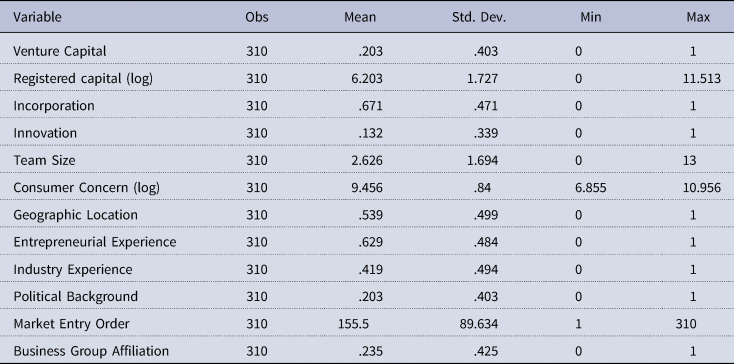
Table 1 displays the statistical description of each variable. Of the 310 bike-sharing startups, 63 (20.3%) attracted VC funding. The average logarithm of the registered capital of the enterprise was 62,203 yuan. Before August 2, 2017, the number of businesses established was 208 (67.1%). Forty-one (13.2%) had patents or patent applications before attracting VC. The average number of startup team members was 2.626, and the largest number of people on the startup team was 13. The average number of searches by consumers for shared bikes was 9.456. A total of 167 (53.9%) startups were established in the top 10 cities for investment.
Descriptive Statistics

Regarding the entrepreneurial experience of founders, 195 founders (62.9%) had at least one entrepreneurial experience before starting their bike-sharing business. A total of 130 (41.9%) of the founders had relevant industry experience, and 63 founders had previous political affiliations (20.3%). Regarding enterprise characteristics, 73 startups (23.5%) belonged to a particular BG.
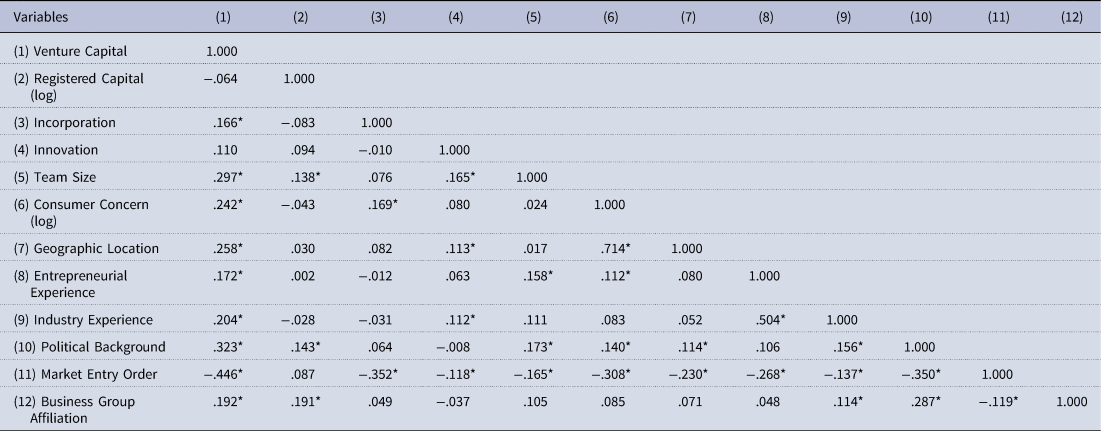
Pearson correlation analysis is usually used to verify the degree of linear correlation between variables before regression analysis (Alexopoulos, Reference Alexopoulos2010). Therefore, we calculate the Pearson correlation coefficient. Table 2 shows the correlations among the variables. As seen from the table, there was no high correlation between most variables. Although the correlation coefficients between geographical location and consumers' concerns (r = .714) and industrial experience and entrepreneurial experience (r = .504) were slightly higher, considering the reality and the nature of the variables, such a result was within the reasonable range. We pay special attention to the correlation between the independent and dependent variables. For Entrepreneurial experience (r = .172), Industrial experience (r = .204), Political background (r = .323), Market Entry Order (r = −.446), Business Group Affiliation (r = .192), the correlation coefficients are all less than .5 and are significant at the .05 level. Then we conduct a multicollinearity test, for which big multicollinearity problems would lead to inaccurate analysis results (Jou, Huang, & Cho, Reference Jou, Huang and Cho2014). The mean VIF of each variable was 1.45, indicating no multicollinearity problem between the variables.
Pairwise correlations

*Significance at the .05 level.
Regression analysis
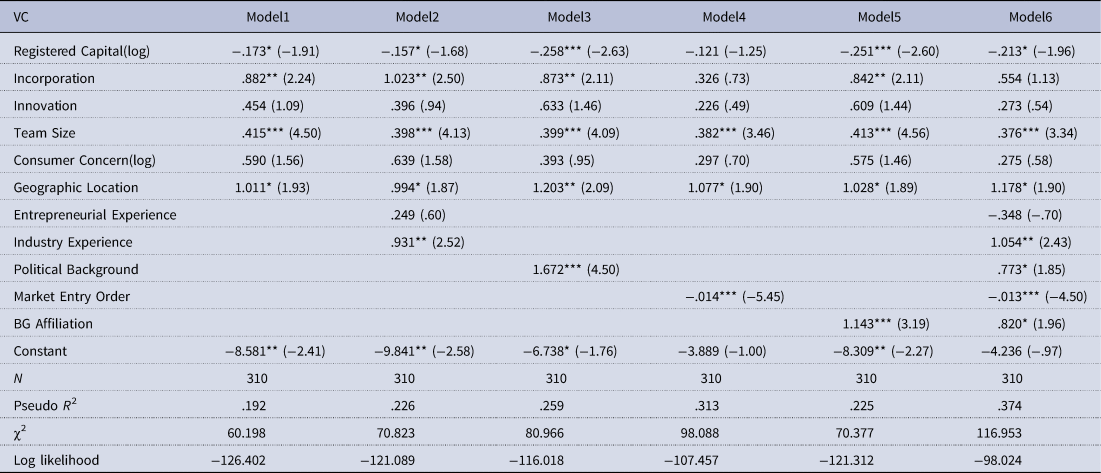
Table 3 shows the logit regression analysis results for founders' entrepreneurial experience, industrial experience, political background, and their firms' characteristics of market entry order, BG ownership, and attraction of VC. Model 1 is the analysis result that includes only control variables. In the control variables, the registered capital of the enterprise (β = −.173, p < .1) had a negative impact on attracting VC.
Logit regression analysis results

*** p < .01, **p < .05, *p < .1 (T-values are in parentheses).
The date of establishment (β = .882, p < .01), the size of the founding team (β = .415, p < .01), and the geographical location (β = 1.011, p < .1) had positive impacts on attracting VC.
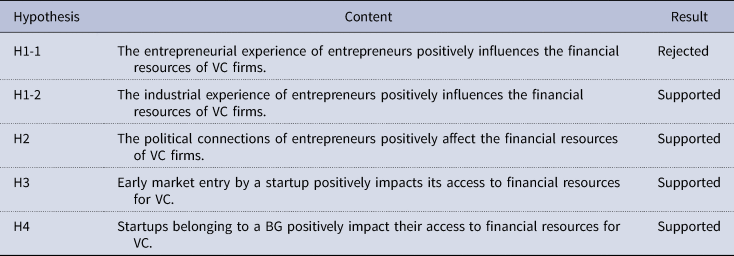
Model 2 displays the test results of H1-1 and H1-2. We can see from Model 2 that entrepreneurial experience was not an important factor in attracting VC (β = .249, ns), so we rejected Hypothesis H1a: entrepreneurs' entrepreneurial experience positively impacts attracting VC (β = .931, p < .05). Entrepreneurs with industry experience were more likely to attract VC than founders without industry experience, so Hypothesis H1-2 was supported. Most studies have proved that investors attach great importance to the experience of entrepreneurs when making decisions (Skalicka et al., Reference Skalicka, Zinecker, Balcerzak and Pietrzak2023). However, our empirical results suggest that experience should also be categorized, and irrelevant experience does not directly affect attracting VC. This is contrary to the findings of Ko and McKelvie (Reference Ko and McKelvie2018).
Model 3 tests H2: The political connections of entrepreneurs have a positive effect on attracting VC (β = 1.672, p < .01). Since entrepreneurs with political affiliations were more likely to attract VC than entrepreneurs without them, H2 was supported. Most scholars focus on enterprises' direct access to government subsidies (Hulsink & Scholten, Reference Hulsink and Scholten2017) and establishing cooperative alliances with the government (Doblinger, Surana, & Anadon, Reference Doblinger, Surana and Anadon2019; Wang, Reference Wang2016). In contrast to this explicit signal, the political background of the founder can be seen as an implicit signal, and we test the effect of this implicit signal.
Model 4 is the test of H3: The earlier a startup enters the market, the more positively it will attract VC (β = −.014, p < .01). The earlier an enterprise enters the market, the more likely it is to attract VC. Thus, H3 was supported. As shown by Halberstadt, Kollhoff, Kraus, and Dhir (Reference Halberstadt, Kollhoff, Kraus and Dhir2022), first-mover advantage exists among the first-to-market and early followers in web-based social entrepreneurship activities; our results support this view from the VC perspective.
Model 5 tests H4: Startups belonging to a BG positively impact attracting VC (β = 1.143, p < .01). Since a startup affiliated with a BG is more likely to receive VC than a startup that is not, H4 was supported. Our results are consistent with the findings by Lee and Choi (Reference Lee and Choi2014) that VCs are more likely to invest when partnering with business groups.
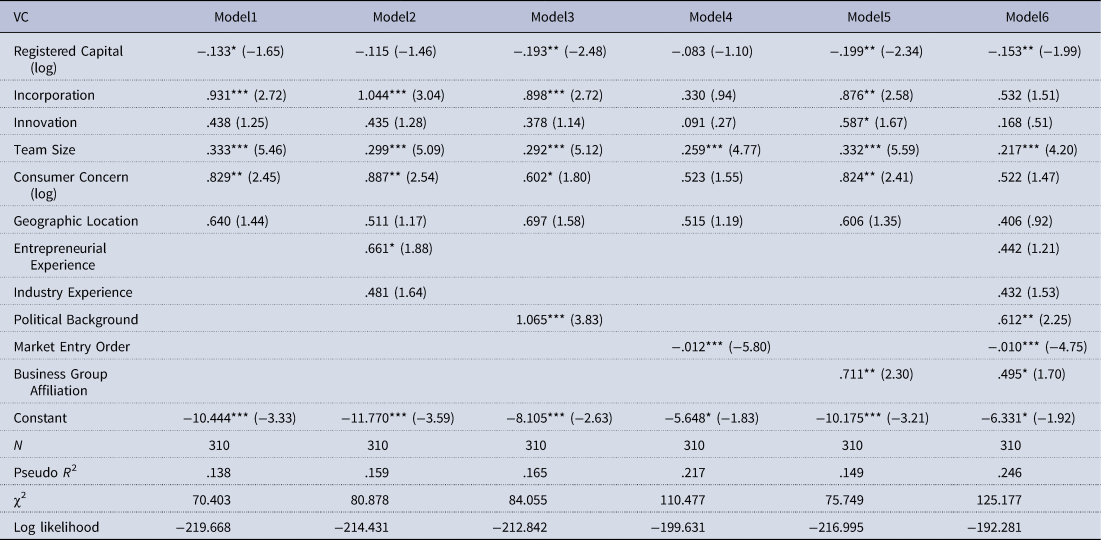
To ensure the robustness of the constructed model, this paper utilized investment rounds as the dependent variable for retesting the analysis results. As investment rounds are non-negative integers, Poisson regression analysis would be appropriate. However, the dependent variable had a mean value of .468, a variance of 1.386, and a variance greater than the mean value, indicating excessive dispersion. As this does not meet the prerequisites of Poisson regression, negative binomial regression was used for estimation. The analysis results are presented in Table 4. Apart from entrepreneurial and industry experience having no positive influence on attracting VC, the political background of the founders, the order of entering the market, and the affiliation of the business group all had a positive impact on attracting VC, which was consistent with the results of the logit analysis. Taking the analysis results of dichotomous variables (Table 3) as the standard, the results of all hypotheses were summarized in Table 5.
Negative binomial regression analysis results

*** p < .01, ** p < .05, * p < .1 (T-values are in parentheses).
Summarizes the final results of hypotheses

Discussion
Against the background of the same business model of startups in the fierce entrepreneurial competition in the internet field, the signal venture enterprises send to attract external financial resources of VC has become the issue of most concern. Our study explores the types and quality of signals released by internet startups based on the characteristics of internet VC (early-stage investment, fast pace, multiple rounds, and large amounts of money). We empirically analyze bike-sharing startups, a representative industry in the innovative internet-based sharing economy. Sixty-three out of 310 startups (20.3%) received at least one VC investment. The two companies with the most financing received 12 investments, showing the interest generated by the entire industry, favored by VC. In the specific enterprise selection, we determined the types and functions of several investment signals in the internet field.
First, in the objective signal of the founder's personal characteristics (H1 and H2), industry experience and political background become alternative signals representing the commitment and prospect of the enterprise, which has a significant signal effect, especially the political background signal of the founder. Second, in the subjective signals of enterprise characteristics (H3 and H4), both market entry order and BG affiliation show strong signal effects, which become representative signals to occupy market share and cope with future uncertainty. Our results were both surprising and plausible.
In traditional human capital signals, the role of entrepreneurial experience signals is weakened, and the role of industrial experience signals is amplified. This contradicts the opinion of Zhang (Reference Zhang2011) that serial entrepreneurs are more likely to obtain financial support. Our results partially support Nigam, Benetti, and Johan (Reference Nigam, Benetti and Johan2020) view that traditional human capital factors do not necessarily signal the quality of financing for tech startups. This conclusion once again proves that VC in the internet field has changed its recognition of traditional human capital signals. In the eyes of investors, they may think that the founder's previous entrepreneurial experience, such as experience and resources accumulated in catering, real estate, culture, entertainment, medicine, and other fields, is not beneficial for the operation and development of bike-sharing startups. However, the industrial experience will send positive signals for investors to understand industrial policies, industry prospects, market saturation, profit level, risk status, access threshold and other professional knowledge, industry information, and development trends. Investors judge that this result may reduce a founder's fear of unknown risks and increase the likelihood of making correct decisions in time. Therefore, exaggerating one's entrepreneurial experience may not be the best choice in the early stage of Internet financing.
The development of China's Internet sector industry is supported and regulated by the Chinese government, and VC knows that establishing ‘guanxi’ with government departments or personnel can provide additional competitive advantages. However, existing studies that focus on government financial signals (Chen, Heng, Tan, & Lin, Reference Chen, Heng, Tan and Lin2018; Meuleman & De Maeseneire, Reference Meuleman and De Maeseneire2012) or non-financial signals (Zhang et al., Reference Zhang, Zhang, Ren and Jia2020) do not apply to VC scenarios in the Internet sector. When trying to secure investor funding with only one concept or idea, the political background of the founders becomes a critical signal that can reflect the differences between founders. As this is a significant channel through which government resources can be obtained, our results validate this idea.
In VC research, the time signal of an enterprise entering the market has been seriously ignored. Although corporate strategy scholars have always emphasized that it may be wise to be a follower in an uncertain market environment (Kaličanin, Reference Kaličanin2008), first movers in the Internet field can obtain more external resources. The sooner an emerging enterprise with network effects enters the market, the sooner it can gain brand recognition, acquire users and attention more easily, and grow to a certain scale in a shorter period. Investors will also have a shorter timeframe for obtaining a return on their investment. For Internet investors, the earlier they invest, the higher the risk and the higher the profit after success. Therefore, Internet enterprises entering the market first will send investors the most direct and measurable high-quality signals. Such signals have already been determined when enterprises choose the first-mover or follower strategy and generally will not be perceived by entrepreneurs or investors. Therefore, the results of our study establish the value of time-to-market signals, which should be taken seriously in both real financing and theoretical research.
Another seriously overlooked signal is affiliation with a BG. The BG affiliate signal is one of the most important signals of quality and legitimacy to potential investors because it is not easy for a startup to become a BG affiliate. Generally, mastery of the industry's core technology, products, or services can help a BG expand into new markets. A BG will accept a new startup only when it has competitive advantages, such as the massive potential for future development. The enterprise's quality or future development prospects are evaluated and validated by the BG. By belonging to a certain group, the new startup can obtain various resources within the BG network at a low cost, reduce the pressure of resource input from VC, expand the network of relationships in the Internet field, and gather industry-related professional resources through investment. Ultimately, this can improve the investment ability and performance of the startup in the Internet field or emerging industries.
Implications and directions for future research
VC in China's internet sector has long been described as ‘crazy’. In recent years, every new business model has been popular with a large amount of VC support. In other industries, we observe, for example, the car-sharing industry represented by Didi, in which 207 out of 502 enterprises received financing from at least one VC (financing proportion of 41%). Of the 731 fresh food e-commerce platform enterprises represented by Freshippo, 249 have obtained at least one financing (financing proportion of 34%). Because of the scale and commercial value of China's Internet market, many entrepreneurs follow the crowd, leading to fierce competition for external financial support. However, few scholars pay attention to the current investment status in the Internet field, and there is still a lack of understanding of the types and characteristics of Internet investment signals. Our research fills this gap, and its significance is reflected in theoretical contributions and practical implications.
Theoretical contributions
Getting VC and choosing the object of investment is always the biggest concern of entrepreneurs and investors. Over the years, scholars have also tried to explore the effectiveness of different signals that entrepreneurs send to investors from a theoretical perspective. Svetek (Reference Svetek2022) reviewed 41 articles on applying signal theory in VC over the past 20 years. While most signal types have been covered, many essential but not intensely focused and unverified signal types and qualities exist. Especially in the era of human beings so dependent on the Internet, Internet enterprises have become the prominent VC field. Still, the investment characteristics of this field have not been noticed by scholars, and the signal characteristics could be more precise. Therefore, our study makes an essential contribution to the signaling literature of VC.
Specifically, on the one hand, we discovered a brand-new human capital signal (founder political background) and verified its validity, providing quantitative evidence for the first time. Although ‘relationship and network’ signals have been discussed by scholars (Miozzo & DiVito, Reference Miozzo and DiVito2016; Roma, Petruzzelli, & Perrone, Reference Roma, Petruzzelli and Perrone2017), they did not include the ‘founder's political background’ genre and did not recognize the vital relationship structure and exceptional network value behind the political background signals. This hidden signal is difficult to spot, and its effect should be addressed. On the other hand, two types of traditional human capital (industry experience and entrepreneurial experience) (Naiki & Ogane, Reference Naiki and Ogane2022), which are representative of the entrepreneurship and VC literature, have been widely discussed and verified by scholars. However, our results demonstrate that the role of industry experience and entrepreneurial experience signals in the Internet age has been weakened or subverted.
Finally, our research focuses on the characteristics of financing in the Internet field and takes into account the signal reception speed of recipients. More intuitive objective signals (such as market entry time and BG affiliation) have advantages in the Internet VC field and more substantial signal transmission power to potential investors. Compared with other traditional industries, investors may not pay much attention to the time of entry signals because of the debate over first mover advantage versus follower advantage. However, with the increase of web-based entrepreneurial activities, enterprises that enter the market first become typical winner-takes-all (for example, China's Alibaba, Tencent, and Baidu), and the first-mover advantage increases significantly. Venture investors will rely on the most easily perceived accurate signals to enter quickly, even if the new business model is highly uncertain.
In summary, our new findings can provide new information and understanding for the research of VC signaling, promote the boundary expansion of signaling literature, and provide enlightenment for more scholars to explore further the new fields and directions of implicit signaling and excitation signaling research in the future. Moreover, our results indirectly demonstrate first-mover advantages for Internet-based social enterprises (Halberstadt et al., Reference Halberstadt, Kollhoff, Kraus and Dhir2022), one of which may come from VC, and we provide new ideas for strategic research of Internet startups.
Practical implications
First, we help entrepreneurs and investors better understand the current situation of financing internet enterprises in China, which has much practical significance. Although entrepreneurs have gained some inspiration from existing research or practical experience on the investment criteria of VC, entrepreneurs have always been confused and cautious in winning the favor of VC. Our results avoid survivor bias and provide real-world evidence for more entrepreneurs to communicate what type of information they have most effectively.
Secondly, our results identify the value of two objective signals (market entry time signals and BG affiliation signals) that have not been discussed in depth. Due to the possibility of partial interest competition between investors and entrepreneurs, some low-quality enterprises deliberately send false or misleading signals to obtain funds (Colombo, Reference Colombo2021). There are also speculative phenomena that do not provide sustainable products or services to consumers or the market but only seek to obtain investment money from venture capitalists (known as the B2VC phenomenon or Business to Venture Capitalists). In particular, given the close relationship between the internet industry and VC, investors should pay more attention to verified objective signal statements to avoid falling into a vicious investment vortex.
Finally, existing research on VC mainly focuses on European and American countries, and the particularity of China's system and market inevitably leads to some results that do not apply to the Chinese market. China is also a massive market for VC, and our results provide important insights for scholars, investors, and policymakers to understand the Chinese Internet VC market and investment practices. We also suggest that more scholars pay attention to the current situation of VC in their own countries, verify the universality of the signals mentioned in this paper, and explore the characteristics of investment and signals in the Internet era.
Limitations and future research
This paper also has some limitations. First, the model in this paper has a limited explanation for attracting VC (R 2 = 36.1%). We suggest that follow-up studies integrate various perspectives (such as social capital theory and investors) to further explore financing performance and other issues. Second, our study uses static methods (Elitzur & Gavious, Reference Elitzur and Gavious2003), but leveraged buyout itself is not a static process. In the future, developing a dynamic investment model or a model to test the impact of continuous investment factors will provide a more intuitive understanding of investment criteria.
Data are probably our most challenging limitation to overcome. Our data only use the financing status of a single shared-bike industry. The validity and authenticity of the data are limited to data collected from databases, such as the National Enterprise Credit Information Publicity System, Qichacha, Android/Apple App Store, and relevant enterprises' official publicity platforms. Limitations in the data collection process may also have affected the results. For example, the exact amount of VC and the specific investment rounds of some enterprises are not publicly available; the characteristics of investment institutions, such as their nature, investment fields, and investment preferences, have not been determined; and it is also possible to establish strong political ties through friends and relatives. Obtaining this unofficial data is difficult, so we have to use limited data to test our hypothesis. Future research can expand industry types to obtain more unofficial data from founders through questionnaires or interviews to supplement our research. Finally, future research can strive to build a complete investment standard for VC in the Chinese market.
Acknowledgments
This paper was supported by the Key Research Base Project of Philosophy and Social Sciences of Zhejiang Province (2022JDKTZD40) and Scientific Research and Innovation Team Project of the Zhejiang Wanli University in 2020.
Competing interests
The author declared no potential conflicts of interest with respect to the research, authorship, and/or publication of this article.