Necrotising enterocolitis is an intestinal pathology that predominately affects preterm infants and term neonates with cardiac defects and is one of the most life-threatening conditions that affect neonates.Reference Lau, Cruz and Ocampo1,Reference Kelleher, Laussen, Teixeira-Pinto and Duggan2 It has been theorised that neonates with CHD have a different pathophysiology of necrotising enterocolitis to the preterm population.Reference Overman, Criss and Gadepalli3 Neonates with CHD are at particular high risk of developing necrotising enterocolitis due to impaired cardiac output that reduces mesenteric blood flow, leading to gut ischemia.Reference Neu and Walker4 There exists a broad spectrum of severity among neonates with CHD; neonates who have ductal-dependent CHD or large left-to-right shunts are at higher risk of mesenteric hypoperfusion.Reference Pickard, Feinstein, Popat, Huang and Dutta5
Mesenteric hypoperfusion has been linked to milk substrate stasis in the gastrointestinal tract leading to intestinal dilatation; this distorts normal signal transduction across the intestinal wall barrier resulting in excessive inflammation and intestinal necrosis.Reference Sharma and Hudak6 Of note, necrotising enterocolitis can occur prior to feeding and has been associated with cardiac surgery, particularly the duration of cardiopulmonary bypass.Reference Golbus, Wojcik, Charpie and Hirsch7,Reference Iannucci, Oster and Mahle8
The clinical presentation of suspected necrotising enterocolitis (Bell’s stage 1 A, large gastric aspirates, evidence of abdominal distension, and normal ileus; Bell’s stage 1B, blood within faeces, normal to mild ileus, and pyrexiaReference Bell, Ternberg and Feigin9) may be variable and at times subtle and therefore indistinguishable from other types of sepsis.Reference Giannone, Luce, Nankervis, Hoffman and Wold10 The association between feeding and necrotising enterocolitis results in frequent feed withdrawal and is a contributing factor to malnutrition in the post-surgical cardiac neonate.Reference Golbus, Wojcik, Charpie and Hirsch7,Reference Schuchardt, Kaufman and Lucas11 Neonates with CHD exhibit early and progressive falls in their growth trajectory compared to healthy infants,Reference Medoff-Cooper, Irving and Hanlon12 increasing length of hospital stay and risk of death post-surgery.Reference Eskedal, Hagemo and Seem13,Reference Curzon, Milford-Beland and Li14
Abdominal radiography is a diagnostic tool for necrotising enterocolitis. However, its utility is limited in the early stages of necrotising enterocolitis, when intestinal dilation, ileus, and pneumatosis intestinalis are often absent and not usually visible until Bell’s stage 2.Reference Gephart, Gordon and Penn15 Calprotectin is a faecal biomarker that is used as a diagnostic marker for necrotising enterocolitis in preterm infants.Reference Pergialiotis, Konstantopoulos and Karampetsou16 Calprotectin (36.5 kDa) is a neutrophil activation marker and is mainly exhibited in the cytoplasm of neutrophils (about 5% of their total protein content) and expressed on activated monocytes and macrophages.Reference Yui, Nakatani and Mikami17 Furthermore, calprotectin participates in leukocyte interactions with the endothelium and cellular adhesions, leading to the recruitment of leukocytes to inflamed intestinal tissue. Therefore, elevated faecal calprotectin concentrations are evident in infectious and inflammatory diseases such as necrotising enterocolitis.Reference Elgin, Kern and McElroy18
In light of the proposed different pathogenesis of necrotising enterocolitis in preterm and cardiac neonates, it is necessary to assess calprotectin concentrations independently. The aim of this pilot study was to determine whether there is a correlation between faecal calprotectin concentration and gut inflammation in neonates with CHD.
Materials and methods
A prospective single-centre study was performed at Great Ormond Street Children’s Hospital NHS Foundation Trust, cardiac ICU. Written informed consent was obtained from a parent before inclusion into the study. The study was approved by the Health Research Authority (17/YH/0446) and Great Ormond Street Hospital Research Adoption Committee (16HT03).
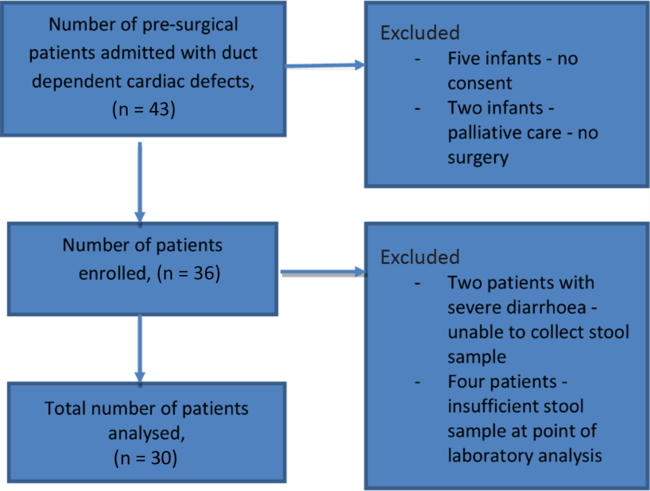
Patients included were term neonates with a duct-dependent cardiac defect (hypoplastic left heart syndrome and hypoplastic right heart, truncus arteriosus, coarctation of great arteries, or double outlet left ventricle). Patients were recruited between March 2018 and March 2019. Patients were excluded if they received preoperative or post-operative care outside the cardiac intensive care, had surgery for a non-cardiac diagnosis or any gastroenterological complication (such as gastro schisis or imperforate anus) or prematurity (<37 weeks gestation). A total of 43 pre-surgical patients were eligible for the study and 30 were enrolled to the study. Five patients were excluded due to no formal consent obtained, and two were deemed unsuitable for surgery. Stool collection was not possible for two patients due to severe diarrhoea, and four patients had insufficient stool sample at point of analysis in laboratory. An overview of patient inclusion is illustrated in Figure 1.
Overview of patients included in the analysis.

Data collection
Data collected included patients’ age and weight at time of surgery, length of time on cardiopulmonary bypass (minutes), length of stay on cardiac ward (days), and total number of days nil by mouth (feed interruption for extubation was not included). Also recorded, the number of days to establish feed volume of 100 ml/kg.
Feeding strategies
All patients followed a high-risk feeding protocol, consisting of nasogastric tube feeding that started at 0.5 ml/kg/day for 8 hours – hourly boluses. If aspirates were less than 5 ml/kg, feed was increased by 0.5 ml/kg/day and continued to increase by 0.5 ml/kg/day every 8 hours until patients achieved target fluid allowance of 100 ml/kg. Patients were fed on maternal expressed human milk (68 kcal and 1.3 g protein/100 ml) or a hydrolysed feed (Peptijunior standard concentration: 66 kcal and 1.8 g protein/100 ml).
Faecal calprotectin collection
Stool collection (50–100 mg) occurred with the first bowel movement after feeding commenced post-surgery, which varied between 48 and 96 hours and was accompanied with audible bowel sounds with passage of stools. Samples were stored in plastic containers and frozen to −80°C until batch analysis (every 24–48 hours). Before analysis, samples were defrosted to room temperature. The calprotectin was measured using the commercially available enzyme-linked immunosorbent assay kit of Bühlmann Laboratories AG (Basel, Switzerland) according to the manufacturer’s instructions.Reference Oord and Hornung19 In brief, monoclonal capture antibodies highly specific to the calprotectin heterodimeric and polymeric complex are coated on the microlitre plate when calprotectin was assayed in a single measurement using DS2 automated enzyme-linked immunosorbent assay processing system (extended range 30–1800 µg/g).
Necrotising enterocolitis diagnosis
An abdominal radiography was requested by the medical or surgical team for patients who displayed clinical symptoms of gut inflammation (distended bowel, high gastric residuals volume (>5 ml/kg), melena). The diagnosis was made by the attending cardiologist and radiologist, in the presence of pneumatosis intestinalis and/or portal venous gas consistent with Bell’s stage 2.Reference Walsh and Kliegman20
Suspected necrotising enterocolitis was defined as patients who had feeding difficulties or clinical exam findings suspicious for necrotising enterocolitis that led to the care team to interrupt enteral feeding regimen or abdominal radiograph that was inconclusive for pneumatosis. Suspected necrotising enterocolitis was categorised as Grade 1 A and 1B using the modified Bell’s criteria.Reference Bell, Ternberg and Feigin9
Statistical analysis
IBM SPSS Package Version 22 (IBM Corporation, Armonk, NY, United States of America) was used for statistical analysis. Variables are presented as n (%) for categorical data. Continuous variables were measured using median and interquartile range; mean and standard deviation; and independent and paired t-tests. Pearson’s correlation was used to assess correlation between variables. A p value less than 0.05 was considered statistically significant.
Results
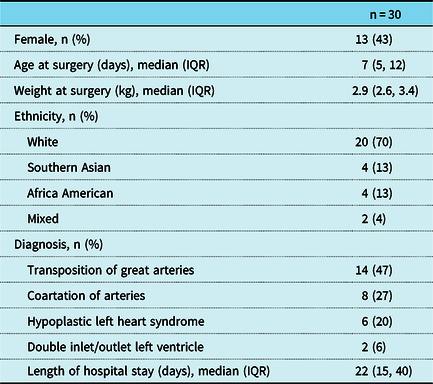
A total of 43 duct-dependent neonates were admitted for cardiac surgery during the calendar year of March 2018 to March 2019. Of these, 30 patients (43% were female) were included in the analysis. Additional patient demographics can be found in Table 1.
Characteristics of patients included in analysis

IQR = interquartile range.
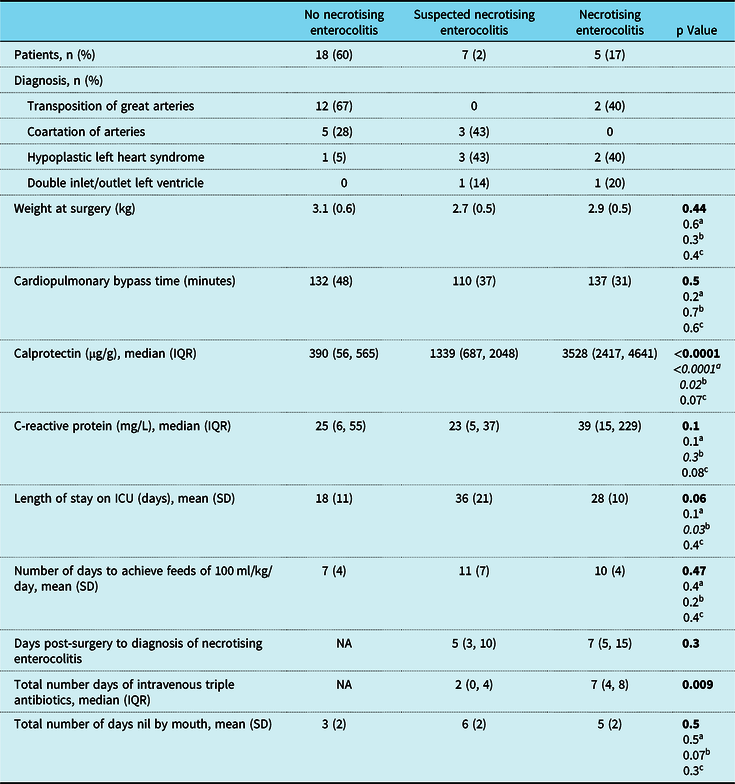
An abdominal radiography was requested in 25 (83%) patients. Of these, five patients (17%) had evidence of necrotising enterocolitis (pneumatosis intestinalis) and seven patients (23%) had suspected necrotising enterocolitis. The incidence of necrotising enterocolitis and suspected necrotising enterocolitis was significantly higher in females (Table 2). Patients with suspected necrotising enterocolitis had a significantly longer length of hospital stay, on average 18 days longer compared to patients without necrotising enterocolitis (p = 0.03). Additionally, these patients took an average 4 days longer to establish feeds of 100 ml/kg compared to those without necrotising enterocolitis (7 days), which was longer than those diagnosed with necrotising enterocolitis (10 days).
Comparison of characteristics in patients with and without NEC, and with suspected NEC

For pairwise comparison: ap value when comparing no NEC with NEC; bp value when comparing no NEC with suspecting NEC; cp value when comparing suspected NEC with NEC. The p value in bold is for F.
IQR = interquartile range; NA = Not Applicable; NEC = Necrotising Enterocolitis; SD = standard deviation.
Bold = mean of pairwise comparisons; Italics = statistically significant.
Treatment of patients with suspected necrotising enterocolitis varied, only four of the seven patients commenced intravenous triple antibiotics, which was administered from 2 to 5 days. Five of the seven patients commenced intravenous nutrition (Table 2). Finally, five of the seven patients with suspected necrotising enterocolitis had their feed withheld on two or more separate episodes.
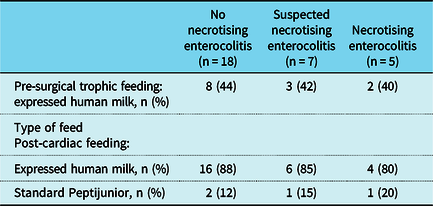
Enteral feeding practices prior to cardiac surgery were similar between patients who developed necrotising enterocolitis and those who did not. Feeding prior to surgery consisted of expressed human milk only and did not exceed more than 10% of calculated energy requirements (trophic feeds). The majority of patients commenced enteral feeding with expressed human milk post-cardiac surgery (Table 3).
Enteral feeding patterns before and after cardiac surgery in relation to the development of necrotising enterocolitis

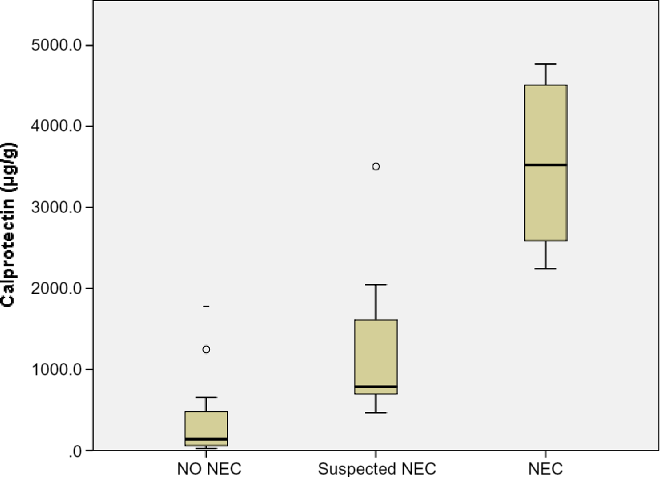
The median calprotectin concentration calculated for all samples was 693 µg/g ranging between 24 and 4772 µg/g. The calprotectin concentration for patients who developed necrotising enterocolitis was 3528 µg/g compared with 390 µg/g in patients without necrotising enterocolitis. Patients with suspected necrotising enterocolitis with no evidence of pneumatosis intestinalis on abdominal radiography had a median calprotectin concentration of 1339 µg/g (Table 2). A box plot illustrates the spread of calprotectin concentrations within each of the groups (Fig 2). Of the five patients who developed necrotising enterocolitis, two (40%) had significantly raised calprotectin concentrations before clinical symptoms presented and before confirmation of necrotising enterocolitis with an abdominal radiography.
Boxplot illustrating the spread of calprotectin concentrations in patients with and without necrotising enterocolitis and with suspected necrotising enterocolitis (p = <0.0001). NEC = Necrotising Enterocolitis.

There was no difference in C-reactive protein (mg/L) levels between the three groups although patients with confirmed necrotising enterocolitis did have higher levels than those without and suspected necrotising enterocolitis. Additionally, there was no correlation between faecal calprotectin concentrations (µg/g) and C-reactive protein level (mg/L), r = 0.4.
A Pearson’s correlation analysis was unable to find an association between calprotectin concentration and weight at surgery (r = 0.3) or cardiopulmonary bypass time (r = 0.4).
Four patients died (13%), of which two did not have necrotising enterocolitis (mean calprotectin concentration 106 µg/g), cause of death – extracorporeal membrane oxygenation-related stroke and tracheobronchomalacia complications; and two had suspected necrotising enterocolitis (mean calprotectin concentration 1984 µg/g), cause of death – septicaemia related to ichthyosis and ischaemic brain injury post-surgery.
Discussion
In this pilot prospective study, we established that calprotectin concentrations were significantly increased in patients with necrotising enterocolitis (Bell’s stage 2) and suspected necrotising enterocolitis (Bell’s stage 1 A and 1B). Neonates with suspected necrotising enterocolitis were associated with increased length of hospital stay than those with and without necrotising enterocolitis. Neonates with suspected necrotising enterocolitis had longer periods of nil by mouth than those with necrotising enterocolitis resulting in a longer time to establish 100 ml/kg.
A study by Schuchardt et al also identified this association between suspected necrotising enterocolitis and increased length of hospital stay compared with neonates who had necrotising enterocolitis.Reference Schuchardt, Kaufman and Lucas11 The study highlights the wide variability in treating suspected necrotising enterocolitis in terms of antibiotic regimen, length of antibiotic treatment, and inconsistencies with length of nil by mouth. The incidence rate of actual necrotising enterocolitis in our study was 16%, which falls within previously reported incidence rates, which range from 3% to 18%.Reference Giannone, Luce, Nankervis, Hoffman and Wold10,Reference Mukherjee, Zhang and Chang21
This wide variation in reported incidence of necrotising enterocolitis has in part been attributed to the disparity in defining and diagnosing necrotising enterocolitis. Gephart et al highlights the need to redefine necrotising enterocolitis in relation to preterm and term neonates, emphasising the importance of precise definitions for necrotising enterocolitis with clear criteria for conducting and reporting studies for necrotising enterocolitis prognostics, including biomarkers.Reference Gephart, Gordon and Penn15 However, despite studies demonstrating a difference in presentation and comorbid conditions, term neonates continue to be treated with the same algorithm of care.Reference Overman, Criss and Gadepalli3 Of note, the majority of term infants with necrotising enterocolitis present in the first few days of life and are less likely to need surgical intervention compared to necrotising enterocolitis in preterm infants who frequently present later once established on feeding.Reference Overman, Criss and Gadepalli3 Similar findings were identified within this study with the majority of patients showing clinical symptoms of necrotising enterocolitis within 7 days post-surgery and none required surgical intervention.
The association between calprotectin concentration and intestinal inflammatory diseases has been thoroughly investigated.Reference Elgin, Kern and McElroy18 A systematic review by Pergialiotis et al reports that current evidence suggested that faecal calprotectin concentration is elevated in preterm infants with necrotising enterocolitis. However, its significance as an early screening marker is unknown, which warrants further prospective research.Reference Pergialiotis, Konstantopoulos and Karampetsou16 In light of the proposed different disease processes for preterm and term neonates, it is essential to investigate calprotectin levels independently from preterm infants.
Feeding has been associated with the development of necrotising enterocolitis, and clinicians are naturally cautious during the reinitiating of feeding post-cardiac surgery.Reference Hehir, Easley and Byrnes22 Furthermore, the exact duration of bowel rest in infants with non-surgical necrotising enterocolitis is based on disease severity and clinical judgement.Reference Arbra, Oprisan, Wilson, Ryan and Lesher23 In this study, the median calprotectin concentrations were significantly different between neonates with and without necrotising enterocolitis.
The ambiguity around feeding arises with suspected necrotising enterocolitis. Patients with suspect necrotising enterocolitis had their feed withheld on multiple separate episodes, which contributed to increased number of days nil by mouth compared to patients who were diagnosed with necrotising enterocolitis. This warrants further research into the treatment to improve clinicians’ management and confidence to feed which in turn may reduce length of hospital stay and duration of nil by mouth.
The strength of this pilot study is the prospective design and that faecal calprotectin collection occurred during the high-risk period post-cardiac surgery and introduction of feed. However, this single faecal sampling also has its limitation, in that it only represents gut inflammation at a single time point, and therefore, serial sampling may be beneficial when designing the follow-up validation study. An unforeseen limitation was the collection of stools in neonates with diarrhoea resulting in unplanned exclusions. Additionally, the diagnosis and interpretation of radiographic pneumatosis is in itself variable and included multiple radiologists. Finally, the small sample size of this pilot study is a limitation to the study.
Conclusion
This pilot study suggests that faecal calprotectin concentrations may reflect severity of gut inflammation in neonates with CHD. Treatment for neonates with suspected necrotising enterocolitis needs further attention as ambivalence to feed maybe contributing to longer days nil by mouth and increase in length of hospital stay.
Acknowledgements
The authors would like to thank members of the British Dietetic Association: Paediatric Cardiology Interest Group for their assistance and support with this project.
Financial Support
Funds to measure faecal calprotectin concentrations were provided from Great Ormond Street Hospital, Cardiology department agreed by Professor Andrew Taylor.
Conflicts of Interest
None
Ethical Standards
The authors assert that all procedures contributing to this work comply with the ethical standards of the relevant national guidelines on human experimentation (North London Ethic Committee – reference 17/YH/0446).
Contributors’ Statement
The authors made the following contribution to the manuscript: G.O’C. formulated the original research question and devised research design and drafted manuscript; A.M.T. involved in initial study design; K.L.B. performed data evaluation and discussion.