Introduction
The widespread adoption of no-till systems in corn and soybean production and the evolution of weeds resistant to multiple-herbicide sites of action (SOAs) has increased the importance of effective weed control prior to planting (Loux et al. Reference Loux, Stachler, Johnson, Nice, Davis and Nordby2006). Broadleaf weed species such as common ragweed, giant ragweed, and horseweed are the most troublesome weeds to control in broadleaf crops; and redroot pigweed is one of the most commonly found in these scenarios (Gibson et al. Reference Gibson, Johnson and Hillger2005; Van Wychen Reference Van Wychen2016).
Horseweed populations have evolved resistance to glyphosate (group 9), paraquat (group 22), acetolactate synthase (ALS)–inhibiting herbicides (group 2), and photosystem II (PSII)–inhibiting herbicides (groups 5 and 7) (Heap Reference Heap2017). Biotypes of common ragweed with resistance to glyphosate, ALS-inhibitor, protoporphyrinogen oxidase (PPO)–inhibitor (group 14), and PSII-inhibitor (5 and 7) herbicides have also been confirmed. In addition, glyphosate- and ALS-resistant giant ragweed and ALS-inhibitor, PPO-inhibitor, and PSII-inhibitor (5, 6, and 7) resistance in redroot pigweed have been documented. Furthermore, populations with resistance to multiple-herbicide SOAs occur for all of the weed species mentioned above (Heap Reference Heap2017).
Best management practices for control of herbicide-resistant weeds in no-till soybean include the use of cover crops and effective preplant burndown herbicide applications to provide a weed-free seedbed at planting plus effective PRE herbicides for residual weed control (Johnson et al. Reference Johnson, Loux, Nordby, Sprague, Nice, Westhoven and Stachler2006; Jordan et al. Reference Jordan, Nice, Smeda, Sprague, Loux and Johnson2007; Loux et al. Reference Loux, Stachler, Johnson, Nice, Davis and Nordby2006). Synthetic auxin herbicides such as 2,4-D and dicamba can be used for control of broadleaf weeds in preplant burndown applications (Bruce and Kells Reference Bruce and Kells1990; Johnson et al. Reference Johnson, Loux, Nordby, Sprague, Nice, Westhoven and Stachler2006; Jordan et al. Reference Jordan, Nice, Smeda, Sprague, Loux and Johnson2007; Loux et al. 2006, Reference Loux, Doohan, Dobbles, Johnson, Young, Legleiter and Hager2017, Vink et al. 2012a,Reference Vink, Soltani, Robinson, Tardif, Lawton and Sikkemab; Wilson and Worsham Reference Wilson and Worsham1988). However, research has shown that horseweed control with 2,4-D can be variable in preplant burndown applications depending on environmental conditions, horseweed size, and horseweed biotypes (Kruger et al. Reference Kruger, Davis, Weller and Johnson2010a; Mithila et al. Reference Mithila, Hall, Johnson, Kelley and Riechers2011; Montgomery et al. Reference Montgomery, Treadway, Reeves and Steckel2017). In addition, herbicides such as 2,4-D and dicamba have inconvenient plant-back restrictions depending on rate and formulation, which can delay soybean planting if unfavorable weather conditions occur (Thompson et al. Reference Thompson, Steckel, Ellis and Mueller2007).
Halauxifen-methyl is a new synthetic auxin herbicide that belongs to the arylpicolinate chemical family and is labeled for control of glyphosate-resistant (GR) horseweed in preplant burndown applications to corn, cotton, and soybean. The field application rate is 5 g ae ha–1 with a preplant interval restriction of 14 d for corn and soybeans, and 30 d for cotton (Anonymous 2017; Epp et al. Reference Epp, Alexander, Balko, Buysse, Brewster, Bryan, Daeuble, Fields, Gast, Green, Irvine, Lo, Lowe, Renga, Richburg, Ruiz, Satchivi, Schmitzer, Siddall, Webster, Weimer, Whiteker and Yerkes2016; Schmitzer et al. Reference Schmitzer, Balko, Daeuble, Epp, Satchivi, Siddall, Weimer and Yerkes2015). Halauxifen-methyl exhibits desirable characteristics in comparison to 2,4-D and dicamba, such as control of economically important broadleaf weeds at lower use rates, low potential for volatility (5.9 × 10⁻⁹ Pa at 20 C), and less restrictive preplant intervals (Anonymous 2017; [EFSA] 2014; Schmitzer et al. Reference Schmitzer, Balko, Daeuble, Epp, Satchivi, Siddall, Weimer and Yerkes2015). However, the weed control spectrum of halauxifen-methyl is limited, and mixtures will be necessary to widen the spectrum in preplant applications. The objective of this study was to evaluate weed control efficacy of halauxifen-methyl, 2,4-D, and dicamba applied alone and in mixtures for control of broadleaf weeds such as GR horseweed, common ragweed, giant ragweed, and redroot pigweed.
Materials and Methods
Experiments were conducted during the 2015 and 2016 growing seasons at three locations in Indiana (Butlerville––39.03°N, 85.53°W; Cortland––38.98°N, 85.95°W; and Lafayette––40.29°N, 86.91°W) infested with early-season summer-annual broadleaf weeds. Common ragweed was the prevalent broadleaf weed at Butlerville, whereas high densities of GR horseweed occurred in Cortland, and giant ragweed and redroot pigweed were predominant at the Lafayette site.
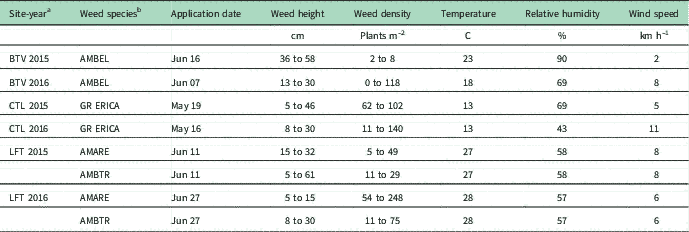
The herbicides 2,4-D, dicamba, glyphosate, and halauxifen-methyl were mixed in a 2k factorial design, where the number two corresponds to the levels of herbicide rates utilized (0× or 1× rate for each herbicide) and k corresponds to the number of herbicides tested (k=4), resulting in 15 treatments plus a nontreated control (Table 1). Treatments were arranged in a randomized complete block design with four replications with plots measuring 3 m wide and 9 m in length. Burndown herbicide applications targeted weeds measuring 13 to 20 cm tall (Table 2). Mixtures were applied using a handheld CO2-pressurized sprayer equipped with four Teejet XR11002 nozzles or AIXR 110015 (depending on wind conditions) spaced 50 cm apart and calibrated to deliver 140 L ha–1 while traveling at 4.8 km h–1 and operating at 165 kPa for Teejet XR11002 nozzles or 289 kPa for AIXR 110015 nozzles.
Description of herbicides and rates used in mixtures for control of glyphosate-resistant horseweed, common ragweed, giant ragweed, and redroot pigweed in Indiana.

a Rate expressed in grams of acid equivalent per hectare (g ae ha–1).
Treatment application dates and application parameters for all site-years.

a Abbreviations: BTV, Butlerville, IN; CTL, Cortland, IN; LFT, Lafayette, IN.
b Bayer codes: AMARE, redroot pigweed; AMBEL, common ragweed; AMBTR, giant ragweed; GR ERICA, glyphosate-resistant horseweed.
Ammonium sulfate (N-Pak® AMS, Winfield Solutions LLC, St. Paul, MN) at 2.5% vol/vol was added to all mixtures. In addition, all treatments containing halauxifen-methyl had methylated seed oil (MSO UltraTM, Precision Laboratories LLC, Waukegan, IL) added at 1% vol/vol. Treatments containing dicamba and/or 2,4-D had non-ionic surfactant (Activator 90, Loveland Products Inc., Greeley, CO) added at 0.25% vol/vol unless mixed with halauxifen-methyl and/or glyphosate.
Evaluations consisted of visual ratings for weed control (%) by species at 7, 14, 21, 28, and 35 d after treatment (DAT), as well as weed density counts (two 1-m2 samples per plot) 35 DAT. In 2016, digital-imagery analysis utilizing the public-domain Java-based ImageJ software (Ferreira and Rasband Reference Ferreira and Rasband2012) was implemented to measure ground cover by weeds as additional information on efficacy of herbicide mixtures. According to the methodology described by Ali et al. (Reference Ali, Streibig, Duus and Andreasen2013), the software––along with the plugin Threshold Colour written by Landini (Reference Landini2009)––can be applied to field images to differentiate between soil, green vegetation (live plants), and plant residue based on different hue and brightness values. Field images were collected in the field each week after herbicide application using a digital camera (COOLPIX 5700, Nikon Inc.) with resolution 2,560 by 1,920 pixels. Pictures were taken from a constant height of 170 cm above the soil surface of each plot with the support of a monopod, and focal-length settings adjusted to cover a ground area of approximately 163 by 122 cm under ambient daylight conditions. The parameters used for processing field images with the Threshold Colour plugin to distinguish between ground cover by vegetation versus soil plus plant residue were 46 to 120 for hue, 0 to 255 for saturation, and 20 to 255 for brightness. Therefore, the percentage of ground cover by vegetation can be a less subjective methodology to evaluate weed control, where lower ground cover (%) corresponds to higher weed control (%).
Untransformed data were pooled across years for each location and analyzed to determine treatment differences for weed control and density by species, and ground cover with one-way analysis of variance using SAS 9.4 PROC GLIMMIX with mean separation using Tukey’s honest significant difference (HSD) test at α=0.05. The model included herbicide treatment as a fixed effect, in addition to replication and site-year, which were considered as random effects. In addition, orthogonal contrasts statements within PROC GLIMMIX were utilized to further compare weed control of the mixtures.
Results and Discussion
Glyphosate-Resistant Horseweed Control
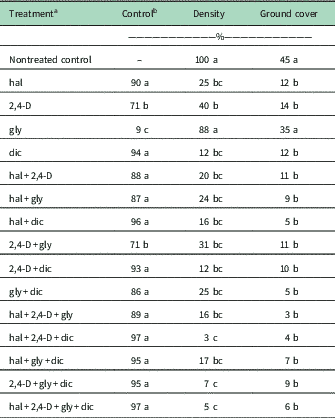
Halauxifen-methyl or dicamba applied alone resulted in 90% or greater GR horseweed control 35 DAT at Cortland, whereas glyphosate or 2,4-D or 2,4-D+glyphosate resulted in lower GR horseweed control (9% and 71%, and 71% control, respectively) (Table 3). Furthermore, all mixtures containing halauxifen-methyl and/or dicamba resulted in 86% or greater GR horseweed control 35 DAT. Research conducted by Braz et al. (Reference Braz, Oliveira, Zobiole, Rubin, Voglewede, Constantin and Takano2017) on Sumatran fleabane [Conyza sumatrensis (Retz.) E. Walker], a weed species closely related to horseweed, utilizing several rates of the mix halauxifen-methyl+diclosulam resulted in 80% to 100% control 45 DAT depending on rate and weed height. Other researchers have shown similar results for GR horseweed control with preplant burndown applications of 2,4-D and dicamba (Brown et al. Reference Brown, Shropshire and Sikkema2016; Byker et al. Reference Byker, Soltani, Robinson, Tardif, Lawton and Sikkema2013; Kruger et al. Reference Kruger, Davis, Weller and Johnson2010a; Mahoney et al. Reference Mahoney, Shropshire and Sikkema2017; Mithila et al. Reference Mithila, Hall, Johnson, Kelley and Riechers2011; Montgomery et al. Reference Montgomery, Treadway, Reeves and Steckel2017).
Glyphosate-resistant horseweed control, density, and ground cover 35 d after treatment in 2015 and 2016 at Cortland, IN.

a Treatment means of two field trials (n=8) are combined, except for ground cover analysis (2016 data only; n=4). Abbreviations and rates: 2,4-D (560 g ae ha–1); dic, dicamba (280 g ae ha–1); gly, glyphosate (560 g ae ha–1); hal, halauxifen-methyl (5 g ae ha–1). Ammonium sulfate (N-Pak® AMS, Winfield Solutions LLC, St. Paul, MN) at 2.5% vol/vol was added to all treatments. All treatments containing halauxifen-methyl had methylated seed oil (MSO UltraTM, Precision Laboratories LLC, Waukegan, IL) added at 1% vol/vol. Dicamba and 2,4-D treatments had non-ionic surfactant (Activator 90, Loveland Products Inc., Greeley, CO) added at 0.25% vol/vol unless mixed with halauxifen-methyl and/or glyphosate.
b Means followed by same letter within a column are not statistically different according to Tukey’s honest significant difference (HSD) test (P≤0.05). Weed control and density presented as percentage of nontreated control, whereas ground cover is presented as the percentage of the total ground area covered with green vegetation.
Orthogonal contrast analysis (P≤0.05) showed that glyphosate+dicamba resulted in lower GR horseweed control than dicamba alone (86% versus 94% control, respectively). However, that adjuvants were not added to 2,4-D or dicamba when mixed with glyphosate (Durango® DMA) may explain the reduced control for glyphosate+dicamba compared to dicamba alone.
Glyphosate-resistant horseweed densities and ground cover were lower 35 DAT for all treatments compared with the nontreated control and glyphosate alone (Table 3). Mixtures of halauxifen-methyl+2,4-D+dicamba, 2,4-D+glyphosate+dicamba, and halauxifen-methyl+2,4-D+glyphosate+dicamba reduced horseweed density compared with 2,4-D alone. Furthermore, orthogonal contrast analysis (P≤0.05) showed that all treatments containing synthetic auxins reduced GR horseweed densities compared with 2,4-D alone, except for halauxifen-methyl alone, 2,4-D+glyphosate, and glyphosate+dicamba (contrasts not shown). Regrowth of injured plants was observed for applications of 2,4-D and 2,4-D+glyphosate. Research conducted by Kruger et al. (Reference Kruger, Davis, Weller and Johnson2010b) showed that certain horseweed populations can produce seed after exposure to 2,4-D and may lead to the evolution of resistance.
Common Ragweed Control
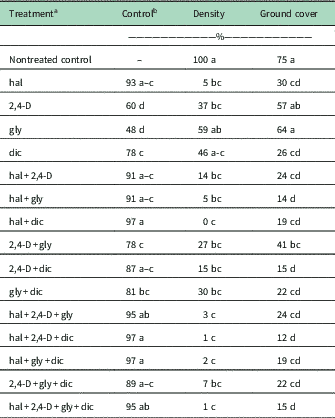
Halauxifen-methyl alone and in mixtures controlled common ragweed 35 DAT at Butlerville, IN (Table 4), ranging from 91% to 97% control. Glyphosate, 2,4-D, and dicamba applied alone resulted in poor common ragweed control (48%, 60%, and 78% control, respectively). Moreover, mixtures of 2,4-D+glyphosate, and dicamba+glyphosate resulted in poor common ragweed control (78% and 81% control, respectively), whereas 2,4-D+dicamba and 2,4-D+glyphosate+dicamba controlled common ragweed (87% and 89% control, respectively).
Common ragweed control, density, and ground cover 35 d after treatment at Butlerville, IN, in 2015 and 2016.

a Treatment means of two field trials (n=8) are combined, except for ground cover analysis (2016 data only; n=4). Abbreviations and rates: 2,4-D (560 g ae ha–1); dic, dicamba (280 g ae ha–1); gly, glyphosate (560 g ae ha–1); hal, halauxifen-methyl (5 g ae ha–1). Ammonium sulfate (N-Pak® AMS, Winfield Solutions LLC, St. Paul, MN) at 2.5% vol/vol was added to all treatments. All treatments containing halauxifen-methyl had methylated seed oil (MSO UltraTM, Precision Laboratories LLC, Waukegan, IL) added at 1% vol/vol. Dicamba and 2,4-D treatments had non-ionic surfactant (Activator 90, Loveland Products Inc., Greeley, CO) added at 0.25% vol/vol unless mixed with halauxifen-methyl and/or glyphosate.
b Means followed by same letter within a column are not statistically different according to Tukey’s honest significant difference (HSD) test (P≤0.05). Weed control and density presented as percentage of nontreated control, whereas ground cover is presented as the percentage of the total ground area covered with green vegetation.
Orthogonal contrast analysis (P≤0.05) showed that all halauxifen-methyl mixtures resulted in greater common ragweed control than mixtures without halauxifen-methyl, except for 2,4-D+dicamba and 2,4-D+glyphosate+dicamba (87% and 89% control). However, 2,4-D+dicamba resulted in lower common ragweed control than halauxifen-methyl+dicamba (87% versus 97% control, respectively) (contrasts not shown).
Treatments containing halauxifen-methyl resulted in lower common ragweed densities (86% to 100% reduction of the nontreated control) than glyphosate, 2,4-D, or dicamba applied alone (41%, 63%, and 54% reduction of the nontreated control, respectively), according to orthogonal contrast analysis (contrast not shown). Research has shown that lower rates of glyphosate do not control common ragweed (Wilson and Worsham Reference Wilson and Worsham1988). Although dicamba and 2,4-D can control common ragweed (Anonymous 2010, 2013; Ganie and Jhala Reference Ganie and Jhala2017; Payne et al. Reference Payne, Sleugh and Bradley2010), the results suggest that 2,4-D and dicamba alone and mixed with glyphosate can result in variable common ragweed control, whereas applications of halauxifen-methyl can provide greater common ragweed control of taller plants (13 to 20 cm).
Giant Ragweed Control
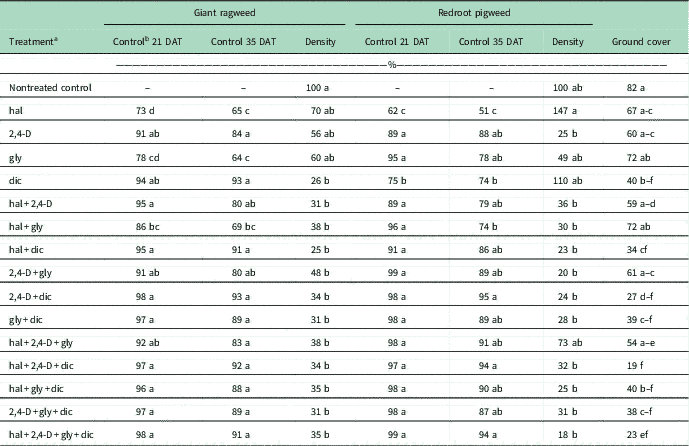
Halauxifen-methyl and glyphosate applied alone resulted in 73% to 80% giant ragweed control 21 DAT, whereas all other mixtures controlled giant ragweed, from 86% to 98% (Table 5). However, by 35 DAT giant ragweed control was reduced as a result of new emergence. All mixtures, except glyphosate alone, resulted in greater giant ragweed control than halauxifen-methyl. However, all mixtures of halauxifen-methyl with 2,4-D and/or dicamba resulted in giant ragweed control equal to or greater than 92% at 21 DAT, indicating that other synthetic auxins can be mixed with halauxifen-methyl to improve giant ragweed control in preplant burndown applications.
Giant ragweed and redroot pigweed control 21 and 35 d after treatment (DAT), density, and ground cover 35 DAT at Lafayette, IN, in 2015 and 2016.

a Treatment means of two field trials (n=8) are combined, except for ground cover analysis (2016 data only; n=4). Abbreviations and rates: 2,4-D (560 g ae ha–1); dic, dicamba (280 g ae ha–1); gly, glyphosate (560 g ae ha–1); hal, halauxifen-methyl (5 g ae ha–1). Ammonium sulfate (N-Pak® AMS, Winfield Solutions LLC, St. Paul, MN) at 2.5% vol/vol was added to all treatments. All treatments containing halauxifen-methyl had methylated seed oil (MSO UltraTM, Precision Laboratories LLC, Waukegan, IL) added at 1% vol/vol. Dicamba and 2,4-D treatments had non-ionic surfactant (Activator 90, Loveland Products Inc., Greeley, CO) added at 0.25% vol/vol unless mixed with halauxifen-methyl and/or glyphosate.
b Means followed by same letter within a column are not statistically different according to Tukey’s honest significant difference (HSD) test (P≤0.05). Weed control and density presented as percentage of nontreated control, whereas ground cover is presented as the percentage of the total ground area covered with green vegetation.
Mixtures containing dicamba resulted in 88% or greater giant ragweed control 35 DAT (Table 5). Mixtures without dicamba resulted in poor giant ragweed control 35 DAT as a result of new giant ragweed emergence, ranging from 64% control for glyphosate alone to 84% control for 2,4-D alone. Dicamba alone resulted in greater giant ragweed control than glyphosate or halauxifen-methyl. Furthermore, orthogonal contrast analysis (P≤0.05) showed that dicamba alone resulted in greater giant ragweed control than 2,4-D, halauxifen-methyl+glyphosate, 2,4-D+glyphosate, and halauxifen-methyl+2,4-D+glyphosate 35 DAT (data not shown). All mixtures reduced giant ragweed density 35 DAT compared with the nontreated control, except halauxifen-methyl, glyphosate, and 2,4-D alone (30%, 40%, and 44% reduction of the nontreated control). Both 2,4-D and dicamba controlled giant ragweed in preplant burndown applications (Vink et al. 2012a,Reference Vink, Soltani, Robinson, Tardif, Lawton and Sikkemab), although the results presented in this experiment suggest that dicamba has longer soil residual activity on giant ragweed than 2,4-D.
Redroot Pigweed Control
Redroot pigweed was controlled with all mixtures 21 DAT at Lafayette (89% to 98% control), except for halauxifen-methyl and dicamba alone (62% and 75% control, respectively) (Table 5). New emergence of redroot pigweed reduced control 35 DAT for most treatments (Table 5). Halauxifen-methyl, glyphosate, dicamba, halauxifen-methyl+glyphosate, and halauxifen-methyl+2,4-D treatments resulted in poor redroot pigweed control 35 DAT (51%, 78%, 74%, 74%, and 79% control, respectively). Halauxifen-methyl alone resulted in lower redroot pigweed control than all other treatments 35 DAT and greater redroot pigweed densities than most treatments, except for dicamba alone (147% and 110% of the nontreated control), according to orthogonal contrasts (contrasts not shown). Furthermore, orthogonal contrasts showed that dicamba alone and halauxifen+glyphosate resulted in lower redroot pigweed control than 2,4-D alone. The addition of halauxifen-methyl to dicamba increased redroot pigweed control and reduced densities compared with dicamba alone (86% versus 74% control, and 110% versus 23% density of the nontreated control, respectively) (contrasts not shown).
Ground Cover Analysis
Ground cover analysis at Cortland in 2016 resulted in similar trends as for horseweed control and weed density (Table 3). However, digital-imagery analysis did not indicate treatments differences for synthetic auxins to the same extent as visual estimates of control because of reduced sample size (n=4) and emergence of other weed species after treatment application {carpetweed (Mollugo verticillata L.), common cocklebur (Xanthium strumarium L.), giant foxtail (Setaria faberi Herrm.), goosegrass (Eleusine indica L. Gaertn.), large crabgrass [Digitaria sanguinalis (L.) Scop.], pitted morningglory (Ipomoea lacunosa L.), prickly sida (Sida spinosa L.), spotted spurge [Chamaesyce maculata (L.) Small), tall waterhemp [Amaranthus tuberculatus (Moq.) Sauer], and trumpetcreeper [Campsis radicans (L.) Seem. ex Bureau]}. Furthermore, the methodology used for imagery analysis did not account for horseweed height.
Digital-imagery analysis at the Butlerville site in 2016 faced limitations similar to those for Cortland because of the interference of other weed species present [carpetweed, common cocklebur, dandelion (Taraxacum officinale G.H. Weber ex F.H. Wigg.), eastern black nightshade (Solanum ptychanthum Dunal), horseweed, Pennsylvania smartweed (Polygonum pensylvanicum L.), pitted morningglory, prickly sida, redroot pigweed, tall waterhemp, yellow nutsedge (Cyperus esculentus L.), and yellow woodsorrel (Oxalis stricta L.)]. However, glyphosate and 2,4-D alone resulted in greater ground cover than all other mixtures, except 2,4-D+glyphosate, as a result of poor common ragweed control (Table 4).
Giant ragweed and redroot pigweed were prevalent at the Lafayette site in 2016 (Table 2), although other summer-annual weed species emerged after treatment application [carpetweed, common purslane (Portulaca oleracea L.), prickly sida, velvetleaf (Abutilon theophrasti Medik.), and tall waterhemp]. Digital-imagery analysis using ImageJ software resulted in similar trends as for the combined giant ragweed and redroot pigweed control 35 DAT (Table 5).
Conclusions
Halauxifen-methyl applied alone and in mixtures with 2,4-D, dicamba, and glyphosate resulted in greater GR horseweed control than 2,4-D applied alone, and greater common ragweed control than 2,4-D and dicamba applied alone. However, halauxifen-methyl applied alone resulted in poor giant ragweed and redroot pigweed control; thus, the use of other synthetic auxin herbicides (2,4-D or dicamba) and glyphosate in mixtures is necessary to increase the weed control spectrum of preplant burndown applications. The decision as to which synthetic auxin herbicides to utilize in mixtures to achieve weed control in preplant burndown applications should be based on weed control spectrum of the herbicides, weed species richness in the field, preplant interval restrictions, and herbicide costs.
Ground cover analysis using ImageJ with the Threshold Colour plugin can measure overall weed control of herbicide treatments in the field, although accurate estimation of weed control by species requires a monoculture of the weed of interest, or more refined parameters for the software/plugin. Distinguishing weed species based on different leaf shapes or color tonality may increase the accuracy of the method compared to using green (weeds) versus non-green (soil+residue) filters only.
Acknowledgments
The authors would like to thank Dow AgroSciences for funding this research. No conflicts of interest have been declared.