Introduction
With bleeding still being the leading cause of preventable death worldwide,Reference Champion 1 , Reference Eastridge, Mabry and Seguin 2 and more than 12 million traumatic wounds treated in the United States every year,Reference Stussman 3 finding a way to treat bleeding is understandably a primary concern for both military and civilian care providers. New hemorrhage control devices, such as junctional tourniquets, hemostatic agents, hemostatic dressings, extremity tourniquets, and wound clamps, are appearing more frequently in the literature, as is an evaluation of these products. These evaluations generally include application time, effectiveness, preference, and safety.Reference Grissom and Fang 4 - Reference Bulger, Snyder and Schoelles 6 Several other factors such as regulatory approval, cost, weight, pain, shelf life, and durability have also been suggested as a means to study these products and inform decision on hemorrhage control protocols.Reference Butler, Holcomb, Giebner, McSwain and Bagian 7 , Reference Kheirabadi 8 However, whether initiating medical aid during care under fire, civilian prehospital, during transport, or in hospital, understanding the impact of the agitated patient or agitated environment should also be considered important. An aggressive patient or environment may render a device less-effective than what is demonstrated during less-traumatic encounters. A seemingly easy to apply device may become impossible to utilize, or simply ineffective, in the wake of a patient or situation that is combative. The iTClamp (Innovative Trauma Care; Edmonton, Alberta, Canada) is a simple, mechanical, skin sealing device applied for hemorrhage control which has demonstrated efficacy in exsanguinating hemorrhage.Reference Filips, Logsetty, Tan, Atkinson and Mottet 9 - Reference St John, Wang, Lim, Chien, Stern and White 13 Although there have been no clinical reports of an iTClamp being inadvertently pulled from the skin’s surface, there is a risk of any hemorrhage-control device being removed by an agitated patient or adverse environment. Since the iTClamp has eight needles on it that anchor it to the skin, a trial was conducted to determine if the iTClamp would create additional skin damage if forcefully removed in the closed position.
Methods
The iTClamp is a self-locking, hemostatic clamp with eight needles that penetrate the skin to evert the skin edges between pressure bars. Pressure is evenly distributed across the bars, which seal the skin over the wound. This action stops the bleeding by creating a temporary contained hematoma until surgical repair. In order to ascertain potential skin damage that could be caused by inadvertent, traumatic disengagement of the iTClamp, with needles still engaged in the skin, human cadaveric and swine skin were tested. A 1.75-inch linear wound was used, as this is the maximum length of a wound that can be sealed prior to using two iTClamps. This was done to ensure that all the needles were engaged in the incision during the testing. The study protocol, both the cadaver and animal portions, was approved by and conducted at the Medical Education and Research Institute (MERI) in Memphis, Tennessee USA. The iTClamps that were used as part of this study were donated by Innovative Trauma Care for this project.
Cadaver Model
The cadaver was thawed for 72 hours at room temperature. Wounds were made on the back of both thighs, the back of both calves, and on the buttock. Wounds were linear and 1.75 inches in length, each wound was labeled, and a new wound was created for each device pull. A total of 30 device pulls were performed on the cadaver.
Swine Model
Male, Yorkshire swine between 18-24 kg were used for this study. The swine used were freshly euthanized just prior to the study being performed. Linear, 1.75-inch wounds were made on the swine’s abdomen and a new wound was made for each device pull. The swine’s abdomen was chosen as it is the most similar to human skin. A total of 30 device pulls were performed on the swine.
Vectors of Disengaging Force
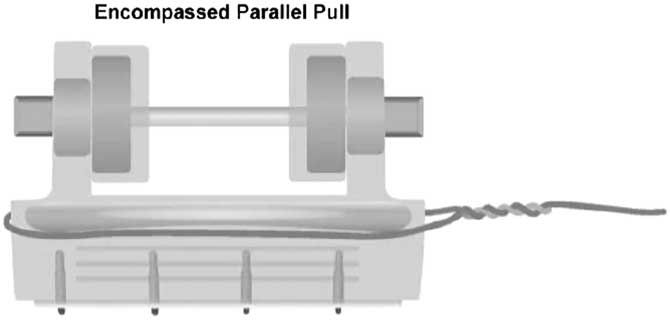
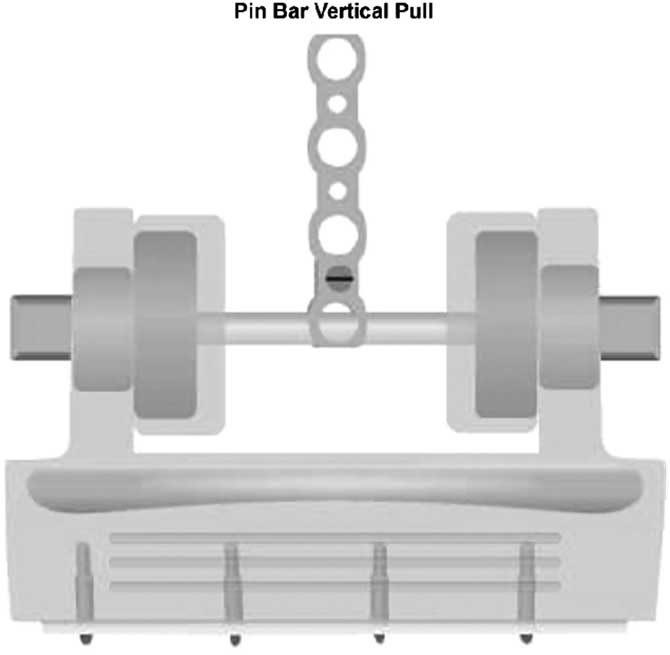
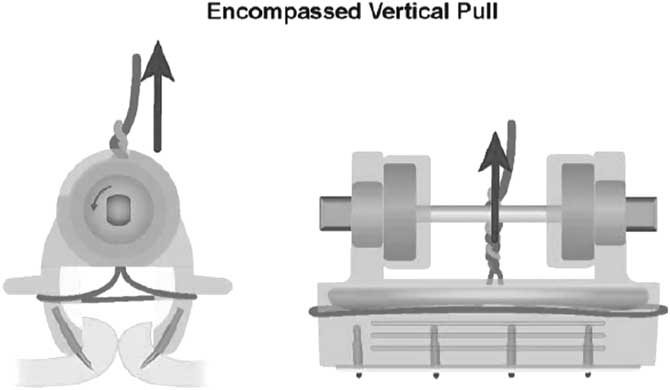
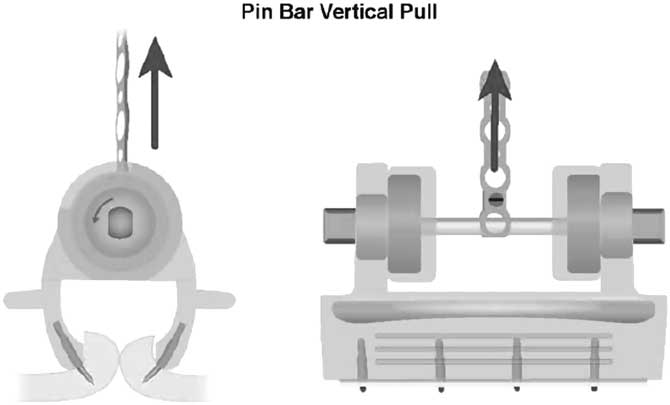
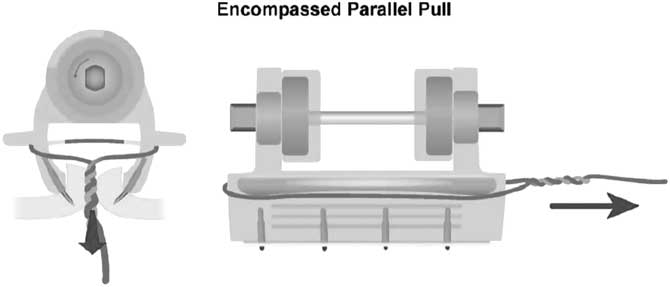
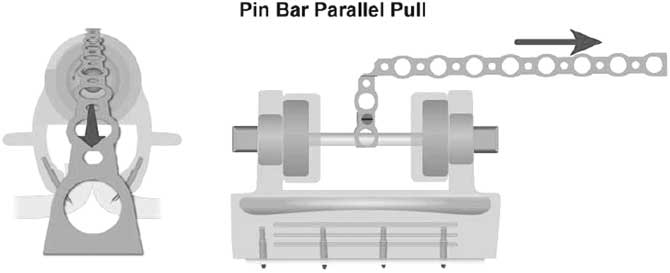
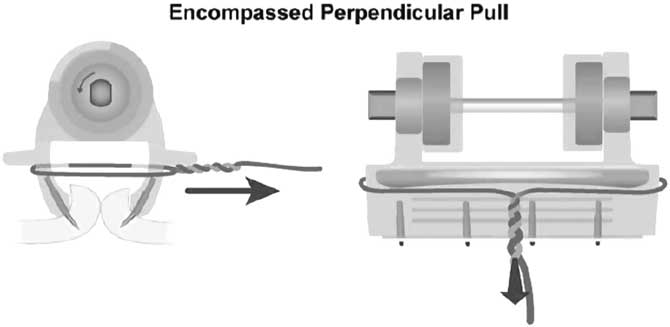
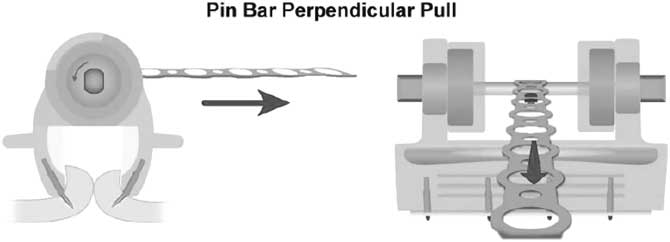
To test varying vectors and mechanisms of inadvertent disengagement, two pull positions were tested in each of three pull directions. The two pull configurations were designated the encompassed device pull and the pin bar pull. Encompassed device pull (Figure 1) meant that wire was wrapped around the base of the iTClamp prior to the pull test, and pin bar pull (Figure 2) meant that wire was attached to the pin bar prior to the pull test. A force gauge (Wagner FDIX Digital Tension and Compression Force Gauge; 50lb/25Kg/250 Newton Capacity; Wagner Instruments; Greenwich, Connecticut USA) was then attached to the end of the wire and pulled forcefully in one of the three directions: vertical, parallel, and perpendicular. For both of the positions, vertical pull meant to pull straight up vertically on the device (Figure 3 and Figure 4) and directly away from the skin. Parallel pull meant to pull on the device horizontally in the direction that the pressure bars are parallel to each other (Figure 5 and Figure 6), being a pull across the skin in the direction of the long axis of the clamp. Perpendicular pull meant to pull on the device horizontally, perpendicular to the pressure bars (Figure 7 and Figure 8), thus along the skin on the broad front of the device.
Encompassed Device Pull.

Pin Bar Pull.

Encompassed Device Vertical Pull.

Pin Bar Vertical Pull.

Encompassed Device Parallel Pull.

Pin Bar Parallel Pull.

Encompassed Device Perpendicular Pull.

Pin Bar Perpendicular Pull.

Four outcomes were considered: pull force (measured in pound force: lb F ), skin effects, device failure, and re-application rates. These outcomes were defined as follows: force - the force required to remove the device from the skin (recorded in lbs); skin effects - once the device was pulled from the skin’s surface, the skin was examined and any tearing, ripping, or deformity was recorded (each wound was also digitally recorded with high-quality images); mechanism of device failure - it was noted if the iTClamp was simply pulled from the skin due to force, if the device remained intact on the skin’s surface, or if the device mechanically failed (any physical damage to clamps was recorded); and re-application - denoted the ability of the clamp to be successfully re-applied to the skin after it had been previously pulled from the skin’s surface. For this determination, each clamp was re-applied to the same wound it was pulled from. Each of these outcomes was decided by two study staff to ensure inter-rater reliability.
Study Procedure
A standardized, 1.75-inch linear incision was made in the skin on the designated study model. The iTClamp was applied to the wound in either the encompassed device pull or pin bar pull position. The force gauge was attached to the wire that was on the iTClamp. Study staff then attempted to pull the iTClamp off of the model in one swift motion in one of the three vector directions: vertical, parallel, or perpendicular. A total of 30 skin pulls were thus completed on each of the cadaver model and swine model (five encompassed/vertical, five encompassed/parallel, five encompassed/perpendicular, five pin bar/vertical, five pin bar/parallel, and five pin bar/perpendicular per model). A new iTClamp was used each time.
Statistical Analysis
Statistical analysis was performed using SPSS (version 21; IBM Corp.; Armonk, New York USA). Descriptive stats were used to examine the data. As the data were not normally distributed, Mann-Whitney U tests were used to compare the data. Mann-Whitney U tests were used to compare pull force between the models as well as when the pull force information from the models was combined to compare between the pull positions and pull directions.
Results
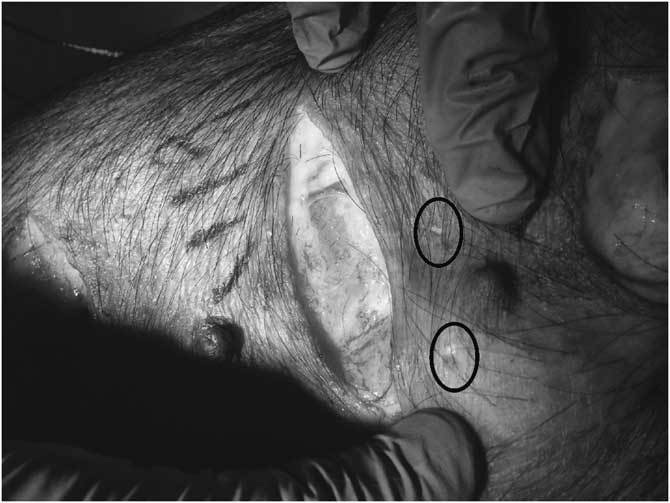
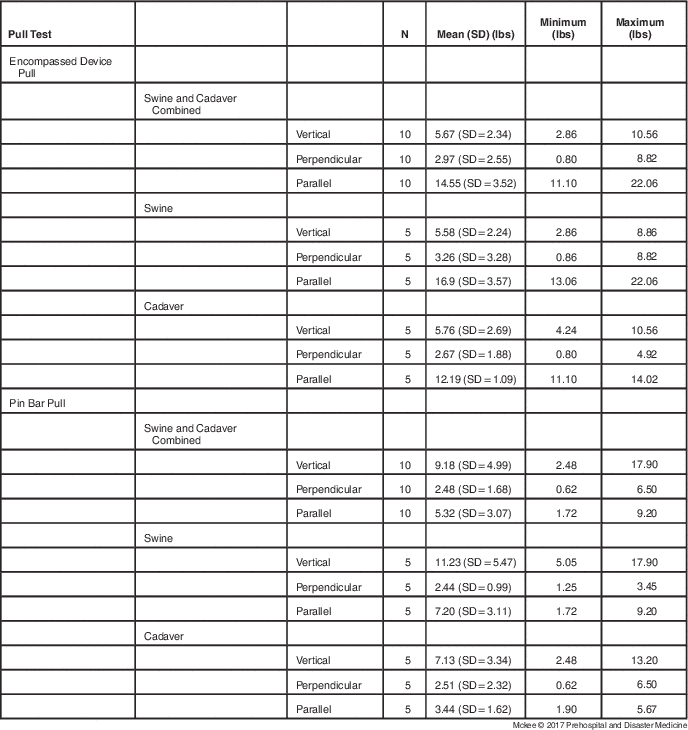
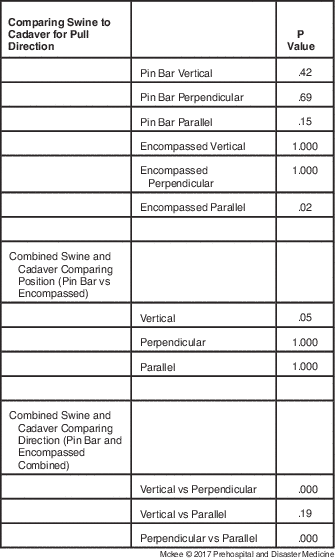
Detailed skin observation revealed that other than the expected eight needle punctures from the device application, there was no other damage to the skin regardless of specimen, position, or direction of the pull in 98.3% (n=59) of the tests. One (1.3%) of the encompassed device parallel pulls in the swine model revealed minor skin surface tearing following a 14.98 lb F lateral pull (Figure 9), during which the device simply pulled off the skin. Of the 60 devices pulled, 93.3% (n=56) of the devices sustained no damage and four (6.7%) showed minimal damage (slight needle bend); however, all of the devices could be re-applied. The overall mean pull force for all groups was 6.70 (SD=5.20) lb F . The pull force for each group is located in Table 1. During the test, over one-half of cases (n=32; 53.3%) ended when the iTClamp simply pulled off the skin; also, the needles slipped out of one side of the skin due to the angle of the pull (n=15; 25.0%), the friction lock disengaged (n=6; 10.0%), or the device stayed attached to the skin (n=7; 11.7%). Of the seven devices that stayed attached to the skin, four (6.7%) of the devices remained in place despite a pull weight >22 lb F . When comparing the models (swine and cadaver), there was no significant difference in the force required to remove the iTClamp (P=.19). Overall, the swine model demonstrated a mean pull force of 7.76 (SD=5.90) lb F with a minimum pull force of 0.86 lb F and a maximum pull force of 22.06 lb F . The mean overall pull force for the cadaver model was 5.61 (SD=4.08) lb F with a minimum pull force of 0.62 lb F and a maximum pull force of 14.02 lb F . When examining the models (swine vs cadaver), comparing position and direction (Table 2), the encompassed device parallel pull demonstrated a significant difference (P=.02), with the swine model requiring slightly more force to remove the iTClamp. When comparing pin bar versus encompassed device, vertical pull showed a significant difference (P=.05), with the pin bar pull requiring more force to dislodge the iTClamp. When all models (swine, cadaver, pin bar, and encompassed) were combined, the parallel pull had the highest overall pull force at 9.93 (SD=5.71) lb F , the vertical pull was second at 7.42 (SD=4.19) lb F , followed by the perpendicular pull at 2.72 (SD=2.11) lb F . There was a significant difference seen between the vertical pull and perpendicular pull (P=.000) and the parallel pull and perpendicular pull (P=.000), but no difference between vertical pull and parallel pull (P=.19).
Minor Skin Tear Seen on the Encompassed Device Parallel Pull from Swine Model.

Descriptive Statistics for Swine and Cadaver Pull Tests

Mann-Whitney U test to Compare Groups

Discussion
Hemorrhage control has been identified as the single most effective intervention after traumatic injury that may save lives on a global basis. Frequently, timeliness and logistical simplicity are the most critical factors in saving lives as rapid application makes the difference between exsanguination and prevention of death. In the last 20 years, there have been remarkable innovations in topical hemorrhage control with an array of advanced devices and bandages to arrest external hemorrhage. Although to date, no one bandage has been proven superior,Reference Grissom and Fang 4 , Reference Kheirabadi 8 , Reference Bennett and Littlejohn 14 , Reference Littlejohn, Devlin, Kircher, Lueken, Melia and Johnson 15 the combination of a wound clamp applied to secure-packed hemostatic bandages has proved superior in animal models over bandage alone.Reference St John, Wang, Lim, Chien, Stern and White 13 This suggests great potential for the iTClamp to fill a critical role in prehospital and tactical hemorrhage control. However, the wound clamp involves a minimally invasive procedure with eight needles that physically engage the skin. As for any invasive device, safe utilization needs to be confirmed before wide-spread clinical adoption.
Numerous published case reports have demonstrated the benefits of the iTClamp to control hemorrhage.Reference Filips, Logsetty, Tan, Atkinson and Mottet 9 - Reference St John, Wang, Lim, Chien, Stern and White 13 , Reference Barnung and Steinmetz 16 However, the potential consequences of inadvertent, unplanned removal have not been well-studied. In operational settings, it is typical that a victim will require transport to definitive care, which may be a significant challenge in itself with risks of inadvertent dislodgment while being carried, littered, or loaded on and off road and aircraft-type ambulances. Akin to Beckett’s work looking at the potential complications of transport of thoracic needles used for decompression in tactical settings with transport,Reference Beckett, Savage, Pannell, Acharya, Kirkpatrick and Tien 17 it will be important for all potential hemorrhage-control modalities to consider potential transportation failures. Further, when dealing with agitated patients, the patient themselves needs to be considered, regardless of the environmental hazards. Physical assaults have been reported in up to 92% of Emergency Medical Service providers in the prehospital environment.Reference Grange and Corbett 18 - Reference Pozzi 20 The emergency department is documented as the most common workplace location for physical assault;Reference Currier 21 in a military setting, care providers not only have to be concerned with combative patients and providing good patient care, but also with protecting themselves and casualties in an agitated environment from contact with enemy forces and incoming hostile fire.Reference Butler, Holcomb, Giebner, McSwain and Bagian 7 Having a full understanding of how any hemorrhage-control device will perform in these situations is essential.
The iTClamp has shown promising results for use in both the civilian and military population; it has demonstrated efficacy in exsanguinating injuriesReference Filips, Logsetty, Tan, Atkinson and Mottet 9 - Reference St John, Wang, Lim, Chien, Stern and White 13 without further damaging the skin, even when abruptly removed. Given the necessity to attend to other urgent needs of the acutely aggravated patient, including physical or chemical restraint or verbal de-escalation,Reference Baker 22 , Reference Weiss, Peterson, Cheney, Froman, Ernst and Campbell 23 rapid, hands-free hemorrhage control has its merits, especially in care under fire situations.Reference LaPorta, Mckee and Roberts 24 Further, interventions that address preventable death until the tactical situation allows more comprehensive care, and do not cause more damage to tissue if forcibly removed, have value to helping obtain the Tactical Combat Casualty Care/TCCC guiding objectives: “(1) treat the casualty, (2) prevent additional casualties, and (3) complete the mission.”Reference Butler, Holcomb, Giebner, McSwain and Bagian 7 Therefore, the fact the iTClamp allows care providers to be hands-free to either deal more comprehensively with a multi-trauma or with the special circumstances of aggressive environments, but does not damage the skin when forcibly removed, appears to be a definite asset.
Limitations
Unavoidable limitations in this study included the need to use the models of thawed cadaver and freshly euthanized swine as an approximation for live human skin, including the frail nature of cadaver skin. These wounds were also not actively perfused, so the ability to control hemorrhage, both from the inciting wound and after being forcibly removed, could not be assessed.
Conclusion
Inadvertent, forcible removal of the iTClamp created essentially no skin damage seen when the wound clamp was forcibly removed from either cadaver or swine models in a variety of positions and directions. Thus, the risks of deployment in operational environments do not seem to be increased.