Introduction
Weeds are troublesome pests in U.S. rice production. Not only do they compete with rice for nutrients, sunlight, and water, but they can also seriously compromise rice quality through interspecific competition (Smith Reference Smith1968, Reference Smith1988). Annual grass weed species, such as junglerice (Echinochloa colona L. Link) and barnyardgrass, as well as several perennial grasses, can also become troublesome in southern Louisiana rice fields (Bottoms et al. Reference Bottoms, Webster, Hensley and Blouin2011; Griffin et al. Reference Griffin, Webster, Zhang and Blouin2008; Webster at al. Reference Webster, Griffin and Blouin2007; Webster Reference Webster2011). Several broadleaf weeds common in Louisiana rice production and plants of the Cyperaceae family, such as yellow nutsedge and rice flatsedge (Cyperus iria L.), are found in nearly every rice field in Louisiana (Webster Reference Webster2014). Rice crops are often rotated with crawfish [Procambarus clarkii (Girard); Procambarus zonangulus (Hobbs & Hobbs)] in Louisiana, and this rotation can involve continuous flood conditions for ≥11 mo. Aquatic weeds, including ducksalad, can cause problems following crawfish production in rice production the next year (Eric Webster, LSU AgCenter Extension Weed Scientist, personal communication).
The level of competition of common rice weeds varies between species and duration of competition. Echinochloa spp. and ducksalad reduced rice yield 79% and 21%, respectively, following season-long competition (Smith Reference Smith1968, Reference Smith1974). Weeds also reduce rice quality and interfere with or influence harvest efficiency. The presence of Ipomoea spp. (family Convolvulaceae) and hemp sesbania [Sesbania herbacea (Mill.) McVaugh] seeds in harvested rice grain reduces grade and has a negative impact on the value of the harvested crop (Smith Reference Smith1988; Smith et al. Reference Smith, Flinchum and Seaman1977). Purple ammannia seed pods in rice grain can lower the value and increase the cost of drying harvested grain (Smith et al. Reference Smith, Flinchum and Seaman1977).
Smith (Reference Smith1988) described a difference in weed complexes depending on planting practices and water management of a rice crop. Common weeds found in dry-seeded production include barnyardgrass, Leptochloa spp., eclipta [Eclipta prostrata (L.) L.] and spreading dayflower (Commelina diffusa Burm. F.). Barnyardgrass and Leptochloa spp. can emerge and be competitive with rice in water-seeded production systems where flood water is temporarily drained to allow for rice seedling establishment. Aquatic weeds such as purple ammannia and ducksalad can emerge through a flood established early in water-seeded plantings.
Herbicide resistance has become a problem in rice production throughout the last two decades. In the early 1990s, barnyardgrass resistance to propanil was discovered in Arkansas (Baltazar and Smith Reference Baltazar and Smith1994; Carey et al. Reference Carey, Hoagland and Talbert1995), and barnyardgrass with multiple resistances to propanil and quinclorac was confirmed in Arkansas in 1999 (Malik et al. Reference Malik, Burgos and Talbert2010). Populations of barnyardgrass resistant to clomazone and imazethapyr were identified in Arkansas in 2007 and 2008, respectively (Norsworthy et al. Reference Norsworthy, Scott and Smith2010; Wilson et al. Reference Wilson, Norsworthy, Johnson, McCallister, DeVore, Griffith, Bangarwa, Scott and Smith2011). Barnyardgrass populations resistant to propanil, quinclorac, and imazethapyr have been documented in Louisiana in 1995, 1998, and 2013, respectively (Heap Reference Heap2017). Amazon sprangletop [Leptochloa panicoides (J. Presl) Hitchc.] resistant to cyhalofop butyl and fenoxaprop-P-ethyl was confirmed in Louisiana in 2009. Rice flatsedge resistant to acetolactase synthase–inhibiting herbicides was confirmed in Arkansas and Mississippi in 2010 and in Louisiana in 2013. One strategy included in an overall resistance management program is rotating herbicide mode of action (Norsworthy et al. Reference Norsworthy, Ward, Shaw, Llewellyn, Nichols, Webster, Bradley, Frisvold, Powles, Burgos, Witt and Barret2012). The adoption of herbicides with a mode of action not currently labeled for use in a particular crop can enhance resistance management strategies or possibly delay the development of herbicide resistance.
Benzobicyclon is a 4-hydroxyphenylpyruvate dioxygenase (HPPD) (EC 1.13.11.27)–inhibiting herbicide that has been labeled for use in Japan since 2001 (Komatsubara et al. Reference Komatsubara, Sekino, Yamada, Koyanagi and Nakahara2009). Sekino et al. (Reference Sekino, Koyanagi, Ikuta and Yamada2008) reported PRE and POST activity on susceptible weeds at 200 and 300 g ha–1 rates. Activity of benzobicyclon is dependent on the uptake of the herbicide through root and shoot tissue, and this occurs more readily under flooded conditions than with dry soil application.
Komatsubara et al. (Reference Komatsubara, Sekino, Yamada, Koyanagi and Nakahara2009) determined that benzobicyclon must undergo a hydrolysis reaction in the presence of water to render the active herbicide, benzobicyclon hydrolysate. Williams and Tjeerdema (Reference Williams and Tjeerdema2016) reported that water pH, temperature, and the presence of dissolved organic carbon affects conversion of benzobicyclon to benzobicyclon hydrolysate. Williams et al. (Reference Williams, Gladfelder, Quigley, Ball and Tjeerdema2017) observed a decrease in benzobicyclon hydrolysate loss under flooded rice field conditions compared with nonflooded conditions, and higher temperatures increased benzobicyclon hydrolysate dissipation. However, control of Schoenoplectus juncoides (Roxb.) Palla was observed 8 wk after treatment, indicating that benzobicyclon provides residual control (Sekino et al. Reference Sekino, Koyanagi, Ikuta and Yamada2008). Weed species common to rice production in Japan that are susceptible to benzobicyclon at early application timings include barnyardgrass, tidalmarsh flatsedge [Cyperus serotinus (Rott.)], and false pimpernel. Cyperus spp., barnyardgrass, and false pimpernel occur as weeds in Louisiana rice production. The objective of this field trial was to evaluate benzobicyclon applied at different rates on common Louisiana rice weeds at multiple locations and years.
Materials and Methods
Field studies were conducted at the LSU AgCenter H. Rouse Caffey Rice Research Station (RRSC) near Crowley, Louisiana (30.12°N, 92.22°W), in 2013, 2014, 2015, and 2016 on a Crowley silt loam soil with a pH of 6.3 and 1.3% organic matter. Studies were conducted at another area of the Rice Research Station on a Midland silty clay loam (RRSM) with 1.2% organic matter and pH 6.1 in 2015 and 2016. This trial was also conducted at the LSU AgCenter Northeast Research Station (NERS) near St. Joseph, Louisiana (31.55°N, 91.14°W) on a Sharkey clay with a pH 6.1 and 2.1% organic matter in 2015. Seedbed preparation included a fall and spring disking followed by two perpendicular passes with a two-way bed conditioner employing S-tine harrows, set at a 10-cm depth, and rolling baskets. Following seedbed preparation, 1.5 by 5.2 m2 plots were established and 113-cm diameter by 30-cm tall galvanized metal rings, or a 1 m2 surface area, were placed at random near the center of each plot and pressed firmly into the soil to a depth of 5 cm to seal the area contained inside the ring from the rest of the plot area. Sekino et al. (Reference Sekino, Koyanagi, Ikuta and Yamada2008) observed activity of benzobicyclon when applied directly to flood water, and the galvanized metal ring was used to allow for herbicide containment without the need for individually leveed plots. Weed evaluations were taken only within the ring; however, the entire plot area, 1.5 by 5.2 m2, was treated.
Water management for this field trial mimicked a water-seeded production system. Following establishment of the permanent flood, water moved into the ring from subsurface flow and reached equilibrium when the flood level inside the ring was equal to flood depth outside the containment ring. The flood depth in the rings and field was maintained at 12 cm. No rice was planted in the plot area to eliminate competition between rice plants and a natural weed infestation. Lack of competition from rice allows the full effect of the herbicide treatment to be evaluated without interference from shading and resource competition. Once the flood was established and ducksalad had reached the first elongated-leaf growth stage, benzobicyclon treatments were applied. Benzobicyclon was applied at 0, 31, 62, 123, 185, 246, 493, 739, 986, and 1,232 g ha–1. The target field rate of benzobicyclon is 246 g ha–1. All treatments included 1% v/v COC (Agri-Dex®; Helena Chemical Company, Collierville, TN). Applications were made using a CO2-pressurized backpack sprayer calibrated to deliver 140 L ha–1 of spray solution at 190 kPa. Fertility and other pest management practices were based on recommendations from the LSU AgCenter Rice Production Guidelines (Harrell and Saichuk Reference Harrell and Saichuk2014). Experimental design for this field study was a randomized complete block replicated four times.
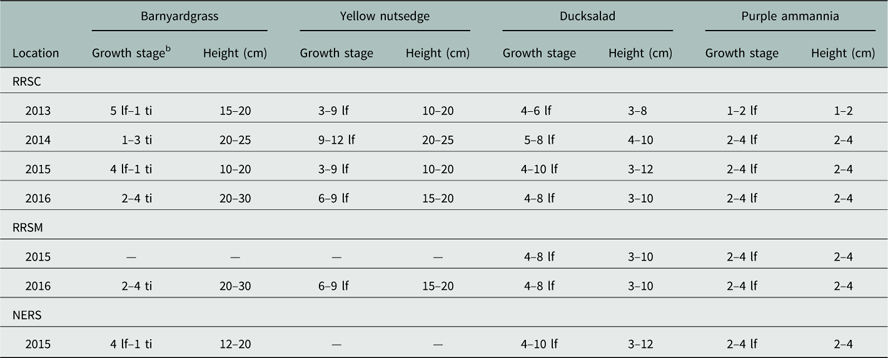
Height and growth stage of weeds present in each year and location at the time of benzobicyclon application are listed in Table 1. False pimpernel and Indian toothcup were present in all study locations and years; however, these late-emerging weeds were not observed in each study until the visual evaluation at 28 DAT. Visual weed control evaluations were recorded at 14, 28, and 42 DAT only within the confined galvanized ring. Visual weed control evaluations were assigned on a scale of 0 to 100%, where 0 = no injury and 100% = complete plant death. At the conclusion of the study, all weed biomass above the soil surface from each treatment containment ring was hand-harvested and separated by species for fresh-weight determination.
Weed species height and growth stage at the time of benzobicyclon application in each year at different locations.Footnote a

a Field trials conducted in 2013, 2014, 2015 and 2016 at the Rice Research Station (RRSC) on Crowley silt loam, 2015 and 2016 at the Rice Research Station (RRSM) on Midland silty clay loam, and 2015 at the Northeast Research Station (NERS).
b Abbreviations: lf, leaf; ti, tiller.
Data were analyzed as repeated measures and subjected to the mixed procedure of SAS (Version 9.4; SAS Institute Inc., Cary, NC). Location, years, replication (nested within year), and all interactions including any of these effects were considered random effects. Considering year or combination of year as random effects permits inferences about treatments over a range of environments (Carmer et al. Reference Carmer, Nyuist and Walker1989; Hager et al. Reference Hager, Wax, Bollero and Stroller2003). Application rate of benzobicyclon and evaluation date were considered fixed effects. Normality of treatment effects over all DAT was checked with the use of a UNIVARIATE procedure (SAS 2013). Significant normality problems were not observed. Type III statistics were used to test all possible interactions of these fixed effects. Tukey’s test was used to separate means at the 5% probability level (P≤0.05).
Results and Discussion
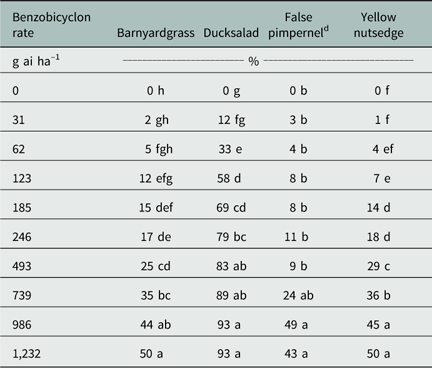
A benzobicyclon rate effect was observed for barnyardgrass, ducksalad, false pimpernel, and yellow nutsedge; therefore, data were pooled over evaluation intervals (Table 2). Barnyardgrass and yellow nutsedge treated with any rate of benzobicyclon did not exceed 50% control; however, benzobicyclon applied at 123 g ha–1 controlled ducksalad 58%. Ducksalad treated with benzobicyclon at 493 g ha–1 was controlled 83% with no difference observed when applied at rates from 246 to 1,232 g ha–1. This level of POSTFLOOD ducksalad control was similar to control observed by Braverman (Reference Braverman1995) with bensulfuron-coated fertilizer granules applied at 111 g ai ha–1. Braverman and Jordan (Reference Braverman and Jordan1996) observed 100% ducksalad control with bispyribac sodium applied late POST; however, control was 36% for the same herbicide applied POSTFLOOD. False pimpernel control was similar to barnyardgrass and yellow nutsedge, never exceeding 49% control from any rate of benzobicyclon applied. Control of false pimpernel was 24%, 49%, and 43% with 739, 986, and 1,232 g ha–1 benzobicyclon, respectively.
Visual control of barnyardgrass, ducksalad, false pimpernel, and yellow nutsedge treated with benzobicyclon at different rates and averaged across evaluation timings 14, 28, and 42 DAT.Footnote a – Footnote c

a Means followed by the same letter within each column do not significantly differ at P = 0.05 using Tukey’s test.
b Field trials conducted in 2013, 2014, 2015, and 2016 at the Rice Research Station on Crowley silt loam, 2015 and 2016 at the Rice Research Station on Midland silty clay loam, and 2015 at the Northeast Research Station.
c Percentage control was measured using a scale of 0 (no control) to 100% (complete control) based on visual symptoms.
d False pimpernel was only observed at 28 and 42 DAT.
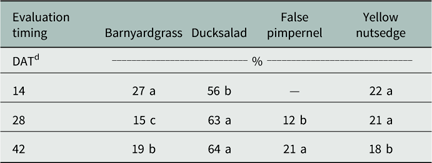
A main effect of evaluation timing was observed on barnyardgrass, ducksalad, false pimpernel, and yellow nutsedge control; therefore, data were averaged over benzobicyclon rate (Table 3). Barnyardgrass control was 27% averaged across all benzobicyclon rates at 14 DAT, but decreased to 15% and 19% at 28 and 42 DAT, respectively, and this further indicates that benzobicyclon has limited activity on barnyardgrass when treated in the tillering stage of growth. Yellow nutsedge control was similar to barnyardgrass, indicating a decrease in control as DAT increased; however, ducksalad control averaged over benzobicyclon rate was controlled 56% at 14 DAT and increased to 64% at 42 DAT. This increase in control indicates activity of benzobicyclon on ducksalad continued to increase over time. False pimpernel control was 12% at 28 DAT and increased to 21% at 42 DAT. False pimpernel can often be a late-emerging weed species in Louisiana rice production. The later emergence of this species may explain why false pimpernel was not observed in the research area prior to 28 DAT.
Visual control of barnyardgrass, ducksalad, false pimpernel, and yellow nutsedge treated with benzobicyclon, averaged across herbicide rate.Footnote a – Footnote c

a Means followed by the same letter within each column do not significantly differ at P = 0.05 using Tukey’s test.
b Field trials conducted in 2013, 2014, 2015, and 2016 at the Rice Research Station on Crowley silt loam, 2015 and 2016 at the Rice Research Station on Midland silty clay loam, and 2015 at the Northeast Research Station.
c Percentage control was measured using a scale of 0 (no control) to 100% (complete control) based on visual symptoms.
d Abbreviation: DAT, days after treatment.
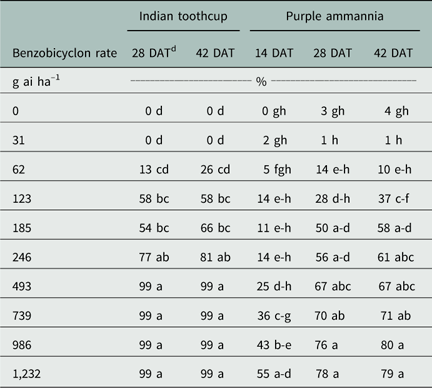
An interaction of benzobicyclon rate by evaluation timing was observed for purple ammannia and Indian toothcup control (Table 4). At 14 DAT, purple ammannia treated with benzobicyclon did not exceed 55% control regardless of the rate of benzobicyclon applied. This level of purple ammannia control is similar to the control observed with propanil (Smith Reference Smith1965). At 28 and 42 DAT, purple ammannia control was 78% and 79%, respectively, when treated with benzobicyclon at 1,232 g ha–1; however, this level of control did not differ substantially from control of purple ammannia when treated with benzobicyclon at 185 to 986 g ha–1. This level of control indicates that the target rate of benzobicyclon, 246 g ha–1, provides the same level of purple ammannia control as 1,232 g ha–1.
Visual control of Indian toothcup and purple ammannia treated with different rates of benzobicyclon, at different evaluation timings.Footnote a – Footnote c

a Means followed by the same letter within each species do not significantly differ at P = 0.05 using Tukey’s test.
b Field trials conducted in 2013, 2014, 2015, and 2016 at the Rice Research Station on Crowley silt loam, 2015 and 2016 at the Rice Research Station on Midland silty clay loam, and 2015 at the Northeast Research Station.
c Percentage control was measured using a scale of 0 (no control) to 100% (complete control) based on visual symptoms.
d Abbreviation: DAT, days after treatment.
Indian toothcup, like false pimpernel, is also a later emerging weed species in Louisiana rice production. This species was not present at the time of treatment or at the first visual evaluation, 14 DAT. At 28 and 42 DAT, Indian toothcup was controlled 99% with benzobicyclon at 493 to 1,232 g ha–1 (Table 4). This level of control did not differ substantially from the control of Indian toothcup, 77% and 81%, with the target rate of benzobicyclon, 246 g ha–1; therefore, a higher rate of benzobicyclon to control this weed is not needed.
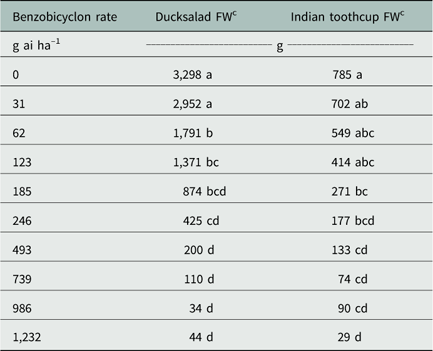
A benzobicyclon rate main effect was observed for fresh-weight biomass of ducksalad and Indian toothcup when the study was terminated at 42 DAT (Table 5). No differences in fresh-weight biomass were observed for barnyardgrass, false pimpernel, purple ammannia, or yellow nutsedge when compared with the nontreated weights of 204, 335, 293, and 35 g, respectively (data not shown). Ducksalad control with benzobicyclon at 31 g ha–1 was 12%, and fresh weight did not differ from the nontreated ducksalad. A rate of 62 g ha–1 was needed to reduce ducksalad fresh-weight biomass compared with the nontreated weed, and a similar trend was observed with the visual control evaluation (Table 2). Increasing the rate of benzobicyclon to the target rate of 246 g ha–1 produced similar trends in fresh-weight biomass as were observed with visual control evaluations. Fresh weight of ducksalad treated with the target rate of benzobicyclon at 246 g ha–1 did not differ substantially from the fresh weights of ducksalad treated with rates of 493 to 1,232 g ha–1.
Fresh weight (FW) of ducksalad and Indian toothcup treated with different rates of benzobicyclon.Footnote a , Footnote b

a Means followed by the same letter do not significantly differ at P = 0.05 using Tukey’s test.
b Field trials conducted in 2013, 2014, 2015, and 2016 at the Rice Research Station on Crowley silt loam, 2015 and 2016 at the Rice Research Station on Midland silty clay loam, and 2015 at the Northeast Research Station.
c Fresh weight determined from weed biomass hand-harvested within 1-m2 galvanized metal ring.
Fresh-weight biomass of Indian toothcup treated with benzobicyclon at 246 to 1,232 g ha–1 was reduced 77% to 96% compared with the nontreated sample (Table 5). The late emergence of Indian toothcup may have affected the control, because it was not observed in the research area prior to the treatment and the 14 DAT evaluation. However, these data indicate that the residual activity of benzobicyclon was still present 42 DAT based on visual evaluations and fresh-weight biomass at harvest.
In conclusion, this research demonstrates that benzobicyclon does have activity on common weeds infesting Louisiana rice fields. Control of barnyardgrass treated with benzobicyclon at 1,232 g ha–1 did not exceed 50% (Table 2). Sekino et al. (Reference Sekino, Koyanagi, Ikuta and Yamada2008) reported barnyardgrass control of >90% when benzobicyclon was applied as a PRE. Barnyardgrass was in the one- to three-tiller growth stage when benzobicyclon was applied in these field trials, and this may explain the lack of control observed in other studies (McKnight et al. Reference McKnight, Webster, Sandoski, Bergeron and Fish2015). Yellow nutsedge control also did not exceed 50%, and like barnyardgrass, was large and actively growing at the time of application.
Ducksalad control was 79% to 93% when treated with benzobicyclon at 246 to 1,232 g ha–1 (Table 2). Young et al. (Reference Young, Norsworthy, Sandoski, Scott and Barber2016) observed 99% control of ducksalad, California arrowhead (Sagittaria montevidensis Cham. & Schltdl.), and smallflower umbrellasedge (Cyperus difformis L.) when treated with benzobicyclon at 246 g ha–1. Ducksalad control from an herbicide applied POSTFLOOD that requires foliar contact can be challenging, because lowering the flood level may be necessary to expose ducksalad foliage (Sankula et al. Reference Sankula, Braverman, Jodari, Linscombe and Oard1997; Webster Reference Webster2014). Braverman and Jordan (Reference Braverman and Jordan1996) observed 100% control of ducksalad with bispyribac sodium applied late POST before the flood was established; however, control was <40% from any rate of bispyribac sodium applied POSTFLOOD. Braverman (Reference Braverman1995) observed ducksalad control with bensulfuron-coated fertilizer granules broadcast at a rate to deliver bensulfuron applied POSTFLOOD at 111 g ha–1. Benzobicyclon provides similar ducksalad control without extra time and costs associated with treating fertilizer granules with the herbicide. As benzobicyclon is active in water, lowering flood irrigation water is not necessary to allow sufficient herbicide contact with foliage. Ducksalad is often an early-season problem in water-seeded rice. Benzobicyclon will be an option for the control of early-season ducksalad infesting Louisiana water-seeded rice production systems, and the residual activity of benzobicyclon will be beneficial in maintaining a weed-free period until rice can become fully established.
Acknowledgments
This work is published with the approval of the Director of the Louisiana Agricultural Experiment Station and the Louisiana State University Agricultural Center, Baton Rouge, LA 70803, under manuscript number 2017-306-31510.