Oxytocin and vasopressin share seven of nine amino acid residues, they can respond to the same stimuli and they can bind to each others' receptors (Zingg, Reference Zingg1996). In the mammary gland both the oxytocin and the vasopressin V1 receptor are found on the myoepithelial cells (Soloff et al. Reference Soloff, Fernström and Fernström1989). Vasopressin was recently shown to induce contraction of myoepithelial cells isolated from rabbit mammary glands (Lollivier et al. Reference Lollivier, Marnet, Delpal, Rainteau, Achard, Rabot and Ollivier-Bousquet2006) and intravenous infusions of vasopressin increased milk flow and milk fat concentration in goats (Olsson et al. Reference Olsson, Malmgren, Olsson, Hansson and Häggström2003). The results showed that vasopressin can affect milk excretion, but the physiological role of vasopressin is still unclear.
Reported changes in plasma vasopressin concentrations during milking are contradictory. Seckl & Lightman (Reference Seckl and Lightman1988) found increased plasma oxytocin concentration, but no change in vasopressin concentration during hand milking of goats. Plasma oxytocin concentration was elevated during machine milking in cows, but the vasopressin concentration did not change (Bruckmaier et al. Reference Bruckmaier, Schams and Blum1992). In rats, Suzuki et al. (Reference Suzuki, Koizumi, Hirose, Hokao, Takemura and Motoyoshi2000) found that both plasma oxytocin and vasopressin concentrations increased after suckling and they suggested that vasopressin was released to stimulate water reabsorption in the kidneys, saving water for the milk.
Worldwide, goats are mostly kept on small farms where they are hand milked for human consumption and also suckle their kids (Mengistu, Reference Mengistu2007). A similar management system was used in the present study. Goats and kids are regularly separated some time before hand milking and stress cannot be excluded. Furthermore, a rise in cortisol at the end or after milking has been observed previously, but the cause is unclear (Koprowski & Tucker, Reference Koprowski and Tucker1973; Gorewit et al. Reference Gorewit, Svennersten, Butler and Uvnäs-Moberg1992; Marnet & Negrão, Reference Marnet and Negrão2000). Therefore, plasma cortisol was also measured.
Our objective was to investigate whether plasma concentrations of vasopressin increased during hand milking and suckling and to compare the changes with simultaneous measurements of oxytocin. Both vasopressin and oxytocin increased during suckling but not during hand milking. Plasma cortisol concentration increased after both treatments. These results initiated a second series in which the objectives were to measure plasma vasopressin and oxytocin concentrations during hand milking in a larger number of goats and to investigate whether the rise in the plasma cortisol concentration was dependent on milk excretion or related to the experimental conditions. Therefore a no-milking treatment was included in the second series.
Material and Methods
Animals
A total of 14 goats of the Swedish domestic landrace (Capra hircus) were used during two lactations. Two goats participated in both series. Between treatments, all goats were kept together with their kids in a loose housing pen with straw and sawdust bedding. Hay was available ad libitum in buckets at 7·00 and 15·00 and the animals had free access to water and mineral licks. Room temperature was kept at 17±1°C. The Local Ethical Committee in Uppsala, Sweden approved the care of the animals and the experimental design.
Experimental procedures common to both series
For at least 2 weeks before the experimental days, the goats were accustomed to walk to individual boxes in an adjacent room while the kids stayed in the pen for at least 4 h. The goats were given hay and water in the boxes. They were hand milked by experienced technicians, who also performed the experimental milkings. On the experimental day the goats walked to the adjacent room at 7·00 where they were milked upon arrival. At about 10·30 a local anaesthetic (lidocain ointment, Emla®, AstraZeneca, Sweden) was applied on the shaved skin covering the jugular veins. Sixty min later a catheter (Secalon T®, Ohmeda, Swindon, UK) was inserted in the vein and the first blood sample was taken 30 min later, i.e. at 12·00 in the first series and at 13·00 in the second series. The catheter was removed after withdrawal of the last sample each day. Ten ml of blood was taken for each sample and transferred into an ice-chilled tube containing K3-EDTA. The tubes were centrifuged at 1500 g at 4°C for 20 min and stored at −80°C until assayed.
Hand milking v. suckling
Seven goats (five goats in their first and two goats in their second lactation) were submitted to hand milking or suckling, from 6–8 weeks after parturition. Two goats had one kid each and the other five goats had twins. The goats weighed 47±2 kg. At 7·00 all goats walked to the boxes as described above, and the kids were brought to a large pen in the same room. Four goats picked at random were assigned to suckle on the first day and the other three were hand milked; the treatments were reversed on the following day. Goats were treated in the same order and at the same time on both days. During blood sampling, one researcher lightly held the head of the goat. The other brought a rack with numbered syringes standing in a bucket with ice into the box. Control samples were taken 10 min and 5 min, respectively, before pre-stimulation. At time zero, massage of the udder started and samples 3 and 4 were drawn after 30 s and 60 s, respectively. Then milking started and the following 8 blood samples were taken one immediately followed by the next. The milker and the person taking blood samples synchronized their timing so that the speed of blood removal was adjusted to the rate of milking. In this manner the samples were evenly distributed during the milking and the samples could be compared among goats. Samples 13, 14, 15 and 16 were taken 5, 10, 15 and 50 min after milking ended in the respective animals. In principle, the sampling procedure was the same in the suckling experiments. After the control samples, the goats sniffed their kids through the box wall during sample 3 and 4 and were suckling during samples 5–12. The kids sucked for about the same time as it took to milk their mother. Kids stayed with their mothers during the rest of the observation time and then occasionally took another sip of milk. One goat suckled during sample 13, three goats during sample 14 and one goat during sample 16.
Hand milking v. no milking
Nine goats were studied in lactation weeks 8–10 and two other goats in weeks 4–5. Two goats were in their third, three in their second and four in their first lactation. They weighed 46·5±2·0 kg. Eight goats had twins and one goat had one kid. The experiment was conducted on two consecutive days as described above. Five goats, picked at random, were assigned to be milked and four goats not to be milked on the first experimental day with the treatments reversed on the following day. Blood was collected as described above except that the udder was not touched in the no-milking treatment. Eight of the goats in this series had previously (at least 5 months before) been provided with telemetric devices for registration of heart rate and arterial blood pressure under full anaesthesia as earlier described (Hydbring et al. Reference Hydbring, MacDonald and Olsson1997).
Hormone analyses
All assays were validated for caprine plasma by showing that dilutions of the plasma were parallel to the standard curve. Before arginine vasopressin and oxytocin were analysed, the plasma was extracted with acetone and petroleum benzene (Merck, Darmstadt, Germany). Vasopressin and cortisol were analysed by radioimmunoassay as previously described (Hydbring et al. Reference Hydbring, Madej, MacDonald, Drugge-Boholm, Berglund and Olsson1999). For vasopressin (Euro-Diagnostica AB, Malmö, Sweden) the lower detection limit in series one was 0·20 pmol/l and the intraassay CV was <10% (values between 0·10 and 60 pmol/l). Corresponding numbers for series two were 0·28 pmol/l and <10% (values between 1·18 and 60 pmol/l). For cortisol (Coat-A-Count, DPC, Los Angeles CA, USA) the lower detection limit was 4·25 nmol/l (series one) and 1·45 nmol/l (series two), respectively, and the intraassay CV was <10% (values between 7·44 and 1380 nmol/l) during both series. Oxytocin was analysed using an EIA kit (Electra-Box Diagnostica AB, Tyresö, Sweden) and evaluated for goat plasma in our laboratory (A Madej & M Norrby, personal communication). The minimum detectable limit was 2·89 pmol/l (series one) and the intraassay CV was <10% (values between 52·71 and 250 pmol/l) and corresponding numbers for series two were 1·75 pmol/l and <10% (values between 38·57 and 152·90 pmol/l).
Statistical analyses
Data were analysed using the SAS software (SAS Institute, 2002–2003). The repeated measurement analysis of variance (procedure MIXED) was applied to the respective variables. The statistical model included the fixed effects of blood plasma sample and treatment and the random effect of goat. Pairwise comparisons against sample two and of values between treatments were tested for significance. Values of the variables are presented as mean±sem.
The procedure MIXED was applied also to the blood pressure and heart rate data from series two. Data were collected every minute from each goat. The model included the fixed effects of time and treatment and the random effect of goat. Values are presented as least square mean±sem.
The significance level was set at P<0·05.
Results
Suckling v. hand milking
After the control samples and pre-stimulation, the hand milking took 2·3±0·2 min and the milk volume was 270±60 g milk. The goats suckled for 2·3±0·4 min.
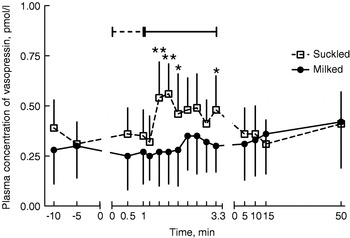
Plasma vasopressin concentration increased during suckling, but not during hand milking (Fig. 1). There was no change in vasopressin while the goat sniffed her kids (at times 0·5 and 1 min; samples 3 and 4) or when the first sample was taken after the kids had entered the box and started to suck, but then the rise was abrupt. The mean plasma vasopressin concentration remained elevated until the kids had stopped sucking (P<0·05–0·01, samples 6, 7 and 10 v. sample 2) and (P<0·05–0·01, in samples 6, 7, 8 and 12 compared with hand milking).
Plasma vasopressin concentration during suckling and hand milking of seven goats. Blood samples were taken 10 min and 5 min before, and at 0·5 min and 1 min during pre-stimulation or while the goat could sniff her kids ( ) Eight blood samples were taken as evenly as possible while the goats were milked or were suckling (
 ). Samples were taken 5, 10, 15 and 50 min after end of milking and suckling. Values are means±sem. *P<0·05 and **P<0·01 suckling v. hand milking.

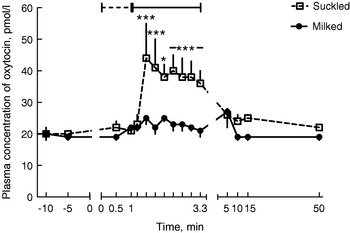
Plasma oxytocin concentration did not change during hand milking (Fig. 2). However, the oxytocin concentration increased with the same time lag as vasopressin when the kids started to suck and remained high until they had finished (P<0·001 for all samples during milking compared with sample 2 and compared with hand milking).
Plasma oxytocin concentration during suckling and hand milking in seven goats. For explanation of blood sampling times, see legend to Fig. 1. Values are means±sem. *P<0·05 and ***P<0·001 suckling v. hand milking.

The plasma cortisol level was 13±2 nmol/l at 5 min before pre-stimulation (sample 2) for both treatments. Values did not change until 5 min after suckling and milking when the cortisol concentration had increased to 38±5 nmol/l after suckling and to 29±4 nmol/l after milking, respectively (P<0·001 v. sample 2, both treatments; P<0·01 between treatments). Corresponding values 5 min later were 29 ±3 nmol/l and 22±3 nmol/l, respectively (P<0·01 and P<0·001 v. sample 2, respectively, and P<0·05 between treatments).
Hand milking v. no milking
In the second series hand milking took 2·5±0·2 min and the milk volume was 350±20 g. It took 2·1±0·2 min from sample 5 until sample 12 had been withdrawn in the no-milking treatments.
The plasma vasopressin concentration was below the lower detection limit of the method both during hand milking and no-milking treatments in this series.
The oxytocin concentration was 11±3 pmol/l and 15 pmol/l (sample 2) before pre-stimulation in the milking and no-milking treatments, respectively, and did not change in either treatment.
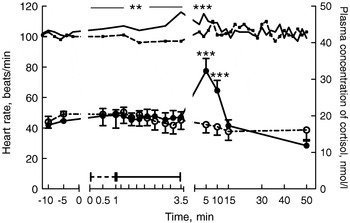
Plasma cortisol levels were low before and during both hand milking and no-milking treatments (Fig. 3). As in the other series, the cortisol concentration was elevated at 5 min and 10 min after hand milking (P<0·001 sample 2 v. sample 13 and sample 14). Cortisol concentration did not change in the no-milking treatment.
Plasma cortisol concentration in nine goats during hand milking (black dots) compared with a no-milking treatment (open circles). Heart rate was measured in eight of the goats (values are illustrated by an uninterrupted line during hand milking and by a broken line during the no-milking treatment). For explanation of blood sampling times, see legend to Fig. 1. The udder was not touched during pre-stimulation () and milking () times in the no-milking treatment. **P<0·01 and ***P<0·001 hand milking v. no milking.

Heart rate rose during pre-stimulation and remained elevated until about 10 min after milking (Fig. 3) compared with the no-milking treatment (P<0·01–0·001). Mean arterial blood pressure was 86±1 mm Hg during 15 min before, 91±2 mm Hg during hand milking and 84±1 mm Hg during 10 min after hand milking at which level it remained throughout the observation time. Corresponding values were 83±1, 85±2, and 81±1 mm Hg for the no-milking treatment (P<0·05 for all) and 82±1 at the end of the observation period (not significant against the hand milking treatment).
Discussion
In this study, suckling caused a simultaneous increase in plasma vasopressin and oxytocin concentrations. The results imply that the release of vasopressin was stimulated by the sucking activity of the kids. A similar neuro-humoural reflex involving both oxytocin and vasopressin occurs when the birth canal is stimulated by the fetus at the onset of labour contractions in goats and cows (Hydbring et al. Reference Hydbring, Madej, MacDonald, Drugge-Boholm, Berglund and Olsson1999). In both cases it is plausible that vasopressin binds to the oxytocin receptor besides the vasopressin V1a receptor (Zingg, Reference Zingg1996) and causes contraction of the myoepithelial and uterine smooth muscles cells, respectively.
Hernandez et al. (Reference Hernandez, Serafin, Terrazas, Marnet, Kann, Delgadillo and Poindron2002) showed that plasma oxytocin concentration did not change while the goat could smell, see and hear her kids, which was confirmed in the present study. When the kids were let in to the goats they massaged the udder intensely and the plasma oxytocin and vasopressin concentrations rose abruptly when the does started to suckle.
Seckl & Lightman (Reference Seckl and Lightman1988) found increased plasma oxytocin concentration, but no change in vasopressin, during hand milking of goats. In that study only one blood sample was taken 1 min after milking started. Plasma vasopressin concentration is low in goats in normal water balance and a change could be missed in a single blood sample. In the present study the frequent blood sampling made it possible to compare changes in plasma vasopressin and oxytocin concentrations. The parallel change of the two hormones during suckling supports the suggestion that vasopressin increased due to the same stimulus as oxytocin.
In contrast to suckling, hand milking was not accompanied by increased plasma vasopressin or oxytocin concentrations in the present study. Plasma oxytocin concentration does not always increase during milking in goats (McNeilly, Reference McNeilly1972; Mosdøl et al. Reference Møsdøl, Sjaastad and Blom1981). Goats can store milk in their large excretory ducts and cisterns between milkings and that portion of milk can be drained without oxytocin (Mosdøl et al. Reference Møsdøl, Sjaastad and Blom1981; Marnet & Negrão Reference Marnet and Negrão2000). It is known that goats establish a selective bond with their kids post partum. In the present study all goats and their kids were kept together in a large pen between experiments and the bonding between goats and their kids was well established. Hernandez et al. (Reference Hernandez, Serafin, Terrazas, Marnet, Kann, Delgadillo and Poindron2002) showed that oxytocin was released when goats nursed their own kids, but not aliens, and that this relied on the individual olfactory signal from the kids. The lack of peptide response to hand milking could therefore have been due to lack of proper sensory stimulation.
The late rise in plasma cortisol concentration after suckling and milking observed here confirmed earlier findings in ewes (Marnet & Negrão, Reference Marnet and Negrão2000) and cows (Gorewit et al. Reference Gorewit, Svennersten, Butler and Uvnäs-Moberg1992). Heart rate and blood pressure increased in relation to pre-stimulation and milking, but there was no change in the cardiovascular variables or in the cortisol concentration in the no-milking treatment. The changes in the cardiovascular variables were small compared with, for example, arousal before feeding (Hydbring et al. Reference Hydbring, MacDonald and Olsson1997). Therefore it appears unlikely that stress brought about by the experimental conditions was the cause. Alternatively, the rise in cortisol was related to the known metabolic effects of cortisol in lactating animals, although a role for cortisol in milk synthesis has not been established (Svennersten-Sjaunja & Olsson Reference Svennersten-Sjaunja and Olsson2005).
In conclusion, suckling increased the plasma concentrations of both vasopressin and oxytocin, but hand milking did not. In a mixed system, presence of the kids may be necessary to stimulate release of the peptides and thereby contraction of the myoepithelial cells. However, the milk stored in the udder cisterns can be obtained by hand milking without the presence of oxytocin or vasopressin and used for human consumption.
This work was supported by the Swedish Research Council-Medicine (Project no 3392). We thank Mrs Åsa Eriksson and Mrs Gunilla Drugge for excellent assistance.